i
The Hidden Power of Superheroes
The Ability of Superhero Movies to Influence
Political Attitudes
ii
Abstract
iii
Acknowledgements
First and foremost, I would like to express my gratitude to my adviser, Dr. Cori Dauber, for the guidance and advice that she provided me. Despite not even enjoying superheroes herself, she had immense faith in the value of my research, which helped propel me across the finish line.
Besides my adviser, I would like to thank the other member of my thesis committee: Dr. Courtney Rivard. First, she served as my faculty mentor for an undergraduate course I taught during Spring 2017 through Carolina Students Taking Academic Responsibility Through Teaching (C-START), which undoubtedly laid the groundwork for my research. Second, her insight and difficult questions during my defense certainly improved my thesis.
Two additional professors, Dr. Joseph Glatthaar and Professor Donald Hornstein, were also instrumental in encouraging me to stick with my thesis during the inevitable rough times during which completing it appeared difficult or even impossible. At this point, it is apparent that both were correct to emphasize the personal gratification and sense of accomplishment that accompanies completing a thesis.
Though I will not list out all of their names here, I thank all of the students who chose to participate in my study. Without you, I could not have acquired the data that was so essential to the main argument of my thesis.
iv
Table of Contents
List of Figures ... vi
List of Tables ... viii
Chapter 1. A New Golden Age: The History of the Superhero and the Rise of the Superhero Movie ...1
Superman: The First Superhero ...7
Criticism of Superheroes ...19
Study Direction ...27
Chapter 2. Mythical, Religious, and Literary Origins: The Psychological Appeal of the Superhero ...30
Mythology and Superheroes ...32
Superheroes and Shamans: The Origin of the Superhero Formula ...33
Wonder Woman and X-Men: The Embedding of Themes Within Superhero Stories ...37
Religion and Superheroes ...44
The Jewish Roots of Superman: The Protector and the Assimilator ...45
The Silver Surfer and Jesus Christ: The Importance of Moral Goodness ...52
Classic Literature and Superheroes ...58
The Science-Fiction Superman: Superheroes and Collectivism Through Institutions ...59
The Vigilante: Superheroes and Individuality ...66
Conclusion ...71
Chapter 3. Propaganda and Political Messages: World War II and Post-9/11 Superheroes ...73
Superheroes in World War II ...74
Superheroes and the Home Front ...77
Superheroes and the Military Might of the United States ...82
Superheroes and the Vilification of the Enemy ...86
The Dark Knight (2008), Iron Man 3 (2013), and Captain America: Civil War (2016) ...90
The Dark Knight: An Endorsement of Torture and Mass Surveillance ...92
Iron Man 3: The Manipulation of the War on Terror and the Ineffectiveness of Military Force ...98
Captain America: Civil War: The Promotion of a Unilateralist Foreign Policy ...104
Conclusion ...110
v
Literature Review ...112
Historical Examination of Media Effects ...114
Media Effects in Entertainment ...116
Research Design ...121
Results ...124
Classifying Attitudinal Change ...126
The Dark Knight ...126
Iron Man 3 ...130
Captain America: Civil War ...133
Discussion...136
Conclusion ...137
Chapter 5. “With Great Power Comes Great Responsibility”: Concluding Remarks ...139
Limitations ...139
Future Research ...140
Implications ...143
Appendix A: Survey Questions ...145
Appendix B: Survey Data ...154
vi
List of Figures
Figure 1. Cover of Action Comics #1 (June 1938)...7
Figure 2. “Hugo Hercules Lifting a Car” ...12
Figure 3. Mighty Mouse ...15
Figure 4. Super-Rabbit ...16
Figure 5. Cover of Wonder Comics #1 (May 1939) ...17
Figure 6. Cover of Crime and SuspenStories #22 (April 1954) ...25
Figure 7. Superman Falling to Earth ...31
Figure 8. Side-by-Side Comparison of Clark Kent and Superman ...35
Figure 9. Nightcrawler Fleeing From Villagers ...42
Figure 10. Superman’s Cape Extending Out Like Angel Wings ...47
Figure 11. Cover of The Death of Captain Marvel (1992) ...52
Figure 12. Pietà by Michelangelo ...52
Figure 13. The Silver Surfer Flying Through Space ...53
Figure 14. Mephisto Tricking Shalla-Bal ...55
Figure 15. Cover of Doc Savage Magazine #1 (March 1933) ...64
Figure 16. Zorro Wearing a Mask and All-Black Outfit ...69
Figure 17. Cover of Captain America #1 (March 1941) ...74
Figure 18. “Killing Time Is Killing Men” ...78
Figure 19. “It’s a Two-Fisted Fight”...78
Figure 20. Cover of Batman #17 (June 1943)...79
Figure 21. Cover of Detective Comics #78 (August 1943) ...80
Figure 22. The Spirit of ‘76 by Archibald McNeal Willard ...80
Figure 23. Cover of Action Comics #55 (December 1942) ...81
Figure 24. Cover of Action Comics #60 (May 1943)...83
Figure 25. “Let’s Give Him Enough And On Time” ...83
Figure 26. “Man the Guns: Join the Navy”...84
Figure 27. Cover of National Comics #32 (May 1943) ...84
Figure 28. Cover of Hit Comics #23 (August 1942) ...87
Figure 29. Cover of Daredevil #7 (January 1941) ...88
Figure 30. Iron Man Destroying Tank ...91
vii
Figure 32. The Mandarin ...100
Figure 33. War Machine ...102
Figure 34. Iron Patriot ...102
Figure 35. Redwing the Drone ...107
Figure 36. The Raft ...108
Figure 37. Effectiveness of Torture Pie Chart ...127
Figure 38. Justifiability of Torture Pie Chart ...128
Figure 39. Justifiability of Civil Liberties Violations Pie Chart ...129
Figure 40. National Defense Spending Pie Chart ...130
Figure 41. Threat of Terrorism Pie Chart ...131
Figure 42. Islam and Violence Pie Chart ...132
Figure 43. Justifiability of Drone Strikes Pie Chart ...133
Figure 44. The United States in World Affairs Pie Chart ...134
Figure 45. United Nations Pie Chart ...135
viii
List of Tables
Table 1. Effectiveness of Torture Compilation of Responses ...154
Table 2. Justifiability of Torture Compilation of Responses ...155
Table 3. Justifiability of Civil Liberties Violations Compilation of Responses ...156
Table 4. National Defense Spending Compilation of Responses ...157
Table 5. Threat of Terrorism Compilation of Responses ...158
Table 6. Islam and Violence Compilation of Responses ...159
Table 7. Justifiability of Drone Strikes Compilation of Responses ...160
Table 8. The United States in World Affairs Compilation of Responses ...161
1
Chapter 1. A New Golden Age: The History of the
Superhero and the Rise of the Superhero Movie
The marginalization of comic book superheroes is an integral part of the history of the medium. . . . Yet . . . this long era of marginalization may at last be coming to an end. . . . [S]uperheroes have been growing in popular esteem for a myriad of reasons in recent decades including the success of superhero movies . . . the rise of cultural studies in academia, and the newfound esteem given to previously disregarded aspects of popular culture. – Shawn O’Rourke1
There has been an explosion in the popularity of superhero movies since the turn of the millennium. Although they existed before this period – indeed, Superman (1978) and Batman
(1989) were both released to critical acclaim and financial success – X-Men (2000) was the film that sparked the spectacular surge of this cinematic genre.2 In its opening scene, a rainy day at the Auschwitz concentration camp, a young boy, who would later become the supervillain Magneto, is forcibly separated from his parents. He cries out in agony while reaching toward the metal gate looming between him and his family, slowly bending it with his magnetic powers until he is brutally knocked unconscious by a Nazi soldier. This poignant scene immediately differentiated X-Men from its predecessors by openly addressing complex social issues and introducing multidimensional characters. Although X-Men earned a relatively modest box office
1 Shawn O’Rourke, “A Brief Historiography of the Age of Marginalization: The Superhero in the American Mind,”
in Ages of Heroes, Eras of Men: Superheroes and the American Experience, ed. Julian C. Chambliss, William Svitavsky, and Thomas Donaldson (Newcastle upon Tyne, UK: Cambridge Scholars Publishing, 2013), 246.
2Superman (1978) made just over $300 million worldwide against a $55 million production budget. Its average
rating on Rotten Tomatoes was an 8/10 with critics calling it a “deft blend [of] humor and gravitas,” and on Metacritic, critics designated the film as deserving of “universal acclaim.” Batman (1989) earned $411 million worldwide against a production budget of just $35 million, making it the fifth highest grossing movie in history at the time of its release as well as the highest grossing movie based on a DC Comics character until the release of The Dark Knight (2008). On Rotten Tomatoes, critics called it “an eerie, haunting spectacle [and] dark entertainment.” Critics also gave the film “generally favorable reviews” on Metacritic. Neither of these films, however, sparked a wave of superhero movies in the same way that X-Men (2000) did, partially because the various sequels to these two blockbusters did not achieve close to the same degree of success. “Superman,” Box Office Mojo, accessed March 5, 2018, http://www.boxofficemojo.com/movies/?id=superman.htm; “Superman,” Rotten Tomatoes, accessed March 5, 2018, https://www.rottentomatoes.com/m/superman_the_movie/; “Superman,” Metacritic, accessed March 5, 2018, http://www.metacritic.com/movie/superman; “Batman,” Box Office Mojo, accessed March 5, 2018,
2 total, it was certainly a profitable endeavor, grossing nearly four times as much as its production budget.3
Spider-Man (2002), however, demonstrated that superhero movies could be blockbusters. Audiences were enraptured by its stunning visual effects and relatable characters – particularly Peter Parker, a nerdy high school student who is bullied by his classmates and struggles to gain the attention of the girl of his dreams. Moreover, though filming was largely complete by June 2001, this film resonated strongly with moviegoers still reeling from the devastating terrorist attacks of September 11, 2001.4 Peter becomes Spider-Man after experiencing a tragedy: the death of his Uncle Ben. He is guided by the notion that “with great power comes great responsibility,” an enduring sentiment in American culture.5 Most importantly, Spider-Man protects New York City from the Green Goblin, a villain who uses his glider to destroy buildings and kill innocent civilians. This film broke several box office records, including the highest single day, opening weekend, and per theater average for an ultra-wide release.6
The number of superhero movies quickly expanded. Within five years of the release of
Spider-Man, both X-Men and Spider-Man expanded into trilogies, the Fantastic Four was
featured in two movies, and Batman was given a grounded origin story in Batman Begins (2005), the first of The Dark Knight Trilogy directed by Christopher Nolan. The Marvel Cinematic Universe began with Iron Man (2008) and now consists of eighteen films and more than twenty
3 “X-Men,” Box Office Mojo, accessed March 5, 2018, http://www.boxofficemojo.com/movies/?id=xmen.htm. 4 Jeffery Moulton argues that Spider-Man (2002) became a blockbuster in large part because it was an “unintentional
allegory” for the events surrounding 9/11. Jeffery Moulton, The Superhero Response: How 9/11 Changed Our Superheroes and Why it Matters (self-pub., 2012), 23-56.
5 Presidents from Abraham Lincoln to George H. W. Bush have relied on a variation of this theme in their State of
the Union addresses. Supreme Court Justice Elena Kagan also inserted this quote into her opinion in Kimble v. Marvel (2015), a case dealing with patent rights. Lily Rothman, “7 State of the Union Quotes That Sound Like Lines
from Spider-Man,” Time, January 20, 2015, http://time.com/3664584/american-history-state-of-the-union/.
6 Brandon Gray, “‘Spider-Man’ Takes Box Office on the Ultimate Spin: $114.8 Million,” Box Office Mojo,
3 superheroes. With the release of Man of Steel (2013), Warner Brothers launched its own Justice League Universe to compete with Marvel. Collectively, both studios have more than a dozen superhero movies planned for release in just the next few years. As its box office revenues and total market share continue to trend upward, there is little doubt that the superhero movie genre will remain prominent for years to come.
In this context, it is unsurprising that superheroes have increasingly become a topic of academic research. Perhaps the most expansive area of research on superheroes is in regards to their origins.7 Various researchers have identified comparisons between superheroes and
countless heroes from mythology, religion, and classic literature in an attempt to understand how these captivating figures contributed to the development of superheroes. Some have instead conducted cultural analyses of superheroes, either examining superheroes as a whole or delving into a specific superhero, to explore how they have responded to the political, religious, and cultural views of society.8 Still others have evaluated the role of superheroes in advancing propaganda or reflecting fears of the enemy.9 A relative few have even analyzed the psychological appeal of superheroes.10
7 Chris Gavaler, On The Origin of Superheroes: From the Big Bang to Action Comics No. 1 (Iowa City: University
of Iowa Press, 2015); Jess Nevins, The Evolution of the Costumed Avenger: The 4,000 Year History of the Superhero (Santa Barbara, CA: Praeger, 2017); Peter Coogan, Superhero: The Secret Origin of a Genre (Austin, TX: MonkeyBrain Books, 2006); Christopher Knowles, Our Gods Wear Spandex: The Secret History of Comic Book Heroes (San Francisco: Weiser Books, 2007); Marco Arnaudo, The Myth of the Superhero, trans. Jamie Richards (Baltimore, MD: Johns Hopkins University Press, 2013).
8 Grant Morrison, Supergods: What Masked Vigilantes, Miraculous Mutants, And A Sun God From Smallville Can
Teach Us About Being Human (New York: Spiegel & Grau, 2011); Bradford Wright, Comic Book Nation: The Transformation of Youth Culture in America (Baltimore, MD: Johns Hopkins University Press, 2001); Larry Tye,
Superman: The High-Flying History of America’s Most Enduring Hero (New York: Random House, 2012); Will Brooker, Batman Unmasked: Analyzing a Cultural Icon (New York: Bloomsbury Academic, 2013); Jill Lepore, The Secret History of Wonder Woman (New York: Alfred A. Knopf, 2014).
9 Christopher Murray, Champions of the Oppressed?: Superhero Comics, Popular Culture, and Propaganda in
America During World War II (Cresskill, NJ: Hampton Press, 2011); Matthew J. Costello, Secret Identity Crisis: Comic Books & The Unmasking of Cold War America (New York: Continuum, 2009).
4 Although this study incorporates research from each of these areas, this study is distinct from existing research because it aims to assess whether viewing a superhero movie can affect individual political attitudes. As Todd Adkins and Jeremiah Castle note, “popular movies have been largely eschewed in modern media research with the bulk of scholarly attention focused on other media types, such as newspapers, the nightly news, and campaign advertising.”11 Even the
limited media effects research that has examined the effects of popular movies on political views has largely been dedicated to “films about politics, political institutions, or political actors” such as JFK (1991), Malcolm X (1992), and All the President’s Men (1976).12 A few studies have focused on the influence of less explicitly political films on political views. For example,
Kenneth Mulligan and Philip Habel found that The Cider House Rules (1999) caused individuals to become more favorable toward legal abortion, Michelle Pautz found that Argo (2012) and
Zero Dark Thirty (2012) led to individuals having an improved perception of government, and Anthony Leiserowitz determined that viewing The Day After Tomorrow (2004) significantly increased individual risk perceptions of the likelihood and severity of climate change in the United States.13 However, a thorough Google Scholar search revealed no such studies regarding
11 Todd Adkins and Jeremiah J. Castle, “Moving Pictures? Experimental Evidence of Cinematic Influence on
Political Attitudes,” Social Science Quarterly 95, no. 5 (2014): 1230; Diana C. Mutz, “The Future of Political Communication Research: Reflections on the Occasion of Steve Chaffee’s Retirement from Stanford University,”
Political Communication 18, no. 2 (2001); Shanto Iyengar and Donald R. Kinder, News that Matters: Television and American Opinion (Chicago: University of Chicago Press, 1987); Richard R. Lau et al., “The Effects of Negative Political Advertisements: A Meta-Analytic Assessment,” American Political Science Review 93, no. 4 (1999).
12Adkins and Castle, “Moving Pictures?”, 1232; Lisa D. Butler, Cheryl Koopman, and Philip G. Zimbardo, “The
Psychological Impact of Viewing the Film ‘JFK’: Emotions, Beliefs, and Political Behavioral Intentions,” Political Psychology 16, no. 2 (1995); Darren W. Davis and Christian Davenport, “The Political and Social Relevancy of Malcolm X: The Stability of African American Political Attitudes,” Journal of Politics 59, no. 2 (1997); William R. Elliott and William J. Schenck-Hamlin, “Film, Politics, and the Press: The Influence of ‘All the Presidents Men,’”
Journalism Quarterly 56, no. 3 (1979).
13 Kenneth Mulligan and Philip Habel, “An Experimental Test of the Effects of Fictional Framing on Attitudes,”
Social Science Quarterly 92, no. 1 (2011): 93; Michelle C. Pautz, “Argo and Zero Dark Thirty: Film, Government, and Audiences,” Political Science and Politics 48, no. 1 (2015): 120; Anthony A. Leiserowitz, “Day After
5 superhero movies.14 This oversight is surprising. Superhero movies are among the most popular movies of all time in the United States – indeed, ten of the top thirty highest-grossing films feature superheroes.15 In a highly competitive media environment in which millions of
Americans are abandoning news entirely in favor of entertainment, it is crucial to assess whether superhero movies can affect individual political views.
This study examines three recent superhero movies: The Dark Knight (2008), Iron Man 3
(2013), and Captain America: Civil War (2016), each of which have received popular and critical acclaim. More importantly, these movies all promote political views regarding various aspects of the war on terror. Specifically, The Dark Knight portrays torture and mass surveillance as justifiable policies during the war on terror, Iron Man 3 argues that the threat of terrorism has been overblown by the military-industrial complex and that military force is relatively ineffective in fighting terrorism, and Captain America: Civil War endorses a unilateralist foreign policy for the United States. To evaluate whether or not these superhero movies can affect political views, this study relied on a two-wave panel experiment in which participants completed a survey before and after viewing one of these three movies. Although this study was somewhat limited by the size and composition of its sample as well as the fact that the order of the statements was not reversed, a comparison of participants’ responses before and after viewing their respective film demonstrates that a significant percentage of participants changed their views on various policy issues related to the war on terror.
14 That is not to say that there were no studies on the effect of superheroes on attitudes. Hillary Pennell and
Elizabeth Behm-Morawitz found that “exposure to the sexualized-heroine images resulted in lower body esteem.” Hillary Pennell and Elizabeth Behm-Morawitz, “The Empowering (Super) Heroine? The Effects of Sexualized Female Characters in Superhero Films on Women,” Sex Roles 72, no. 5 (2015): 211.
15 Tim Dirks, “All-Time Box Office Top 100,” Filmsite, accessed March 11, 2018,
6 Prior to discussing the data acquired during this experiment in further detail, this study will devote significant space to exploring the history of superheroes. First, it will analyze how mythology, religion, and classic literature have contributed to the psychological appeal of the superhero. Second, it will delve into the blatant promotion of propaganda by comic books during World War II as a means of emphasizing that the political views expressed by The Dark Knight,
Iron Man 3, and Captain America: Civil War are more subtle. This lengthy history is necessary for three important reasons. First, it legitimizes the superhero as a topic worthy of academic research. This is not a trivial point; the superhero has faced significant criticism throughout its existence and even today, the superhero is regarded by many as simple and childish. Second, it demonstrates that the superhero is not an ephemeral cultural phenomenon, but one that has existed for decades and will likely endure well into the future. Last, and most importantly, it provides a theoretical basis for understanding how superhero movies have a particularly strong potential to effect attitudinal change, particularly its analysis of why superheroes as characters are psychologically appealing.
7
Superman: The First Superhero
Nearly eighty years after it was first created by Jerry Siegel and Joe Shuster, even as the quality of comic book art has improved substantially and the special effects of superhero movies grow increasingly elaborate, the cover of Action Comics #1 (June 1938) remains enthralling (Figure 1).16 A muscular man with black hair wears a tight-fitting blue costume with an S emblazoned upon a
yellow shield on his chest with a red cape trailing behind him. As he effortlessly lifts a car above his head and smashes it into a rock, two men in business suits flee the scene while another man appears both terrified and dumbfounded at this phenomenal display of strength. Aside from the logo, issue, date, and price, there are no other words; the action is the singular point of emphasis. As a result, readers cannot know whether the fleeing men were thugs or civilians or even
whether the superhuman is the hero or the villain of the story. By intentionally omitting context
16 In modern times, comic book artists not only have more time and experience, but are able to employ better
technology, such as computerized coloring, which allows them to incorporate greater detail into their work. Knowles, Our Gods Wear Spandex, 13; Jerry Siegel and Joe Shuster, Action Comics #1 (New York: DC Comics, June 1938).
8 and instead portraying the climax, readers are compelled to delve into the story to discover the answers to their questions.17
Readers quickly learn Superman is an alien from another planet and that his remarkable speed and strength stem from the advanced evolution of his species. Because Superman elects to use these powers to help mankind, he is rightly classified as a “champion of the oppressed.”18
The story proceeds in a frenetic fashion. Superman runs through the night while carrying a bound and gagged woman in his arms. After arriving at the governor’s estate, Superman dumps the woman by a tree and rushes into the house, smashing down the front door and sprinting upstairs to see the governor, ripping a steel door off its hinges on the way. Superman urges him to pardon Evelyn Curry, a woman who is scheduled to be executed in just fifteen minutes, and produces a signed confession to prove her innocence. In an attempt to protect the governor, the butler shoots at Superman, but learns with dismay that bullets simply ricochet off him. After subduing the butler, Superman once again pleads with the governor to call the prison to save an innocent life. Evelyn Curry is ultimately spared and it is revealed that the woman left on the lawn is the true murderer. In the remainder of the issue, Superman breaks up a domestic violence incident, rescues Lois Lane from kidnappers, and confronts a corrupt lobbyist for the defense industry who is trying to embroil the United States in a war in Europe.19
17 Morrison, Supergods, 8.
18 Siegel and Shuster, Action Comics #1.
19Action Comics #1 (June 1938) was published just fifteen months after the final hearings of the Special Committee
9 Superman was “a hero of the people, a bold, humanist response to [the Great]
Depression.”20 Yet he was also secretly someone else: a reporter who had trouble with women.
As Clark Kent, he was no longer a superhero; indeed, he was misunderstood and disrespected by Lois Lane due to his nerdish characteristics and his mild-mannered personality.21 Although it is easy to criticize the implausibility of Lois Lane failing to recognize Clark as Superman, it is this element of the story that is perhaps most captivating. Superman is a character with whom anyone can identify and attempt to emulate because even though no one can be Superman, they can strive to be like him.
The belief that Superman is the first superhero is widely shared among comics historians, though some disagreement does exist.22 Will Murray explicitly calls Olga Mesmer – who utilizes her superstrength and X-ray vision to help her mother, the immortal queen of Venus, quash a revolt – “The Superhero before Superman” given her brief run in Spicy Mystery Stories from August 1937 to October 1938.23 There are also other candidates: Popeye, who uses his
superstrength and indestructability to win prizefights; Hugo Danner, who fights in World War I because of the opportunity to use his powers without restraint; and the Phantom, a costumed crime-fighter who battles pirates and gangsters from all over the world. There are two reasons, however, to ultimately embrace Superman as the first superhero, and thus the beginning of the
20 Morrison, Supergods, 6.
21 Clark Kent also could have been a reflection of the concerns surrounding masculinity during the Great
Depression. As Josep Armengol argues, “the Great Depression caused millions of American males to feel
emasculated by their incapacity to provide for their families [because] American masculinity has traditionally linked men’s identity to their breadwinning role.” Josep M. Armengol, “Gendering the Great Depression: Rethinking the Male Body in 1930s American Culture and Literature,” Journal of Gender Studies 23, no. 1 (2014): 59-68.
22 Julian C. Chambliss and William L. Svitavsky, “From Pulp Hero to Superhero: Culture, Race, and Identity in
American Popular Culture, 1900-1940,” Studies in American Culture 31, no. 1 (2008): 19,
https://scholarship.rollins.edu/cgi/viewcontent.cgi?referer=https://www.google.com/&httpsredir=1&article=1002&c ontext=as_facpub; Shahriar Fouladi, “Super Savior/Destroyer: Superman, Smallville, and the Superhero Genre’s
Spectre of Monstrosity” (PhD dissertation, University of California, Irvine, 2011), 22; Richard Reynolds, Super Heroes: A Modern Mythology (Jackson: University Press of Mississippi, 1994), 8.
23 Peter Coogan, “Comics Predecessors,” in The Superhero Reader, ed. Charles Hatfield, Jeet Heer, and Kent
10 superhero genre: (1) he was the first to have powers, a selfless mission, and an identity with a code name and costume (in addition to fulfilling the criterion of generic distinction, thereby meeting the definition of a superhero); and (2) he sparked the proliferation of other superheroes in a way that earlier costumed crime-fighters did not.
Precursors to Superman do not fulfill the most appropriate definition of a superhero. Of course, some categorically reject the need for a definition. In a chapter aptly titled “What is a Superhero? No One Knows – That’s What Makes ‘em Great,” Geoff Klock argues that superhero definitions impose boundaries on the genre as a whole, thereby reducing its potential to tell unique and exciting stories.24 Similarly, Chris Gavaler compares definitions to erasers in a pejorative sense and instead opts to use the following non-definition for superheroes: “ultimate amalgams, all-swallowing über characters.”25 Both Klock and Gavaler are correct to point out that the superhero invokes conventions from many different characters. Simultaneously, though, they possess distinctive features. The danger of sloppy or nonexistent definitions is perhaps best illustrated by considering a parallel with the Western genre.26 If this genre were defined on the sole basis of its setting, for instance, both True Grit (1969) and The Beverly Hillbillies (1993) would necessarily be classified as Westerns even though the latter clearly is not.27 What this example demonstrates is that an eraser is crucial. Without a definition of a superhero to impose constraints on the already vast superhero genre, scholarship in this area would lack focus and rigor.
24 Geoff Klock, “What Is a Superhero? No One Knows – That’s What Makes ‘em Great,” in What Is a Superhero,
ed. Robin S. Rosenberg and Peter Coogan (New York: Oxford University Press, 2013), 73.
25 Gavaler, On The Origin of Superheroes, 3.
11 Among the many other definitions examined here, most are vague, broad, or overly specific. Both B. J. Oropeza and Jess Nevins merely provide extensive lists of traits possessed by many superheroes without specifying the quantity necessary to be considered one.28 Kurt Busiek claims that to be a superhero is to possess three of the following six criteria: “superpowers,
costume, code name, secret identity, heroic ongoing mission, and superhero milieu.”29 This, however, is too broad. John-117 from the Halo franchise has superhuman strength and reflexes, a code name of Master Chief that highlights his fighting and leadership skills, and a heroic
ongoing mission to save humanity from aliens known as the Covenant as well as a parasitic life form called the Flood, yet it does not seem correct to classify him as a superhero given his close connections to the science fiction genre. Danny Fingeroth believes superheroes differ from other heroic characters because of their “nobility of purpose.”30 Once again, this definition fails to omit
characters like James Bond, who clearly has a noble purpose, but is a spy rather than a superhero. Richard Reynolds has the opposite problem; his definition excludes characters who are obviously superheroes. For example, one of his criteria, “being marked out of society,” does not apply to
the portrayal of Iron Man in the Marvel Cinematic Universe.31 The difficulty of finding a definition for a superhero lies in the fact that it must encompass god-like beings like Superman, soldiers like Captain America, and wizards like Doctor Strange, while leaving out
correspondingly similar characters such as Aslan, Jason Bourne, and Harry Potter, all of whom
28 B. J. Oropeza, “Introduction: Superhero Myth and the Restoration of Paradise,” in The Gospel According to
Superheroes: Religion and Pop Culture, ed., B. J. Oropeza (New York: Peter Lang, 2005), 5; Nevins, The Evolution of the Costumed Avenger, 6-9.
29Kurt Busiek, “The Importance of Context: Robin Hood Is Out and Buffy Is In,” in What Is a Superhero, ed. Robin
S. Rosenberg and Peter Coogan (New York: Oxford University Press, 2013), 133.
30 Danny Fingeroth, “Power and Responsibility…And Other Reflections on Superheroes,” in What Is a Superhero,
ed. Robin S. Rosenberg and Peter Coogan (New York: Oxford University Press, 2013), 125.
31 Richard Reynolds, “Masked Heroes,” in The Superhero Reader, ed. Charles Hatfield, Jeet Heer, and Kent
12 appear increasingly similar to superheroes in a time where “the border between the superhero genre and other mass entertainment genres have been smudged.”32
The definition formulated by Peter Coogan overcomes this challenge with four elements: powers, mission, identity, and generic distinction.33 Coogan interprets powers broadly to include not only superpowers, but “extraordinary abilities, advanced technology, or highly developed physical, mental, or mystical skills.”34 Thus, Superman obviously has powers, but so does
Batman by virtue of his seemingly inexhaustible wealth, genius intellect and athletic prowess. The mission is also an essential
component of this definition. Superheroes do not seek gain or glory and they are not simply helpful. For example, in this panel from October 26, 1902, Hugo Hercules uses his superstrength to lift a car just to help a couple have an intimate experience (Figure 2).35 Superman obviously has a selfless mission because he has no ulterior motives with regards to his service towards mankind. On the other hand, Olga Mesmer, Popeye, and Hugo Danner
do not act selflessly as they clearly use their powers to help their families or themselves rather than society as a whole.
32 Charles Hatfield, Jeet Heer, and Kent Worcester, introduction to The Superhero Reader, ed. Charles Hatfield, Jeet
Heer, and Kent Worcester (Jackson: University Press of Mississippi, 2013), xiii.
33 Coogan, Superhero, 30. 34 Ibid.
35 Ibid.
13 Identity incorporates both a code name and a costume.36 In order to satisfy this portion of the definition, though, the code name and costume must emblematize the character.37 The name
“Superman” relates to his ideals of being a champion of the oppressed and his costume allows Superman to be quickly identified.38 James Bond, because his designation of “007” reflects nothing about either his powers or his mission, could not claim to have a superhero identity. Moreover, he does not have a costume that demonstrates his identity as a spy. Aslan, Jason Bourne, and Harry Potter also do not satisfy the identity component as they similarly lack both a code name and a costume.39
This definition, however, remains incomplete as there are undoubtedly characters who have powers, a selfless mission, a code name, and a costume who are nevertheless not
superheroes.40 Thus, as the final element in his definition, Coogan includes generic distinction, which makes one noteworthy qualification: if a character largely fits the first three conventions,
but clearly belongs in another genre, the character is not a superhero.41 With generic distinction, Master Chief can be denied a place among the superheroes. Even though he has powers, mission, and identity, reflected in both a code name and a costume, he clearly belongs to the science fiction genre, and is thus not a superhero. Similarly, the Phantom, despite meeting all other qualifications of being a superhero, is not one because the exotic nature of his adventures places
36 Coogan, Superhero, 32. 37 Ibid., 33.
38 Ibid., 33, 36.
39 One could argue that Harry Potter does potentially have a code name, specifically either “the Boy Who Lived” or
“the Chosen One.” Because these names are used relatively rarely compared to his actual name, however, it is clear that Harry Potter does not have a code name. Regardless, he does not have a costume; it is apparent that his wizarding robes are a uniform rather than a costume. As such, Harry Potter is undoubtedly not a superhero under this definition.
40 Coogan, Superhero, 39-40.
41 In describing generic distinction, Peter Coogan also suggests that characters who do not fit all three of his
14 him more closely in the genre of adventure fiction.42 As such, this element requires a certain amount of subjectivity.
At first glance, this generic distinction may make this definition seem as indeterminate as that of Gavaler. By including powers, mission, and identity, however, Coogan provides much more structure than Gavaler. He only includes generic distinction to address the few exceptions that arise. Given that Olga Mesmer, Popeye, Hugo Danner, and the Phantom all fail to meet the aforementioned standards of a superhero, while Superman clearly fulfills each convention, Superman, by definition, was the first superhero. Because the superhero genre is centered on the superhero, Superman represents the beginning of the superhero genre.
One does not have to rely on a definition, however, to demonstrate that Superman launched the superhero genre. Because he rejects a narrow definition of a superhero, Gavaler identifies as superheroes dozens of “masked and superpowered do-gooders” originating before Superman, ranging from the Gray Champion, an elderly man with a sword and a staff who battled British soldiers, to Zorro, a masked vigilante who fought the government and the rich on behalf of the poor.43 Nevertheless, Gavaler believes that Superman was the first superhero because of his role in sparking the growth of the superhero genre:
Picture superhero history as an hourglass body. . . . The thin middle space where the glass almost touches, that’s Superman. That’s why [he] “invented” the genre. It’s like saying that Sherlock Holmes invented the detective story – untrue since Conan Doyle built upon Poe, Dickens, and Collins, and yet without Holmes I doubt all those paperbacks in the supermarket aisle would exist. After reading Uncle Tom’s Cabin, George Eliot said Harriet Beecher Stowe “invented the Negro novel.” The statement is equal nonsense since novels by and about African Americans preceded it (including Frederick Douglass’s The Heroic Slave, also published in 1852), but Stowe’s popularized the
preexisting genre so massively that no novel that followed it could be read without placing it in relation to Uncle Tom’s Cabin. It’s as if Stowe invented the genre, even though she was participating in a range of already defined genre tropes.44
42 Coogan, Superhero, 182-183.
15 There are two ways in which Superman can be said to have a similar relationship with the
superhero genre: (1) he inspired parody, and (2) he sparked imitation.
Unlike his predecessors, Superman quickly began to serve as a basis for parody, which Thomas Schatz identifies as an important component in the development of a genre.45
There are at least two prominent and humorous parodies of Superman that appeared just a few years after the publication of
Action Comics #1. The first is an animated short released by 20th Century Fox called “The Mouse ofTomorrow” (1942), which saw the debut of Mighty Mouse (Figure 3).46 In Mouseville, cats capture all the mice in the town
except for one who manages to flee into a supermarket. After bathing in super soap, eating super soup, chewing on super celery, and dining on super cheese, this mouse transforms into Mighty Mouse. With the powers of superstrength, invulnerability, and flight, Mighty Mouse successfully rescues the captured mice and defeats the cats. Mighty Mouse is very similar to Superman with
45 Thomas Schatz, Hollywood Genres: Formulas, Filmmaking, and the Studio System (Philadelphia: Temple
University Press, 1981), 39.
46 20th Century Fox, “The Mouse of Tomorrow,” from a film on October 16, 1942, YouTube,
https://www.youtube.com/watch?v=vxivTJJCVbw.
Figure 3. 20th Century Fox, “The Mouse of Tomorrow,” from a film
on October 16, 1942, YouTube,
16 regards to his powers, his costume, and his mission: fighting on behalf of mice who are seeking to gain their freedom from their cat oppressors.
The second is a cartoon called “Super-Rabbit”(1943), which was distributed by Warner Brothers and stars Bugs Bunny (Figure 4).47 After gaining
superpowers by eating a super carrot, Bugs flies to Deepinaharta, Texas to confront a hunter known as Cottontail Smith. Once he arrives, he assumes the identity of a
“mild-mannered forest creature” with glasses, and confronts Smith and his horse.48 After the
latter eats his super carrots, however, Bugs loses his superpowers. Fortunately, Bugs is able to duck into a phone booth and transform into a “real Superman,” a Marine ready to fight in “Berlin and Tokyo.”49 There are multiple instances of parody here. The decision of Super-Rabbit to
appear weaker mirrors the dichotomy between Superman and Clark Kent. Additionally, Bugs Bunny changing into a superhero in a phone booth was a convention already utilized in
Superman comics. Both of these parodies illustrate that Superman had established a new genre, one that was so quickly understood by audiences that it could quickly result in successful parodies.
47 Warner Brothers, “Super-Rabbit,” from a film on April 3, 1943, Dailymotion,
http://www.dailymotion.com/video/x2mvq3f.
48 Ibid. 49 Ibid.
17 Superman also sparked
imitation.50 Just months after the
release of Action Comics #1, Victor Fox, who cofounded a comic book publisher called Fox Feature
Syndicate, commissioned one of his writers to make him another
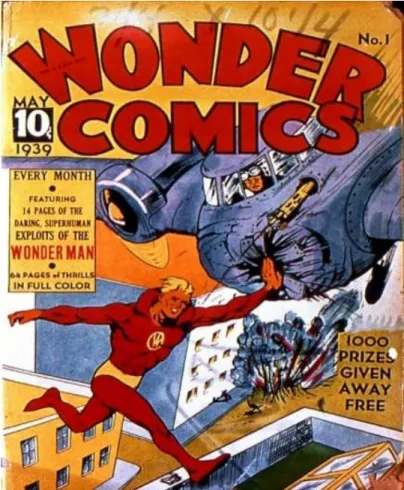
Superman.51 The result was Wonder Comics #1 (May 1939) featuring Wonder Man (Figure 5).
Unfortunately, this writer did his job too well, which is best seen by comparing the cover of Wonder
Comics #1 to that of Action Comics #1.
Wonder Man lasted only this one issue before the Court of Appeals for the Second Circuit declared the character to be a copyright infringement in Detective v. Bruns (1940), arguing that “the only real difference between Superman and Wonder Man was the color of their uniforms,” noting that “the defendants . . . used more than general types and ideas and [instead] appropriated pictorial and literary details.”
50 By its seventh issue, Action Comics was selling more than half a million copies per month due to the massive
popularity of Superman, prompting the launch of Superman just one year later. It wasthe first comic book to feature a single character. Wright, Comic Book Nation, 9.
51 Mike Benton, Superhero Comics of the Golden Age: The Illustrated History (Taylor History of Comics, Volume 4)
(Dallas, TX: Taylor Publishing Company, 1992), 22.
18 Fortunately for superheroes, however, other publishers would create imitations of
Superman that were sufficiently dissimilar to avoid meeting the same fate. The same month of the first and last appearance of Wonder Man, Batman made his first appearance in Detective Comics #27 (May 1939). As the grimmer counterpart to Superman, Batman has no intrinsic powers, but is able to fight crime because he “trains his body and mind to the pinnacle of perfection.”52 Marvel Comics followed with the Human Torch as well as the Sub-Mariner,
Fawcett Publications introduced readers to Captain Marvel, whose popularity would actually surpass that of Superman in the early 1940s, and Wonder Woman made her first appearance in December 1941.53
These popular superheroes as well as scores of minor ones quickly achieved enormous popularity. By 1942, nearly 150 comic book titles were being sold in New York newsstands and national sales had climbed to fifteen million copies per month.54 As many as 95% of children
between the ages of eight and eleven were regularly reading comic books, and an article in
Recreation from 1942 found that 75% of the reading done for pleasure by American children was comic books.55 The popularity of superhero comic books even extended to adults with readership surveys taken in 1943 revealing that 35% of adults between the ages of eighteen and thirty read comic books.56 Undoubtedly, much of this popularity can be linked to the fact that
these superheroes successfully protected the United States from Nazi Germany and Imperial Japan, thereby representing a form of wish fulfillment in the midst of the existential conflict of World War II.
52Wright, Comic Book Nation, 17.
53 Ibid., 18.
54 “Superman Scores,” Business Week, April 18, 1942, 54.
19 Unsurprisingly, this era has come to be known as the Golden Age of Comic Books, which was marked by the formation of the new and exciting genre centered on the superhero. With the possible exception of the current explosion of the superhero movie genre, superheroes have never again been as popular as they were during this period.
Criticism of Superheroes
The rapid rise of the comic books, however, quickly sparked a public backlash beginning with an editorial written by Sterling North that was published in the Chicago Daily News on May 8, 1940.57 Referring to comic books as “a poisonous mushroom growth,” North argued that comic book publishers were guilty of taking one million dollars from the pockets of children.”58 Contending that comic books were “badly drawn [and] badly written,” North urged parents and teachers to instead encourage their children to read classics such as Treasure Island (1883) to ensure that they would not be victims of a “cultural slaughter.”59 North also criticized comic
books for promoting “Superman heroics . . . [and] hooded ‘justice,’” and warned that they
represented a “violent stimulant.”60 Because of its sensationalist language and its widespread influence on public discourse surrounding comic books, this editorial can be said to have established each of the four main arguments that would be levied against comic books in the period surrounding World War II, some of which continue to linger decades later.61
57 Sterling North, “A National Disgrace,” Childhood Education 17, no. 1 (1940): 56. 58 Ibid.
59 Ibid. 60 Ibid.
61 In just two years, the Chicago Daily News received more than 25 million requests for copies of this editorial,
20 First, comic books were deemed undesirable because they were produced by corporations seeking profits. At the time, elites valued high culture because of its uniqueness and intricacy.62
According to North, the mass production of comic books rendered it impossible for them to be distinctive.63 Additionally, he believed the desire for profits incentivized comic book companies to appeal solely to the desires of consumers rather than formulate complex stories. These
concerns were echoed by other critics of comic books. During a radio debate in 1948, John Mason Brown of the Saturday Review referred to his opponent, cartoonist Al Capp, as merely a part of a “conveyor belt.”64 A year later in an article published by National Parent-Teacher,
Fredric Wertham, perhaps the most fervent opponent of comic books, argued that the competition for profits compelled comic book companies to rely on increasingly gruesome violence in an attempt to outsell their competitors. Indeed, he viewed the commercialized culture for children to be inherently harmful because greedy, powerful businesses were able to easily manipulate them.65
Second, it was claimed that comic books rendered it more difficult for children to read and appreciate classic literature. In 1941, Eva Anttonen argued in the Wilson Library Bulletin
that comic books were mistakenly conveying to children that “the library is a ‘sissy place,’” and warned that the only solution was to “bring out all [the] dragons” in the form of better
literature.66 That same year, Stanley Kunitz criticized the overly sensational plots of comic books, and George Hill disparaged their simplistic language.67 Just one year later, Paul Witty,
62 Amy Kiste Nyberg, Seal of Approval: The History of the Comics Code (Jackson: University Press of Mississippi,
1998), 4.
63 Ibid.
64 “Bane of the Bassinet,” Time, March 15, 1948, 70.
65 Fredric Wertham, “Reading for the Innocent,” Wilson Library Bulletin, September 1954, 611. 66 Eva Anttonen, “On Behalf of Dragons,” Wilson Library Bulletin, March 1941, 567, 595.
67 Stanley J. Kunitz, “Libraries, to Arms!,” Wilson Library Bulletin April 1941, 670; George E. Hill, “Taking the
21 even as he found no evidence suggesting that reading comic books had any discernible effect on intelligence, academic success, or reading levels, indicated that “excessive reading in this area may lead to a decline in artistic appreciation and a taste for shoddy, distorted presentations.”68 Although the authors targeted their criticisms at different aspects of comic books, all of them agreed that reading comic books barely represented reading at all and actually reduced the desire of children to read other books. Some librarians and teachers attempted to address this issue by finding reading material to serve as appealing substitutes for comic books.69 One teacher,
characterizing the endeavor as “missionary work among my comic book heathens,” formulated a list that included Treasure Island, War of the Worlds (1897), and The Adventures of Sherlock Holmes (1892), which ironically contributed much to superhero comic books.70
Despite these efforts, comic book sales continued to rise and actually surpassed those of all other books by 1946.71 This quickly sparked increased attacks against comic books for their
supposed lack of literary value. During the 1948 radio debate, Brown devoted a substantial portion of his opening statement towards this argument:
Comic books . . . are . . . not only trash, but the lowest, most despicable, and most harmful form of trash. As a rule, their word selection is as wretched as their drawing, or the paper on which they are printed. They are designed for readers who are too lazy to read, and increase both their unwillingness and inability to do so. . . . As a writer, I resent the way in which they get along with the poorest kind of writing. . . . I hate their appeal to illiteracy and their bad grammar. . . . I detest them . . . because they have no subtlety, and certainly no beauty. They substitute bad drawing for good description. They reduce the wonders of language to crude monosyllables, and narratives to no more than printed motion pictures. . . . [M]ost comics . . . are the marijuana of the nursery; the bane of the bassinet; the horror of the house; the curse of the kids; and a threat to the future.72
68 Paul Witty, “Reading the Comics – A Comparative Study,” Journal of Experimental Education 10, no. 2 (1941):
109; Paul Witty, Ethel Smith, and Anne Coomer, “Reading Comics in Grades VII and VIII,” Journal of Educational Psychology 33, no. 3 (1942): 181.
69 Stanley J. Kunitz, “The Comic Menace,” Wilson Library Bulletin, June 1941, 846-847; Earl J. Dias, “Comic
Books – A Challenge to the English Teacher,” English Journal 35, no. 3 (1946): 143.
70 Dias, “Comic Books,” 143-144.
71 Ruth Emily Smith, “Publishers Improve Comic Books.” Library Journal 73 (1948): 1651.
22 Brown was not the last to criticize comic books for decreasing the ability of children to understand classic literature. In The Lonely Crowd (1950), a book widely recognized as one of the most important examinations of the character of the United States, David Riesman wrote that comic book readers were more likely to overlook complexities in literature because comic books focused so heavily on the simple issue of whether the hero or the villain emerged victorious.73 Wertham focused instead on the significant presence of art in comic books. In The Seduction of the Innocent (1954), an influential compilation of criticism towards comic books, Wertham argued that children who read comic books harm their vocabularies and develop poor reading habits because they are able to follow the story without reading the text.74 In short, comic books were widely viewed as anti-educational in the sense that they not only fueled disinterest in classic literature, but weakened reading skills, thereby making it more difficult for children to read these books.
Third, comic books allegedly harmed society by fueling fascist attitudes, a fear sparked by the rise of fascism during World War II. Shortly after the end of World War II, Walter Ong wrote an article for Time entitled “Are Comics Fascist?,” which provocatively declared that
Superman was a Nazi and that Wonder Woman was a form of “Hitlerite paganism.”75 Years
earlier, both James Vlamos and Margaret Frakes had made similar claims.76 Because public
officials were constantly overshadowed by superheroes in comic books, Marya Mannes believed that they reduced the legitimacy of government by convincing individuals that superheroes could solve their problems.77
73 David Riesman, The Lonely Crowd: A Study of the Changing American Character (New Haven, CT: Yale
University Press, 1950), 99-100.
74 Fredric Wertham, Seduction of the Innocent (New York: Rinehart, 1954), 141. 75 Walter Ong, “Are Comics Fascist?,” Time, October 22, 1945, 68.
76 James Frank Vlamos, “The Sad Case of the Funnies,” American Mercury, April 1941, 412; Frakes, “Comics Are
No Longer Comic,” 1349-1350.
23 Finally, comic books were said to promote juvenile delinquency. This was undoubtedly the most damaging argument levied against comic books; indeed, at the time, some viewed juvenile delinquency “more seriously than open-air testing of atomic weapons or school segregation or political corruption.”78 In August 1947, the Fraternal Order of Police publicly
condemned comic books as a contributing factor of juvenile delinquency.79 In the months following this declaration, several crimes occurred that were allegedly inspired by comic books.80 In this atmosphere, the research conducted by Wertham attracted significant attention.
In March 1948, Wertham presented at a symposium called “The Psychopathology of Comic Books,” where he claimed that comic books taught children that violence was an acceptable
means of solving problems.81 Immediately after this symposium, Wertham was quoted extensively in an article in Collier’s where he was able to express his view that comic books were an important contributor to violence because of their tendency to present “cruelty [as] heroic.”82 Just two months later, Wertham wrote an article published inthe Saturday Review of
Literature that detailed his clinical work with juvenile delinquents, many of whom expressed their enthusiasm for the violence illustrated in comic books.83 Neglecting to mention the fact that the vast majority of children in the United States who read comic books did not engage in
criminal behavior, Wertham argued that comic books had a significant impact with regards to increasing violence among children. In Seduction of the Innocent, Wertham compiled all of his previous ideas, asserting that comic books were not only responsible for juvenile delinquency by
78 James Gilbert, A Cycle of Outrage: America’s Reaction to the Juvenile Delinquent in the 1950s (New York:
Oxford University Press, 1986), 63.
79 Wright, Comic Book Nation, 89. 80 Ibid., 90.
81 Ibid., 94.
82 Judith Christ, “Horror in the Nursey,” Collier’s, March 27, 1948, 22.
24 “suggest[ing] criminal ideas . . . [and] furnish[ing] the rationalization for them,” but that comic books could inspire authoritarian and sexually abnormal ideas within children.84
While making these arguments, Wertham targeted three of the most iconic superheroes of the time. According to Wertham, Superman either caused children to idealize themselves as supermen and develop feelings of superiority against others or meekly submit to supermen.85 Batman and Robin was “a wish dream of two homosexuals living together” that unconsciously stimulated homosexuality in children.86 Wonder Woman was the lesbian counterpart to Batman,
promoting anti-masculine sentiments.87 To Wertham, as well as many opponents of comic books who preceded him, comic books did not merely impede the ability and desire of children to read classic literature, but rather represented a great danger to society, one that was contributing to political, cultural, and moral deterioration.
Collectively, these arguments had a significant influence on societal views towards comic books. In 1948, a number of children burned comic books at schools in communities including Spencer, West Virginia; Chicago, Illinois; and Binghamton, New York.88 Around the same time, various cities and states unsuccessfully attempted to ban comic books from being published or circulated. New York Governor Thomas Dewey vetoed bills in 1949 and 1952 that would have restricted the sale of comic books, and a Los Angeles County law that banned the sale of comic books depicting a crime to minors was struck down by the California Superior Court.89
84 Wertham, Seduction of the Innocent, 118. 85 Ibid., 34.
86 Ibid., 190. 87 Ibid., 192-193.
88 “Spencer School Pupils Wage War on Comic Books,” Charleston Daily Mail, October 27, 1948; “600 Pupils
Prepare Petitions Asking Ban on ‘Indecent Comics,’” Chicago Daily Tribune, December 7, 1947; David Hajdu, The Ten-Cent Plague: The Great Comic-Book Scare and How It Changed America (New York: Farrar, Straus, and Giroux, 2008), 117-119.
89 This crusade against comic books is, of course, similar to other campaigns against pop culture such as rap and
25 Magazines, newspapers, and
academic journals widely praised Seduction of the Innocent.90 Shortly after its
publication, Wertham even testified at hearings held by the Senate Subcommittee on Juvenile Delinquency, where he further criticized the comic book industry and implored Congress to pass legislation that would end the sale of comic books to
children under the age of fifteen.91 Yet it was
not this testimony that so harmed the reputation of the comic book industry, but that of William Gaines, the publisher of Entertaining Comics. After Gaines was confronted with the cover of
Crime and SuspenStories 22 (Figure 6), this infamous exchange with Senator Estes Kefauver followed:
Senator Kefauver: Do you think that is in good taste?
Mr. Gaines: Yes, sir; I do, for the cover of a horror comic. A cover in bad taste, for example, might be defined as holding the head a little higher so that the neck could be seen dripping blood from it and moving the body over a little further so that the neck of the body could be seen to be bloody.
Senator Kefauver: You have blood coming out of her mouth.
Mr. Gaines: A little.92
90 Joy Elmer Morgan, “Seduction of the Innocent,” NEA Journal 43 (1954): 473; William Wolf, “Seduction of the
Innocent,” American Journal of Psychotherapy 8, no. 3 (1954): 547; Anita L. Mishler, “Seduction of the Innocent,”
Public Opinion Quarterly, 19, no. 1 (1955): 115-117; Winfred Overholser, “Want a Laugh?,” Saturday Review of Literature, April 24, 1954.
91 Bart Beaty, Fredric Wertham and the Critique of Mass Culture (Jackson: University Press of Mississippi, 2005),
157.
92 Ibid., 159.
26 This exchange was printed in the New York Times and Newsweek and inflicted lasting damage upon the reputation of the comic book industry.93 Although the committee did not
choose to impose legislation to regulate comic books, the industry – aware that legislative
debates were occurring around the country and that a significant majority of the country believed comic books should be blamed for causing juvenile delinquency – agreed to self-regulation in the form of the Comics Code.94 In short, it emphasized portraying crime in a negative light, creating respect for established authority, and making sure that excessive violence was purged.95
Although opponents of comic books were initially skeptical of the Comics Code, it succeeded in mostly ending the public outcry over comic books.96
The Cold War hysteria that contributed to the widespread fear that comic books were responsible for societal decay has long since dissipated.97 Much of the research Wertham conducted on the links between comic books and juvenile delinquency has been discredited.98
Even the Comics Code recently became obsolete in January 2011 after the last major comic book
93 Peter Kihss, “No Harm in Horror, Comics Issuer Says,” New York Times, April 22, 1954; “Are Comics Horrible?”
Newsweek, May 3, 1954.
94 Hajdu, The Ten-Cent Plague, 294; Paul Lopes, Demanding Respect: The Evolution of the American Comic Book
(Philadelphia: Temple University Press, 2009), 53.
95 “The Comics Code of 1954,” Comics Magazine Association of America,
http://cbldf.org/the-comics-code-of-1954/.
96 Lopes, Demanding Respect, 56. 97 Ibid., 37.
98 While studying the case records, transcripts, notes, and personal correspondence of Fredric Wertham in the
27 publishers abandoned it entirely. Yet the cultural crusade against comic books has had enduring effects on the modern perception of superheroes. Although the belief that superheroes cause children to become more inclined to commit violence or embrace authoritarian views has essentially disappeared, superhero movies are still widely perceived as childish, incapable of telling unique stories or exploring complex themes, even among those who enjoy them.
Study Direction
The modern period of superhero movies has much in common with the Golden Age of Comic Books. First, the superhero movie genre has produced successful parodies, the most notable of which is Superhero Movie (2008). In this film, Rick Riker, an unpopular high school student, is bitten by a radioactive dragonfly and subsequently develops superpowers. After allowing his uncle to be shot by a fleeing bank robber, Rick attends a school with mutants such as Storm, Wolverine, and the Invisible Woman, who subsequently convince him to become a superhero. There is also a flashback of Rick remembering the murder of his parents by a thief outside an opera, a scene that loosely resembles the origin story of Batman that is featured in
Batman Begins. In short, Superhero Movie parodies films such as Spider-Man, X-Men, Batman Begins, and The Fantastic Four (2005), thereby demonstrating the establishment of the
28 enjoyable experience. By incorporating the roots of these superheroes while simultaneously modifying them so that they remain relevant in the post-9/11 age, superhero movies have achieved immense popularity, much like superhero comic books did decades ago. It is this fact that makes evaluating the attitudinal effects that superhero movies have on viewers so important; they are a major cultural phenomenon that millions of people around the United States consume.
Having established this background on superheroes, this study will proceed as follows. The second chapter will evaluate how the mythological, religious, and literary origins of superheroes have contributed to their psychological appeal. First, it will demonstrate that
shamans provided the formula for the superhero genre. Second, it will show that the tendency of the superhero genre to discuss meaningful social themes originated in mythology. Third, it will argue that Judaism provided the basis of the superhero as both a protector and an assimilator. Fourth, it will contend that the strong moral character of superheroes came from Christianity. Fifth, it will emphasize that superheroes responded to the science-fiction superman to become strong supporters of collective responsibility through existing institutions. Last, it will show that the emphasis that superheroes place on individualism emerged from the vigilante.
29 The fourth chapter will provide an overview of the experiment that was administered to determine whether The Dark Knight, Iron Man 3, and Captain America: Civil War can influence political views on various policy issues related to the war on terror. First, it will present a
literature review consisting of a brief history of media effects as well as research specifically related to the ways in which popular movies can change individual views. Second, it will explain how the experiment was conducted. Last, it will present and discuss the data.
30
Chapter 2. Mythical, Religious, and Literary Origins: The
Psychological Appeal of the Superhero
[M]ythological and legendary heroes provide the deep background, roots, and prototypes for the superhero. Sometimes they offer immediate inspiration to the creators . . . ; other times they merely serve as a version of the collective “cultural unconsciousness” – the background we all carry with us because of the way characters, motifs, and plot dynamics provide the models of character and narrative that authors draw on intentionally and
unintentionally. – Peter Coogan1
John Cawelti, an author of detective fiction and Westerns and a strong proponent of the idea that popular genres should be held in the same esteem as high literature, has argued that “a formulaic pattern will be in existence for a considerable period of time before it is conceived of by its creators and audience as a genre,” arguing that genres emerge from existing motifs and themes.2 The superhero genre is no exception to this. Indeed, writers and artists borrowed
extensively from mythology, religion, and literature in formulating their superhero stories. There are two important practical reasons that they chose to do so. First, they attempted to protect their superheroes from the copyright infringement lawsuits that befell Wonder Man.3 Mythology,
religion, and literature represented an “inexhaustible reserve of superhuman personalities and adventurous deeds,” which could easily be incorporated into superhero stories.4 Second, they sought to bolster the legitimacy of the comic book medium and the superhero genre. After all, North wrote his scathing rebuke of comic books not even two years after Action Comics #1 (June 1938) and before the initial appearances of popular superheroes like Green Lantern, Captain America, and Wonder Woman. By drawing on mythological, religious, and literary heroes,
1 Peter Coogan, Superhero: The Secret Origin of a Genre (Austin, TX: MonkeyBrain Books, 2006), 124-125. 2 John G. Cawelti, Adventure, Mystery, and Romance: Formula Stories as Art and Popular Culture (Chicago:
University of Chicago Press, 1976), 8; Coogan, Superhero, 116.
3 Marco Arnaudo, The Myth of the Superhero, trans. Jamie Richards (Baltimore, MD: Johns Hopkins University
Press, 2013), 11.