Racecaris a recommender system for movies that combines collaborative filtering-based, feature-based, and tag-based recommendations. A simple linear model (SlopeOne) is used for the collaborative filtering module, while the other two sub-systems are na¨ıve Bayes clas-sifiers.
In order to derive the best system, the modules are tested both alone and in combination. The lowest error (MAE 0.9328, RMSE 1.214) results from putting 90% weight on the col-laborative filtering module and 10% weight on the feature-based recommendation module. Headings:
Recommender systems (information filtering) Tagging (Internet)
by Eliah Hecht
A Master’s paper submitted to the faculty of the School of Information and Library Science of the University of North Carolina at Chapel Hill in partial fulfillment of the
requirements for the degree of Master of Science in Information Science.
Chapel Hill, North Carolina April, 2009
Approved by:
Contents
1 Introduction 2
2 Literature review 5
3 Research question 10
4 Methods 10
5 Results 21
6 Discussion 21
7 Conclusions and implications 23
1
Introduction
This paper describes racecar, a recommender system for movies that uses three factors for producing recommendations. Recommender systems have been a subject of intensive research and development for some time as one way to deal with information overload. In almost every area where information is being produced – web pages, journals, movies, music – much more of it is produced than can be consumed by any one person. A variety of filtering strategies have emerged to combat this problem:
• Human filtering: professional critics, peer-reviewed journals, etc.
• Subsetting: only attending to sub-genres or sub-fields, thus reducing the amount produced in the area of interest.
• Summarizing/skimming: on the web, services like RSS allow users to view headlines for many items in a short period of time. In journals, abstracts allow easy previewing of the contents of an article without many words needing to be read.
• Machine filtering: recommender systems, social news services like Digg1 and Reddit,2 fully automatic news services like Google News,3 and more.
Recommender systems aim to provide personalized content that is expected to be of interest to the user in question. The advantage of recommender systems in particular as a filtering strategy is that they offload most of the effort into the system. Once a recommender system is built, it takes advantage of existing activity – users providing ratings for content, or metadata that would already be collected for other purposes – and leverages this information to provide the recommendations to users.
Recommender systems can be divided into two broad categories: collaborative filtering (CF), and feature-based (FB). They differ in what information they use to provide their recommendations: CF uses ratings provided by users, while FB uses metadata about the items – for books, this might be author and publisher; for movies, actors, directors, etc. Racecar combines CF and FB.
1.1 Collaborative filtering
Collaborative filtering is the art and science of producing recommendations to one user based on what other users like. Most recommender systems, such as Amazon’s,4 make heavy use of collaborative filtering with headings such as “users who liked this item also liked.” The general idea is to either group users together based on how they tend to rate items (Amazon’s “users who liked this also liked. . . ”), or group items together based on how users tend to rate them (“users who provide ratings similar to yours also liked. . . ”).
Some systems make use of both types of information (user-focused and item-focused); the collaborative filtering module used byracecar, called SlopeOne, is one of these. Briefly put, to predict user u’s ratings of moviej, SlopeOne looks atu’s ratings, and ratings ofj
by other users who have rated movies that u has rated.
1.2 Feature-based recommendation
Feature-based recommender systems provide recommendations based not on other users’ ratings, but on information about the items themselves.
Some recommendation systems, such as Pandora,5 a music recommendation service, use intrinsic information about the content to make recommendations. For instance, Pandora looks at the musical characteristics of music you like to suggest other, similar music you might like. Figure 1 (on page 6) shows an example of this system.
Tags are another type of metadata that can be used to build recommendations. There are no production-quality tag-driven recommender systems that I know of yet, although some research has been done into this area. Tag-based recommendation looks at tags that
users have applied to the items to produce recommendations – if you have rated books tagged “hard-boiled” highly, a tag-based recommending system would probably be more likely to recommend to you other books tagged “hard-boiled”. Tags differ from other metadata in that they are user-provided and generally not subject to editorial verification or control.
The feature-based recommender system in racecar, ContentRec, looks at such meta-data as directors, writers, genres, leading actor and actress, year of production, and title of movies. “Content” in this paper refers to intrinsic metadata, as opposed to tags. The third subsystem of racecar, TagRec, uses tags to provide recommendations.
1.3 Combining approaches
The innovation of racecaris to combine the above three types of recommender systems: collaborative filtering, content-based recommendation, and tag-based recommendation. The combination is straightforward – each system is asked to produce a predicted rating for the given user and movie, and the three independent ratings are each multiplied by a weighting factor before being added together. Weighting factors are varied (from 0 to 1, by steps of 0.1; 66 different combinations) to determine the most effective combination of systems, with the constraint that the three rating factors must add to 1.0.
Each combination of ratings is tested for accuracy. Performance is tested by comparing predicted ratings with actual ratings for the same user and movie.
The motivation for this approach is simple: to provide better recommendations. Com-bining multiple approaches to giving recommendations, at least intuitively, has the potential to get better results than any one system operating alone. A more accurate recommender system is a better one, and there is certainly room for improvement.
2
Literature review
2.1 Collaborative filtering
In general, collaborative filtering works by gathering numerical ratings given by users (such as ratings out of five stars on many web sites) and applying linear algebra techniques to predict unknown user ratings. It is also possible to use CF on a binary feature like “is the user interested in this item,” instead of on a rating with a range like 1–5.
Applications of collaborative filtering range from online movie rentals (Bennett and Lanning, 2007) to Usenet postings (Resnick et al., 1994). The earliest example I can find of an application for CF is Goldberg et al. (1992), an attempt to use CF to filterall email lists in a given network and select messages of interest to the user, instead of having the user subscribe to individual mailing lists (the rationale being that “the set of documents of interest to a particular user rarely maps neatly to existing lists” (61)). The work of Resnick et al. (1994) was similar: it tried to filter the huge volume of news articles posted to Usenet according to “Better Bit Bureaus” – CF systems that recorded user’s ratings and provided predicted ratings. Performance was not discussed in either Resnick et al. (1994) or Goldberg et al. (1992).
More recently, Google has used collaborative filtering to personalize their Google News service (Das et al., 2007). In general, wherever there is a recommendation system online, it is probably driven by collaborative filtering. Amazon.com (Linden et al., 2003) is probably the highest-profile example.
The CF system used in racecar, called SlopeOne, was developed by Lemire and Maclachlan (2005). They find that a computationally simple linear CF system can achieve results competitive with more complex CF algorithms; they achieve a mean absolute error (MAE) of 0.752 on the MovieLens data. Wang et al. (2006) have a more sophisticated approach to combining user- and item-based collaborative filtering, but the math involved is much more complex than SlopeOne, and the computational power required would have been prohibitive for this study. Additionally, SlopeOne performs better than the Wang et al. system on the MovieLens data set (see Table 1, page 9).
Figure 1: Pandora
which shares data with other nearby cars in ad-hoc networks (Woerndl and Eigner, 2007). It has also been suggested that SlopeOne would be a useful algorithm for online shopping (Leimstoll and Stormer, 2007).
2.2 Feature-based methods
Feature-based recommendation methods are not as well-established in the literature as CF. The most commercially successful FB system is probably Pandora, a music recommendation service developed by the Music Genome Project. Pandora’s goal is to play music that is intrinsically similar to music that the user has selected as the basis of a given “station” (collection of results). See Figure 1 for a representative example. The system relies on a database of musical features generated by musicologists.
Mooney and Roy (2000) uses machine learning to build feature sets for providing FB recommendations of books. The data for their system, called Libra, is drawn from Ama-zon.com. Users then give 1–10 ratings to a training set; Libra builds a profile for each user, and matches that profile to books by features. Top matches that were not part of the training set are recommended. As far as I can tell, their system was tested with four users. Precision and recall each average around 80%, although there is variation depending on the genre under consideration; the system performs poorly on science fiction, due to there being few highly-rated books in that genre.
foreign), and the movie’s director.
Feature-based recommendation appears to have fallen out of favor recently; the only relatively recent citation I can find (Pazzani and Billsus, 2007) appears to be from a text-book, and simply defines the term and surveys some earlier work. Although results from feature-based recommendation were promising, CF appears to have developed at a faster rate, possibly due to the sheer quantities of data and processing power becoming available.
2.3 Comparisons between and combinations of feature-based and
collab-orative filtering
Han and Karypis (2005) clearly lays out at least one niche where collaborative filtering-based recommendation is next to useless: areas where there is little to no historical data on customer preference. For instance, in home improvement, many products are custom-made, so “the probability of the same exact two products being bought together is next to zero” (446).
CF can run into difficulties even in high-traffic systems, like Amazon. Mooney and Roy (2000) mentions a long tail effect in relation to CF systems – most books in a library are checked out by few patrons, so CF will tend to concentrate on the popular items, “perpet-uating homogeneity in reading choices” (1). Anecdotally, I noticed this myself around the
timeHarry Potter and the Deathly Hallows was coming out – Amazon was recommending
that book in the section for “users who liked this item also liked,” for every item I looked at, because so many people were buying Deathly Hallows that just about any item in the database had become associated with it. Feature-based recommendation does not have this weakness, assuming the metadata itself is evenly distributed; in fact, FB has no notion of item popularity (unless it is included as a feature).
Mooney and Roy (2000) put forward the suggestion that CF and FB could be combined, given that they have some complementary strengths and weaknesses. In fact, the Libra system used in their research already contains some of Amazon’s CF-derived data, so they were able to test for an effect of CF combination by removing that data. They found that “overall, the results indicate the use of collaborative content has a significant positive effect” (6) on the their system, which suggests that there is a benefit to be derived by combining the two methodologies.
These findings support previous findings in Basu et al. (1998), which found that a hybrid CF/content-based recommender improved precision and recall over a CF-only system, as well as the Fab system discussed in Balabanovi´c and Shoham (1997), which aimed to find “interesting” web pages by combining CF with learned keywords that were calculated to match users’ interest.
2.4 Tags
Tags in general are an established part of “web 2.0,” often termed “folksonomies” in this context (Mathes, 2004). As a light-weight methodology for users (as opposed to experts) to add metadata to a system, their success is not surprising. Using these tags to provide recommendations seems like a reasonable goal – after all, they are user-provided, so they might be expected to align well with user interest.
However, as previously mentioned, tags have not been used in any production-quality recommender systems. There has been some research into the topic, however. Firan et al. (2007) found a 44% increase in quality of recommendations over their baseline CF algo-rithm, working in the area of music recommendations (using data from Last.fm6). The CF algorithm used in this study was not specified, however.
Ohmukai et al. (2005) propose a tag-based social bookmarking service, which uses tags to group users together based on shared interests. As far as I know, this site was never actually built, but it is an intriguing idea. Users are already motivated to tag (as seen on Delicious,7 for instance), and leveraging that tagging information to build the social
Table 1: Comparison of MAE for CF systems tested on MovieLens MAE
Sarwar et al. (2001) 0.72
Wang et al. (2006) 0.80
Lemire and Maclachlan (2005) 0.75
Racecar 0.79
characteristics of a bookmarking system is a smart idea.
2.5 Assessment
The industry-standard performance metric for recommender systems appears to be mean absolute error (MAE), which is the average distance between a predicted value and its corresponding actual value (i.e., on average, how far is a prediction off?). MAE is also used in Lemire and Maclachlan (2005), which is the source of the CF algorithm I use, further motivating MAE’s use in the present study. Table 1 shows the performance level of cited systems that use MAE. (For more onracecar’s results, see Section 5).
Sarwar et al. (2001) found that cosine similarity methods for item-based collaborative filtering can achieve an MAE as low as 0.72, and that item-based CF scales well to large data sets. Wang et al. (2006) developed a complex CF model combining item- and user-based CF in a probabilistic framework; their best system’s MAE was 0.803.
Another metric occasionally used is root mean squared error (the square root of the average of the square of error). Of particular note, the Netflix prize8is based on RMSE. The Netflix prize is an award of $1,000,000 which Netflix is offering to anyone who can improve on their Cinematch CF system (used on Netflix.com to provide movie recommendations to users) by 10%, as measured by RMSE. Cinematch scores an RMSE of 0.9514 on the contest set; an RMSE of 0.8563 is needed to win the prize.
More sophisticated metrics are used in some studies, but these metrics are not compa-rable to each other, making comparisons across studies difficult. Herlocker et al. (2004), for instance, evaluated evaluation methods for CF systems. They looked at dozens of different metrics, and concluded that “more standardized methods of evaluation” might be helpful.
Among the more commonly-used advanced statistics are the family of ROC (receiver
operating characteristic) curves, including notably CROC curves (Schein et al., 2005), but even with these metrics I found that every study seemed to use a new variant, which seems to defeat the purpose of using a semi-standardized measurement.
3
Research question
The aim of this research is to answer the following question:
What combination of collaborative filtering, tag-based recommendations, and feature-based recommendations provides the most accurate predictions on the MovieLens data set?
If the best combination uses multiple systems (as opposed to any one system alone), that would tell us that those systems incorporate different information with predictive power. Combining multiple kinds of systems requires more data, more system complexity, and more computational power. Does this get us better recommendations?
4
Methods
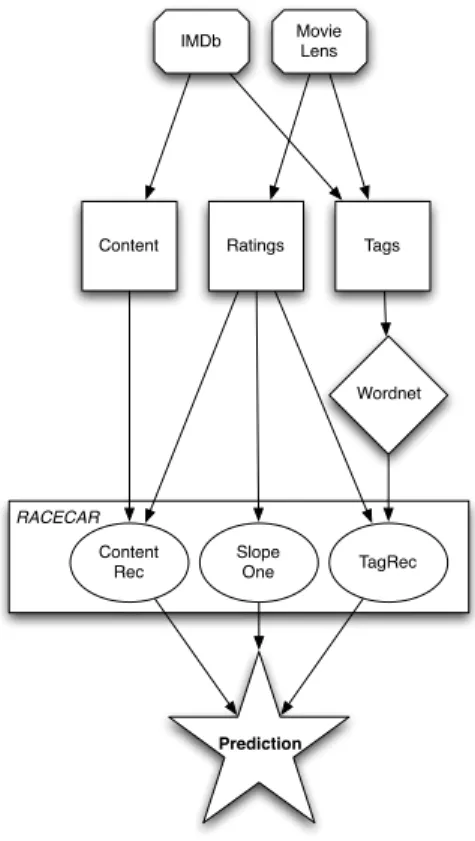
An overview of racecar is shown in Figure 2. “Content” denotes intrinsic metadata about the movies, namely directors, writers, genres, lead actors and actresses, titles, and production years. Racecarcomprises three subsystems.
• ContentRec uses content information and the user’s ratings to train a Bayesian clas-sifier to provide recommendations.
• TagRec uses tags and the user’s rating to train its Bayesian classifier.
• SlopeOne (the collaborative filtering recommender) uses all users’ ratings to train a linear model.
Recommendations from these three subsystems are weighted and summed to produce one final prediction for a given user and movie of how many stars the user is expected to rate that movie.
Ratings
Content Tags
RACECAR
TagRec Slope
One Content
Rec
Prediction IMDb MovieLens
Wordnet
Figure 2: Racecarsystem architecture
4.1 Data
This research uses two data sets. The MovieLens data set contains users’ ratings of movies, which are used to train all systems and to evaluate performance. The MovieLens set also contains some tags, which TagRec uses. The other data set is the IMDb, which contains all intrinsic content information about the movies (used by ContentRec), as well as most of the tags (see Table 3, page 14 for information on tag distribution).
4.1.1 MovieLens
The main data set used is the MovieLens 10M/100k data set,9 which contains approximately ten million ratings and 100,000 tags. Table 2 gives a summary of some characteristics of the MovieLens data. GroupLens, the University of Minnesota research group that runs MovieLens (and also developed the system described in Resnick et al., 1994), prepared the data set by selecting random users from the set of users who rated at least 20 movies,
Table 2: Summary of MovieLens data
Movies 10,681
Users 69,878
Ratings 10,000,054
Tag tokens 95,580
Average rating 3.5
Average number of ratings given by each user 143.1 Average number of tags applied by each user 6.3 Average number of ratings received by each movie 936.2 Average number of tags received by each movie 50.0
Figure 3: Distribution of ratings
although the average user rated 143 movies. Users are not allowed to rate a given movie more than once, although they can change their ratings later.
Ratings are on a scale from 0.5 to 5.0, in increments of 0.5. However, half-point ratings were only added recently as a feature to MovieLens. Many of the ratings in the data set were given by users before the half-point ratings were implemented, which helps account for their relative infrequency (see Figure 3). Tags were also added recently, which again helps explain their relative infrequency: for each tag the average user assigned, they gave 100 ratings.
The original source of the data is users of the MovieLens web site,10 where users enter ratings for movies and the system attempts to predict their ratings for other movies, using collaborative filtering techniques. Both the number of ratings per movie (Figure 4) and
Figure 4: Ratings per movie
Figure 5: Ratings per user
the number of ratings per user (Figure 5) display a characteristic long-tail distribution: the vast majority of users and movies have only a small number of ratings.
More recently, users have been able to apply tags to movies as they see fit, in addition to rating the movies; the interface for doing so is shown in Figure 6. Tags can be any number of words, and there are no limitations on what can be included in a tag. A given tag can be applied to a given movie multiple times. The two most common tags,classic and Tumey’s DVDs, were dropped. These tags were overwhelmingly more frequent than the next most common tags, and I judged that they would have little predictive accuracy –classic doesn’t seem to mean anything consistent that I can tell, and Tumey’s DVDs was merely listing the extent of a particular user’s collection.
Figure 6: MovieLens tagging interface and tags for Watchmen (2009)
Table 3: Summary of tag information Total Distinct
All tags 437,764 47,446
MovieLens 95,580 15,240
IMDb 342,184 32,206
Non-single-use 406,615 23,545 Wordnet-disambiguated 165,740 4379
an attempt to collapse near-synonymous tags, such asdrama anddramatic. Wordnet11 is a lexicon of the English language that lists connections between words. Of particular relevance to this study is the concept of a synonym set or “synset” – a set of closely related words that are considered to be synonymous or near-synonymous. For each tag that was found in Wordnet, the heading for the synset was used in place of the original tag. Forty-one percent of tags were assigned a synset (see Table 3); these included words such as adaptation. By contrast, a tag like author:Alan Moore would not be found in Wordnet.
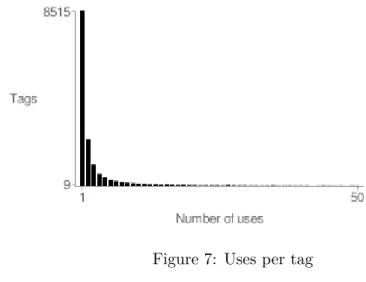
The distribution of tag frequency (Figure 7) shows an even sharper drop-off than the other distributions – under 10% of tags are used more than 10 times, and 56% of them are only used once. Tags that were only used once were removed from the analysis, since they could not possibly have any predictive use.
Figure 7: Uses per tag
4.1.2 IMDb
For content information (cast, crew, and movie genres), the data of the Internet Movie Database was used.12 The IMDb is a very large web site which aims to build comprehensive information on all movies, as well as TV shows and video games. I used the Python package IMDBpY13 to import the flat-text files provided by the IMDb into my database.
After initial experimentation I ended up using only director, writer, genre, title, and year of release information from IMDb. Information that I experimented with and decided not to use includes any actors and actresses beyond the first, languages, locations, producers, movie studios, and MPAA rating (PG-13, etc.). Movie studios and locations were especially unhelpful; many movies have a great number of each listed, with evidently little correlation with a user’s preference. This additional information proved to hurt, rather than help, the predictive accuracy of the system, as well as slightly slowing the speed of prediction.
IMDb also has a field called “keywords.” Users may submit keywords, but they have to be approved by an editor before being added to the database. New keywords are discouraged – the example given is that if the keyword police already exists, users should use that instead of cop. Keywords should be singular, and must be formatted as one word (spaces are replaced by hyphens). This reduces the number of distinct tags in the system. I judged that these keywords are very similar to MovieLens tags, so I combined them with the MovieLens tag set.
4.1.3 Combining the two data sets
In order to establish a bridge between the MovieLens data set and the IMDb data set, I used a title and year lookup to attempt to determine which MovieLens ID numbers were equivalent to which IMDb ID numbers. This was complicated by several circumstances:
• Listed years of production in the IMDb vs MovieLens were often off by one. For instance, Don Juan DeMarco is listed as being produced in 1995 in MovieLens, and in 1994 in the IMDb.
• The “canonical” title in IMDb was often the original language title if the film was foreign, while MovieLens used the English language title (e.g., Shichinin no samurai
in IMDb isThe Seven Samurai in MovieLens).
• Various typos were present, since the information in both databases (especially in MovieLens) is largely human-entered.
By attempting to check alternate titles and years for each movie, I established an IMDb ID number equivalence for 8,954 of the 10,681 movies in the MovieLens data set (84%), thus allowing me to retrieve content information for those movies. The remaining movies were excluded from the analysis.
4.2 Collaborative filtering (SlopeOne)
Racecaruses a collaborative filtering algorithm called SlopeOne (Lemire and Maclachlan, 2005), which was chosen for its comparative ease of implementation and computational speed. SlopeOne is so called because it uses a simple linear model of the formy =mx+b
to form predictions, with the slope m set to one.
The core equations of the basic SlopeOne algorithm that racecar uses are as follows, whereχ is the training set,Sj,i(χ) is the set of all users inχthat rated both movies j and i,uj is useru’s rating of moviej, and card(Z) is the number of elements in set Z.
devj,i = ! u∈Sj,i(χ)
uj−ui
card(Sj,i(χ)) (1)
Rj ={i|i∈S(u), i#=j,card(Sj,i(χ))>0} (2)
P(u)j = 1 card(Rj)
!
i∈Rj
(devj,i+ui) (3)
Equation 1 defines the concept of deviation: how far apart, on average, the ratings are of two itemsiand j by users who have rated both items. The matrix of all such deviation
values can be calculated once and reused for all future predictions, speeding up real-time predictions dramatically.
Equation 2 describes the set of relevant items that are used for making predictions about item j for user u: all items i that the user under consideration u has rated, that are not
the target item j, and for which someone else has rated both iand j.
Equation 3 is the prediction function itself. As Lemire and Maclachlan say, “Given that devj,i+ui is a prediction foruj givenui, a reasonable predictor might be the average of all such predictions.” The predicted rating of itemj for user u is the average, for each item i
inRj, of the user’s rating ofi plus the deviation betweeniand j.
As a concrete example, suppose user u gives a rating of 3 to Jurassic Park (i), and the
deviation ofThe Dark Knight (j) with respect toJurassic Park is 0.5 (i.e., users who rate
both films rateThe Dark Knight an average of 0.5 stars higher). devj,i+ui then comes out to 3.5, so taking into account onlyJurassic Park, we predict a value of 3.5 foruj,u’s rating
of The Dark Knight. The actual SlopeOne algorithm repeats this process for every movie
4.3 ContentRec
The feature-based recommender system, ContentRec, is a na¨ıve Bayes classifier, imple-mented using the Classifier module for Ruby.14. When asked to make a prediction for user
u and item j, it trains a Bayes classifier with every other item u has rated, passing as a
training string the directors, writers, genres, title, and leading actor and actress of each movie. The training string is split on whitespace, punctuation is removed, and the words are stemmed using the Porter stemming algorithm.
The five classes are ratings 1, 2, 3, 4, and 5 (half-point ratings are rounded up – e.g., 3.5 becomes 4). Training in ten classes (including half-point ratings) was tested, but proved to have no effect on error while increasing computation time. The trained classifier is then passed the content string for the target itemj, and asked to predict which class it falls into,
i.e., asked to provide a rating. The system returns the closest match out of the five possible classes.
4.4 TagRec
The tag-based recommender system, TagRec, is similar to ContentRec: a na¨ıve Bayes classifier with five classes. The difference is that with TagRec, the input is tags taken from both the MovieLens and the IMDb data sets. Tags are first passed to WordNet for possible synonym collapsing, and then stemmed, before being used to train the classifier. Many tags are not dictionary words, and thus are not disambiguated by WordNet; out of 406,615 total tags, 165,740 (41%) were assigned a WordNet synset.
A system combining both tag and content information in one Bayes predictor was tested, but it did not perform as well as either system alone. Speculation on the reason for this is given in Section 4.6.
4.5 The experiment
The actual experiment was to combine the three subsystems (SlopeOne, ContentRec, and TagRec) according to a range of different weighting schemes and see which weighting scheme
14
produced the best results. Weights for each subsystem were varied from 0 to 1, by increments of 0.1, with the constraint that for each trial the three weights added up to 1.0. There are 66 different combinations of weighting factors.
Weighting one subsystem 1 thus means the other two subsystems must be weighted 0, which is equivalent to using results from only one of the three subsystems. The closest this experiment can get to equally-weighted subsystems is setting the three weights to 0.3, 0.3, and 0.4, but as the results show, this was not a major issue.
The tests were done by repeating the following procedure 5,000 times. 5,000 was chosen to be the number of iterations as a compromise between a large sample size and a reasonable computation time.
1. Select a random user ufrom the database.
2. Select a random moviej that u has rated.
3. Train new TagRec and ContentRec predictors on all ofu’s dataexcluding their rating
of j (uj), and ask the predictors to predictuj. 4. Ask SlopeOne to predictuj.
These 5,000 results were then collected, and for each possible set of values for the three weights, MAE (mean absolute error) and RMSE (root mean squared error) between the prediction and the actual value ofuj were calculated.
Where S is the set of values for which a prediction was made, N is the number of
elements inS, and ˆı is the predicted value of i, MAE and RMSE are defined by equations
4 and 5, respectively.
MAE = "
i∈S|i−ˆı|
N (4)
RMSE = #"
i∈S(i−ˆı)2
N (5)
4.6 Discussion of methods
On the theory that a model more sophisticated than na¨ıve Bayes might produce better results, I did some preliminary tests of latent semantic indexing (LSI) classifiers on the content and tag data and did not see a large increase in performance of those classifiers. LSI was too computationally intensive to be used for the full-scale testing.
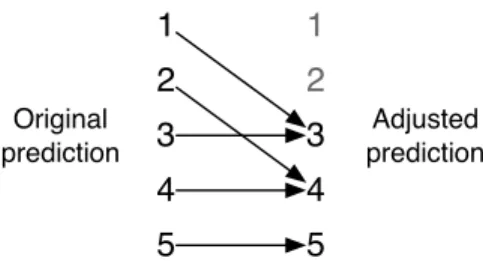
Late in the investigation, I noticed that the results of ContentRec and TagRec are far too likely to predict a rating of 1 or 2. That is, these ratings are predicted much more frequently than they actually occur in the collection. (For theories on why, see Section 6.) A system that adds two points to any rating below 3 gives much better results, and this is what is used in the final analysis. This leads the counterintuitive result that if the unadjusted prediction is 2, the adjusted prediction is 4, while an unadjusted prediction of 3 stays at 3. However, a variety of adjustment procedures were tested, and this one worked best over a large data set. See Section 6 for more on this topic.
A model that combines tag and content information (“FusionRec”) was tested, but it proved to provide less accurate recommendations than ContentRec. At that time I had not yet implemented the practice of adding 2 points to ratings of 1 or 2, and the MAE of TagRec and ContentRec were 2.1 and 1.8, respectively. FusionRec returned an MAE of 2.0: it was more accurate than TagRec, but less accurate than ContentRec. Essentially, it seems that tags were dragging the system down, and content alone provides better predictions.
I also tested training the TagRec and ContentRec classifiers on more than just the user’s ratings, using a couple of different procedures. In one version, where the user didn’t have a rating for a given movie, I used the average rating for that movie. In another, I used the SlopeOne prediction for the user’s rating of that movie. Neither system was better than the final implementations, and they both took much longer to compute ratings (untenably so in the latter case). I suspect this is because these other sources of information (a movie’s average rating, SlopeOne predictions) do not directly access a user’s preference, and so are of little use in training the system.
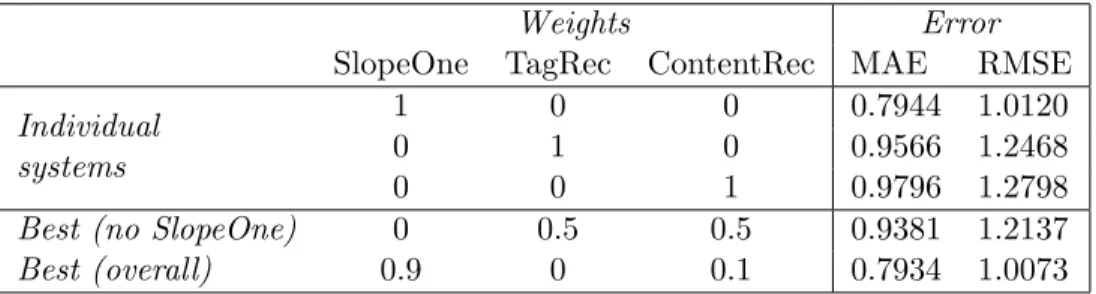
Table 4: Summary of results
Weights Error
SlopeOne TagRec ContentRec MAE RMSE
Individual systems
1 0 0 0.7944 1.0120
0 1 0 0.9566 1.2468
0 0 1 0.9796 1.2798
Best (no SlopeOne) 0 0.5 0.5 0.9381 1.2137
Best (overall) 0.9 0 0.1 0.7934 1.0073
majority of ratings (82%) are between 3 and 5. However, the RMSE of the 4 predictor is relatively high, and in any case if I include it as one of the predictors in the weight-setting experiment, no weight is placed on it, implying that it does not contribute any information. The uselessness of the 4 predictor makes sense: a recommender that says 4 for everything is giving the user no information whatsoever. In the end, the low MAE of the 4 predictor may reflect more on the limitations of MAE as a measure of performance than anything else.
5
Results
The final results can be seen in the Appendix. A summary of results is presented in Table 4, which gives the results for each system alone as well as the combination providing the best MAE and best RMSE, with and without SlopeOne.
The best performance is provided by a system which puts 90% of the weight on SlopeOne and 10% on ContentRec. Although the gains from incorporating the content system are not huge, they are present, and the size of the data set makes it unlikely that they are an artifact of chance. As a baseline, a “predictor” that randomly guesses between 3, 4, and 5 achieves an MAE of 1.08 and an RMSE of 1.42 on the test data set.
6
Discussion
1 2 3 4 5
1 2
3 4 5
Original prediction
Adjusted prediction
Figure 8: Adjustments for TagRec and ContentRec
to produce recommendations, and it makes intuitive sense that information about ratings would be helpful for predicting other ratings. The performance of SlopeOne given in Lemire and Maclachlan (2005) is approximately replicated in this study (they achieved an MAE of 0.752 on their version of the MovieLens data set).
Interestingly, although TagRec alone performs better than ContentRec alone in MAE and RMSE, incorporating TagRec into the overall recommender does not improve results. This suggests that TagRec is not providing much in the way of new, useful information on top of SlopeOne. It could be that the tags that are of value in predicting ratings tend to correlate highly with ratings themselves, in which case SlopeOne would have ready access to that data. This theory works well with the observation that the best system that does not include SlopeOne is 50% TagRec and 50% ContentRec – evidently each of the two systems
is providing some sort of useful information, but TagRec’s information is redundant with, and not as accurate as, SlopeOne.
The adjustments on TagRec and ContentRec predictions – adding 2 to any predictions below 3 – are intuitively slightly odd (see Figure 8). They prevent the subsystems from ever predicting 1 or 2, as well as pushing 2 up to 4 while leaving 3 as 3. However, before adjustment, the frequency of each predicted rating from TagRec and ContentRec was not a good match for the actual frequency of each rating (Figure 9). For instance, 40% of the time, the systems predicted a 1; only 5% of actual ratings are 1.
I suspect that the readiness of the predictors to return 1 and 2 is due to their very rarity. Most keywords from the training data end up being interpreted as predictors in the classes for 3, 4, and 5, which means if you find one of those keywords in a test item, it doesn’t carry as much weight as if you find a keyword that predicts 1 or 2.
Figure 9: Frequency of actual ratings vs. ratings predicted by TagRec and ContentRec (before adjustment)
1 2 3 4 5
1 2
3 4 5
Original prediction
Adjusted prediction
Figure 10: An alternate mapping scheme (not used)
[1,2→ 3, 3,4→ 4, 5→ 5], and [1,2,3,4,5 →4]), but they did not perform as well in the
overall system, though some performed better for ContentRec/TagRec individually. The mapping system in Figure 8 is evidently a good compromise between fitting the predictions to the frequency of the various ratings in the data, and not throwing away too much information from the classifier.
In particular, I think the mapping scheme shown in Figure 10 was not as effective (despite making more intuitive sense than the final mapping scheme) because it collapses the two predictions ContentRec and TagRec are most likely to make, 1 and 2, into one set (3), thus losing the information contained in the distinction between a prediction of 1 and a prediction of 2.
7
Conclusions and implications
collaborative filtering methods are not available, it would be possible to make use of content-or tag-based recommendations to bootstrap the system.
There are several directions for future research suggested in this study. LSI or other alternative classifier schemes could be used for TagRec and ContentRec, to try to improve their accuracy. Tags could be filtered more aggressively to try to improve a tag-based recommender system’s accuracy (it seems likely that many tags do not hold predictive accuracy). Clustering could be applied to tags or content to attempt to collapse them more than WordNet can. CF predictors other than SlopeOne could be used to see if they combine better with feature-based predictors.
The most interesting conclusion to me is that a feature-based recommender, even a very simple one such as ContentRec, can contribute valuable information to a recommender system, and can be combined with a CF recommender to improve overall accuracy.
References
Alspector, J., Kolcz, A., and Karunanithi, N. (1998). Comparing feature-based and clique-based user models for movie selection. In Proceedings of the third ACM conference on
Digital libraries, pages 11–18. ACM Press New York, NY, USA.
Balabanovi´c, M. and Shoham, Y. (1997). Fab: content-based, collaborative recommenda-tion. Commun. ACM, 40(3):66–72.
Basu, C., Hirsh, H., and Cohen, W. (1998). Recommendation as classification: Using social and content-based information in recommendation. In Proceedings of the National Conference on Artificial Intelligence, pages 714–720.
Bennett, J. and Lanning, S. (2007). The Netflix prize. In Proceedings of KDD Cup and
Workshop.
Das, A., Datar, M., Garg, A., and Rajaram, S. (2007). Google news personalization: scalable online collaborative filtering. In Proceedings of the 16th international conference
on World Wide Web, pages 271–280, New York. ACM.
Firan, C., Nejdl, W., and Paiu, R. (2007). The benefit of using tag-based profiles. InLatin
American Web Conference, 2007., pages 32–41.
Goldberg, D., Nichols, D., Oki, B. M., and Terry, D. (1992). Using collaborative filtering to weave an information tapestry. Commun. ACM, 35(12):61–70.
Han, E.-H. S. and Karypis, G. (2005). Feature-based recommendation system. In CIKM ’05: Proceedings of the 14th ACM international conference on Information and knowledge
management, pages 446–452, New York. ACM.
Herlocker, J., Konstan, J., Terveen, L., and Riedl, J. (2004). Evaluating collaborative filtering recommender systems. ACM Transactions on Information Systems, 22(1):5–53. Leimstoll, U. and Stormer, H. (2007). Collaborative recommender systems for online shops.
AMCIS 2007 Proceedings, page 156.
Lemire, D. and Maclachlan, A. (2005). Slope one predictors for online rating-based collabo-rative filtering. InProceedings of the 5th International Conference on Data Mining, page 471. Society for Industrial Mathematics.
Linden, G., Smith, B., and York, J. (2003). Amazon.com recommendations: Item-to-item collaborative filtering. IEEE Internet computing, 7(1):76–80.
Mooney, R. and Roy, L. (2000). Content-based book recommending using learning for text categorization. In Proceedings of the fifth ACM conference on Digital libraries, pages 195–204, New York. ACM.
Ohmukai, I., Hamasaki, M., and Takeda, H. (2005). A proposal of community-based folk-sonomy with RDF metadata. InWorkshop on End User Semantic Web Interaction, Held
in conjunction with the Fourth International Semantic Web Conference (ISWC2005).
Pazzani, M. and Billsus, D. (2007). Content-based recommendation systems. InThe Adap-tive Web, page 325. Springer.
Resnick, P., Iacovou, N., Suchak, M., Bergstrom, P., and Riedl, J. (1994). GroupLens: an open architecture for collaborative filtering of netnews. In CSCW ’94: Proceedings of
the 1994 ACM conference on Computer supported cooperative work, pages 175–186, New
York. ACM.
Sarwar, B., Karypis, G., Konstan, J., and Reidl, J. (2001). Item-based collaborative filtering recommendation algorithms. InProceedings of the 10th international conference on World
Wide Web, pages 285–295, New York. ACM.
Schein, A., Popescul, A., Ungar, L., and Pennock, D. (2005). CROC: A new evaluation criterion for recommender systems. Electronic Commerce Research, 5(1):51–74.
Wang, J., de Vries, A., and Reinders, M. (2006). Unifying user-based and item-based col-laborative filtering approaches by similarity fusion. In Proceedings of the 29th annual international ACM SIGIR conference on Research and development in information
re-trieval, pages 501–508, New York. ACM.
Appendix
Full results of the racecarexperiment.
CF Tags Content MAE RMSE
0 1 0 0.9566 1.24676
0 0.9 0.1 0.95214 1.23226
0 0.8 0.2 0.94768 1.22163
0 0.7 0.3 0.94398 1.21496
0 0.6 0.4 0.94104 1.21232
0 0.5 0.5 0.9381 1.21373
0 0.4 0.6 0.94592 1.21919
0 0.3 0.7 0.95374 1.22864
0 0.2 0.8 0.96204 1.24199
0 0.1 0.9 0.97082 1.2591
0 0 1.0 0.9796 1.27984
0.1 0.9 0 0.9332 1.20043
0.1 0.8 0.1 0.92726 1.18696 0.1 0.7 0.2 0.92284 1.17751 0.1 0.6 0.3 0.91951 1.1722 0.1 0.5 0.4 0.91662 1.17107 0.1 0.4 0.5 0.91808 1.17414 0.1 0.3 0.6 0.92571 1.18137 0.1 0.2 0.7 0.93361 1.1927
0.1 0.1 0.8 0.94219 1.208
0.1 0 0.9 0.9516 1.22712
0.2 0.8 0 0.90982 1.15805
0.2 0.7 0.1 0.90293 1.14572 0.2 0.6 0.2 0.89842 1.13759 0.2 0.5 0.3 0.89519 1.13374 0.2 0.4 0.4 0.89422 1.13423 0.2 0.3 0.5 0.89806 1.13906 0.2 0.2 0.6 0.90562 1.14815 0.2 0.1 0.7 0.91388 1.16142
0.2 0 0.8 0.92362 1.17872
0.3 0.7 0 0.88671 1.12006
0.3 0.6 0.1 0.87963 1.109
0.3 0.5 0.2 0.87476 1.10231
CF Tags Content MAE RMSE
0.3 0.4 0.3 0.87265 1.10005 0.3 0.3 0.4 0.87366 1.10226 0.3 0.2 0.5 0.87853 1.10892
0.3 0 0.6 0.8697 1.09713
0.3 0 0.7 0.89611 1.1352
0.4 0.6 0 0.86437 1.08693
0.4 0.5 0.1 0.85736 1.07727 0.4 0.4 0.2 0.85297 1.07213 0.4 0.3 0.3 0.85223 1.07157 0.4 0.2 0.4 0.85448 1.07559
0.4 0 0.5 0.84486 1.0651
0.4 0 0.6 0.8697 1.09713
0.5 0.5 0 0.84339 1.05909
0.5 0.4 0.1 0.83687 1.05097 0.5 0.3 0.2 0.83387 1.0475 0.5 0.2 0.3 0.83384 1.04872
0.5 0 0.4 0.82406 1.03968
0.5 0 0.5 0.84486 1.0651
0.6 0.4 0 0.82506 1.03699
0.6 0.3 0.1 0.81984 1.03053 0.6 0.2 0.2 0.81759 1.02881
0.6 0 0.3 0.80823 1.02134
0.6 0 0.4 0.82406 1.03968
0.7 0.3 0 0.81059 1.021
0.7 0.2 0.1 0.80641 1.01628 0.7 0.1 0.2 0.80549 1.01639
0.7 0 0.3 0.80823 1.02134
0.8 0.2 0 0.80073 1.0114
0.8 0.1 0.1 0.79767 1.0085
0.8 0 0.2 0.7981 1.01048
0.9 0.1 0 0.79527 1.00838
0.9 0 0.1 0.79343 1.00734