COMPARISON OF ACTIVITY CONCENTRATIONS OF
NAT-URAL RADIONUCLIDES IN SOILS COLLECTED AT
DIF-FERENT DEPTHS OF SELECTED HAND-DUG WELLS IN
ABEOKUTA
*1I.C. OKEYODE, 1A.O. MUSTAPHA, 2N.N. JIBIRI, 1V. MAKINDE, 1F.G.
AKINBORO, 1F.S. SAKA, 3D. AL-AZMI
1 Department of Physics, Federal University of Agriculture, Abeokuta, Nigeria, Postcode 110001 2 Dept of Physics ,University of Ibadan, Ibadan, Nigeria
3 Department of Applied Sciences, College of Technological Studies, Public Authority for
Ap-plied Education and Training, Shuwaikh, P. O. Box: 42325, Code 70654, Kuwait. UAE. *Corresponding author: [email protected] Tel: +2348030731404
Apart from the natural sources, there are other known technically enhanced sources: nuclear and electric generating plants, gas and oil production and solid mineral mining (Fasasi et al., 1999).
Also known to contribute to naturally occur-ring radionuclides is rock phosphate. This is a basic raw material for all inorganic fertiliz-ers, used in agriculture. The continuous
ABSTRACT
This study was aimed at measuring and comparing the activity concentration of soil samples collected from some selected hand – dug wells with their corresponding depths of collection in Abeokuta metropolis. Total of twenty (20) soil samples were collected from hand-dug wells in five sites (Obada, Adigbe, Kuto, Olorunsogo, and Obantoko) within Abeokuta with four (4) soil samples from each hand-dug well at the surface, (0.0m) through to 2.25m depth. Gamma ray spectroscopy with High Purity Germanium (HPGe) detector was used for the measurements. The average activity concentrations obtained for the three natural radionuclides 226Ra, 232Th and 40K in Bq/Kg are 34.31 ± 2.01, 128.73 ± 4.41 and 152.31 ± 2.59 respectively at depth 0.00 m (surface), 23.00 ± 1.61, 68.39 ± 3.24 and 191.08 ± 3.11 respectively at depth 0.75 m, 31.52 ± 2.21, 145.37± 4.95 and 375.56 ± 5.50 respectively at 1.50 m and lastly 28.57±1.70, 95.61 ± 3.71 and 181.10 ± 3.94 respectively at 2.25 m depth. The world average activity concentrations for 226Ra, 232Th and 40K are given to be 35 Bqkg-1, 30 Bqkg-1 and 400 Bqkg-1 respectively (UNSCEAR 2000). 232Th showed higher average values than the world’s average while averages of 226Ra and 40K were lower but most of the activity concentration values obtained in some of the locations are higher than the world’s average values, especially 226Raand 232Th in the soil samples.
Keywords: Activity Concentrations, Depth, High Purity Germanium (HPGe) detector, Abeokuta
INTRODUCTION
Our natural environment is continuously bombarded with ionising radiations from both natural and man-made sources (UNSCEAR, 1999). With the knowledge of the negative effects of an unguided expo-sure to ionising radiation, there has been a tremendous effort to locate and control the-se sources.
Journal of Natural Science, Engineering
and Technology
ISSN:
Print - 2277 - 0593 Online - 2315 - 7461
application of fertilizers in a given field could enhance the radioactivity level of the field (Nwankwo, 2013; Hussein, 1994). Water is vital and concurrently, one of the most important natural resources. About 70% of the Earth’s surface is covered with water, (Ashton et al., 2012). However, most of it is salty, and only around 2.5% of the global water resources consists of freshwa-ter (Nwankwo, 2013 ).
Over 30% is stored as groundwater beneath the earth’s surface which are useful for dif-ferent domestic purposes through hand dug wells and the likes. However the quality of groundwater sources of many communities can be unfit for drinking as a result of con-taminations (Nwankwo, 2013, Ibe and Njokwu, 1999).
The research motivation was based on the fact that it has been estimated that at least one-eighth of the mean annual effective dose due to natural sources of radiation is caused by the consumption of foodstuff and water (UNSCEAR 2000). Since Water plays a central role in human nutrition and existence, therefore studies of the dose from this radioactive sources and its effects on health are of primary importance from the point of view of environmental radia-tion protecradia-tion. This motive is justified since the earth’s crust contains naturally oc-curring radioactive materials (terrestrial radi-oactivity), which increases with depth (Kozinski, 1995) and these radioactive ma-terials occur naturally and of most concern are the uranium series, thorium series and their progenies (radon and thoron). Because of this, drinking water from deep wells and boreholes is likely to contain a higher con-centration of radioactive elements than
sur-ing water, passes through rocks that contain many radioactive materials and this could be transported into wells and boreholes (Saidu and Ike 2013). Most of the sources of water supply in Nigeria are upland surface water or groundwater from boreholes and hand dug wells since portable tap water is not readily available to many communities. Many works have been done on radionuclides in water in Nigeria and around the world (Nwankwo, 2013, Ibe and Njokwu, 1999 and Saidu and Ike 2013. etc), but very few studies was carried out on radionuclides in soil samples from Hand dug wells. Researchers have also shown that Abeokuta, (the study area), is among the high background radiation areas in Nigeria (Jibiri et al., 2009, Farai and Jibiri, 2000). Which they also show that geology of an area enhances the level of radiation in the area. Hence the objectives of this study are to:
Determine the activity concentra-tions of natural radionuclides in soil samples collected at different depths of some selected hand-dug wells from which water for different domestic purposes can be obtained in Abeokuta metropolis which is known to be a high background radi-ation area.
Determine the relationship between activity concentrations of the natural radionuclides in the soils collected with depths
Determine the level of radiological hazards that is associated with the use of these wells for drinking and domestic purposes.
Disseminate the information ob-tained from this study to the com-munities involved.
M
ATERIALSANDM
ETHODSThe materials and methods used to carry out this study and the study area are dis-cussed below
The Study Area
The project work was carried out on five (5) sites within Abeokuta in Ogun State Nigeria (Table 1). Abeokuta means “Refuge Among Rocks” in the local language, this is because the caves of the outcrop rocks provided shelter and save havens for the early settlers from invaders (Britannica, 2012; Demeji, 2010). Abeokuta is the capital city of Ogun state, Southwestern Nigeria. It is situated between latitudes 30 20''and 30 54'' and
longitude 70 9'' and 70 39'' on the east bank
of Ogun river, around a group of rocky outcroppings that rise above the surrounding wooded savanna. The geology of Abeokuta comprises of sequence of rocks that starts with the Precambrian basement and consists of quartzites and biotite schist, hornblende-biotite, granite and gneisses. The sedimentary rock sequences are from Cretaceous to Recent; the oldest of them, known as Abeokuta formation, consists of grey sand intercalated with brown to dark grey clay. It is overlain by the Ewekoro formation, which typically contains thick limestone layers at its base (Jibiri and Okeyode, 2012).
Table 1: Locations of the hand dug wells
SN SAMPLE POINTS NORTH (Deg.) EAST (Deg.)
1 ADIGBE 7.11717 3.318
2 KUTO 7.16069 3.34093
3 OBADA 7.07678 3.2935
4 OBANTOKO 7.17606 3.89022
5 OLORUNSOGO 7.17606 3.37086
Methodology
The Five (5) hand-dug well sites that were visited are in areas previously studied and had been known as high radiation areas in Abeokuta. (Adigbe, Kuto, Obada, Olo-runshogo and Obantoko. Four (4) soil sam-ples from each well were collected at each depth of 0.0m, 0.75 m, 1.50 m and 2.25 m, making a total of twenty (20) soil samples in all. In order to quantify the natural radionu-clides that maybe present in soil which could eventually filter/drain into the well water, the following processes were carried out.
Each soil sample was collected using hand-trowel at each of the depths and the soil samples were labelled with their respective well locations and depths to avoid mix-up. Soil samples were air dried, pulverised/ crushed and made to pass through a 2 mm mesh sieve. A total of 150g of the dried, grounded and sieved sediment samples were put in plastic containers of uniform sizes. The containers were shielded hermetically and also shielded externally to ensure that all daughter products of uranium and thorium, in particular, radon isotope formed, do not escape. A time of 4 weeks was allowed after packing, which was a sufficient time required
to attain a state of secular radioactive equi-librium after their progeny.
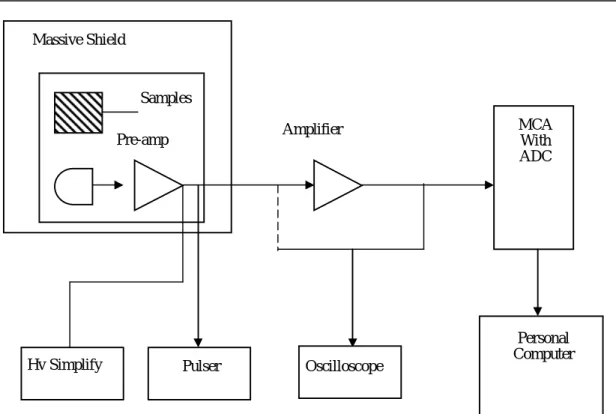
A computerized gamma ray spectrometry system with high purity germanium (HPGe) detector (model: GC 8023) was used (Fig 1). This is an instrument that changes the kinetic energy of an incident ionizing parti-cle in a particular substance into a flash of light. The number of light photon emitted is proportional to the energy of the absorbed radiation which corresponds to the number of pulses displayed under a photo peak and is proportional to the intensity of the radia-tion reaching the detector from the samples. The activity concentration of a given natural radionuclide in a sample is proportional to the count per second obtained under a gam-ma photo peak due to the radionuclides present.
The equipment, (HPGe) detector (model: GC 8023) was calibrated using standard ref-erence samples. It was ensured that the cali-bration standard reference samples used for the detector efficiency calibration represent-ed the samples to be countrepresent-ed, i.e. calibra-tion standard and samples to be counted are identical in size, shape, density, spatial dis-tribution of active material, they have the same geometrical configurations (Alatise, 2007). The standard reference samples were from International Atomic Energy Agency (IAEA Agency’s Laboratories) in Austria.
Having done with the equipment calibration, Computerized gamma ray spectrometry sys-tem with the mathematical relations of equa-tions 1 and 2 (UNSCEAR 2000), were used to obtain the activity concentrations of the soil samples (Tables 2-5).
C a A (1)
C = KA (2)
Where C is the concentration in Bq/kg, A is the count rate i.e counts in 18,000 seconds (5 hours) under the corresponding peak and K is a constant of proportionality for each radi-onuclide at constant geometry.
Where C is the concentration in Bq/kg, A is the count rate i.e counts in 18,000 seconds (5 hours) under the corresponding peak and K is a constant of proportionality for each radi-onuclide at constant geometry.
The constant K is determined by the detec-tor efficiency of the assembly due to the en-ergy emitted by the standard source and it is
equal to . is the detector
efficiency at the specific gamma-ray energy, is the absolute transition probability of the specific gamma-ray and is the mass
) (
1 s M p
p
s M
using a conversion factor of 0.7SvGy-1 which
was used to convert absorbed dose rate in air to human effective dose equivalent with an outdoor occupancy factor of 40%.. The annual effective dose was determined using equation (4) (UNSCEAR, 2000):
Outdoor Annual effective Dose Rate (mSv/
yr) = D x T x F ( 4 )
Where; D is the calculated dose rate (nGyh -1), T is the outdoor occupancy factor (0.4 x
24 x 365.25) hy-1 and F is the conversion
factor (0.7 x 10⁻⁶ SvGy-1). Radiological parameters
To estimate radiological hazards that could be associated with the use of the sampled wells for domestic purposes, external and internal hazard indices were calculated.
Hv Simplify Pulser Oscilloscope
Personal Computer
MCA With ADC Amplifier
Massive Shield
Samples Pre-amp
Figure 1. Schematic diagram of the detector, high purity germanium crystal
Absorbed Dose Rates
To know the amount of absorbed radiation dose for the samples (i.e the energy deposited per unit mass of medium, which may be measured as joules per kilogram and represented by the equivalent SI unit, gray (Gy)), equation 3 was used.
D (nGy h-1) = 0.462 CRa + 0.621 CTh +
0.417 CK (3)
Where CRa, CTh and CK are the activity
con-centrations of 226Ra, 232Th and 40K of the
samples respectively and conversion factors of 0.462 nG4h-1/Bqkg-1, 0.621 nGyh-1/
Bqkg-1 and 0.0417 nGyh-1/Bqkg-1 for 226Ra, 232Th and 40K respectively (UNSCEAR
2000).
Outdoor Annual Effective Dose Rate
The external hazard index Hex can be
calcu-lated by using equation (5):
Hex = CRa /370 + CTh /259 + CK /4810 ≤ 1
(5) where CRa, CTh and CK are the activity
con-centrations of 226Ra, 232Th and 40K in Bq kg -1, respectively from the soil samples. The
value of this index is recommended to be less than unity in order to keep the radiation hazard insignificant.
Internal Hazard Index (H IN)
In addition to the external hazard index, Radon and its short – lives products are also hazardous to the respiratory organs. The internal exposure to radon and its daughter product is quantified by the internal hazard index (Hin), which is given
by equation (6) (Jibiri and Okeyode, 2012; UNSCEAR, 2000) .
HIN = (CRa/185) + (CTn/259) + (CK/4810)
≤ 1 (6)
where CRa, CTh and CK are the activity
con-centrations of 226Ra, 232Th and 40K in Bq kg -1, respectively from the soil samples. These
values are also recommended to be less than unity in order to keep the radiation hazard insignificant.
D
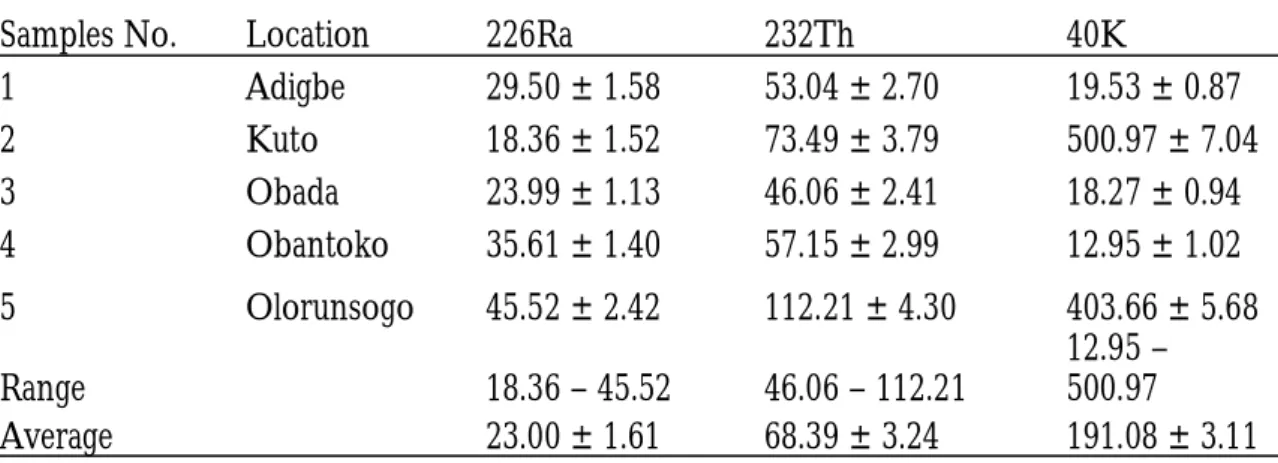
ISCUSSIONTable 2 summarizes the results of measurements of natural radionuclide (226Ra, 232Th and 40K) concentrations in the
collected wells soil samples at the surface, Table 3 shows the results at depth 0.75m, Table 4, indicates the values at depth 1.5m and Table 5 shows the values for depth 2.25m. World average concentrations are 35 Bq kg-1, 30 Bq kg-1 and 400 Bq kg-1 for 226Ra, 232Th and 40K respectively (UNSCEAR,
2000). Comparing these values with the averages and ranges obtained in this study, it shows that in general, most of the activity concentration values are higher than the world’s average values, especially 226Ra,and 232Th in the soil samples.
Table 2: Activity Concentration (Bq/kg) of 226Ra, 232Th and 40K in soil Samples at the Surface (0.0m)
Sample No Location 236Ra 232Th 40K
1 Adigbe 22.52 ± 1.40 54.05 ± 2.70 11.85 ±0.84
2 Kuto 61.01 ± 3.39 257.07 ± 7.37 584.85 ± 7.95
3 Obada 14.57 ± 0.96 40.33 ± 2.19 31.55 ± 0.96
4 Obantoko 27.71 ± 1.66 64.85 ± 3.09 18.67 ± 0.96
5 Olorunsogo 45.70 ± 2.63 227.29 ± 6.69 114.64 ± 2.22
Range 22.52 – 61.01 40.33 – 257.07 11.85 – 584.85
Table 3: Activity Concentration (Bq/kg) of 226Ra, 232Th and 40K in soil samples at depth 0.75m
Samples No. Location 226Ra 232Th 40K
1 Adigbe 29.50 ± 1.58 53.04 ± 2.70 19.53 ± 0.87
2 Kuto 18.36 ± 1.52 73.49 ± 3.79 500.97 ± 7.04
3 Obada 23.99 ± 1.13 46.06 ± 2.41 18.27 ± 0.94
4 Obantoko 35.61 ± 1.40 57.15 ± 2.99 12.95 ± 1.02
5 Olorunsogo 45.52 ± 2.42 112.21 ± 4.30 403.66 ± 5.68
Range 18.36 – 45.52 46.06 – 112.21
12.95 – 500.97
Average 23.00 ± 1.61 68.39 ± 3.24 191.08 ± 3.11
Table 4: Activity Concentration (Bq/kg) of 226Ra, 232Th and 40K in soil samples at depth 1.50m
Samples No. Location 236Ra 232Th 40K
1 Adigbe 29.45 ± 2.23 218.69 ± 6.57 507.93 ± 7.14
2 Kuto 31.18 ± 2.71 190.99 ± 6.12 485.42 ± 6.83
3 Obada 20.20 ± 1.29 43.96 ± 2.48 31.87 ± 1.12
4 Obantoko 44.74 ± 2.54 136.22 ± 4.77 411.93 ± 6.01
5
Olo-runsogo 32.01 ± 2.29 137.01 ± 4.83 439.73 ± 6.41
Range 20.20 – 44.74 43.96 – 218.69 31.87 – 507.93
Average 31.52 ± 2.21 145.37 ± 4.95 375.56 ± 5.50
Table 5: Activity Concentration (Bq/kg) of 226Ra, 232Th and 40K in soil samples at depth 2.25m
Sample No. Location 226Ra 232Th 40K
1 Adigbe 26.46 ± 1.48 33.76 ± 2.30 8.75 ± 0.69
2 Kuto 30.03 ± 1.39 64.19 ± 3.41 31.87 ± 6.21
3 Obada 21.69 ± 1.53 64.59 ± 3.07 57.89 ± 1.46
4 Obantoko 42.29 ± 2.60 227.01 ± 6.76 504.49 ± 7.01
5
Olo-runsogo 22.40 ± 1.50 88.49 ± 3.01 302.49 ± 4.25
Range 21.49 – 42.29 33.76 – 227.01 8.79 – 504.49
At 0.0m, Kuto has the highest value in the three radionuclides. At 0.75m, Olorunsogo has the highest value of 226Ra and 232Th,
while Kuto has the highest in 40K. At 1.5m
depth, Adigbe has the highest value of 232Th
and 40K, while Obantoko has highest value
of 226Ra. At 2.25m, Obantoko has highest
value of the three radionuclides. Farai and Vincent (2006) confirmed Obantoko to have high radiation level. From these re-sults, it shows that the geology of the soil from the sampled wells are really enriched in Thorium and Radium. It implies that ra-don (daughter product of radium) would be emanating from these soils into the well water. The geology of Abeokuta is base-ment complex (Gbadebo, 2011; Jones and Hockey 1964) which accounts for the high values as this enhances level of radiation
( Gbadebo, 2011).
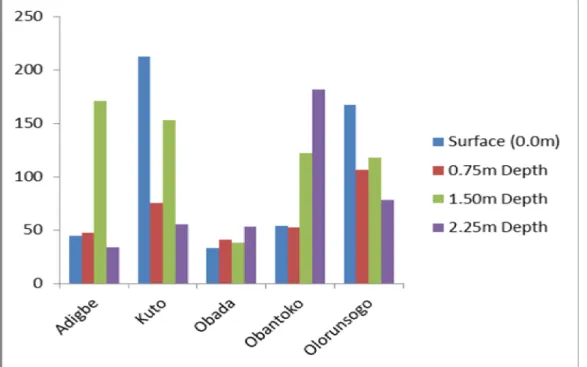
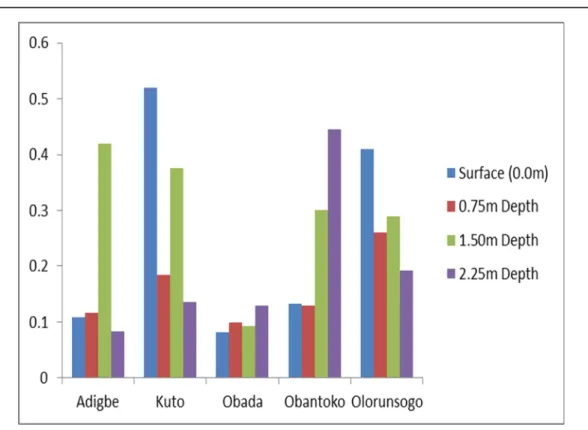
The calculated absorbed dose rates are plot-ted in Figure 2, while annual effective dose rates of the samples are plotted in Figure 3.
The International Commission on
Radiological Protection (ICRP) has recommended the annual effective dose equivalent limit of 1 mSv/yr for the individual members of the public and 20 mSv/yrfor radiation workers (ICRP, 1993). The average absorbed dose rate (D) is nGyh -1 for the five locations, Adigbe, Kuto,
Obada, Obantoko, and Olorunsogo are 74.01, 123.90, 41.04, 102.59 and 117.34 respectively. These values are higher than 57 nGyh-1 reported by UNSCEAR 2000 except
Obada with a value of 41.04n Gyh-1.
Fig 2: Absorbed dose rate (D) nGyh-1 for the soil samples at various Locations
The corresponding outdoor annual effective doses range from 0.08 to 0.42 mSv/yr from 0.0m through 2.25m depth for Adigbe, 0.14 to 0.52 mSv/yr for Kuto, 0.08 to 0.13 mSv/ yr for Obada, 0.13 to 0.45 mSv/yr for Obantoko and 0.19 to 0.41 mSv/yr for Olorunsogo respectively. The averages for each of the locations from depth 0.0m through 2.25m are 0.18 mSv/yr, 0.30 mSv/ yr, 0.10 mSv/yr, 0.25 mSv/yr and 0.29 mSv/yr respectively. The world’s average annual effective dose is approximately given as 0.5 mSv, comparing with value in this study, all locations are below the world’s average value and are less than the
recom-mended value of 1mSv/yr.
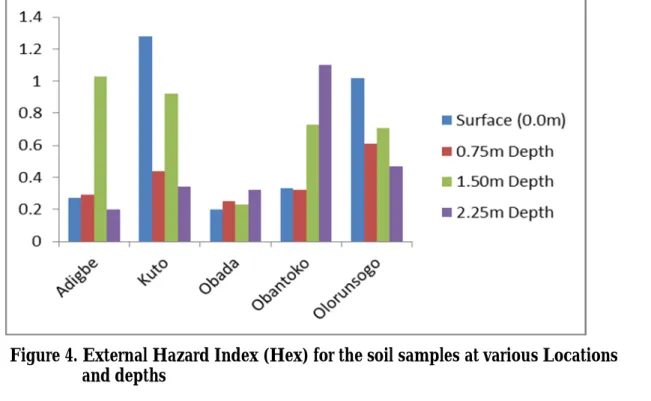
The calculated average values for External Hazard Index (Hex) for Adigbe, Kuto,
Obada, Obantoko, and Olorunsogo are 0.45, 0.75, 0.25, 0.62 and 0.71 respectively from depths 0.0m through 2.25m, Figure 4. The Internal Hazard Index (Hin) are 0.50, 0.84,
0.32, 0.71 and 0.81 for Adigbe, Kuto, Obada, Obantoko and Olorunsogo respectively Fig-ure 5. Although, there are some locations that have high values greater than unity, the calculated averages are still less than unity in the two indices.
Figure 3. Outdoor Annual Effective Dose Rate in (mSvy-1) for the soil samples at
Figure 5: Internal Hazard Index (Hin) for the soil samples at various Locations and depths
Figure 4. External Hazard Index (Hex) for the soil samples at various Locations and depths
CONCLUSION
The specific radioactivity values of 226Ra, 232Th and 40K measured in the soil samples
from the selected wells were determined by High Purity Germanium (HPGe) gamma ray spectrometer. For each sample in this study, the absorbed dose rate, annual effective dose rate, External Hazard Index (Hex) and Internal Hazard Index (Hin) were
determined to assess the radiological hazards that may be linked with the use of water from the wells from which the soil samples were obtained.
In this study, the order of the contributions of radionuclides to the activity concentra-tions is 40K.> 232Th > 226Ra. Although,
the-se values are high but they still fall within the safe range of high radiation areas. There was no relationship between the con-centrations and the depths of 226Ra and 232Th, but for 40K the mean activity
concen-trations increased from the surface with in-creasing depth to 1.50m and finally de-creased at 2.25m. Therefore the activity concentrations of the radionuclides are nei-ther permanently increasing nor decreasing with increasing depth.
Although the absorbed doses calculated are higher than the world’s average value but the outdoor annual effective dose equiva-lent is lower than 1mSv/yr.
The hazard indices are higher than unity in some locations but the averages are all less than unity, showing that the soils from the wells do not pose any significant radiological hazard to the people using the wells for domestic purpose.
R
EFERENCESAlatise, O. O. 2007. Radioactivity
concen-trations and distribution of some naturally occurring radioactive materials in the soils of some Coastal States of Nigeria Unpublished Ph.D. thesis, submitted to the University of Agriculture Abeokuta, Nigeria.
Ashton K., Heckler A. and Jones C. 2012.
Water For Life – Investigating water as a global issue. Publication of Geography Teachers’ Association of Victoria Inc. (Global Educa-tion Project Victoria), Australia. http:// w w w . g lo b a le d uc a t io n . e d u. a u/ ve r ve / resources/Water_for_Life_web.pdf
Britannica Inc., 2012. Abeokuta
Encyclopædia. Encyclopædia Britannica Online. Web.
Dimeji K . A. 2010. Water scarcity bites harder in Abeokuta. Retrieved 2010-05-22.
Farai, I.P., Jibiri, N.N 2000. Baseline
stud-ies of terrestrial outdoor gamma dose rate levels in Nigeria. Radiat. Prot. Dosim. 83(3) 247-254.
Farai I.P., Vincent U.E 2006. Outdoor
radiation level measurement in Abeokuta, Nigeria, by Thermoluminescence dosimetry. Nigerian Journal of Physics 18(1), 121-126.
Fasasi, M.K. Tchokossa, P. Ojo, J.O. Balogun, F.A. 1999. Occurrence of natural
radionuclides fallout Cesium-137 in dry-season agricultural land of south western Ni-geria, Journal of Radioanalytical and Nuclear Chemistry 240 (3), 949-952.
Gbadebo, A.M. 2011. Natural radionuclides
distribution in the granitic rocks and soils of Abandoned quarry sites Abeokuta, South-western Nigeria. Asian Journal of Applied
Sci-ences, 4:176-185
Hussein, E.M. 1994. Radioactivity, Health Physics 67, pp 280.
Hassan NM, Ishikawa T, Hosoda M, Sorimachi A, Tokonami S, Fukushi M, Sahoo SK. 2010. Assessment of the natural
radioactivity using two techniques for the measurement of radionuclide concentration in building materials used in Japan. J Radio-anal Nucl Chem 283(1):15–21. doi:10.1007/ s10967-009- 0050-6
ICRP, International Commission on
Radio-logical Protection ICRP publication 65, An-nals of the ICRP 23(2). Pergamon Press, Oxford. (1993).
Ibe, K.M., Njoku, J.C. 1999. Migration of
contaminants in groundwater at a landfill site, Nigeria, Journal of Environmental Hydrolo-gy 7 (8), 1-9.
Jibiri, N.N., Okeyode, I.C. 2012.
Evaluation of radiological hazards in the sediments of Ogunriver, South-Western Nigeria. Radiation Physics and Chemistry 81 (2012) 103–112
Jibiri, N.N., Alausa, S.K., Farai, I.P.
2009. Radiological hazard indices due to activity concentrations of natural radionuclides in farm soils from two high back- ground radiation areas in Nigeria. Int. J. Low Radiat. 6 (2), 79–95.
Jones H.A and Hockey R.D 1964. The
geology of part of South-western Nigeria Geol. Survey Niger. Bull., 31:1-101.
Kozinsiki D.H. 1995. Natural radioactivity
and inorganic chemistry of ground water in the Kirkwood-Cohansey Aquifer system, Southern New Jersey. U.S Geological survey water investigation reports 92-41.
Nwankwo L.I. 2013. Determination of
natural radioactivity in ground water in Tanke-Ilorin, Nigeria. West African Journal of Applied Ecology, Vol. 21(1), 2013.
Saidu, A., Ike, E.E 2013. Survey of Gross
Alpha Radioactivity in Bore Hole and Well Water in Sokoto City North-Western Nige-ria. Nigerian Journal of Basic and Applied Science , 20(3): 20-26.
Tajudeen H.V. 2006. Survey of
radioactivi-ty in wells and bore holes from Gwammaja area of Kano city. Unpublished M.Sc. Thesis, A.B.U. Zaria.
United nations scientific committee on the effects of atomic radiation, sources, effects and risks of ionising radiation, Report to the UN General Assembly, with Annexes, Unit-ed Nations, 1999.
UNSCEAR 2000. Sources and effects of
ionizing radiation. United Nations Scientific Committee on the Effects of Atomic Radia-tion, United Nations, New York