Data Assimilation with a Machine Learned Observation Operator and
Application to the Assimilation of Satellite data for Sea Ice Models
Siyang Jing
An undergraduate honors thesis submitted to the faculty of the department of mathematics of University of North Carolina at Chapel Hill.
Chapel Hill 2019
To be approved by:
Prof. Christopher Jones Prof. David Adalsteinsson
ABSTRACT
Siyang Jing: Data assimilation with a machine learned observation operator and application to the assimilation of satellite data for sea ice models
In collaboration with Dr. Christian Sampson Under the direction of Prof. Christopher Jones
Data assimilation embodies a wide variety of techniques used to combine model output and
real-world observations in an optimal way to estimate the true state of a system. Important to all
data assimilation schemes are the modelMused to evolve physical state variables forward in time,
and the observation operatorHused to map those state variables to observed quantities. Ideally,
the observed quantities are the state variables themselves in which caseHis simply a projection.
However, in practice, this may not be the case. In many cases, the relationship between the physical
state variables and the observed quantities can be very complex and highly nonlinear. An example
is the case of passive microwave satellite observations of sea ice. Sea ice plays a vital role in the
Earth’s climate system and is a focus of both remote sensing and modeling efforts in modern times.
Passive microwave radiometry provides a daily picture of the ice, despite persistent Arctic cloud
cover, at a low resolution of 25km. While one cannot resolve many ice features in this data set,
the concentration of ice in a given 25km pixel may be derived from the intensities of observed
microwaves at various frequencies. Sea ice is far more emissive in the microwave spectrum than
open water and that contrast can be exploited to estimate sea ice concentration. The emissivity of the
ice depends on its temperature, bulk salinity, thickness, and its snow cover. Further, the microwaves
must pass through the atmosphere producing noise in the observed signal. The map from sea ice
state variables to observable microwave intensities is thus very difficult to model.
More empirical methods can obtain concentrations; the NASA TEAM 2 algorithm is an example.
Given the frequent observations possible with passive microwave, the long 30-year record sea ice
concentration derived from these observations is an enticing data set for assimilation into large-scale
sea ice models. In addition, sea ice concentration is a sea ice state variable allowing for a simple
can be inaccurate due to the presence of melt ponds, which are ponds that form atop the ice from
melting snow. These ponds block the microwave signature from the ice below them making it appear
as though there is less ice leading to an underestimation of sea ice concentration. Assimilation of
this data could be detrimental. However, one could avoid the issue by instead using an observation
operator which maps the sea ice state, which can include the ponds, directly to the satellite radiances.
This way if the model is in line with the radiances themselves we avoid assimilation of incorrect data.
As stated, this relationship is complicated and computationally expensive to model. We propose
to that end to machine learn the observation operator that takes ice state to satellite radiances. In
this initial study, we use a simplified proxy model of sea ice that mimics ponding behavior as an
experimental test bed. Using our model we generate a training data set from the state variables and
non-injective functions which produce “observed radiances”. We explore the amount of data needed
to train the operator to obtain successful assimilations with an Ensemble Kalman Filter scheme. We
compare our results to using retrieved concentration values which suffer from the pond masking
effect. We find that with sufficient training data our machine learned observation operator leads to
ACKNOWLEDGEMENTS
This study is conducted in collaboration with Dr. Christian Sampson under the supervision
of Prof. Christopher Jones. This study is part of the projects initiated on the AIM work shop
“Climate Change and Resilience: Methods of Dynamical Systems and Data Assimilation” supported
by NSF Grant #DMS-1722578. Thank the Mathematics and Climate Research Network (MCRN)
and American Institute of Mathematics (AIM) for support. Thank Amit Apte for part of the EnKF
TABLE OF CONTENTS
LIST OF FIGURES . . . vii
LIST OF ABBREVIATIONS . . . ix
LIST OF SYMBOLS . . . x
1 Introduction . . . 1
1.1 Data Assimilation . . . 1
1.1.1 Kalman Filter . . . 2
1.1.2 Ensemble Kalman Filter . . . 4
1.2 Sea Ice Modeling and Data Assimilation . . . 7
1.2.1 Numerical Sea Ice Models . . . 7
1.2.2 Sea Ice Concentration Retrieval . . . 7
1.2.3 Assimilating with the satellite radiances . . . 10
1.3 Machine Learning . . . 11
1.3.1 Neural Networks . . . 11
1.4 Rationale for Testbed Model . . . 12
2 Testbed Model Formulation . . . 14
2.1 Original Model of Eisenman and Wettlaufer . . . 14
2.2 Proposed Model . . . 15
2.3 Proxy for Ice and Pond Concentration and Satellite Radiances . . . 19
2.4 Problem of Using Satellite Retrived Concentration in DA . . . 21
3 Methods . . . 24
3.2 Model Training and Selection . . . 26
3.3 Evaluation . . . 26
3.3.1 Data Density . . . 28
3.3.2 Training with Sparse Data . . . 32
4 Experiments . . . 35
4.1 Setup . . . 35
4.2 Choices of Observation operators . . . 36
4.3 Error Estimation and Inflation. . . 37
4.4 Results . . . 38
4.4.1 Results with Sparse Data . . . 41
4.4.2 Review and Comparison . . . 41
5 Discussion . . . 46
5.1 Conclusions. . . 46
5.2 Future Direction . . . 47
LIST OF FIGURES
2.1 The state space trajectory that we use in data assimilation experiments. . . 17
2.2 Trajectories with various initial points whenFCO2 = 0. . . 18
2.3 Trajectories with various initial points whenFCO2 = 60. . . 19
2.4 Overview of the proposed proxy for the melt pond problem in sea ice concentration retrieval. . . 20
2.5 Overview of the proposed proxy for the melt pond problem in sea ice concentration retrieval. . . 21
2.6 The proxy for satellite radiances versus energy. . . 21
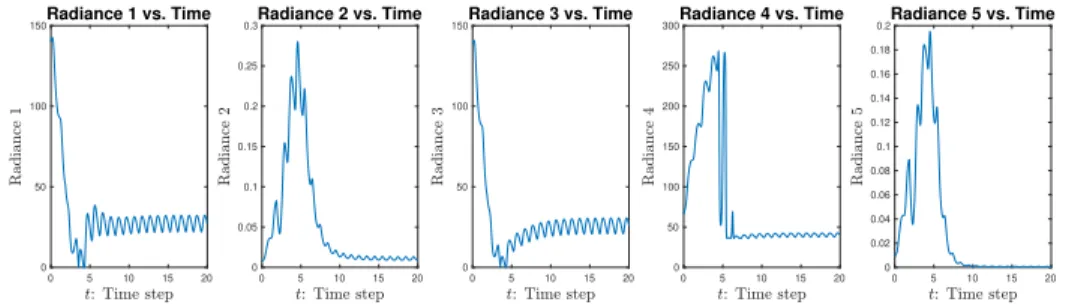
2.7 The proxy for satellite radiances versus time. . . 22
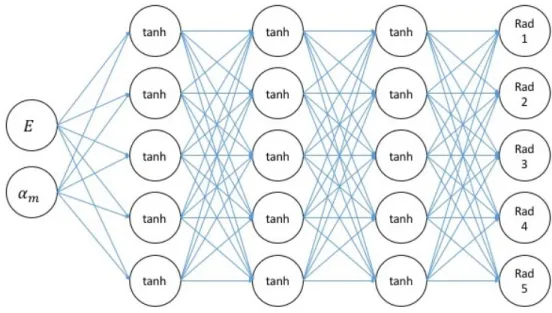
3.1 Graphical representation of the proposed machine learning model. . . 27
3.2 The performance of machine learning observation operator evaluated on one trajectory. . . 28
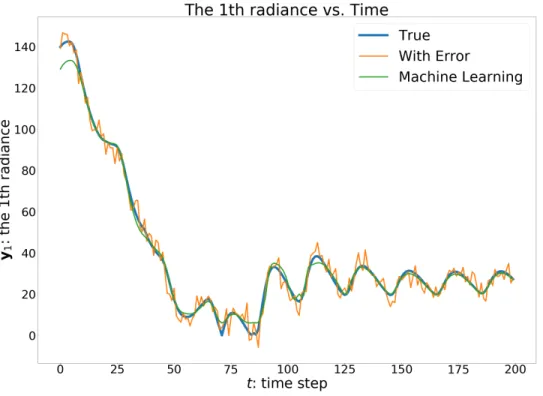
3.3 Time evaluation of the 1st radiance, true value, noisy value and ML fitted value. . . 29
3.4 Density of available training data for machine learning in the state space. . . 30
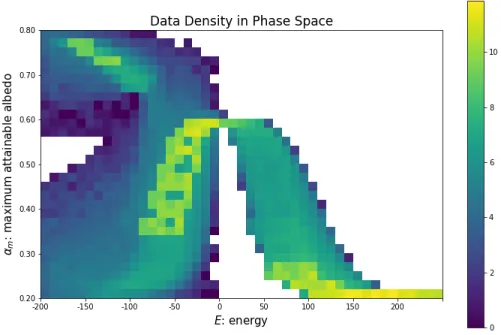
3.5 Error of machine learning algorithm in state space. . . 31
3.6 Drop out data in the shaded region of interest. . . 33
3.7 Comparison between the original data density (left) and the data density after dropping95%data inE∈[−50,50]. . . 33
3.8 Comparison between the error of machine learning algorithm with all data (left) and with5%data inE ∈[−50,50]. . . 34
4.1 DA experiment withH, the true observation operator. . . 39
4.2 DA experiment withHˆML, i.e. ML OP with grid training data. . . 39
4.3 DA experiment withHML, i.e. ML OP with training data from trajectories. . . 40
4.4 DA experiment withHretrieval, the observation operator representing the proxy for satellite retrieval algorithm. . . 41
4.5 DA experiment withH30%, i.e. ML OP trained with30%data inE∈[−50,50]. . . 42
4.7 Time evolution of absolute error ofαmwithH,HˆML,HML, andHretrieval, respectively 43
4.8 Time evolution of absolute error ofEwithH,HˆML,HML, andHretrieval, respectively 43
4.9 Time evolution of absolute error ofαmwithH,HˆML, andHML, respectively . . . 44
LIST OF ABBREVIATIONS
DA Data Assimilation
EnKF Ensemble Kalman Filter
EW09 The Sea Ice Model Proposed by Eisenman and Wettlaufer in 2009
FNN Fully Connected Neural Network
i.i.d Independent and identically distributed
KF Kalman Filter
ML Machine Learning
NN Neural Network
OP Observation Operator
LIST OF SYMBOLS
α Albedo, the percentage of solar radiation reflected back
αm Maximum attainable albedo
C(Rn,Rm)Continuous function fromRntoRm
The uncertainty in model
η The uncertainty in observation operator
H Observation operator
H The linearization or matrix form ofH
HML Machine learning observation operator with realistic training data
ˆ
HML Benchmark machine learning observation operator with unrealistically large amount of training data
Hretrieval Observation operator representing the proxy for satellite retrieval algorithm
H5% Machine learning observation operator with5%data inE ∈[−50,50]for training.
H30% Machine learning observation operator with30%data inE∈[−50,50]for training.
In The identity mapping inC(Rn,Rn)
K The Kalman gain matrix
M The dynamic model used in data assimilation
M The linearization or matrix form ofM
N(µ,σ) Normal distribution with meanµand error covariance matrixσ.
P The covariance matrix representing the uncertainty in state estimate
Q The covariance matrix representing the uncertainty in model
R The covariance matrix representing the uncertainty in observation
ξ The error of machine learning observation operator.
x The state vector, in our study is2-dimensional containingE andαm.
xf The forecast estimate of the state.
xfi The forecast estimate of thei-th ensemble member.
xa The analysis estimate of the state.
y The observation vector, in our study is5-dimensional representing the satellite radiances.
CHAPTER 1
Introduction
1.1
Data Assimilation
Data assimilation is an analysis technique in which the observed information is accumulated into
the model state by taking advantage of consistency constraints with laws of time evolution and
physical properties. In this study, we will focus on sequential data assimilation with its discrete time
formulation.
We first consider themodelthat evolves the state variablesxt∈Rnin time, which is typically a dynamical system defined by the mapM ∈C(Rn×N,Rn)
xt+1 =M(xt, t) +t, t∈N (1.1)
where = {t}t∈N is an i.i.d. sequence. In many applications, models are supplemented by
observations of the system as it evolves; this information then changes the probability distribution
on the states, typically reducing the uncertainty. To describe such situations, we assume that we are
given data, or observations,yt∈Rmdefined as follows. At each discrete time instance, we observe a (possibly nonlinear, as in this study) function of the state variables, with additive noise:
yt=H(xt) +ηt, t∈N (1.2)
whereη ={ηt}t∈Nis an i.i.d. sequence. The functionHis known as theobservation operator.
The objective ofdata assimilationis to determine information about the statesxt, given datayt, at
each time stept. For example, if we are directly observing all the state variables, then the observation
variables, then the observation operator becomes a projection. As later described in Section 2.3, the
observation operator in our study is much more complicated and non-linear.
Sequential DA consists of two steps at each discrete time, the prediction step, where the estimate
from last time step is evolved using the model to give theforecast, and the update step, where the
forecast is updated to theanalysisreflecting the observations.
As described above, the observation operator is very important - it allows us to compare our
forecast model states with measurements and obtain a more accurate estimate of the model state.
Passive microwave satellite data is an example where the physical state of a system, ocean temperature,
for example, is not directly observed, but the intensity of microwave radiation it emits is. In a situation
like this, we have two choices for an observation operator.
1. Infer the physical quantities from the light intensities with an inverse scheme. (Often done,
but can be inaccurate) and use an observation operator which is a projection on to the inferred
state variables.
2. Use an observation operator which maps the model state variable directly to the actually
observed quantities.
In cases where the inversion option 1 is not a good choice as incorrect data would be assimilated
pushing the model in the wrong direction. In this situation, it is advantageous to use option 2.
However, option 2 presents its own difficulties,Hmay be highly nonlinear and complex, as is the
case for satellite radiance measurements. In this work, we explore methods for discoveringHusing
data and machine learning with a focus on sea ice modeling.
1.1.1 Kalman Filter
From the beginning of data assimilation, many algorithms that aim to produce the optimal state
estimate under various constraints and assumptions have been proposed. Some popular methods
include 3D-Var, 4D-Var, particle filter, and Kalman filter along with its variants. In this study, we
focus on the Ensemble Kalman Filter. First, let us review the Kalman filter. Named after Rudolf E.
Kalman, the Kalman filter first emerged in control theory. It uses a system’s dynamic model (e.g.,
physical laws of motion), known control inputs to that system, and multiple sequential observations,
by using only one measurement alone. In terms of data assimilation, the standard Kalman filter
(KF) is the optimal sequential data assimilation method for linear dynamics and observations with
Gaussian error, i.e., we assume in Equation (1.1) and Equation (1.2)MandHare linear mappings
andtandηtat each time step are normal distribution with zero mean. Usually, the problem which
KF applies to can be formulated as follows:
• xb, B, prior guess of initial state vector and error covariance matrix
• xt+1=M(xt) +t, t∼ N(0,Qt), whereMis the dynamic model that evolves the state in time andQtis the error covariance matrix for the model. In addition, we have to know the
matrix form (linearization in the case of nonlinear dynamics) ofM:M.
• yt =H(xt) +ηt, ηt ∼ N(0,Rt), whereHis the observation operator that maps system states to observations, and Rt is the error covariance matrix for the observation operator.
Similarly, the matrix form (linearization in the case of nonlinear observation operator) ofH:
H.
The algorithm goes as follows:
1. Setxa0 =xbandPa0 =B
2. Forecast step:
• Propagate the prior guess forward in time,xft+1 =M(xat)
• Propagate the prior guess error covariance matrix forward in time:Pft+1=MPatMT +Q
3. Analysis step:
• Calculate the Kalman gain matrix:K=PfHT(R+HPfHT)−1
• Get the analysis of the state using the observations:xa=xf+K(y− H(xf)
• Calculate the analysis error covariance matrix:Pa= (I−KH)Pf
1.1.2 Ensemble Kalman Filter
As stated above, the standard Kalman filter (KF) only gives the optimal state estimate for linear
dynamics and measurement processes with Gaussian error statistics. For non-linear situations,
the extended Kalman filter (EKF) can be used with the linearization ofMandH, although it is
well known that EKF is unstable under strong nonlinearities. Both the KF and the EKF explicitly
propagate error information with a dynamic equation for the state error covariance matrix. However,
the integration of this equation is not computationally feasible for large-scale environmental systems.
To overcome these limitations, the ensemble Kalman filter (EnKF) was proposed by (Evensen, 2003).
The ensemble Kalman filter is a suboptimal estimator, where the error statistics are predicted by
using a Monte Carlo or ensemble integration to solve the Fokker-Planck equation. In this study,
we use the formulation of (Gillijns et al., 2006). Like the Kalman filter, EnKF also consists of the
forecast step and the analysis step.
First, to represent the error statistics in the forecast step, we assume that at timet, we have an
ensemble ofqforecasted state estimates with random sample errors. We denote this ensemble as
Xft ∈Rn×q, where
Xft = (xf1
t , ...,x fq
t ) (1.3)
and the superscriptfi refers to the i-th forecast ensemble member. Then, the ensemble mean
¯
xft ∈Rnis defined by
¯
xft = 1
q q
X
i=1
xfi
t (1.4)
From the ensemble members, we calculate the forecast output and the forecast output mean
yfi
t =H(x fi
t ) (1.5)
¯
yft = 1
q q
X
i=1
yfi
t (1.6)
We define the ensemble error matrixEft ∈Rn×qaround the ensemble mean by
Eft = (xf1
t −¯x f t, ...,x
fq
t )−¯x f
and the ensemble of output errorEfyt ∈R
n×q
Efy
t = (y
f1
t −¯y f t, ...,y
fq
t )−¯y f
t (1.8)
The forecast of the error covariance in the state is estimated with the ensemble error covariance, i.e.
Pft = 1
q−1E f t(E
f
t)T (1.9)
We also define
Pfxy
t =
1 q−1E
f t(Efyt)
T (1.10)
Pfyy
t =
1 q−1E
f yt(E
f yt)
T (1.11)
We interpret the forecast ensemble mean¯xft as the best forecast estimate of the state, and the sample covariance of the ensemble membersPft as the forecast estimate for the uncertainty.
The second step is the analysis step. The Kalman gain matrix is estimated by
Kt=Pfxyt(P
f yyt)
−1 (1.12)
To obtain the analysis estimates of the state, the EnKF performs an ensemble of parallel data
assimilation cycles, where fori= 1, ..., q
xai
t =x fi
t +Kt(yit− H(x fi
t ) (1.13)
whereyitare perturbed observations given by
yit=yt+ηt, ηt∼ N(0,Rt) (1.14)
The ensemble mean and covariance are calculated as follows
¯
xat = 1
q q
X
i=1
xai
Pat = 1 q−1E
a
t(Eat)T (1.16)
and are used as the best analysis estimate of the state and uncertainty, respectively. The last step is
the prediction of error statistics in the next forecast step:
xfi
t+1=M(x ai
t ) +t, t∼ N(0,Qt) (1.17)
Unlike the extended Kalman filter, the evaluation of the filter gainKtin the EnKF does not
involve an approximation of the nonlinearity M and H. Hence, the computational burden of
evaluating the Jacobians ofMandHis absent in the EnKF.
As we can see from the formulation of EnKF, it is a sub-optimal estimation derived from Kalman
filter to compensate for high computational cost and nonlinearity. Like the Kalman filter, EnKF
would still perform better under the same constraints and assumptions of Kalman filter. Typically,
the closer the actual system is to linear and Gaussian, the more likely EnKF is useful.
However, when there is a systematic error or bias in our knowledge about the observation
operatorH, wrong information might be assimilated into the system and the analysis could be even
worse than the forecast. If the true observation operator isH, but we think it is insteadH0, when
calculating the output forecastyfi
t in Equation (1.1.2), we would useH0 instead of the correctH. Intuitively, even if the forecast ensemble statesxfi
t are exactly the same as the truth, forecast output
of the ensemble membersyfi
t =H0(x fi
t )would be far from the observation which is generated by
Hinstead ofH0, and the update step based on such difference would likely drive the model farther
away from the truth. Since the calculation of the Kalman gain matrix Equation (1.12) is based on the
output forecast through Equation (1.1.2) and Equation (1.1.2), the algorithm would likely to give an
estimate of the Kalman gain matrix that is far from the truth. Furthermore, in Equation (1.13), each
ensemble member is updated with the Kalman gain and the difference between the observation and
forecast output, where we again would put the wrongH0in the equation. In our study, this is exactly
what happens in a sea ice concentration retrieval algorithm when melt ponds obscure the microwave
1.2
Sea Ice Modeling and Data Assimilation
1.2.1 Numerical Sea Ice Models
A complete sea ice model consists of a momentum equation, thermodynamic model, and an equation
governing the evolution of the ice thickness distribution. Here we give a brief review of the standard
equations used to model sea ice on large scales (Hunke et al., 2017). The typical form of the
momentum equation for sea ice is given by,
ρ¯hdv
dt =∇ ·(¯hσ) +τa+τw−fc−ρ¯hga∇H. (1.18)
Herevis the ice velocity,σ the stress,τa atmospheric forcing,τw ocean forcing,fcthe Coriolis
force,Ha sea surface tilt term,ρthe ice density,¯hthe average ice thickness, andgagravitational acceleration. In addition to a thermodynamic model, the ice thickness distribution,g, are tracked and
evolved according to the ice thickness distribution equation (Thorndike et al., 1975) given by,
dg
dt + (∇ ·v)g+ (f g)
h =ψ. (1.19)
The first two terms in equation 1.19 describe horizontal transport and the changes in ice
thick-nesses due to flow,f =dh/dtis the rate that thickness changes due to thermodynamic processes andψa term accounting for mechanical redistribution due to ridging, where convergence causes ice
to pile up. Typically discrete thickness categories are tracked within a grid cell of the model and
measures of observable quantities, such as ice concentration, can be calculated by looking at the
amount of ice in the zero thickness categories. In this work, we focus on sea ice concentration as a
quantity of interest for assimilation into a large scale sea ice model.
1.2.2 Sea Ice Concentration Retrieval
Sea ice concentrations themselves are derived by exploiting the high contrast in the microwave
emissivities of sea ice and open water. The satellite itself retrieves the brightness temperatureTB.
The brightness temperature can be approximated, in the microwave regime, through the dimensionless
with the equation
TB(λ, p) =εs(λ, p)Ts. (1.20)
Hereλis the wavelength,pthe polarization, andTsis the physical temperature in degrees Kelvin.
The emissivity itself depends on the dielectric properties of the emitting material. For sea ice, this
is primarily a function of the salinity and brine volume fraction while for snow it is the grain size
and water content. Further, the atmosphere must also be considered since the brightness temperature
retrieved by the satellite is a combination of several contributions from the Earth, atmosphere, and
space.
Once atmospheric and other effects are accounted for, the retrieved brightness temperature can
be thought of as coming from a mix of open water, first year, and multiyear sea ice. The assumption
is that the measured temperature brightness is coming from a linear mix of the constituents. That is,
withFbeing the fraction,
TB(λ, p) =εs(λ, p)Ts=εw(λ, p)TwFw+εf y(λ, p)Tf yFf y+εmyTmy(λ, p)Fmy (1.21)
wheres,w,my,f ystand for the scene, water, multiyear and first-year ice respectively.
For many of the established algorithms, retrieval of ice concentration depends on tie points which
are observed brightness temperatures for open waterTBw, first-year iceTBf y, and multiyear ice
TBmy. The tie points themselves incorporate most atmospheric effects and can depend on location,
the season, and the sensor itself. The successful retrieval of ice concentration relies heavily on having
correct tie points. In the wintertime, these do not vary much. However, in the summer, observed
brightness temperatures can vary greatly both spatially and temporally (Willmes et al., 2014).
As the melt season progresses, higher water content in the snow layer atop the ice increases the
microwave emissivity of the snow while absorbing most of the emissions from the ice below. The
snow itself can have an emissivity close to 1 compared to that of multiyear ice at 0.7-0.8 or first-year
ice at 0.9-0.95. This can have the effect of increasing the overall emissivity of a given scene. As the
snow melt progresses, water runoff settles into the topographic low points of the surface forming melt
ponds. These ponds continue to grow, deepen and eventually connect to form complex geometries
when the ice becomes sufficiently permeable. Melt ponds have a microwave signature very close
to that of open water at the relevant frequencies and also absorb most of the emission from the ice
below. This has the opposite effect of wet snow, decreasing the overall emissivity. The increased
emissivity of the wet snow is likely to push toward a concentration retrieval on the high side, whereas
melt ponds tend to push toward lower values (Kern et al., 2016; Kongoli et al., 2011). The extent
of these effects on sea ice concentration retrieval depends on the tie points of the algorithm used.
Many algorithms are tuned to mitigate the masking effect of melt ponds in the summer to provide
concentrations that more closely represent the extent of sea ice. These values are important for heat
fluxes as the heat flux of sea ice and the ocean differs significantly.
One might also be interested in albedo. In this case, one would want a concentration that more
closely represents the surface fraction of exposed sea ice. This is because the critical factor here is
the difference between the albedo of melt ponds and the ice. For this purpose, one may not want to
mitigate the masking effect of melt ponds at all. As an example, in (Kern et al., 2016) it was observed
that for100%sea ice concentration with40%melt pond coverage, many of the standard concentration retrieval algorithms returned concentrations of≈90%. While still an underestimation, this value is a far cry from the 60% sea ice surface fraction an algorithm not tuned to account for melt ponds
might produce. Further, for an algorithm that is tuned high, the large spatial and temporal variability
of surface conditions in summer can lead to concentration retrievals of>100%. In addition, ponds can rapidly drain through the porous microstructure of the ice when it is warm enough, this means a
retrieval algorithm tuned high will be over predicting concentrations in situations where ponds have
disappeared.
Attempts to quantify this effect were carried out in (Kern et al., 2016). Linear correlations were
found in a comparison of sea ice concentrations obtained using NASA’s MODIS sensor, which can
resolve melt ponds, and NASA’s AMSR-E sensor. The slopes ranged from 0.9 to 1.12 , depending
on the algorithm, indicating that some algorithms are underestimating concentration while others
are overestimating it. These errors have been found to be as high at26%when compared to data obtained using NASA’s Moderate Resolution Imaging Spectroradiometer (MODIS) sensor (Kern
et al., 2016). This can create serious problems when attempting to assimilate concentration data into
large scale sea ice models. Many large scale sea ice models also include pond fraction as a state
the true values, one would not want to assimilate a retrieved concentration of 70% ice, the amount
hidden by the ponds.
1.2.3 Assimilating with the satellite radiances
Given that 100% ice and 30% ponds looks the same to a passive microwave satellite as 70% ice and
no ponds, in that observed radiances are very similar, one possible way to avoid the assimilation of
incorrect data is to change the observation operator and map the state variables of the model to the
radiances instead of obtaining an (inaccurate) estimate of state variables from them. This itself is
a challenging task and the radiances emitted by a scene of emissivity will depend not only on the
fraction of ice, water, and ponds, but on the thickness, salinity, temperature and snow cover of the ice.
Perhaps the most difficult parameter to estimate is sea ice emissivity. Sea ice may be viewed as a
composite of ice and brine, and the microwave emissivity depends heavily on the volume fraction and
configuration of the brine pore space, a problem which relates to classic problems in homogenization
theory. Further atmospheric effects need to be taken into consideration as it serves as an intermediate
layer between the ice pack and observing satellite.
One method previously studied uses various parameterizations of sea ice emissivities and an
atmospheric radiative transfer model to build a complex observation operator which takes sea ice
model state variables directly to passive microwave satellite radiances (Scott et al., 2012). It was
found that this improved model predictions, especially during the melt season. However, it is sensitive
to the parameterization of emissivity chosen and computationally expensive. In this work a 3D-var
assimilation scheme was used. However, the Ensemble Kalman Filter (EnKF) has many advantages
over 3D-Var but due to the needed atmospheric modeling would be computationally prohibitive. We
instead propose to use a machine-learned observation operator which takes inputs of sea ice state
variables and rough atmospheric conditions and outputs likely observed satellite radiances. Once
learned, the low computational cost of the observation operator would allow for an EnKF scheme
to be possible. The primary difficulty here, however, is in building a data set to train on. As a first
step, we will use a simple Testbed Model designed to mimic how ponds form and drain during the
melt season with proxies for satellite radiance, true ice concentration, pond fraction, and retrieved
concentrations to investigate how successful a machine learning observation operator is in improving
1.3
Machine Learning
Machine learning (ML) is the scientific study of algorithms and statistical models that computer
systems use to effectively perform a specific task without using explicit instructions, relying on
patterns and inference instead. It is seen as a subfield of artificial intelligence. Machine learning
algorithms build a mathematical model of sample data, known as “training data”, in order to make
predictions or decisions without being explicitly programmed to perform the task. Machine learning
algorithms are used in a wide variety of applications, such as email filtering, and computer vision,
where it is infeasible to develop an algorithm of specific instructions for performing the task. Machine
learning is closely related to computational statistics, which focuses on making predictions using
computers. The study of mathematical optimization delivers methods, theory and application domains
to the field of machine learning.
1.3.1 Neural Networks
Neural networks (NNs) are computing systems vaguely inspired by the biological neural networks
that constitute animal brains. The neural network itself is not an algorithm, but rather a framework for
many different machine learning algorithms to work together and process complex data inputs. Such
systems “learn” to perform tasks by considering examples, generally without being programmed
with any task-specific rules.
An ANN is a model based on a collection of connected units or nodes called artificial neurons,
which loosely model the neurons in a biological brain. Each connection, like the synapses in a
biological brain, can transmit information, a “signal”, from one artificial neuron to another. An
artificial neuron that receives a signal can process it and then signal additional artificial neurons
connected to it. In common ANN implementations, the signal at a connection between artificial
neurons is a real number, and the output of each artificial neuron is computed by some non-linear
function of the sum of its inputs. Artificial neurons and edges typically have a weight that adjusts
as learning proceeds. The weight increases or decreases the strength of the signal at a connection.
Typically, artificial neurons are aggregated into layers. Different layers may perform different kinds
of transformations on their inputs. Signals travel from the first layer (the input layer) to the last layer
the neural network can be summarized as
xl+1=fl(Wlxl+bl) (1.22)
whereflis a element-wise nonlinear function called the “activation function”. We may have different
activation functions for different purposes in different layers. For example, in our study, the hidden
layers all havetanhas the activation function while the final output layer does not have activation function, i.e.,foutis the identity mapping.
1.4
Rationale for Testbed Model
As mentioned in Section 1.2.3, the motivation of this study is to investigate how successful a machine
learning observation operator is in improving predictions compared to retrieved concentrations.
Typically, sea ice dynamics are simulated with the numerical sea ice models described in Section 1.2.1
e.g., the Community Sea Ice Model (CSIM) (Hunke and Lipscomb, 2010). However, use of such
large-scale sea ice models in this study, while describable, would act as a bottleneck preventing
timely exploration of the state space and its relationship to satellite radiance values. This is partly
because of the computational cost in running the large-scale models, especially in EnKF, where a
large ensemble is needed, and the dynamics of every ensemble member needs to be calculated. Also,
the state space in a large-scale sea ice model is usually high-dimensional. Here we wish to be able to
fully explore the state space, and so we will require a low-dimensional model.
Besides a low-dimensional model, we also need to define proxies for satellite radiances, ice
concentration, and pond concentration from the model state variables. While real observations
exist, for this initial study, we focus on exploring how machine learning can be used to discover
an observation operator. Therefore we desire to have complete control over the state variables, the
observations, and the error in each and as such real ice observations would not be appropriate for use
at present.
In data assimilation, Lorenz’96 (Lorenz, 1995) is often used as a model problem. It is a 40-dimensional dynamical system formulated by Edward Lorenz in 1996, originally used to study issues
success with Lorenz’96. However, it is not sufficient to make our argument. In this work, we are
motivated by the sea ice concentration retrieval problem caused by melt ponds, so we seek a low
dimensional model which mimics the specific situation of interest. For example, the formation and
drainage of ponds cause errors in retrieved concentrations which would not otherwise be present, and
the model should display behaviors representing such phenomenon.
To this end, we use the ODE energy balance model of (Eisenman and Wettlaufer, 2009). This
model accounts for energy input and loss in sea ice and as a result, can give us an accounting of
how and when a pond should form or drain. However, this model does not explicitly have a variable
related to the formation of melt ponds. Therefore, we will introduce a second ODE and variable to
account for this. Since we will only have two variables, we will be able to easily explore the whole
state space by simply generating model runs of different initial conditions. This will further allow us
to create a proxy for satellite radiances, ice concentration, and pond fraction based on a simple input
space. The details of this model are presented in Chapter 2. With this model, we are able to focus on
CHAPTER 2
Testbed Model Formulation
2.1
Original Model of Eisenman and Wettlaufer
As mentioned in Section 1.2.3, we build a Testbed Model to mimic the physical process of ponds
forming and draining form to investigate how successful a machine learning observation operator
is in improving predictions compared to retrieved concentrations. We base our model on a simple
sea ice model developed by I. Eisenman and J.S. Wettlaufer in 2009 (EW09). The original ODE of
(Eisenman and Wettlaufer, 2009) is given by:
dE
dt = [1−α(E, αm)]Fs(t)−F0(t) +Fco2 −FT(t)
E cmlHml
+FB (2.1)
where α(E, αm) =
αml+αm 2 +
αml−αm 2 tanh
E Lihc
(2.2)
In Equation (2.1), Fs(t) is the incoming solar radiation, F0(t) is the amount of longwave radiation(heat) that escapes to space,FCO2 is the amount of longwave radiation reflected back from
clouds and CO2,FT(t)has to do with heat exchange with lower latitudes, andFBis the heat input from the ocean below the ice. In the original model,FCO2 andFBare constants, whileFs(t),F0(t), andFT(t)are taken to be step-wise constant functions consisting of the monthly averaged values. In our study, the time-dependent quantities are replaced with continuous functions consisting of10-term Fourier series fitted to the monthly averaged values. Meanwhile, we are most interested inFCO2, and
we will vary its value to investigate its influence on the system.
In the model, Equation (2.2) represents the albedo (the percent of incoming solar radiation the
ice reflects) and depends on the energy of the ice as a whole. In this equationαml is the albedo
thickness which is used to control the smoothness of the parameterization. In the original model,
αm is the maximum attainable albedo of the ice which they take to be0.68. In reality, it can be as high as0.8with snow on top of it in cold conditions. AsEincreasesαgoes down, this serves as a way to account for the ice albedo feedback caused by the formation of melt ponds. However, this
does not take into account pond drainage. As sea ice warms, it becomes increasingly permeable to
fluid flow. Large connected pathways form in the ice called brine channels. When these connect up
enough, ponds can drain through the porous microstructure of the ice into the ocean. This happens
at temperatures higher than when the ponds initially form. With the dark-colored ponds removed,
the albedo of the ice is temporally increased and more solar radiation reflected. In this work, we are
interested in having a model which mimics, in some way, ponding on sea ice. To approximate this
behavior, we will allow the maximum attainable albedo to vary withEin a way that roughly mimics
the effect of pond drainage. We will also use the values ofE andαm to ”measure” pond and ice
fractions. This is discussed below.
2.2
Proposed Model
The primary argument for makingαmchange in time will be the following, in very cold conditions
the maximum attainable albedo of the surface should tend toward 0.8 with snow fall and other processes keeping the albedo high. When the ice is in warmer conditions, like melting, the maximum
attainable albedo should tend to lower values, e.g. 0.2, the albedo of open water, and there should be a competition of values. Initially, as the ice begins to pond the albedo drives down pretty quickly,
however as the ice temperature increases the ice becomes permeable and the melt ponds drain out,
which then causes the albedo of the ice to recover quickly. In order to mimic this physical process, we
model the rates of change of the maximum attainable albedoαmwith a Filippov system (F. Filippov,
dE
dt = [1−α(E, αm)]Fs(t)−F0(t) +Fco2 −FT(t)
E cmlHml
+FB dαm
dt = E2 K12αm
1−αm
0.8
+ K 2 2 1 +E2αm
1− αm
0.6
in S1 ={(E, αm) :H(E, αm)>0} (2.3)
dE
dt = [1−α(E, αm)]Fs(t)−F0(t) +Fco2 −FT(t)
E cmlHml
+FB
dαm dt =
K32 1 +E2αm
1−αm
0.6 + E 2 K2 4 αm
1− αm
0.2
in S2 ={(E, αm) :H(E, αm)<0} (2.4)
where H(E, αm) =α(E, αm)−0.6. (2.5)
In our proposed model, the dynamics for the energy E is the same as the original EW09
model. αm is modeled by separate equations representing the two different situations. In “cold”
conditions,αmis modeled by competing logistic models with the carrying capacity to be0.8and0.6 Equation (2.3). In “warm” conditions,αmis similarly modeled by competing models with carrying
capacities of0.2and0.6Equation (2.4). We also let the growth or decay rate in these equations depend on the energyEand some scaling factorKi’s. The two parts of the dynamics are separated
by the discontinuity boundaryH = 0, whereH is defined by the smooth function Equation (2.5). Since the boundary is supposed to divide the state space into “cold” and “warm” parts, therefore
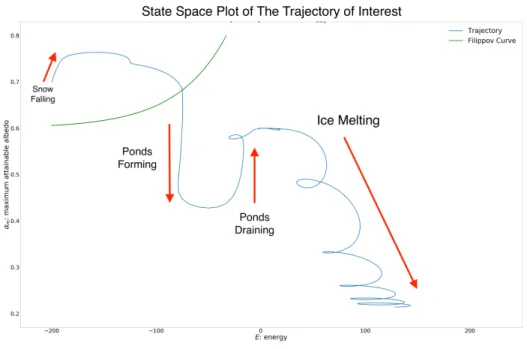
we choose the boundaryH = 0to simply be where the albedo of the systemα(E, αm)crosses the α= 0.6threshold. Figure 2.2 is a plot of a state space trajectory of the system, with initial condition E = −200, αm = 0.7and parameter valueFCO2 = 60. It gives an example of how the system
behaves.
• In cold conditions, the system is at the left top part of the state space shown in Figure 2.2,
whereα(E, αm) > 0.6. When the energy is largely negative, the logistic model term with the energy in the numerator dominates in Equation (2.3), and the maximum attainable albedo
Figure 2.1: The state space trajectory that we use in data assimilation experiments.
falling. The initial rise from0.7towards0.8in Figure 2.2 illustrates to this process. When the energy is close to zero, the term with the energy in the denominator (with the addition of 1 to
avoid singularities atE = 0) dominates, andαmapproaches0.6, which is not apparent from Figure 2.2. As the system’s energy keeps increasing, it crosses the boundary between the two
parts of dynamics.
• In warm conditions, the system is at the center part of the state space shown in Figure 2.2,
whereα(E, αm) <0.6. The rate thatαm approaches0.2is faster when the energy is away from0whereas the rate to approach0.6is faster when the energy is near0. As a result, we take the energy to be in the denominator for the logistic model with a carrying capacity of
0.6and the energy in the numerator for the logistic model with a carrying capacity of0.2 Equation (2.4). In Figure 2.2, we can see that right after the system crosses the boundary,αm
is rapidly driven towards0.2, representing the process of ponding. When energy is higher, the ice becomes permeable, and melt pond drainage exposes the surface of the ice again, causing
Figure 2.2: Trajectories with various initial points whenFCO2 = 0.
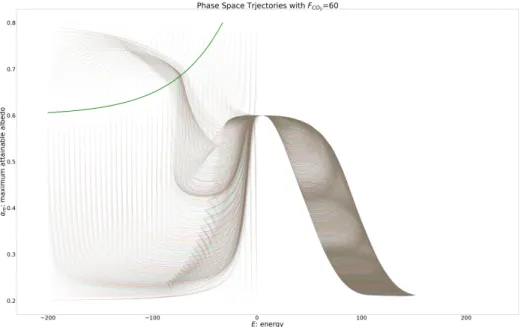
Figure 2.2 and Figure 2.2 plot the boundary curve and trajectories from various initial points
in the state space with different values of FCO2, respectively. When the value ofFCO2 is small,
as in Figure 2.2 whereFCO2 = 0, the energy of the system stays negative, whereas whenFCO2
is sufficiently large, as in Figure 2.2 whereFCO2 = 60, the states that start with negative energy
will cross zero and become positive. In our data assimilation experiments, we will focus on one
particular trajectory of interest, the one with initial conditionE=−200,αm = 0.7and parameter valueFCO2 = 60. The aforementioned Figure 2.2 plots this trajectory along with the boundary curve
separating the two parts of the dynamical system.
In terms of discrete time sequential data assimilation, the state variable is a two dimensional
vector defined by
x= (E, αm) (2.6)
The model Min Equation (1.1) is therefore defined by integrating the ODE Equation (2.3) or
Equation (2.4) in time
M(xt, t) =
Z (t+1)∆τ
t∆τ
dx
Figure 2.3: Trajectories with various initial points whenFCO2 = 60.
where ddtx = (dEdt,dαm
dt ), and∆τ is the time step in data assimilation. In our study, all the ODE’s are numerically integrated using the Matlab programdisode45(Calvo et al., 2016) with its default
settings (the major algorithm parameters include absolute error tolerance10−6 and relative error tolerance10−4).
2.3
Proxy for Ice and Pond Concentration and Satellite Radiances
As mentioned in Section 1.2.3, for our particular problem, we need to define from our state variables
E andαm proxies for other physical quantities of interest, including ice and pond concentration
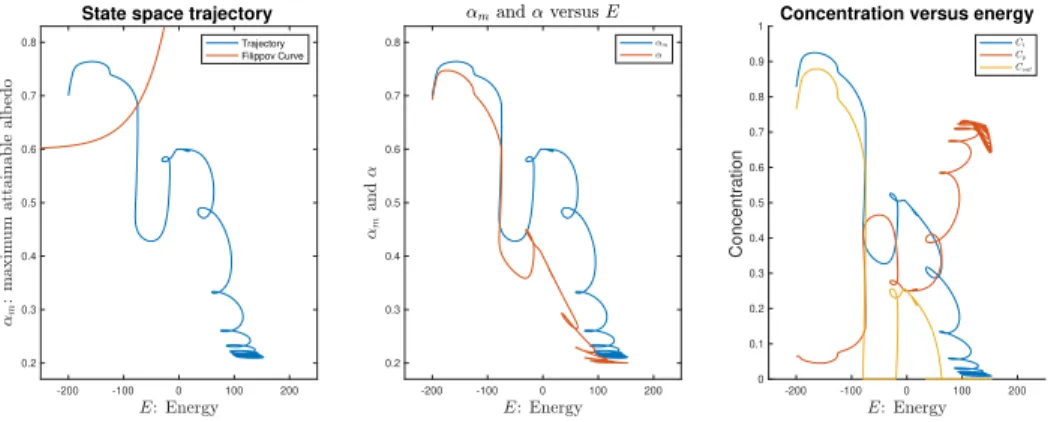
values, the satellite radiances, and satellite-retrieved ice concentration. In Equation (2.8) We define
the concentration of iceCito be the one minus the percent difference between the physically highest
attainable albedo of0.8and the average of the maximum attainable albedo and the current albedo. The concentration here would approach 1 when the system is in a very cold state and the average is
-200 -100 0 100 200 0.2 0.3 0.4 0.5 0.6 0.7 0.8
State space trajectory
Trajectory Filippov Curve
-200 -100 0 100 200
0.2 0.3 0.4 0.5 0.6 0.7 0.8
-200 -100 0 100 200
0 0.1 0.2 0.3 0.4 0.5 0.6 0.7 0.8 0.9 1 Concentration
Concentration versus energy
Figure 2.4: Overview of the proposed proxy for the melt pond problem in sea ice concentration retrieval.
Ci(E, αm) = 1−
0.8−12(αm+α(E, αm)) 0.6
!
(2.8)
The pond concentration is defined as one minus the ratio of the current albedo to the maximum
surface albedo. The idea here is that a low albedo at timetcompared to the maximum attainable
albedo should mean the surface is covered in ponds.
Cp(E, αm) = (0.5 tanh(
E+ 200
10 ) + 0.5)(1− 0.2 α(E, αm)
)1000(1−αm
0.8) (2.9)
For the satellite retrieved concentration, to model the fact that the melt ponds obscure the
microwave signature of the ice and thus melt ponds and open water are indistinguishable in terms of
satellite radiances as mentioned in Section 1.2.2, we take the maximum of zero and the difference
between ice concentration and pond concentration.
Csat(E, αm) = max(0, Ci(E, αm)−Cp(E, αm)) (2.10)
Figure 2.3 plots the quantities of interest as they change with the state variables on the trajectory
shown in Figure 2.2 in the state space. Figure 2.3 gives plots of the time evolution of quantities of
interest.
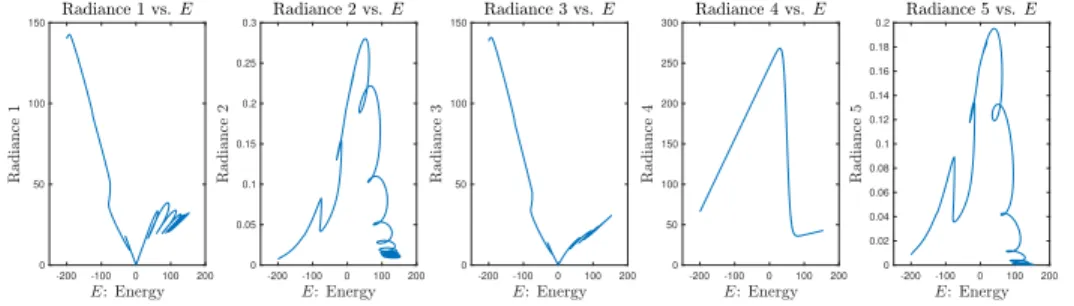
Finally, for the satellite radiances, we define functions of the state variables that give non-unique
0 5 10 15 20 -200 -150 -100 -50 0 50 100 150 200
0 5 10 15 20
0.2 0.3 0.4 0.5 0.6 0.7 0.8
0 5 10 15 20
0 0.1 0.2 0.3 0.4 0.5 0.6 0.7 0.8 0.9 1
Figure 2.5: Overview of the proposed proxy for the melt pond problem in sea ice concentration retrieval.
-200 -100 0 100 200
0 50 100 150
-200 -100 0 100 200
0 0.05 0.1 0.15 0.2 0.25 0.3
-200 -100 0 100 200
0 50 100 150
-200 -100 0 100 200
0 50 100 150 200 250 300
-200 -100 0 100 200
0 0.02 0.04 0.06 0.08 0.1 0.12 0.14 0.16 0.18 0.2
Figure 2.6: The proxy for satellite radiances versus energy.
change with the state variables on the trajectory shown in Figure 2.2 in the state space. Figure 2.3
gives plots of the time evolution of the five radiances.
O(E, αm) =
|Eαm|
αm−α(E, αm) α(E, αm)|E|
(0.5 + 0.4 tanh(5010−E))(E+ 273.15) Ci(1−α(E,ααmm))
(2.11)
2.4
Problem of Using Satellite Retrived Concentration in DA
In terms of data assimilation, if we assimilate with the satellite retrieved concentration, the real
0 5 10 15 20 0
50 100 150
Radiance 1 vs. Time
0 5 10 15 20 0 0.05 0.1 0.15 0.2 0.25 0.3
Radiance 2 vs. Time
0 5 10 15 20 0
50 100 150
Radiance 3 vs. Time
0 5 10 15 20 0 50 100 150 200 250 300
Radiance 4 vs. Time
0 5 10 15 20 0 0.02 0.04 0.06 0.08 0.1 0.12 0.14 0.16 0.18 0.2
Radiance 5 vs. Time
Figure 2.7: The proxy for satellite radiances versus time.
be the actual satellite retrieved ice concentrationCsat as a function ofEandαmin Equation (2.10)
Hsat(x) =Hsat(E, αm) =Csat(E, αm) = max(0, Ci(E, αm)−Cp(E, αm)) (2.12)
However, since we think it is supposed to give the correct ice concentration, the observation operator
Hretrievalthat is used to produce forecast outputyfti in Equation (1.1.2) and Equation (1.13) would be
the ice concentrationCi(E, αm)as a function ofEandαm in Equation (2.8)
Hretrieval(x) =Ci(E, αm) = 1−
0.8−12(αm+α(E, αm)) 0.6
!
(2.13)
In this case, there is a systematic bias betweenHsat andHretrieval. As discussed in Section 1.1.2, the apparent error in our knowledge about the observation operatorHcould create severe problems
in EnKF, and thus assimilate wrong information into our state estimate. Therefore, we propose to
assimilate directly on satellite radiances with machine learned observation operator. In that case, our
observation space is no longer the1-dimensional space of ice concentration, but the5-dimensional space of the satellite radiances. The real observation operatorHwould be
H(x) =H(E, αm) =O(E, αm) =
|Eαm|
αm−α(E, αm) α(E, αm)|E|
(0.5 + 0.4 tanh(5010−E))(E+ 273.15) Ci(1− α(E,ααmm))
While we do not have information of the specific form of the five functions in Equation (2.14)
that make upH, we aim to find with machine learning a functionHML ∈C(R2,R5)that closely approximatesH, that is
HML≈ H or H(xt, t)− HML(xt, t) =ξt (2.15)
whereξtis ideally an i.i.d sequence with0mean and small variance. In this way, although there is still an error betweenHMLandH, the systematic bias present in the case ofHsatandHretrievalis gone.
Ifξtdoes behave like an i.i.d sequence with0mean and small variance, we can incorporate this error as part of the uncertaintytin the forecast model in Equation (1.1) or as part of the uncertaintyηtin
the observation in Equation (1.2).
• In Equation (1.1.2), HML would be used to calculate {yfti} i=q
i=1, which are further used to
estimate the Kalman gain. Without explicitly quantifying the error in the approximation of
HMLtoH, we could think of this error as coming from the ensemble states{xfti} i=q
i=1instead
of from HML, since both uncertainty in {xfi
t } i=q
i=1 and HML could could contribute to the
uncertainty in{yfi
t } i=q
i=1. We will discuss this perspective in more details in Section 4.3.
• Furthermore, in Equation (1.13), each ensemble member is updated with the Kalman gain
and the difference between the observation and forecast output, whereHMLis used in place
ofHin the equation. Here we could consider the uncertainty brought byHMLas part of the uncertainty in the observationsyt.
yt− HML(xfti) =yt− H(xt, t) +ξt=ηt+ξt (2.16)
Originally, the observations are perturbed byN(0,Rt)in Equation (1.14) to account for uncer-tainty. Here we could account for this increased uncertainty fromHMLby first appropriately
estimatingξtand further perturbing the observations accordingly. This is discussed in more
CHAPTER 3
Methods
3.1
Data Generation
To generate a data set for the training of machine learning observation operators, we first select points
from the state space asX, calculate the corresponding radiancesY, i.e. observations, and finally add
error to the observations to getY˜.
state space points The first data set we generate isDtraj. To mimic the situation in the real world,
we decide to use points on various trajectories in the phase space to formXtraj. From the model’s
formulation, the maximum attainable albedoαmis only meaningful between0.2and0.8, and the region of interest forE is between−200to0. Therefore,20×30uniform grid data points from S = [−200,0]×[0.2,0.8]are chosen as initial conditions. Figure 2.2 and Figure 2.2 are in fact generated with such initial values withFCO2 = 0andFCO2 = 60, respectively. Note that in our
dynamical system Equation (2.3) and Equation (2.4), the forcing parameterFCO2 is also of interest.
The real world analogy ofFCO2 would be the combined influence of total carbon dioxide emissions,
different weather conditions, climate changes, and etc. Thus we should expect various values of
FCO2 in the data set. To capture this effect, we generate trajectories with12values ofFCO2 ranging
from−10to100. The model is run for200time steps with a step length of0.05for each initial condition and each value ofFCO2, resulting in2400trajectories and1440000data points. From the
data points,Ytraj=H(Xtraj)are calculated and noises are added to giveY˜traj.XtrajandY˜trajform the
data setDtraj= (Xtraj,Y˜traj).
grid data points From Figure 2.2 and Figure 2.2, we can see that in places where the limit cycles
exist, the trajectories are clustered and the data is dense in that region, whereas in places where
Section 3.3.1, such imbalance creates a problem for the machine learning algorithm. To fully exploit
the potential of the machine learning algorithm to fit the satellite radiances, we also generate a data
set with the unrealistically large amount of data filling up the whole state space.2000×3000uniform grid data points fromS = [−200,0]×[0.2,0.8]are chosen to formXgrid. From the data points,
Ygrid=H(Xgrid)are calculated and noises are added to giveY˜grid.XgridandY˜grid form the data set Dgrid = (Xgrid,Y˜grid).. We expect that with sufficient data, the machine learning algorithm should
perform well everywhere in the state space.
observations and error The observations are calculated for each of the generated data points with
Equation (2.11). In the real world, the data is never perfectly clean, so it is important to add error in
the observations. Moreover, the machine learning algorithms are expected to average out the white
noise error and learn the true pattern behind the noises. Note that the five radiances have different
magnitude scales, radiance 1,3,4 are of∼101while radiance 2,5 are of∼10−2. We initially did not take such effect into account and add the same errorN(0,1)to all five radiances. Experiments showed that machine learning algorithms were not able to learn anything about radiance 2,5. We also
tried to add error proportional to the value of each radiance at each point. However, this approach
created a problem for values near0, in which case essentially no error is present. Our final approach is adding error proportional to the mean absolute value of each radiance.
¯ yj =
n
X
i=1
|yij| (3.1)
˜
yij =yij +ηij (3.2)
ηij ∼ N(0, λ¯yj) (3.3)
whereλis a control parameter for the magnitude of the error. We generate 7 datasets withλ ∈
{0,0.1,0.2,0.3,0.4,0.5,0.6}to investigate how error affects machine learning algorithms. In data
3.2
Model Training and Selection
Since we construct the function for satellite radiancesHin a highly nonlinear manner, we decide to
use the artificial neural network (ANN) as the machine learning algorithm. Other algorithms such
as XGBoost and Random Forest are also worth experimenting in the future. We split the data set
randomly into90%for training and validation, and10%for evaluation. We also exclude from the training set the points on the trajectory that we will use in the DA experiment to avoid overfitting. The
training-validation set is further split into the training set and validation set. We choose hyperbolic
tangenttanhas the activation function in hidden layers. We add batch normalization (Ioffe and Szegedy, 2015) before each hidden layer and dropout (Srivastava et al., 2014) after each hidden layer
to regularize the network and prevent it from overfitting. All parameters are initialized using Xavier
initialization (Glorot and Bengio, 2010). The network is trained with Adam optimizer (Kingma
and Ba, 2015). Hyperparameters are chosen based on 9-fold cross-validation. The network is
implemented in Python with Keras framework using Tensorflow as backend. After experiments, we
choose four layers to get our architecture shown in Figure 3.2. The machine learning model can be
written as a composed function in Equation (3.4)
y=xout=W4(tanh(W3(tanh(W2(tanh(W1xin+b1)) +b2)) +b3)) +b4 (3.4)
wheretanhis the element-wise hyperbolic tangent function,W2,W3,W4 are5×5matrices,W1 is a5×2matrix andb1,b2,b3,b4are5-dimensional vectors. The total number of parameters is105. The parameters are determined by the optimization algorithm.
3.3
Evaluation
To examine the accuracy of the prediction model, two evaluation measures are used in this study:
Figure 3.1: Graphical representation of the proposed machine learning model. as: RMSE= v u u t 1 nm n X i=1 m X j=1
(yij0 −yij)2 (3.5)
MAPE= 1 nm n X i=1 m X j=1
yij0 −yij yij (3.6)
whereyijis thejth feature of theith sample,yij0 is the predicted value of the correspondingyij.
Figure 3.3 plots the points on the trajectory that we will use in the DA experiment and the
corresponding values of radiance 1,2,4 on those points. Figure 3.3 is a larger illustration of the lower
left plot of Figure 3.3. The figures compare the values given by machine learning algorithmHML(X) with the truthYand the noisy training dataY˜ withλ= 0.4. In most places, the machine learning values overlap with the truth and give reasonable values in general. Particularly, it seems that machine
learning is able to average out the noise and discover the real pattern in the data. In the lower middle
plot of the 4th radiance value, even though the noise in the training data is disproportionately large,
our machine learning model is still able to recover the true values behind the noise. In fact, through
experiment, we found out that, with appropriate techniques and sufficient data, machine learning is
Figure 3.2: The performance of machine learning observation operator evaluated on one trajectory.
machine learning modelHˆMLtrained with a large amount of data is almost perfect, as we expected.
The plot is not shown since the machine learning values virtually overlap with the truth everywhere.
In some sense, we can safely say that the machine learning algorithm fit the function perfectly and
should be identical as and indistinguishable from the true functionH. The accuracy ofHMLand ˆ
HMLsatisfies our assumption in Equation (2.15) that the error in the machine learned observation
operator should be white noise with zero mean and small variance.
3.3.1 Data Density
Although in general machine learning achieves a high level of accuracy, HML displays different levels of error in different parts in the state space. It is well known that the amount of available
training data is a significant factor in determining the performance of machine learning algorithms.
In our study, since we generate data with trajectories forHML, the data points are not uniformly
distributed spatially. In regions where the system achieves equilibrium states and where limit cycles
exist, the data points are clustered together and we therefore have a large amount of data to train
the machine learning algorithm. In regions where the system goes through transient states, the data
points are sparse and we have a limited amount of data to train the machine learning algorithm. The
experiments show correlation between the accuracy and the amount of available training data, or data
Figure 3.3: Time evaluation of the 1st radiance, true value, noisy value and ML fitted value.
expected error in different regions, we divide the state space into45×30uniform grids, with each grid square representing10units in energyEand0.02unit in maximum attainable albedoαm. In each grid square, we sum up the number of data points in the training data (and then take logarithm)
to represent the data density in this square region. We take the averaged RMSE of all the values in
the grid square to serve as the expected error estimation in that region. Figure 3.3.1 is a heat map
plot of the density in the grid regions, where the color bar represents the logarithm of the number of
available data points in each grid. Figure 3.3.1 is a heat map plot of the expected error in the grid
regions, where the color bar represents the averaged RMSE.
From the plots, we can see the correlation between data density and error. The darker blue colors
in Figure 3.3.1 roughly correspond to the lighter green-yellow colors in Figure 3.3.1. In particular,
for the equilibrium states, where sufficient training data exists, our model tends to perform quite well,
whereas for the transient state, where training data is extremely sparse, the values given by machine
learning does not make much sense. As previously described in Section 2.4 and Equation (2.15), we
expect the difference betweenHMLandHto be an i.i.d. sequence with 0 mean and small variance.
issue in data assimilation, we considerξas a function of the state variablesEandαm, and estimate
ξ(E, αm)with the averaged RMSE error and data density in the corresponding grid square. Then we apply appropriate covariance estimation and inflation. The details are discussed later in Section 4.3.
3.3.2 Training with Sparse Data
As discussed above, data density plays a significant role in determining the accuracy of the machine
learning algorithm in different regions in the state space. In the real world, different regions of the
state space represent different physical configurations of the system. It is completely possible that
the current states of the system are rarely seen in the past and thus the machine learning algorithm
does not have sufficient historic data to learn the behavior of observation operator in such situation.
To further investigate the influence of sparse training data in the region of interest, we generate
another two data sets, where we have limited training data in a certain region, and train another two
machine learning observation operator with these data sets respectively. We are most interested in
the regionS = {(E, αm) : E ∈ [−50,50]}, shown in Figure 3.3.2 as the shaded region, where the energy crosses zero and the interesting dynamics corresponding to pond forming and draining
happens. From the data set Dtraj, we randomly drop95% (70%, respectively) of the data from
Xtraj in the regionS and the corresponding observations from Y˜traj to significantly decrease the
amount of available training data in that region. The resulting data sets areD5%= (X5%,Y˜5%)(and
D30% = (X30%,Y˜30%), respectively).
After training our neural network withD5%andD30%, we get two machine learning observation
operatorsH5%andH30%. They are again evaluated and analyzed with the same methods described
in Section 3.3. Figure 3.3.2 compares the original data density of Dtraj and the data density of
D5%after dropping95%data inE ∈[−50,50]. Figure 3.3.2 compares the accuracy ofHMLand
H5%. There is a clear boundary in both figures - inside the regionSwhere data is dropped, data is
apparently sparser and the error is significantly larger than outside the region. We can clearly see that
Figure 3.6: Drop out data in the shaded region of interest.
CHAPTER 4
Experiments
4.1
Setup
In this chapter, we test our machine learning observation operator in the data assimilation scheme.
The state variable in the experiment isx= [E, αm]. The model that evolves the states in timeM is defined by Equation (2.3) and Equation (2.4). To focus on the observation operator, we adopt
the perfect model assumption in our experiment, i.e. assume we know the true model and exclude
any model error from our experiment. Therefore the forecast model dynamics is the same as the
true dynamics. The time step is set as0.05, which roughly corresponds to 18 days in the physical sense, allowing us to see the seasonal effects brought by the seasonally varying terms in the model
FT(t),F0(t), andFs(t). The experiment lasts for200steps, i.e. 10years, after which no further interesting behaviors can be observed from the experiments. The true observations are generated by
Equation (2.11) in most experiments and by Equation (2.10) in the experiment withHretrieval. We
assume that the observations are available at every timet. We also add noise to the true observations
the same way we add error to the training data in Equation (1.1.2), Definition 3.2, and Definition 3.3,
withλ= 20%. Data assimilations are done at every integration timetn. The analysis error is defined as thel2norm of the difference between the true value and the analysis.
The true initial condition isx0= [0.7,−200], i.e.E0 =−200andαm0 = 0.7, withFCO2 = 60,
from which Figure 2.2 is generated. The initial ensemble mean is a perturbed value from the true
initial condition:
¯
xf0 =x0+N(0,
0.12 0 0 40
The initial spread is defined as
Pf0 =
0.12 0 0 40
The size of the ensemble is taken as 100. Through experiments, we found that a larger size
of the ensemble does not provide a proportionate improvement in performance. 100 seems a
computationally reasonable size for our experiment.
4.2
Choices of Observation operators
We conduct two parts of experiments consisting of several runs of identical twin experiment with
ensemble Kalman filter, using different observation operators, in order to show the different
perfor-mance of EnKF with assimilating the incorrect information from satellite retrieved ice concentration
and with assimilating directly the satellite radiances.
In the first part, the observation space isR, and the observations are real numbers representing the satellite retrieved ice concentration generated withHsat, defined in Equation (2.12), while the
forecast outputyfi
t are generated withHretrieval, which givesCi as the supposed satellite retrieved value defined in Equation (2.13).
In the second part, the observation space is R5, and the observations represent the satellite radiances generated withHdefined in Equation (2.11). We experiment with several machine learning
observation operators to generate the forecast output:
• HML: Machine learning observation operator trained onDtrajdescribed in Section 3.1,
con-sisting of various trajectories from different initial points with various values ofFCO2.
• HˆML: Machine learning observation operator trained onDgriddescribed in Section 3.1,
con-sisting of an unrealistically large amount of data filling up the whole state space.
• H5%: Machine learning observation operator trained onD5%described in Section 3.3.2, with
5%data inE ∈[−50,50]for training
• H30%: Machine learning observation operator trained onD30%described in Section 3.3.2,