ISSN Online: 2333-9721 ISSN Print: 2333-9705
DOI: 10.4236/oalib.1105429 Aug. 28, 2019 1 Open Access Library Journal
Approximation to the Composition and
Biodiversity of Saltlicks Forest for Two
Indigenous Communities in the Colombia
Amazonas Trapeze
1
Ana Maria Monsalve-Cuartas
1, Francisco Castro Rego
2, Ignacio Sanchez
31University of Lisbon—Higher Institute of Agronomy (ISA), Lisboa, Portugal 2Higher Institute of Agronomy (ISA), Lisboa, Portugal
3Francisco Jose Caldas District University, Bogotá, Colombia
Abstract
Tikuna and Uitoto indigenous communities believe that Saltlicks are sacred natural spaces (SNS) in the Amazon Rainforest, health and nutrition spaces of important species of fauna, especially mammals and birds. The perception, knowledge, use and spiritual management of saltlicks under the values of these indigenous communities help the conservation of more than 130 species of flora identified in forest inventories in saltlicks. The purpose of this article is to identify the composition and biodiversity of the forest in a sample of 11 saltlicks (6 in the TICOYA Resguardo2 in the San Martin de Amacayacu (SMA)3 area, Tikuna community, and 5 in RITU Resguardo, LosKilometro-sarea, Uitoto community), recognizing genres (or species when were possible) and frequently botanical families. The data were obtained through field work with forest inventories by transects of 4 × 50 meters made in the years 2015, 2016 and 2017, with help of guides and knowledgeable flora elders from both communities. As a conclusion, the saltlicks samples in both Resguardos have
1This article is part of the thesis developed of the SUSFOR Doctorate Program for the University of
Lisbon—Higher Institute of Agronomy (ISA) with the title “Sacred Natural Places in the Tropical Forest, case study saltlicks in territories of indigenous communities” Tikuna and Uitoto (Colombia Amazon Trapeze).
2Legal and sociopolitical institution of a special nature, made up of one or more indigenous
com-munities. With a collective property title enjoys the guarantees of private property, owns its territory and is governed, for the management of this and its internal life, by an autonomous organization protected by the indigenous jurisdiction and its own normative system. (Article 21, decree 2164 of 1995).
3In the text SMA is San Martin de Amacayacu.
How to cite this paper: Monsalve-Cuartas, A.M., Rego, F.C. and Sanchez, I. (2019) Approximation to the Composition and Biodiversity of Saltlicks Forest for Two Indigenous Communities in the Colombia
Amazonas Trapeze. Open Access Library
Journal, 6: e5429.
https://doi.org/10.4236/oalib.1105429
Received: April 25, 2019 Accepted: August 25, 2019 Published: August 28, 2019
Copyright © 2019 by author(s) and Open Access Library Inc.
This work is licensed under the Creative Commons Attribution International License (CC BY 4.0).
DOI: 10.4236/oalib.1105429 2 Open Access Library Journal high biodiversity and richness indices. More than 130 species of trees and palms were identified in 90 genres and 30 botanic families. The families in the saltlicks samples with more number of trees or palms are Fabaceae, Arecaceae and Lecythidaceae. In the 6 saltlicks of SMA, 28 families with 59 genres were identified. The families with more individuals are Arecaceae, Fabaceae and Myristicaceae. In the 5 saltlicks of Los Kilometros, 30 families with 67 genres were identified. The families with more number of trees are Arecaceae, Faba-ceae and LecythidaFaba-ceae. This information contributes to the knowledge of the saltlicks forest and helps the recognition and conservation of their flora.
Subject Areas
Environmental Sciences
Keywords
Trees Species, Saltlicks, Amazon Rainforest, Tikuna and Uitoto Ethnic Groups, Biodiversity, Composition, Colombia
1. Resumen
Para las etnias indígenas Tikuna y Uitoto, los salados son espacios naturales sa-grados ubicados dentro de la Selva Amazónica. Su percepción, conocimiento, gestión y manejo espiritual ayuda a la conservación de más de 130 especies de flora identificadas en inventarios realizados en los salados.
El objetivo de este estudio fue analizar la composición y biodiversidad de la comunidad forestal en una muestra de 11 salados (6 salados en el resguardo TICOYA sector de San Martin de Amacayacu—etnia Tikuna, y 5 salados en el resguardo RITU sector los Kilometros, etnia Uitoto), reconocer los géneros (o especies hasta donde fue posible) y familias botánicas frecuentes. La información necesaria se obtuvo a través del trabajo de campo con inventarios realizados por medio de transectos de 4 × 50 mts en los años 2015, 2016 y 2017, con la ayuda de conocedores de flora de ambas comunidades.
Se concluye que la muestra de salados presenta índices de biodiversidad y ri-queza altos. Se identificaron más de 130 especies de árboles y palmas en 90 géneros y 30 familiasbotanicas. Las familias con mayor número de individuos identificados son Arecaceae, Fabaceae, y Lecythidaceae.
En los 6 salados de SMA, se identificaron 28 familias con 59 géneros. Las fa-milias con mayor número de individuos son fafa-milias Arecaceae, Fabaceae y My-risticaceae. En los 5 salados del sector los Kilometros, se identificaron 30 familias con 67 géneros. Las familias con mayor número de individuos son Arecaceae, Fabaceaey Lecythidaceae.
Esta información contribuye al conocimiento de la flora arbórea de los salados y ayuda al reconocimiento y conservación de sus comunidades de flora.
Tiku-DOI: 10.4236/oalib.1105429 3 Open Access Library Journal na y Uitoto, biodiversidad, composición.
2. Introduction
According to [1][2] and [3] one of the most important ways of conservation based on culture has been the identification and protection of sacred natural sites (SNS), which frequently have a valuable biodiversity; as well as these sacred natural places protect key ecosystems and heritage landscapes. Indigenous local and traditional cultures, with their respective worldviews, created protected areas before the beginning of Yellowstone National Park, which turned out to be the model used for the current legislation, policy and practices for protected areas. Sacred Natural Sites are therefore, the oldest protected areas on the planet.
SNS, are water or land areas with a special spiritual significance for native people and communities. These SNS can be perceived in a variety of scales. It can be a single tree or a rock formation and extend to an entire forest and mountain. In some cases whole landscapes are considered by one community or by several, as being sacred, containing within even more sacred centers. as in-formed [1] and [3] and Suchis the case of the Sierra Nevada de Santa Marta, the territory of the Yurupary Jaguars and the Sibundoy Valley in Colombia [4] [5] [6].
For many indigenous communities in Colombia, SNS are areas where nature connects with the greater consciousness and universe, where the collective or in-dividual memories are reunited in meaningful ways. SNS can be home of deities, natural spirits and ancestors [7]. They are important sites of reference for the cultural identity of a clan, a tribe or a community. See too [8] and [9]. These places are marked in the topography creating territorial references, which in the Amazonas context are identified as saltlicks, cananguchales, morichales, varil-lales, hills, rivers, lakes, lagoons, waterfalls. As confirmed by [10][11].
Saltlicks are part of sacred places or places with spiritual owner, appointment, history or special. These Spiritual Owners personify all the knowledge that al-lows the harmonious management of the ecosystem (ecosophy). As discussed in [12] and [13]. For Uitotos and Tikuna, saltlicks are the Malokas of the Jungle Owners, who are non-human beings with whom the Chaman negotiates the access to natural resources, food disease healing and ritual elaboration. See too [14] and [11]. The spiritual management of the saltlicks allows the regulation and balance the use of this biocultural heritage. See Figure 1.
DOI: 10.4236/oalib.1105429 4 Open Access Library Journal Figure 1. Saltlick drawing by Ignacio Sanchez (2017).
reproduction and [17][18]. In the scientific literature saltlick are named as min-eral licks, claylicks, natural licks, minmin-eral springs, colpas, canama, salgados, sa-lados.
Numerous sacred sites in Colombia are now in danger and suffer from a wide variety of pressures and threats: illegal logging, wildlife extractive industry oper-ations, use and usurpation by outsiders; disrespectful tourism; poverty; margi-nality and high dynamics of their populations due to external pressures; degra-dation of surrounding environments; reduction of land and resource availability for indigenous communities [3][7][19][20].
There are few studies that have approached the state of the structure, compo-sition and richness of the forest saltlicks in the Colombia Amazonas Trapeze. The purpose of this article is to give an approximation of the structure, biodiver-sity and composition of a sample of saltlicks in two Resguardos in the Colombia Amazonas trapeze.
3. Context and Methodology
3.1. Colombia Amazon Trapeze and Its Resguardos
The Amazonas region in Colombia is political conformed by 6 departments with a total area of 40,494,267 Ha, and a population of approximately 1,000,000 inha-bitants. This region represents nearly10% of the Amazon basin, covering 43% of the Colombian territory, and has 80% of the area within the tropical humid fo-rests (Bht). Its annual precipitation ranges between 2500 and 4000 cubic milli-meters per year, with a 30˚C average temperature and a relative humidity that rises up to 80%. Along the year laps there are two periods of rain, an intense one in the months of January and February and one of less intensity during Septem-ber and DecemSeptem-ber [18][21][22].
(Colom-DOI: 10.4236/oalib.1105429 5 Open Access Library Journal bia), it borders on the north with the Putumayo River, on the south by the Amazon River. To the east on the border line with Brazil from Tarapacá to Leti-cia, and to the West on the borderline with Peru from the Yaguas river in the Putumayo to the Atacuari River in the Amazon. In this area are located the Pu-tumayo River with its main tributary, the Cotuhé, and the Amazon river with its tributaries Uassú, Atacuari, Loretoyacu and Amacayacu. The Amazon trapeze comprises the Municipalities of Leticia and Puerto Nariño. In terms of the native population, there are the indigenous communities of Tikuna, Cocama, Yagua, Ui-toto, Muinane, Tanimuca who’s people inhabit in several Resguardos [19][21].
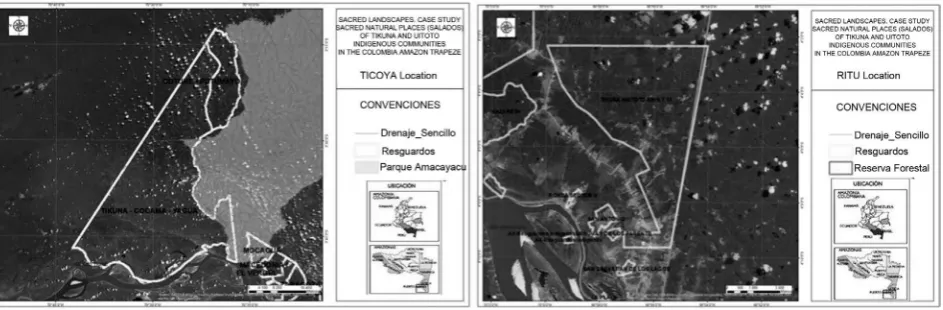
The Tikuna community extends from the Atacuari River between Colombia and Peru up to the Jutaí River in Brazil. In Colombia they occupy the entire Amazon trapeze with a population of 8.000 people. They share a “unique” lan-guage, with three dialects and live mainly on the banks of the Amazon River. They practice tomb and burning horticulture (chagras), fishing, hunting and tourism activities for income. Its Resguardos are: San Antonio de los Lagos, San Sebastián, El Vergel, Macedonia, Mocagua, San Martin de Amacayacu and Co-thué-Putumayo, in the Department of Amazonas. More information consult [10][18][23]. See the location in Figure 2.
The Uitoto community (the Sons of Tabaco, coca and sweet yucca), live in the Colombo-Peruvian Amazon. The main settlements are located in the Igarapa-raná and Carapararana rivers, in the Caquetá River middle courses, and in some Peruvian localities. At the end of the first third of the last century, no more than three thousand Uitotos survived to the ethnic elimination and genocidal action of rubber companies—domestic and foreign-forcing the displacement of many of them to the Amazonas trapeze. At present there are about 6000 Uitotos in Colombia [10] [24][25]. In the Amazon trapeze, the Uitotos are located in the Kilometro 6 and 11 in the Leticia -Tarapacastreet (RITU), Arara, San Antonio de los Lagos and San Sebastián.
[image:5.595.65.537.550.705.2]TICOYA Resguardo, has indigenous communities of the Tikuna, Cocama and Yagua tribes, making up a population of 56,201, distributed in 22 communities along the Amazon river and its tributaries the Atacuari, Boyahuasú, Loretoyacu
DOI: 10.4236/oalib.1105429 6 Open Access Library Journal and Amacayacu [19][26]. This Resguardo was created as a conservation area by decree No. 021 of March 13, 1990. The San Martin de Amacayacu community is formed mostly of Tikunas (600 people, according to CuracaMamerto Gregorio 2019).
RITU Resguardo or Los Kilometros, was constituted by resolution of INCORA N˚ 005 of 1986 with an extension of 7560 hectares, and is inhabited by more than 1563 indigenous. They are indigenous people who came from other parts of the Amazon, displaced by violence through Colombian history. The families are made up of two predominant ethnic groups, Tikuna and Uitoto4[19][27].
3.2. Tracing and Inventory Sampling
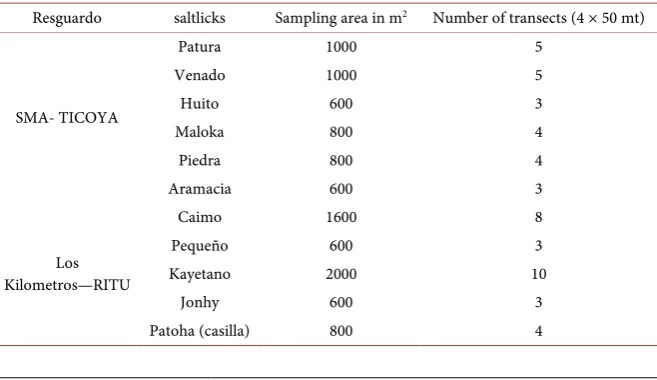
The procedure was developed in three stages. 1) Identification and analysis of relevant information about saltlicks and its flora composition and structure, as-signing particular value to the information on the Tikuna and Uitoto life plans5. 2) Visits and recognition of 11 saltlicks in the years 2015, 2016, 2017, 2019 with the permission and the attendance of a Tikuna family in SMA, and Uitoto indi-genous guides in Los Kilometros. See Table 1. The status and forest structure by inventories was made, and the current management of saltlicks were observed. 3) Analysis of biodiversity indicators, statistical analysis and conclusions.
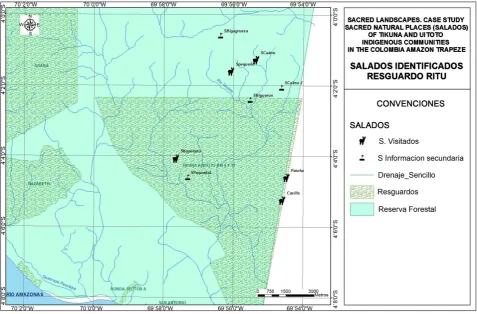
The visit and identification of the 11 saltlicks was carried out with the accom-paniment of indigenous knowledgeable locals (see Table 1). Along with them, was calculated the approximate area to establish transects of (4 × 50 m) with a distance between each transect of at least 60 meters, the guides suggestions were accepted for the location of the transects and interior ways to transit into the sal-tlick, in order to respect the areas of more use of the local animals and the most susceptible areas to human presence as the licking areas. The approximate loca-tion of the saltlicks and some images of its forest component are shown in Fig-ures 3-7.
This research procedure was circular and in permanent redesign due to the social, environmental and access conditions to these areas. The method pro-posed had to be adjusted according to the possibilities of accessibility to such places—the saltlicks, access conditions of the land, permissions granted, availa-ble time of the field guides, climatic state, economic conditions for the displace-ment and paydisplace-ment of guides.
21 transects were recorded along the SMA and 28 transects in the Kilometers see Table 2.
Trees6 with diameters at breast height more or equal to 10 cm were characte-rized; species data (local name) and approximate total height were recorded. See Table 3.
Tree data with their respective identified species were analyzed using the
4For more information look
https://www.youtube.com/watch?v=kBcauPW4rgI&list=LLk4-VFCPgHn_fA7c1SCeF2w&index=7. 5https://www.youtube.com/watch?v=5paJyhf_Flo&index=6&list=LLk4-VFCPgHn_fA7c1SCeF2w.
DOI: 10.4236/oalib.1105429 7 Open Access Library Journal Table 1. Guides and local experts collaborators for saltlicks identification, inventory and information collection. Source: the authors.
Name Place Occupation
Humberto Gregorio—Clan
Cascabel
San Martin de Amacayacu—TICOYA
Hunter, knowledgeable of flora and fauna, local guide, grandfather of the knowledge council of the Tikuna community
Robinson Gregorio—Clan
Cascabel
San Martin de Amacayacu—TICOYA
Guide and knowledgeable about flora and fauna, fisherman and local guide. Tikuna translator José Gregorio—Clan
Cascabel Amacayacu—TICOYA San Martin de Flora knowledge, fisherman and community leader Tikuna
Mamerto Antonio
Gregorio—Clan Cascabel Amacayacu—TICOYA San Martin de Curaca, leader, traslator and local research Tikuna
Antonio Cayetano
Sánchez. Los Kilómetros—RITU
Malokero, grandfather of the knowledge council of the Uitoto community
Nicanor Morales Los Kilometros—RITU
Hunter, knowledgeable of flora and fauna, local guide, grandfather of the knowledge council of the Uitoto community
Walter Torres
Fariratofe Los kilómetros—RITU Hunter, knowledgeable of flora and fauna, local guide, Uitoto
Jesús Vargas Los kilómetros—RITU Hunter, knowledgeable of flora and fauna, local guide, Uitoto
Jesus Negedeka Los Kilómetros—RITU Hunter, knowledgeable of flora and fauna, local guide,
Muinanecommunity
Celimo Negedeka Los Kilómetros—RITU Hunter, knowledgeable of flora and fauna, local guide, Muinane
community
Ignacio Sánchez Los kilómetros—RITU
Forest engineer student Universidad Distrital Francisco Jose de Caldas, Uitoto indigenous research.
Table 2. Forest base information of saltlicks. Source: the authors.
Resguardo saltlicks Sampling area in m2 Number of transects (4 × 50 mt)
SMA- TICOYA
Patura 1000 5
Venado 1000 5
Huito 600 3
Maloka 800 4
Piedra 800 4
Aramacia 600 3
Los Kilometros—RITU
Caimo 1600 8
Pequeño 600 3
Kayetano 2000 10
Jonhy 600 3
[image:7.595.208.537.549.739.2]DOI: 10.4236/oalib.1105429 8 Open Access Library Journal Table 3. Heights and diameters trees classification. Source: the authors.
High in the vertical strata Diameter7 rangers
H1 < 2 m DAP A (10 - 30 cms)
H2 (2 - 10 m) DAP B (30 - 60 cms)
H3 (10 - 20 m) DAP C > 60 cms
[image:8.595.74.538.390.690.2]H4 (20 - 30 m) H5 > 30 m
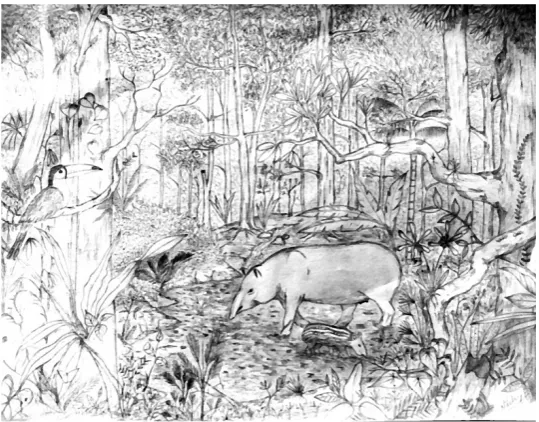
Figure 3. Drawing of a saltlick adapted from [28]. Source: the authors.
Figure 4. Location of the saltlicks visited near of SMA and reported by secondary reports. Source: the authors.
DOI: 10.4236/oalib.1105429 9 Open Access Library Journal Figure 5. Forest cover in the saltlicks of SMA. Source: the authors.
Figure 6. Location of the saltlicks visited near of Los Kilometros village. Source: the authors.
Diversity, Dominance, Equity and Wealth indices described in [29], in order to determine the differences between the saltlicks of each Resguardo. The indices used were:
DOI: 10.4236/oalib.1105429 10 Open Access Library Journal Figure 7. Forest cover in the saltlicks of Los Kilometros. Source the authors.
ln
i i
n n
H
N N
= − ∗
∑
H: is Shannon-Weaver’s diversity index; ni is the number of individuals of each species; N: is the total number of individuals; ln: it is the natural logarithm.
Values between 0 and 1.0 of H indicate slightly biodiverse environments, be-tween 1.0 and 3.0 correspond to moderately biodiverse environments and, of 3.0 or onwards, environments of good biodiversity [29].
2) Simpson’s dominance index (1949)
(
)
(
1)
1i i n n D
N N
− =
−
∑
D: is Simpson’s dominance index; ni: is the number of individuals of each spe-cies; N: is the total number of individuals
The values for this index are between 0 and 1.0. As dominance increases, di-versity decreases.
3) Equity index of Pielou (1966)
( )
ln
H J
S
=
J: is the equity index of Pielou; H: it’s the Shanon-Weaver diversity index; S: is the number of species; ln: is the natural logarithm
This index is between 0 and 1.0, where the value of 0 represents the minimum equity and 1.0, the maximum equity.
4) Margalef’s richness index (1968)
( )
ln
S R
N
DOI: 10.4236/oalib.1105429 11 Open Access Library Journal
R: is Margalef’s richness index; S: is the number of species; N: is the total number of individuals; ln: is the natural logarithm.
If the Margalef index is less than 2.0, is low richness in the environment, if it is between 2.0 and 5.0, there is moderate richness, if it is greater than 5.0, there is great richness in the ecosystem [29].
3.3. Biodiversity Statistical Analysis
Using the SPSS statistical program, the data was analyzed in order to recognize if significant differences between the compositions of the saltlicks in both Res-guardos existed. In total 756 trees were analyzed in 143 taxonomic units at the level of genre and species (when the tree was fully identified).
The univariate analysis tool with the fixed variable Resguardos and saltlick name, and the area of inventory as a covariate, were used to analyze if the de-pendent variables such as number, species, family, genre, diameter (DAP) and height stratum (H) have significant relationships between them.
4. Results
4.1. Saltlicks for Tikuna and Uitoto Communities
The saltlick is a very special place in the jungle to see animals [30]. Under the perception of Tikuna and Uitoto this places are the doors of the Malokas for the animal’s parties (where the animals transformed into men take Masato and dance). The saltlicks are social spaces for humans and non-humans animal (personal communication Gregorio, Morales and Negedeka families, 2015, 2016, 2017).
Saltlicks are composed of two areas8: one area remains most of the time flooded with species of flora adapted to their salt condition; this is where the traces of numerous species of animals are in evidence. The other area corres-ponds to the forest of the mainland. Each saltlick has a dominant species of ani-mal; the area that corresponds to the perimeter forest for each saltlick can oscil-late between 60 and 600 meters from the edge of the water or wet zone. This for-est area is delimited for protection purposes by the indigenous community. In both areas extractive activity of vegetation and hunted are not allowed.
For Tikuna and Uitoto the saltlicks are considered prohibited and/or enc-hanted spaces. Inside them it is prohibited to hunt, collect fruits, eliminate asso-ciated flora, cut trees, and change the land use. They must be entered with the permission of their respective owner. Table 4 gives a definition of these spaces along with others considered sacred for both ethnic groups.
4.2. Saltlicks Forest
DOI: 10.4236/oalib.1105429 12 Open Access Library Journal Table 4. Typology of some natural places of importance for the Uitoto and Tikuna indi-genous communities. Source [21] corroborated in personal communication with the fam-ilies Negedeka, Morales and Gregorio (2015, 2016, 2017).
Natural
Places Concept Location (Uitoto) Location (Tikuna)
Pr
oh
ib
ite
d
Reserved areas. It is not allowed hunting, fishing, collecting, sowing, clearance, deforestation, wood cutting, these sites were inhabited by creators.
Cananguchales, streams, lakes, ponds, mountains, saltlicks, origin sites (chorera place), cemeteries, hills.
Cananguchales, streams, lakes (Chica, largo, Tigre, Julio, Sabalo), mountains, saltlicks, origin sites (Eware river), cemeteries, hills (Bue, Kwapu, Yoyoene, Twirupw).
Bew
itc
hed
It is not allowed to enter without the permission of its spiritual owners, through clean, purification and harmonization rituals.
Cerro del Diablo, Chorro Nofko, cananguchales, streams, rivers, huecadas, lakes, ponds, saltlicks.
Tarapatolake, Amacayacu and Amazonas river, lagarto cocha stream, Mkarepu loma, Bougunelagoon, Moruapu aguajal.
Table 5. Forest saltlicks basic information of SMA and Los Kilometros source the authors.
Resguardo Saltlicks name Tree number Species number Families number
SMA—TICOYA
Patura 63 31 18
Venado 75 37 21
Huito 41 22 17
Maloka 57 29 16
Piedra 46 28 16
Aramacia 54 26 17
Los Kilometros—RITU
Kaimo 120 40 23
Pequeño 52 21 12
Kayetano 176 68 28
Jonhy 29 18 11
Patoha 37 18 12
Kayetano and Kaimo saltlicks (Los Kilometros).
144 species9 of trees were identified in six saltlicks in SMA, and 130 species of trees in the five saltlicks of Los Kilómetros. All the saltlicks have more than 60 genres and 21 families.
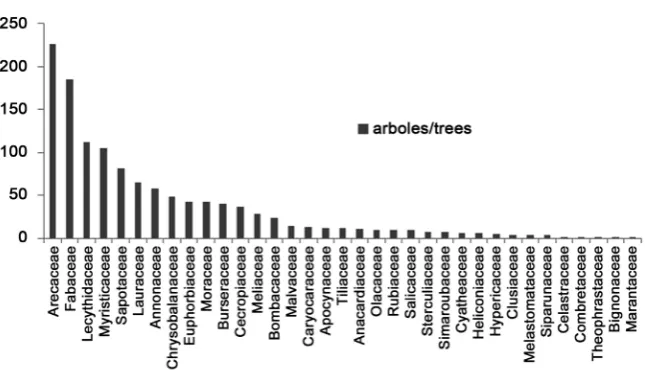
Graph 1 shows a Family summary (botanic families most frequently identi-fied in the saltlicks visited). The frequent families are Fabaceae, Arecaceae and Lecythidacea.
As a complement to Graph 1, in the saltlicks of SMA, 28 families with 59 ge-nres were identified. The 3 families with more individuals are Arecaceae, Faba-ceae and MyristicaFaba-ceae. In saltlicks of Los Kilometros, 30 families with 67 genres
[image:12.595.207.538.338.540.2]DOI: 10.4236/oalib.1105429 13 Open Access Library Journal Graph 1. Botanical families distribution by number of trees in the saltlicks sample. Source: The authors.
[image:13.595.212.535.85.270.2]were identified. The 3 families with more number of individuals are Arecaceae, Fabaceae and Lecythidaceae.
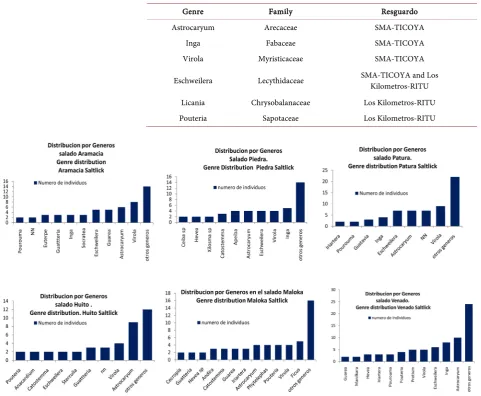
Table 6 and, Figure 8 and Figure 9, show a summary of the botanical genres in saltlicks that have more than one tree in each saltlick and that are present in four or more saltlicks in each Resguardo. Dominating genre was not found in the inventoried saltlicks.
The Eschweilera genre is common in 90% of all the saltlicks in both Resguar-dos, representing between 10% and 12% of saltlicks trees. The Astrocaryum, In-ga and Iryantheragenres, are common in 80% of the saltlicks in SMA. Astroca-ryum is found in different percentages, the highest percentage of these palms is in Huito saltlick with 21%.
The Inga genre and Virolagenre are represented in approximately 10% - 15% of the trees in the saltlicks of SMA. See de following graphics in Figure 8.
In the meantime, Licania and Pouteria genres are frequent in 80% of the sal-tlicks in Los Kilometros, but they do not represent more than 10% of the trees in these saltlicks (Figure 9).
Forest Structure
In both Resguardos, the distribution of the trees according to their diameter, concentrate in the DAP A and DAP B diametric classes10.
In SMA saltlicks, the trees that are in more proportion in DAP A class, were identified in Patura, Venado, Huito and Maloka saltlicks. In DAP B diametric class Piedra and Aramacia saltlicks. In Los Kilometros, the trees that are more in proportion to the DAP A diametric class, were identified in Pequeño, Johny and Patoha saltlicks, and the diametric class DAP B in Caimo and Kayetano saltlicks. See Graph 2 that illustrates the distribution of the diameters for both Resguar-dos.
DOI: 10.4236/oalib.1105429 14 Open Access Library Journal Table 6. Frequent botanical genres in saltlicks. Source: the authors.
Genre Family Resguardo
Astrocaryum Arecaceae SMA-TICOYA
Inga Fabaceae SMA-TICOYA
Virola Myristicaceae SMA-TICOYA
Eschweilera Lecythidaceae SMA-TICOYA and Los Kilometros-RITU
Licania Chrysobalanaceae Los Kilometros-RITU
Pouteria Sapotaceae Los Kilometros-RITU
Figure 8. Botanical genre distribution in each saltlick of SMA-TICOYA. Source: the authors.
For the distribution of tree heights by strata, they occur in more number be-tween strata H3 and H4 (see Graph 3).
In SMA, the trees heights are concentrated in stratum H3 in all the saltlicks. In Maloka saltlick has a few dominance in stratum H4. In Los Kilometros has con-centrate of trees in stratum H3 in Pequeño, Jhony and Kayetano saltlicks. In stratum H4 in Kaimo and Patoha saltlicks.
In the saltlicks samples, the trees do not have big diameters, their heights are concentrated in the middle strata H3 with few trees in the upper strata (H4 and H5). This is explained by the special conditions of humidity and salinity of sal-tlicks, which are reported by several authors. See too [16][17][28][30]. In the statistical analyzes, the tree diameters and heights did not show significant dif-ferences between saltlicks of both resguardos.
DOI: 10.4236/oalib.1105429 15 Open Access Library Journal Figure 9. Botanical genre distribution in percentage in each saltlick of Los Kilometros—RITU. Source: the authors.
Graph 2. Saltlick tree diameters distribution for both Resguardos. Left SMA saltlicks, right Los Kilometros saltlicks. Source: the authors.
Graph 3. Saltlicks heights distribution under methodology parameters. Left SMA sal-tlicks, right Los Kilometros saltlicks. Source: the authors.
DOI: 10.4236/oalib.1105429 16 Open Access Library Journal Figure 10. Venado saltlick in SMA. Source: the authors.
Figure 11. Maloka saltlick in SMA. Source: the authors.
[image:16.595.167.542.520.708.2]DOI: 10.4236/oalib.1105429 17 Open Access Library Journal Figure 13. Caimo saltlick in Los Kilometros—RITU. Source: the authors.
Figure 14. Pequeño saltlick in Los Kilometros—RITU. Source: the authors.
DOI: 10.4236/oalib.1105429 18 Open Access Library Journal
4.3. Statistical Analysis
With the SPSS statistical program, an analysis was done to recognize if there ex-ists a significant difference between the compositions of the saltlicks in both resguardos. 756 trees were used in 143 taxonomic units in a level of genera and species (when the tree was fully identified).
The univariate analysis tool was used with the fixed variable: Resguardos and
Saltlick Name, and the area of inventory as the covariate, to analyze if the de-pendent variables: number, species, family, genera, diameter (DAP) and height stratum (H), have significant relationships between them. According to whit the deriving results (see Table 7), there is a tendency of more number of trees, spe-cies, genera and families in Los Kilometros but statistically it is not significant.
Figure 16 shows the families distribution by percentage in the saltlicks. It was observed that there are not families that represent more than 50% of the trees in each saltlick, so there are not dominant botanical families in the composition of species in the eleven inventoried saltlicks.
Afterwards, the significance of families in the saltlicks was evaluated of both
[image:18.595.206.540.392.466.2]Resguardos. The analysis allowed to conclude that statistically there are no sig-nificant differences in the number of botanical families that have higher number of trees in the saltlicks (see Table 8).
Table 7. Saltlicks statistical analysis composition. Source: the authors.
Saltlicks estimated average RITU estimated average TICOYA P Value statistically significant
Trees 82.8 56.5 0.81 No
Species 32.6 28.8 0.575 No
[image:18.595.207.538.496.735.2]Families 17.2 17.33 0.090 No
Table 8. Families—statistical analysis composition. Source: the authors.
Family estimated average RITU. Saltlicks TICOYA. Saltlicks estimated average P Value statistically significant
Arecaceae 13.5 18.9 0.102 No
Fabaceae 14.3 7.2 0.096 No
Lauraceae 4.5 2.2 0.640 No
Myristicaceae 4.1 10.7 0.096 No
Sapotaceae 6.2 2.5 0.415 No
Lecythidaceae 7.85 7.97 0.999 No
Bombacaceae 2.2 0 0.232 No
Burceraceae 2.9 0 0.154 No
Euphorbiaceae 1.4 0.88 0.575 No
Annonaceae 1.1 2.55 0.488 No
Anacardiaceae 0 1.2 0.544 No
Moraceae 0 1.7 0.450 No
Meliaceae 0 1.85 0.544 No
DOI: 10.4236/oalib.1105429 19 Open Access Library Journal Figure 16. Up: Distribution graphic with principal botanical families in SMA. Down: Distribution graphic with the principal botanical families in Los Kilometros. Source: The authors.
The saltlicks in SMA have more number of trees without any dominant fami-lies in Arecaceae, Fabaceae and Myristicaceae. The saltlicks in Los Kilometros have more number of trees without having dominant families in Arecaceae, Fa-baceae and Lecythidaceae.
In the case of botanical genres, there are not significant differences between the resguardos.
4.4. Biodiversity Indices
The values of the indices for the sample saltlicks in both Resguardos are shown in Table 9, where it can be observed that:
Shanon-Weaver Diversity Index: Venado, Maloka and Piedra saltlicks have a high biodiversity, their index is more than 3.0, while in the other saltlicks, the result are near of 3.0, which indicates that this last saltlick environment is still with good biodiversity but not as highly as the first three.
DOI: 10.4236/oalib.1105429 20 Open Access Library Journal Table 9. Saltlicks indices. Source: the authors.
Resguardo saltlick Index
diversity Dominance Equity richness
SMA—TICOYA
Patura 2.75 0.07 0.88 5.88
Venado 3.28 0.04 0.92 8.24
Huito 2.70 0.07 0.90 5.46
Maloka 3.16 0.03 0.95 7.12
Piedra 3.09 0.03 0.95 7.05
Aramacia 2.78 0.06 0.91 5.52
Los Kilometros—RITU
Caimo 3.22 0.07 0.83 9.70
Pequeño 2.86 0.05 0.92 5.65
Kayetano 3.93 0.02 0.93 13.16
Jonhy 2.76 0.04 0.95 5.52
Patoha 2.76 0.05 0.94 5.34
than 3.0, while the other saltlicks are near 3.0, which indicates that the environ-ments in these saltlicks have a high biodiversity.
Simpson dominance index: the sample shows little dominance of species, this is because the values of this index are close to zero. That is good because indi-cates that in this saltlicks don’t exist dominant species
Pielou Equity Index: In all saltlicks this index is close to 1.0, which indicates that these habitats are equitable for all species.
Margalef’s richness index: The values of this index are more than 5, all these saltlicks have good species richness. The saltlick with a value more than 7 are Venado and Maloka in SMM and Caimo and Kayetano in Los Kilometros.
5. Conclusions
Saltlicks are of great importance for the conservation of animal and tree species with cultural and spiritual use. This approach to the composition and richness of the saltlicks forest community, contributes to the knowledge, management and conservation of their flora communities by Tikuna and Uitoto in both Resguar-dos.
The perception, knowledge and spiritual management of the saltlicks by the indigenous communities Tikuna and Uitoto, help their conservation and the recognition of more than 130 species of flora that help for the health and nutri-tion of numerous species of fauna, especially mammals such as the Tapir ( Terre-strial Tapirus) and the Deer (Mazamsp).
DOI: 10.4236/oalib.1105429 21 Open Access Library Journal the statistical analysis.
In SMA saltlicks (TICOYA), 28 families were identified with 59 genres. The 3 families with more number of individuals are Arecaceae, Fabaceae and Myristi-caceae. In Los Kilometros sector (RITU), 30 families with 67 genres were identi-fied; the 3 families with more number of individuals are Arecaceae, Fabaceae and Lecythidaceae.
The Biodiversity within the saltlicks in both Resguardos is high, according to the measurement of the indices that show values of more or equal to 3. The do-minance index is low, due to the fact that the values of this index are close to ze-ro. The saltlicks richness is high; the values of this index are more or equal to 5. The structure of the saltlicks forests concentrates their trees in diameters less than 30 cm of DAP and heights in strata H3 and H4 corresponding to heights between 10 - 30 mts. Under the statistical analysis, no significant differences were found for the Diameter and Height variable between the saltlicks of both
Resguardos.
In saltlicks observations, it was identified that the diameters in category DAPA are common in Los Kilometros; in SMA the diameters are between the diametric categories DAP B and DAP C. For the case of the heights in Los Kilo-metros, a trend in tree number in strata H2 and H4 is shown. In SMA saltlicks are more in strata H2, H3 and H5.
Funding
This work is funded by FEDER funds through the Operational Programme for Competitiveness Factors—COMPETE and by National Funds through FCT—Foundation for Science and Technology under the UID/BIA/50027/2013 and POCI-01-0145-FEDER-006821.
Conflicts of Interest
The authors declare no conflicts of interest regarding the publication of this pa-per.
References
[1] Vershcuuren, B., Robert, W., Jeffrey, M. and Gonzalo, O. (2011) Sacred Natural Sites. Conserving Nature and Culture. UICN, London.
[2] Europarc-España (2012) El Patrimonio Inmaterial: Valores culturales y espirituales. Manual para su incorporacion e las areas protegidas. Fundacion Fernandez Bernal-dez, Madrid.
[3] Saade Granados, M. and Paramo, C. (2018) Lugares Sagrados: Definiciones y ame-nazas. Instituto Colombiano de Antropologia e Historia, Bogota.
[4] Suarez, C. (2018) O Homem como harmonizador da energia do Universo e da terra, do visivel e do invisivel. Conferenca Lisboa: Jardim de luz, 2018. Jardimdeluz.org. [5] ACAIPI (2015) Hee Yaia Godo Bakari. El territorio de los Jaguares de Yurupari.
Vaupez. Amazonas. Gaia. Bogota.
Putu-DOI: 10.4236/oalib.1105429 22 Open Access Library Journal mayo. Colombia Forestal, 8, 110-120.
https://revistas.udistrital.edu.co/ojs/index.php/colfor/article/view/3382/4919 [7] Davis, W. (2016) Los guardianes de la sabiduria ancestral (su importancia en el
mundo moderno). Silaba, Medellin.
[8] Vincent, V.H.M. and Brackelaire (2012) Guardianes de la Selva (Gobernabilidad y Autonomia en la Amazonia Colombiana) Fundacion Gaia Amazonas, Bogota. [9] Fernandez, R. and Carlos, A. (2011) El banco del Pensamiento y el banco de la
ne-gociacion. Tropenbos, Bogota.
[10] ACITAM (2008) Plan de Vida de la Asociacion de Cabildos Indigenas del Trapecio Amazonico. Puerto Nariño-Amazonas.
[11] Cassu Camps, E. (2015) El Manejo Indigena del Mundo Global: El caso de los Ti-kuna de Yahuarcaca. Mundo Amazonico, 6, 47-71.
https://doi.org/10.15446/ma.v6n1.46061
[12] Urbina Rangel, F. (2010) Las Palabras del Origen. Breve compendio de la mitologia de los Uitotos. Ministerio de Cultura, Bogota.
[13] Santos, A.A. (2013) Percepcion Tikuna de Naane y Naüne: Territorio y cuerpo. Ms Thesis, Univesidad Nacional de Colombia. sede Amazonas.
[14] Gregorio Vasquez, J. and Verschoor, G. (2011) In Defense of Ourselves, towards the Perfections in the Relationships between the Tikuna World and the Western World. Tropenbos, Leticia.
[15] Molina, E., Espelta, J.M., Pino, J., Bagaria, G. and Armenteras, D. (2018) Influence of Clay Licks on the Diversity and Structure of an Amazonian Forest. Biotropica, 50, 740-749.https://doi.org/10.1111/btp.12568
[16] Juan, C. (2012) Natural Licks and People: Towards an Understanding of the Eco-logical and Social Dimensions of Licks in the Colombian Amazon. PhD Thesis, University of Kent, Canterbury.
[17] UNAL (2017) Ojos de Sal. Elaboracion de estudios de detalle para la proteccion de humedales. Universidad Nacional de Colombia sede Medellin.
[18] Maldonado, A.M. (2012) Hunting by Tikunas in the Southern Colombian Amazon. LAP Lambert Academic Publishing, Puerto Nariño.
[19] DNP (2010) Los Pueblos Indigenas de Colombia En el Umbral del Nuevo Milenio. Departamento de Planeacion Nacional-Colombia Bogota.
[20] Rodriguez, C.F. and Clara, V.D.H.M. (2011) El Bosque intervenido: Conservacion en territorios indigenas de la Amazonia Colombiana. Colombia Amazonica N4. [21] Ministerio, C. (2009) Caracterizacion y situacion actual de los Pueblos indigenas.
Ministerio de cultura, Bogota.
[22] Rojas, E.M.J. (2013) Carbon Allocation in North-Western Amazon Forests Colom-bia. PhD Thesis, Universidad Politecnica de Madrid, Leticia.
[23] Garcia, C.L. (2005) Ticunas brasileros, colombianos y peruanos. Etnicidad y nacio-nalidad en la region de fronteras de alto Amazonas/Solimoes. PhD Thesis, CEPPAC, Brasilia.
[24] AZCAITA (2008) Plan de Vida de los Pueblos Tikuna, Uitoto, Cocama y Yagua. AZCAITA, Leticia.
[25] Barrero, C.M.L. (2004) Efectos de la Accion humana sobre la frecuencia y uso de los salados por las Dantas (Tapirus terrestres) en el sureste del Trapecio Amazonico Colombiano. Ms Thesis, Universidad Nacional de Colombia, sede Leticia.
DOI: 10.4236/oalib.1105429 23 Open Access Library Journal Yagua. Puerto Nariño.
[27] DANE (2007) Colombia una Nacion Multicultural, su diversidad etnica. Departa-mento Administrativo Nacional de Estadistica, Bogota.
[28] Narvaez, L.H. and Olmos, J.R. (1990) Caracterizacion fitoedafologica de algunos sa-lados en el Parque Nacional Amacayacu. Thesis, Universidad Nacional de Colom-bia.
[29] Naidu, M.T. and Kimar, O.A. (2016) Tree Diversity, Stand Structure, and Commu-nity Composition of Tropical Forests in Eastern Ghats of Andhra Pradesh. Journal of Asia Pacific Biodiversity, 9, 328-334. https://doi.org/10.1016/j.japb.2016.03.019
![Figure 3. Drawing of a saltlick adapted from [28]. Source: the authors.](https://thumb-us.123doks.com/thumbv2/123dok_us/8989054.395761/8.595.74.538.390.690/figure-drawing-saltlick-adapted-source-authors.webp)