c
Sharif University of Technology, April 2010
Rotation as a General Operation
for Conguration Processing
A. Kaveh
1;, X. Jia
2and Q. Weng
3Abstract. In this paper, a graph theoretical method is used to introduce three basic operations of conguration processing; rotation, translation and reection. The relationships between translation and rotation, and reection and rotation, are established. Examples are then constructed using three dierent procedures of conguration processing. From the comparison and discussion of the results, it is concluded that rotation can be considered as a general operation of conguration processing.
Keywords: Conguration processing; Graph; Rotation; Translation; Reection.
INTRODUCTION
For a large system, conguration processing is one of the most tedious and time-consuming parts of the anal-ysis. Dierent methods have been proposed for cong-uration processing and data generation. Nooshin [1,2] developed a mathematical tool, so-called Formex al-gebra, for conguration processing (see also [3,4]). Behravesh et al. [5] employed set theory and showed that some concepts of set algebra can be used to build up a general method for describing the interconnection patterns of structural systems, and a graph theoretical method has been developed by Kaveh [6,7]. In all these methods, a sub-model is expressed in algebraic forms and then functions are used to produce the entire model. The basic functions include translation, rotation, reection, and projection, or a combination of these functions.
In all the above mentioned methods, neither the sub-models nor the operations to be selected are unique. A model can be generated using a translation function. The same model may be obtained by pure rotation or pure reection. One can also use a
1. Department of Civil Engineering, Iran University of Science and Technology, Tehran, P.O. Box 16846-13114, Iran. 2. Institute for Mechanics of Materials and Structures,
TU-Wien, Karlsplatz 13, A-1040 TU-Wien, Austria.
3. Institute of Geotechnical Chongqing Jiaotong University, Chongqing, 400074, China.
*. Corresponding author. E-mail: [email protected] Received 21 October 2009; accepted 30 January 2010
combination of these operations in a hybrid form to generate a model.
Now, the question is whether there is a general operation which can be used to generate any required congurations. The answer seems to be positive, and rotation may be considered as the right choice.
In this paper, three basic operations of congura-tion processing, based on the graph theory, including rotation, translation and reection, are rst intro-duced. Then, the relationships between translation and rotation, and reection and rotation, are established. Finally, two examples are constructed and dierent procedures of conguration processing are applied to form this model. From comparison and discussion of the results, rotation is concluded as a general operation of conguration processing.
Here, the operations that will change the shape of the graph are excluded, i.e. the operations discussed in this paper correspond only to the rigid body move-ments of the graphs.
CLASSIC OPERATION FUNCTIONS Coordinate System and Denitions from Graph Theory
In graph theory, a conguration consists of a nite set of points (nodes) and a nite set of lines (members) together with a relation of incidence, which associates two points with each line. The conguration of a structure describes the connectivity of the model.
member always consists of two nodes and is dened as M := fN1; N2g, M 2 N2 N2. If a graph contains m
members, it will be written as G = fM1; M2; ; Mmg,
G 2 (N2 N2)m. For convenience, the sub-graph and
base-graph should also be dened. Sub-graph Gi is a
component of graph G, and Gi G, i 2 f1; 2; ; kg^
k m ^ k 2 N+. A graph can be expressed as:
G =
k
X
i
Gi: (1)
The base-graph, Si, is a special sub-graph and it is the
basic component of sub-graph Gi; Si Gi and:
Gi = f(Si); (2)
where f(R) is the abstract operation function. The operation functions will be introduced in the follow-ing sections. Thus, selection of the base-graph and the quality of the base-graph are very important for conguration processing. The coordinate system and notations are illustrated in Figure 1.
Translation Function
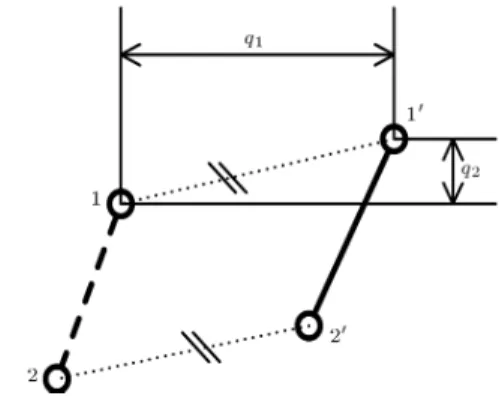
If a graph is moved from one position to another, and the lines joining each initial and nal nodes of the graph are a set of parallel straight lines, the operation is called translation. The `translation' function is denoted by Tran and is dened as:
graph. A translation operation is displayed in Figure 2. The dashed line indicates the graph before operation, and the solid line implies the graph after operation. Rotation Function
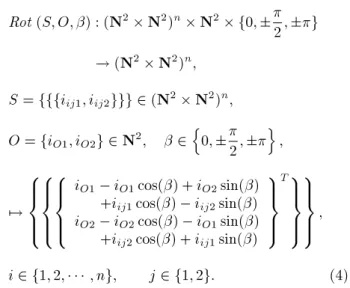
For a two-dimensional graph, the operation of rotation makes the graph rotate around a center, O. For a three-dimensional graph, the rotation will take place around an axis. Herein, only the two-dimensional rotation is considered, which is denoted by Rot. This function is dened as:
Rot (S; O; ) : (N2 N2)n N2 f0;
2; g ! (N2 N2)n;
S = fffiij1; iij2ggg 2 (N2 N2)n;
O = fiO1; iO2g 2 N2; 2
n 0; 2; o ; 7! 8 > > < > > : 8 > > < > > : 8 > > < > > :
iO1 iO1cos() + iO2sin()
+iij1cos() iij2sin()
iO2 iO2cos() iO1sin()
+iij2cos() + iij1sin()
9 > > = > > ; T9 > > = > > ; 9 > > = > > ;;
i 2 f1; 2; ; ng; j 2 f1; 2g: (4)
In Equation 4, 2 N represents the rotation an-gle. Since the integer coordinate is adopted, for the
Figure 2. Translation of a sub-graph.
Figure 3. Rotation of a subgraph.
time being, the magnitude of can only be one of 0; =2; . The positive direction of rotation is anticlockwise. Figure 3 shows the rotation operation acting on a subgraph.
Reection Function
In mathematics, a reection is a map that transforms an object into its mirror image, thus, it can also be called mirror operation. We use Ref to denote this operation, and the denition of this operation is given as:
Ref (S; h; a) : (N2 N2)n N2 f1; 2g
! (N2 N2)n;
S = fffiij1; iij2ggg 2 (N2 N2)n; a 2 N;
h 2 f1; 2g ! (
if h = 1; fff2a iij1; iij2ggg
if h = 2; fffiij1; 2a iij2ggg ;
i 2 f1; 2; ; ng; j 2 f1; 2g: (5)
In Equation 5, h denotes the direction of reection, and a is the reference axis of reection (Figure 4). Here, a is allowed to have a non-integer value, while 2a should be an integer.
GENERAL PROPERTY OF ROTATION Conguration processing can be performed by pure translation, pure rotation, pure reection, or combi-nations of these three operations, and a good choice
Figure 4. Reection of a subgraph.
of operation depends on the conguration itself and the selection of the sub-graphs. However, one may want to nd a general operation which can produce any conguration. Hence, the question is which one of the operations is superior: translation, rotation or reection? In this paper, it is shown that rotation can be considered as a general operation of the three operations; translation and reection can be expressed in the form of rotation but not vice versa.
Translation in the Form of Rotation
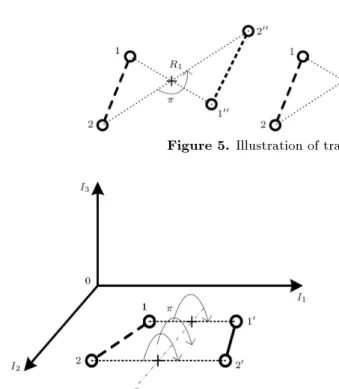
Translation and rotation have dierent properties. Translation moves a body \parallel", while rotation rotates a body, keeping a point xed in plane and a line xed in space. Nevertheless, if we are only concerned with the initial state and nal state, a translation movement of a rigid body could be realized as a rotation. The replaced operation is called rotation-translation. Figure 5 illustrates rotation-translation which is actually a two-step rotation. First, rotation is performed on the member around R1 through and,
then, rotated around R2 through again. R1 is the
center of the parallelogram composed of graphs 12 and 100200, and R2 is the mid-point of graph 100200.
In mathematical language, rotation-translation can be expressed as:
Tran (S; Q) = Rot (Rot (S; R1; ); R2; );
R1: center of S and Tran (S; Q);
R2: mid-point of Rot (S; R1; ): (6)
In addition, rotation-translation has no reverse opera-tion, which means there is no way to realize rotation by nite steps of translation.
Reection in the Form of Rotation
Reection is a kind of rotation, whereas the rotation center and the rotation angle are restricted. In Fig-ure 6, it is shown that the two-dimensional reection is a rotation around the reection axis through in the three-dimensional coordinate system.
Figure 6. Illustration of reection in the form of rotation.
Indeed, the rotation is superior to the other operations and can be considered a general operation for conguration processing.
EXAMPLES
In this section, two examples are considered to illus-trate the concepts presented in the previous section. Example I
A graph model of a planar truss selected from [1] is displayed in Figure 7.
Figure 7. Graph model G of Example I.
In the following sections, three dierent proce-dures consisting of pure translation, pure reection and pure rotation are performed for the conguration processing of G, and a comparison and discussion are provided.
Procedure 1: Pure Translation
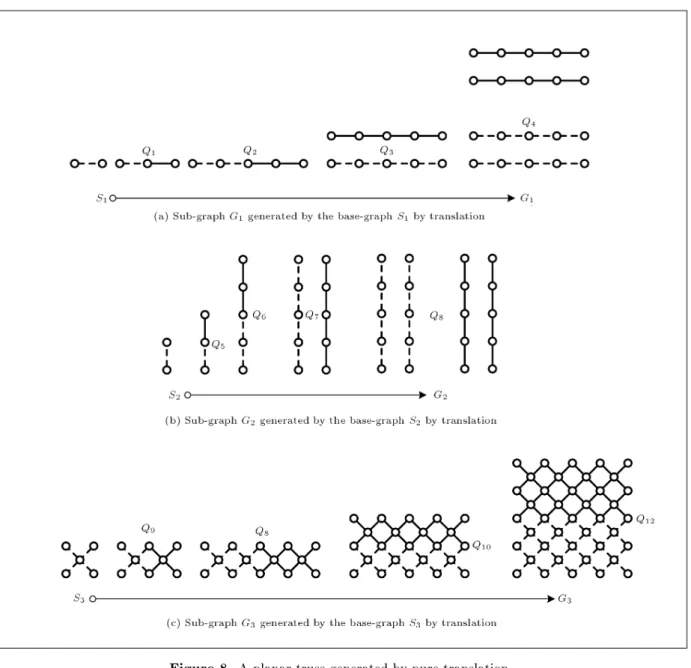
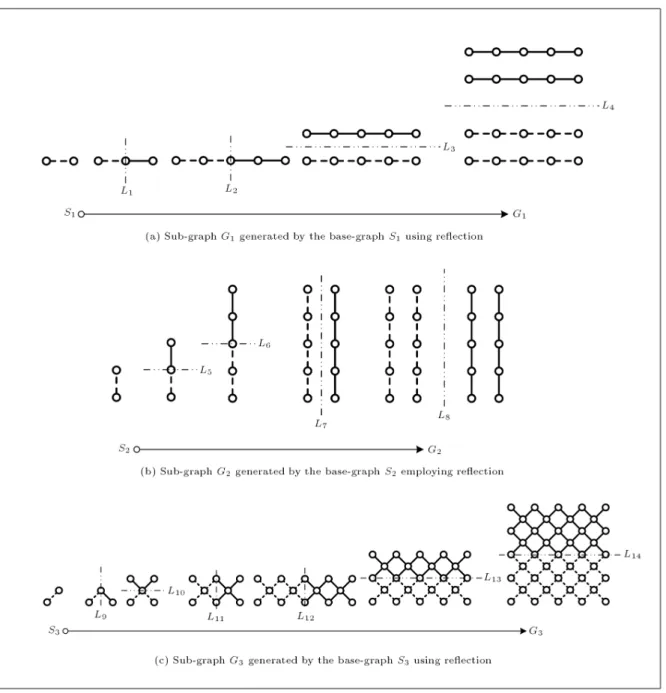
Figure 8 provides a detailed procedure for the gen-eration of graph G. Three base-graphs S1, S2 and
S3, are chosen to generate sub-graph G1, G2 and G3,
respectively. There is only 1 member in S1 and S2,
whereas S3is comprised of 4 members. The translation
function is called 4 times to generate G1 by S1, G2
by S2 and G3 by S3. Thus, G = G1 [ G2 [ G3
is generated upon 12 times calling of the translation function.
Procedure 2: Pure Reection
In this procedure, three base-graphs, S1, S2 and S3,
are chosen to generate the sub-graphs G1, G2 and
G3, respectively. There is only 1 member in each
base-graph, which is simpler than the procedure of pure translation. The reection function is used 4 times to generate S1 formed by G1, 4 times to
generate G2 formed by S2, and 6 times to generate G3
formed by S3 (Figure 9). Thus, G = G1[ G2[ G3
is generated upon 14 times calling of the reection function.
Procedure 3: Pure Rotation
The procedure of pure rotation is shown in Figure 10. Only two base-graphs, S1 and S2, are needed to
generate the sub-graphs G1 and G2, respectively, and
each base-graph consists of only 1 member. The total number of steps of calling the rotation function is 11. Thus, G = G1[ G2[ G3 is generated upon 11 times
calling of the rotation function. Comparison and Discussion
From Table 1, it is easy to nd out that the number of base-graphs, the number of calling the function and the procedure of pure rotation are superior to pure translation and pure reection.
In this example, the base-graphs in the procedure of pure rotation are necessarily the simplest ones. These are denoted by ~S1 and ~S2, and the shapes of ~S1
and ~S2 are illustrated in Figure 10. It is not possible
Figure 8. A planar truss generated by pure translation.
Table 1. Statistical data of three procedures.
Procedure Number of Base-Graphs
Total Number of Members in Base-Graphs
Number of Calling the Function Pure Translation 3 6 12 Pure Reection 3 3 14 Pure Rotation 2 2 11
graph by ~S1 and ~S2; hence, we should increase the
complexity of the base-graph to fulll the procedure of pure translation. This is the reason for the numbers in the row corresponding to pure translation in Table 1 being larger.
Although it needs 14 times calling of the reection
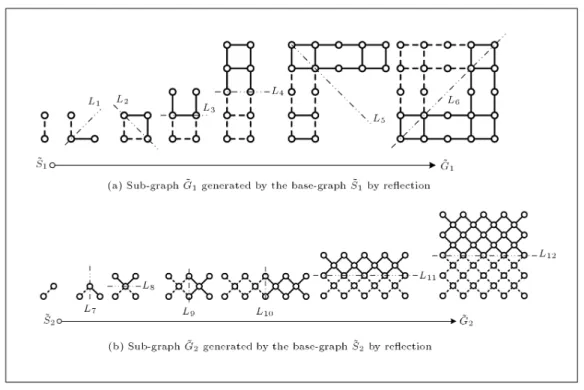
function to generate the entire graph, which is more than that of pure translation, the sub-graphs in pure reection are much simpler than those of pure transla-tion. Furthermore, if we introduce a reection axis with a slope of =4 or =4, the entire graph can also be produced by pure reection of ~S1, ~S2. The procedure is
Figure 9. A planar truss generated by pure reection.
shown in Figure 11. The reason for the higher number of steps of reection is because the reection is a kind of restricted rotation, which cannot rotate arbitrarily. Hence, the cost of the restriction is higher operation steps.
Example II
A graph model of a second truss is shown in Fig-ure 12.
This example consists of two parts: four trian-gular sub-graphs and one rectantrian-gular sub-graph. As discussed previously, the reection is a special kind of rotation, therefore, only the procedures of pure
translation and pure rotation are provided in the following.
Pure Translation
The steps of the formation of the model by pure translation are illustrated in Figure 13.
Pure Rotation
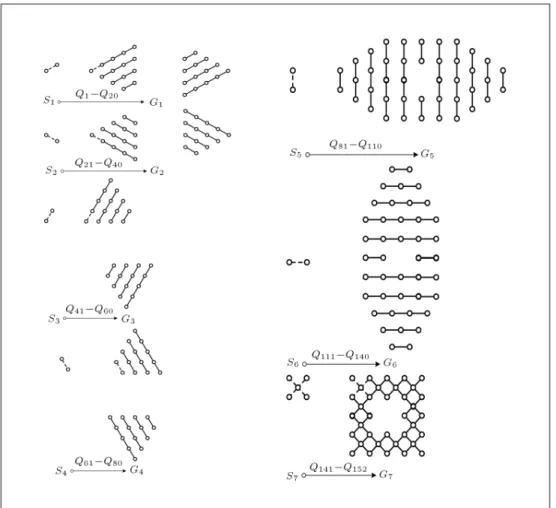
The steps of the formation of the model by pure rotation are illustrated in Figure 14.
Discussion
As shown above, the number of calling functions in the procedure of pure translation is far more than that of
Figure 10. A planar truss generated by pure rotation.
Figure 11. A planar truss generated by pure reection using improved reection function.
pure rotation, as is the number of selected base-graphs. For the complex graph, it is very dicult to generate the model using pure translation. For some graphs, it is even hard to nd the base-graphs, if one wants to use pure translation.
CONCLUSIONS
Three basic operation functions of conguration pro-cessing are reproduced in the paper, and rotation is found to be an intrinsic operation. Two comprehensive
Figure 12. Graph model G of Example II.
examples are given for explaining the general property of the rotation. The conclusions from theoretical analysis and example problems are derived as follows: Most structural congurations can be processed via
Reection is a kind of restricted rotation.
Rotation is the simplest and most ecient procedure to generate a given structural model.
Though only a planar model is considered as an example, many space structures can be generated by transforming the generated planar models. This can be achieved by means of simple functions.
Though the examples presented in this paper are selected from two-dimensional models, the ideas are quite general and applicable to three-dimensional mod-els. Some three-dimensional models can also be formed using two-dimensional ones and by using appropriate geometric transformations.
Figure 14. Steps of the generation of the model by pure rotation.
ACKNOWLEDGMENT
The rst author is grateful to Iran National Science foundation for the support.
REFERENCES
1. Nooshin, H. \Algebraic representation and processing of structural congurations", Comput. Struct., 5, pp. 119-130 (1975).
2. Nooshin, H., Formex Conguration Processing in
Structural Engineering, Elsevier Applied Science Pub-lishers, London (1984).
3. Nooshin, H., Disney, P. and Yamamoto, C. , Formian, U.K., Multi-Science Publishers (1995).
4. Nooshin, H. and Disney, P.L. \Formex conguration processing I, II, III", Int. J. Space Struct., 15, pp. 1-52 (2000); 16, pp. 1-56 (2001), 17, pp. 1-50 (2002). 5. Behravesh, A., Kaveh, A., Nani, M. and Sabet, S. \A
set theoretical approach to conguration processing", Comput. Struct., 30, pp. 1293-1302 (1988).
congu-Tabriz, Iran. After graduation from the department of civil engineering at the University of Tabriz in 1969, he continued his studies on structures at Imperial College of Science and Technology in London and received his MS, DIC, and PhD in 1970 and 1974. He then joined the Iran University of Science and Technology in Tehran and is presently a professor of structural engineering at this university. Professor Kaveh is the author of 250 papers published in international jour-nals, 120 papers presented at international conferences,
His research interests include structural optimization, applied graph theory, solid and structural mechanics and the nonlinear nite element method, and soil and rock mechanics.
Qineng Weng is an associate professor at the Institute of Geotechnical Engineering at Jiaotong University in Chongqing, China. His research interests include structural optimization, applied graph theory, and soil and rock mechanics.