
Vol. 17, No. 2, pp. 149{162 c
Sharif University of Technology, December 2010 Invited/Review Article
Microwave Photonics Mixing
B. Cabon
1Abstract. The multidisciplinary eld of Microwave-Photonics is at the convergence of photonic and microwave or even wireless technologies. In this context, the processing, conversion and transmission of microwaves, as well as high data rate digital and wireless signals, today use broadband optical techniques with many applications. However, the frequency band available is frequently changing with up-to-date commercial standards, and it is necessary to up- or down- convert the frequency of the electrical signals using a suitable optical approach for mixing. This paper intends to give an overview on the optical techniques used for frequency conversion, i.e. mixing, and gives the advantages and drawbacks of all techniques presented.
Keywords: Microwave-photonics; Mixing; Wireless systems; Millimeter-wave; Ultra wide-band.
INTRODUCTION
Nowadays, there is great interest in commercial ex-ploitation of the millimeter-wave (MMW) spectrum around 60 GHz, because the fractional available band-width is wider, the antennas are smaller and at-tenuation of the atmosphere allows a reduction in interference from adjacent cellular systems. Since the classical direct generation of millimeter wave signals is expensive using conventional electronic techniques, up-conversion to 60 GHz is an attractive solution that can be done optically to prot from the huge bandwidth of the ber.
Much progress in microwave-photonics techniques has been made since the 1996 rst International Topical Meeting on Microwave Photonics (MWP) [1-3]. E-cient solutions are given, not only for transport, but also for processing signals like microwave, millimeter wave, wireless and digital. Transport is done via optical ber networks with attractive results, since ber has a low loss of 0.2 dB/km, is immune to interference, and is capable of transmitting very large bandwidth signals. Ecient processing like all-optical ltering and mixing is achieved using performing components and 1. IMEP-LAHC, Institut de Microelectronique Electromag-netisme et Photonique, UMR 5130 INPG-UJF-CNRS, Grenoble INP - MINATEC 3, parvis Louis Neel - BP 257, F - 38016 Grenoble, Cedex 01, France. E-mail: [email protected]
Received 8 April 2010; received in revised form 26 May 2010; accepted 8 June 2010
innovative systems. The European Commission has funded a number of projects in microwave photonics, among which are ISIS, IPHOBAC and UROOF [4] in which photonics are used for MMW signal processing and where huge progress has been shown both at component and system levels in terms of performance and exibility, respectively.
This paper gives an overview of the eld of optical processing and, in particular, mixing for up-and down-frequency conversion. Since optical components can be modulated by MMW signals at rather low cost with broadband eciency, results using specic optical com-ponents and systems have been reported recently, and are summarized here. The following topics covering various frequency ranges will be addressed:
(i) Wide band photonic techniques for microwave mixing.
(ii) Results with microwave-photonic systems based upon the merging of microwave and photonic technologies.
Comparisons will nally summarize the advantages and drawbacks of all methods.
MICROWAVE-PHOTONICS TECHNIQUES FOR MIXING
Although optical generation of MMW signals is pos-sible by optical heterodyning or frequency multipli-cation using non linear bers, this paper is limited
to giving methods for optical frequency conversion; so called microwave-photonics mixing where a remote Local Oscillator (LO) signal is used with a non-linear device to up- or down- convert an Intermediate Frequency (IF) signal to a Radio Frequency (RF) band. Applications are in sensors, radar systems and telecommunication cellular systems as well, all requiring wide band processing and remote antenna [5]. In some cases, many microwave sub-carriers have to be converted optically [6]. The huge bandwidth of the ber and low weight are here precious advantages, well adapted to the remote transmission of broadband signals. Important progress in photonic components like distributed feedback laser sources (DFB), vertical surface emitting lasers (VCSELs) and External Optical Modulators (EOMs) allows the ecient processing of microwave signals. Their system implementation requires accurate modeling [7-15].
In a conventional scheme without frequency con-version, the RF signal to be radiated to the antenna is either externally modulated onto the optical carrier by an EOM, or directly modulated by the Laser Diode (LD). The transmission suers from the dispersion eect of the ber when the RF frequency is high or when it is transmitted over long distances [16-19]. In that case, the chromatic dispersion of the ber limits the maximum MMW signal frequency, and there is a need for processing at the remote end of the optical link. Then, at lower IF, the signals can be transmitted over longer distances. The other scheme, addressed in this paper, uses frequency conversion or mixing on the optical link of an IF signal. In both schemes, the RF signal is carried by the optical eld of the ber and may be optically amplied if necessary. The photo-detected RF signal is then amplied electrically and radiated to the antenna. Architectures using remote antenna and frequency conversion up to the 7th harmonic of the LO have been demonstrated to minimize the eect of dispersion with external modulation and digital modulation formats like QAM, PSK and ASK [20].
For example, in radio over ber systems sup-porting wireless networks like Personal Area Networks (WPANs), Wireless Local Area Networks (WLANs) and 3rd generation mobile communication systems, low cost Base Stations (BS) are connected via bers to a Central Oce (CO). Signal routing and processing is done at the CO rather than at the numerous BS. To avoid the eect of chromatic dispersion, lower frequency LO signals are distributed from the CO, and frequency remote up-conversion is done at the BS [21]. Low cost commercial components can then be used at the BS when the up-conversion is done there. Moreover, the generation of high frequency by optical up conversion imposes less stringent requirements on the modulation bandwidth of optical modulators, thus decreasing their cost.
From the above examples, it appears that dif-ferent methods for mixing must be considered, which dier by:
(i) The location of the up-conversion process, either at one or the other end of the optical link. (ii) The LO frequency range, since the chromatic
dispersion eects of the ber impose length limita-tion, depending on RF frequency transmitted on the optical link and, therefore, the up-conversion process must be closer to the photo-receiver end.
Two congurations can be employed for micro-wave-photonics mixing, and are examined below.
In the rst, \mixing at modulation side", modu-lation of the optical carrier and IF to RF up- or down-conversion are realized together before transmission on the ber. This includes mixing using fundamental optical non linearity like four-wave mixing.
In the second, \mixing at the detection side", photo-detection after optical transmission of the IF signal and up-conversion to RF frequency are done simultaneously.
Mixing at Modulation Side
A non-linear element has to be inserted in the opti-cal transmission link to generate a mixing signal at frequency fRF = fIF fLO detected at the output
of the optical link. Modulation of the light is done either by direct or external modulation of a laser diode, and can prot by Wavelength Division Multiplexing (WDM), a unique possibility of optics [14]. Two dierent congurations for mixing are applied: two cascaded linear modulations [22-25] or two modulations of a single device working in a nonlinear regime [26,27]. The rst conguration uses two cascaded devices, each of them under linear modulation with either LO or IF signals, since cascading linear transfer functions result in the product of each of them; a non-linear operation.
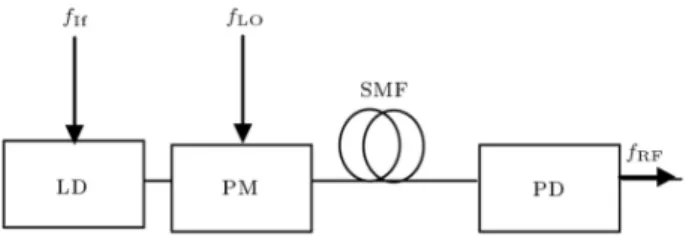
A rst example of the application of the rst conguration with two cascaded modulations is shown in Figure 1, and has been developed in a collabora-tive work within a European network of excellence ISIS [4] between the University of Ottawa (Canada) and CNRS-IMEP (France). It uses a Phase Modulator
Figure 1. Microwave-photonics mixing system with cascaded elements.
(PM) and a dispersive ber (SMF). This is a very low cost system, since the ber is the main element for frequency conversion [23,24]. The LD is directly modulated by the IF signal, while phase modulation is realized with a LO signal at a remote port. This technique takes advantage of the chromatic dispersion properties of the ber inserted between the phase modulator and the Photo-Detector (PD) to convert the Frequency Modulation (FM) of the laser diode and phase modulation into Intensity Modulation (IM). Results are presented in the next section.
A second example of cascaded modulations is based on two external EOM's supporting the IF or LO signals, respectively [25]. The conguration of Figure 1 still applies, but LD and PM are replaced by two EOM's; the optical source not being modulated (CW). Results will be presented in the next section.
The second conguration uses only one opto-electronic device modulated by both LO and IF signals, for example a LD or EOM directly or externally modulated by both LO and IF signals.
One rst example of the second conguration takes advantage of laser chirp and non linear FM to IM conversion including phased induced intensity noise conversion [26-29] by using a passive optical unbalanced interferometer integrated on glass substrate, which is a very low cost solution. In this method, a LD of high chirp is directly modulated by LO and IF sig-nals. Nevertheless, temperature stability is necessary to control the coherent interference regime and the frequency bandwidth of this method is limited by the Free Spectral Range (FSR) of the interferometer and the LD bandwidth.
A second example of the second conguration with a direct modulation of a LD uses VCSEL's, which are low-cost components well-suited for wireless access applications [30-34].
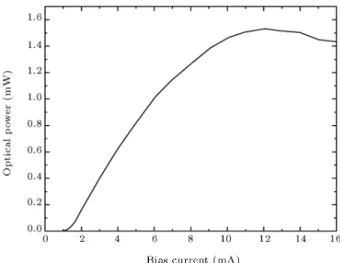
The non-linear curve, optical output power as a function of DC bias, is shown in Figure 2 for a typical VCSEL.
When the VCSEL is directly modulated by both LO and RF signals and operated in a non-linear regime, mixing is generated.
While VCSEL's modulation bandwidths are lim-ited to 10 GHz, they are suitable for wireless appli-cations like Wireless Local Area Networks (WLAN's) or Band Orthogonal Frequency Division Multi-plexing (MB-OFDM) Ultra Wide Band (UWB) sig-nals. In MB-OFDM, the up-converted process could therefore allow the covering of one or another band in the 3.1-10.6 GHz UWB range [32,33] for example by frequency hopping. That type of work was extensively developed in the European project UROOF [4]. It has been demonstrated that it is possible to up-convert a UWB monocycle (800 MHz-2.5 GHz) or WLAN signal, beyond the relaxation frequency of the laser diode up
Figure 2. VCSEL power-current characteristics.
to frequencies as high as 16 GHz [32,33]. Moreover, it has been found that the best condition for mixing using directly modulated laser diodes is fRF = kfr =
mfL0+ nfIF, where fris the resonant frequency of the
laser diode [35].
Other optical techniques based on Semiconductor Optical Ampliers (SOA's) for frequency up-conversion have been reported in the literature [36-41]. The main techniques used are derived from non-linear eects, namely, the four-wave mixing (FWM) [39,40], cross phase modulation (XPM) [36], and cross gain modu-lation (XGM) [37,38,41]. The simplest technique for all optical wavelength conversion involves XGM. This can be performed by using the pump wavelength to sat-urate an SOA along with a counter or co-propagating probe wavelength. The pump signals experience the cross-gain modulation induced by the probe [37,41]. The simplicity of the XGM conversion is countered by a limited wavelength conversion range where the extinction ratio of the pump is maintained. The next section reports some results of up-conversion with SOA's achieved within the ISIS European project [4] with comparisons of up-conversion with VCSEL's.
Mixing at Detection Side
Several authors have investigated the performance of GaAs MESFET's [42] and, more recently, Hetero-junction Bipolar Transistors (HBT) [3] under illumi-nation. Optical processing is explored with those devices [3] and with photodiodes also [26,43] for both CW and UWB signals.
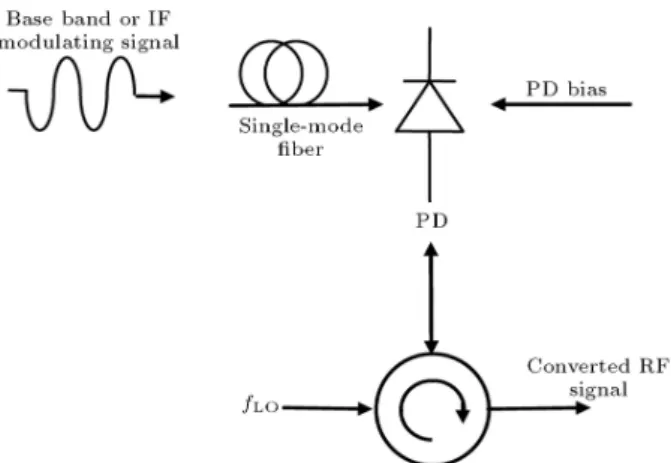
When injecting a LO signal at the electrical port of the photodiode and simultaneously illuminating the device by an IF modulated optical signal, mixing of the two signals occurs. The mixing process is explained as a result of the nonlinearity of the PD current-voltage relationship.
nonlin-Figure 3. Frequency conversion of IF signal by photodiode (PD).
earity in the vicinity of 0 V, which is the optimal operation point for ecient mixing [43].
In the photodiode mixing conguration shown in Figure 3, a baseband data or IF signal is transmitted by the optical ber. The converted signal is then separated from the LO signal by a circulator before transmission to the RF port [43].
However, for ecient microwave-photonics mix-ing, some considerations applicable to the above two methods are important to observe. In an optical link made of laser, external modulators, bers and photo-detectors for up-conversion, the combined eects of laser chirp, electro-optical mixing, dispersive ber transmission, and photo-detection on the nonlinear signal properties of the electro-optically generated millimeter-wave signal resulting from up-conversion must be considered. They all have been modeled, and their analysis compared to experimental results achieved good agreement [44]. A limited number of model parameters describing the behavior of the above components are essential to predict the mixing signal correctly [44]. They include laser chirp, ber length and its dispersion coecient, intensity and phase modulation index.
All methods presented above require ltering to suppress the undesired mixing products. This can be achieved optically with a very good Q factor [45] proting from the optical link for both transmission and signal processing purposes, which avoids optical to electrical conversion if ltering is made electrically.
Results and applications of the above two meth-ods are given in the next section. The properties of the microwave-photonic mixer, conversion gain, isolation between input ports, and input bandwidth are impor-tant gures in comparing all techniques.
RESULTS
In the transmission systems dedicated to all-optical up-conversion, as described hereafter, the conversion gain
of the mixing process is a very important gure of merit and is dened as:
CG (dB) = PRF (dBm) PIF(dBm);
where PRF denotes the power of the converted signal
at RF frequency and PIF is the applied available input
power before conversion at IF frequency. This gure will be used to compare all solutions for microwave-photonics mixing.
Cascaded Modulation
One solution exploring mixing with cascaded modula-tions is to use an electro-optic Phase Modulator (PM) and a Laser Diode (LD), where the LO and IF signals are applied to a LD and PM, respectively [23,24].
With the natural dispersion of a classical Single Mode Fiber (SMF), simultaneous all-optical microwave mixing and bandpass ltering can be achieved. In works reported in ISIS [4], a subcarrier IF frequency up-conversion from 3.5 GHz to 11.7 GHz over a 25 km dispersive ber link has been experimentally investi-gated, with a BPSK modulated signal and a data rate of 172 Mb/s applied to the PM. The mixed optical LO and IF signals after the PM were then applied to the SMF link, serving as a dispersive device, as well as a transmission medium, and other intermodulation products, other than the one desired, were rejected.
A rst step is aloptical microwave bandpass l-tering. To achieve microwave ltering with very narrow bandwidths, a multi-wavelength ber ring laser must be used with about 30 wavelengths and a wavelength spacing of 0.2 nm. With this conguration, the RF frequency at the peak of the band-pass lter of 11.8 GHz was determined by the wavelength spacing of the multi-wavelength light source and the accumulated dispersion of the 25-km SMF link [23,24].
A second step is all-optical microwave mixing and bandpass ltering. By applying IF and LO signals to the phase modulator, the up-converted microwave signal at the output of the photo-detector was obtained. The converted signal can be naturally distributed to a remote station over a 25 km span, which provides an added advantage to the proposed system.
For system applications, the performance of the mixer has been evaluated in Figure 4, with a Pseudo Random Bit Sequence (PRBS) 27 1 BPSK signal and
data rate of 172 Mb/s modulating the IF subcarrier at frequency fSC. A light source composed of two
wavelengths generated from two LDs with a wavelength spacing of 0.75 nm was used for experiments. A two-tap notch lter has been, thus, implemented.
In the experiment, the results of which are given in Figure 4, the IF and LO frequencies are 3.5 GHz and 8.25 GHz, respectively, while the LO signal has an output power of 18 dBm. The electrical spectrum at
Figure 4. (a) Measured electrical spectrum at the output of the photodetector, and (b) measured eye diagram at the receiver when 172 Mb/s PRBS 27 1 signal is applied (X
axis: 2ns/div).
the output of the photo-detector is shown in Figure 4a. We can see that the power levels of other unwanted inter-modulation products are signicantly suppressed. Figure 4b shows the eye diagram of the demodulated PRBS signal, which is clear and wide open, demon-strating that an excellent up-conversion is achieved.
Another solution for exploring mixing with cas-caded modulations uses cascas-caded EOMs. Many RF systems incorporating up and down processing signals and multiple EOMs for up and down conversion have already been used to implement the required frequency conversion in Radio over Fiber (RoF) systems, where one modulator impresses the LO, and the other the IF signal [46]. Some eorts to implement image reject down-conversion [47] or multiple simultaneous down conversions on many RF channels have been made [48] by proting from one precious advantage of optics in oering Wavelength Division Multiplexing (WDM).
We can now consider applications of microwave
photonics mixing to RoF for mobile communications and WLANs [49-52], where the desired mixing fre-quency at the output of the system can be in the 60 GHz range [53]. In this eld, much study has been done recently on optical transmission of UWB signals [54-78], in particular for WPANs applications. Dierent formats for optical transmission, like Impulse Radio (IR) or MB-OFDM, have been compared [79]. Some simplied optical transmitters and receivers of an UWB signal, with direct photonic conversion tech-niques, have also been proposed. They include optical detection and regeneration of the optically generated 24- GHz UWB signal with a bandwidth of 4 GHz at a data rate of 250 Mb/s after 3-m long transmission in the air. This technique uses an EOM modulated at 24 GHz, and works with a Double Side Band Suppressed Carrier (DSB-SC) [80].
For a UWB signal at higher frequency, one rst attempt at up-conversion was made at 40 GHz with cascaded modulators and a DSB-SC method for fre-quency up-conversion of a UWB monocycle signal with a total conversion gain of -56 dB [81] including optical link loss. Generation of a 60 GHz UWB multi-band MB-OFDM signal over ber by up-conversion using cascaded EOMs has been demonstrated also [82]. Since most commercial modulator bandwidths are limited to the 50 GHz range, 60 GHz applications require nding another way to transmit at that frequency. The above technique, with suppression of the optical carrier (DSB-SC), allows the conversion of the IF signal at 2fL0 in the 60 GHz range, as shown in Figure 5,
and exceeding the EOM bandwidth limitation. In that experiment, the rst EOM was biased in a linear regime and modulated by one UWB-OFDM sub-band of 528 MHz width with a QPSK modulation format and 200 Mbit/s bit rate, centered at frequency fRF =
3:432 GHz. This frequency corresponds to the UWB-MB-OFDM sub-band. The second EOM operated at the minimum transmission point for purposes of optical carrier suppression and was driven with a LO at frequency fLO = +30 GHz. The Conversion Gain
(CG), as dened earlier in this section, is here of 30 dB for an LO power of +15 dBm. This value takes into account a gain of 20 dB obtained by amplication at the output of the photodiode. Therefore, CG would be of only -50 dB without this amplication. But this low value also includes the optical insertion loss of each modulator, which is of -4 dB to -5 dB optical, represents -8 to -10 dB of electrical loss at the photodiode output for each modulator, and -20 dB for the two cascaded modulators. If we remove this loss from the CG value of 50 dB, a conversion loss of -30 dB is obtained by this method.
Figure 5a shows the QPSK modulated input signal, while Figure 5b shows the two up-converted sidebands and the signal at frequency 2fLO= 60 GHz.
Figure 5. Measured spectrum of the rst UWB-OFDM sub-band (a) and after up-conversion at 60 GHz (b).
To avoid a chromatic dispersion eect and undesired mixing products, a Fiber Bragg Grating (FBG) optical lter with a suitable rejection prole of +30 dB over 4 GHz spacing can lter out both the 60 GHz signal and one sideband [83].
Error Vector Magnitude (EVM) measurements are often used to evaluate the performance of RF mod-ulated systems [84-87]. For powers, PLO = +15 dBm
and PRF = +9 dBm, an EVM rms of 12.6% at
60 GHz has been obtained by the above system of cascaded external modulators. This corresponds to a BER below 10 9, which is in compliance with standard
requirements [82].
One Single Optoelectronic Device with Two LO and IF Modulations
Both Distributed Feedback (DFB) laser diodes and VCSELs can be modulated in the 10 GHz frequency range [88-92], and used as up-converters. In that case, the two LO and IF signals modulate the current injected in the laser.
Up conversion, with both directly modulated low-cost multimode 850 nm and single mode 1550 nm VCSEL's, has been demonstrated within the ISIS and UROOF projects [4]. With multimode VCSEL,
up-conversion of the triple band UWB OFDM signal composed of time frequency codes TFC5, TFC6 and TFC7 has been demonstrated from UWB band group 1 to band group 3 [93], while it is possible to up-convert the signals all over the UWB bandwidth from 3.1 GHz up to 10.6 GHz. This was based on the third order nonlinearity of a multimode 850 nm VCSEL. The EVM after up-conversion was 20% to 25%, while the back-to-back, without up-conversion, EVM value at the transmitter was 19%. The conversion gain CG was of the order of -22 dB [93].
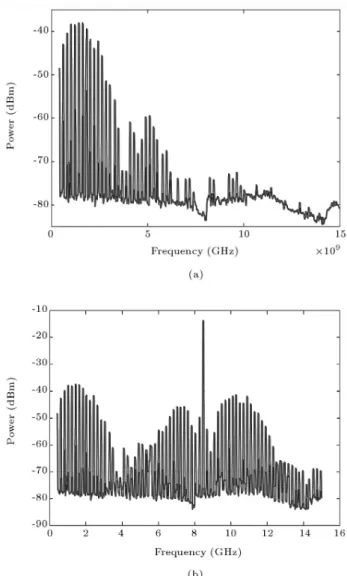
With single-mode VCSEL, an experiment for up-converting an IR-UWB monocycle was also realized. The feasibility of up-converting the monocycle, while retaining a high resemblance, was demonstrated [33] for lengths of single mode ber connected to the laser up to 100 m. The spectrum is shown in Figures 6a and 6b, respectively, before and after up-conversion with fLO= 8:5 GHz, equal to the relaxation frequency
of the VCSEL, for a better conversion gain [35].
Figure 6. Spectrum of the monocycle in the baseband before (a) and after (b) up-conversion.
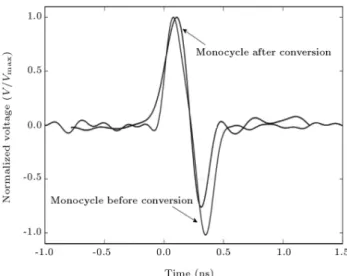
Figure 7. Monocycle before and after up-conversion to 8.5 GHz using a single-mode VCSEL.
A monocycle before transmission and the same monocycle up-converted to 8.5 GHz and, subsequently, being down-converted to the baseband for purposes of measurement are shown in Figure 7.
Waveforms of the UWB monocycle signal, before and after frequency up-conversion, are quite similar.
For purpose of comparison between direct trans-mission and up-conversion with a single optoelectronic device, a unique EOM device has been utilized at the same frequency [94].
The EOM was biased in either a linear (for simple transmission) or non-linear regime (for up-conversion) and was used to realize both distributions of Multi-Band-Orthogonal Frequency Division Multiplexing (MB-OFDM) UWB signals. An all-optical frequency up-conversion of a UWB-OFDM sub-band was demonstrated at around 10 GHz, while this technique could also be applied to the MMW bands, with bandwidth limitation due to the PFD and EOM. Results have shown a low penalty induced by the optical mixing process and enhanced performance of an up-converted MB-OFDM sub-band compared to direct transmission. This is due to reduced optical noise and, consequently, reduced detected shot-noise on the PD, since the EOM biased at a minimum of transmission for mixing purposes has very low optical output power. The optimal conversion gain of this technique is of the order of -45 dB (without amplication) for a LO power of 20 dBm [94].
Use of Optical Non Linearity
All-optical up-conversion, using cross-gain modula-tion in Semiconductor Optical Ampliers (SOA), has been demonstrated [37,38]. This benets from cross-gain modulation (XGM) in the SOA where a pump wavelength is used to saturate the SOA along with
a counter or co-propagating wavelength. The LO signal wavelength can be separated from the IF signal wavelength, and at least one of them must be within the SOA optical gain range. Therefore, a tunable laser source must be used to adjust the wavelength. The double sideband suppressed carrier modulation method with an EOM biased at a minimum of trans-mission is necessary for the optical carrier supporting the LO signal. For IF and LO powers of around -10 dBm, an optimum conversion gain of -20 dB is obtained.
The SOA photonic up-converter has high con-version eciency, a LO frequency limited to that of the EOM and high-speed PD, and has a wavelength range compatible with that of the SOA. However, since the SOA operates in saturation, non linear distortion must be studied. The Spurious-Free Dynamic Range (SFDR) is maximum when the IF wavelength is at the SOA gain peak [37], while the measured SFDR is not very high compared to conventional electrical mixers.
Comparisons Between Optical and Opto-Electronic Techniques for Mixing
Comparisons of up conversion solutions, based on SOA with XGM, and directly modulated DFB or VCSEL's with non-linear functions have been investigated in ISIS [4]. The DFB was the optical source driving the SOA, replacing the tunable laser, as described earlier. The DFB is modulated by the IF data, while an EOM is modulated by the LO signal. Electrical mixing with the VCSEL directly modulated by both LO and IF signals, was undertaken, as described in the previous section.
Under the same conditions for all cases, for purposes of comparison, a 10 MSymb/s QPSK signal; on a fIF= 1:1 GHz carrier was up-converted to 3.1 GHz
using a 2 GHz LO tone. The IF input power was only -10 dBm due to the much lower current range of the VCSEL compared to the DFB, and a single operating power for the LO power of 6 dBm was chosen to provide optimum performance.
Figure 8 shows the resulting r.m.s. EVM on the converted 3.1 GHz channel for the three cases: optical mixing based on XGM and tunable VCSEL or XGM with DFB and nally electrical mixing with a single-mode VCSEL.
It can be seen that the technique using the VC-SEL has performance benets and demonstrated both a superior EVM performance as well as operation with lower signal powers. The optical techniques using the SOA show an acceptable but degraded performance. They do, however, provide potential operation benets, in particular from options for remote operation and the ability to reuse the LO to up-convert a number of IF signals produced by low frequency sources.
Figure 8. Comparisons of EVM after up conversion at 3.1 GHz, with techniques employing an SOA+ tunable source or SOA+DFB laser diode (\optical") and a VCSEL (\electrical").
Up Conversion with a Photo-Detector
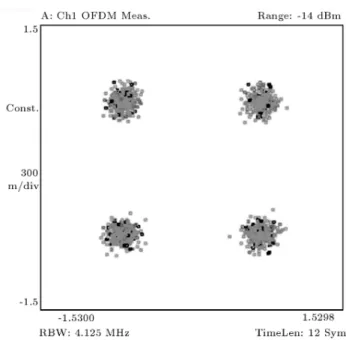
Simultaneous photo-detection and up-conversion can be done by a simple p-i-n photodiode (PD) [26,43,95,96]. In this context, optical up-conversion of a 3.4 GHz bandwidth UWB monocycle has been successfully demonstrated in the 10 GHz band showing good performances in terms of conversion loss and available bandwidth [96]. The up-converted monocycle waveform and spectrum are not aected by the mixing process. With a LO power of 7 dBm, CG has been evaluated at -41 dB including all optical link losses. However, when removing the optical link, an intrinsic loss of -35 dB after linear photo-detection, this conversion gain would be as low as -6 dB. In the 10 GHz frequency range, electrical mixers show a typical conversion loss as low as -4 dB, which is slightly better. However, in MMW bands, electronic mixers integrate high cost electronics and conversion loss increases dramatically, therefore, microwave-photonics mixing can be very attractive. A UWB signal has been successfully up-converted on a 60 GHz frequency carrier [43]. Figure 9 shows the resulting constellation of the QPSK OFDM signal, presenting a bandwidth of 528 MHz up converted in the 60 GHz band, and further down-converted electrically around an intermediate frequency of 400 MHz to fall into the 6 GHz bandwidth of the oscilloscope. The constellation does not show any distortion. The EVM has also been evaluated as being less than 10% after optical up-conversion. This is a very good result, since, according to the ECMA standard [56], EVM lower than 20% guarantees Bit Error Rates (BER) lower than 10 10 after
code correction, which is assumed to be error free transmission.
A new method has been proposed for mixing with PD called optical-microwave double mixing. It utilizes a photodiode and an EOM with two eects: a direct
Figure 9. Constellation of a QPSK-OFDM signal converted to 60 GHZ and further down-converted by an electrical mixer to an intermediate frequency of 400 MHz.
and an indirect mixing process of the modulated optical signal and the microwave signal [95]. An optical carrier with a RF externally modulated signal is applied to a P-I-N photodiode. By a proper embedding circuit in the photodiode, the detected signal is reected back into the nonlinear EOM device and is then mixed again with the microwave signal, which is a kind of resonant enhancement procedure. The CG is then 10-15 dB higher than the one involving a simple p-i-n mixing without resonant enhancement [95].
Phototransistors have a further advantage over photo-diodes; they act as photo-detectors and ampli-ers as well [97-100]. Their non-linear behavior can be exploited for microwave-photonics mixing [3]. Since the photo-HBT has the highest optical coupling eciency among dierent photo-transistors [97], can be easily integrated with an amplier [98] and has low frequency noise [99], this device is attractive for microwave-photonics links. Mixing reported experiments [100] use two photo-HBTs, where one transistor self-oscillates is optically injection locked and feeds, in turn, a second HBT, which serves as an opto-electronic mixer. Analog and digital modulations were demonstrated and the characteristics were found to be better than the corresponding ones in the single HBT case [100]. The two-transistor conguration allows good isolation between the LO carrier and the IF modulated signal. Under an illuminating power of -10- to -3 dBm, the up-converted spectrum of the 30- GHz carrier modulated at 300 MHz exhibited a CG of -16 dB for a modulating input power ranging from -40 to -26 dBm and LO power of -10 dBm.
Figure 10. Intrinsic conversion gain in a phototransistor as function of IF frequency (after [3]).
unique photo-HBT; results are shown on Figure 10. A DFB laser operating at 1550 nm was externally modu-lated by an RF source and the optical modumodu-lated signal was amplied by an Erbium Doped Fiber Amplier (EDFA) before being focused onto the optical window of the HBT.
In both down- and up-conversion experiments, with results shown in Figures 10, LO and IF signals were applied; one to the EOM and the other to the HBT base in the range of 0.5-20 GHz, while keeping the separation between them at 500 MHz. The LO power was of -10 dBm. An intrinsic conversion gain is a useful gure of merit for microwave-photonics mixing [3,100].
The intrinsic conversion gain, Gint, is dened as the
ratio of the output power (Pdown, Pup for down- and
up-conversion) to Pprime, the primary photo detected
RF power. Pprime is the photo induced RF electrical
power detected by the base collector junction without amplication. Figure 10 shows that the conversion gain of the down-conversion process is higher than that of the up-conversion case for all frequencies. The conversion cut-o frequency (dened as the frequency where the intrinsic conversion gain is 0 dB) was 9 GHz for the down-conversion process and 4 GHz for the up-conversion process. The intrinsic conversion gain is high for a frequency below cut-o; this is the main advantage of this technique and can be explained by intrinsic amplication.
COMPARISONS
Although all techniques described above have their own specicity in terms of system architectures, which require remote or collocated IF and LO inputs, the fol-lowing Table 1 gives some comparisons of performances based on experimental results as reported here and on theory. Special care must be taken to not take into account RF amplication at the RF output, for an equal basis of comparison.
Conversion gain CG is indicated in Table 1, but values depend on the optical power injected also. Mixing with HBT and LD seems the most ecient in terms of conversion gain CG, but suers from limited bandwidth. Mixing with cascaded EOMs has a high loss, but allows one to double the frequency and oers a better LO/IF isolation.
Table 1. Comparison of dierent solutions for microwave-photonics mixing under specic conditions.
Solutions Unique EOM
Unique LD
2 Cascaded EOMs
Cascade LD+Phase Modulator
P-I-N
Photodiode HBT
Conversion gain CG (dB)
-45 -22 -50 (without
amplication) -41 -16
LO power needed (dBm)
20 1-6 15 18 7 -10
IF frequency limit (commercial devices)
50 GHz
(can be doubled) 10 GHz
50 GHz
(can be doubled) 10 GHz 50 GHz 4-9 GHz
Rejection of fundamentals
Yes No No Yes No No
LO/IF isolation
CONCLUSIONS
Microwave-photonics has demonstrated the capability to transmit and process wide band signals in the microwave and millimeter-wave regions.
We have described various methods and research results in photonics microwave mixing, mainly for radio-over ber applications. These are based on both direct and external modulation, photo-detection, and the use of single-mode and multimode ber, for the support of existing and emerging communication networks. Novel architectures for both analogue and digital signal processing are possible, and are more and more attractive, since the frequency and dynamic response of optoelectronic components have improved in the past decade and are now competitive in regard to pure electronics.
Implementation of several photonic components and systems with high eciency for microwave mixing is necessary in their applications to wireless, security and radar systems. The results in this paper show that it is possible to up- or down-convert with high eciency microwaves and complex digital signals. The conversion gain depends on many factors like available optical and local oscillator power, and architecture with remote or close inputs to the microwave-photonics mixer.
With a continuously evolving market in broad-band and high capacity communications, many other solutions will probably emerge in the future.
REFERENCES
1. Seeds, A.J. and Williams, K.J. \Microwave photonics", IEEE J. Lightwave Technol., 24(12), pp. 4628-4641 (2006).
2. Jager, D. and Stohr, A. \Microwave photonics-from concepts to applications", Proc. 2005 German Mi-crowave Conference, pp. 136-139 (2005).
3. Vilcot, A., Cabon, B. and Chazelas, J., Microwave Photonics, from Components to Applications and Sys-tems, Kluwer Academic Publishers, Boston ISBN 1-4020-7362-3 (2003).
4. ISIS Network of Excellence, FP6-IST-026592, www.ist-isis.org, IPHOBAC Integrated Project, FP6-IST-035317, http://www.ist-iphobac.org/, UROOF Spe-cic Targeted Research Project FP6-IST 033615, http://www.ist-uroof.org/.
5. Wake, D. et al. \Video transmission over a 40 GHz radio-ber link", Electron. Lett., 28, pp. 2024-2025 (1992).
6. Nasu, H., Isawa, K., Matsunaga, T., Takashima, S.I. and Omura, H. \An optically repeated SCM system with subcarrier frequency conversion", Electronics and Communications in Japan, Part 2, 84(1), pp. 1-10 (2001).
7. Cartledge, J. and Srinivasan, R.C. \Extraction of DFB laser rate equation parameters for system simulation purposes", IEEE J. Lightwave Technol., 15(5), pp. 852-860 (1997).
8. Bruensteiner, M. and Papen, G.C. \Extraction of VCSEL rate-equation parameters for low-bias system simulation", IEEE J. of Selected Topics in Quantum Electronics, 5(3), pp. 487-494 (1999).
9. Mena, P.V, Morikuni, J.J., Kang, S.M., Harton, A.V. and Wyatt, K.W. \A simple rate-equation-based thermal VCSEL model", IEEE J. Lightwave Technol., 17(5), pp. 865-872 (1999).
10. Li, H. and Iga, K., Vertical-Cavity Surface-Emitting Laser Devices, Springer, New York (2001).
11. Chrostowski, L., Faraji, B., Hofmann, W., Amann, M.C., Wieczorek, S. and Chow, W.W. \40 GHz band-width and 64 GHz resonance frequency in injection-locked 1.55 m VCSELs", IEEE J. of Selected Topics in Quantum Electronics, 13(5), pp. 1200-1208 (2007). 12. Gopalakrishnan, G.K., Burns, W.K., McElhanon, R.W., Bulmer, H. and Greenblatt, A.S. \Performance and modeling of broadband LiNbO3 travelling wave
optical intensity modulators", IEEE J. Lightwave Technol., 12(10), pp. 1807-1819 (1994).
13. Walklin, S. and Conradi, J. \Eect of Mach-Zehnder modulator DC extinction ratio on residual chirp-induced dispersion in 10-Gb/s binary and AM-PSK duo-binary lightwave systems", IEEE Photonics Tech-nol. Lett., 9(10), pp. 1400-1402 (1997).
14. Hraimel, B., Twati, M.O. and Wu, K. \Closed-form dynamic range expression of dual-electrode Mach-Zehnder modulator in radio-over-ber WDM system", IEEE J. Lightwave Technol., 24(6), pp. 2380-2387 (2006).
15. Mitomi, O., Noguchi, K. and Miyazawa, H. \Broad-band and low driving-voltage LiNbO3 optical
modu-lators", IEE Proceedings Opto-electronics, 145(6), pp. 360-364 (1998).
16. Schmuck, H. \Comparison of optical millimeter-wave system concepts with regard to chromatic dispersion", Electron. Lett., 31, pp. 1848-1849 (1995).
17. Smith, G.H., Novak, D. and Ahmed, Z. \Technique for optical SSB generation to overcome dispersion penal-ties in ber-radio systems", Electron. Lett., 33(1), pp. 74-75 (1997).
18. Le Guennec, Y. et al. \Improvement of dispersion re-sistance in analog radio-on-ber up-conversion links", IEEE J. Lightwave Technol., 21(10), pp. 2211-2216 (2003).
19. Gliese, U. et al. \Chromatic dispersion in ber-optic microwave and millimeter-wave links", IEEE Trans. on Microwave Theory and Techniques, 44(10) pp. 1716-1724 (1996).
20. Candelas, P. et al. \Optically generated electrical-modulation formats in digital-microwave link applica-tions", IEEE J. Lightwave Technol., 21, pp. 496-499 (2003).
21. Smith, G.H. and Novak, D. \Broadband millimeter-wave ber radio network incorporating remote up/down conversion", IEEE MTT-S Digest, TH3C-1 (TH3C-1998).
22. Sun, C.K., Orazi, R.J. and Pappert, S.A. \Ecient microwave frequency conversion using photonic link signal mixing", IEEE Photonics Technol. Lett., 8(1), pp. 154-156 (1996).
23. Yao, J., Maury, G., Le Guennec, Y. and Cabon, B. \All-optical subcarrier frequency conversion using an electro-optic phase modulator", IEEE Photonics Technol. Lett., 17(11), pp. 2427-2429 (2005).
24. Le Guennec, Y., Maury, G., Yao, J. and Cabon, B. \New optical microwave up-conversion solution in radio-over-ber network for 60 GHz wireless applica-tions", IEEE J. of Lightwave Technol., 24, pp. 1277-1282 (2006).
25. Cabon, B. and Nguyen, G. \Ultra-wide band over ber in millimeter waves using up-conversion technique", Journal of the European Microwave Association, Spe-cial Issue on Microwave Photonics, 4, pp. 206-211 (2008).
26. Maury, G., Hilt, A., Berceli, T., Cabon, B. and Vilcot, A., \Microwave-frequency conversion methods by op-tical interferometer and photodiode", IEEE Trans. on Microwave Theory and Techniques, 45, pp. 1481-1485 (1997).
27. Maury, G. and Cabon, B. \New technique for optical generation of microwave mixing", Microwave and Op-tical Technology Letters, 16(5), pp. 275-280 (1997). 28. Mansouri-Rad M. and Salehi, J.A. \Phase-induced
intensity noise in digital incoherent all-optical tapped-delay line systems", IEEE J. Lightwave Technol., 24(8), pp. 3059-3072 (2006).
29. Salehi, M.R. and Cabon, B. \Theoretical and ex-perimental analysis of inuence of phase-to-intensity noise conversion in interferometric systems", IEEE J. Lightwave Technol., 22(6), pp. 1510-1518 (2004). 30. Larsson, A., Larsson, C., Gutavsson, J., Haglund,
A., Modh, P. and Alping, A. \Broadband direct modulation of VCSELs and applications in ber-optic links", in Proc. IEEE International Topical Meeting of Microwave Photonics MWP'04, WA-1 (2004). 31. Constant, S.B., Le Guennec, Y., Maury, G., Corrao,
N. and Cabon, B. \Low-cost all-optical up-conversion of digital radio signals using a directly modulated 1550 nm emitting VCSEL", IEEE Photonics Technol. Lett., 20(2), pp. 120-122 (2008).
32. Schimpf, A., Bucci, D. and Cabon, B. \Optimum biasing of VCSEL diodes for all-optical up-conversion of OFDM signals", IEEE J. of Lightwave Technol., 27, pp. 3484-3489 (2009).
33. Schimpf, A., Bucci, D. and Cabon, B. \Low cost optical up-conversion of IR-UWB signals beyond the relaxation frequency of a vertical cavity surface emit-ting laser (VCSEL)", Proc. 2008 IEEE Int. Conf. Ultra-Wideband (ICUWB2008), Hannover, Germany, pp. 25-28 (2008).
34. Chen, C. and Choquette, K.D. \Microwave frequency conversion using a coupled cavity surface emitting laser", IEEE Photonics Technol. Lett., 21(19), pp. 1393-1395 (2008).
35. Khorasani, S. and Cabon, B. \Theory of optimal mixing in directly modulated laser diodes", Scientia Iranica, Trans. D, 16(2), pp. 157-162 (2009).
36. Song, H.J., Lee, J.S. and Song, J.I. \Signal up-conversion by using a cross phase modulation in all optical SOA-MZI wavelength converter", IEEE Pho-ton. Technol. Lett., 16(2), pp. 593-595 (2004). 37. Seo, Y.K., Choi, C.S. and Choi, W.Y.
\Spurious-free dynamic range characteristics of the photonic up-converter based on a semiconductor optical amplier", IEEE Photon. Technol. Lett., 15(11), pp. 1591-1593 (2003).
38. Seo, Y.K., Choi, C.S. and Choi, W.Y. \All-optical signal up-conversion for radio-on-brr applications us-ing cross-gain modulation in semi-conductor optical ampliers", IEEE Photon. Technol. Lett., 14(10), pp. 1448-1450 (2002).
39. Inoue, K. \Polarization-insensitive wavelength conver-sion using ber four-wave mixing with two orthogonal pumps at dierent frequencies", Proc. OFC '94, ThQ5 (1994).
40. Tatham, M.C., Sherlock, G. and Westbrook, L.D. \20-nm optical wavelength conversion using nondegenerate four-wave mixing", IEEE Photon. Technol. Lett., 5, p. 1303 (1993).
41. Durhuus, T., Mikkelsen, B., Joergensen, C., Lykke Danielsen, S. and Stubkjaer, K.E. \All-optical wave-length conversion by semiconductor optical ampli-ers", IEEE J. of Lightwave Technol., 14, pp. 942-954 (1996).
42. Madjar, A., Herczfeld, P. and Paolella, A. \Analyt-ical model for opt\Analyt-ically generated currents in GaAs MESFETs", IEEE Trans. on Microwave Theory and Techniques, 40(8), pp. 1681-1691 (1992).
43. Gary, R., Le Guennec, Y. and Cabon, B. \60 GHz UWB over ber system using photodiode based fre-quency up-conversion", Microwave and Optical Tech-nology Letters, 51(2), pp. 421-423 (2009).
44. Kojucharow, K., Sauer, M. and Schaer, C. \Millimeter-wave signal properties resulting from electro-optical up-conversion", IEEE Trans. on Mi-crowave Theory and Techniques, 49(10), pp. 1977-1985 (2001).
45. Madsen, C.K. and Zhao, J.H., Optical Filter Design and Analysis: A Signal Processing Approach, John Wiley & Sons, Inc (1999).
46. Williams, K.J. and Esman, R.D. \Optically amplied down-converting link with shot noise limited perfor-mance", IEEE Photon. Technol. Lett., 8(1), pp. 148-150 (1996).
47. Strutz, S.J. and Williams K.J. \A 0.8-8.8 GHz image rejection microwave photonic down converter", IEEE Photon. Technol. Lett., 12(10), pp. 1376-1378 (2000).
48. Winnall, S.T., Mahady, K.L., Hunter, D.B. and Lindsay, A.C. \An optically amplied four channel WDM converter for wideband receiver applications", Proc. 2000 IEEE Int. Topical Meeting on Microwave Photonics, pp. 175-178 (2000).
49. Wake, D., Webster, M., Wimpenny, G., Beacham, K. and Crawford, L. \Radio over ber for mobile commu-nications", Proc. 2004 IEEE Int. Topical Meeting on Microwave Photonics, pp. 157-160 (2004).
50. Smith, G.H., Novak, D. and Lim, C. \A millimeter-wave full-duplex ber-radio star-tree architecture in-corporating WDM and SCM", IEEE Photon. Technol. Lett., 10(11), pp. 1650-1652 (1998).
51. Kim, A., Joo, Y.H. and Kim, Y. \60- GHz wireless communication systems with radio-over-ber links for indoor wireless LANs", IEEE Trans. Consum. Elec-tron, 50(2), pp. 517-520 (2004).
52. Cabon, B., Jazayerifar, M. and Nguyen, G. \RoF techniques for broadband access", IEEE Radio and Wireless Symposium RWS2008 Workshop WM2: Ra-dio over Fiber Technologies (2008).
53. Kim, A., Joo, Y.J. and Kim, Y. \60 GHz wireless communication systems with radio-over-ber links for indoor wireless LANs", IEEE Trans. Consumer Elec-tronics, 50(2), pp. 517-520 (2004).
54. Le Guennec, Y. and Gary, R. \Optical frequency conversion for millimeter wave ultra wide band-over-ber systems", IEEE Photon. Technol. Lett., 19(13), pp. 996-998 (2007).
55. Multi band OFDM Alliance \Multi-band OFDM phys-ical layer proposal for IEEE 802.15 task group 3a", MBOA UWB White Paper (2004).
56. \High rate ultra wideband PHY and Mac stan-dard", standard ECMA-368 1St Edition - Decem-ber 2005, www.ecma-international.org/publications/ les/ECMA-ST/E CMA-368.pdf.
57. Yee, M.L., Pham, V.H., Guo, Y.X., Ong, L.C. and Luo, B. \Performance evaluation of MB-OFDM ultra-wideband signals over single mode ber", IEEE Inter-national Conference on Ultra-Wideband (ICUWB), pp. 674-677 (2007).
58. Introduction to physical layer specication of MB-OFDM UWB proposal, http://wise.cm.nctu.edu.tw/ wise lab/course/Seminar/Download%20les/MB OFDM UWB.pdf (2008).
59. Batra, A., Balakrishnan, J. and Dabak, A. \Multi-band OFDM: a new approach for UWB", Proc. 2004 International Symposium on Circuits and Systems (IS-CAS), 5, pp. V-365-V-368 (2004).
60. Batra, A. et al. \Multi-band OFDM physical layer proposal for IEEE 802.15 Task Group 3a", IEEE P802.15 Working Group for Wireless Personal Area Networks (WPANs), doc: IEEE P802.15-03/268r4 (2004).
61. Wah, M.Y., Chia, Y. and Ming, L.Y. \Wireless ultra wideband communications using radio over ber", IEEE Conference on Ultra Wideband Systems and Technologies, pp. 265-269 (2003).
62. Ong, L.C., Yee, M.L. and Luo, B. \Transmission of ultra wideband signals through radio-over-ber sys-tems", Proc. 19th Annual Meeting of the IEEE LEOS (2006).
63. Lim, C.S., Yee, M.L. and Ong, L.C. \Performance of transmission of ultra wideband signals using radio-over-ber system", Proc. International Conference on ITS Telecommunication, pp. 250-253 (2006).
64. Ong, L.C. \Performance analysis of ultra wideband signals transmission in radio-over-ber system", Radio and Wireless Symposium, Workshop on UWB-over-ber (2007).
65. Zeng, F. and Yao, J. \Optical generation and dis-tribution of UWB signals", IEEE LEOS conference, Proc. Special Symposium on Photonic Generation and Distribution of Ultra-Wideband Signals, pp. 2024-2029 (2006).
66. Pizzinat, A., Charbonnier, B. and Moignard, M. \Analysis of laser induced distortions in ultra wide band MB-OFDM over ber", IEEE Lasers & Electro-Optics Annual Meeting, pp. 520-521 (2006).
67. Ghavami, M., Michael, L.B. and Kohno, R., Ultra Wide Band Signals And Systems In Communication Engineering, John Wiley (2004).
68. Le Guennec, Y., Lourdiane, M., Cabon, B., Maury, G. and Lombard, P. \Technologies for UWB over ber", IEEE Lasers & Electro-Optics Annual Meeting, pp. 518-519 (2006).
69. Yang, L. and Giannakis, G.B. \Ultra-wideband com-munications, an idea whose time has come", IEEE Signal Processing Magazine, 21(6), pp. 26-54 (2004). 70. Bosci, G. and Poggiolini, P. \The impact of receiver
imperfections on the performance of optical direct-detection DPSK", IEEE J. Lightwave Technol., 23(2), pp. 842-848 (2005).
71. Molisch, A.F., Foerster, J.R. and Pendergrass, M. \Channel models for ultra-wideband personal area networks", IEEE Wireless Communications, 10(6), pp. 14-21 (2003).
72. Chang, R.W. \Synthesis of band-limited orthogonal signals for multichannel data transmission", Bell Syst. Tech. J., 45, pp. 1775-1796 (1996).
73. Salzberg, B.R. \Performance of an ecient parallel data transmission system", IEEE Trans. Commun. Technol., COM-15, pp. 805-813 (1967).
74. Schulze, H. and Luders, C., Theory and Applications of OFDM and CDMA, John Wiley & Sons (2005). 75. Jazayerifar, M., Salehi, J.A. and Cabon, B. \Analytical
study of binary dierential IR-UWB over single mode ber systems using two receiver structures", IET Communications, 3(2), pp. 309-320 (2009).
76. IEEE P802.15 Working group for wireless personal area networks (WPANs), UWB channel modeling con-tribution from Intel (2002).
77. Abtahi, M., Magne, J., Mirshaei, M., Rusch, L.A. and LaRochelle, S. \Generation of power-ecient FCC-compliant UWB waveforms using FBGs: analysis and experiment", IEEE J. Lightwave Technol., 26(5), pp. 628-635 (2008).
78. Hamidi, E. and Weiner, A.M. \Phase-only matched ltering of ultrawideband arbitrary microwave wave-forms via optical pulse shaping", IEEE J. of Lightwave Technol., 26(15), pp. 2355-2363 (2008).
79. Jazayerifar, M., Cabon, B. and Salehi, J.A. \Trans-mission of multi-band OFDM and impulse radio ultra-wideband signals over single mode ber", Joint Special Issue on Microwave Photonics 2008 of the IEEE/OSA J. Lightw. Technol. & The IEEE Trans. on Microwave Theory and Techniques, 26(15), pp. 2594-2603 (2008). 80. Kuri, T., Omiya, Y., Kawanishi, T., Hara, S. and Kitayama, K.I. \Optical transmitter and receiver of 24-ghz ultra-wideband signal by direct photonic con-version techniques", Proc. 2006 Int. Topical Meeting on Microwave Photonics, pp. 278-281 (2006).
81. Nguyen, G.H., Merzouk, K., Gary, R., Cabon, B., Constant, S.B., Maury, G. and Le Guennec, Y. \IR-UWB Transmission in 40- GHz-band using optical conversion by cascaded modulators", Proc. 2007 IEEE Int. Topical Meeting on Microwave Photonics (2007). 82. Nguyen, G.H., Cabon, B. and Le Guennec, Y.
\Gen-eration of 60 GHz MB-OFDM signal over ber by up-conversion using cascaded external modulators", IEEE J. of Lightwave Technol., 27(11), pp. 1496-1502 (2009). 83. Cabon, B., Constant, S., Nguyen, G., Yu, Z. and Fonjallaz, P.Y. \All-optical systems for both frequency conversion of UWB signals and ltering", Proc. Broad-band Europe Conference, We2B1 (2007).
84. \Agilent 8 hints for making and interpreting EVM measurements", http://cp.literature.agilent.com/litweb/pdf/5989-3144EN.pdf.
85. Wang, A.K., Ligmanowski, R., Castro, J. and Maz-zara, A. \EVM simulation and analysis techniques", Military Communications Conference MILCOM, pp. 1-7 (2006).
86. McKinley, M.D., Remley, K.A., Mylinski, M.,. Kenney, J.S., Schreurs, D. and Nauwelaers, B. \EVM calcu-lation for broadband modulated signals", Technical Report, Work of United States Government (2005). 87. Shak, R.A., Rahman, S. and Islam, R. \On the
extended relationships among EVM, BER and SNR as performance metrics", 4th International Conference on Electrical and Computer Engineering (ICECE), pp. 408-411 (2006).
88. Cartledge, J. and Srinivasan, R.C. \Extraction of DFB laser rate equation parameters for system simulation purposes", IEEE J. of Lightwave Technol., 15(5), pp. 852-860 (2007).
89. Bruensteiner, M. and Papen, G.C. \Extraction of VCSEL rate-equation parameters for low-bias system simulation", IEEE J. of Selected Topics in Quantum Electronics, 5(3), pp. 487-494 (1999).
90. Mena, P.V., Morikuni, J.J., Kang, S.M., Harton, A.V. and Wyatt, K.W. \A simple rate-equation-based ther-mal VCSEL model", IEEE J. of Lightwave Technol., 17(5), pp. 865-872 (1999).
91. Li, H. and Iga, K., Vertical-Cavity Surface-Emitting Laser Devices, Springer, New York (2001).
92. Chrostowski, L., Faraji, B., Hofmann, W., Amann, M.C., Wieczorek, S. and Chow, W.W. \40 GHz band-width and 64 GHz resonance frequency in injection-locked 1.55 m VCSELs", IEEE J. of Selected Topics in Quantum Electronics, 13(5), pp. 1200-1208. (2007). 93. Ben Ezra, Y., Ran, M., Lembrikov, B., Cabon, B., Leibowitch, A. and Haridim, M. \Up-conversion of triple-band OFDM UWB signals by a multimode VCSEL", IEEE Photon. Technol. Lett., 21, pp. 869-871 (2009).
94. Lombard, P., Le Guennec, Y., Maury, G., Novakov E. and Cabon, B. \Optical distribution and up-conversion of MB-OFDM in ultra wide band over ber systems", IEEE J. of Lightwave Technol., 27(9), pp. 1072-1078 (2009).
95. Jaro, G. and Berceli, T. \A new high-eciency optical-microwave mixing approach", IEEE J. of Lightwave Technol., 21(12), pp. 3078-3084 (2003).
96. Gary, R., Le Guennec, Y. and Cabon, B. \A pho-todiode up-conversion technique for UWB-over-ber-systems", Journal of the European Microwave Associ-ation, Special Issue on Microwave Photonics, 4, pp. 303-305 (2008).
97. Chandrasekhar, S., Lunardi, L.M., Gnauck, A.H., Hamm, R.A. and Qua, G.J. \High-speed monolithic p-i-n-/HBT HPT/HBT photo-receivers implemented with simple phototransistor structure", IEEE Photon. Technol. Lett., 5, pp. 1316-1318 (1993).
98. Polleux, J.L., Paszkiewicz, L. and Billabert, A.L. et al. \Optimization of InP-InGaAs HPT gain: design of an opto-microwave monolithic amplier", IEEE Trans. on Microwave Theory and Techniques, 52(3), pp. 871-881 (2004).
99. Hsu, S.T., Fitzgerald, D.J. and Grove, A.S. \Surface state related 1/f noise in p-n junctions and MOS transistors", Appl. Phys. Lett., 12, pp. 287-289 (1968). 100. Lasri, J., Bilenca, A., Eisenstein, G. and Ritter, D. \Opto-electronic mixing, modulation, and injection locking in millimeter-wave self-oscillating InP/InGaAs heterojunction bipolar photo transistors-single and dual transistor congurations", IEEE Trans. on Mi-crowave Theory and Techniques, 49(10), pp. 1934-1939 (2001).
BIOGRAPHY
Beatrice Cabon is a Professor at Grenoble-INP (Grenoble Institute of Technology, France). She re-ceived a PhD degree in microelectronics from the Grenoble-INP in 1986. She has been coordinator of the
club \optics and microwaves" of the French Optical So-ciety (S.F.O) from 1999 to 2008, of the IST-2001-32786 \NEFERTITI" (Network of Excellence on broadband Fiber Radio Techniques and Its Integration Technolo-gies) from 2002-2005, and of the network of excellence FF6-IST-26592 \ISIS" (InfraStructures for broadband access in wireless/photonics an Integration of Strengths
in Europe, www.ist-isis.org) from 2006-2009, both funded by the European Commission. Her research interests at IMEP-LAHC Grenoble, France, include Microwave-Photonics, Photonic-Microwave Signal Pro-cessing, Optical Links for High Bit Rate Signals. She has contributed to over 230 technical publications and is the editor of ve books in these areas.
![Figure 10. Intrinsic conversion gain in a phototransistor as function of IF frequency (after [3]).](https://thumb-us.123doks.com/thumbv2/123dok_us/8394646.2230365/9.892.85.421.148.446/figure-intrinsic-conversion-gain-phototransistor-function-frequency.webp)
