Sharif University of Technology
Scientia IranicaTransactions A: Civil Engineering www.scientiairanica.com
Invited/Review Article
Central force metaheuristic optimisation
N. Siddique
a;and H. Adeli
ba. School of Computing and Intelligent Systems, Ulster University, Northland Road, Londonderry, BT48 7JL, United Kingdom. b. Departments of Biomedical Engineering, Biomedical Informatics, Civil, Environmental, and Geodetic Engineering, Electrical and
Computer Engineering, Neuroscience, and Neurology, the Ohio State University, 470 Hitchcock Hall, 2070 Neil Avenue, Columbus, Ohio 43210 U.S.A.
Received 31 October 2015; accepted 3 November 2015
KEYWORDS Central force optimisation; Nature-inspired computing; Gravitational kinematics; Metaheuristic algorithm; Circuit design; Antenna design; Water pipe network; Articial neural networks.
Abstract.Central Force Optimisation (CFO) is a nature-inspired conceptual framework with roots in gravitational kinematics, a branch of physics that models the motion of masses moving under the inuence of gravity. This paper presents a review of CFO, its variants, and applications to engineering problems. Example applications include electric circuit design, antenna design, water pipe network design, and training of articial neural networks.
© 2015 Sharif University of Technology. All rights reserved.
1. Introduction
Nature-inspired computing and optimisation para-digms have been the subject of signicant research in the past three decades. They include evolutionary computing [1-4], genetic algorithm [5,6], Ant Colony Optimisation (ACO) [7], Particle Swarm Optimisation (PSO) [8-11], chemical reaction optimisation [12], and the patented neural dynamics model of Adeli and Park [13-17]. Central Force Optimisation (CFO) is a nature-inspired conceptual framework with roots in gravita-tional kinematics, a branch of physics that models the motion of masses moving under the inuence of gravity. In CFO, there is no a priori information about the max-ima. The objective function is dened on a Decision
*. Corresponding author.
E-mail addresses: [email protected] (N. Siddique); [email protected] (H. Adeli)
Space (DS) of unknown topology that is searched by the algorithm. Dened as points in an N-dimensional space, CFO searches by moving probes through DS at discrete time steps (iterations) [18]. Probes are agents similar to ants used in ACO and particles used in PSO [19-21]. Each probe's location is specied by its position vector computed from equations of motion that are analogous to their real-world counterparts for objects moving through physical space under the inuence of gravity without energy dissipation. CFO consists of two simple equations of motion drawn from gravitational kinematics. Gravity is deterministic, and so is CFO as it adopts the Newton's laws of gravity and motion. Each probe experiences an acceleration created by the gravitational pull of masses in DS. The acceleration causes the probe to move from an initial position to the next position according to the laws of motion. By combining the acceleration and probe po-sition, a new probe distribution is obtained. The value
of the objective or tness function to be maximised is computed at each probe's location iteratively, and then input to a user-dened function known as the CFO's mass analogous to real mass in the universe.
This paper reviews the physics behind the cen-tral force optimisation metaphor, the CFO algorithm with discussion on dierent parameters aecting the algorithm, convergence analysis, and applications to engineering problems.
2. Central force optimisation metaphors
CFO is a relatively new metaheuristic optimisation algorithm proposed by [18,22]. CFO uses a population of probes. The probes are distributed over the entire search space. The main concept behind CFO is the search for the biggest mass that has the strongest force to attract all other masses towards it within a DS and converge towards the optimal probe that achieves the highest mass measured in terms of a predened tness. This is considered to be the global optimum of the problem at hand.
In contrast to other population-based algorithms where the initial population is generated randomly, such as GA [23-25], CFO uses probes as its basic pop-ulation. The movement of the probes is based on the theory of gravitational kinematics that describes the force between two objects as dened by the following equation [26]:
F = gm1m2
r2 : (1)
The force F is proportional to the two masses m1
and m2 and inversely proportional to the distance r
between them and g is the gravitational constant. The force F acts along the line connecting the centres of gravity of the two masses. According to Newton's law of motion, F = m1a, where a is the acceleration and
m1is the mass. The acceleration ~a of mass m1towards
the mass m2 is given by the following equation where
^e denotes unit vector acting along the line joining the centres of gravity of the masses m1 and m2:
~a = gmr22^e: (2)
CFO is based upon three basic kinematics equations in terms of the force F between masses, acceleration a, and change of position of the mass. The new position can be calculated from the old position and the distance travelled by the mass with an initial velocity V0 and
acceleration ~a over time t. Thus, the new position after t is calculated using the following equation:
~
X(t + t) = ~X0+ ~V0t +12~at2; (3)
where ~X(t + t) is the position at time t + t, ~X0
is the position at time t, and ~V0 is the velocity at
time t. A position vector ~X in a 3-dimensional space described by Cartesian coordinate system is dened by
~
X = x^ei+ y^ej+ z^ek where ^ei, ^ej, and ^ek are the unit
vectors along the x, y, and z axes, respectively. The search procedure is implemented by ying a limited number of probes through the decision space. Probes in CFO are equivalent to chromosomes in GA [27,28], i.e. each probe position represents a solution to the problem at hand. Each probe p is a feasible solution to the problem in an Nd-dimensional space (i.e. with
Nd coordinates). The vector ~Xjp =Pk=1Nd xpk;j^ek is its
position vector at time step (or iteration) j, where xpk;j is the k-th direction (decision variable) of probe p's coordinates and ^ek is the unit vector along the k-th
axis. A tness value, the mass M in CFO, is calculated by evaluating the objective function of the optimisation problem and assigned to each probe. Smaller probes are attracted by bigger probes within the decision space like a larger mass attracting a smaller mass in the universe. The attraction force F dened by Eq. (1) causes the probes to y with an acceleration a dened by Eq. (2) through the space over time. As a consequence, the probe position vectors are updated by applying rules of the equation of motion and all probes tend to settle around the larger probes. In order to represent a solution to a problem, CFO denes each probe as having a position vector X, an acceleration vector a, and a tness value M. The position vector is a representation of the probe's current coordinates with regard to each dimension of the search space. 3. CFO algorithms
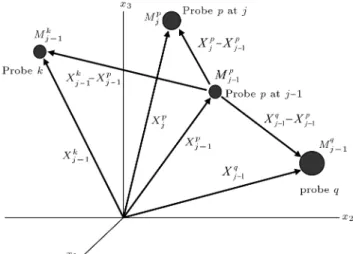
With these theoretical underpinnings, an optimisation problem can now be formulated using Eqs. (1)-(3) based on Newton's universal laws of gravitation. Fig-ure 1 shows three probes k, p, and q, their positions, distances between them and their masses in DS. Probe p moves from position Xj 1p to the new position Xjp that changes the mass from Mj 1p to Mjp. Consider two probes k; p 2 Np with position vectors Xj 1k ; Xj 1p 2
XNdat time step j 1. An attraction force will act on
the probes creating an acceleration apj 1 described by Formato [18]:
apj 1= g
Np
X
k=1
k6=p
U Mk
j 1 Mj 1p
: Mk
j 1 Mj 1p
: Xj 1k X
p j 1
Xk
j 1 Xj 1p
; (4)
where Np is the total numbers of probes. > 0 and
Figure 1. Decision space of CFO in 3D with three probes k, p, and q.
be chosen. In the physical space, and are 1 and 3, respectively. In the CFO space, the user can choose > 0 and > 0, depending on the problem at hand based on experience with the problem. That is, and are free parameters and the user is free to assign a completely dierent variation of the gravitational acceleration dened by Eq. (4) in terms of mass and distance. In other words, the gravity in CFO is dierent than the real gravity. Simulation results reveal that the convergence of CFO algorithm is sensitive to the choice of values of and . The term U(:) in Eq. (4) is the unit step function, dened as:
U Mk
j 1 Mj 1p
=
(
1 if Mk
j 1 Mj 1p
0
0 otherwise (5)
The position vector of probe k at step j is dened by: Xk
j = Nd
X
l=1
xk
l;j^el; (6)
where xk
l;j are probe k's coordinates and ^el is the
unit vector along the xl axis. Nd is the number of
dimensions (or axes) of the decision space.
In CFO, there are a total of Np probes
y-ing through the Nd-dimensional decision space as a
function of time along the trajectories determined by acceleration and position vectors. At each time step, the probes move to new positions, which create a new probe distribution. A physically realizable mass does not exist in CFO space. A tness function is dened for the given optimisation problem. The tness function value of each probe is called the mass in CFO. The tness at the location of the k-th probe at time step j 1 is dened by:
Mk
j 1= f xk1;j 1; xk2;j 1; :::; xkNd;j 1
; (7)
where Mk
j 1, k = 1; :::; p 1; p; p + 1; :::; Np are the
tness function values (or masses) in the CFO space. f(:) is the tness function and xk
l;j 1 are the decision
variables of the optimisation problem. The probes that are close to each other in the decision space are likely to have similar tness values, which will lead to an excessive gravitational force on the subject probe. In practice, the dierence between tness values is used as mass, for example, Mk
j 1 Mj 1p
. According to gravitational theory, real mass must be positive. Due to the dierence used, the term Mk
j 1 Mj 1p
can be negative or positive. Therefore, a unit step function U Mk
j 1 Mj 1p
is included to avoid the possibility of negative mass in CFO. It forces CFO to create only positive masses that are consequently attractive in nature. If negative masses were allowed, the corresponding accelerations would be repulsive instead of attractive. The eect of a repulsive gravitational force is to y probes away from large masses instead of attracting toward them. Thus, the mass in CFO is dened as the dierence of tness raised to the power multiplied by the unit step function U(:):
U Mk
j 1 Mj 1p
Mk
j 1 Mj 1p
: (8)
The term U Mk
j 1 Mj 1p
Mk
j 1 Mj 1p
in the numerator in Eq. (4) is the tness function correspond-ing to the mass. As explained earlier, > 0 is a free parameter. It is usually set to 1 [22].
The distance between two masses Mk j 1 and
Mj 1p is given by the Euclidean distance between the positions of two probes k and p at time step j 1 dened by the following relation:
Xk
j 1 Xj 1p =
v u u tXNd
l=1
Xj 1k;l Xj 1p;l 2: (9) The term Xk
j 1 Xj 1p in the denominator in
Eq. (4) is used to represent the distance between two probes.
The update of position vector for probe p at time step j is calculated by adding the distance to the previous position, that is:
Xjp= Xj 1p + Sjp: (10)
The distance Sjptravelled by the probe p due to initial velocity V0p and acceleration apj 1 from time step j 1 to time step j is given by:
Sjp= V0pt +12apj 1t2: (11)
The position of probe p at time step j is given by: Xjp= Xj 1p + V0pt +12apj 1t2; j 1: (12)
the time increment t have been used primarily as a formalism to preserve the analogy to gravitational kinematics. The initial velocity V0p is considered 0 and the time step increment t is actually the time dierence between two time steps, i.e. j (j 1) = 1, hence t is unity here. Thus, Eq. (12) becomes:
Xp
j = Xj 1p +12apj 1; j 1: (13)
The new positions of probes are calculated using Eq. (13). It is important to note that the terminology in Eq. (13) is chosen to reect the CFO metaphor, for example the factor 1
2 in Eq. (13) comes from Eq. (12)
after setting the values of initial velocity and time dierence. There is no specic signicance for the factor. Therefore, some researchers have dropped the factor 1
2 in Eq. (13) [29]. A possible problem with the
calculation of new position vectors using Eq. (13) is that some positions may fall outside of the DS and CFO may search regions outside the DS. Formato [18] suggested a simple deterministic repositioning scheme for avoiding an unallowable search space and repairing infeasible solutions as follows:
Xj;ip = 8 > > > > < > > > > :
xmin
i + Frep: Xj;ip xmini
if Xj;ip < xmin
i
xmax
i Frep: Ximax xpj;i
if Xj;ip > xmax
i
(14)
where xmin
i and xmaxi are the lower and upper bounds
of the i-th decision variable, respectively, and Frep is
an arbitrary repositioning factor specied by the user within the range of 0 Frep 1.
Another relocation mechanism is to reposition the probes randomly. While CFO has been shown to be promising in terms of solution quality and functional evaluations, the computational time required to solve optimisation problems is often high compared with other algorithms. Studies have shown that this in-creased computational time is due to the computations used to update the acceleration of each probe [30].
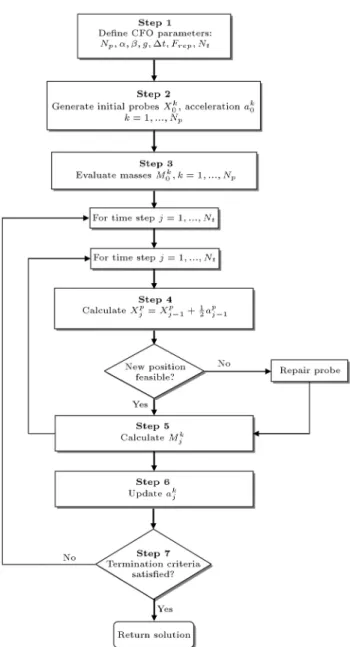
To summarise, CFO algorithm is a deterministic metaheuristic algorithm for solving optimisation prob-lems. Most optimisation problems are formulated as minimisation problems, but that CFO usually performs maximisation, which, of course, is the same as minimis-ing f(x). CFO algorithm consists of two simple equa-tions; Eq. (4) for a probe's acceleration and Eq. (13) for its position vector in the search space. With the above background and assumptions, implementation of CFO algorithm is simple. A owchart for the CFO algorithm is presented in Figure 2.
4. Parameters of CFO algorithm
The main issue in CFO is selection or estimation of the parameter values. There are, in general, seven
Figure 2. Flowchart of the CFO algorithm.
parameters in CFO that are required to be initialised, controlled, or tuned by the user in order to achieve a desired optimal performance for the algorithm. They are the total number of probes Np, repositioning factor
Frep, gravitational constant G, parameters and
required for computation of acceleration, time interval t, and maximum number of iterations Nt.
Formato [31] empirically found that CFO's per-formance depends mostly on the number of probes Np and its initial distribution. Parameters and
provide exibility for the implementation of the CFO algorithm. In general, and are found empirically. In most of CFO applications reported in the literature, and are set to 2 across a wide range of test functions and applications.
The repositioning factor 0 Frep 1 has a
sig-nicant inuence on the convergence of the algorithm. Formato [31] used a simple and deterministic approach
to set values of Frep from a starting value, increase it
by some predetermined value Frep, to a nal value
of 1. At each step, the current and previous 4 tness values are stored in a 5-element array. Frep starts
at a value of 0.5 and is increased by 0.005 whenever the absolute values of the dierence between the 5th array element and elements 3, 4, and 5 dier by less than 0.0005. If increasing Frep in this way results
in Frep 1, then Frep is reset to the starting value.
The starting value of Frep, increment Frep, and the
tness tolerance are determined empirically. Certain values of Frepcan also help avoid local trapping of the
algorithm. Local trapping of CFO algorithm can be measured by the normalised average distance, denoted as Davg. Oscillation in Davg curve is an indication of
local trapping and a convergence diculty. Changing Frepat each step by some small increment appears to
mitigate local trapping in most cases.
Very often, G is chosen the same as or . The parameter t is the time interval between steps during which the acceleration is constant. It is chosen to reect CFO's gravitational metaphor and is usually set to 1. G and t have direct analogues in the equations of motion for real masses moving under gravity. Some researchers combine the constant values of G and t into a single coecient, but there is still the possibility to vary these two parameters, individually [31]. The maximum number of iterations Nt has been chosen
between 250 and 300 in most applications reported in the literature. Another possible parameter is the initial probe acceleration a0which is usually set to zero. Some
researchers consider it as a parameter to change [31,32]. 5. Decision space and probe distribution The global optimum in CFO depends on the probe distribution within the decision space. The CFO algorithm is sensitive to initial probe distribution which is dened by two variables: the total number of probes Npand where the probes are placed inside the decision
space. Dierent suggestions have been made on how to distribute the probes within the search space, such as uniform distribution across the axis of each dimension, uniform distribution on the diagonals of the problem space, or random distribution across the search space. Researchers have shown that the CFO algorithm is sensitive to distinctive topological distributions and these topologies can be mapped to certain mathemati-cal functions [33]. Researchers have used topologies to improve the local search and avoid the trapping in local maxima. Toscano-Pulido et al. [34] rst studied the eect of neighbourhood topologies in the behaviour of Particle Swarm Optimisation (PSO) algorithm. They investigated distinct neighbourhood topologies such as ring, fully connected, mesh, star, toroidal, and static tree. Green et al. [30] showed that CFO and PSO
share some common features and some neighbourhood topologies used in PSO algorithm provide clues to the application of such neighbourhood topologies in the CFO algorithm. Green et al. [30] noted that the neighbourhood topologies used by Toscano-Pulido et al. [34] for PSO can also be applied to CFO to ensure a good distribution of search points within the decision space.
6. Variants of CFO
Several dierent formulations for calculation of the mass, acceleration, and position have been proposed to improve the quality of solution and convergence speed. A number of modications of parameters have been proposed to improve the exploration and exploitation of the search space. Some of the variants of CFO algorithm are discussed in this section.
6.1. Extended CFO (ECFO)
To enhance the global search ability of CFO and speed up its convergence, Ding et al. [35] proposed an Extended CFO (or ECFO) by dening a new mass function which is updated in an adaptive fashion based on historical information (using values from previous iterations).
A balance between exploitation and exploration in CFO is sought for general problems. In CFO, the mass is dened as positive by using the unit step function. In ECFO, a new landscape of mass is introduced by dening a new unit step function based on an adaptive mean threshold. The total relative masses are adjusted to dierent probe distributions, adaptively. The adaptive mean threshold is dened as:
Mamt j 1 =N 1
p 1 Np
X
k=1
k6=p
Mk
j=1 Mj 1p
: (15)
The unit step function is then dened based on the value of the adaptive mean threshold:
U(z) = (
1 if z Mamt j 1
0 else (16)
This denition of unit step function, Eq. (16), expands the gravitational range of both larger and smaller probes and helps exploit the search space globally more eectively.
A second modication, included in ECFO, is the addition of a weighted historical experience of acceler-ation term to the calculacceler-ation of position in Eq. (13). Although Newton's motion law says that the velocity term in Eq. (12) is necessary, it is avoided for sim-plicity in most of the CFO implementations [30,36,37]. The historical velocity information, i.e. the last ini-tial velocity, is similar to the inertia term used in
PSO. A larger inertia weight changes the dynamic searching process, intrinsically, to achieve better global exploration [38,39]. Therefore, a weighted historical experience term apj 2t is added to the original CFO and the position information is calculated according to the equation as follows:
Xjp= Xj 1p + apj 2t +12apj 1t2: (17)
Meanwhile, the cost of nding optimal initial distri-bution is reduced accordingly. A rigorous convergence proof of ECFO is provided by Ding et al. [35].
6.2. Pseudo-Random CFO (PR-CFO)
CFO algorithm is inherently deterministic, wherein the decision space is searched by using a population of probes governed by the laws of motion. It is evident from the empirical investigations of PSO and ACO that these algorithms fail if the randomness is removed from the algorithms' implementation. Therefore, in order to improve the basic algorithm, randomness is introduced into the algorithm, indirectly, without aecting the deterministic nature of the algorithm. This new version of CFO with adjustment to include near-stochastic characteristics is called Pseudo-Random CFO (PR-CFO) [32].
The pseudo-randomness is introduced into the original CFO algorithm in three ways:
(i) Initial probe distribution;
(ii) Repositioning factor;
(iii) Dynamic decision space bounds.
A variable initial probe distribution is an eective way to inject randomness into the CFO algorithm and to provide a better sampling of the decision space than a static distribution. In the original CFO algorithm, Formato [18] suggested a simple mechanism of deterministic repositioning and repairing infeasible solutions using Eq. (14), where the repositioning factor Frepis an empirical parameter with values in the range
of 0 Frep 1 and specied by the user. In
PR-CFO, a variable Frep is dened by Frep Frep 1,
where Frepis the step increment. Frephas the eect
of pseudorandom distribution of probes throughout the DS. In order to achieve a better convergence speed, the DS is gradually reduced around the location of the best probe by using Frep. This eventually redistributes the
probes within a smaller DS.
6.3. Parameter-Free CFO (PF-CFO)
The most troublesome part in implementation of meta-heuristic algorithms is the selection of values for their parameters considering the following unsettling facts:
(i) There is no methodology for choosing good val-ues;
(ii) Parameter values are very often problem-specic;
(iii) Solutions are often sensitive to small changes;
(iv) Setting of the same parameters never yields the same results due to the inherently stochastic nature of the algorithms.
Therefore, a simple strategy would be to eliminate or reduce some of the parameters. Parameter-Free CFO (PR-CFO) is a modication of the original CFO to reduce the number of parameters that must be tweaked in order to generate suciently good re-sults [40]. In PF-CFO, the attraction force of two probes k; p 2 Np with position vectors Xj 1k ; Xj 1p 2
XNd at time step j 1 causes an acceleration ap
j 1on
the probe p. The acceleration apj 1 is described in a parameter-free form as:
apj 1=
Np
X
k=1
k6=p
U Mk
j 1 Mj 1p
: Mk
j 1 Mj 1p
=1
: Xj 1k X
p j 1
Xk
j 1 Xj 1p =1
: (18)
The three parameters, the gravitational constant G and and , are eliminated by setting them all equal to a xed value of one, G = 1, = 1, and = 1. This simplies the PF-CFO equation substantially. The unit step function U(:) remains the same as the original CFO. The second equation of motion in PF-CFO is the position vector Xjp2 XNdwhich is now dened as:
Xjp= Xj 1p + apj 1; j 1: (19) It is important to note that the new position of probe is calculated using Eq. (19), where the factor 1
2 in
Eq. (13) is also dropped as there is no real signicance to this factor in implementation of CFO [29]. Thus, the PF-CFO can now be described by the two simplied equations of motions (Eqs. (18) and (19)). The internal parameters such as the number of probes Np,
repositioning factor Frep, Frep, and the maximum
number of iterations Ntremain the same. Formato [40]
applied the PF-CFO algorithm to 23 unimodal and multimodal benchmark functions.
6.4. Improved CFO
Based on the empirical performance studies of the orig-inal CFO algorithm, it is found that the performance of the algorithm depends on the initial probe distribution, signicantly [37]. Decision space reconguration or adaptation helps the CFO algorithm exploit the search space more eectively and improve convergence speed. Formato [41] presents an improved CFO algorithm by introducing variable initial probe distribution and DS adaptation. The initial probe distribution is dened by
two variables: (i) the total number of probes Np, and
(ii) the dimension of the decision space Nd. A
well-distributed initial probe distribution can be formed by an orthogonal array of Np=Nd probes per dimension
deployed uniformly on each probe's lines determined by a distribution factor . The position vector X is dened as:
X = Xmin+ (Xmax Xmin) ; (20)
where Xmin=PNi=1d=2xmini ^eiand Xmax=PNi=1d=2xmaxi
^ei are the positions of the diagonal's endpoints. Here,
Nd = 2 for 2-dimensional DS. The DS is dened
by xmin
i xi xmaxi and 1 i Nd where xi
is the decision variable. The parameter 2 [0; 1] determines where the probe lines intersect with the diagonal. Using this simple notion, the initial probe distribution can be generalised for Nd-dimensional DS,
and Nd number of probe lines can be drawn in the
DS parallel to Nd-coordinates. Formato [41] presented
a number of examples of initial probe distribution for 2D and 3D decision spaces with varying values of the parameter .
An ecient local search mechanism would exploit the local decision space eectively, avoid unnecessary iterations, and improve overall convergence speed. Adaptive reconguration of the decision space is a suitable mechanism to reduce the size of DS around the location of the probe with the best tness. The decision space boundary is reduced by one-half the distance from the best probe's position to the boundary of each coordinate, dened as:
x0min
i = xmini +Xbest:^ei x min i
2 ; (21)
x0max
i = xmaxi +x max
i Xbest:^ei
2 ; (22)
where xi is the decision variable, and x0i is the new
boundary of decision space. It is to be noted that Xbest
may also change in each iteration. Changing decision space boundary every 10 steps seems to provide good result [37,41]. The performance of ICFO algorithm has been assessed using recognised antenna benchmark problems.
Liu and Tian [42] proposed a Multi-start CFO (MCFO) algorithm by combining a multi-start strategy with CFO to overcome the problem of premature convergence. The performance of the MCFO approach is evaluated on a comprehensive set of benchmark functions.
7. Applications to engineering problems
Dierent engineering applications of CFO and its vari-ants are presented in this section.
7.1. Electronic circuit design
Formato [18] applied the CFO algorithm to a stan-dard electronic circuit problem, such as Fano Load Equaliser. Roa et al. [43] applied CFO algorithm to design a simple electronic circuit comprising nonlinear element, such as a diode which makes it dicult for electronic circuit design. Roa et al. [43] also applied the CFO algorithm to the Buck converter with increasing load. Buck converter is a voltage step down and current step up converter, remarkably ecient, making it useful for converting the main voltage in a computer down to the 0.8-1.8V required by the processor.
7.2. Antenna design
The linear array antenna comprises 2Nd elements
equally spaced by a half wavelength (=2) and po-sitioned symmetrically about the origin along x-axis. The array factor is simplied to:
F ('; x0 i) = 2
Nd
X
i=1
cos (x0
icos ') ; (23)
where x0
i==2xi is the normalised xi, i = 1; 2; :::; Nd; Nd
is the maximum dimensionality of CFO decision space; and xi is the coordinate of the ith element, uniformly
spaced. The array factor F ('; x0
i) has a maximum
value of 2Nd. The array's normalised radiation pattern
(or directivity) in dB is given by: D0('; x0
i) = 10 log10
1
2NsF (':x 0 i)
2
: (24)
The objective of the optimisation problem is to meet specic design criteria for the array's pattern by chang-ing the positions of the array elements xi, xmini
xi xmaxi , i = 1; 2; :::; Nd. The CFO algorithm has to
determine the array element coordinates xi. The choice
of Nd is important to maximise the tness function
dened by Eq. (24). The constraints are the main lobe beamwidth BW [D0('; x0
i)] 7:7, the maximum side
lobe level SLL [D0('; x0
i)] 15 dB, and the deep
null in the direction 'null[D0('null; x0i)] = 81 and
'null[D0('null; x0i)] = 99 in a 32-element array [44].
This is a constrained optimisation problem as xi must
meet the requirement that no array elements occupy the same position, i.e. xi 6= xj for i 6= j and i; j =
1; 2; :::; Nd. Formato [18] applied CFO algorithm to
design a 32-element array using 1 pattern resolution
in a decision space dened by 0:1 x0
i 32:5, i =
1; 2; :::; 16.
CFO was subsequently applied to many other antenna design problems. Microstrip patch antennas are widely used in wireless and mobile communication systems because of their low prole, light weight, and ease of fabrication. The objective is to determine the geometric parameters of the antenna by satisfying
certain performance criteria. Qubati and Dib [45] applied a modied CFO algorithm to design microstrip patch antenna. Qubati et al. [46] applied the CFO algorithm to design optimisation of a 32-element linear array and a 10-element non-uniform circular array antenna.
Bluetooth technology (2.4-2.484 GHz) has been widely used in portable devices and Ultra-Wideband (3.1-10.6 GHz) has been widely used in various radars and communication systems as well as indoor and handheld devices. To design light-weight consumer products, it is necessary to integrate Ultra-Wideband (UWB) with Bluetooth wireless technology. A simple solution would be to have a single antenna to work in both UWB and Bluetooth. The problem is that some existing narrow band communication systems, such as WLAN (5.15-5.825 GHz), interfere with UWB systems. To minimise potential interference, researchers try to design antennas with band-notched characteristic [47]. Montaser et al. [48] applied the CFO algorithm to optimise an E-shaped patch antenna for Bluetooth and UWB applications with WLAN band notched characteristics.
Pantoja et al. [49] created ve antenna benchmark problems, known as PBM suite, to test eectiveness of evolutionary algorithms. The benchmark problem one is the most dicult unimodal problem. Formato [41] applied the improved CFO algorithm to PBM bench-mark problem one. The objective is to maximise a centre-fed dipole's directivity D(L; ) as a function of its total length L and the polar angle . The improved CFO algorithm was able to determine the global maximum with a value slightly higher than the value computed by a numerical electromagnetic code.
Asi and Dib [50] applied CFO algorithm to optimal design of multi-layer microwave absorbers in a specic frequency range. Multilayer microwave absorbers are important elements of many civil and military electronic equipments used for minimising electromagnetic reection from metal plates, such as aircrafts, ships, tanks, and many other electronic appliances. Optimal characteristics can be obtained by varying dierent parameters of the absorbers. These parameters are number of layers, thickness of layers, dielectric constant, permeability, frequency, angle of incidence, and wave polarisation [51]. The challenge in designing an absorber is minimisation of the reection coecient of an incident wave on a multilayer structure for a range of frequencies and incidence angles. CFO has been applied to the absorber design to achieve the maximum reection coecient.
The notion of increasing antenna bandwidth by adding impedance loading has been around for a long time. Formato [52] applied the parameter-free CFO algorithm to maximise the antenna bandwidth of a loaded monopole antenna. Mahmoud [53] proposed a
hybrid method combining CFO with Nelder-Mead al-gorithm, called CFO-NM, for improving local optimiser and applied it to optimise rectangular microstrip patch antennas. Montaser et al. [48] also applied the hybrid CFO-NM algorithm to optimise triple band dual bow-tie slot antenna for RFID applications. Variable Z0
is a new concept in antenna design. Dib et al. [54] used the CFO algorithm to optimise an ultra-wideband meander monopole antenna. An improved performance is observed for variable Z0design using CFO.
7.3. Water pipe networks
Leak detection and reduction of friction factors in water supply and distribution networks is an important engineering issue, since leaks and ruptures in such networks cause major physical damage, operational disruption, and high operating pressure level with potential for huge economic cost. Ecient detection of leaks and locations is thus required in order to eectively control water losses and to quickly repair the system. A benchmark water pipe network was introduced by Pudar and Liggett [55] consisting of 11 pipes and 7 nodes with a reservoir at node 1 that feeds the water into the network system at constant inow under gravitation, a constant inow at node 7 that supplies water into the network at node 7, and a small leak at node 2. All pipes have uniform diameter, length, and speed of water. Initially, there is a steady outow at node 4. Inverse Transient Analysis (ITA) has been used for leak detection, location identication, and calibration of friction in pressurised pipe networks by many researchers [56,57]. The method is based on the minimisation of mean square errors between measured and calculated state variables (pressures or ow rates). Based on this concept, the water pipe network is then modelled as a function of unknown variables. The leakage detection can now be formulated as a minimisation problem. The indirect approach to solve the ITA problem of parameter optimisation can be set as the minimisation of weighted mean square errors between observed and computed pressures at a number of measurement sites (i.e., piezometric heads) in the pipe network. Haghighi and Ramos [58] used a simplied version of the objective function, dened by:
min
z F = mH
X
t=1 nH
X
j 1
Hd
t;j Ht;jo
2
; (25)
where F is the objective function to be minimised, z is the set of decision variables, mH is the number
of observed hydraulic transient events t, Hd
t;j is the
desired pressure of the piezometric heads at site j, Ho t;j
is the corresponding observed piezometric heads at site j for transient event t, and nHis the number of pressure
observation sites j in the system.
Ideally, F is close to zero. Researchers applied various optimisation techniques to the benchmark
wa-ter pipe network problem. For example, Soares et al. [57] and Vtkovsky0 et al. [59] used GA to solve
the optimisation problem. Haghighi and Ramos [58] used the CFO algorithm to solve ITA-based approach to minimisation problem of the pipe network system. Nodes 4 and 7 are chosen as the measurement sites where pressures are sampled. All nodes, except the reservoir node, and friction factors are considered unknown, resulting in 17 unknown variables to be optimised. CFO was applied to the pipe network problem with 36 probes. Authors report that CFO is computationally more ecient than GA.
7.4. Training of Neural Networks
Neural networks need a training or learning rule, such as backpropagation [60,61], adaptive conjugate gradient learning [62], dictionary learning [63] among others [64-69]. In recent years, evolutionary and soft computing approaches have been employed for training of neural networks, such as GA [70] and fuzzy logic [71-74].
Green et al. [30] appear to be the rst to apply CFO algorithm to train a neural networks representing a logical XOR (exclusive-OR) function. The XOR problem is one of the benchmark problems for testing training algorithms because it is not linearly separable and complex enough for the backpropagation learning algorithm [75] to be trapped in local minima. XOR problem exhibits local minima [76]. The network consists of one input layer with two neurons, a single hidden layer containing three neurons with a sigmoidal activation function and one output layer neuron with linear activation function. All biases are set to zero.
The problem is to nd the weights of the network connection for the given architecture to produce the correct output for the XOR function for each corre-sponding input. Thus, for the given architecture, to solve the XOR function, 9 weights have to be optimised. The weights training of neural networks can be carried out by minimising the mean squared of the error (MSE) function dened by:
MSE(w) = min
w
( 1 N
N
X
i=1
(yi ^yi)2
)
; (26)
where yiis the target output and ^yiis the actual output
of the network.
Green et al. [30] use the CFO algorithm to train two dierent neural network architectures for classi-cation of the UCI Iris data set using three and ve neurons in the hidden layer. The Iris data set consists of 150 samples. The objective of the CFO algorithm is to minimise the MSE. PF-CFO was applied to train the neural networks wherein initial velocities and ac-celerations were set to zero. Uniform-on-diagonal and uniform-on-axis methods were used for initial probe
distribution. PF-CFO resulted in a tness value of zero when applied to networks for XOR function. CFO is found to be sensitive to initial probe distribution for Iris data classication and uniform-on-axis initial probe distribution approach shows good results. Chao et al. [29] applied distributed multi-objective CFO algorithm to optimise individual network components of a neural network ensemble and showed that the CFO is capable of achieving better solutions in terms of convergence speed and local minima compared to PSO. 7.5. Other applications
Clustering is a signicant issue in complicated pattern recognition problems and has been the focus of sub-stantial research in recent years [5,77-80]. For example, Ahmadlou and Adeli [81] developed an Enhanced Prob-abilistic Neural Network (EPNN) with local decision circles that increases robustness of the original PNN.
Chen et al. [82] applied a modied CFO method to solve the complicated path-optimisation problem for the rotary wing vertical take-o and landing of unmanned aerial vehicles with improved performance over the original CFO.
8. Conclusions
CFO algorithm is a deterministic search and opti-misation algorithm based on gravitational mechanics. Because CFO is deterministic, it is straightforward and reproducible. CFO algorithm has already attracted signicant interest from research community which will help its further development. CFO is computationally intensive and demands large computational resources, especially computation time, which is the major obsta-cle of CFO for new applications.
References
1. Campomanes- Alvareza, B.R., Cordon, O. and Dama-sa, S. \Evolutionary multi-objective optimization for mesh simplication of 3D open SModels", Inte-grated Computer-Aided Engineering, 20(4), pp. 375-390 (2013).
2. Hejazi, F., Toloue, I., Noorzaei, J. and Jaafar, M.S. \Optimization of earthquake energy dissipation system by genetic algorithm", Computer-Aided Civil and In-frastructure Engineering, 28(10), pp. 796-810 (2013).
3. Joly, M.M., Verstraete, T. and Paniagua, G. \In-tegrated multidelity, multidisciplinary evolutionary design optimization of counterrotating compressors", Integrated Computer-Aided Engineering, 21(3), pp. 249-261 (2014).
4. Reyes, O., Morell, C. and Ventura, S. \Evolutionary feature weighting to improve the performance of multi-label lazy algorithms", Integrated Computer-Aided En-gineering, 21(4), pp. 339-354 (2014).
5. Menendez, H., Barrero, D.F. and Camacho, D. \A ge-netic graph-based approach to the partitional cluster-ing", International Journal of Neural Systems, 24(3), 1430008 (19 pages) (2014).
6. Lin, D.Y. and Ku, Y.H. \Using genetic algorithms to optimize stopping patterns for passenger rail trans-portation", Computer-Aided Civil and Infrastructure Engineering, 29(4), pp. 264-278 (2014).
7. Forcael, E., Gonzalez, V., Orozco, F., Vargas, S., Moscoso, P. and Pantoja, A. \Ant colony optimization model for tsunamis evacuation routes," Computer-Aided Civil and Infrastructure Engineering, 29(10), pp. 723-737 (2014).
8. Hsu, W.Y. \Application of quantum-behaved particle swarm optimization to motor imagery EEG classica-tion", International Journal of Neural Systems, 23(6), 1350026 (15 pages) (2013).
9. Zeng, Z., Xu, J., Wu, S. and Shen, M. \Antithetic method-based particle swarm optimization for a queu-ing network problem with fuzzy data in concrete trans-portation systems", Computer-Aided Civil and Infras-tructure Engineering, 29(10), pp. 771-800 (2014).
10. Montalvo, I., Izquierdo, J., Herrera, M. and Perez-Garca, R. \Water distribution system computer-aided design by agent swarm optimization", Computer-Aided Civil and Infrastructure Engineering, 29(6), pp. 433-448 (2014).
11. Wu, J.W., Tseng, J.C.R. and Tsai, W.N. \A hybrid linear text segmentation algorithm using hierarchical agglomerative clustering and discrete particle swarm optimization", Integrated Computer-Aided Engineer-ing, 21(1), pp. 35-46 (2014).
12. Szeto, W.Y., Wang, Y. and Wong, S.C. \The chem-ical reaction optimization approach to solving the environmentally sustainable network design problem", Computer-Aided Civil and Infrastructure Engineering, 29(2), pp. 140-158 (2014).
13. Adeli, H. and Park, H.S. \A neural dynamics model for structural optimization - Theory", Computers and Structures, 57(3), pp. 383-390 (1995).
14. Adeli, H. and Park, H.S. \Optimization of space struc-tures by neural dynamics", Neural Networks, 8(5), pp. 769-781 (1995).
15. Adeli, H. and Park, H.S. \Neurocomputing for design automation", CRC Press, Boca Raton, Florida (1998).
16. Park, H.S. and Adeli, H. \A neural dynamics model for structural optimization - Application to plastic design of structures", Computers and Structures, 57(3), pp. 391-399 (1995).
17. Park, H.S. and Adeli, H. \Distributed neural dynamics algorithms for optimization of large steel structures", Journal of Structural Engineering, ASCE, 123(7), pp. 880-888 (1997).
18. Formato, R.A. \Central force optimization: A new metaheuristic with applications in applied electromag-netics", Progress in Electromagnetics Research, PIER, 77(1), pp. 425-491 (2007).
19. Amini, F., Khanmohamadi Hazaveh, N. and Abdolahi Rad, A. \Wavelet PSO-based LQR algorithm for optimal structural control using active tuned mass sampers", Computer-Aided Civil and Infrastructure Engineering, 28(7), pp. 542-557 (2013).
20. Shafahi, Y. and Bagherian, M. \A customized particle swarm method to solve highway alignment optimiza-tion problem", Computer-Aided Civil and Infrastruc-ture Engineering, 28(1), pp. 52-67 (2013).
21. Iacca, G., Carani, F. and Neri, F. \Multi-strategy coevolving aging particle optimization", International Journal of Neural Systems, 24(1), 1450008 (19 pages) (2014).
22. Formato, R.A. \Central force optimization: A new nature inspired computational framework for multidimensional search and optimization", In N. Krasnogor, G. Nicosia, M. Pavone, & D.A. Pelta (Eds.), NICSO, Studies in Computational Intelligence, Springer-Verlag, 129, pp. 221-238 (2007).
23. Adeli, H. and Hung, S.L., Machine Learning - Neural Networks, Genetic Algorithms, and Fuzzy Sets, John Wiley and Sons, New York (1995).
24. Adeli, H. and Kumar, S., Distributed Computer-Aided Engineering for Analysis, Design, and Visualization, CRC Press, Boca Raton, Florida (1999).
25. Adeli, H. and Sarma, K., Cost Optimization of Struc-tures - Fuzzy Logic, Genetic Algorithms, and Parallel Computing, John Wiley and Sons, West Sussex, United Kingdom (2006).
26. Marion, J., Classical Dynamics of Particles and Sys-tems, 2nd edition, Harcourt Brace Jovanovich, New York, NY (1970).
27. Fuggini, C., Chatzi, E., Zangani, D. and Messervey, T.B. \Combining genetic algorithm with a meso-scale approach for system identication of a smart polymeric textile", Computer-Aided Civil and Infrastructure En-gineering, 28(3), pp. 227-245 (2013).
28. Zhu, W., Hu, H. and Huang, Z. \Calibrating rail transit assignment models with genetic algorithm and automated fare collection data", Computer-Aided Civil and Infrastructure Engineering, 29(7), pp. 518-530 (2014).
29. Chao, M., Xin, S.Z. and Min, L.S. \Neural net-work ensembles based copula methods and distributed multi-objective central force optimisation algorithm", Engineering Applications of Articial Intelligence, 32, pp. 203-212 (2014).
30. Green, R.C., Wang, L. and Alam, M. \Training neural networks using central force optimization and particle swarm optimization: Insights and comparisons", Ex-pert Systems with Applications, 39, pp. 555-563 (2012).
31. Formato, R.A. \Central force optimization: A new de-terministic gradient-like optimization metaheuristic", Journal of the Operations Research Society of India, 46(1), pp. 25-51 (2009).
32. Formato, R.A. \Pseudorandomness in central force optimization", British Journal of Mathematics and Computing, 3(3), pp. 241-264 (2013).
33. Formato, R.A. \Central force optimisation: A new gradient-like meta-heuristic for multidimensional search and optimisation", International Journal of Bio-Inspired Computation, 1(4), pp. 217-238 (2009).
34. Toscano-Pulido, G., Reyes-Medina, A.J. and Ramirez-Torres, J.G. \A statistical study of the eects of neighbourhood topologies in particle swarm optimi-sation", in: Computational Intelligence, K. Madani, A. Correria, A. Rosa, and J. Filipe, Eds., Springer Verlag, Berlin, Heidelberg, Studies in Computational Intelligence, 343, pp. 179-192 (2011).
35. Ding, D., Qi, D., Luo, X., Chen, J., Wang, X. and Du, P. \Convergence analysis and performance of an extended central force optimisation algorithm", Applied Mathematics and Computation, 219(4), pp. 2246-2259 (2012).
36. Formato, R.A. \Central force optimization applied to the PBM suite of antenna benchmarks", Comput-ing Research Repository, vol. abs/1003.0221, [Online]. Available: http://arxiv.org/abs/1003.0221 (2010).
37. Formato, R.A. \Comparative results: Group search optimizer and central force optimization", Comput-ing Research Repository, vol. abs/1002.2798, [Online]. Available: http://arxiv.org/abs/1002.2798 (2010).
38. Bergh, F.V.D. and Engelbrecht, A.P. \A study of particle swarm optimization particle trajectories", In-formation Sciences, 176, pp. 937-971 (2006).
39. Jiang, M., Luo, Y.P. and Yang, S.Y. \Stochastic convergence analysis and parameter selection of the standard particle swarm optimization algorithm", In-formation Processing Letters, 102, pp. 8-16 (2007).
40. Formato, R.A. \Parameter-free deterministic global search with central force optimization", Computing Research Repository, vol. abs/1003.1039, [Online]. Available: http://www.springerlink.com/content/ d45u6135702015wq/ (2010).
41. Formato, R.A. \Improved CFO algorithm for antenna optimization", Progress in Electromagnetics Research, PIER B, 19, pp. 405-425 (2010).
42. Liu, Y. and Tian, P. \A multi-start central force optimization for global optimization", Applied Soft Computing, 27, pp. 92-98 (2015).
43. Roa, O., Amaya, I., Ramirez, F. and Correa, R. \Solution of nonlinear circuits with the central force optimization algorithm", Proceedings of the IEEE 4th Colombian Workshop on Circuits and Systems, Bar-ranquilla, Colombia, November 2012, pp. 1-6 (2012).
44. Rajo-Iglesias, E. and Quevedo-Teruel, O. \Linear ar-ray synthesis using an ant colony optimization based algorithm", IEEE Ant. Prop. Mag., 49(2), pp. 70-79 (2007).
45. Qubati, G.M. and Dib, N.I. \Microstip patch antenna optimization using modied central force optimiza-tion", Progress in Electromagnetics Research B, 21, pp. 281-298 (2010).
46. Qubati, G., Formato, R. and Dib, N.I. \Antenna benchmark performance and array synthesis using central force optimisation, microwaves", Antennas & Propagation, IET, 4(5), pp. 583-592 (2010).
47. Kim, Y. and Kwon, D.-H. \CPW-fed planar ultra wideband antenna having a frequency band notch function", Electronics Letters, 7, pp. 403-405 (2004).
48. Montaser, A.M., Mahmoud, K.R. and Elmikati, H.A. \Tri-band slotted bow-tie antenna design for RFID reader using hybrid CFO-NM algorithm", 29th Na-tional Radio Science Conference (NRSC 2012), Cairo University, Cairo, April 10-12, 2012, Egypt, pp. 119-126 (2012).
49. Pantoja, M.F., Bretones, A.R. and Martin, R.G. \Benchmark antenna problems for evolutionary opti-misation algorithms", IEEE Transactions on Antennas and Propagation, 55(4), pp. 1111-1121 (2007).
50. Asi, M.J. and Dib, N.I. \Design of multilayer mi-crowave broadband absorbers using central force op-timisation", Progress in Electromagnetics Research B, 26, pp. 101-113 (2010).
51. Macedo, J., de Sousa, M. and Dmitriev, V. \Opti-mization of wide band multilayer microwave absorbers for any angle of incidence and arbitrary polarization", Microwave and Optoelectronics, pp. 558-561 (2005).
52. Formato, R.A. \Central force optimization with vari-able initial probes and adaptive decision space", Ap-plied Mathematics and Computation, 217(21), pp. 8866-8872 (2011).
53. Mahmoud, K.R. \Central force optimization: Nelder-mead hybrid algorithm for rectangular microstrip an-tenna design", Electromagnetics, 31(8), pp. 578-592 (2011).
54. Dib, N., Sharaqa, A. and Formato, R.A. \Variable Z0 applied to optimal design of multi-stub matching net-work and meander monopole", International Journal of Microwave and Wireless Technologies, 6(5), pp. 505-514 (2014).
55. Pudar, R.S. and Liggett, J.A. \Leaks in pipe net-works", Journal of Hydraulics Engineering, 118(7), pp. 1031-1046 (1992).
56. Liggett, J.A. and Chen, L.C. \Inverse transient analy-sis in pipe networks", Journal of Hydraulic Engineer-ing, 120(8), pp. 934-955 (1994).
57. Soares, A.K., Covas, D.I.C. and Reis, L.F.R. \Leak de-tection by inverse transient analysis in an experimental PVC pipe system", Journal of Hydraulics, 13(2), pp. 153-166 (2011).
58. Haghighi, A. and Ramos, H.M. \Detection of leakage freshwater and friction factor calibration in drinking networks using central force optimization", Water Resources Management, 26(8), pp. 2347-2363 (2012).
59. Vtkovsky0, J.P., Simpson, A.R. and Lambert, M.F. \Leak detection and calibration issues using tran-sient and genetic algorithms", Journal of Water Re-source Planning and Management, 126(4), pp. 262-265 (2000).
60. Hung, S.L and Adeli, H. \Parallel backpropagation learning algorithms on cray Y-MP8/864 supercom-puter", Neurocomputing, 5(6), pp. 287-302 (1993).
61. Hung, S.L. and Adeli, H. \Object-oriented back prop-agation and its application to structural design", Neu-rocomputing, 6(1), pp. 45-55 (1994).
62. Adeli, H. and Hung, S.L. \An adaptive conjugate gradient learning algorithm for eective training of multilayer neural networks", Applied Mathematics and Computation, 62(1), pp. 81-102 (1994).
63. Huo, J., Gao, Y., Yang, W. and Yin, H. \Multi-instance dictionary learning for detecting abnormal event detection in surveillance videos", International Journal of Neural Systems, 24(3), 1430010 (15 pages) (2014).
64. Ghosh-Dastidar S. and Adeli, H. \A new supervised learning algorithm for multiple spiking neural networks with application in epilepsy and seizure detection", Neural Networks, 22(10), pp. 1419-1431 (2009).
65. Cona, F. and Ursino, M. \A multi-layer neural-mass model for learning sequences using theta/gamma os-cillations", International Journal of Neural Systems, 23(3), 1250036 (18 pages) (2013).
66. Cabessa, J. and Siegelmann, H.T. \The super-turing computational power of evolving recurrent neural networks", International Journal of Neural Systems, 24(8), 1450029 (22 pages) (2014).
67. Gurubel, K.J., Alanis, A.Y., Sanchez, E.N. and Carlos-Hernandez, S. \A neural observer with time-varying learning rate: analysis and applications", International Journal of Neural Systems, 24(1), 1450011 (15 pages) (2014).
68. Yang, Y.B., Li, Y.N., Gao, Y., Yin, H.J. and Tang, Y. \Structurally enhanced incremental neural learning for image classication with subgraph extraction", In-ternational Journal of Neural Systems, 24(7), 1450024 (13 pages) (2014).
69. Pinto, T., Vale, Z., Sousa, T.M., Praca, I., Santos, G. and Morais, H. \Adaptive learning in agents be-haviour: A framework for electricity markets simula-tion", Integrated Computer-Aided Engineering, 21(4), pp. 399-415 (2014).
70. Hung, S.L. and Adeli, H. \A parallel genetic/neural network learning algorithm for MIMD shared memory machines", IEEE Transactions on Neural Networks, 5(6), pp. 900-909 (1994).
71. Zhang, Y. and Ge, H. \Freeway travel time predic-tion using Takagi-Sugeno-Kang fuzzy neural network", Computer-Aided Civil and Infrastructure Engineering, 28(8), pp. 594-603 (2013).
72. Vlahogianni, E.I. and Karlaftis, M.G. \Fuzzy-entropy neural network freeway incident duration modeling with single and competing uncertainties", Computer-Aided Civil and Infrastructure Engineering, 28(6), pp. 420-433 (2013).
73. Jahani, E., Muhanna, R.L., Shayanfar, M.A. and Barkhordari, M.A. \Reliability assessment with fuzzy random variables using interval Monte Carlo simula-tion", Computer-Aided Civil and Infrastructure Engi-neering, 29(3), pp. 208-220 (2014).
74. Boutalis, Y., Christodoulou, M. and Theodoridis, D. \Indirect adaptive control of nonlinear systems based on bilinear neuro-fuzzy approximation", International Journal of Neural Systems, 23(5), 1350022 (18 pages) (2013).
75. Siddique, N. and Adeli, H., Computational Intelli-gence: Synergies of Fuzzy Logic, Neural Networks and Evolutionary Computing, John Wiley & Sons (2013).
76. Dayho, J.E., The Exclusive-OR: A Classic Problem, in Neural Network Architectures: An Introduction, New York, Van Nostrand Reinhold, pp. 76-79 (1990).
77. Kodogiannis, V.S., Amina, M. and Petrounias, I. \A clustering-based fuzzy-wavelet neural network model for short-term load forecasting", International Journal of Neural Systems, 23(5), 1350024 (19 pages) (2013).
78. Peng, F. and Ouyang, Y. \Optimal clustering of reil-road track maintenance jobs", Computer-Aided Civil and Infrastructure Engineering, 29(4), pp. 235-247 (2014).
79. Goncalves, N., Nikkila, J. and Vigario, R. \Self-supervised MRI tissue segmentation by discriminative clustering", International Journal of Neural Systems, 24(1), 1450004 (16 pages) (2014).
80. Chira, C., Sedano, J., Camara, M., Prieto, C., Villar, J.R. and Corchado, E. \A cluster merging method for time series microarray with product values", Interna-tional Journal of Neural Systems, 24(6), 1450018 (18 pages) (2014).
81. Ahmadlou, M. and Adeli, H. \Enhanced probabilistic neural network with local decision circles: A robust classier", Integrated Computer-Aided Engineering, 17(3), pp. 197-210 (2010).
82. Chen, Y., Yu, J. Mei, Y., Wang, Y. and Su, X. \Modied central force optimization (MCFO) algo-rithm for 3D UAV path planning", Neurocomput-ing, http://dx.doi.org/10.1016/j.neucom.2015.07.044i (2015).
Biographies
Nazmul Siddique is a Lecturer at the School of Computing and Intelligent Systems, University of Ul-ster. He obtained Dipl.-Ing. degree in Cybernetics from the Dresden University of Technology, Germany, MSc degree in Computer Science from Bangladesh University of Engineering and Technology, and PhD degree in Intelligent Control from the Department of Automatic Control and Systems Engineering, Uni-versity of Sheeld, England. His research interests include: cybernetics, computational intelligence, bio-inspired computing, stochastic systems, and vehicular
communication. He has published over 130 research papers in the broad areas of cybernetics, intelligent control, computational intelligence, and robotics. He authored/co-authored 3 books, and guest edited eight special issues of reputed journals on Cybernetic Intel-ligence, Computational IntelIntel-ligence, Neural Networks, and Robotics. He is a Fellow of the Higher Education Academy, a senior member of IEEE, and member of dierent committees of IEEE SMC Society and UK-RI Chapter. He has been involved in organising many national and international conferences and co-edited 7 conference proceedings. He is on the editorial board of seven international journals, including Editor-in-Chief of the International Journal of Automation and Control Engineering. He secured funding from DEL, DAAD, EU FP7-ICT, and Daiwa Anglo-Japanese Founda-tion.
Hojjat Adeli received his PhD from Stanford Uni-versity in 1976 at the age of 26. He is Professor of Civil, Environmental, and Geodetic Engineering, and by courtesy, Professor of Biomedical Engineering, Biomedical Informatics, Electrical and Computer En-gineering, Neuroscience, and Neurology at The Ohio
State University. He has authored over 530 research and scientic publications in various elds of com-puter science, engineering, applied mathematics, and medicine, including 15 books. In 1998, he received the Distinguished Scholar Award, from The Ohio State University \in recognition of extraordinary accomplish-ment in research and scholarship". He is the recipient of numerous other awards and honours such as The Ohio State University College of Engineering Lumley Outstanding Research Award (quadruple winner), Pe-ter L. and Clara M. Scott Award for Excellence in Engineering Education, and Charles E. MacQuigg standing Teaching Award, the 2012 IEEE-EMBS Out-standing Paper Award (IEEE Engineering in Medicine and Biology Society), a Special Medal from The Polish Neural Network Society in Recognition of Outstanding Contribution to the Development of Computational Intelligence, Eduardo Renato Caianiello Award for Ex-cellence in Scientic Research from the Italian Society of Neural Networks, and an Honorary Doctorate from Vilnius Gediminas Technical University, Lithuania. He is a Distinguished Member of ASCE, and a Fellow of AAAS, IEEE, AIMBE, and American Neurological Association.