An Investigation into the Inuence of Deformable
Dies on the Springback of Circular Plates
M. Kadkhodayan
1
The technique of Sheet Stamping by Deformable Forming Tools (SSDFT) has been recognized as a promising alternative to control the springback of sheet blanks. This paper deals with the springback of elastic-plastic circular plates on deformable dies subjected to transverse external forces. Dierent signicant parameters are examined within the framework of the present investigation. For instance, the inuence of the friction coecient between the workpiece and elastomer on the equivalent plastic strain and, therefore, on the springback, for dierent boundary conditions, are investigated in detail. Moreover, the eects of the thickness of the workpiece on the springback, for both deformable and conventional dies, are discussed.
INTRODUCTION
Computer modeling techniques are being used at an increasing rate for simulation of metal deformation processes involving sheet metal forming operations, because they allow understanding of the physical phe-nomena involved in processes. Indeed, the prediction of some process details at the design stage and reducing expensive trial and error methods in developing new processes or operations, are the most important conse-quences of computer modeling.
In sheet metal forming, a sheet blank is plastically deformed into a three-dimensional object without sig-nicant changes in sheet thickness and surface charac-teristics. In some cases, the magnitudes of permanent plastic and recoverable elastic deformations are com-parable; therefore, elastic recovery or springback may be signicant. In recent years, the elastomer forming technique (SSDFT) has received more attention in the sheet stamping industry and is being used, increasingly, as a pressure-transmitting medium, which is due to the introduction of a new range of materials. However, the topic is still challenging because it poses a three-body contact problem involving the determination of the interface stress. From a mechanical point of view, how-ever, to deal with the strong non-linearities associated with large plastic deformation and contact problems,
1. Department of Mechanical Engineering, University of Ferdowsi, P.O. Box 91775-1111, Mashhad, I.R. Iran.
almost only numerical methods, like FEM, can be employed. In the last decade, a number of parametric studies have been carried out to understand the com-bined eects of plate and foundation properties through the modeling of plate deformations. Zhang investigated the deformation mechanisms of sheet metals stamped by rigid punches and deformable dies. He developed a mechanics model to study the interface interaction oered by the die in plane-strain conditions [1]. In another study, Zhang and Lin proposed a mechanics model of stamping a thin strip on an elastic foundation. They generated a semi-analytical method to calculate interface forces between the thin strip and the rigid elliptical punch [2,3]. An experimental investigation into the deformation mechanisms of V-shaped sheet forming, using deformable punches and rigid dies, was also described by Zhang et al. [4]. A comprehensive review about the analytical and numerical analysis of springback in sheet metal forming was done by Zhang and Yu [5]. Recently, Silva, Silveria and Goncalves presented a numerical method for the analysis of plates on elastic foundations. But, in their model, the contact surface was assumed unbounded and frictionless [6].
The purpose of this paper is to investigate, numer-ically, the inuence of an elastomer die on springback in the bending of a circular plate. The numerical simulation of the stamping process is carried out using a general-purpose nite element analysis code, ANSYS. Various relevant parameters are examined within the framework of the present investigation.
For instance, the inuence of the friction coecient between the workpiece and elastomer on the equivalent plastic strain and, therefore, on the springback, for dierent boundary conditions, is investigated in detail. Moreover, the eects of the thickness of the workpiece on the springback, for both deformable and normal dies, are discussed.
PROBLEM DESCRIPTION AND
MODELING
Consider the stamping of a thin circular plate on an elastic foundation by a rigid cylindrical punch, Figure 1. As long as the maximum deection of the plate is not too large (it is taken as being wmax
t
2 in this study) and the plate and punch remain in contact, the contact stress between them can be assumed to be uniform. Although, by using the nite element analysis, such an assumption is unnecessary and the contact stress distribution can be the output of the deformation simulation. It was, however, realized by the author that this assumption does not cause many dierences in the results in the framework of the problem. A commercial FEM code, ANSYS 5.4, is employed to simulate the stamping process. The material is considered to be an elastic/perfectly plastic metal (thickness t, radius a, yield stress
Y = 200 MPa, Young's modulus E
s = 196 GPa, Poisson's ratio = 0:3) on an elastic die (a standard elastomer with Young's modulus, E
d, Es E
d = 17730). The ratio of the radius to the thickness of the plate and the friction coecient between the plate and elastomer are assumed to be a=t = 50 and = 0:05, respectively, unless other quantities are mentioned. The radius of the cylindrical punch is R
p = 50 mm and the corner radius of the curvature of the punch and die is R = 5 mm; is a non-dimensional parameter by denition of = a
2 =R
p
t and M
P is the fully plastic bending moment of the plate (M
p = Y t 2 =4). Twenty shell elements are used in a radial direction and Hyperelastic elements 56 and contact element 26 are employed for treatment of the contact between the punch and the workpiece and that of between the
Figure1. The schematic of plate stamping on an elastic
die.
workpiece and the elastomer die. It is assumed that the elastomer treats as rubber and the Mooney-Rivilin option in the ANSYS program can be applied with the constantsC
1= 0
:293 MPa andC 2= 0
:177 MPa. This option can be more claried as follows: Hyperelasticity refers to materials which can experience nite elastic deformation that is completely recoverable. Rubber and many other polymer materials fall into this cat-egory. The Mooney-Rivilin option is a material law suitable for incompressible materials and the stresses for these materials are usually derived from strain energy density functions. The Coulomb model is used to simulate the friction between the elastomer and the workpiece. In the current research, the words \con" and \def" stand for the forming on conventional and deformable dies, respectively. Furthermore, two dierent boundary conditions, i.e., the simply sup-ported edge and the clamped edge, are examined. It is assumed that the edges are movable and, therefore, the supports let the plate move in a radial direction (Figure 1).
RESULTS ANDDISCUSSION
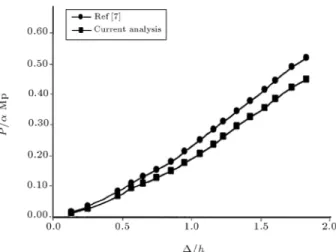
Figure 2 shows a comparison between the current analysis and a numerical result [7] for the conventional U-bending. A maximum dierence of 15%, for the non-dimensional load-deection curves, was observed. No other data was found to be compared with those of the present work.
As known, the amount of springback in a blank depends on the plastic zone development and this char-acteristic, in turn, can be estimated by the equivalent plastic strain in the blank. This will be especially true when dierent blanks under the same loading condition are compared [8]. Hence, in the following discussion, the equivalent plastic strain will always be used as an index to predict the amount of springback in a plate.
Figure2. A comparison between load-displacement
To demonstrate the dependency of the springback on dierent parameters, discussion has been initiated to investigate the eects of the following: (a) Friction coecient between plate and elastomer, (b) Plate thickness, (c) Deformable die. The equivalent plastic strains displayed in Figures 3 to 5 have been obtained for the same ratio of maximum deection to plate thickness, wmax
t = 2.
The friction between the sheet and die has a great eect on the behavior of the equivalent plastic strain (Figure 3). It is obvious that a die possessing a larger coecient of friction is desirable, in terms of a higher equivalent plastic strain and, therefore, less springback. An interpretation of the above eect is that friction increases the membrane force. In addition, one can see clearly that, for 0:6<r=a <0:9, in the case of a movable, simply supported edge, more reduction in the amount of springback is observed, which is almost in agreement with the results obtained in [1]. However, the trend for the movable clamped plates is dierent, which could be attributed to the process of plastic zone development.
Figure3. Eect of friction coecient on the equivalent
plastic strain at bottom of plate (in this gurestands
for the friction coecient).
Figure 4. Eect of plate thickness on equivalent plastic
strain at bottom of plate.
Figure 4 clearly shows the relationship between springback and plate thickness for dierent boundary conditions. It may be seen that for the dierent types of support, the springback amount always decreases as the plate becomes thicker. Furthermore, the trend of a springback, with the distance from the center as in Figure 4, is nearly similar to Figure 3, for dierent boundary conditions, respectively. It means that the nature of the friction eect on dierent plates is, approximately, similar. For the clamped plate, the amount of springback remains nearly constant when the a=t is between 50 and 70, which is almost in agreement with [9].
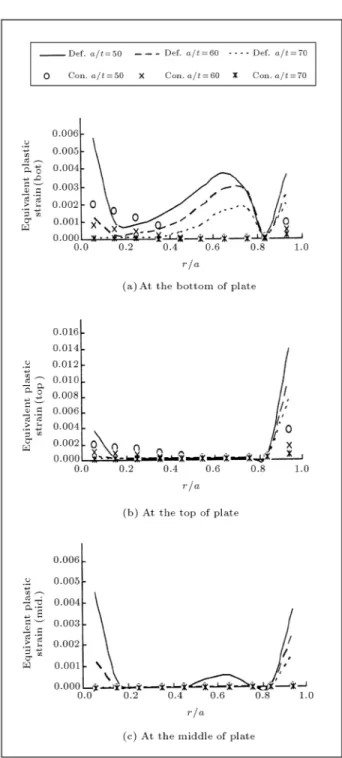
To observe the eect of elastomer on springback, Figure 5 may be considered. Generally, this gure demonstrates that the use of elastomer usually reduces the amount of springback in plates. Although, in some small areas, more plastic strain is observed in the conventional die, it can be attributed to the lesser eect of elastomer on the produced membrane forces in plate, in those parts. Moreover, the eect of plate thickness, for both deformable and conventional dies, has a similar trend and, in both cases, there is less springback in thicker plates.
Figure5. Comparison of equivalent plastic strain
between conventional and deformable dies with clamped edge.
Figures 5b and 5c show a comparison between two dierent dies for the amount of total plastic strain at the middle and top of the plate. As may be observed from Figure 5b, an opposite trend can be observed in the elastomer eect for r=a < 0:5, compared to that in Figure 5a. This may be dicult to understand at rst glance. However, one can explain this by carefully following the bending process of the plate. At the top of the plate, bending and membrane eects act in dierent directions, i.e. compressive and tensile, respectively.
However, when loading precedes the development of the plastic zone, produced by the tensile bending moment, membrane forces will have the dominant eects of plastic strain development. Additionally, near to the edge of the plate, a dierent trend of plastic strain can be seen for r=a > 0:9, which is because the plastic zone produced by the clamped support becomes dominant in that part. Finally, at the middle layer of the plate, however, the eect of pure membrane forces on the springback shows a similar trend to the bottom layers (Figure 5c). Hence, it can almost be understood that the membrane forces in blank, produced by the interaction between elastomer and plate, would mainly explain the mechanism of springback reduction in deformable dies. Finally, it has to be pointed out that the computations have been repeated for similar cases of work hardening materials (Romberg-Osgood model). It is concluded that using work hardening materials increases the springback of the workpiece, compared to that of the perfect plastic ones. However, the other attained results are, qualitatively, almost the same. SUMMARY
A numerical solution to the springback of circular plates was presented. The analysis conducted can be outlined in the following conclusions:
1. Deformable dies seem to be capable of reducing the amount of springback in plates. A die possessing a larger coecient of friction is desirable, in terms of a higher equivalent plastic strain and, therefore, less springback;
2. Monitoring of equivalent plastic strain inside the workpiece, even when plates with dierent thick-nesses are being compared, may be applied and, potentially, can give some suitable guidelines for estimating and controlling springback;
3. The membrane forces created by the interaction forces between the elastomer and plate would mainly explain the mechanism of springback reduc-tion in deformable dies;
4. It was found that the springback ratio tends to be smaller in thicker blanks.
REFERENCES
1. Zhang, L.C. \A mechanics model for sheet metal stamp-ing usstamp-ing deformable dies", J. Mater. Proc. Tech.,53,
pp 798-810 (1995).
2. Zhang, L.C. and Lin, Z. \A new mechanics model of stamping a thin strip on an elastic foundation",Int. J. Solids Structures,34, pp 327-339 (1997).
3. Zhang, L.C. and Lin, Z. \An analytical solution to springback of sheet metals stamped by a rigid punch
and an elastic die",J. Mater. Proc. Tech.,63, pp 49-54
(1997).
4. Zhang, L.C., Lu, G. and Leong, S.C. \V-shaped sheet forming by deformable punches",J. Mater. Proc. Tech.,
63, pp 134-139 (1997).
5. Yu, T.X. and Zhang, L.C.,Plastic Bending: Theory and Applications, World Scientic Publishing (1996). 6. Silvia, A.R.D., Silveria, R.A.M. and Goncalves, P.B.
\Numerical methods for analysis of plates on tensionless elastic foundations",Int. J. Solids Struct.,38, pp
2083-2100 (2001).
7. Akbari, R., Hardy, S.J., Kadkhodayan, M. and Pipelzadeh, M.K. \Simulation of springback in 2-D draw-bending", Proceeding of 11th International Con-ference of ISME, Mashhad, Iran, pp 326-332 (2003). 8. Samuel, M. \Experimental and numerical prediction
of springback and side wall curl in U-bending of anisotropic sheet metals", J. Mater. Proc. Tech.,105,
pp 382-393 (2000).
9. Kadkhodayan, M. and Najjari, M. \Springback of laterally loaded circular plates",Key Eng. Mater.,177,