Sharif University of Technology
Scientia IranicaTransactions A: Civil Engineering www.scientiairanica.com
Bi-level optimization of resource-constrained multiple
project scheduling problems in hydropower station
construction under uncertainty
Zh. Zhang
a;, J. Xu
b, H. Yang
aand Y. Wang
ca. School Economics & Management, Nanjing University of Science and Technology, Nanjing 210094, P. R. China. b. State Key Laboratory of Hydraulics and Mountain River Engineering, Sichuan University; Uncertainty Decision-Making
Laboratory, Sichuan University, Chengdu, 610065, P. R. China.
c. National Key Laboratory of Air Trac Control Automation System Technology, Sichuan University, College of Computer Science, Sichuan University, Chengdu, 610065, P. R. China.
Received 21 September 2013; received in revised form 21 May 2014; accepted 17 November 2014 KEYWORDS
Bi-level programming; Fuzzy random variables;
Resource-constrained scheduling problem; Multiple projects; Multi-objective optimization; Particle swarm optimization.
Abstract. The aim of this paper is to deal with Resource-Constrained Multiple Project Scheduling Problems (RCMPSP), which consider the complex hierarchical organization structure and fuzzy random environment in the decision making process. A bi-level multi-objective RCMPSP model with fuzzy random coecients is presented, taking into account the strategy and process in the practical RCMPSP. In the model, the project director is considered the leader at the upper level who aims to minimize the total tardiness penalty of all sub-projects and the consumption of resources. Meanwhile, the sub-project manager, a follower at the lower level, regards the target to minimize the duration of each sub-project. To deal with the uncertainties, fuzzy random parameters are transformed into trapezoidal fuzzy variables rst, which are subsequently de-fuzzied by the expected value index. A multi-objective bi-level adaptive particle swarm optimization algorithm (MOBL-APSO) is designed as the solution method to solve the model. The results and analysis of a case study are presented to highlight the practicality and eciency of the proposed model and algorithm.
c
2015 Sharif University of Technology. All rights reserved.
1. Introduction
As the scale of projects has generally become larger in recent years, the organizational structure of activ-ities in a large-scale construction project is also very complex. Hence, these activities are usually deemed sub-projects in practice. In this situation, Resource-Constrained Multiple Project Scheduling Problems (RCMPSP) have attracted growing attention in both
*. Corresponding author. Tel.: +86 025 84315478; Fax: +86 025 84315478
E-mail addresses: [email protected] (Zh. Zhang); [email protected] (J. Xu); [email protected] (H. Yang); [email protected] (Y. Wang)
theory and practice. Since Fendley rst considered activities in a complex project as sub-projects, in 1968 [1], the importance and comprehensive practical-ity of RCMPSP have been widely accepted by project managers. Fricke and Shenhar [2] provided insight into how the most important multiple-project success factors in a manufacturing support environment dier from factors of success in traditional single-project management, by a case study method. Lova et al. [3] developed a multi-criteria heuristic that improved the criteria lexicographically, i.e. project delay or multi-project duration increase and multi-project splitting, in-process inventory, resource leveling or idle resources. Then, in 2001, Lova and Tormos [4] analyzed the eect of schedule generation schemes, such as serial
or parallel, and priority rules that were MINLFT, MINSLK, MAXTWK, SASP or FCFS in single and multiple project environments. Kim et al. [5] proposed a hybrid genetic algorithm with a fuzzy logic controller (c-hGA) for RCMPSP, and demonstrated that the proposed c-hGA yielded better results than conven-tional and adaptive genetic algorithms. Deng et al. [6] and Czogalla [7] used a Particle Swarm Optimization (PSO) approach to solve RCMPSP. Brucker et al. [8], Kolisch and Padman [9] Demeulemeester and Herroe-len [10] reviewed the numerous project optimization scheduling problems in project management theory in [8,9,10], respectively, including RCMPSP. Recently, deeper research into RCMPSP has been undertaken by a number of researchers, such as Browning and Yassine [11], Tasan and Gen [12], Dong et al. [13], Palencia and Delgadillo 14], and so on.
In all the above literature, there is an implicit as-sumption that the decision-maker is unique. However, since the scale of the project is usually very large, in practice, more elements and the complex hierarchical organization structure should be considered in the scheduling process of RCMPSP. Actually, multi-level programming has been successfully applied in project scheduling problems. Chen and Tzeng [15] established a bi-level fuzzy multi-objective model to aid the re-construction scheduling for a post-quake road network. The upper objectives were to minimize travel time, total working time, and idle time between work-troops. The lower objective was to obtain a convergent link ow under the reconstruction states of the road network from the upper level. Tan et al. [16] used a bi-level decision method to construct a mathematical model of a multi-resource constrained multi-project scheduling problem, and proposed a stochastic global optimization method, based on direct search, to solve the global optimal problem. Roghanian et al. [17] proposed a probabilistic bi-level linear multi-objective program-ming model to enterprise-wide supply chain planning problems, and obtained a compromised solution using a fuzzy programming technique. Peng et al. [18] constructed a bi-level model for maintenance fund allocation and project prioritization, and used dynamic programming and the genetic algorithm to solve the proposed model. Although there is little research into multi-level organizational structures in RCMPSP, application of multi-level decision-making methods in RCMPSP will become increasingly extensive and in-depth following the advances in engineering design and industry segmentation.
Another key issue worth our attention in RCMPSP is the inevitable uncertainty in the decision-making process. Generally speaking, there are two types of uncertainty in practical RCMPSP: The rst is internal, such as the perception and dissension of decision makers (subjective uncertainty); the second
uncertainty is caused by external factors, such as treacherous weather and equipment failure (objective uncertainty). Subjective uncertainty can be tackled using fuzziness, and objective uncertainty can be han-dled by randomness, respectively. Traditionally, the uncertainty of project scheduling problems is assumed to be random. In 1960, Freeman rst solved the project scheduling problem using a probability theory [19]. After that, many researchers considered randomness in the scheduling process, such as activity durations [20-22], task costs [23,24], and so on. Following Prade [25], which rst applied fuzzy set theory to project schedul-ing problems in 1979, many researchers have become devoted to Resource Constrained Project Scheduling Problems (RCPSP) under a fuzzy environment, such as Wang et al. [26], Bhaskar et al. [27], and Masmoudi and Hat [28]. Fuzziness and randomness are considered separate aspects in the above research. However, we may face a hybrid uncertain environment in practical RCMPSP. Hence, the fuzzy random variable, which was initialized by Kwakernaak [29] in 1978, can be a useful tool to deal with two kinds of uncertainty simultaneously. No attempt has been made to consider the quantity of maximum renewable resources, penalty cost coecients, duration of sub-projects, and the processing time of activities in sub-projects as the fuzzy random variables. Therefore, there is a strong motivation and justication for this study, i.e. taking into account the complex hierarchical organizational structure and the fuzzy random environment in prac-tical RCMPSP.
This paper will solve RCMPSP by bi-level decision-making methods, with a mixed uncertainty of fuzziness and randomness. The remainder of the paper is organized as follows. In Section 2, the research problem and statement are presented, including the explanation of the motivation behind employing fuzzy random variables. Then, a bi-level multi-objective RCMPSP model is proposed in Section 3. Details of the approach used in transforming fuzzy random variables into trapezoidal fuzzy variables are also presented, and then the expected value operator is employed to deal with the fuzzy variables. In Section 4, a Multi-Objective Bi-Level Adaptive Particle Swarm Optimization algorithm (MOBL-APSO) is utilized to resolve the RCMPSP model. The eectiveness of the proposed model and algorithm is proven by the practical application in Section 5. Concluding remarks are made in Section 6, along with discussion about further research.
2. Research problem and statement
The problem considered in this study is from the Xiangjiaba Hydropower Project, which is a large-scale water conservancy and hydropower
construc-Figure 1. The location of Xiangjiaba Hydropower Station.
tion project on the Jinsha River; a tributary of the Yangtze River in Yunnan Province and Sichuan Province (southwest of China). As the ultra-large hy-dropower project (the third largest hyhy-dropower project in China, second only to the three Gorges station and the Xiluodu station), Xiangjiaba Hydropower Station is a concrete gravity dam, and it is the lowest station of the Jinsha River downstream cascade development (see Figure 1). The facility of the Xiangjiaba Hydropower Station runs on eight turbines, each with a capacity of 800,000-kilowatts, totaling the generating capacity to 6,400 6,400,000-kilowatts. The height and length of the dam are 161 meters (528 ft) and 909 meters (2,982 ft), respectively. The project boasts comprehensive functions such as power generation (transmits much of the power to Shanghai), ood prevention, navigation and irrigation.
2.1. Bi-level problem description
In the Xiangjiaba Hydropower Project, the Hydrochina Zhongnan Engineering Corporation (HZEC) is the con-struction contractor and is in charge of operation and management, such as exploration, project scheduling design, construction site design, and so on. However, in the RCMPSP, HZEC do not undertake sub-projects, because they are typically bidden and outsourced in the large-scale construction project. In this situation, the practical RCMPSP discussed in this paper considers the construction contractor (project director) as the Upper Level Decision Maker (ULDM), while the sub-project manager is the Lower Level Decision Maker (LLDM). Moreover, the ULDM and LLDM have dier-ent goals: ULDM aims to minimize the total tardiness penalty of all sub-projects and the consumption of resources, and LLDM regards its target as minimizing the duration of each sub-project.
In the scheduling design process of the RCMPSP, the resource allocation scheme of the whole project is given by the ULDM at rst. Then, LLDM assigns the resources to determine the minimum duration of sub-projects, and provides feedback of the results to
the ULDM. Subsequently, ULDM adjusts the resource allocation according to the upper objective functions. The process above is repeated, until the optimal scheduling and optimal resource allocation schemes are nally obtained. This complex decision making process, with its hierarchical organizational structure is shown in Figure 2.
2.2. Motivation for employing fuzzy random variables in RCMPSP
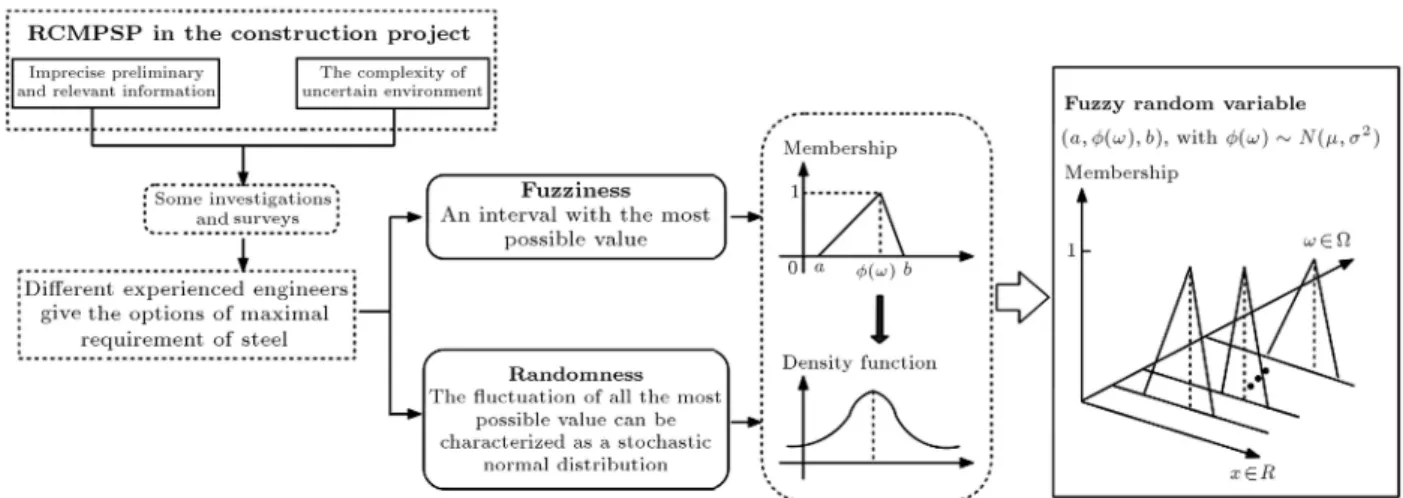
The requirements for addressing uncertainty in project scheduling problems are widely recognized [30]. Al-though the probability theory has been applied to project scheduling problems successfully, sometimes it may not be suitable for RCMPSP in a new large-scale construction project because the preliminary and relevant information is more imprecise than before, due to advancements in engineering technology. For example, in order to collect the data in the Xiangjiaba Hydropower Station, some investigations and surveys are undertaken with dierent experienced engineers (i.e., e = 1; 2; ; E, where e is the index of engineers). However, instead of exact parameters, the engineers can describe the parameters as an interval (i.e., [le; re]),
with the most possible value (i.e., me), such as \the
maximal requirement of steel is between 8.50 and 10.15 million kg, and the most possible quantity is 9.45 million kg". Because dierent engineers have dierent opinions for the parameters, the minimum value of all le (i.e., a) and the maximal value of all re (i.e.,
b) are selected as left and right borders, respectively. Meanwhile, by comparing the most possible values (i.e., me for e = 1; 2; ; E) and using the
maxi-mum likelihood method, uctuation of all me can be
characterized as a stochastic normal distribution (i.e., (!) N(; 2)). Hence, it means that the maximal
requirement of steel is a fuzzy variable taking a random parameter, i.e. a fuzzy random variable (a; (!); b), where (!) N(; 2).
In fact, the fuzzy random variable has been successfully applied in many areas, such as project scheduling problems [31], inventory problems [32-34], vehicle routing optimization problems [35], portfolio selection problems [36-39], and so on. The research mentioned above proves that the fuzzy random vari-ables can eectively deal with a hybrid uncertain environment, where fuzziness and randomness co-exist. In this paper, the fuzzy random variable is also em-ployed to characterize the complexity of the uncertain environment in the practical RCMPSP. The reason why the maximal requirement of steel is a triangular fuzzy random variable is shown in Figure 3.
Similarly, while modeling the RCMPSP in Xi-angjiaba Hydropower Station under the fuzzy random environment, the quantity of maximum renewable re-sources, the penalty cost coecients, the duration of
Figure 3. Flowchart of why the maximal requirement of steel is a fuzzy random variable.
the sub-project, and the processing time of activities in the sub-project are represented as triangular fuzzy random numbers. The details will be discussed further in the next section.
3. Fuzzy random bi-level RCMPSP modeling Dierent from the classical resource constrained project scheduling problems, the RCMPSP can be stated as follows: A project consists of I+2 (i = S0; 1; 2; :::; I; T0)
sub-projects, where activities S0 and T0
are dummy (i.e., they do not have any duration, and just represent the initial and nal sub-projects). There are J + 2 activities, Aij, in the sub-projects, i, and activities S
and T are also dummy. There exists a set of renewable resources, k = f1; 2; ; Kg (such as equipment and labor), and non-renewable resources, n = f1; 2; ; Ng (such as raw materials and cost consumption). A simple example of RCMPSP is shown in Figure 4.
To model this practical RCMPSP under a fuzzy random environment, the following descriptions are made:
1. The RCMPSP consists of I sub-projects which contain several activities.
2. The start time of each activity is dependent upon the completion of some other activities (precedence constraints of activities). After completing a spe-cic activity, the next activity must also be started.
3. When a specic sub-project (precedence constraints of multiple projects) is initiated, it must be nished without changes to another sub-project.
4. Activities cannot be interrupted, and there is only one execution mode for each activity.
5. Multiple resources are available in limited quanti-ties. The quantity of maximum renewable resources is ^~rM
k for resource k (where ^~rkM is a fuzzy
dom variable), and the quantity of maximum no-renewable resources is rM
n for resource n.
6. Each sub-project requires sr = f1; 2; ; Srg
shared resources, including renewable and non-renewable resources. The requirement of activity Aij during every stage is rijsr, where the quantity
of renewable resources is rijk, while non-renewable
resources are rijn (i.e., rijsr = rijk+ rijn).
7. Except for the shared resources, the activities of each sub-project also require a separate resource. To simplify the problem, independent resource allocation is not considered in this paper, and all independent resources can meet the demand.
8. The duration of the activity, which requires the shared resources, is proportional to the workload in the sub-project, and inversely proportional to the allocation of shared resources.
9. The maximal quantity of renewable resources (^~rM k ),
the penalty coecient of each sub-project (^~cT P i ),
the duration of sub-project ( ^~di), and the processing
time of activity j in the sub-project i ( ^~dij) are fuzzy
random variables.
10. The objectives of the upper level are to minimize the total tardiness penalty of all sub-projects and the consumption of resources, while the objective of the lower level is to minimize the duration of each sub-project.
3.1. Notation
In order to facilitate mathematical descriptions in the RCMPSP, the following notation is introduced: i : Sub-project index;
j : Activity index in each sub-project; k : Renewable resource index;
n : Non-renewable resource index;
t : Time index;
It: The set of activities being in progress
in time t;
Pre(o) : The set of immediate predecessors of sub-project i;
Pre(j) : The set of immediate predecessors of activity j;
^~cT P
i : The penalty coecient of sub-project
i;
Ui: The workload of sub-project i, which
uses the shared resources;
^~di: The duration of sub-project i, which
uses the shared resources;
^~dij: The duration of activity j, which uses
the shared resources in sub-project i;
dD
i : The duration of sub-project i, which
uses independent resources; tE
i : The due date of the sub-project, i;
tfi : The nish time of sub-project i; tfij : The nish time of activity j in
sub-project i; tEF
ij : The earliest nish time of activity j in
sub-project i; tLF
ij : The latest nish time of activity j in
sub-project i;
rijk: The quantity of shared renewable
resource, k, for activity j in sub-project i;
rijn: The quantity of shared non-renewable
resource, n, for activity j in sub-project i;
^~rM
k : The maximal quantity of renewable
resources; rM
n : The maximal quantity of
non-renewable resources; xijt: xijt=
(
1; if activity j in sub-project i is; scheduled to be nished in time t 0; otherwise
3.2. Fuzzy random bi-level RCMPSP model formulation
Based on the requirements of ULDM and LLDM, a fuzzy random bi-level RCMPSP model is proposed as follows.
Upper level model for the bi-level RCMPSP. For the RCMPSP in large-scale construction projects, the rst objective of ULDM is to minimize the total tardiness penalty, which is the sum of penalty costs for all sub-projects, i.e.:
min C =XI
i=1
^~cT P
i (tfi tEi ) : (1)
Furthermore, the second objective of ULDM is to minimize the consumption of resources, i.e.:
min R =
I
X
i=1 J
X
j=1 Sr
X
sr=1
rijsr: (2)
The constraints for the upper level in RCMPSP are divided into resource constraints and other logical constraints. Multiple resources are available in limited quantities, so, constraints:
I
X
i=1 J
X
j=1
rijk
t+dXjm 1
=t
I X i=1 J X j=1 rijn tLF ij X t=tEF ij
xijt rnM; 8j; k; n; (3)
can be employed. In addition, in order to describe some non-negative variables for practical purposes, we can use:
tfi 0; tEF
ij 0; tEFij 0; rijk 0; rijn 0
8 i = 1; 2; ; I; j = 1; 2; ; J; k = 1; 2; ; K: (4) Thus, we have the upper level model as:
8 > > > > > > > > > > > > > > > > > > > > > > > > > > < > > > > > > > > > > > > > > > > > > > > > > > > > > :
min C =PIi=1^~cT P
i (tfi tEi )
min R =PIi=1PJj=1PSr
sr=1rijsr
s.t. 8 > > > > > > > > > > > > > > > > > > < > > > > > > > > > > > > > > > > > > : PI i=1 PJ
j=1rijkPt+d=tjm 1xij ^~rMk ;
8i; j; k PI
i=1
PJ
j=1rijn
PtLF j
t=tEF
j xijt r
M n ;
8j; k; n tf
i 0; tEFij 0; tEFij 0
rijk 0; rijn 0
xijt= f0; 1g
i = 1; 2; ; I; j = 1; 2; ; J; k = 1; 2; ; K
(5)
Lower level model for the bi-level RCMPSP. For the LLDM, the objective is to minimize the nish time of the sub-project. In this study, we use the sum of all the durations of the sub-projects:
min T =
I
X
i=1
(tfi tf
o); (6)
where o 2 Prei. Let xoisr be a 0-1 variable, and:
xoisr =
1; if o; i consumes the shared resources sr
0; otherwise (7)
Thus, if sub-projects o; i (o 2 Prei) consume the shared
resources, sr, then, the duration of i is PSsrr=1
Ui
risr. If
they only consume independent resources, the duration is dD
i .
xoisr ^~di=
( PSr
sr=1
Ui
risr
dD i
(8) In addition, since the sub-project and the activity in the sub-project should meet precedence constraints, the relationship should be:
xoisr ^~dixoisr(tfi tfo); xoisr ^~dijxoisr(tfij tfil);
(9)
where l 2 Prej. Finally, the logical constraints are also
satised.
Ui 0; tfi 0; tfij 0: (10)
Hence, we have the lower level model as: 8 > > > > > > > > > > > > > > > > > > < > > > > > > > > > > > > > > > > > > :
min T =PIi=1(tfi tf o) s.t. 8 > > > > > > > > > > > > > > > > < > > > > > > > > > > > > > > > > :
xoisr ^~di xoisr(tfi tfo)
xoisr ^~dij xoisr(tfij tfil)
xoisr ^~di=
( PSr
sr=1rUisri
dD i
xoisr= f0; 1g
Ui 0; tfi 0; tfij 0
o; i = 1; 2; ; I; j = 1; 2; ; J o 2 Prei; l 2 Prej
(11)
Global model for the bi-level RCMPSP. Based on the discussion above, by integrating Eqs. (1) to (11), the following global model for the bi-level multi-objective RCMPSP model under a fuzzy random envi-ronment is formulated for the large-scale construction project: 8 > > > > > > > > > > > > > > > > > > > > > > > > > > > > > > > > > > > > > > > > > > > > < > > > > > > > > > > > > > > > > > > > > > > > > > > > > > > > > > > > > > > > > > > > > :
min C =PIi=1^~cT P
i (tfi tEi )
min R =PIi=1PJj=1PSr
sr=1rijsr
s.t. 8 > > > > > > > > > > > > > > > > > > > > > > > > > > > > > > > > > > > > > > > < > > > > > > > > > > > > > > > > > > > > > > > > > > > > > > > > > > > > > > > : PI i=1 PJ
j=1rijkPt+d=tjm 1xij ^~rMk ; 8i; j; k
PI
i=1
PJ
j=1rijnPt
LF j
t=tEF
j xijt r
M
n ; 8j; k; n
xijt =
8 > < > :
1; if activitiy j in the sub-project i scheduled to be nished in time t 0; otherwise
tf
i 0; tEFij 0; tEFij 0; rijk 0; rijn 0
i = 1; 2; ; I; j = 1; 2; ; J; k = 1; 2; ; K min T =PIi=1(tf
i tfo)
s.t. 8 > > > > > > > > > > > > > > > > > > < > > > > > > > > > > > > > > > > > > :
xoisr ^~di xoisr(tfi tfo)
xoisr ^~dij xoisr(tfij tfil)
xoisr ^~di =
(PSr
sr=1
Ui
risr
dD i
xoisr =
8 > < > :
1; if o; i consume the shared resources sr
0; otherwise Ui; tfi; tfij 0
o; i = 1; 2; ; I; j = 1; 2; ; J o 2 Prei; l 2 Prej
3.3. Dealing with fuzzy random variables Since some coecients involved in the proposed bi-level RCMPSP model are triangular fuzzy random numbers,
it is very hard to solve. In this case, considering the optimistic-pessimistic attitude of DMs, a hybrid crisp approach is employed to transfer the fuzzy random bi-level PCMPSP model to an equivalent one. This method transforms the fuzzy random parameter into a (; )-level trapezoidal fuzzy variable at rst, and then defuzzies the trapezoidal fuzzy variable by an expected value operator. Motivated by the form of the fuzzy random variable in the model, we consider the denition proposed by Puri and Ralescu [41], i.e. the fuzzy random variable is a measurable function from a probability space to a collection of fuzzy variables. Denoting the fuzzy random coecient as ^~ = (L; (!); "R) (where (!) follows a normal
distribution N(; 2)), the given possibility level of
fuzzy variable is , and the given probability level of the random variable is . These parameters, L, R, ,
and , are estimated by collected data and professional experience using statistical methods. After that, we can obtain the DMs's degree of optimism, and , through a group decision making approach.
Now, let the probability density function of (!) be p(x). Then, the -level set of (!) is =
[L
; R] = fx 2 Ujp(x) g (see Figure 5).
If p(x) = p21 e
(x )2
22 = , then, we get:
x = q
22ln(p2):
It means that: L
=
q
22ln(p2);
R = +
q
22ln(p2): (12)
Thus, ^~ = (L; (!); R) is transferred as a class of
triangular fuzzy numbers (see Figure 6).
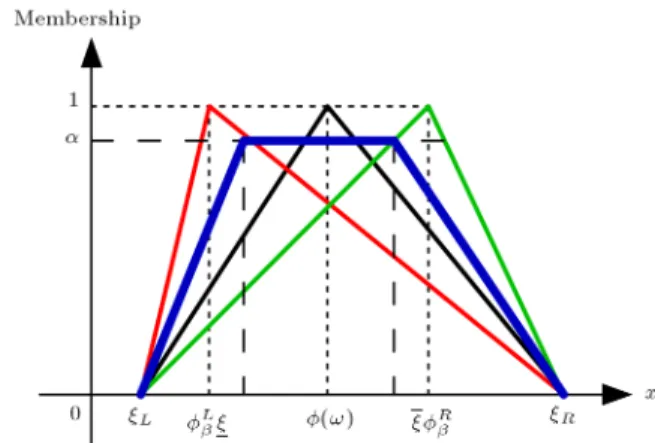
Subsequently, for the given possibility level, , we can get the -level set of these triangular fuzzy numbers as Figure 7.
From Figure 7, we can see that the fuzzy random variable, ^~ = (L; (!); R), is transferred as a
trape-zoidal fuzzy variable, ^~ ! ~(;) = (L; ; ; R) (the
Figure 5. The probability density function p(x).
Figure 6. Transferring the fuzzy random variable to a class of triangular fuzzy number (Step 1).
Figure 7. Transfering the fuzzy random variable to a trapezoidal fuzzy number (Step 2).
blue one), where:
=R (R L) and =L+(R L): (13)
Hence, the fuzzy random variables, ^~cT P
i , ^~rkM, ^~di, and
^~dij, in the proposed model can be transformed into
(; )-level trapezoidal fuzzy variables, as follows: ^~cT P
i ! ~cT Pi(1;1) = ([cT Pi ]L; cT Pi ; cT Pi ; [cT Pi ]R);
^~rM
k ! ~rkM(2;2)= ([rMk ]L; rMk ; rMk ; [rkM]R);
^~di! ~di(3;3) = ([di]L; di; di; [di]R);
^~dij! ~dij(4;4) = ([dij]L; dij; dij; [dij]R): (14)
Finally, a new measure with an optimistic-pessimistic adjustment index, Me, which is proposed by Xu and Zhou [42] for dealing with the trapezoidal fuzzy variable, is employed. The measure, Me, can evaluate the condence degree that a fuzzy variable takes in an interval, and the expected value of the trapezoidal fuzzy variable can be obtained by Me as:
EMe[~=(
where is the optimistic-pessimistic index of DMs, and = 1 indicates that the best case has the maximal chance of occurring, while = 0 is opposite. Therefore, we have:
EMe[~cT P
i(1;1)] = 1 2 1([cT Pi ]L+ cT Pi )
+21(cT P
i + [cT Pi ]R);
EMe[~rM
k(2;2)] = 1 2 2([rMk ]L+ rMk )
+2
2 (rMk + [rMk ]R); EMe[ ~d
i(3;3)]=
1 3
2 ([di]L+ di) +23(di+ [di]R);
EMe[ ~d
ij(4;4)] =1 2 4([dij]L+ dij)
+24(dij+ [dij]R); (16)
where parameters []L, []R, , , , and have been
gained previously by statistical methods, and [] and [] can be calculated by Eqs. (12) and (13).
Based on the above hybrid method, the fuzzy random bi-level RCMPSP model can be transformed into the following equivalent crisp model:
8 > > > > > > > > > > > > > > > > > > > > > > > > > > > > > > > > > > > > > > > > > > > > > > > > < > > > > > > > > > > > > > > > > > > > > > > > > > > > > > > > > > > > > > > > > > > > > > > > > :
min C =PIi=1EMeh~cT P i(1;1)
i (tf i tEi )
min R =PIi=1PJj=1PSr
sr=1rijsr
s.t. 8 > > > > > > > > > > > > > > > > > > > > > > > > > > > > > > > > > > > > > > > > > > < > > > > > > > > > > > > > > > > > > > > > > > > > > > > > > > > > > > > > > > > > > : PI i=1 PJ
j=1rijk
Pt+djm 1
=t xij
EMeh~rM k(2;2)
i ; 8i; j; k PI
i=1
PJ
j=1rijnPt
LF j
t=tEF
j xijt r
M
n ; 8j; k; n
xijt=
8 > < > :
1; if activity j in the sub-project i scheduled to be nished in time t 0; otherwise
tfi 0; tEF
ij 0; tEFij 0; rijk 0; rijn 0
i=1; 2; ; I; j = 1; 2; ; J; k = 1; 2; ; K min T =PIi=1(tfi tf
o) s.t. 8 > > > > > > > > > > > > > > > > > > > < > > > > > > > > > > > > > > > > > > > :
xoisr EMe
h ~ di(3;3)
i
xoisr(tfi tfo)
xoisr EMe
h ~ dij(4;4)
i
xoisr(tfij tfil)
xoisr EMe
h ~ di(3;3)
i =
(PSr
sr=1
Ui
risr
dD i
xoisr =
8 > < > :
1; if o; i consume the shared resources sr
0; otherwise Ui; tfi; tfij 0
o; i = 1; 2; ; I; j = 1; 2; ; J o 2 Prei; l 2 Prej
4. Multiple Objective Bi-Level Adaptive Particle Swarm Optimization algorithm (MOBL-APSO)
Due to the superior search performance and fast convergence, the Particle Swarm Optimization (PSO) algorithm (rst proposed by Kennedy and Eberhart in 1995 [43]), is considered an eective tool for solv-ing optimization problems. It simulates the social behaviors of birds ocking to a promising position for certain objectives in multi-dimensional space [44]. In PSO, an n-dimensional position of a particle represents a solution, and the particles y through the problem space following the current optimum particles. The updating mechanism of the particle is:
vi
d( + 1) = w()vid() + cpr1[pi;bestd () pid()]
+cgr2[gdi;best() pid()]
pi
d( + 1) = pid() + vid( + 1); (17)
where vi
d() is the velocity of the ith particle at the
dth dimension in the th iteration, w is an inertia weight, pi
d() is the position of the ith particle, r1
and r2 are random numbers in the range [0; 1], cp and
cg are personal and global best position acceleration
constants and, pi;bestd and gi;bestd are the personal and global best positions of the ith particle at the dth dimension.
Since PSO can be implemented easily and ef-fectively, the researchers also consider PSO to be a very strong competitor with other algorithms in solving multi-objective decision making problems [45]. Some studies reported in the literature have extended PSO to multi-objective problems, such as Zhang et al. [46], Tavakkoli-Moghaddam et al. [47], Damghani et al. [48], Garg and Sharma [49], and so on. The improved approach employs the concept of Pareto dominance to determine the ight direction, and it maintains previously found non-dominated vectors in a global repository [45]. All the particles of this swarm are compared to each other and the non-dominated particles are stored in the repository. Dierent from classical PSO, the positions of particles are updated by:
vi
d( + 1) = wvid() + cpr1[pi;bestd () pid()]
+cgr2[REP () pid()]; (18)
where REP is the positions of the particles that represent non-dominated vectors in the repository, i.e. several equally good non-dominated solutions stored in the external repository instead of the global best position, gdi;best().
This paper will apply a Multiple Objective Bi-Level Adaptive Particle Swarm Optimization algorithm (MOBL-APSO) to solve the proposed mathematical model. As an NP-hard problem, bi-level programming is dicult to obtain an analytical optimal solution (Ben-Ayed and Blair [50], especially for a multi-objective one. In this condition, MOBL-APSO is designed using a combination of the Pareto Archived Evolution Strategy (PAES) [51] and passive congrega-tion (PSO-PC [52]). The following notacongrega-tion is used to MOBL-APSO for RCMPSP:
u: Upper-level particle index, u = 1; 2; ; U; l: Lower-level particle index, l = 1; 2; ; L;
u: Iteration index of the upper level, u= 1; 2, ; Tu;
l: Iteration index of the lower level, l= 1; 2; ; Tl;
d: Dimension index, d = 1; 2; ; D;
r1; r2, r3; r4; r5: Uniform distributed random number
within [0; 1];
wu(u), wl(l): Inertia weight of upper and lower level;
cpu; cpl: Personal best position acceleration constant of
upper and lower level;
cgu; cgl: Global best position acceleration constant of
upper and lower level;
cpc: Passive congregation coecient;
Pu(
u); Pl(l): Vector position, i.e. the uth candidate
solution for ULDM and the lth candidate solution for LLDM;
Vu(
u); Vl(l): Vector velocity of the uth particle in
the u iteration and lth particle in the l iteration;
Pu;best(
u); Pl;best(l): Vector personal best position;
Gl;best(
l): Global best position of the lth particle in
the l iteration;
pl
pc(l): Particle selected randomly from the swarm in
the l iteration;
REP: The positions of the particles that represent non-dominated vectors in the repository.
4.1. Multiple Objective Adaptive PSO (MO-APSO) for the upper level programming
For the upper level programming, the solution ap-proach combines multi-objective PSO with the Pareto Archived Evolution Strategy (PAES), which is one of the Pareto-based approaches to update the best posi-tion [51]. This approach employs a truncated archive, which is used to separate the objective space into a number of hypercubes, to store the elite individuals. Based on the density, every hypercube has its own score. After selecting the best of the particles based on the roulette wheel selection of the best hypercubes the particle is selected uniformly. Details of the PAES procedure, test procedure and selection procedure are stated below:
PAES procedure
Generate initial random solution Pu(
u) and add it to the
archive Update Pu(
u) to generate Pu(u+ 1)
if Pu(
u) dominates Pu(u+ 1) discard Pu(u+ 1)
else if Pu(
u+ 1) dominates Pu(u)
replace Pu(
u) with Pu(u+ 1) and add
Pu(
u+ 1) to the archive
else if Pu(
u+ 1) is dominated by any member in the
archive discard Pu( u+ 1)
else if Pu(
u+ 1) dominates any member in the archive
replace it with Pu( u+ 1)
else if apply test procedure to Pu(
u), Pu(u+ 1)
and archive to determine
which is the new current solution and whether add Pu(
u+ 1) to the archive or not
until a termination criterion is reached, otherwise return to line 2
Test procedure if the archive is not full
add Pu(
u+ 1) to the archive
if Pu(
u+ 1) is in a less crowded region than
Pu(
u) in the archive accept Pu(u+ 1) as
the new current solution else
maintain Pu(
u) as the current solution
else if Pu(
u+ 1) is in a less crowded region than any
other member add Pu(
u+ 1) to the archive, and
remove a member of the archive from the most crowded region
if Pu(
u+ 1) is in a less crowed region than Pu;best(u)
accept Pu(
u+ 1) as the new current solution
else
maintain Pu(
u) as the current solution
else
do not add Pu(
u+ 1) to the archive
Selection procedure
Step 1. Divide 1 by the number of particles in each hypercube to get its score.
Step 2. Select a hypercube by the roulette wheel selection according to the scores.
Step 3. Choose a particle in the selected hypercube uniformly.
Based on the above, the velocity and position of the particles are:
vu
d(u+ 1) = wu(u)vud(u) + cpur1[pu;bestd (u)
pu
d(u)] + cgur2[REP (u) pud(u)]
pu
d(u+ 1) = pud(u) + vud(u+ 1) (19)
where wu= w(Tu) +1 Tu Tuu[w(1) w(Tu)] [53].
4.2. PSO-PC for the lower level programming Since there are many constraints in the lower level programming of the proposed model, we apply the PSO with Passive Congregation (PSO-PC) to avoid prema-ture convergence. By adding the passive congregation coecient into the standard PSO, PSO-PC will help the algorithm jump out of local optimal solution in the running process, and then improve the global search ability [52].
Let cpc be the passive congregation coecient,
pl
pc(l) be a particle selected randomly from the swarm,
and r3; r4; r5 be the uniform distributed random
num-bers. Thus, the velocity and position are updated by:
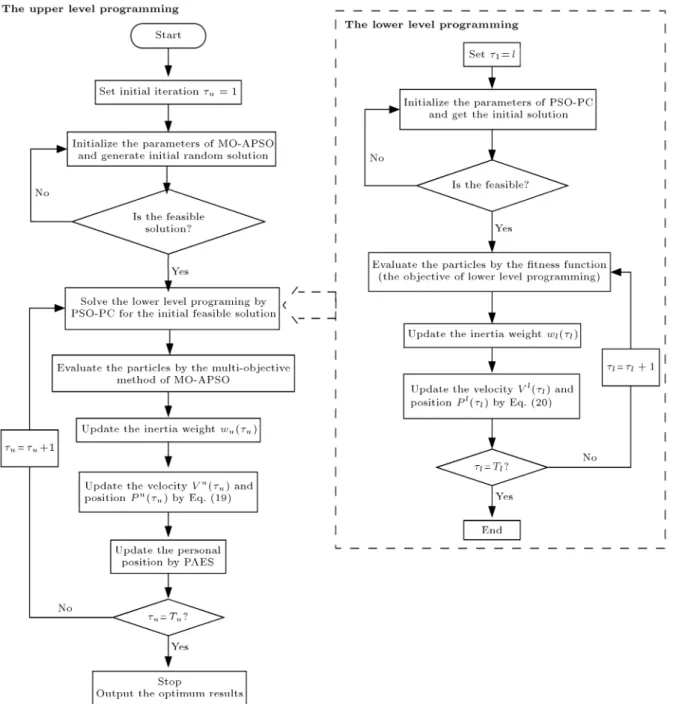
Figure 8. The outline of MOBL-APSO for the bi-level RCMPSP.
vl
d(l+ 1) = wl(l)vld(l) + cplr3[pl;bestd (l) pld(l)]
+cglr4[gdl;best(l) pld(l)]+cpcr5[plpc(l) pld(l)];
pl
d(l+ 1) = pld(l) + vdl(l+ 1): (20)
4.3. Overall procedure of MOBL-APSO
Based on the description above, the overall procedure of the MOBL-APSO algorithm for bi-level RCMPSP is:
MOBL-APSO algorithm for bi-level RCMPSP Step 1. Initialize the velocity and position for
the upper level particles. For u = 1; 2; ; U, initialize the parameters:
swarm size, iteration max, the range of position, inertia weight min, inertia weight max, cpu, cgu;
Step 2. Check the feasibility of the upper level solutions: if the feasibility criterion is met by all particles, then continue. Otherwise, return to Step 1; Step 3. By the initialization result of upper-level particles,
apply PSO-PC to achieve the optimal objective for the lower-level programming;
Step 4. Calculate each tness value using multi-objective methods in MO-APSO and restore the
Pareto optimal solutions
(i.e., the elite individuals) in REP ; Step 5. While the maximum number of cycles has
not been reached Do
Step 5.1: Update the velocity and the position of each particle by Eq. (19); Step 5.2: Evaluate every particle and update
the contents of REP
and the geographical representation of the particles within
the hypercubes. Insert all the currently non-dominated locations into the repository and eliminate any dominated locations from the repository; Step 5.3: Use PAES, test
procedure, and selection procedure to update the best position.
Otherwise, the position in memory replaces the current one; if any of them is
dominated by the other, select one of them randomly; Step 5.4: Increment the loop counter. Step 6. End while;
Step 7. If the stopping criterion is met, i.e., u= Tu,
continue to Step 8. Otherwise, u= u+ 1 and return to Step 3;
Step 8. Decode REP as the optimal solution set.
The MOBL-APSO algorithm for the bi-level RCMPSP
is outlined in Figure 8, and the overall procedure is presented in Figure 9.
5. Practical application
The bi-level RCMPSP considered in this paper is from the Phase II Project of the Xiangjiaba Hydropower Station. The following are representations of the case problem, data collection, case problem results and analysis.
5.1. Representation of the case problem
The Phase II Project in the Xiangjiaba Hydropower Station contains preparation, the aggregate processing system of the Mayanpo and Taiping raw material yard, river diversion, dam construction, spillway project, and power capacity of the stream. the Phase II Project uses months as the measure of duration, i.e., one month per unit. The duration, precedence relationship, and resource requirements of activities in each sub-project are shown in Figure 10. There are three types of resource in the Phase II Project, i.e. manpower (r1, renewable resources), equipment (r2, renewable
resources) and material (r3, nonrenewable resources).
Manpower is composed of the vice-header, plasterer, installer, decorator, surveyor, electrician, ordinary worker, and so on. Equipment consists of a high portal crane, tower belt, concrete mixing plant, 480-ton gantry crane, translation cable machine, electric impact drill, and so on. Material involves cement, admixture, concrete, reinforcement, steel pipes, con-crete accelerator, stabilizer, and so on. For calculating dierent resources expediently, the quantities of all resource consumption are transferred into a cash value (ten millions CNY per unit).
Manpower r1= actual number of workers working time
wage;
Equipment r2= actual number of equipment working time
[cost of equipment purchases (or rental cost) + loss of equipment];
Material r3= actual demand material price
5.2. Data collection
All detailed data of the Phase II Project in the Xi-angjiaba Hydropower Station are gained from the
Hy-Figure 9. Framework of MOBL-APSO.
drochina Zhongnan Engineering Corporation (HZEC). The fuzzy random data, including the maximal quan-tity of renewable resources (^~rM
k ), the penalty coecient
of each sub-project (^~cT P
i ), the duration of the
sub-project ( ^~di), and the processing time of activity j in
the sub-project i ( ^~dij), are obtained based on previous
data and experts' experience. The detailed information is shown in Table 1.
5.3. Results and analysis
The optimal scheduling scheme (the nish time of each sub-project and activity) and resource allocation is generated by APSO. The parameters of MOBL-APSO for this practical case problem are: swarm size
popsize, L = 50, iteration max, T = 100, personal and global best position acceleration constant of upper and lower levels, cpu = cpl = cgu = cgl = 2, passive
congregation coecient, cpc = 1, and inertia weight of
upper and lower levels, wu(1) = wl(1) = 0:4; wu(u) =
wl(l) = 0:9. Using Mat lab 7.0 and Visual C++
language on a Inter Core I7 M370, 2.40 GHz, with 2048 MB memory, and taking the data above into the computer program, the case problem is solved by MOBL-APSO within 21 minutes, on average, which is accepted by the ULDM and LLDM. The dots in Figure 11 are the Pareto optimal solutions of upper level programming.
Figure 11. Pareto optimal solutions of upper level programming.
scheduling plan from these Pareto-optimal solutions, according to the actual situation of the Phase II Project in Xiangjiaba Hydropower Station. For example, if ULDM determines that the objective of the tardiness penalty is the more important factor, they may allow an increased resource consumptions. Thus, they would choose the far left Pareto-optimal solutions, such as R = 40:9459, C = 15:9185. In this situation, the minimal project duration is T = 99:05 months, and the following resource consumptions are: Manpower r1 = 10:6780, Equipment r2 = 4:9234, and Material
r3 = 25:3445, respectively. In addition, the project
scheduling scheme is presented in Figure 12, and the nish time of each sub-project is shown in Figures 13-18. In practice, the DMs can change the relevant parameters to obtain dierent solutions under dierent levels of the parameters. The solutions reect dierent optimistic-pessimistic attitudes for uncertainty and dif-ferent predictions of probability and possibility levels.
Figure 12. The overall scheduling scheme.
Figure 13. The schedule of sub-project-1.
Figure 14. The schedule of sub-project-2.
Figure 15. The schedule of sub-project-3.
Figure 16. The schedule of sub-project-4.
Figure 17. The schedule of sub-project-5.
Figure 18. The schedule of sub-project-6.
6. Conclusions and further research
Considering the complex hierarchical organizational structure and the hybrid uncertain environment, where fuzziness and randomness co-exist, a bi-level multi-objective RCMPSP model with fuzzy random coe-cients for the practical resource-constrained multiple project scheduling problems (RCMPSP) is presented in this paper. The fuzzy random coecients are transformed into trapezoidal fuzzy variables by the
DMs's degree of optimism, and , which are nally de-fuzzied by the expected value index, . In order to solve the equivalent crisp model, the MOBL-APSO algorithm is designed to obtain the optimal solution. For illustrating the eectiveness, the proposed model and algorithm are applied to the Phase II Project in the Xiangjiaba Hydropower Station.
The main contributions of this study are as follows: (1) This study focuses on the RCMPSP with complex hierarchical organizational structure and a hybrid uncertain environment in the large-scale wa-ter conservancy and hydropower construction project, which has great practical signicance. (2) The fuzzy random variable is employed in the practical bi-level multi-objective RCMPSP model to characterize the hy-brid uncertain environment, and this work is original. (3) The proposed model is transferred to an equivalent crisp one by the DMs's degree of optimism , , and the expected value index . For solving the complex model, a Multi-Objective Bi-Level Adaptive Particle Swarm Optimization algorithm (MOBL-APSO) is designed as the solution method. (4) The model and algorithm are successfully applied to the practical case.
Future research has three aspects: Firstly, more realistic factors and constraints for the RCMPSP with complex hierarchical organizational structure should be considered. Secondly, more ecient heuristic methods should be designed to solve this NP-hard problems. Thirdly, software development based on the proposed mathematical model and MOBL-APSO algorithm in this paper is necessary. All are very important and worth equal concern.
Acknowledgment
This research was sponsored by Natural Science Foun-dation of China (NSFC Grant no. 71401075, 71102073, 71301076), Jiangsu Provincial Natural Science Foun-dation of China (Grant no. BK20130753), and the Fundamental Research Funds for the Central Univer-sities (Grant no. JGQN1403, no. 30920130132012). We would like to extend our appreciation to all the reviewers and editors who contributed to this research. References
1. Fendley, L. \Toward the development of a complete multiproject scheduling system", The Journal of In-dustrial Engineering, 19(10), pp. 505-515 (1968).
2. Fricke, S. and Shenhar, A. \Managing multiple engi-neering projects in a manufacturing support environ-ment", IEEE Transaction on Engineering Manage-ment, 17, pp. 258-268 (2000).
3. Lova, A., Maroto, C. and Tormos, P. \A multicriteria heuristic method to improve resource allocation in
mul-tiproject scheduling", European Journal of Operational Research, 127(2), pp. 408-424 (2000).
4. Lova, A. and Tormos, P. \Analysis of scheduling schemes and heuristic rules performance in resource-constrained multiple project scheduling", Annals of Operations Research, 102, pp. 263-286 (2001).
5. Kim, K., Yun, Y., Yoon, J., Gen, M. and Yamazaki, G. \Hybrid genetic algorithm with adaptive abilities for resource-constrained multiple project scheduling", Computers in Industry, 56, pp. 143-160 (2005).
6. Deng, L., Wang, Y. and Lin, Y. \A particle swarm optimization based on priority rule for resource-constrained multi-project scheduling problem", Con-trol and Decision Conference, pp. 1038-1041 (2008).
7. Czogalla, J., Particle Swarm Optimization for Schedul-ing Problems, Shaker Verlag (2010).
8. Peter Bruckera, P., Drexl, A., Rolf Mohring, R., Neumannd, K. and Pesch, E. \Resource-constrained project scheduling: notation, classication, models, and methods", European Journal of Operational Re-search, 112(1), pp. 3-41 (1999).
9. Kolisch, R. and Padman, R. \An integrated survey of deterministic project scheduling", Omega, 29, pp. 249-272 (2001).
10. Demeulemeester, E. and Herroelen, W., Project Scheduling: A Research Handbook, Boston: Kluwer Academic Publishers (2002).
11. Browning, T. and Yassine A. \Resource-constrained multi-project scheduling: Priority rule performance revisited", International Journal of Production Eco-nomics, 126(2), pp. 212-228 (2010).
12. Tasan, S. and Gen, M. \An integrated selection and scheduling for disjunctive network problems", Comput-ers & Industrial Engineering, 659(1), pp. 65-76 (2013).
13. Dong, N. et al. \A genetic algorithm-based method for look-ahead scheduling in the nishing phase of construction projects", Advanced Engineering Infor-matics, 26(4), pp. 737-748 (2012).
14. Palencia, A. and Delgadillo, B. \A computer appli-cation for a bus body assembly line using Genetic Algorithms", International Journal of Production Eco-nomics, 140(1), pp. 431-438 (2012).
15. Chen, Y. and Tzeng, G. \A fuzzy multi-objective model for reconstructing the post-quake road-network by genetic algorithm", International Journal of Fuzzy Systems, 1(2), pp. 85-95 (1999).
16. Tan, Y., Zhong, W. and Xu, N. \Bi-level decision method for multi-resource constrained multi-project scheduling", Systems Engineering- Theory & Practice, 21(2), pp. 1-5 (2001).
17. Roghanian, E., Sadjadi, S. and Aryanezhad, M. \A probabilistic bi-level linear multi-objective program-ming problem to supply chain planning", Applied Mathematics and Computation, 188, pp. 786-800 (2007).
18. Peng, H., Chen, Z. and Sun, L. \A bilevel pro-gram for solving project scheduling problems in net-work level pavement management system", Journal of Tongji University (Natural Science), 38(3), pp. 380-385 (2010).
19. Freeman, R. \A generalized network approach to project activity sequencing", IRE Transactions on Engineering Management, 7, pp. 103{107 (1960).
20. Golenko-Ginzburg, D. and Gonik, A. \Stochastic net-work project scheduling with non-consumable limited resources", International Journal of Production Eco-nomics, 55(2), pp. 29-37 (1998).
21. Bidot, J., Vidal, T., Laborie, P. and Beck, J. \ A theoretic and practical framework for scheduling in a stochastic environment", Journal of Scheduling, 10, pp. 41{65 (2008).
22. Zhu, G., Bard, J., and Yu, G. \A two-stage stochastic programming approach for project planning with un-certain activity durations", Journal of Scheduling, 10, pp. 167-180 (2007).
23. Choi, J., Real, M. and Lee, J. \Dynamic pro-gramming in a heuristically conned state space: a stochastic resource-constrained project scheduling ap-plication", Computers and Chemical Engineering, 28, pp. 1039-1058 (2004).
24. Haldun Aytug, H., Lawley, M., McKay, K., Mohan, S. and Uzsoy, R. \Executing production schedules in the face of uncertainties: A review and some future directions", European Journal of Operational Research, 161, pp. 86-110 (2005).
25. Prade, H. \Using fuzzy set theory in a scheduling problem: A case study", Fuzzy Sets and Systems, 2, pp. 153-165 (1979).
26. Wang, H., Lin, D. and Li, M. \A genetic algorithm for solving fuzzy resource constrained project scheduling", Advances in Natural Computation, 3612, pp. 171-180 (2005).
27. Bhaskara, T., Pal, M. and Pal, A. \A heuristic method for RCPSP with fuzzy activity times", European Jour-nal of OperatioJour-nal Research, 208(1), pp. 57-66 (2011).
28. Masmoudi, M. and Hat, A. \Project scheduling under uncertainty using fuzzy modeling and solving tech-niques", Engineering Applications of Articial Intel-ligence, 26(1), pp. 135-149 (2013).
29. Kwakernaak, H. \Fuzzy random variables-I, denitions and theorems", Information Sciences, 15, pp. 1-29 (1978).
30. Herroelen, W. and Leus, R. \Project scheduling under uncertainty: Survey and research potentials", Euro-pean Journal of Operational Research, 165(2), pp. 289-306 (2005).
31. Nematian, J., Eshghi, K. and Jahromi, A. \A resource-constrained project scheduling problem with fuzzy ran-dom duration", Journal of Uncertain Systems, 4(2), pp. 123-132 (2010).
32. Xu, J. and Liu, Y. \Multi-objective decision making model under fuzzy random environment and its appli-cation to inventory problems", Information Sciences, 178, pp. 2899-2914 (2008).
33. Bag, S., Chakraborty, D. and Roy, A. \A production inventory model with fuzzy random demand and with exibility and reliability considerations", Computers & Industrial Engineering, 56(1), pp. 411-416 (2009).
34. Xu, J. and Zeng, Z. \A dynamic programming-based particle swarm optimization algorithm for an inventory management problem under uncertainty", Engineering Optimization, iFrist, pp. 1-30 (2012).
35. Xu, J., Yan, F. and Li, S. \Vehicle routing optimization with soft time windows in a fuzzy random environ-ment", Transportation Research Part E: Logistics and Transportation Review, 47(6), pp. 1075-1091 (2011).
36. Ammar, E. \On solutions of fuzzy random multiob-jective quadratic programming with applications in portfolio problem", Information Sciences, 178(2), pp. 468-484 (2008).
37. Hao, F. and Liu, Y. \Mean-variance models for port-folio selection with fuzzy random returns", Journal of Applied Mathematics and Computing, 30(1-2), pp. 9-38 (2009).
38. Li, J. and Xu, J. \A novel portfolio selection model in a hybrid uncertain environment", Omega, 37(2), pp. 439-449 (2009).
39. Xu, J., Zhou, X. and Li, S. \A class of chance constrained multi-objective portfolio selection model under fuzzy random environment", Journal of Opti-mization Theory and Applications, 150(3), pp. 530-552 (2011).
40. Zhang, Z. \Bi-level multi-objective resource-constrained project scheduling models under complex random phenomena and the application", Doctoral Dissertation, Sichuan University (in Chinese) (2011).
41. Puri, M. and Ralescu, D. \Fuzzy random variables", Journal of Mathematical Analysis and Applications, 114, pp. 409-422 (1986).
42. Xu, J. and Zhou, X., Fuzzy-Like Multiple Objective Decision Making, Springer- Verlag, Berlin Heidelberg (2011).
43. Kennedy, J. and Eberhart, R. \Particle swarm opti-mization", In Proceedings of the IEEE Conference on Neural Networks, Piscataway: IEEE Service Center, pp. 1942-1948 (1995).
44. Kennedy, J. and Eberhart, R. Swarm Intelligence, Morgan Kaufmann (2001).
45. Coello, C. and Lechuga, M. \MOPSO: A proposal for multiple objective particle swarm optimization", In: Proceedings of the 2002 Congress on Evolutionary Computation, pp. 1051-1056 (2002).
46. Zhang, G., Shao, X., Li, P. and Gao, L. \An eec-tive hybrid particle swarm optimization algorithm for multi-objective exible job-shop scheduling problem", Computers & Industrial Engineering, 56(4), pp. 1309-1318 (2009).
47. Tavakkoli-Moghaddam, R., Azarkish, M., Sadegh-nejad-Barkousaraie A. \A new hybrid multi-objective Pareto archive PSO algorithm for a bi-objective job shop scheduling problem", Expert Systems with Appli-cations, 38(9), pp. 10812-10821 (2011).
48. Damghani, K., Abtahi, A., Tavana, M. \A new multi-objective particle swarm optimization method for solving reliability redundancy allocation problems", Reliability Engineering & System Safety, 11, pp. 58-75 (2013).
49. Garg, H. and Sharma, S. \ Multi-objective reliability-redundancy allocation problem using particle swarm optimization", Computers & Industrial Engineering, 64(1), pp. 247-255 (2013).
50. Ben-Ayed, O. and Blair, C. \Computational diculties of bilevel linear programming", Operation Research, 38, pp. 556-560 (1990).
51. Knowles, J. and Corne, D. \Approximating the non-dominated front using the Pareto archived evolution strategy", Evolution Computation, 8, pp. 149-172 (2000).
52. He, S., Wu, Q., Wen, J., Saunders, J. and Paton, R. \A particle swarm optimizer with passive congregation", BioSystems, 78(1-3), pp. 135-147 (2004).
53. Shi, Y. and Eberhart, R. \Particle swarm optimiza-tion", In Proc. IEEE Int. Conf. on Neural Networks, pp. 69-73 (1998).
Biographies
Zhe Zhang was born on November 25, 1984, Changchun, P. R. China. She obtained her PhD degree from Sichuan University in December 2011. She is a lecturer of Nanjing University of Science
and Technology. Her current research interests are in the areas of complex uncertainty, MODM, project scheduling, supply chain management, and so on. Jiuping Xu was born on September 11, 1962, Chongqing, P. R. China. He obtained his PhD of Aap-plied Mathematics from Tsinghua University and PhD of Physical Chemistry from Sichuan University. Dr. Xu is currently a Professor of Sichuan University and the Dean of School of Business. He is the editor-in-chief of International Journal of Management Science and Engineering Management, the executive editor-in-chief of World Journal of Modelling and Simulation. His current research interests are in the areas of emergency management, reconstruction in post-disaster, circular economy, low-carbon economy, applied mathematics, physical chemistry, and systems science and engineer-ing. He has published 31 books in Springer Press and over 300 journal papers in academic journals.
Hui Yang was born on May 13, 1977, Jiangsu Province, P.R. China. She obtained her PhD degree from Nanjing University in June 2007. She is an associate professor of Nanjing University of Science and Technology. Her research interests are in the areas of service operations management, supply chain management, and so on.
Yang Wang was born on June 5, 1982, Sichuan Province, P.R. China. She is a PhD candidate in Sichuan University, and is a lecturer of Sichuan Uni-versity. Her current research interests are in the areas of complex uncertainty, project scheduling, aircraft landing scheduling, and so on.