Review of Applications of Ferrous Based Shape
Memory Smart Materials in Engineering and in
Biomedical Sciences
R. A. Rahman*1, 2, Daniel Juhre1, Thorsten Halle1
1. Department of Mechanical Engineering, OvGU, Magdeburg, Germany 2. Department of Mechanical Engineering, UET, Taxila, Pakistan
Corresponding Author: Email: [email protected]
Abstract
Shape memory alloys have revolutionized the material engineering sciences as they exhibit exclusive features i.e. shape memory effect and super-elasticity. Shape memory alloys (SMAs) are those alloys that when deformed returns to its pre-deformed shape upon heating, they can also restore their original shape by removing the load. Research on properties of newly advent of many types of iron-based shape memory alloys (Fe-SMAs), shows that they have a great potential to be the counterpart of Nitinol. These Fe-SMAs have been used and found to be effective because of their low cost, high cold workability, good weldability & excellent characteristics comparing with Nitinol (high processing cost and low cold workability). Some of the Fe-SMAs show super-elasticity. Iron-based shape memory alloys, especially Fe-Mn-Si alloys have a great potential for civil engineering structures because of its unique properties e.g. two-way shape memory effect, superelasticity and shape memory effect as well as due to its low cost, high elastic stiffness and wide transformation hysteresis comparative to Nitinol. A detailed review of applications of pre-existing Fe-SMAs is performed in this paper. Different fields of applications of Fe-SMAs are discussed. These applications are categorized and tabulated in different fields. An analysis is performed that in which field the Fe-SMAs applications mostly exist. An analysis is performed showing the percentage increase in the applications of Fe-SMAs from 1990 to date.
Key Words:
Ferrous, SMA, Fe-SMAs, applications1.
Introduction
Well-known shape memory alloys might be replaced by the Fe-SMAs since the research has unfolded their features of cost-effectiveness and weldability (Chang & Araki, 2016). Research on properties of newly advent of many different types of Fe-SMAs during the last decade shows that they have great potential to be the counterpart of Nitinol (Mishra & Anish Ravindra, 2014). Various advantageous mechanical characteristics such as ductility, shape memory effect, elasto-plastic damping and strain hardening in austenitic ferrous high-manganese alloys and steels are induced as a result of deformation induction γ to ε martensitic phase transformation (ε-MT) (Nikulin, Sawaguchi, Ogawa, & Tsuzaki, 2016)(Grässel, Krüger, Frommeyer, & Meyer, 2000)(A Sato, Chishima, Soma, & Mori, 1982)(A. Sato, Yamaji, & Mori, 1986)(Cladera et al., 2014). Owing to the superior features of Fe-SMAs, they can efficiently be used for different applications and innovations e.g. Fe-SMAs are playing a vital role in the construction and repairing of the structures. Since their applications and features are not fully discovered, therefore further research must be done to unfold its advantages and usage (Chang & Araki, 2016). Fe-SMAs exhibit exceptional characteristics that
lag in the other materials. On the basis of excellent characteristics and cost-effectiveness, Fe-SMAs are bound to overtake their Nitinol counterparts (Mishra & Anish Ravindra, 2014). In applications like pipe couplings; stainless shape memory alloys (Fe-SMAs) can be alternative to more expensive Nitinol because their remarkable shape recovery upon pseudo-plastic deformation is about 3 to 4%. Otubo et al proved the existence of better shape recovery in Fe-Mn-Si-Cr-Ni-C SMA alloy without Co instead of that with Co, shown by 80% shape recovery upon 4% tensile strain and 65% recovery for the same tensile strain (Otubo, Nascimento, Mei, Cardoso, & Kaufman, 2002).
2.
Applications of Fe-SMAs
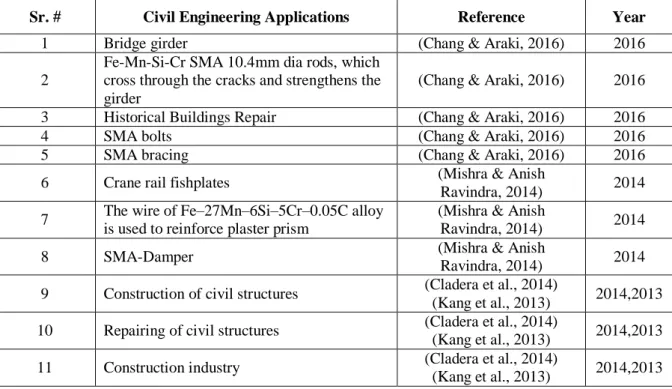
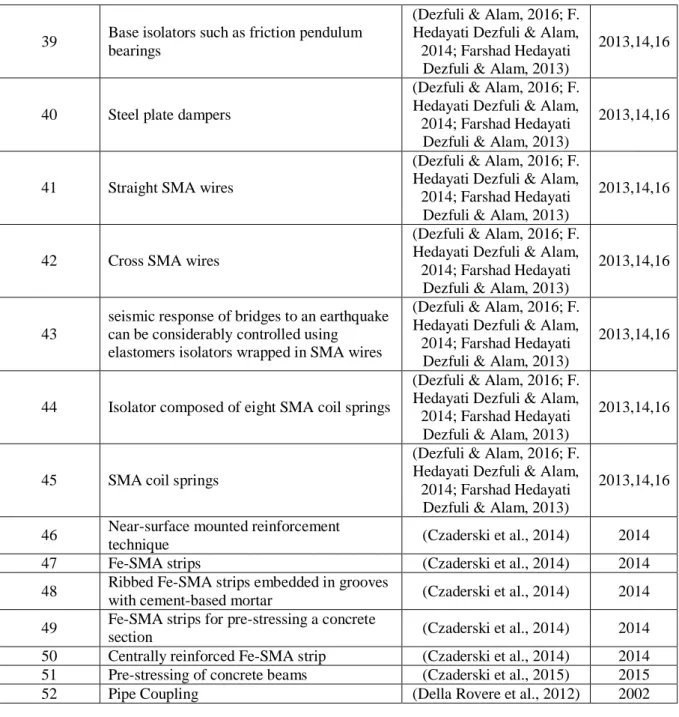
By analyzing all the applications mentioned in Table 1→Table 3, it has been found that the applications of Fe-SMAs exist in following different fields of research (1) Civil Engineering (2) Material Science (3) Physics (4) Seismic control (5) Mechanical Engineering (6) Biomedical (7) Vibration Control (8) Railway (9) Joining (10) Drilling (11) Forging (12) Automobile (13) Cement Industry (14) Aerospace (15) Fluid Mechanics (16) Automation (17) Micro Engineering (18) Pneumatic (19) Hydraulic (20)
Electromagnetic field. However, the authors would like to merge them in only three categories as mentioned below;
Civil Engineering Applications
Mechanical Engineering Applications
Biomedical Applications
2.1 Civil Engineering Applications
This literature is a modest contribution to the ongoing discussion on applications of iron-based shape memory alloys in civil construction. They are the most promising candidates for fast development in the construction industry. Fe-SMAs, especially Fe-Mn-Si alloys have a great potential for civil engineering structures because of its unique properties. Many applications are yet to be explored more. Fe-SMAs are being used for constructing as well as repairing civil structures when using these SMAs as pre-stressing tendons. Fe-SMAs are also being used for the pre-stressing of construction beams because of their pseudo-elasticity and sometimes used as damping materials in civil constructions. Their cost effectiveness, workability, and good weldability are some of the features upon which Ni-Ti SMAs can be replaced by Fe-Mn-Si SMAs. Some of the notable applications of Fe-Mn-Si SMAs include pipe joining for tunnel construction and crane rail joint bars. Until now their applications are not completely discovered. It has been observed that adding the considerable amount of Cr to Fe-Mn-Si SMA generates its ability to corrosion resistance but there is a restriction associated with Cr. If Cr is added more than 7% it affects the shape memory effect which is the consequence of brittle σ-phase, therefore alternatively adding Ni will have counter effect and thus the SME (shape memory effect) can be restored (Cladera et al., 2014)(Kang, Zhizhong, Yongchang, & Lin, 2013). Work has also been done on the strengthening of 80 mm long plaster prism specimen by inserting 1mm diameter pre-stressed wire of Fe-27Mn-6Si-5Cr-0.05C alloy (Watanabe, Miyazaki, & Okada, 2002). Square Fe–28Mn–6Si–5Cr–1(NbC) bars were inserted in small prism mortars (Sawaguchi et al., 2006).
Shape memory alloys are those alloys that when deformed returns to its pre-deformed shape upon heating. Fe-SMAs (Fe-Mn-Si) is favored over Ni-Ti based SMAs owing to its low cost. Since SMA’s does not require anchor heads and mechanical jacks, therefore shape memory alloys are being utilized for the strengthening of concrete beams using NSM (near surface mounted) method. Wearing and tearing of concrete bridges can be
avoided using Fe-SMAs strips as shown in Fig. 1. These have the following advantages; (1) Fe-SMA strips can be used for the strengthening of concrete beams by generating pre-stressing force, (2) Fe-SMA pre-stressed concrete beams have 80% higher cracking load than the same Fe-SMA without pre-stressing, (3) Pre-stressing of beams leads to following advantages: reduction of the stresses in internal steel, reduced deflections, reduced crack width and increased fatigue resistance, (4) using Fe-SMA strips has an ease as no mechanical anchors and jacks are required. Moreover, there are comparatively smaller ducts required than those in the case of CFRP strips, (5) the pre-stresses after activation were observed to be 200 MPa, which clearly depicts the sufficient strengthening of Fe-SMA strips with cement based mortar (Shahverdi, Czaderski, & Motavalli, 2016).
Fig. 1: Power supply to embedded Fe-SMA strips (Shahverdi, Czaderski, & Motavalli, 2016)
Fe-Mn-Si-Cr-Ni-VC shape memory alloy has a wide range of post-tensioning and pre-stressed applications in concrete structures (Lee, Weber, Feltrin, Motavalli, & Leinenbach, 2012). Recently developed Fe-SMA with the composition of Fe–17Mn–5Si–10Cr–4Ni–1VC (mass-%) shows encouraging properties with respect to potential civil engineering applications. The flexural behaviors of the beams were experimentally investigated during four-point bending until failure. The behavior was significantly improved by the pre-stressed Fe-SMA bars as compared to normal steel reinforcement bars. Application of such type of Fe-SMA bars embedded in a shotcrete layer to strengthen RC structure is presented (Shahverdi, Czaderski, Annen, & Motavalli, 2016) as shown in Fig. 2. This technique of shotcrete is used to construct & repair tunnels, structures (Cladera et al., 2014), swimming pools (Doyle, Dale, Choi, &
City, 2012), mine support (Song & Lu, 2001), building columns, building beams (Tsonos, 2010), retaining walls, foundations (Reese, Kulchin, & City, 1990)(Data, 2005), Refractory (Terzić, Andrić, & Mitić, 2014), artificial rock (Li, 2006).
Fig. 2: Shotcrete or spraying concrete (proshot concrete PC)
As it is mentioned earlier, the most common application of Fe-SMAs is structural strengthening
of reinforced concrete (RC) beams using Fe-SMA strips (Shahverdi, Czaderski, & Motavalli, 2015). Behavior of the properties of two different smart elastomeric bearings composed of shape memory alloy (SMA) wire has been illuminated as shown in Fig. 3. Based on different parameters such as variety of SMA, shear strain amplitude, base isolator aspect ratio, SMA wire thickness and the quantity of pre-strain existence in wires SMA-NRBs performance have been examined. Fe-Ni-Cu-Al-Ta-B with 13.5% superelastic strain and a very low austenite finish temperature (-62oC) has been proposed as the best material to be used in SMA-NRBs, exposed to high shear strain amplitudes. One of the well-known seismic control methods being used in bridges, buildings, and other civil structures is seismic base isolation. Several types of base isolators such as lead rubber bearings, high-damping rubber bearings, friction pendulum bearings, and steel plate dampers etc. are being used all around the world depending upon their practice and needs.
Fig. 3: Smart Rubber Bearings (a) straight SMA wires (b) cross SMA wires (Dezfuli & Alam, 2016; F. Hedayati Dezfuli & Alam, 2014; Farshad Hedayati Dezfuli & Alam, 2013)
The main reason for the use of base isolators is their high flexibility, which results in the change of natural period to a safer value far away from the critical period range of earthquake. Seismic behavior of highway bridges isolated by high-damping rubber bearing was observed. They indicated that the seismic response of bridges to an earthquake can be considerably controlled using elastomers isolators wrapped in SMA wires. They recommended an isolator composed of eight SMA coil springs. It was assumed that these SMA coil springs can be used with rubber bearings or friction pendulum systems permitted to control the vertical and horizontal impacts to the civil structures (Dezfuli & Alam, 2016; F. Hedayati Dezfuli & Alam, 2014; Farshad Hedayati Dezfuli & Alam, 2013).
Near-surface mounted reinforcement technique is being used in civil concrete structures for their reinforcement. In near-surface mounted technique, strips are embedded in the concrete into their grooves. The possibility of using Fe-SMA strips has been discussed rather than using Fibre-Reinforced Polymer (FRP) because it results in the recovery stress ranging from 250 to 300 MPa, which represents the strengthening of Fe-SMA strips comparatively higher. The possibility of using Fe-SMA (Fe-Mn-Si) in civil structures has been discussed due to distinctive properties of shape memory alloys e.g. two-way shape memory effect, superelasticity and shape memory effect as well as due to its low cost, high elastic stiffness and wide transformation hysteresis comparative to NiTi-SMA. Therefore, Fe-SMA strips shape
memory effect is utilized for the pre-stressing of strips (Czaderski, Shahverdi, Brönnimann, Leinenbach, & Motavalli, 2014).
Lap-shear test results for using ribbed Fe-SMA strips embedded in grooves with cement-based mortar revealed their usage for strengthening applications. Bond shear stress of CFRP strips with epoxy came out to be 14MPa while it was observed to be 4Mpa in case of ribbed Fe-SMA with mortar. Fe-SMA strips could be stimulated by resistive heating and are embedded in the concrete bars as shown in Fig. 4. Compressive stresses in the range of 3MPa indicated the possibility of using Fe-SMA strips for pre-stressing a concrete section (Czaderski et al., 2014).
Fig. 4: Centrally reinforced Fe-SMA strip (Czaderski et al., 2014)
As shape memory alloys (SMAs) can restore their original shape after being distorted upon heating or removing the load, therefore, they can be utilized for pre-stressing of concrete beams as shown in Fig. 5 and Fig. 6, because they can replace anchor heads, hydraulic jacks or duct injections (Czaderski et al., 2015).
Fig. 6: 8mm Ribbed Fe-SMA bars used for concrete reinforcement
Shape memory alloys can also be used for seismic purposes i.e. for the seismic construction and repair. Therefore due to available variety of alloys, Fe-Ni-Co-Al can be regarded as seismic application shape memory alloy due to its wide temperature range (i.e. between -500°C to 500°C) availability (Chang & Araki, 2016). Bridge girder is reinforced by inserting Fe-Mn-Si-Cr SMA 10.4mm diameter rods, which cross through the cracks and strengthens the girder as shown in Fig. 7 (Chang & Araki, 2016).
Fig. 7: Fe-SMAs rods crossing the cracks (Chang & Araki, 2016)
As mentioned earlier, shape memory alloys can be used for both construction and repairing of civil structures, therefore many historic destructed structures have been repaired using shape memory alloys (Chang & Araki, 2016). SMA bolts as shown in Fig. 8, are also found to be very effective for earthquake components. Their results show that base shears are reduced by using such type of bolts (Chang & Araki, 2016).
Fig. 8: SMA Bolt (Chang & Araki, 2016)
SMA bracing is used to overcome the steel related problems of limited ductility and energy dissipation caused by buckling of bracing as shown in Fig. 9 (Chang & Araki, 2016).
Fig. 9: Bracing system design (Chang & Araki, 2016)
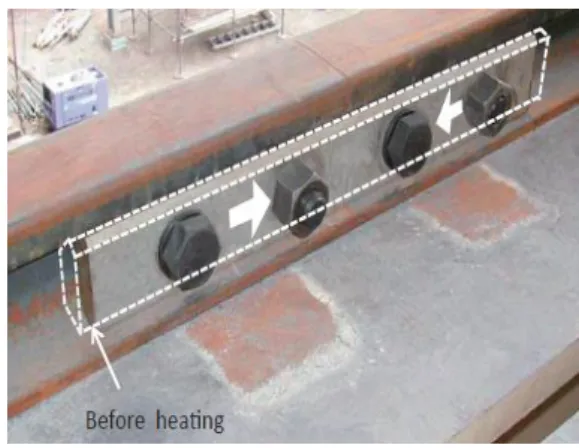
SMAs help in reparation of structures as well as they withstand further damages brought on by disasters such as earthquakes. Crane rail fishplates are manufactured by using Fe-SMA. The wire of Fe–27Mn–6Si–5Cr–0.05C alloy as shown in Fig. 10, is used to reinforce plaster prism specimen (Mishra & Anish Ravindra, 2014).
Fig. 10: SMA-wire contracts by electric heating and hence reduces crack (Mishra & Anish Ravindra, 2014)
Experimental based review of damping characteristics of shape memory alloys, depicts the advantageous aspects of SMAs in civil engineering structures as a Super-Elastic SMA Damper (Mishra & Anish Ravindra, 2014).
All the above-mentioned applications of Fe-SMA in the field related to Civil Engineering, are collected below in Table 1.
Table 1: Applications of Fe-SMAs in Civil Engineering
Sr. # Civil Engineering Applications Reference Year
1 Bridge girder (Chang & Araki, 2016) 2016
2
Fe-Mn-Si-Cr SMA 10.4mm dia rods, which cross through the cracks and strengthens the girder
(Chang & Araki, 2016) 2016 3 Historical Buildings Repair (Chang & Araki, 2016) 2016
4 SMA bolts (Chang & Araki, 2016) 2016
5 SMA bracing (Chang & Araki, 2016) 2016
6 Crane rail fishplates (Mishra & Anish
Ravindra, 2014) 2014
7 The wire of Fe–27Mn–6Si–5Cr–0.05C alloy is used to reinforce plaster prism
(Mishra & Anish
Ravindra, 2014) 2014
8 SMA-Damper (Mishra & Anish
Ravindra, 2014) 2014
9 Construction of civil structures (Cladera et al., 2014)
(Kang et al., 2013) 2014,2013 10 Repairing of civil structures (Cladera et al., 2014)
(Kang et al., 2013) 2014,2013
11 Construction industry (Cladera et al., 2014)
12 Pre-stressing tendons (Cladera et al., 2014)
(Kang et al., 2013) 2014,2013 13 Pre-stressing of construction beams (Cladera et al., 2014)
(Kang et al., 2013) 2014,2013 14 Damping materials in civil construction (Cladera et al., 2014)
(Kang et al., 2013) 2014,2013 15 Pipe joining for tunnel construction (Cladera et al., 2014)
(Kang et al., 2013) 2014,2013
16 Crane rail joint bars (Cladera et al., 2014)
(Kang et al., 2013) 2014,2013 17
strengthening of 80 mm long plaster prism specimen by inserting 1mm diameter pre-stressed wire
(Watanabe et al., 2002) 2002 18 Square Fe–28Mn–6Si–5Cr–1(NbC) bars (Sawaguchi et al., 2006) 2006 19 Strengthening of concrete beams (Shahverdi, Czaderski, &
Motavalli, 2016) 2016 20 Wearing and tearing of concrete bridges can
be avoided using Fe-SMA strips
(Shahverdi, Czaderski, &
Motavalli, 2016) 2016 21 Fe-SMA strips with cement-based mortar (Shahverdi, Czaderski, &
Motavalli, 2016) 2016 22 Post-tensioning and pre-stressed applications
in concrete structures (Lee et al., 2012) 2012
23 Fe-SMA bars embedded in a shotcrete layer to strengthen RC structure
(Shahverdi, Czaderski,
Annen, et al., 2016) 2016
24 Constructing Tunnels (Cladera et al., 2014) 2014
25 Repairing Tunnels (Cladera et al., 2014) 2014
26 Swimming pools (Lee et al., 2012) 2012
27 Mine support (Song & Lu, 2001) 2001
28 Building columns (Tsonos, 2010) 2010
29 Building beams (Tsonos, 2010) 2010
30 Retaining walls and foundations (Reese et al., 1990) (Data,
2005) 1990,2005
31 Refractory (Terzić et al., 2014) 2014
32 Artificial rock (Li, 2006) 2006
33 Structural strengthening of reinforced
concrete (RC) beams using Fe-SMA strips (Shahverdi et al., 2015) 2013 34 Elastomeric bearings composed of
SMA-wire
(Dezfuli & Alam, 2016; F. Hedayati Dezfuli & Alam, 2014; Farshad Hedayati
Dezfuli & Alam, 2013)
2013,14,16
35 Seismic control methods being used in bridges
(Dezfuli & Alam, 2016; F. Hedayati Dezfuli & Alam, 2014; Farshad Hedayati
Dezfuli & Alam, 2013)
2013,14,16
36 Seismic base isolation
(Dezfuli & Alam, 2016; F. Hedayati Dezfuli & Alam, 2014; Farshad Hedayati
Dezfuli & Alam, 2013)
2013,14,16
37 Base isolators such as lead rubber bearings
(Dezfuli & Alam, 2016; F. Hedayati Dezfuli & Alam, 2014; Farshad Hedayati
Dezfuli & Alam, 2013)
2013,14,16
38 Base isolators such as high-damping rubber bearings
(Dezfuli & Alam, 2016; F. Hedayati Dezfuli & Alam, 2014; Farshad Hedayati
Dezfuli & Alam, 2013)
39 Base isolators such as friction pendulum bearings
(Dezfuli & Alam, 2016; F. Hedayati Dezfuli & Alam, 2014; Farshad Hedayati
Dezfuli & Alam, 2013)
2013,14,16
40 Steel plate dampers
(Dezfuli & Alam, 2016; F. Hedayati Dezfuli & Alam, 2014; Farshad Hedayati
Dezfuli & Alam, 2013)
2013,14,16
41 Straight SMA wires
(Dezfuli & Alam, 2016; F. Hedayati Dezfuli & Alam, 2014; Farshad Hedayati
Dezfuli & Alam, 2013)
2013,14,16
42 Cross SMA wires
(Dezfuli & Alam, 2016; F. Hedayati Dezfuli & Alam, 2014; Farshad Hedayati
Dezfuli & Alam, 2013)
2013,14,16
43
seismic response of bridges to an earthquake can be considerably controlled using
elastomers isolators wrapped in SMA wires
(Dezfuli & Alam, 2016; F. Hedayati Dezfuli & Alam, 2014; Farshad Hedayati
Dezfuli & Alam, 2013)
2013,14,16
44 Isolator composed of eight SMA coil springs
(Dezfuli & Alam, 2016; F. Hedayati Dezfuli & Alam, 2014; Farshad Hedayati
Dezfuli & Alam, 2013)
2013,14,16
45 SMA coil springs
(Dezfuli & Alam, 2016; F. Hedayati Dezfuli & Alam, 2014; Farshad Hedayati
Dezfuli & Alam, 2013)
2013,14,16
46 Near-surface mounted reinforcement
technique (Czaderski et al., 2014) 2014
47 Fe-SMA strips (Czaderski et al., 2014) 2014
48 Ribbed Fe-SMA strips embedded in grooves
with cement-based mortar (Czaderski et al., 2014) 2014
49 Fe-SMA strips for pre-stressing a concrete
section (Czaderski et al., 2014) 2014
50 Centrally reinforced Fe-SMA strip (Czaderski et al., 2014) 2014 51 Pre-stressing of concrete beams (Czaderski et al., 2015) 2015
52 Pipe Coupling (Della Rovere et al., 2012) 2002
2.2 Mechanical Engineering
Applications
Fe-30Mn-6Si-4Cr-5Ni stainless shape memory alloy is used to make Fe-SMA Nut as shown in Fig. 11. By using such type of Nut; (1) self-locking frictional moment is considerably increased (2) axial load uniformity among different screw teeth is improved (3) failure phenomena reduces (4) thread connection loosening is prevented (5) disengaging is controlled and (6) thread fatigue fracture is prevented (Junliang, DU, & Baochen, 2015).
Realization of recovery stresses in Fe–Mn– Si–Cr–Ni–VC shape memory alloy used for mechanical coupling as shown in Fig. 12, to which
we can use for pipe joining. It can also be used for reinforcement of concrete as shown in Fig. 13 (Lee, Weber, & Leinenbach, 2015).
Fig. 11: Fe-SMA Nut (Junliang, DU, et al., 2015) Fe43.5-Mn34-Al15-Ni7.5 shape memory alloy has been found suitable for the applications of automobiles, space, seismic and cryogenic. As it is evident from the temperature and critical
tensile stress graph, the slope shows the response of super-
Fig. 12: Pipe Joining by using SMA Coupling (Lee et al., 2015)
Fig. 13: Reinforcement by Fe-SMA (Lee et al., 2015)
elastic behavior for a greater range of temperature which makes it suitable for the high-temperature applications (Tseng et al., 2015).
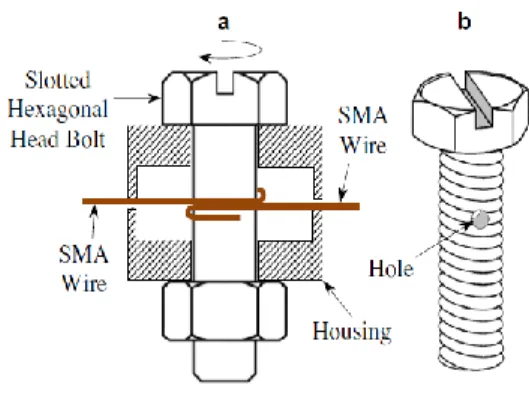
Shape memory alloy Stone Breakers based on Ferrous-SMA have their example applications such as Stone exploitation, tunnels, side slopes, pre-splitting blasting, and demolition blasting. (Benafan, Noebe, & Halsmer, 2015). Fig. 14 shows the mechanism for determining pre-straining effect on smart elastomeric bearings, in this mechanism FeNCATB SMA wires with cross-sectional area of 19.6mm2 are firstly wrapped around the rubber then passing the wires through the bolted hooks located on steel end plates, wire ends are finally passed through the hole located in the bolt enclosed in a housing in order to avoid sliding. The wire is wrapped around this bolt and bolt is rotated to generate a pre-stress in the wire, which results in pre-strain of SMA wire (2%). The advantage of the suggested mechanism is its high accuracy in adjusting the level of pre-strain by accurately tightening the bolt. Amount of pre-strain generated in the wire can be regulated adjusting the dimensions of screw used and the number of rotations given to the bolt to generate pre-stress (F. Hedayati Dezfuli & Alam, 2014).
Fig. 14: Pre-strain ferrous FeNCATB SMA wires (F. Hedayati Dezfuli & Alam, 2014) It has been observed that Fe-14Mn-3Si-10Cr-5Ni (wt. %) with Samarium (atomic number 62) addition, shape memory alloy’s features such as shape memory behavior, critical stress and proof stress can be improved by thermomechanical treatments, making them useful for the applications such as large shape memory devices, hard metal/alloy joining in transport systems, heat to shrink pipe couplings, pipe joining in oil fields, pipe joining during civil work, protective casings for ceramic parts, nozzles of bottom blown oxygen furnaces for melting of iron and railway rail tracks joining (Farjami, Hiraga, & Kubo, 2005; Kubo, Otsuka, Farjami, & Maruyama, 2006; Lin, Lin, Chen, & Yang, 2005; Maji, Das, Krishnan, & Ray, 2006; Shakoor & Ahmad Khalid, 2009). Couplings for shafts and pipes as shown in Fig. 15, are one of the more inspiring applications of Fe-SMAs. Couplings of Fe–15Mn–5Si–9Cr–5Ni (wt. %) SMA Alloy are found to recover 83% of their diametrical expansion. Hence, suitable for a large number of industrial applications (A. V. Druker, Perotti, Esquivel, & Malarría, 2014)(A.V. Druker, Perotti, Esquivel, & Malarría, 2015)(Ana Velia Druker, Esquivel, Perotti, & Malarria, 2014).
Fig. 15: Finished prototype Fe-SMA coupling (A. V. Druker et al., 2014)(A.V. Druker et al., 2015)
Creep and stress relaxation behavior of Fe– 17Mn–5Si–10Cr–4Ni–1(V, C) (wt. %) shape memory alloy at low temperatures was studied. Fe-Mn-Si-X are Fe-SMAs which are also called as shape memory steels. It has been found that active vibration control, energy dissipation, and passive vibration damping are possible applications of Fe-SMAs as shown in Fig. 16 a-b. Shape memory alloys function as actuators due to their shape memory effect (Leinenbach et al., 2016)(Janke, 2005).
Fig. 16a: Fe-SMA device at Basilica San
Francesco at Assisi Italy, for earthquake protection (Janke, 2005)
Fig. 16b: Fe-SMA-springs used in active vibration control (Janke, 2005)
Development of applications of Fe-Mn-Si based polycrystalline shape memory alloys was started in 1984. Lock ring for bicycle frame pipes as shown in Fig. 17, is a typical application of Fe-28Mn-6Si-5Cr shape memory alloy (Sawaguchi et al., 2016).
Fig. 17: Fe-SMA lock ring for frame pipe of a bicycle (Sawaguchi et al., 2016)
Fe-28Mn-6Si-5Cr shape memory alloy ring is used so as to reinforce as well as prevent bulk superconductor from breakage and cracking in furnaces as shown in Fig. 18 (Sawaguchi et al., 2016).
Fig. 18: SMA Ring to reinforce and protect bulk superconductor (Sawaguchi et al., 2016) In 2003, pipe joints made of Fe-28Mn-6Si-5Cr shape-memory alloy as shown in Fig. 19, were employed in the construction of the Wakunami Tunnel in Kanazawa, Japan (Sawaguchi et al., 2016).
Fig. 19: Pipe joints of Fe-SMA (Sawaguchi et al., 2016)
Fe-28Mn-6Si-5Cr shape-memory alloy is used as joint plates as shown in Fig. 20 (Sawaguchi et al., 2016).
Fe-15Mn-4Si-10Cr-8Ni shape memory alloy is also found to be successful for seismic dampers as shown in Fig. 21 (Sawaguchi et al., 2016).
Fig. 21: Seismic Damper (Sawaguchi et al., 2016) Melt-extracted polycrystalline micro-wires are made of Ni49.7-Mn25.0-Ga19.8-Fe5.5 shape memory alloy. These Fe-doped micro-wires show the least dependency of strain on stress as compared to other alloys. Therefore, these wires can be used as candidate materials in micro-devices (Y. Liu et al., 2014).
Fe–28%Mn–6%Si–5%Cr SMA are used to make long twisted plates of 0.3mm thickness as shown in Fig. 22. Another example is the SMA twisted wire for drilling purposes as shown in Fig. 23 (Akikazu Sato, Kubo, & Maruyama, 2006).
Fig. 22: Fe-SMA long twisted plates (Akikazu Sato et al., 2006)
Fig. 23: Fe-SMA twisted wire (Akikazu Sato et al., 2006)
The connecting property of cast pipe joint of Fe-15Mn-5Si-8Cr-5Ni-0.25C shape memory alloy is as good as that of the forged pipe joint. In addition, cast pipe joint has much lower cost as compared to that of forged pipe joint (Zhao, Li, & Jiang, 2003).
Unique properties of ferromagnetic shape memory alloys such as magnetic field induced strain (MFIS) and quick response make them useful for diverse applications e.g. sensors and actuators. This exclusive feature, magnetic field induced strain (MFIS) was first observed by Ullakko. Furthermore, to get excessive MFIS e.g. (twin boundary mobility, high magnetic anisotropy energy and low volume change as a result of transformation) some specific magnetic and micromechanical requirements must be met. Currently, several types of alloys are found to exhibit a magnetically-induced shape memory effect including NiMnGa, NiFeGa , FePd, FePt (J. Liu, Zheng, Xia, Huang, & Li, 2005)(Karaca, Karaman, Chumlyakov, Lagoudas, & Zhang, 2004).
FSMA actuator as shown in Fig. 24, shows its working principle i.e. spring is actuated by generating a magnetic field, as a result, the spring elongates by covering the distance h between plungers and stopper that gives rise to a stroke h and vice versa. Greater the magnetic flux larger will be the magnetic field produced (Faran & Shilo, 2016).
Development of biomedical systems by using some devices like drag mixing systems and swimming micro-robots. They require the propulsion of fluid using actuators of large strokes and high bandwidth enabling their features. These
Fig. 24: Ferromagnetic-SMA actuator (Faran & Shilo, 2016)
devices are made of ferromagnetic shape memory alloys (Faran & Shilo, 2016). Lower coercivity (Hc) of Co2FeSi nano-particles results in such GMR behavior making them suitable for sensor applications. Likewise, Heusler nano-particles g-GMR behavior induces distinctive characteristics
such as higher sensitivity, reliability and cost-effectiveness for mass production (Wang et al., 2014). Shape memory effect controlled by magnetism is found to be a principle of a new class of actuator materials. Such type of actuators have the ability to replace pneumatic, hydraulic
and electromagnetic drives in many applications (Ullakko, 1996).
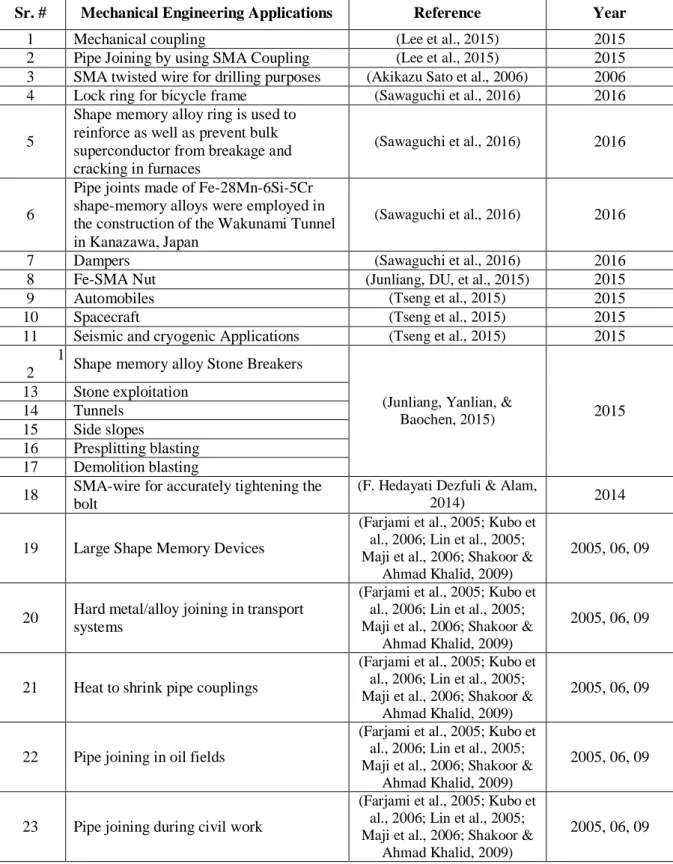
All the above-mentioned applications of Fe-SMA in the field related to Mechanical Engineering, are collected below in Table 2.
Table 2: Applications of Fe-SMAs in Mechanical Engineering
Sr. # Mechanical Engineering Applications Reference Year
1 Mechanical coupling (Lee et al., 2015) 2015
2 Pipe Joining by using SMA Coupling (Lee et al., 2015) 2015
3 SMA twisted wire for drilling purposes (Akikazu Sato et al., 2006) 2006
4 Lock ring for bicycle frame (Sawaguchi et al., 2016) 2016
5
Shape memory alloy ring is used to reinforce as well as prevent bulk superconductor from breakage and cracking in furnaces
(Sawaguchi et al., 2016) 2016
6
Pipe joints made of Fe-28Mn-6Si-5Cr shape-memory alloys were employed in the construction of the Wakunami Tunnel in Kanazawa, Japan
(Sawaguchi et al., 2016) 2016
7 Dampers (Sawaguchi et al., 2016) 2016
8 Fe-SMA Nut (Junliang, DU, et al., 2015) 2015
9 Automobiles (Tseng et al., 2015) 2015
10 Spacecraft (Tseng et al., 2015) 2015
11 Seismic and cryogenic Applications (Tseng et al., 2015) 2015 1
2 Shape memory alloy Stone Breakers
(Junliang, Yanlian, &
Baochen, 2015) 2015
13 Stone exploitation 14 Tunnels
15 Side slopes
16 Presplitting blasting 17 Demolition blasting
18 SMA-wire for accurately tightening the bolt
(F. Hedayati Dezfuli & Alam,
2014) 2014
19 Large Shape Memory Devices
(Farjami et al., 2005; Kubo et al., 2006; Lin et al., 2005; Maji et al., 2006; Shakoor &
Ahmad Khalid, 2009)
2005, 06, 09
20 Hard metal/alloy joining in transport systems
(Farjami et al., 2005; Kubo et al., 2006; Lin et al., 2005; Maji et al., 2006; Shakoor &
Ahmad Khalid, 2009)
2005, 06, 09
21 Heat to shrink pipe couplings
(Farjami et al., 2005; Kubo et al., 2006; Lin et al., 2005; Maji et al., 2006; Shakoor &
Ahmad Khalid, 2009)
2005, 06, 09
22 Pipe joining in oil fields
(Farjami et al., 2005; Kubo et al., 2006; Lin et al., 2005; Maji et al., 2006; Shakoor &
Ahmad Khalid, 2009)
2005, 06, 09
23 Pipe joining during civil work
(Farjami et al., 2005; Kubo et al., 2006; Lin et al., 2005; Maji et al., 2006; Shakoor &
Ahmad Khalid, 2009)
24 Protective casings for ceramic parts
(Farjami et al., 2005; Kubo et al., 2006; Lin et al., 2005; Maji et al., 2006; Shakoor &
Ahmad Khalid, 2009)
2005, 06, 09
25 Nozzles
(Farjami et al., 2005; Kubo et al., 2006; Lin et al., 2005; Maji et al., 2006; Shakoor &
Ahmad Khalid, 2009)
2005, 06, 09
26 Couplings for shafts
(A. V. Druker et al., 2014)(A.V. Druker et al., 2015)(Ana Velia Druker et
al., 2014)
2014, 2015
27 Couplings for pipes
(A. V. Druker et al., 2014)(A.V. Druker et al., 2015)(Ana Velia Druker et
al., 2014)
2014, 2015
28 Industrial applications
(A. V. Druker et al., 2014)(A.V. Druker et al., 2015)(Ana Velia Druker et
al., 2014)
2014, 2015
29 Active vibration control (Leinenbach et al.,
2016)(Janke, 2005) 2005, 2016 30 Energy dissipation & Passive vibration
damping
(Leinenbach et al.,
2016)(Janke, 2005) 2005, 2016
31 Actuators (Leinenbach et al.,
2016)(Janke, 2005) 2005, 2016 32 Steel bar with Fe-SMA device at Basilica
San Francesco (Janke, 2005) 2005
33 Steel bars of Fe-SMA device used in the
bell tower (Janke, 2005) 2005
34 Fe-SMA bars used in simply supported
bridges (Janke, 2005) 2005
35 Fe-SMA-springs used in active vibration
control (Janke, 2005) 2005
36 Large diameter pipe couplings (Karaca et al., 2016) 2016
37 Polycrystalline micro-wires (Y. Liu et al., 2014) 2014
38 Micro Devices (Y. Liu et al., 2014) 2014
39 Casted pipe joint (Zhao et al., 2003) 2003
40 Sensors (J. Liu et al., 2005)(Karaca et
al., 2004)(Wang et al., 2014) 2004, 05, 14
41 FSMA actuator (Faran & Shilo, 2016) 2016
42 SMA-Spring actuated by a magnetic field (Faran & Shilo, 2016) 2016
43 Drag mixing systems (Faran & Shilo, 2016) 2016
44 Swimming micro-robots (Faran & Shilo, 2016) 2016
45 Pneumatic drives (Ullakko, 1996) 1996
46 Hydraulic drives (Ullakko, 1996) 1996
47 Electromagnetic drives (Ullakko, 1996) 1996
2.3 Medical Applications
The literature manifests the benefits of Iron-based alloys over Mg-Iron-based alloys as stent material, based on ductility and strength.
It further elaborates the
a) Designing and manufacturing of Fe based alloys.
b) Cell viability test.
c) In vitro and in vivo performance.
Pure Fe and Fe based alloys e.g. Fe-21Mn-0.7C-1%Pd, Fe-Mn-Si, and Fe-based bulk metallic glasses have been suggested as manufacturing materials for Iron alloy-based stent applications as shown in Fig. 25. Owing to the already existence of Si in the human body, Fe based alloy (Fe-30Mn-6Si) has been established due to its
compatibility with the human body (Francis, Yang, Virtanen, & Boccaccini, 2015)(Moravej & Mantovani, 2011).
Fig. 25: Cardiovascular Stent of Fe-SMA (Francis et al., 2015)
Shape memory alloys are also classified into Ferromagnetic shape memory alloys (FSMAs) which exhibit remarkable properties such as magnetically switchable strains of several percent at constant temperature and frequencies from
quasi-static to few kilohertz. They also show super-elasticity in addition to FMSM properties that make them appropriate for medical applications. Cytotoxic effects of polycrystalline surfaces with various roughness profiles can be excluded giving another tunable parameter for applying Fe–Pd magnetically switchable membranes e.g. in stents and valves. Fe–Pd has been a promising candidate for new types of biomedical devices. Several biomedical devices such as actuators, valves, stents, bone prostheses, regenerative medicine and matrices for tissue engineering use Fe-Pd (FSMA) as magnetically switchable membranes because of its biocompatibility and bioactivity with different cell types (Allenstein, Ma, Arabi-Hashemi, Zink, & Mayr, 2013).
All the above-mentioned applications of Fe-SMA in the field related to Biomedical, are collected below in Table 3.
Table 3: Biomedical Applications of Fe-SMAs
Sr. # Biomedical Applications Reference Year
1 Cardiovascular Stent of Fe-based SMA
(Francis et al., 2015)(Moravej & Mantovani, 2011)
2011, 2015 2 Fe–Pd magnetically switchable membranes e.g.
in stents and valves (Allenstein et al., 2013) 2013
3 Bio Medical Device as Actuators (Allenstein et al., 2013) 2013
4 Bio Medical Device as Valves (Allenstein et al., 2013) 2013
5 Bio Medical Device as Bone prostheses (Allenstein et al., 2013) 2013 6
Regenerative medicine and matrices for tissue engineering use Fe-Pd (FSMA) as magnetically switchable membranes
(Allenstein et al., 2013) 2013
3.
Results & Discussions
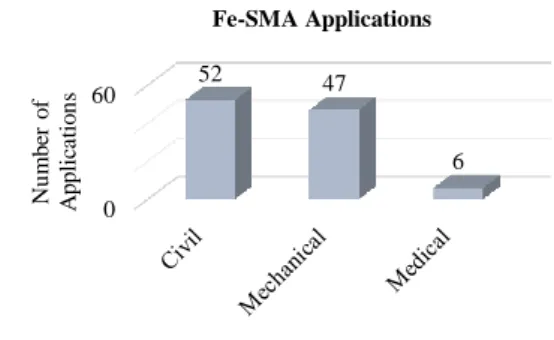
There are many different applications of Fe-SMAs. These applications are collected in Table 1→Table 3, which also show the results of this work. Fig. 26 shows the analysis performed by observing the data in Table 1→Table 3. Fig. 26 shows that most of the applications of Fe-SMA are related to Civil Engineering, the second most are related to Mechanical Engineering and the third most are related to Medical Applications. This type of analysis was performed by counting the number of applications from each of civil, mechanical and medical fields mentioned in Table 1, Table 2 and Table 3. The authors hope that promptly growing development and research on
Fe-SMAs will lead to their application in biomedical and different engineering disciplines in the coming near future.
Fig. 26: Fe-SMA Applications in different fields 0
60 52 47
6
N
u
m
b
er
o
f
A
p
p
li
ca
ti
o
n
s
Field of Applications Fe-SMA Applications
The analysis shown in Fig. 27 is performed to show the development in applications of Fe-SMAs since 1990 to date (almost during the last three decades). The data is taken from Table 1→Table 3 to have the following analysis. It has been clearly observed that there is a considerable percentage increase in the applications of Fe-SMA during the last three decades.
Fig. 27: Percentage increase in applications of Fe-SMA
By analyzing all the applications mentioned in Table 1→Table 3, it has been found that the applications of Fe-SMAs exist in the following different fields of research. (1) Civil Engineering (2) Material Science (3) Physics (4) Seismic control (5) Mechanical Engineering (6) Biomedical (7) Vibration Control (8) Railway (9) Joining (10) Drilling (11) Forging (12) Automobile (13) Cement Industry (14) Aerospace (15) Fluid Dynamics (16) Automation (17) Micro Engineering (18) Pneumatic (19) Hydraulic (20) Electromagnetic field. However, the authors would like to summarize them only in three categories as mentioned in subsection 4.1→subsection 4.3 as well as in Fig. 28→Fig. 30.
Fig. 28: Categorization of Fe-SMA Applications
Fig. 29: Fields of applications of Fe-SMA related to Mechanical Engineering
Fig. 30: Fields of applications of Fe-SMA related to Civil Engineering
4.
Acknowledgment
The financial support for this work was provided by UET Taxila Pakistan under Grant No. UET/Estab/2012/1646. This work was technically supported by OvGU, Magdeburg, Germany. The affectionate supervision of my supervisor Prof. Ing. Daniel Juhre and co-supervisor Prof. Dr.-Ing. habil. Thorsten Halle gave me encouragement. The author is thankful for financial as well as technical support.
5.
References
[1] Allenstein, U., Ma, Y., Arabi-Hashemi, A., Zink, M., & Mayr, S. G. (2013). Fe-Pd 0
20 40 60 80
1990-2000 2001-2010 2011-2016
2.56
25.64
71.8
P
erc
en
ta
g
e
In
cre
a
se
in
A
p
p
li
ca
ti
o
n
s
Decades
Percentage increase in applications of Fe-SMA
Fe-SMA application's
categories Civil Engineering
Biomedical Mechanical
Engineering
Mechanical
VibrationControl
Railway
Fluid Dynamics
Joining
Drilling
Forging
Automo-bile Aerospace
Automa-tion Micro
Enginee-ring Pneumatic
System Hydraulic
System Elecrtro-magnetic
field
Civil
Material sciencePhysics Siesmic
based ferromagnetic shape memory actuators for medical applications: Biocompatibility, effect of surface roughness and protein coatings. Acta Biomaterialia, 9(3), 5845–5853. http://doi.org/10.1016/j.actbio.2012.10.040 [2] Benafan, O., Noebe, R. D., & Halsmer, T. J.
(2015). Shape Memory Alloy Rock Splitters (SMARS)-A Non-Explosive Method for Fracturing Planetary Rocklike Materials and Minerals. National Aeronautics and Space Administration (NASA), (July), 1–35. [3] Chang, W.-S., & Araki, Y. (2016). Use of
shape-memory alloys in construction: a critical review. Proceedings of the Institution of Civil Engineers, 169(2), 87– 95. http://doi.org/10.1680/jcien.15.00010 [4] Cladera, A., Weber, B., Leinenbach, C.,
Czaderski, C., Shahverdi, M., & Motavalli, M. (2014). Iron-based shape memory alloys for civil engineering structures: An overview. Construction and Building Materials, 63, 281–293.
http://doi.org/10.1016/j.conbuildmat.2014.0 4.032
[5] Czaderski, C., Shahverdi, M., Brönnimann, R., Leinenbach, C., & Motavalli, M. (2014). Feasibility of iron-based shape memory alloy strips for prestressed strengthening of concrete structures. Construction and Building Materials, 56, 94–105.
http://doi.org/10.1016/j.conbuildmat.2014.0 1.069
[6] Czaderski, C., Weber, B., Shahverdi, M., Motavalli, M., Leinenbach, C., & Lee, W. (2015). Iron-based shape memory alloys (Fe-SMA) - a new material for prestressing concrete structures. Smar 2015, (September).
[7] Data, P. P. (2005). US Patent.
[8] Della Rovere, C. A., Alano, J. H., Silva, R., Nascente, P. A. P., Otubo, J., & Kuri, S. E. (2012). Influence of alloying elements on the corrosion properties of shape memory stainless steels. Materials Chemistry and Physics, 133(2–3), 668–673.
http://doi.org/10.1016/j.matchemphys.2012. 01.049
[9] Dezfuli, F. H., & Alam, M. S. (2016). Seismic vulnerability assessment of a steel-girder highway bridge equipped with different SMA wire-based smart elastomeric isolators. Smart Mater. Struct., 25(7), 1–16.
[10] Doyle, I. M. P., Dale, G., Choi, H., & City, B. (2012). (12) United States Patent, 2(12), 2–11. http://doi.org/10.1126/science.Liquids [11] Druker, A. V., Esquivel, I., Perotti, A., & Malarria, J. (2014). Optimization of Fe-15Mn-5Si-9Cr-5Ni shape memory alloy for pipe and shaft couplings. Journal of Materials Engineering and Performance, 23(7), 2732–2737.
http://doi.org/10.1007/s11665-014-0981-0 [12] Druker, A. V., Perotti, A., Esquivel, I., &
Malarría, J. (2015). Design of Devices and Manufacturing of Fe-Mn-Si Shape Memory Alloy Couplings. Procedia Materials Science, 8, 878–885.
http://doi.org/10.1016/j.mspro.2015.04.148 [13] Druker, A. V., Perotti, A., Esquivel, I., &
Malarría, J. (2014). A manufacturing process for shaft and pipe couplings of Fe-Mn-Si-Ni-Cr shape memory alloys. Materials and Design, 56, 878–888. http://doi.org/10.1016/j.matdes.2013.11.032 [14] Faran, E., & Shilo, D. (2016).
Ferromagnetic Shape Memory Alloys-Challenges, Applications, and Experimental Characterization. Experimental Techniques, 40(3), 1005–1031.
http://doi.org/10.1007/s40799-016-0098-5 [15] Farjami, S., Hiraga, K., & Kubo, H. (2005).
Crystallography and elastic energy analysis of VN precipitates in Fe-Mn-Si-Cr shape memory alloys. Acta Materialia, 53(2), 419–431.
http://doi.org/10.1016/j.actamat.2004.09.03 7
[16] Francis, A., Yang, Y., Virtanen, S., & Boccaccini, A. R. (2015). Iron and iron-based alloys for temporary cardiovascular applications. Journal of Materials Science. Materials in Medicine, 26(3), 138.
http://doi.org/10.1007/s10856-015-5473-8 [17] Grässel, O., Krüger, L., Frommeyer, G., &
Meyer, L. (2000). High strength Fe-Mn-(Al, Si) TRIP/TWIP steels development-properties-application. International Journal of Plasticity, 16(10), 1391–1409.
http://doi.org/10.1016/S0749-6419(00)00015-2
[18] Hedayati Dezfuli, F., & Alam, M. S. (2013). Shape memory alloy wire-based smart natural rubber bearing. Smart Materials and Structures, 22(4), 1–17.
http://doi.org/10.1088/0964-1726/22/4/045013
[19] Hedayati Dezfuli, F., & Alam, M. S. (2014). Performance-based assessment and design of FRP-based high damping rubber bearing incorporated with shape memory alloy wires. Engineering Structures, 61, 166–183. http://doi.org/10.1016/j.engstruct.2014.01.0 08
[20] Janke, L. (2005). Applications of shape memory alloys in civil engineering structures-Overview, limits and new ideas. Materials and Structures, 38(279), 578–592. http://doi.org/10.1617/14323
[21] Junliang, L., DU, Y., & Baochen, S. (2015). Application Research on Fe-based SMA in the Anti-breaking of Screw Connection. The 14th IFTOMM World Congress, Taipei, Taiwan, 14, 1–5.
[22] Junliang, L., Yanlian, D., & Baochen, S. (2015). Application Research on Fe-based SMA in the Anti-breaking of Screw Connection. The 14th IFTOMM World Congress, Taipei, Taiwan, 1–5.
[23] Kang, L., Zhizhong, D., Yongchang, L., & Lin, Z. (2013). A newly developed Fe-based shape memory alloy suitable for smart civil engineering. Smart Materials and Structures, 22(4), 45002.
http://doi.org/10.1088/0964-1726/22/4/045002
[24] Karaca, H. E., Karaman, I., Chumlyakov, Y. I., Lagoudas, D. C., & Zhang, X. (2004). Compressive response of a single crystalline CoNiAl shape memory alloy. Scripta Materialia, 51(3), 261–266.
http://doi.org/10.1016/j.scriptamat.2004.04. 002
[25] Karaca, H. E., Turabi, A. S., Chumlyakov, Y. I., Kireeva, I., Tobe, H., & Basaran, B. (2016). Superelasticity of [001]-oriented Fe42.6-Ni27.9-Co17.2-Al9.9-Nb2.4 ferrous shape memory alloys. Scripta Materialia, 120, 54–57.
http://doi.org/10.1016/j.scriptamat.2016.04. 008
[26] Kubo, H., Otsuka, H., Farjami, S., & Maruyama, T. (2006). Characteristics of Fe-Mn-Si-Cr shape memory alloys in centrifugal casting. Scripta Materialia, 55(11), 1059–1062.
http://doi.org/10.1016/j.scriptamat.2006.07. 058
[27] Lee, W. J., Weber, B., Feltrin, G.,
Motavalli, M., & Leinenbach, C. (2012). Thermomechanical characterization of an Fe-Mn-Si-Cr-Ni-VC shape memory alloy for application in prestressed concrete structures, 544–552.
[28] Lee, W. J., Weber, B., & Leinenbach, C. (2015). Recovery stress formation in a restrained Fe-Mn-Si-based shape memory alloy used for prestressing or mechanical joining. CONSTRUCTION & BUILDING MATERIALS, 95, 600–610.
http://doi.org/10.1016/j.conbuildmat.2015.0 7.098
[29] Leinenbach, C., Lee, W. J., Lis, A., Arabi-Hashemi, A., Cayron, C., & Weber, B. (2016). Creep and stress relaxation of a FeMnSi-based shape memory alloy at low temperatures. Materials Science and Engineering A, 677, 106–115.
http://doi.org/10.1016/j.msea.2016.09.042 [30] Li, C. C. (2006). Rock support design based
on the concept of pressure arch. International Journal of Rock Mechanics and Mining Sciences, 43(7), 1083–1090. http://doi.org/10.1016/j.ijrmms.2006.02.007 [31] Lin, H. C., Lin, K. M., Chen, Y. S., &
Yang, C. H. (2005). Ion nitriding of Fe-30Mn-6Si-5Cr shape memory alloyII. Erosion characteristics. Surface and Coatings Technology, 194(1), 74–81. http://doi.org/10.1016/j.surfcoat.2004.05.01 0
[32] Liu, J., Zheng, H. X., Xia, M. X., Huang, Y. L., & Li, J. G. (2005). Martensitic transformation and magnetic properties in Heusler CoNiGa magnetic shape memory alloys. Scripta Materialia, 52(9), 935–938. http://doi.org/10.1016/j.scriptamat.2004.12. 034
[33] Liu, Y., Zhang, X., Xing, D., Qian, M., Shen, H., Wang, H., Sun, J. (2014). Shape memory effects of Ni 49.7 Mn 25.0 Ga 19.8 Fe 5.5 microwires prepared by rapid solidification. Physica Status Solidi (A), 211(11), 2532–2536.
http://doi.org/10.1002/pssa.201431287 [34] Maji, B. C., Das, C. M., Krishnan, M., &
Ray, R. K. (2006). The corrosion behaviour of Fe-15Mn-7Si-9Cr-5Ni shape memory alloy. Corrosion Science, 48(4), 937–949. http://doi.org/10.1016/j.corsci.2005.02.024 [35] Mishra, M., & Anish Ravindra, A. (2014).
iron-based shape memory alloys and their potential in structural applications. Int. J. of Struct. & Civil Engg. Res., 3(4), 96–112. [36] Moravej, M., & Mantovani, D. (2011).
Biodegradable metals for cardiovascular stent application: Interests and new opportunities. International Journal of Molecular Sciences, 12(7), 4250–4270. http://doi.org/10.3390/ijms12074250 [37] Nikulin, I., Sawaguchi, T., Ogawa, K., &
Tsuzaki, K. (2016). Effect of γ to ε martensitic transformation on low-cycle fatigue behaviour and fatigue microstructure of Fe-15Mn-10Cr-8Ni-xSi austenitic alloys. Acta Materialia, 105, 207–218.
http://doi.org/10.1016/j.actamat.2015.12.00 2
[38] Otubo, J., Nascimento, F. C., Mei, P. R., Cardoso, L. P., & Kaufman, M. J. (2002). Influence of Austenite Grain Size on Mechanical Properties of Stainless SMA. Materials Science, 43(5), 916–919.
[39] Reese, P. E. A., Kulchin, S. A., & City, F. (1990). 4,952,097.
[40] Sato, A., Chishima, E., Soma, K., & Mori, T. (1982). Shape memory effect in γ⇄ϵ transformation in Fe-30Mn-1Si alloy single crystals. Acta Metallurgica, 30(6), 1177–
1183.http://doi.org/10.1016/0001-6160(82)90011-6
[41] Sato, A., Kubo, H., & Maruyama, T. (2006). Mechanical Properties of Fe-Mn-Si Based SMA and the Application. Mater. Trans., 47(3), 571–579.
http://doi.org/10.2320/matertrans.47.571 [42] Sato, A., Yamaji, Y., & Mori, T. (1986).
Physical properties controlling shape memory effect in Fe-Mn-Si alloys. Acta Metallurgica, 34(2), 287–294.
http://doi.org/10.1016/0001-6160(86)90199-9
[43] Sawaguchi, T., Kikuchi, T., Ogawa, K., Kajiwara, S., Ikeo, Y., Kojima, M., & Ogawa, T. (2006). Development of prestressed concrete using Fe-Mn-Si-based shape memory alloys containing NbC. Materials Transactions, 47(3), 580–583. http://doi.org/10.2320/matertrans.47.580 [44] Sawaguchi, T., Maruyama, T., Otsuka, H.,
Kushibe, A., Inoue, Y., & Tsuzaki, K. (2016). Design Concept and Applications of Fe–Mn–Si-Based Alloys—from Shape-Memory to Seismic Response Control.
Materials Transactions, 57(3), 283–293. http://doi.org/10.2320/matertrans.MB20151 0
[45] Shahverdi, M., Czaderski, C., Annen, P., & Motavalli, M. (2016). Strengthening of RC beams by iron-based shape memory alloy bars embedded in a shotcrete layer. Engineering Structures, 117, 263–273. http://doi.org/10.1016/j.engstruct.2016.03.0 23
[46] Shahverdi, M., Czaderski, C., & Motavalli, M. (2015). Strengthening of RC beams with iron-based shape memory alloy strips. Third Conference on Smart Monitoring, Assessment and Rehabilitation of Civil Structures, (February).
http://doi.org/10.13140/RG.2.1.1029.6081 [47] Shahverdi, M., Czaderski, C., & Motavalli,
M. (2016). Iron-based shape memory alloys for prestressed near-surface mounted strengthening of reinforced concrete beams. Construction and Building Materials, 112, 28–38.
http://doi.org/10.1016/j.conbuildmat.2016.0 2.174
[48] Shakoor, R. A., & Ahmad Khalid, F. (2009). Thermomechanical behavior of Fe-Mn-Si-Cr-Ni shape memory alloys modified with samarium. Materials Science and Engineering A, 499(1–2), 411–414. http://doi.org/10.1016/j.msea.2008.08.042 [49] Song, H. W., & Lu, S. M. (2001). Repair of
a deep-mine permanent access tunnel using bolt, mesh and shotcrete. Tunnelling and Underground Space Technology, 16(3), 235–240. http://doi.org/10.1016/S0886-7798(01)00045-1
[50] Terzić, A., Andrić, L., & Mitić, V. (2014). Mechanically activated coal ash as refractory bauxite shotcrete microfiller: Thermal interactions mechanism investigation. Ceramics International, 40(8 PART A), 12055–12065.
http://doi.org/10.1016/j.ceramint.2014.04.04 5
[51] Tseng, L. W., Ma, J., Wang, S. J., Karaman, I., Kaya, M., Luo, Z. P., & Chumlyakov, Y. I. (2015). Superelastic response of a single crystalline FeMnAlNi shape memory alloy under tension and compression. Acta
Materialia, 89, 374–383.
http://doi.org/10.1016/j.actamat.2015.01.00 9
[52] Tsonos, A. D. G. (2010). Performance enhancement of R/C building columns and beam-column joints through shotcrete jacketing. Engineering Structures, 32(3), 726–740.
http://doi.org/10.1016/j.engstruct.2009.12.0 01
[53] Ullakko, K. (1996). Magnetically controlled shape memory alloys: A new class of actuator materials. Journal of Materials Engineering and Performance, 5(3), 405– 409. http://doi.org/10.1007/BF02649344 [54] Wang, C., Meyer, J., Teichert, N., Auge, A.,
Rausch, E., Balke, B., … Felser, C. (2014). Heusler nanoparticles for spintronics and ferromagnetic shape memory alloys. Journal of Vacuum Science & Technology B: Microelectronics and Nanometer Structures,
32, 020802.
http://doi.org/10.1116/1.4866418
[55] Watanabe, Y., Miyazaki, E., & Okada, H. (2002). Enhanced Mechanical Properties of Fe-Mn-Si-Cr Shape Memory Fiber/Plaster Smart Composite. Materials Transactions, 43(5), 974–983. Retrieved from http://www.jim.or.jp/journal/e/43/05/974.ht ml%5Cnhttp://www.scopus.com/inward/rec
ord.url?eid=2-s2.0-0036577896&partnerID=tZOtx3y1
[56] Zhao, M., Li, J. C., & Jiang, Q. (2003). Cast Pipe Joints of Fe-15Mn-5Si-8Cr-5Ni-0.25C Shape Memory Alloy with High Carbon Content. Materialwissenschaft Und Werkstofftechnik, 34(8), 756–759.