Research Article
July
2017
Computer Science and Software Engineering
ISSN: 2277-128X (Volume-7, Issue-7)
VANET Routing and Trust Model Evaluation Using
Artificial Bee Colony Algorithm
Rakhi*
Research Scholar, Department of Electrical Engineering, NIT, Kurukshetra, Haryana, India
G.L Pahuja
Professor, Department of Electrical Engineering, NIT, Kurukshetra, Haryana, India
DOI: 10.23956/ijarcsse/V7I7/0182
Abstract— Vehicular ad-hoc network contains of very intelligent vehicles on the pathways and give communication service to the dives in the network or can connect with the roadside devices. In the near future it will provide many service and fast delivery of information with minimal delay. It is the modern technology which is mixing the wireless networking to vehicles. The main goal of the VANET system is to provide uninterrupted connectivity to the vehicular users on road, smart vehicle to vehicle interaction without any interruptions is known as intelligent transportation system (ITS). In this paper, we present a review on the VANET, its trust issues, how routing is done in VANET. Different routing and the type of trust models with which routing takes place are discussed. Comparison of parameter such as throughput, bit-error rate and delay are done on the basis of, with optimization and without optimization according to number of rounds.
Keywords— Vehicular ad-hoc network (VANET), on-board unit (OBU), application unit (AU), artificial bee colony (ABC)
I. INTRODUCTION
Vehicular ad-hoc network is an emerging technology from the last few years. It is kind of network which is created by establishing a network of cars or any moving device for a specific situation. It is a reliable network that is used by vehicle to communicate remotely. The main aim of the vehicular ad-hoc network to set up communication channel or network among the vehicles without using the base controller. The major applications of the vehicular ad-hoc network is its use in medical emergency when need of service to human or any individual is required, the communication channel helps in sending the information to right place on right time. With VANET benefits, challenges also emerge such as lack of infrastructure. Every vehicle manages and control the communication of its own and on the network In vehicular network moving vehicles can communicates to each other directly which is known as vehicle to vehicle communication [1].
It converts every participating car in the network into vehicular router, allowing the range of connection from 1 km to 3 km. If some vehicle losses its connection it can re-join to another near network and the old place can be filled up by any other approaching vehicle near the network. It is assumed that firstly this type of system was used by police and fire vehicles for communication. Vehicular ad-hoc network may implement different technologies for its working such as dedicated short range communication, cellular, satellite and Wi-Max networks. VANET is considered as the factor of intelligent transportation system [2].
In today technology, VANET has done a lot of advancement in the vehicle performance by consuming less battery and jitter. It is basically a fusion network which provides the connectivity to all the vehicles in the network [3]. It is the type of MANET network which also use moving cars to make a network. The whole communication is in particular range. The vehicles try to exchange data and other signals even if they are not directly into each other range.
ISSN(E): 2277-128X, ISSN(P): 2277-6451, DOI: 10.23956/ijarcsse/V7I7/0182, pp. 182-188
Architecture of network has moving units which basically contain two components:
1. An on-board unit (OBU) which has communication capabilities in it.
2. An application unit (AU) are used for executing programs which enable OBU.
The infrastructure environment of the VANET consists of Road side units and different access networks. Two different types of communication occur in VANET network i.e. V2V is purely wireless communication between the vehicles whereas V2I is a communication between the nodes and the infrastructure units such as Road Side Units or any cellular network as depicted in fig. 1.
VANET is different from other ad-hoc networks of the similar class in some terms:
Large storage capacity.
High processing power
Energy abundance
Movement of nodes are predictable.
VANET consist of vast application in the different domains like Security and User based. As in security the VANET consist of applications in Traffic analysis, Interactive driving and Covering collision avoidance [4]. On the other hand in user based VANET has applications like Internet connectivity on the paths or roads, Entertainment domain, providing location information of the restaurants and pumps etc.
The main goal of the VANET is to observe and collect data from the nearby nodes and transport the data to the node which can take charge of the analysing and observation of data.
As the new innovations are being done in this field it lead to new challenges such as to do work in less time and less power in a multi-node network with the limited resources, monitoring of the data and location of the vehicles which change their network continuously.
II. TRUST ISSUES IN VANET
The information which is not secure may lead to catastrophe in the network. So different privacy protocols should be applied in the data to make it more secure, accurate and efficient for further use in the network nodes. The main aim of the VANET is in delivering the secure information among the nodes or vehicles to provide road safety. An attack on the information on the nodes can have large and non-demolishing effect like serious accidents, economical loss etc [5]. It is assumed that every node in the network has its own trust system which can verify the data, requests and the statements. The vehicle in the network change their route time to time and their speed depends upon the congestion or traffic on the roads
VANET is an open system so any vehicle can enter or leave the network on any interval. Communication between nodes should be secure; no false information should be transmitted. The false node transmit false locations to the receiver which can lead to jams on roads and probability of congestion on roads increases. There is high mobility in the network to do moving of vehicles at random speeds.
The speed which is perceived from vehicle when they run on roads are60-100 km/hr and they move randomly due to which their connection to their neighbours is not always maintained. Due to the different road conditions, one cannot forecast the traffic. Times to time the location of the nodes are sent to other vehicles and Remote station unit for trust establishment.
Numerous challenges of VANET:
Security
Controlling of Congestion and collision
Management of network
Impact of environment
Main issue of the VANET
a. As the security information is sent too many nodes on the network it may attract the intruders or attackers.
b. The infrastructure of the network is which let the attackers have easy access to the network information.
c. Chance of threat to privacy.
d. Due to altering topology the connection interruption is very easy.
VANET has more focus on improvisation of transportation safety, avoidance of collision and efficiency in traffic. So some protocols must be put to deployed security system [1].
Authentication: Authentication provides an assurance that message is created by a sincere user. In network
vehicles reply according to the statistics received from the other node, therefore it is compulsory that the information broadcasting in the system is accurate and created by a sincere user.
Reliability: Information received in interaction should be accurate and truthful. Constant verification of the
structure is done to remove the inappropriate information.
Integrity: The received information should be legitimate and correct and is not altered by unauthorised user. These
ISSN(E): 2277-128X, ISSN(P): 2277-6451, DOI: 10.23956/ijarcsse/V7I7/0182, pp. 182-188
Anonymity: At many intervals owners are driving vehicles in not known environment. Hence full security measure
must be followed for privacy of all honest nodes.
Availability: These system are made to transfer urgent information to all authorised user effortlessly and efficiently.
Delay handling: Safety information is sensitive to time, therefore latency ought to be avoided and handled.
Confidentiality: Subtle data should not be retrieved by unauthorised user.
VANET has a lot of features which make it more efficient but sometime these features create an obstacle in deployment of VANET like in some technical, social and economic challenges. It provides full safety measures to data and traffic is also monitored. Challenges which need to been seen by security system are as follows [4, 5]:
Consistency of data: Any nasty modification in life serious information can lead to mishaps, to avoid nasty
activity from known and non-authenticated nodes that cause inconsistency in data, some tool need to be designed. Cross checking is done on received information from several nodes.
High Mobility: VANET are network of high mobility so less complex procedure are needed for security as they
are capable of high processing and storing power.
Error Tolerance: Action of Receive and response in VANET are very quick, so any error in algorithm can
damage the system severely. Hence, taking in consideration this issue, protocols need to be designed
III. ROUTING IN VANET
The main challenges in designing of VANET are the development of a dynamic routing protocol that helps in transferring information from one node to another. It is highly different from other ad-hoc networks as the routes of the vehicles change frequently which relates to dynamic environment of routing tables. Hence, the path at which the data was sent at previous time interval can be different for same route at next interval according to traffic. The protocols which were designed for MANET environment has been tested for VANET. The main challenge is always about how to reduce the time to transfer the data between the nodes than earlier transmission. [6].
As the VANET has dynamic characteristics, routing protocols should be made on that basis that withstand the unpredictable traffic of the VANET. The main and the most critical task in VANET routing is searching and maintaining the correct path for communication.
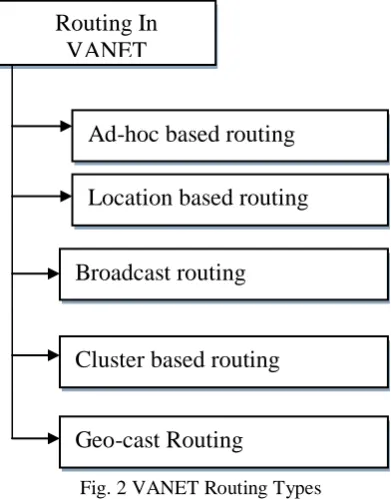
Fig. 2 VANET Routing Types
Based on the topology many distinct routing protocols are used in the network which are as follows [7]:
Ad-hoc driven Protocols
Location Based Routing Protocol
Cluster Based Protocols
Broadcast Based Protocols
Geo-cast Protocols
A. Ad-hoc based routing
VANET are infrastructure less network [7]. This topology based routing has three further categories i.e. proactive, reactive and hybrid. In first proactive protocol, nodes time to time modify the routing table with the new updated information of routes in the network. This information of routing table is passed to other nodes by sending HELLO packets. But it restricts the use of available bandwidth. Second is reactive protocol which sends the data when needed but
Routing In
VANET
Ad-hoc based routing
Location based routing
Broadcast routing
Cluster based routing
ISSN(E): 2277-128X, ISSN(P): 2277-6451, DOI: 10.23956/ijarcsse/V7I7/0182, pp. 182-188
it reduces the overhead which is established during link creation. Due to less overhead the information is delivered faster. At last, in hybrid approach the main focus is on the architecture of the network instead of performance analysis
B. Location Based Routing
In this location based routing approach, geographical location of the nodes is attained from the global Positioning System, maps etc. no route maintenance is needed, route is automatically established when needed. Greedy perimeter stateless routing is the type of location based protocol which helps in searching the position of nearby neighbour.
C. Cluster based routing
Cluster based routing is introduced to reduce the network traffic and routing overhead in the VANET network. The main goal of cluster based routing to make an architecture based on cluster of vehicles. One vehicle play the head of the cluster. The cluster size is dependent on number of vehicle in the network [11].
Fig. 3 Cluster based routing
D. Broadcast Routing
Broadcast approach is used when the packet is needed to send outside the network. Flooding technique is used to route the packet. In this approach delivery is ensured but the bandwidth usage is more.
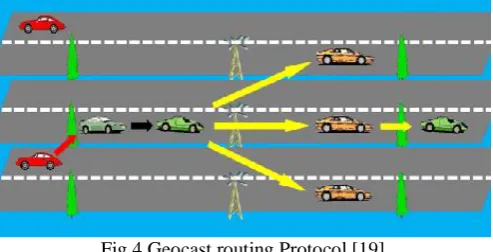
E. Geocast Routing
It is the routing protocol which deals with distribution of information in the particular area of relevance. The main point of this routing is too slender down the search for the next node in particular area of relevance [16].
Fig.4 Geocast routing Protocol [19]
IV. TYPES OF TRUST MODEL IN VANET
Trust model is categorized into categories: 1. Entity-oriented 2. Data-oriented 3. Hybrid trust models. These categories are based on how trust evaluation is performed i.e. on basis of data, node (entity) or on basis of both the data and node. Entity-oriented is called a direct trust as it give information about the specific node or identity node. Second approach which is data-oriented focuses on assessing the content of the message for making trust decisions. Finally, hybrid trust models are based on the straight interpretations [8].
In entity-oriented trust model, the multiple factors are combined for an entity. Whereas in data-oriented trust models, it deal more with the content of the message received from the nearby nodes and finally in combined trust models ensure the trustworthiness of the network nodes and reliability of the data transferred from one node to another [9, 10].
V. ROUTING ENHANCEMENT IN VANET
Artificial bee colony consists of working bees or employed bees, onlookers and scouts. The algorithm was designed seeing the cooperative behaviour of the natural bees in the swarm. The fitness of the solution is evaluated by the scout bees whereas the onlookers been wait in the hive. Scout bees become the employed bees after the initial search. Now the employed bees search for the other nectars. If the neighbour-hood has better solution then that position is kept. After selecting the data from the employed bees about the food they go on search towards the neighbourhood [12].
CH1
Source
CH2
ISSN(E): 2277-128X, ISSN(P): 2277-6451, DOI: 10.23956/ijarcsse/V7I7/0182, pp. 182-188
Beehive algorithm is ABC inspired algorithm which is applied to wireless computer network in routing mechanism. It is mainly inspired by the communication and evaluation method of the working of the honey bee. This method is fault tolerant, scalable and depends upon the regional information.
There is no need of global information in the creation of this topology rather it works on local information. No global synchronization clock is required due to which it is easily installed on routers and is more fault tolerant. Bee agent travel in the network all over the regions known as forging zones.
When travelling, they deliver the information to the routing tables for updating their tables time to time [13, 14]. The bee agent have significant role in enhancing the throughput as they uses only 1% of bandwidth.
But the enhancement in the routing table performance is attained if the size of the routing table is of order of Open Shortest Path First protocol for routing in Internet Protocol based on Dijkstra algorithm.
When the artificial bee colony is used in routing, the formal definition is discussed below:
The employed bees generated the modification in position in its storage memory and also checks for the fitness value of the source. After that fitness value evaluation is done and then the appropriate source is chosen on basis of fitness value.
A. On-lookers movement
The probability in source selection,
𝑃𝑖 =
𝐹(𝜃) 𝐹(𝜃𝑘)
𝑡 𝑘=1
𝑃I = Probability of choosing the ith employed bee S = Number of employed bee
𝜃I = Position of the ith employed bee
𝐹(𝜃𝑖) = Fitness value
B. Calculation of next position
𝑥𝑖𝑗 𝑡 + 1 = 𝜃𝑖𝑗 𝑡 + ∅(𝜃𝑖𝑗 𝑡 − 𝜃𝑘𝑗(t))
𝑥𝑖 = onlooker bee position
t = iteration no.
𝜃𝑘 = employed bee randomly chosen
j = solution dimension
∅() = random variable series ranges [-1, 1] and called as greedy selection.
C. Movement of scout bees
𝜃𝑖𝑗 = 𝜃𝑗 𝑚𝑖𝑛 + 𝑟𝑎𝑛𝑑 ∙ (𝜃𝑗 𝑚𝑎𝑥 − 𝜃𝑗𝑚𝑖𝑛) Whereas, r = random no.
Below the enhancement of parameters has been shown with respect to proposed approach.
1) Throughput
Throughput refers to the maximum time at which any task can be accomplished. When communication networks are involved, at that time throughput is more when there is successful message deliver over the channel. Data or information which is transferred can be on any medium such as network node, physical link, logical link or wire. The measurement criteria of the throughput are in bits per second or in network it is also measured in data packets [17].
The below figure 5 represents the throughput comparison between optimization and without optimization technique. From the above figure we observe that average value of throughput with optimization is greater than the value of throughput without optimization. From this we find that if we use the optimization technique the throughput rate increases.
ISSN(E): 2277-128X, ISSN(P): 2277-6451, DOI: 10.23956/ijarcsse/V7I7/0182, pp. 182-188
2) Bit error rate
Bit error is the data streams which are received from the network by a node but are noisy, distorted. Hence, Bit error rate is the amount of error bit in an interval. Whereas bit error ratio is the amount of bit error by the total number by bit transferred.
Fig.6 BER comparison
The figure 6 represents the BER comparison between optimization and without optimization technique. From the above figure we observe that average value of BER with optimization is better than the value of BER without optimization. From this we find that if we use the optimization technique the BER decreases
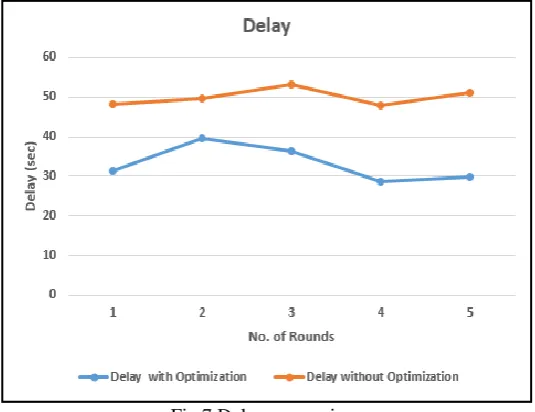
3) Delay
In network delay refers to how much time data takes to travel through the network from one node to the endpoint or terminal point. Measurement of delay is in multiple fractions of seconds. Delay alters according to traffic, network conditions, resource alteration, environment of the network paths, routing tables [18].
The figure 7 depicts the delay comparison between optimization and without optimization technique. From the above figure we observe that average value of delay with optimization is better than the value of BER without optimization. From this observation we find that if we use the optimization technique the delay decreases.
Fig.7 Delay comparison
VI. CONCLUSION
ISSN(E): 2277-128X, ISSN(P): 2277-6451, DOI: 10.23956/ijarcsse/V7I7/0182, pp. 182-188
REFERENCES
[1] Saif Al-Sultan, Moath M. Al-Doori, Ali H. Al-Bayatti, and Hussien Zedan, “A comprehensive survey on
vehicular Ad Hoc network,” Journal of network and computer applications, vol. 37, pp. 380-392, 2014.
[2] Yu Wang, and Fan Li, “Vehicular ad hoc networks,” In Guide to wireless ad hoc networks, Springer London,
pp. 503-525.2009.
[3] Rejab Hajlaoui, Hervé Guyennet, and Tarek Moulahi, “A Survey on Heuristic-Based Routing Methods in
Vehicular Ad-Hoc Network: Technical Challenges and Future Trends,” IEEE Sensors Journal, vol.16, no. 17,
pp. 6782-6792, 2016.
[4] Hannes Hartenstein, and L. P. Laberteaux, “A tutorial survey on vehicular ad hoc networks,” IEEE
Communications magazine, vol. 46, no. 6, 2008.
[5] Sherali Zeadally, Ray Hunt, Yuh-Shyan Chen, Angela Irwin, and Aamir Hassan, “Vehicular ad hoc networks
(VANETS): status, results, and challenge,” Telecommunication Systems, vol.50, no. 4, pp.217-241,2012.
[6] Nirav J. Patel, and Rutvij H. Jhaveri, “Trust based approaches for secure routing in VANET: A survey,”
Procedia Computer Science, vol. 45, pp. 592-601,2015.
[7] Neha Goel, Gaurav Sharma, and Isha Dhyani, “A study of position based VANET routing protocols,”
Computing, Communication and Automation (ICCCA), International Conference on IEEE, 2016.
[8] Pallavi Agarwal, and Neha Bhardwaj, “A Review on Trust Model in Vehicular Ad Hoc Network,” International
Journal of Grid and Distributed Computing, vol. 9, no. 4, pp. 325-334, 2016.
[9] Tahani Gazdar, Abderrezak Rachedi, Abderrahim Benslimane, and Abdelfettah Belghith, “A distributed
advanced analytical trust model for VANETs,” In Global Communications Conference (GLOBECOM),IEEE,
pp. 201-206, 2012.
[10] Qasim Alriyami, Asma Adnane, and Anthony Kim Smith, “Evaluation criterias for trust management in
vehicular ad-hoc networks (vanets),” In Connected Vehicles and Expo (ICCVE), International Conference on
IEEE, pp. 118-123, 2014.
[11] Evjola Spaho, Leonard Barolli, Gjergji Mino, Fatos Xhafa, and Vladi Kolici, “Vanet simulators: A survey on
mobility and routing protocols,” In Broadband and Wireless Computing, Communication and Applications
(BWCCA), International Conference onIEEE, pp. 1-10. 2011.
[12] Wei-Chang Yeh, and Tsung-Jung Hsieh, “Solving reliability redundancy allocation problems using an artificial
bee colony algorithm,” Computers & Operations Research, vol. 38, no. 11, pp.1465-1473, 2011.
[13] Feng Xia, Li Liu, Jie Li, Ahmedin Mohammed Ahmed, Laurence Tianruo Yang, and Jianhua Ma, “BEEINFO:
Interest-based forwarding using artificial bee colony for socially aware networking,” IEEE Transactions on
Vehicular Technology, vol. 64, no. 3, pp.1188-1200,2015.
[14] Ashutosh Tripathi, Reena Dadhich, Narendra Yadav, and Ravendra Pal Singh, “Guaranteed Data Delivery with
ACO, ABC and AODV for Wireless Sensor Networks.” I J C T A,vol. 9,no.20, pp. 213-219,2016.
[15] Christian List, Christian Elsholtz, and Thomas D. Seeley, “Independence and interdependence in collective
decision making: an agent-based model of nest-site choice by honeybee swarms,” Philosophical transactions of
The Royal Society B: biological sciences, vol.64, no. 1518, pp. 755-762, 2009.
[16] Salim Bitam, Abdelhamid Mellouk, and Sherali Zeadally, “Bio-inspired routing algorithms survey for vehicular
ad hoc networks,” IEEE Communications Surveys & Tutorials, vol.17, no. 2 pp. 843-867, 2015.
[17] Abolfazl Toroghi Haghighat, Karim Faez, Mehdi Dehghan, Amir Mowlaei, and Y. Ghahremani, “GA-based
heuristic algorithms for QoS based multicast routing,” Knowledge-Based Systems, vol.16, no. 5, pp.
305-312,2013.
[18] Amit Dua,, Neeraj Kumar, and Seema Bawam “A systematic review on routing protocols for vehicular ad hoc
networks,” Vehicular Communications, vol. 1, no. 1 pp.33-52,2014.