Volume 4 (2006)
Proceedings of the
Second International Workshop on
Graph and Model Transformation
(GraMoT 2006)
Termination of Algebraic Rewriting with Inhibitors
Paolo Bottoni, Kathrin Hoffmann, Francesco Parisi-Presicce
13 pages
Guest Editors: Gabor Karsai, Gabriele Taentzer
Managing Editors: Tiziana Margaria, Julia Padberg, Gabriele Taentzer
Termination of Algebraic Rewriting with Inhibitors
Paolo Bottoni1, Kathrin Hoffmann2, Francesco Parisi-Presicce1
1(bottoni,parisi)@di.uniroma1.itDipartimento di Informatica
Universit`a di Roma “La Sapienza”, Italy
2[email protected]Department of Software Engineering and Theoretical Computer
Science
Technical University of Berlin, Germany
Abstract: We proceed with the study of termination properties in the double
pushout approach to algebraic rewriting, and show a concrete termination criterion for rewriting systems with inhibitors. Inhibitors prevent elements in an algebra to participate in rule matches, so that termination depends only on whether new possi-bilities for matches are created. The notion of inhibitor can be extended to consid-ering different levels of inhibition, by which the ability of an element to participate in a match is progressively reduced. We illustrate the approach by considering some application contexts in model transformation.
Keywords:termination, double pushout approach, inhibitors
1
Introduction
When defining model transformation through rewriting systems, it is often the case that rules must be applied as long as possible, so that it becomes important to reason on the termination of such processes. While termination of graph transformations is undecidable in general [Plu98], the termination of specific systems can be decided with different techniques. In a previous paper [BHPT05], we have identified an abstract notion of termination criterion for high-level replace-ment (HLR) systems, i.e. algebraic rewriting systems operating on objects and morphisms in adhesive HLR categories [EHPP04], in which rewriting is steered by control expressions.
Extending such a notion to rules with negative application conditions (NACs) meets with several difficulties. However, excluding matches on some parts of the host objects can also be realized through other techniques than NACs. For example, in semi-Thue systems, an inhibitor is an element which cannot be involved in a rewriting [McN97], forcing matches to occur to either its left or its right, but not across it.
N
m0 ???
? ? ? ?oo n L
(1)
m
I
(2)
l
oo r //
R
Goo g D
h //H
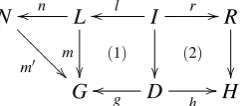
Figure 1: A DPO rule with negative application condition
can be further extended to the case of attributed rewriting systems, where attribute domains are totally ordered, and attribute value transformations have to comply with the ordering.
Paper organization. We revise some formal notions in Section 2and investigate literature
on termination and inhibitors in Section3. Section 4compares provability of termination for rules with NACs in graph and multiset rewriting. Section5 shows how to introduce inhibitors in an algebraic setting. In Section6we state a concrete termination criterion for algebras with inhibitors and Section7 extends the result to the case of inhibitory structures with more than two inhibition levels. Finally, Section8shows some applications of the concept, while Section 9draws some conclusion and points to future work.
2
Formal background
Informally, a pushout in a categoryCATis a gluing construction of two objects over a specific interface, while a pullback is dual to a pushout in the sense that a pullback construction extracts the common part of two objects. Let now CATbe a category with a distinguished morphism classM, such thatCAThas pushouts and pullbacks alongM-morphisms, i.e. if a morphism is inM, then its opposite is inM, too, andM-morphisms are closed under pushouts and pullbacks (the notation(CAT,M)will also be used).
A rulep:L←l I→r RinCATis given by two morphismslandrofM.L(p)is the left-hand side andR(p) the right-hand side of p. Given an objectGand a rule p:L←l I →r R, a match of p toG is a morphism m:L→G. A direct derivationd from G toH by p and match m,
d:G⇒p,mH, is given by a double pushout (DPO) (1) and (2) in Figure1. In a rule with NACs, as shown in Figure1, the morphismnis an injective total morphism, so that the rule is applicable only if matchmcannot be extended to a matchm0such thatm0◦n=m[HHT96]. Several objects
Ni, and associated morphismsni, can be coupled with one L, indicating that no extension ofm should exist for anyi.
The DPO approach has been largely used for graph transformation systems (GTS) allowing the study of notions like confluence, sequential or parallel independence, etc. and supporting several extensions, e.g. to typed and attributed graphs. High-level replacement (HLR) systems extended the approach to other algebraic structures, by considering only their categorical prop-erties [EHKP91]. A HLR system in a category CATconsists of a set of rulesP and may be extended by a set of finite input objects. Moreover, some form of control on rule applications can be exploited like layering and rule expressions [BHPT05].
∧ 6 ∃Z6=Kfor whichK=⇒pZ). Rule pis said to terminate if∀G∈G, pterminates onG. A functionF :G →N from objects to natural numbers is a termination criterion for(CAT,M)
if for any two morphismsa:C→Aandb:C→BinM, the valueF(A+CB)of the pushout objectA+CBofaandbis given byF(A+CB) =F(A) +F(B)−F(C). Given a rulep, if there exists a functionF which is a termination criterion forCAT, such thatF(L(p))>F(R(p)), then
pterminates [BHPT05].
Adhesive HLR categories [EHPP04] are based on adhesive categories [LS04] and HLR sys-tems. In contrast to HLR systems where properties are given in a more ad-hoc manner, adhesive HLR categories introduce a more simplified version of these properties; especially the so-called van Kampen-square property for pushouts alongM-morphisms is sufficient to prove fundamen-tal results such as Local Church-Rosser etc. In general, a van Kampen-square is a pushout which is stable under pullbacks in a commutative cube. Typical examples of adhesive HLR categories are the categories of sets and graphs.
3
Related work
The possibility of forbidding rule application, based on the presence or absence of some proper-ties in the object to be rewritten has been treated in several formalisms. Graph transformations with negative application conditions have been long used [HHT96], but their termination prop-erties started to be investigated only recently. In particular, Ehriget al. proved termination of layered GTSs [EEL+05] with NACs. Results for the general case are still missing1. The express-ibility of the Post Correspondence Problem in the form of GTSs has been exploited by Plump to prove undecidability of termination and confluence for GTSs without NACs [Plu98,Plu05]. The decidability of termination for some specific GTSs has been used in an experimental setting to prove safety properties [KMP02].
The presence of a forbidding context for rule application has been exploited in different forms. In particular, context-free grammars have been equipped with several types of control. For ex-ample, conditional grammars allow the use of a rule only if the host string belongs to a certain regular language [Nav70]. In semi-conditional grammars, for each rule p, a regular languageR
defines the language of subwords that have to appear in the string forpto be applicable, while a different regular languageQdefines the set of subwords that must not appear [Pau79,Pau85]. In a random context grammar, these sets are reduced to subsets of nonterminals [vdW71]. For grammars, termination is related to the problems of non-emptiness and finiteness of the gener-ated language. The first three types of grammars produce type-0 languages if erasing productions are allowed, and context-sensitive languages otherwise. Membership, finiteness and emptiness of a language are all decidable problems for random context grammars, which instead have an expressive power not related to grammars in the Chomsky hierarchy.
Moving from grammars to general string rewriting systems, semi-Thue systems have rules of typex→y,x,y∈Σ∗being strings on an alphabetΣ. For these systems, termination is undecidable in general. McNaughton has proposed semi-Thue systems of one rule with inhibitors, where an inhibitor is a special symbolι 6∈Σ, which cannot appear in x, but has to appear at least once 1 The problem is only significant if a non-trivial NAC exists for each rule, which we assume throughout the rest of
iny[McN97]. In this case termination becomes decidable, in that inhibitors divide a string in fragments such that each rule match is constrained to occur on a single fragment.
In Petri nets, inhibitors are special arcs connecting places to transitions, such that the place must not contain the number of tokens indicated by the arc. The presence of inhibitors strictly increases the expressive power of nets, making problems such as reachability or liveness become undecidable [Hac76].
In multisets, differently from sets, several copies of the same element can appear. Rewrit-ing simply replaces the elements in the antecedent with those in the consequent. In this frame-work, inhibitors have been introduced for P-Systems, a generalization of multiset rewriting where rewriting is restricted to occur within an isolated region. An inhibitor for a rule is a multiset of symbols, such that the rule cannot be applied in a region which contains this multiset. This allows the characterization of recursively enumerable languages of Parikh vectors, in a signifi-cantly more compact way than by traditional methods in the field of membrane computing, e.g. catalysts, priorities, target indications [BMPR02].
One can observe, that, with the exception of McNaughton’s work, the use of forbidding con-texts increases the expressive power of the underlying formalism (context-free grammars, Petri nets, P-Systems), thus making several problems undecidable, which were not so in the basic version of the formalism. The basic difference is that in the semi-Thue case inhibitors iden-tify portions of the string to be rewritten which are definitely excluded from the possibility of a match, while in other cases they prevent the application of a specific rule, which can later be-come applicable again if the context changes. We leverage this concept to propose our notion of inhibitors as a way to prevent sorted elements to participate in a match, independently of the concrete structure to which they belong, but in a purely algebraic setting.
4
Examples: Rules with Negative Application Conditions
We discuss difficulties in the identification of termination criteria for DPO rules with NACs of a general form. We consider the case of nondeleting rules, i.e. in which an inclusion morphism
L,→Rcan be constructed coherently with the two inclusionsI ,→l L,I ,→r R. For rules which cause some deletion, we can simply consider counting functions as termination criteria, disre-garding the presence of NACs. In particular, even restrictingNto be included inR, or viceversa, does not solve the problem for GTSs. We also discuss rewriting of multisets, i.e. empty graphs, and show how in this case rules are either trivially terminating, or their termination depends on the source multiset to which they are applied.
4.1 Graphs
LetF:G →N be a termination criterion. Inclusion ofNintoRdoes not provide an immediate criterion for termination, at least under the assumption that the morphismsI,→l L,L,→n N,I,→r R
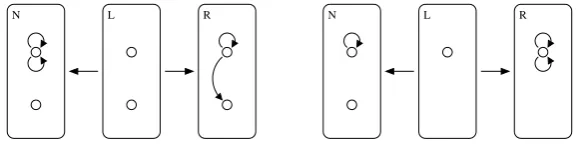
exist. Indeed, the left hand side of Figure2shows a terminating rule, while the right hand side of Figure2a case of nontermination. In both cases, due to the relations betweenL,NandR, we must have, for any choice ofF,F(L)≤F(N)≤F(R).
R L
N N L R
Figure 2: Rules withN⊆R.
when the repeated creation of matches forRcomes to saturate the possibility of matches forL
not forbidden byN. However, while this is true for the rule in the left hand side of Figure3, no match is ruled out by its application for the right hand side of Figure3. In this case, we have
F(L)≤F(R)≤F(N).
R L
N N L R
Figure 3: Rules withR⊆N.
Finally, we consider the case where no immediate relation can be identified betweenRandN
(still maintainingL,→NandL,→R). Again, the left hand side of Figure4shows a terminating rule (the rule can be repeated at most until all nodes in the graph have two loops attached). The right hand side of Figure4shows a rule which may terminate or not, depending on the presence in the original host graph of at least two nodes. In both cases two new edges and zero new nodes are created.
R L
N N L R
Figure 4: Rules withN6⊆RandR6⊆N.
4.2 Multisets
Empty graphs, i.e. those in which each node is isolated, can be modelled as multisets. A multiset
∀x∈Σ: 1) fA∪B(x) = fA(x) +fB(x). 2) fA\B(x) = fA(x) fB(x), wherem n=m−nifm>n, 0 otherwise. 3) fA∩B(x) =min(fA(x),fB(x)), while for inclusionA⊆B⇒ fA(x)≤ fB(x).
Multiset rewriting can be immediately set in the DPO framework by considering the mor-phisms, in particular the match morphism, induced by the subset relation, so thatI=L∩R. Each
FM|xcounting the number of occurrences ofx∈ΣinMis a termination criterion.
The notion of negative application conditions for multisets amounts to inhibiting the applica-tion of a rule if some subset is present in the host multiset. Again, we can restrict ourselves to the case of nondeleting rules, such thatI,LandRare multisets, withL=I⊂RandL⊂N.
Theorem 1(Decidability for multiset rewriting) Termination is decidable for single rule
mul-tiset rewriting with DPO rules with NACs.
Proof. Forp:L←l-I,→r Ra DPO rule on multisets andMa host multiset s.t.L⊂M, three cases are given.
N⊆R. Then eitherN⊂M, so thatpterminates trivially, orN6⊂M. Now, applyingpproduces
M0, withR⊂M0and, viaN⊆R,N⊂M0, so that pcan no longer be applied.
R⊂N. LetY =N\LandZ=R\L. LetZi=Zi−1∪Z, fori>0, withZ0= /0 andMi=M∪Zi.
Zi is the set of elements added toMafteriapplications of p. Lety=|Y |andz=|Z|.
R⊂N⇒y≥z. Then,∃!j≥0, depending onR,N, andL, such thatz·j≤y<z·(j+1). Hence, after at most japplications ofp, eitherN⊂Mj, orN6⊂Mhfor anyh≥j.
N6⊆R∧R6⊆N. Following the argument above, termination or nontermination is decidable for any pair(rule,host)through static analysis, considering the two different casesz≥yand
z<y.
By reconsidering the examples shown above, one can notice that for the graph rewriting case, the essential problem lies in the possibility of repeating or not the same match on a subsequent application of the same rule, if no new match is created. For the multiset case, all matches are equivalent. Hence, we look for some formal device that allows us to consider the occurrence of a match on some element of the host structure in a uniform way. We thus turn our attention to a general notion of (match) inhibitor.
5
Many sorted algebras with inhibitors
Inhibitors are here introduced by a suitable extension of many-sorted algebras [Wec92]. Given a set of sortsS, a signatureSIGdefines a setOPof operations and an arity for each operation as a functionar:OP→S×S, i.e. we only consider unary operations. A many-sortedSIG-algebra is defined by providing a carrier setA, such that a typing functiont p:A→S, assigns a sort to each value inA. We also use the notion As to summarize the values inA of type s∈S. The realization of an operation must then be consistent with its declared arity. Moreover,SIG-Alg
Definition 1((Un-)Inhibitor) Let(Flag,≤)be a totally ordered set, withFlag={√,•}and
≤={(√,√),(√,•),(•,•)}. We call√the uninhibitor and•the inhibitor.
Definition 2(Inhibitable version ofSIG) Given a signatureSIG, then an inhibitable version of
SIG,SIG0= (S0,OP0), is such thatS0=S∪ {f lag}, where f lagis the new sort of (un-)inhibitors. Given a set of inhibitable sortsX⊆S,OP0is extended by adding for eachx∈X an operationinx of arity(x,f lag).
Due to the construction in Definition2,SIGis a subsignature of its inhibitable version, i.e. the signature morphismI:SIG→SIG0is an inclusion.
Definition 3(Inhibitable version ofA) LetAbe aSIG-algebra. Then aSIG0-algebraA0 is an
inhibitable version ofAifA0f lag=FlagandA0|SIG=A, whereA0|SIGis theSIG-reduct ofA0.
Thus, for each x∈X the operations inx of arity (x,f lag) map each x-sorted element of A0 into√or•. Moreover, the notion of restriction can be generalized to the forgetful functorUI:
SIG’-Alg→SIG-Alginduced by the signature morphismI, such that for each homomorphism
inSIG’-Algthere is a corresponding homomorphism inSIG-Alg.
Lemma 1((SIG’-Alg,M)is adhesive) (SIG’-Alg,M)withM the class of injective
homo-morphisms is an adhesive HLR category.
Proof. SinceSIG0contains only unary operation symbols, we exploit results in [EEPT05]:M is closed under composition and decomposition,(SIG’-Alg,M)has pushouts and pullbacks along M-morphisms andM-morphisms are closed under pushouts and pullbacks, and pushouts along M-morphisms inSIG’-Algare van Kampen-squares. Thus,(SIG’-Alg,M)is an adhesive HLR category.
Example 1 (Graphs) Let GRAPH be the signature of graphs and let nodesbe an inhibitable
sort. Then we get the following inhibitable version ofGRAPH,GRAPH0.
GRAPH = GRAPH0 =
sort : nodes,edges sort: nodes,edges,f lag opns: source:edges→nodes opns: source:edges→nodes
target:edges→nodes target:edges→nodes innodes:nodes→ f lag
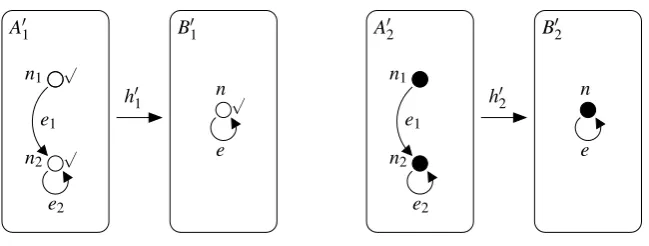
LetAbe a GRAPH-algebra with carriersAnodes={n1,n2}andAedges={e1,e2}and
realiza-tionssourceA(e1) =n1andsourceA(e2) =targetA(e1) =targetA(e2) =n2. The algebrasA01and
A02with carriersA01,nodes=A02,nodes=Anodes,A01,edges=A
0
2,edges=Aedges, andA01,f lag=A 0 2,f lag=
{√,•}and additional realizationsinA0
1,nodes(n1) =
√
andinA0
1,nodes(n2) =
√
resp. inA0
2,nodes(n1) =
•andinA02,nodes(n2) =•are inhibitable versions ofA.
LetBbe aGRAPH-algebra with carriers and realizations as follows: Bnodes={n},Bedges=
{e}, and sourceB(e) =targetB(e) =n. There are two different inhibitable versions of B, B0i,
i∈ {1,2},defined by the carriers as above andBi0,f lag={√,•}. The realizations are given as
before, but forinnodeswe haveinB01,nodes(n) =
√
e1
e2 n1
n2 A01
h01 B01
e n √
√
√
A02
e2 n1
h02 B02
e n
n2 e1
Figure 5: Homomorphismsh01:A01→B01andh02:A02→B02.
Example2 (Graph morphisms) Let the inhibitable versions ofAandBas defined in Example1
andh01:A01→B01andh02:A02→B02(see Figure5) be two different homomorphisms inSIG’-Alg.
Due to the forgetful functorUI there is a corresponding homomorphismh:A→BinSIG-Alg
defined byhnodes(n1) =hnodes(n2) =nandhedges(e1) =hedges(e2) =e.
6
Concrete termination criteria for algebras with inhibitors
In this section we define a termination criterion for algebras with inhibitors.
Definition 4(Rule with inhibitors) A rule with inhibitorsp:L←l I→r Ris given by three
SIG’-algebrasL,I andRwith finite carrier sets and two injective homomorphismslandrofM. In
L(p)the realizations of the operationinxfor eachx∈Xare defined byinL,x(o) =
√
whereois a value from the carriers of the sorts inX.
Next, we define a suitable termination criterion for(SIG’-Alg,M).
Definition 5(Termination criterion) LetG be the class of all objects inSIG’-AlgandF:G →
N from objectsA∈G to natural numbers be the function which counts the number of uninhib-ited elements, i.e., the number of valuesofrom the carriers of the sorts inX withinA,x(o) =
√
.
F(A) =|U n(A)|=|{o|x∈X,inA,x(o) =
√ }|
Lemma 2(Termination criterion) The function F of Definition5is a termination criterion for
(SIG’-Alg,M).
Proof. We have to show that for any two arbitrary morphisms a:C→A and b:C→B in M, the value F(A+CB) of the pushout object A+CB of a and b is given by F(A+CB) =
have
∀s∈S:(As+CsBs) =Bs](As−as(Cs))
⇒ ∀x∈X:U n(Ax+CxBx) =U n(B)x](U n(A)x−ax(U n(C)x))
⇒ |U n(A+CB)|=|U n(B)|+|U n(A)| − |U n(C)|
⇒ F(A+CB) =F(A) +F(B)−F(C)
Theorem 2(Termination of rules with inhibitors) Let p be a rule with inhibitors as in
Defini-tion4. If F(L(p))>F(R(p)), the application of p, using injectiveM-morphisms and inclusions as match morphism, terminates.
Proof. From Lemma 2, F is a termination criterion for (SIG’-Alg,M), thus it is a termina-tion criterion for p. Hence, ifF(L(p))>F(R(p)), the iteration of rule application terminates [BHPT05].
The result of Theorem2can be extended to a set of rulesP(see Theorem 1 in [BHPT05]), i.e. a replacement system terminates ifF is a termination criterion which holds for all rules inP. Additionally, [BHPT05] shows how this termination criterion can be used to prove termination of replacement units with control structures like sequential composition, choice, and as long as possible operators.
It is worth noting that for single-sorted algebras, termination for single rule rewriting with inhibitors becomes decidable, as witnessed by Theorem3.
Theorem 3(Decidability for single-sorted algebras) Let SIG0 be the inhibitable version of a
signature SIG with a single sort s∈X . Let p be a rule with inhibitors. Then p terminates in
SIG’-Algif and only if there exists a termination criterion for it.
Proof. Theif direction is a consequence of Theorem2. For theonly if direction, asSIGcontains only one sort s, for pto terminate there must exist some element x of its carrier which either appears inL(p), but not inR(p), or which appears in L(p)tagged with√and in R(p) tagged with •. In the first case, a function counting the number of occurrences of x is a termination criterion, in the second case, the functionFof Definition5is a termination criterion.
Note that ifSIGis a signature with a single sort, each object inSIG’-Algis isomorphic to a multiset.
7
Multiple levels of inhibition
The carrier Flag can be extended in such a way that its elements constitute a finite set W, equipped with a partial order ≤and a distinguished elementk, calledtop inhibitor level, such that6 ∃x∈W,x6=kwithk≤x. Each elementi∈W is called alevel.
Definition 6(Multi level inhibitors) Given(W,≤)as above, the multi level inhibitable version
Here the realization of the operationsinxof arity(x,f lag)for eachx∈Xis a mapping of each
x-sorted element ofAinto a leveli∈W.
Definition 7(Rule with multi level inhibitors) A rule with multi level inhibitorsp:L←l I→r Ris
given by three SIG’-algebrasL,IandRwith finite carrier sets and two injective homomorphisms
landrofM. Moreover,∀x∈X∀o∈Lx:inL,x(o)6=k, whereois a value from the carriers of the sorts inXandkis the top inhibitor level.
Next, we define a suitable termination criterion forSIG’-Alg.
Definition 8(Termination criterion) LetF = (Fi)i∈W a family of functionsFi:G →N from
objects to natural numbers, each counting the number of uninhibited elements of a specific level
i∈W.
Fi(A) =|U ni(A)|=|{o|x∈X,i∈W,inA,x(o) =i}|
Lemma 3(Termination criterion) Each function Fias defined in Definition8is a termination
criterion.
Proof. The proof follows from the fact that for any two arbitrary morphisms a:C→A and
b:C→BinM, the valueFi(A+CB)of the pushout objectA+CBofaandbis given by
Fi(A+CB) = |U ni(A+CB)|
= |U ni(A)|+|U ni(B)| − |U ni(C)|
= Fi(A) +Fi(B)−Fi(C)
Theorem 4(Termination of rules with multi level inhibitors) Let p be a rule with multi level
inhibitors as given in Definition 4. If ∃i∈W :Fi(L(p))>Fi(R(p)), application of p using
inclusion as match morphism terminates.
Proof. From Lemma3, if∃i∈W :Fi(L(p))>Fi(R(p)), then the iteration of rule application terminates.
The results in this Section can be extended to the case whereWcontains a subsetKsuch that
k∈K⇔ 6 ∃x∈W withk≤x. Eachk∈Kcan then act as top level inhibitor.
8
Applications
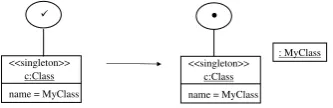
Providing full support of NACs in the DPO approach is costly and in many situations the notion of inhibitor provides a simpler alternative. As an example, the definition of singleton classes requires that only one instance of that class can be created. This can be achieved by creating the object representing a class in an uninhibited version, and inhibiting it after the first object creation, as shown in Figure6.
per-<<singleton>> c:Class name = MyClass
•
: MyClass
9
<<singleton>> c:Class name = MyClass
Figure 6: The rule for guaranteeing creation of singletons.
n:Node
9
n:Node
:Node
9
9
p p’
•
n:Node n:Node
9
:Node 9
Figure 7: A pair of rules to create ramifications (p) up to the point when p’ is applied.
forming the transformations using rules with inhibitors, and finally reprojecting on the original signature. The process can be iterated several times, possibly removing from the set of rules those which have been exploited to inhibit some element.
The approach exploited for singletons could be extended to any situation in which we want to limit or discontinue the possibility of generating elements in relation with another specific element. For example, in the creation of trees, one could prevent further ramification of a node. A pair of rules such as those depicted in Figure7would then allow an arbitrary level of ramifica-tion, but also prevent, for instance in an interactive or collaborative setting, a node to be further expanded. Note that, while the rule of Figure6terminates, as the number of uninhibited elements decreases with every application, the composed rule obtained from the rules of Figure7does not terminate, nor does any individual rule.
Expansion limitation can occur at specific configurations instead that at arbitrary derivation steps. For example, in modeling visual languages, plex languages allow only a well-defined number of connections to depart or enter into nodes of a given type. Hence, by adopting multi-level inhibitors, the creation of connections could increase the multi-level of saturation up to the point when all attachment points are busy, without the need to define rules for each possible configu-ration of already connected points.
With this solution the inhibited elements would not be available for any other rule. This can be mitigated by relaxing the notion of inhibitor, so that instead of having a “general-purpose” inhibition, one could define “rule-specific” inhibitor sets. In this case, carriers for the f lagsort would be partitioned in pairs{√p,•p}, where pidentifies uniquely a rule with respect to which an inhibitor is defined. Instead of having a total order, one would have a partial order ≤s.t.
∀p∈P, {(√p,√p), (√p,•p), (•p,•p)} ⊂≤ and ∀p0 6=p, xp ∈ {
√
p,•p}, xp0 ∈ {
√
p0,•p0} ⇒
xp6≤xp0 ∧xp0 6≤xp.
an indication of the availability of the model element for a rule. In other cases, one can devise suitable extensions of the model to define analogous of the inhibition mechanism. The analysis conducted in this paper can help identify the necessary adaptations of the model, according to the desired type of inhibition.
9
Conclusions
A study of decidability of termination for high level replacement rules with negative application conditions in the DPO approach shows the difficulties of extending the notion of termination cri-terion, presented in [BHPT05] to rules of this form. We have therefore turned to the weaker, but somehow related, notion of inhibitor, by which we mean tagging terms in a many-sorted algebra with a flag removing it from further matches. We have also shown that the termination results obtained for simple inhibitors can be extended to multiple levels of inhibition (coming to satu-rate the availability of an element to matches). Some uses of inhibitors in model transformation applications have been discussed.
We plan to study termination properties for rule-specific inhibitors, preventing the possibil-ity of involving an element in a match for a specific rule, and to investigate the possibilpossibil-ity of more general inhibitors, associated not with individual elements, but with generic subobjects in a category. Moreover, we plan to investigate confluence properties for rewriting systems with inhibitors and to set a general framework for proving properties of such systems.
Acknowledgements: Partially supported by the EC under Research and Training Network
SegraVis. Kathrin Hoffmann acknowledges the financial support provided through the European Community’s Human Potential Programme under contract HPRN-CT-2002-00275, SegraVis.
Bibliography
[BHPT05] P. Bottoni, K. Hoffmann, F. Parisi-Presicce, G. Taentzer. High-Level Replacement Units and their Termination Properties.Journal of Visual Languages and Computing
16:485–507, 2005.
[BMPR02] P. Bottoni, C. Mart´ın-Vide, G. Paun, G. Rozenberg. Membrane systems with pro-moters/inhibitors.Acta Informatica38(10):695–720, 2002.
[EEL+05] H. Ehrig, K. Ehrig, J. de Lara, G. Taentzer, D. Varr´o, S. Varr´o-Gyapay. Termina-tion criteria for model transformaTermina-tion. InProc. FASE 2005. LNCS 3442, pp. 49–63. Springer, 2005.
[EHKP91] H. Ehrig, A. Habel, H.-J. Kreowski, F. Parisi-Presicce. Parallelism and Concurrency in High-Level Replacement Systems. Math. Struct. in Comp. Science1:361–404, 1991.
[EHPP04] H. Ehrig, A. Habel, J. Padberg, U. Prange. Adhesive high-level replacement cate-gories and systems. In H. Ehrig and G. Engels and F. Parisi-Presicce and G. Rozen-berg (ed.),Proc. ICGT’04. LNCS 3256, pp. 144–160. Springer, 2004.
[Hac76] M. Hack. Decidability questions for Petri nets. Technical report 161, Laboratory for Computer Science, M.I.T., June 1976.
[HHT96] A. Habel, R. Heckel, G. Taentzer. Graph Grammars with Negative Application Con-ditions.Fundamenta Informaticae26(3,4):287–313, 1996.
[KMP02] M. Koch, L. V. Mancini, F. Parisi-Presicce. Decidability of Safety in Graph-Based Models for Access Control. In Gollmann et al. (eds.), Proc. ESORICS’02. LNCS 2502, pp. 229–243. Springer, 2002.
[LS04] S. Lack, P. Sobocinski. Adhesive Categories. In Walukiewicz (ed.), Proc. FOS-SACS’04. LNCS 2987, pp. 273–288. 2004.
[McN97] R. McNaughton. Semi-Thue Systems with an Inhibitor.Journal of Automated Rea-soning26:409–431, 1997.
[Nav70] E. Navratil. Context-free grammars with regular conditions.Kybernetika2:118–126, 1970.
[Pau79] G. Paun. On the generative capacity of conditional grammars.Information and Con-trol43(2):178–186, 1979.
[Pau85] G. Paun. A Variant of Random Context Grammars: Semi-Conditional Grammars.
Theoretical Computer Science41:1–17, 1985.
[Plu98] D. Plump. Termination of graph rewriting is undecidable.Fundamenta Informaticae
33(2):201–209, 1998.
[Plu05] D. Plump. Confluence of Graph Transformation Revisited. In Middeldorp et al. (eds.),Processes, Terms and Cycles: Steps on the Road to Infinity: Essays Dedicated to Jan Willem Klop on the Occasion of His 60th Birthday. LNCS 3838, pp. 280–308. Springer, 2005.
[vdW71] A. van der Walt. Random context grammars. InProc. IFIP Congress 1970. Pp. 66– 68. North-Holland Publ. Co., 1971.