561
THE EFFECTS OF EVODIAMINE ON SERUM TOTAL CHOLESTEROL AND
TRIGLYCERIDE LEVELS ARE ASSOCIATED WITH THE ACTIVATION OF THE AMPK
SIGNALING PATHWAY IN RATS WITH HYPERLIPEMIA
Hui Yu1, Hai Hu2, Wuzhuang Gong3, Li Yang3, Zhanli Wang3,4,* and Cuifeng Wang3,*
1 The Second Affiliated Hospital, Baotou Medical College, Baotou 014030, China 2 Department of Pathophysiology, Baotou Medical College, Baotou 014060, China 3 The First Affiliated Hospital, Baotou Medical College, Baotou 014010, China
4 School of Public Health, Baotou Medical College, Baotou 014060, China
*Corresponding authors: [email protected]; [email protected]
Received: September 4, 2015; Revised: October 14, 2015; Accepted: October 26, 2015; Published online: May 9, 2016
Abstract: Evodiamine, a naturally occurring indole alkaloid, has been reported to have numerous biological activities, including antitumor, antimicrobial and anti-inflammatory effects. Previous studies also suggest that evodiamine prevents obesity. In this study, we confirmed that evodiamine lowered the levels of serum total cholesterol (TC) and triglycerides (TG) in rats with hyperlipemia. Furthermore, our findings suggest that the activation of the AMP-activated protein kinase (AMPK) pathway might contribute in part to the effect of evodiamine on the serum levels of TC and TG.
Key words:evodiamine; AMP-activated protein kinase; total cholesterol; triglycerides
INTRODUCTION
Evodiamine is a bioactive compound present in the fruit of Evodia rutaecarpa (Juss.) Benth [1]. Initially, it was identified as a vanilloid receptor 1 (TRPV1) ago-nist, which possesses a property that can be utilized to modulate pain [2]. To date, three proteins are believed to be direct targets of evodiamine, including TRPV1, the aryl hydrocarbon receptor (AhR) and topoisomer-ases [3-5]. These proteins are apparently important in inflammation, cancer and other diseases. In fact, many other pharmacological properties of evodiamine have been uncovered, such as antitumor, antimicrobial, and anti-inflammatory activities [6].
Previous studies found that evodiamine has anti-obesity effects and possible mechanisms were proposed. Part of the anti-obesity effects of evodi-amine was thought to be via enhancement of uncou-pling protein-1 (UCP1) thermogenesis through β3-adrenergic stimulation [7]. It was found that [8] that
evodiamine inhibited neuropeptide Y (NPY) mRNA and peptide levels in the arcuate nucleus (ARC) of the hypothalamus, which might be one of the mecha-nisms by which evodiamine exerted its anti-obesity effects. It was also reported [9] that the ERK/MAPK signaling pathway might contribute to the fat-loss ef-fects of evodiamine. Moreover, evodiamine increased the plasma concentration of cholecystokinin (CCK), which is involved in the regulation of digestion and appetite [10].
and thus inhibiting acetyl-CoA carboxylase (ACC), a critical enzyme for controlling fatty acid biosyn-thesis and oxidation [14]. The activation of AMPK also decreases total cholesterol (TC) and triglyceride (TG) levels by inhibiting the activity of glycerol-3-phosphate acyltransferase (GPAT) and HMG-CoA reductase, respectively [15]. AMPK has therefore been proposed as a major therapeutic target for obesity and obesity-linked metabolic disorders such as hyperlipid-emia and atherosclerosis [16]. 5-Aminoimidazole-4-carboxamide-1-β-D- ribofuranoside (AICAR) is one of the activators of AMPK [17].
It was been reported that evodiamine could acti-vate AMPK [18]. Also, evodiamine has been recog-nized to improve glucose tolerance and prevent the progress of insulin resistance through AMPK activa-tion followed by inhibiactiva-tion of mTOR-S6K signaling and IRS1 serine phosphorylation in adipocytes [19]. However, the effects of evodiamine-mediated AMPK activation on lipid metabolism remain unclear.
Our previous studies suggested that cordycepin acted as an AMPK agonist to regulate lipid metabo-lism [20]. Continuing our investigation in this field, the present study investigated the effects of evodi-amine on the levels of serum TC and TG in rats with hyperlipemia. We further explored whether the effects of evodiamine on lipid metabolism are mediated, at least in part, by its activation of the AMPK signaling pathway.
MATERIALS AND METHODS
Animals and treatment
Male Wistar rats (weight 120-150 g) were purchased from Vital River Lab Animal Technology Co., Ltd (Beijing, China). All rats were randomly divided into 6 groups: control group, model group, evodiamine high-dose group (HD group, 40 mg/kg), evodiamine mid-dle-dose group (MD group, 20 mg/kg), evodiamine low-dose group (LD group, 10 mg/kg) and AICAR group (n=8 for each group). The control group was fed with a normal diet throughout the experiment.
The model and other 5 drug-treated groups were fed with a high-fat diet (i.e., the normal diet supplemented with 8 % axunge, 1% cholesterol and 0.25% sodium taurocholate) to induce hypercholesterolemia for 4 weeks. For the next 2 weeks, evodiamine was admin-istered to treated animals at the designed dosage. The AICAR dose was 500 mg/kg. Body weights were recorded every 48 h during the experiment. At the end of the experimental period, the rats were fasted overnight. Animal studies were performed under con-ditions approved by the Local Animal Care and Use Committee.
Biochemical analysis
Blood samples were collected from the marginal ear vein of each rat. The serum was separated for the estimation of TC and TG levels using commercially available kits (Biosino Biotechnology Company Ltd, Beijing, China) as described previously [21].
Histological analyses
The animals in each group were sacrificed by intraper-itoneal pentobarbital overdose followed by immediate exsanguination. The livers were removed, immersed in 10% (v/v) formaldehyde in neutral buffer solution, dehydrated, cleared and embedded in paraffin. Paraf-fin sections (4 µm thick) underwent hematoxylin and eosin (H&E) staining. All observations were done with a fluorescence microscope (Olympus, Tokyo, Japan).
Western blot
anti-β-actin (1:1000 dilution, Cell Signaling Technology, Danvers, MA, USA), following incubation with horse-radish peroxidase-conjugated secondary antibodies (Sangon Biotech, Co., Ltd., Shanghai, China). Blots were visualized using enhanced chemiluminescence substrate (ECL, Sangon Biotech, Co., Ltd., China)
Statistical analysis
Statistical analysis was performed using SPSS15.0. Multiple groups were compared using one-way ANO-VA, followed by the least significant difference test. A P value less than 0.05 was considered statistically significant.
RESULTS AND DISCUSSION
Effects of evodiamine on body weights of rats
Evodiamine is a known bioactive compound with anti-obesity effects. In the present study, we assessed whether evodiamine does indeed contribute to the fat-loss effects in rats with hyperlipemia. As shown in Fig. 1A, the body weights of rats in the model group were significantly higher than those of the control group (P<0.05). The body weights in rats administrated with evodiamine at dosages of 20 and 40 mg/kg (MD and HD groups) were significantly decreased compared to the model rats, demonstrating that evodiamine is an alkaloidal compound with anti-obesity effects. This was consistent with previous results [7-10]. As a positive control, AICAR treatment also significantly decreased the body weights in rats with hyperlipe-mia (P<0.05). However, there were no significant dif-ferences in body weight between the LD and model groups (P>0.05).
Effects of evodiamine on the levels of serum TC and TG
We further investigated whether evodiamine affected the levels of serum TC and TG in rats with hyperlipe-mia. The levels of TG and TC were measured in vivo using AICAR as a positive control. The lipid profiles
Fig. 1. Effects of evodiamine on the body weight (A) and levels of serum TC (B) and TG (C) in rats with hyperlipemia. #p<0.05 vs control, *p<0.05 vs model.
of the serum (TG, TC) of rats from all groups are summarized in Fig. 1B and 1C. The rats in the model group showed markedly higher serum TG and TC levels than those in the control group (P<0.05). Evo-diamine administered in doses of 20 and 40 mg/kg to rats with hyperlipemia showed a reduction in the levels of TC and TG, demonstrating that evodiamine significantly decreased the contents of serum TC and TG in rats with hyperlipemia. Similar effects were ob-served after treatment with AICAR, as shown in Fig. 1B and 1C. However, there is no statistically signifi-cant in the levels of TC and TG between the LD and model groups (P>0.05).
Effects of evodiamine on the adipose tissue deposition in the liver of rats
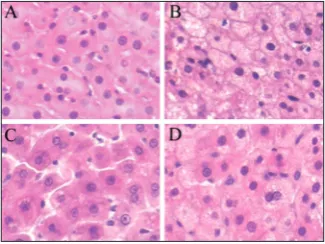
stain-ing liver sections with H&E showed apparent lipid deposition in the livers of rats in the model group. The marked accumulation of lipid vesicles was observed in the hepatocytes in liver sections (Fig. 2B). Treatment with 20 mg/kg of evodiamine substantially decreased lipid accumulation in the liver of rats with hyperli-pemia, as evidenced by H&E evaluation (Fig. 2C). Histologic analyses suggest that evodiamine helped maintain normal fat deposition in the liver when rats were fed with a high-fat diet.
Effects of evodiamine on the phosphorylation of AMPK and ACC
It is widely accepted that the overall function of the AMPK cascade is to control metabolism in response to variations in the energy status of the cell [22]. As a downstream target for AMPK, ACC is phosphory-lated by AMPK, which leads to the inhibition of fatty acid synthesis. To gain insight into the mechanism by which evodiamine regulates the contents of serum TC and TG, phosphorylation of AMPK and ACC in evodiamine-treated animals was measured. As shown in Fig. 3A, the phosphorylation of AMPK was signifi-cantly stimulated by evodiamine at the dosage of 20 mg/kg, but the expression of the total AMPK was not changed. We also observed that phosphorylation of ACC was significantly stimulated, but the expression of endogenous ACC protein was not changed (Fig. 3B). Previous studies showed that evodiamine could influence lipid metabolism through the regulation of the expressions of its key genes, as well as reduce body Fig. 2. Hepatic lipid deposition in the four experimental groups.
A – control; B – Model; C – HD; D – AICAR. All the photo-micrographs show H&E staining. Original magnification × 400.
Fig. 3. The effects of evodiamine on the AMPK pathway. Evo-diamine increases the phosphorylation levels of AMPK (A) and ACC (B), and does not significantly affect the dephosphorylation level of LKB1 (C). *p<0.05 vs the model.
heat and body weight [23]. In this study, our results further suggest that the AMPK pathway is involved in evodiamine-mediated TC and TG metabolism of rats with hyperlipemia.
Effects of evodiamine on the dephosphorylation of LKB1
LKB1 is an upstream regulator of the AMPK pathway, and the activation of AMPK leads to the phosphoryla-tion of downstream targets, such as ACC [24]. Recent-ly, Sid et al. [25] reported that folic acid supplementa-tion may improve cholesterol and glucose metabolism by restoring AMPK activation, which was mediated through an elevation of its allosteric activator AMP and activation of its upstream kinase LKB1 in the liver. To determine whether LKB1 is required for the activa-tion of AMPK by evodiamine, the dephosphorylaactiva-tion of LKB1 was monitored in rats treated with 20 mg/kg of evodiamine. The results indicated that evodiamine treatment had no effect on LKB1 dephosphorylation (Fig. 3C), suggesting that evodiamine treatment in-creased the phosphorylation of ACC and AMPK in a LKB1-independent manner.
Acknowledgments:The present study was supported by the Na-tional Natural Sciences Foundation of China (grant. nos. 81260478 and 81460049), the Natural Science Foundation of Inner Mongo-lia Autonomous Region of China (grant. no. 2014JQ04), and the Program for Young Talents of Science and Technology in Uni-versities of Inner Mongolia Autonomous Region, China (grant. no. NJYT-14-A13).
Authors’ contributions: H.Y. and H.H. conceived and conducted the experiment and collected the data; H. H and H. Y. contributed equally to this work; W.G. performed the experiments and col-lected the data; L.Y. performed the experiments; Z.W. conceived and designed the experiments, conducted the experiments, col-lected the data, constructed the figures and wrote the manuscript; C.W. conceived and designed the experiments, collected and in-terpreted the data.
Conflict of interest disclosure: The authors declare no conflicts of interest.
REFERENCES
1. Shoji N, Umeyama A, Takemoto T, Kajiwara A, Ohizumi Y. Isolation of evodiamine, a powerful cardiotonic principle, from Evodia rutaecarpa Bentham (Rutaceae). J Pharm Sci. 1986;75(6):612-3.
2. Pearce LV, Petukhov PA, Szabo T, Kedei N, Bizik F, Kozikowski AP, Blumberg PM. Evodiamine functions as an agonist for the vanilloid receptor TRPV1. Org Biomol Chem. 2004;2(16):2281-6.
3. Wang Z, Sun L, Yu H, Zhang Y, Gong W, Jin H, Zhang L, Liang H. Binding mode prediction of evodiamine within vanilloid receptor TRPV1. Int J Mol Sci. 2012;13(7):8958-69. 4. Yu H, Tu Y, Zhang C, Fan X, Wang X, Wang Z, Liang H.
Evo-diamine as a novel antagonist of aryl hydrocarbon receptor. Biochem Biophys Res Commun. 2010;402(1):94-8.
5. Dong G, Wang S, Miao Z, Yao J, Zhang Y, Guo Z, Zhang W, Sheng C. New tricks for an old natural product: discovery of highly potent evodiamine derivatives as novel antitumor agents by systemic structure-activity relationship analysis and biological evaluations. J Med Chem. 2012;55(17):7593-613. 6. Yu H, Jin H, Gong W, Wang Z, Liang H. Pharmacological
actions of multi-target-directed evodiamine. Molecules. 2013;18(2):1826-43.
7. Kobayashi Y, Nakano Y, Kizaki M, Hoshikuma K, Yokoo Y, Kamiya T. Capsaicin-like anti-obese activities of evodiamine from fruits of Evodia rutaecarpa, a vanilloid receptor agonist. Planta Med. 2001;67(7):628-33.
8. Shi J, Yan J, Lei Q, Zhao J, Chen K, Yang D, Zhao X, Zhang Y. Intragastric administration of evodiamine suppresses NPY and AgRP gene expression in the hypothalamus and decreases food intake in rats. Brain Res. 2009;1247:71-8. 9. Wang T, Wang Y, Kontani Y, Kobayashi Y, Sato Y, Mori N,
Yamashita H. Evodiamine improves diet-induced obesity in
a uncoupling protein-1-independent manner: involvement of antiadipogenic mechanism and extracellularly regulated kinase/mitogen-activated protein kinase signaling. Endocri-nology. 2008;149(1):358-66.
10. Wu CL, Hung CR, Chang FY, Lin LC, Pau KY, Wang PS. Effects of evodiamine on gastrointestinal motility in male rats. Eur J Pharmacol. 2002;457(2-3):169-76.
11. Srivastava RA, Pinkosky SL, Filippov S, Hanselman JC, Cramer CT, Newton RS. AMP-activated protein kinase: an emerging drug target to regulate imbalances in lipid and car-bohydrate metabolism to treat cardio-metabolic diseases. J Lipid Res. 2012;53(12):2490-514.
12. Sakamoto K, McCarthy A, Smith D, Green KA, Grahame Hardie D, Ashworth A, Alessi DR. Deficiency of LKB1 in skeletal muscle prevents AMPK activation and glucose uptake during contraction. EMBO J. 2005;24:1810-20.
13. Zhou L, Deepa SS, Etzler JC, Ryu J, Mao X, Fang Q, Liu DD, Torres JM, Jia W, Lechleiter JD, Liu F, Dong LQ. Adiponectin activates AMP-activated protein kinase in muscle cells via APPL1/LKB1-dependent and phospholipase C/Ca2+/Ca2+/ calmodulin-dependent protein kinase kinase-dependent pathways. J Biol Chem. 2009;284:22426-35.
14. Makinde AO, Gamble J, Lopaschuk GD. Upregulation of 5’-AMP-activated protein kinase is responsible for the increase in myocardial fatty acid oxidation rates following birth in the newborn rabbit. Circ Res. 1997;80(4):482-9. 15. Cao S, Zhou Y, Xu P, Wang Y, Yan J, Bin W, Qiu F, Kang N.
Berberine metabolites exhibit triglyceride-lowering effects via activation of AMP-activated protein kinase in Hep G2 cells. J Ethnopharmacol. 2013;149(2):576-82.
16. Kurokawa H, Sugiyama S, Nozaki T, Sugamura K, Toyama K, Matsubara J, Fujisue K, Ohba K, Maeda H, Konishi M, Aki-yama E, Sumida H, Izumiya Y, Yasuda O, Kim-MitsuAki-yama S, Ogawa H. Telmisartan enhances mitochondrial activity and alters cellular functions in human coronary artery endothelial cells via AMP-activated protein kinase pathway. Atheroscle-rosis. 2015;239(2):375-85.
17. Sullivan JE, Brocklehurst KJ, Marley AE, Carey F, Carling D, Beri RK. Inhibition of lipolysis and lipogenesis in isolated rat adipocytes with AICAR, a cell-permeable activator of AMP-activated protein kinase. FEBS Lett. 1994;353(1):33-6. 18. Ching LC, Chen CY, Su KH, Hou HH, Shyue SK, Kou YR, Lee
TS. Implication of AMP-activated protein kinase in transient receptor potential vanilloid type 1-mediated activation of endothelial nitric oxide synthase. Mol Med. 2012;18:805-15. 19. Wang T, Kusudo T, Takeuchi T, Yamashita Y, Kontani Y, Oka-matsu Y, Saito M, Mori N, Yamashita H. Evodiamine inhibits insulin-stimulated mTOR-S6K activation and IRS1 serine phosphorylation in adipocytes and improves glucose toler-ance in obese/diabetic mice. PLoS One. 2013;8(12):e83264. 20. Wang Z, Wang X, Qu K, Zhu P, Guo N, Zhang R, Abliz Z, Yu
21. Wang Z, Bao Y, Zhang Y, Zhang J, Yao G, Wang S, Zhang H. Effect of Soymilk Fermented with Lactobacillus plantarum P-8 on Lipid Metabolism and Fecal Microbiota in Experimen-tal Hyperlipidemic Rats. Food Biophysics. 2012;8(1):43-9. 22. O’Neill LA, Hardie DG. Metabolism of
inflamma-tion limited by AMPK and pseudo-starvainflamma-tion. Nature. 2013;493(7432):346-55.
23. Jiang DF, Li WT, Yang HL, Zhang ZZ, Chen D, Sun C. Long-term effects of evodiamine on expressions of lipogenesis and lipolysis genes in mouse adipose and liver tissues. Genet Mol Res. 2014;13(1):1038-46.
24. Estañ MC, Calviño E, de Blas E, Boyano-Adánez Mdel C, Mena ML, Gómez-Gómez M, Rial E, Aller P. 2-Deoxy-D-glucose cooperates with arsenic trioxide to induce apopto-sis in leukemia cells: involvement of IGF-1R-regulated Akt/ mTOR, MEK/ERK and LKB-1/AMPK signaling pathways. Biochem Pharmacol. 2012;84(12):1604-16.