Available Online at www.ijpret.com
111
INTERNATIONAL JOURNAL OF PURE AND
APPLIED RESEARCH IN ENGINEERING AND
TECHNOLOGY
A PATH FOR HORIZING YOUR INNOVATIVE WORK
CARDIAC FAILURE ALERT SYSTEM USING WEARABLE SENSOR NETWORK WITH
GSM MOBILE AND GPS
MR. NAGESH D. MATHARIA1, PROF. S.V. DHOPTE2
1. Second Year M.E Scholar, Department of Information Technology, PRMIT&R, Badnera. 2. Senior Faculty Member, Department of Information Technology, PRMIT&R, Badnera.
Accepted Date: 24/04/2014 ; Published Date: 01/06/2014
Abstract: All of we know that now a days the use of wireless devices has been drastically increased due to revolution in wireless technology, in addition to that peoples are more addicted to use internet, this wireless technology can be more efficiently used for monitoring patients in real time, hence we are giving try to develop a system which will use wireless technology for real time patient monitoring. Here in this paper we will discuss the design of the system which will monitor the patient in real time.
Keywords: Cardiac Failure Alert, GSM Mobile, GPS
Corresponding Author: MR. NAGESH D. MATHARIA
Access Online On:
www.ijpret.com
How to Cite This Article:
Nagesh Matharia, S. V. Dhopte; IJPRET, 2014; Volume 2 (10): 111-119
Available Online at www.ijpret.com
112
INTRODUCTION
Now a days the use of internet has been drastically increased in every field because it has number of advantages of online system, the one and most important reason behind this is, it reduces the time required for the work.[4] So this project is proposed to save the time required for providing the medical assistant for the cardiac patient, those who are having the history of the heart disease by providing real time monitoring to patient through the use of internet by using wearable sensor network, this proposed project will also help to locate the person remotely with use of GPS from his GSM mobile. [3] This project will not only locate and track the patient but also will send the alert message to the mobile ambulance and to the closest relatives of the person in case of any emergency. The goal behind developing the system is mainly to save the peoples those who are suffering from heart problems and to provide them medical assistance. In our India most of the senior citizen are living alone in their home as their offspring are busy in due to work load or a employment issues, and as we know with increase in the age factor of the person the threat of stroke also increases and it will be difficult for the person who is elderly and living alone to overcome the situation. So to overcome this problem we are proposing a real time patient monitoring system as explained in above paragraph. This facility is enabled due to the development in the mobile computing, wireless sensor network and distributed computing it very easy to develop such kind of system which can be able to monitor the elderly anytime anywhere. Biomedical sensors are playing very vital role in the development of such systems for specially the elderly suffering from diabetes, high blood pressure or heart disease .this system can not only monitor the patient but also it is one secure intelligent system for transmitting medical results to doctors. Wireless sensor network provides the useful method to remotely acquire and monitor physiological signals without the need of disrupting the patient's normal life. We intend to develop a real time patient monitoring system. It can monitor the old people anytime and anywhere. Through vital physiological data monitoring, accidents perception, real-time emergency response and other functions, our system will reduce sudden accidents and life-threatening. It is convenient that the elderly can have access to medical care at home. At the same time, we feature auxiliary functions which cater for the need of the elderly without anyone accompanied or health professionals as their life assistant.[11] Therefore, the system acts as not only remote health monitoring system, but also the life assistant.
2. SYSTEM REQUIREMENT
Available Online at www.ijpret.com
113
we are considering for monitoring, so that we can build the specific system. At present there so many systems are in use for patient monitoring which we have already discussed and from that discussion we came to know that there is not a single system which is giving you real time data of patients. Designing such system is possible by using the combination of hardware and software. For designing such system we need heart beat sensor, temperature sensor, microcontroller, GSM modem, GPS receiver Also we require Mikro C software for coding the microcontroller, then we requires TCP/IP data login module for monitoring the patients. By using the wireless sensors we can design a mobile patient monitoring system we can keep the real time record of patients physiological parameters, GSM modem will be used for transmitting the alert signal to care takers of the patients and they can find the patient by using the GPS receiver attached with the patient. Detail design and the working of the devices we will discuss below.
Hardware requirement
o Atmega128Microcontroller
o GSM modem
o Heart beat sensor
o Temperature sensor
o GPS receiver
Software requirement
o Mikro C
o Windowa Xp/ Windows 7
o TCP/IP and UDP Data logger module
For making the circuitry we required above mentioned hardware and software components, which are discussed in detail in designing part
3. PROPOSED SYSTEM
Available Online at www.ijpret.com
114
Temperature) by using GPRS to the monitoring station. So as to provide emergency help to the patient
This project has following phases
1. Attaching the sensors to patients body
2. Sending the IP address of the monitoring system to patients GSM
3. Monitor the patients on monitoring system using Data logger.
4. Compare the parameters with normal parameter.
5. Find the location using the latitude and longitude from the received parameter of GPS unit
6. If the received parameters are crossing the normal range then send alert message to ambulance unit and to the familiars of patients.
4. System implementation
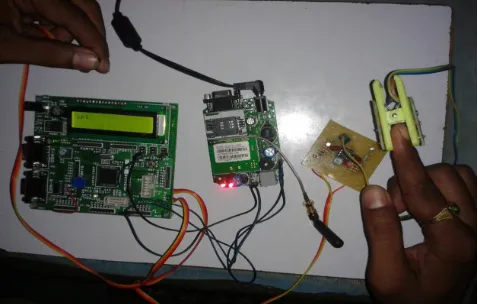
In implementation part we have to make the following connections, after coding the microcontroller LCD will display the bit rate of human heart. When a finger is put in the sensor, it displays the beats per minute (BPM) rate. The pulse signal is applied to the P1.0 input of U2 that is AT89S52 (Can be any 8051 type) which is monitored by the program whenever this input goes high. Internally to U2, there is a counter which counts how many 1ms intervals there are between two high going heart beat pulses. This number is then divided by 60,000 and the result is the pulse rate. For example, if the pulse rate is 60 BPM (beats per minute) there will be a pulse every second. The duration of one heart beat will be one seconds or 1000 x 1ms. Dividing 60,000 by 1000 will give the correct result of 60 which is shown on the display. If there is invalid result (BPM>200) it is invalid and waits for next cycle. The code does not average reading, but shows instantly. To steady reading averaging of 10 past values can be implemented.
Available Online at www.ijpret.com
115
STEP 1 : open the advance TCP/IP data logger software
Screenshot 1: Main
STEP 2: Click on the Plus symbol
Screenshot 2: IP setting
STEP 3: after opening the screen shown in screenshot 2 select UDP and enter your dynamic IP address along with the port no. which is shown in the following screenshot
Available Online at www.ijpret.com
116
STEP 4: In step 4, after entering IP address and port number add that configuration by pressing the plus symbol. And then press ok, after pressing ok we will get again first screen with entered IP address and the port number.
Screenshot 4: Enabling Communication
STEP 5: Now just press play symbol and you will get your output which is shown below. Here you can see the temperature as well as the bits per minute of the patient.
Screenshot 5: Output
Available Online at www.ijpret.com
117
Figure 1 : Complete system
5. CONCLUSION
Available Online at www.ijpret.com
118
6. REFERENCES
1. American Heart Association, http://www.americanheart.org, 2007.
2. D. Lloyd-Jones, R. Adams, M. Carnethon, “Heart disease and stroke statistics—2009 update: a report from the American heart association statistics committee and stroke statistics subcommittee,” Circulation 2009; 119: 41.
3. Y. M. Huang, M. Y. Hsieh, H. C. Chao, “Pervasive, Secure Access to a Hierarchical Sensor-Based Healthcare Monitoring Architecture in Wireless Heterogeneous Networks,” IEEE Journal on Selected Areas in Communications, vol. 27, No. 4, May 2009.
4. K. Dearne, “Project Flatline,” Australian IT, September 2005, pp. 1- 4.
5. T. Martin, E. Jovanov, and D. Raskovic, “Issues in wearable computing for medical monitoring applications: A case study of a wearable ECG monitoring device,” Int. Symp. Wearable Computers ISWC 2000, Atlanta, GA, Oct. 2000.
6. C. Otto, A. Milenkovic, C. Sanders, and E. Jovanov, “System architecture of a wireless body area network for ubiquitous health monitoring,” J.Mobile Multimedia, vol. 1, no. 4, pp. 307– 326, 2006.
7. A. Milenkovic, C. Otto, and E. Jovanov, “Wireless sensor network for personal health monitoring: Issues and an implementation,” Computer Communications, vol. 29, no. 13/14, pp. 2521–2533, 2006.
8. M. F. A. Rasid and B. Woodward, “Bluetooth telemedicine processor for multi-channel biomedical signal transmission via mobile cellular networks,” IEEE Trans. Inf. Technol. Biomed., vol. 9, no. 1, pp. 35– 43, Mar 2005.
9. V. Shnayder, B. Chen, K. Lorincz, T. R. F. Fulford-Jones, and M. Welsh, “Sensor networks for medical care,” Div. Eng. Appl. Sci., Harvard Univ.,Cambridge, MA, Tech. Rep. TR-08-05, 2005.
10.R.-G. Lee, C.-C. Lai, S.-S. Chiang, H.-S. Liu, C.-C.Chen, and G.-Y. Hsieh, “Design and implementation of a mobile-care system over wireless sensor network for home healthcare applications,” in Proc. 28th Annu. Int. Conf. IEEE-EMBS, New York, Aug. 30–Sep. 3, 2006.
Available Online at www.ijpret.com
119
workshop on systems and networking support for healthcare and assisted living environments, pp. 70–72, 2007.
12.J. Rodriguez, A. Goni, and A. Illarramendi, “Real-Time Classification of ECGs on a PDA,” IEEE Transactions on Information Technology in Biomedicine, vol. 9, pp. 23-34, 2005.
13.N. Daja, I. Relin, and B. Reljin, “Telemonitoring in cardiology-ECG transmission through mobile phones,” J.Annals Academy Studenica, vol. 4, 2001, pp.63-66.
14.Cardio Control. http://www.cardiocontrol.com/cardio.htm.
15.R. C. Hawkins, “Evaluation of Roche Accu-Chek Go and Medisense Optium blood glucose meters,” Clin Chim Acta 353:127-131, 2005.
16.L. Docksteader, R. Benlamri, “MORF: A Mobile Health-Monitoring Platform,” IT Professional, vol. 12, pp. 18–25, 2010.
17.W. Wu, J. Cao, Y. Zheng, and Y. Zheng, “WAITER: A wearable personal healthcare and emergency aid system,” In PerCom '08: IEEE International Conference on Pervasive Computing and Communications, 2008.
18.A. Pantelopoulos, N. G. Bourbakis, “Prognosis - A Wearable Health- Monitoring System for People at Risk: Methodology and Modeling,” IEEE Transactions on Information Technology in Biomedicine, vol. 14, no. 3, 2010.
19.V. Gay, P. Leijdekkers, and E. Barin, “A Mobile Rehabilitation Application for the Remote Monitoring of Cardiac Patients after a Heart Attack or a Coronary Bypass Surgery,” PETRA’09, June 09–13, 2009, Greece.
20.Alive Technologies, http://www.alivetec.com