Reference & User Services Quarterly, vol. 56, no. 2, pp. 96–107
© 2016 American Library Association. All rights reserved.
Permission granted to reproduce for nonprofit, educational use.
Reading promotion and readers’ advisory (RA) are key services of the public library. Reading as a concept and an activity has a long history in China. This study is to first have a thorough examination of reading promotion and RA through the literature, and then to focus on exploring the two main research questions: what the current state of RA services is at Chinese public libraries and what Chinese public library users are interested in reading. To conduct the study, 236 libraries at the provincial and municipal levels are chosen as repre-sentatives. Some key findings of the study include that Chinese libraries have been paying more and more attention to the importance of reading and reading promo-tion; a variety of reading promotion activi-ties are being carried out in public libraries nationwide; Chinese librarians are proac-tive in promoting reading and applying new technologies (e.g., WeChat, Blog and library website) to reach out patrons; non-fiction reading is still considered vital in Chinese culture. This study suggests more can be done to improve the service than providing new titles on the library website which is currently the main reading pro-motion activity online. Libraries should more actively provide RA services (e.g., writing book reviews and developing RA
software) and consider introducing formal RA services to user services to overcome the weakness of inadequacy of explicit RA.
R
eading promotion and readers’advisory (RA) are key services of the public library. The Public Library: A Living Force for Popu-lar Education, published by UNESCO and often referred to as the Public Li-brary Manifesto 1949, positions the pub-lic library as a dynamic part of com-munity life. It points out that the public library “should be active and positive in its policy,” “should not tell people what to think, but it should help them decide what to think about,” and “the spotlight should be thrown on significant issues by exhibitions, booklists, discussions, lectures, courses, films and individual reading guidance.”1 RA services have a long history in libraries of North Amer-ica. RA is not a new idea and organized programs in this regard have been documented since the 1920s. Provid-ing RA services shows that the public library should not only provide appro-priate reading materials but also have the responsibility to promote reading and offer reading suggestions, thus giving the library and knowledgeable
Lili Sun and Jingzhen Xie
Lili Sun ([email protected]) is Librarian Consultant, Eastern Shores School Board, Quebec, Canada. Jingzhen Xie (xjingzhen@ hotmail.com) is Reference Librarian, Macau University, Macau, China.
An Exploration of Reading Promotion
and Readers’ Advisory at Chinese
librarians, an active role in users’ reading activities.2 Leisure reading has become an important research topic and RA for both fiction and nonfiction has been recognized as one of the primary library services. It is also true that the public library has spared no efforts to champion and encourage reading for information as well as for pleasure, and thus RA must be supported, encouraged, and cherished by the library administration to prosper.3
In Imperial China, reading in the sense of studying and memorizing the Confucian Classics was the preparation for the Imperial Examination. Young Chinese read the Classics to succeed the examination to obtain a government position. In this context, reading had a deep utilitarian purpose. Since Confucianism had been the orthodoxy in China from the Han Dynasty (206 BCE–220 CE) through the Qing Dynasty (1644–1911 CE), merely reading Confucian texts did not foster, but instead, most of the time suppressed intellectual freedom. After the establishment of the People’s Republic of China, communist ideology prevailed. Particularly, during the Cultural Revolution (1966–76) young students were sent to rural areas for re-education and educated people were la-beled as “stinking intellectuals.” Reading was not encouraged but suspended, especially leisure reading.
Since the 1980s, reading as a concept and an activity started to gain new meanings in Chinese society. Reading promotion and leisure reading gradually became a discus-sion topic in the literature. A variety of reading promotion activities were progressively organized and offered through-out the whole country. In the twenty-first century, reading
is being promoted as a nationwide activity, indicating the growing importance of reading, including leisure reading, in China. As a key role of the public library is to promote reading and to provide RA service, it is useful to study how Chinese public libraries have been doing in this regard.
In this study the change in views of reading as a concept as well as an activity in Chinese public libraries is examined. The paper also evaluates what Chinese public libraries have accomplished in reading promotion. The evolution of read-ing as a concept and an activity in Chinese libraries is in-vestigated through the examination of the academic writings by Chinese librarians. The literature also provides valuable insight into the achievements that Chinese libraries have brought to reading promotion in the country. Activities and services related to reading provided by the library are also examined through the study of Chinese library websites.
Since China joined the International Federation of Li-brary Associations and Institutions in 1981, which marked the point at which Chinese librarianship started to be aligned with international standards, the study period is set as the 1980s to the present. Based on the unique character-istics that reading promotion had in China, the period is further divided into the following three sub-periods: 1981 to mid-1990s, mid-1990s to 2005, 2006 to the present. The following topics are investigated: the nature of read-ing in the Chinese library service and its development, the development of reading promotion as a library service, the methods of reading promotion, achievements, inadequacies and challenges.
EXAMINATION OF READING PROMOTION
AND READERS’ ADVISORY THROUGH THE
LITERATURE
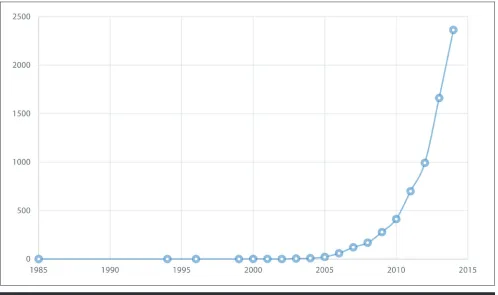
Since the 1980s Chinese public libraries have been paying more and more attention to reading and reading promo-tion. In Chinese, “reading promotion” is “阅读推广” and “library” is “图书馆.” A subject search with these two words as the subjects was conducted in the National Knowledge Infrastructure database, the largest journal article database in China. Only one article was published in 1985 and three articles in the 1990s were found. In 2000–2004, about 10 ar-ticles were published each year. A noticeable change started to take place in 2006 where 60 articles were published in a single year. After 2007 the number of publications continued to increase each year. Since the second decade of the twenty-first century the number has been soaring and in 2014 it peaked 2364 (see figure 1). The large increase in the total number of publications indicates that Chinese librarianship is emphasizing reading and reading promotion. It also re-flects reading promotion is gaining more and more weight in library services overall.
During the period from 1981 to the mid-1990s, reading promotion had not yet been pointed out and studied as a sep-arate library service in China. It was often discussed together with general library service since using the library mainly meant reading books during this period. At this time, the nature of reading was to learn and its purpose was to provide knowledge and foster talents.4 Developing this purpose was considered an important role of the library in serving both library users and society. Libraries recommended books to users to promote socialist cultural and ethical progress.5 In this period, RA slowly started to become a focus of research. This research mainly referred to Russian theories and expe-rience as international standards. Russian librarians’ study of RA was translated and published in important Chinese library journals; Russian libraries’ experience on how to im-prove children’s reading skills, for example, was introduced to Chinese librarianship.6 Studies also suggested that RA was an important component of library education, that theories on RA had a positive meaning for library science, and that RA was the foundation of library practice and the nature of li-brary work.7 It is clear at this time leisure reading had not yet become a positive concept in library services, and librarians frequently differentiated good books from bad books and urged users to read good books. It was thought that library reading activities should be guided by dominant ideologies such as Marxism, Leninism and Maoism.8 Meanwhile, librar-ians were asked to improve their RA skills to help readers who lacked reading skills due to the deprivation of learn-ing opportunities in the Cultural Revolution; both public libraries and academic libraries were requested to consider improving reading skills as an important task.9 Additionally, special aspects of reading had attracted scholars’ attention. There was a noticeable development in research on reading at libraries during this period, in particular, the investigation of
the psychology of reading and emphasis on the importance of research on this topic. Russian influence can still be seen. For example, studies referred to the theory of the Russian librarian B. P. Kanevsky and argued that, as serving library users constituted an essential duty of the library service, it was significant for librarians to study the psychological processes involved in reading to provide quality services.10 In the meantime, research on reading and users started to appear. Scholars began examining the relationship between the different elements: reader, purposes for reading, read-ing materials, etc.11 Scholars also started to look at reading experiences through field study and pointed out the impor-tance of studying the motivation of reading. For insimpor-tance, researchers conducted a survey on college students’ reading habits, interests, and purposes, as well as looking at titles and favorite authors.12 They studied how students read jour-nals and magazines in a university.13 They also conducted a more specific study on how students in natural sciences and engineering programs read materials in the humanities.14 During this period, methods of improving reading skills and promoting reading started to appear in the publications as a specific topic; methods/strategies of promoting reading also began to be discussed.
The second period of reading promotion was from the mid-1990s to 2005. In this period information started to appear as a clear concept in the discourse of Chinese librarianship. It was pointed out that Chinese libraries should not be confined to traditional reading guidance but use emerging informa-tion technologies to improve RA, thus to make it an integral part of “information advisory” which represented the trend of Chinese library services.15 Information advisory should be understood as information services to which Chinese librar-ies were supposed to orient themselves. Chinese librarianship was entering a new era of development and more aligned with international standards. Chinese librarians’ new thoughts and ideas on RA emerged.
awareness of using library services and that a nationwide reading movement should be launched in China.20 Leisure reading was recognized as a correct reading behavior and RA services on leisure reading should be provided. Thus, the term 休闲阅读 (“leisure reading”) appeared and became an important topic of research; scholars analyzed its charac-teristics, acknowledged leisure reading had an educational function, and pointed out that the library should help read-ers with leisure reading. Nonetheless, emphasizing provid-ing “healthy books” was still considered the primary task in RA.21 There was concern among some librarians that college students read inappropriate books. Scholars conducted a study on college students’ reading behavior and discovered to their dismay that the students read primarily for utilitar-ian purposes including reading only textbooks and fast-food materials (e.g., magazines), were not interested in reading the classics, and read without any purpose. Strengthening RA services as a corrective to this type of reading was seen as an important task for the library.22
More research on the psychology of reading began to be produced during this time, including a case study analyzing college students’ reading behavior and research into different levels of readers. For example, three types of readers were identified in county libraries of China: the first type were learners and thinkers who read with a purpose of gaining new knowledge or passing required examinations; the second type were knowledge users who read to acquire knowledge and then apply it to solve situational problems; the last were those who read for fun.23 It was argued the library should primarily consider serving scientific readers in the first and second types of readers because these readers were the core work force in local economic development and read mainly to improve their professional skills.24 Active reading psychology and passive reading psychology were differentiated. Reading for purposes of gaining knowledge or doing research was con-sidered a behavior involved in positive psychological reading process. However, reading for relaxation or entertainment purposes only was considered a passive reading behavior chologically. Furthermore, readers with passive reading psy-chology were criticized for three issues they had: they lacked clear reading goals and did not have strong reading desire; their reading volume was large, but its scope was narrow; and their reading was not effective due to the two previous prob-lems.25 A scholar did a field study using survey as the main tool and interview as the supplementary tool to study readers’ reading habits and found out that readers tended to read liter-ary works that were interesting and fun. These literliter-ary works included the classics which were both fun and educational at the same time. According to this scholar, these findings were critical to guide the library to better performance in RA as he considered reading could be both educational and interest-ing.26 It was also pointed out that reading for fun was often carried out by individuals who did not like to study and read books which were often not beneficial. Hence, the library was urged to build scientific and healthy collections to make sure reading was always beneficial for every user.27
During this period, scholars began the discussion on e-books and digital reading. The different formats of e-e-books (PDF and EPUB) and how to download and access e-books were examined. Electronic reading rooms became a research topic.28 Scholars also introduced and reported on the existing software for users to read e-books online and hardware for users to read offline, the content of e-books and the develop-ment of e-books in China, which indicated e-books would have a promising future.29
Researchers analyzed the impact of e-books, but there was little discussion on their effect on existing reading mod-els.30 In 2002 scholars evaluated the e-book service provided by the National Library of China and noted that readers would have a better reading experience if the website had been designed in a more user-friendly way, if the service was free, and if more copyrighted titles were provided. It was also pointed out that the library should prioritize readers’ needs and only readers’ evaluation could demonstrate the quality of library services.31 New media such as the Internet, DVDs, CD-ROMs and websites, had attracted readers’ attention; however, they would not replace books. Libraries should still offer quality RA services.32 The age of mobile reading had arrived; digital books would change the future of read-ing and readers would be able to read on mobile phones and listen to audiobooks.33
Finally, bibliotherapy became a topic of interest for librar-ians during this period. Reading as a therapy has existed in China since ancient times. Researchers argued why reading could be a treatment and advocated that medical libraries should be the first to engage in providing bibliotherapy.34 Other studies explored how reading benefits minority ethnic university students in terms of college success and libraries should take measures to allow these students to benefit from bibliotherapy. For university students who had psychologi-cal issues, reading good books helped resolve these issues.35 The final period examined here is from 2006 to the pres-ent. More studies on reading were published compared to the previous two periods, suggesting that reading-related library services have become widely recognized as an im-portant task to libraries. During this period, libraries con-tinued to pay attention to the role of reading promotion in library services, reading promotion activities, the relation-ship between reading and librarianrelation-ship, and bibliotherapy. Two noticeable changes are promotion of mass reading or nationwide reading movement and RA connected to e-books and online materials.
in 1995, was introduced officially by the Chinese Library Association. This event is considered as the most important library event in China in 2004 as well as one of the most important events that took place in the past one hundred years in Chinese librarianship by the Chinese Library Asso-ciation. The two events symbolize that the Chinese Library Association has conscientiously endorsed reading promo-tion as a key library service. In 2006 the Popular Science and Reading Advisory Board of the Chinese Library Asso-ciation was formed. In 2009 the Reading Promotion Com-mittee of the Chinese Library Association was established. Other committees related to reading promotion founded are Title Suggestions Committee, Library and Public Read-ing Committee, Media and ReadRead-ing Committee, Teen Reading Promotion Committee, College Students Reading Promotion Committee, Classics Reading Promotion Com-mittee, Community and Rural Areas Reading Committee and People with Disability Reading Committee. Under the leadership of the Chinese Library Association, libraries have been carrying out a variety of nationwide reading-related library services.
During this period, digital reading and reading of elec-tronic resources is developing in China as a new, promising reading form. The number of Chinese who read print books continues to go down. In 2006, the percentage dropped below 50 percent. However web reading has seen a steady increase from 1999 to 2005. During this period online read-ing increased by 750 percent. It is advocated that promotread-ing reading online will supplement the decreased reading of print books and should be considered as a useful counter-measure. Libraries should develop a good collection of on-line resources, use the web, provide quality free electronic resources, spread popular science knowledge, and offer good online RA services.36 Studies have explained what con-stitutes web reading, analyzed the forms and characters of web reading and the problems that college students encoun-tered during web reading, and recommended the measures that academic libraries should take to solve these problems. At the same time, although web reading provides many opportunities, such as rich information and easy access, collecting print materials and providing access to such ma-terials still constitute the primary job of libraries. In other words, because print books are carefully selected by library staff, they are quality reading sources, thus reflect libraries’ value.37 Web reading marks an opportunity; however it can have a negative impact on reading outcome. One concern is that it will lower the nation’s cultural literacy; hence it is proposed that libraries should actively take positive measure such as encouraging reading of print materials and offering effective online RA services by posting new titles, staff picks and book reviews online in combination with traditional programs such as book talks and launches, book clubs and book displays.38 One criticism of web reading by scholars is that it constitutes shallow reading that does not implicate study, research, or reflection. This is the general standpoint of view of Chinese librarians although some disagree with
this view.39 Advocating deep reading is still a dominant po-sition of many Chinese librarians.
Championing nationwide reading is another important characteristic of this period. Many scholars suggest that it is necessary to promote reading the classics and offer RA services on the classics, and also argue that librarians’ book reviews should play an important role in the nationwide read-ing promotion.40 In response to this call to action, specific reference books have been compiled. Yan Xu, a professor at the Nanjing University and an expert on RA, edited two books: The Handbook of Nationwide Reading Promotion (2011) and Suggested Titles for Nationwide Reading (2011). The former introduces different theories on reading in China as well as in the West, addresses how to organize reading promotion activities, introduces different reading media, explains how to plan reading promotion in a strategic way, suggests read-ing titles, and shares best practices of readread-ing promotion in China and other countries. These two books provide impor-tant guidance on nationwide reading and its promotion. The publication of these two works indicates nationwide reading has moved beyond theoretical thinking in China to become a practice guided by the principles.
Finally, the term “readers’ advisory” (阅读辅导 or
阅读指导) has become a specific concept and a topic of dis-cussion in the literature. The nature of RA is being investi-gated and reading promotion activities are heavily discussed. Scholars and librarians advocate that libraries should offer RA to all ages of users, particularly children and teens. It is recommended that web reading may be a good option to encourage teens to read and libraries should be the primary institution to promote children’s reading. A new focus of li-brary reading promotion should be encouraging children to read the classics.41 RA should be offered particularly to rural left-behind children.42 The service should also be a system-atic work offered to college students at academic libraries.43
STUDY OF THE CURRENT STATE OF READING
AND READING-RELATED LIBRARY SERVICES
To explore reading and reading-related services in China, the study is conducted focusing on the two main research questions: what the current state of RA services in Chinese public libraries is, and what Chinese public library users are interested in reading.
Regarding research method, libraries in this study were chosen based on the List of Categorized Libraries in the 5th Evaluation and Categorization of Public Libraries: Libraries in the First Class published by the Public Culture Branch of the Ministry of Culture of the Chinese government in November 2013.44 Only libraries in the first class at the provincial and municipal levels on the list are selected to be representatives for this study.
1. Whether the library has a website and the RA section is visible on the website. The questions include “does it have a link to Ask a Librarian, or Instant Messaging (IM) service and does it indicate that both reference and RA questions may be asked?”
2. Whether the website has book reviews, librarians’ picks, staff blogs, or new titles lists in terms of number, fre-quency of update, language, genre (fiction and nonfic-tion) and the format of new materials (DVD, audiobook, book and CD).
3. Whether the library uses social media to interact with users and to promote reading.
4. Does the library organize activities related to reading? 5. Does the library have any software such as NoveList
or other RA databases to facilitate library users to self-learning to meet their own needs?
To explore what library users are interested in reading, the most circulated titles lists in 2015 from the library web-sites are chosen to be examined. The main subject/genre of the titles chosen to be studied from the Chinese Library Classification are: Nonfiction, foreign literature, foreign children’s literature, foreign children’s comics, Chinese children’s literature, Chinese children’s comics, social love story, science fiction/ fantasy, historical novels, mystery, spy/ thriller/adventure, Chinese martial arts novels, adult comics, Chinese classics and other.
RESULTS
The Current State of RA Services
The authors studied 236 libraries. Of those, 40 either had broken links to the library websites or the library websites could not be found by search engines. Therefore 196 librar-ies which represent 83 percent of those on the list were studied further.
Among the 196 libraries that have a library website, 70 libraries (35.71 percent) have librarians’ picks on their web-sites; 23 libraries (11.73 percent) provide a certain amount of book review information; 164 libraries (83.67 percent) display the new titles list, which can be mostly found on the library homepage (see figure 2).
The number of new titles provided by each library var-ies from several (e.g., 3, 5, or 9) to thousands. Some librarvar-ies replace the whole list with a new list for each update while others keep adding new titles to the existing list. Five librar-ies used the searching/filtering feature empowered by the li-brary software to automatically provide the new title list (e.g., filtering titles added within thirty days) rather than librar-ians manually selecting and providing the list. Among the 164 libraries that have the new title list, 35 libraries (21.34 percent) update the new titles list regularly (e.g., weekly, monthly, and quarterly).
Target readers
Regarding target readers, among the 171 libraries that have either librarians’ picks or new titles lists, over 95 percent choose new titles for adults. More than 60 percent of the li-braries promote new titles for young adults/teens and children. Several libraries have separate lists for children (see figure 3).
Genre
Among the 171 libraries that have either librarians’ picks or new titles, 163 libraries provide fiction titles (95.32 percent). More than 90 percent of the libraries have nonfiction titles. It is found that nonfiction titles represent a big percentage on many of the lists.
Figure 2. Online reading promotion (percent of 196 libraries)
Format
Ninety eight percent Of the 171 libraries, 98.00 percent fo-cus on the print format, 4.09 percent of the libraries choose some titles in the digital format (e.g., e-books and audio-books), and 8.19 percent of the libraries have a separate list for new CDs or DVDs (see figure 4).
More than 90 percent of the libraries organize activi-ties related to reading, such as lectures and theme-related
reading/writing display. Of the 171 libraries, 51.46 percent promote foreign literatures/books that are either translated into Chinese language or in the original languages (e.g., Eng-lish, Russian, Korean, and Japanese). Among the 171 librar-ies that have librarians’ picks or new titles lists, 51 librarlibrar-ies (29.82 percent) provide the last updated date and 7 of them were updated in 2013 or 2012.
Of 196 libraries, 73 (37.24 percent) provide IM for online reference services. Twelve libraries do not have IM services but provide users with online form-based reference services or the library online bulletin board for users to post ques-tions. None of the libraries specify that the IM service is for RA. Eighty-three libraries (42.35 percent) use social media to promote library materials and services. Most popular social media tools implemented are Wechat, QQ (a popular instant messaging software service developed by a Chinese company), and Sina Weibo (a Chinese microblogging web-site) that Chinese users are familiar with.
Online Readers’ Advisory Service
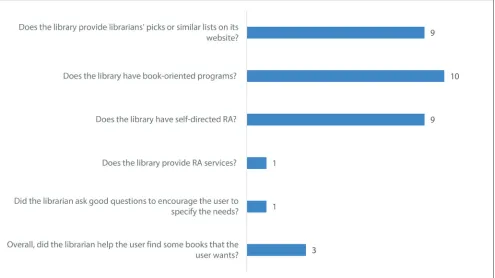
To further investigate how the online reference service support readers’ reading needs, a scenario was developed. Among the 73 libraries in this study that provide IM reference services, only 10 libraries were reached online through the service. The other libraries redirected users to ask questions by filling out forms or via email, could not be connected, or did not answer the question. Overall, the scenario was designed to explore the five main areas, as shown in figure 5.
Figure 4. Format (percent of 171 libraries)
The following scenario was used first to start the con-versation. Unfortunately, most of the IM reference services did not conduct good reference interview to encourage the patron to clarify her interests to understand her needs; therefore they failed to make appropriate suggestions. The patron did not have a chance to be asked to explain the “the elements of a story that are important to her (such as plot, characterization, setting and length).”45 To continue the con-versation to explore the RA services, the patron had to ask the questions in figure 5 directly to receive answers. The suggestion given to the patron includes: searching the library catalog, browsing the stack, using Baidu search engine or Douban to search for books that best fit. Some directly told the patron that they were not able to help as people had dif-ferent reading preferences or they were not an expert of a certain genre, and suggested she search for titles by herself. The impression given to the patron was that reading was a very personal thing.
RA Scenario
I just read Tan Xiang Xing (檀香刑) by Mo Yan (莫言). I want to know if there are some other authors who have similar writ-ing style. And I want to read some of their books; I am inter-ested in modern day setting this time. My statement to start the conversation is as follows: “Can you suggest some titles to me? How can I find good books that I like to read? (请问贵 馆有读书推荐吗?怎样可以找到自己喜欢的风格的书啊).”
The questions directly asked to continue the conversa-tion after the patron was not encouraged to clarify her needs, translated in English, are as follows:
1. I just read Tan Xiang Xing. I am looking for authors who write similar stories.
2. You cannot find authors. This is fine. Do you help people select books to read? Do you have librarians’ suggestions or similar lists on your website?
3. Oh, I see. Thank you. I will have a look at the book display or the library website to see if I can find inter-esting titles. By the way, do you have programs like book talks?
All of the ten libraries provide reading promotion activi-ties. The majority of them have self-directed RA services, which are mainly new titles and the most circulated titles posted on the website. For Chinese librarians, the self-directed RA services include the catalog. In this scenario, almost all the librarians suggested using the library catalog to find books that the user was interested in reading; they were reluctant to recommend, which reflects the feeling that reading is a very personal matter and only readers know what they want to read. This also echoes the discour-aging results that only one library provides RA services and asked good questions to encourage the user to specify the needs, and only three libraries found some books that the user was interested in reading.
CHINESE LIBRARY USERS’ READING
INTERESTS
Of the 196 libraries surveyed, 40 have most circulated titles lists on their website. Among these 40 libraries, two of the new title links on the two library websites did not function when studied. Therefore 38 libraries (19.39 per-cent) have been studied further. Of those 38 libraries, 32 (84.21 percent) have nonfiction titles on the most circu-lated titles list.
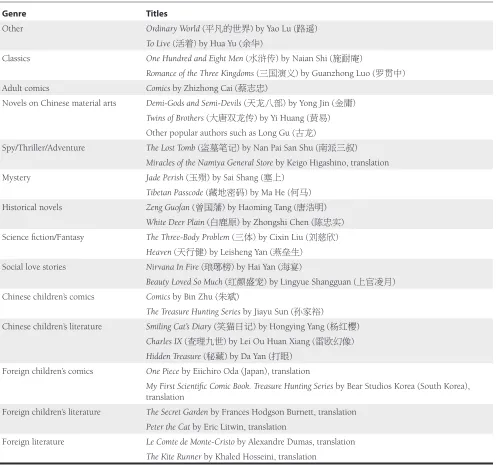
Figure 6 shows the genres/subjects that have been stud-ied. Genres/subjects that are not on the list are included as “other.” In total, 14 categories are decided to explore. The Chinese Library Classification is followed in this study.
FINDINGS AND DISCUSSION
Most new titles lists are targeted toward adult readers. Sev-eral libraries provide separate new titles lists for children. Among the most circulated lists, children’s literature (63.16 percent on Chinese children’s literature; 47.37 percent on foreign children’s literature) ranks as the top. Chinese chil-dren’s comic books and foreign chilchil-dren’s comic books also take a good percentage, 23.68 percent and 21.05 percent, respectively. The top list for adults is social love stories (63.16 percent). This finding raises the awareness of the high needs of children’s books in collection development.
The high rate of nonfiction circulation (84.21 percent) reflects its importance in Chinese culture. The traditional Table 1. Some titles from the top circulated lists
Genre Titles
Other Ordinary World (平凡的世界) by Yao Lu (路遥)
To Live (活着) by Hua Yu (余华)
Classics One Hundred and Eight Men (水浒传) by Naian Shi (施耐庵)
Romance of the Three Kingdoms (三国演义) by Guanzhong Luo (罗贯中) Adult comics Comics by Zhizhong Cai (蔡志忠)
Novels on Chinese material arts Demi-Gods and Semi-Devils (天龙八部) by Yong Jin (金庸)
Twins of Brothers (大唐双龙传) by Yi Huang (黄易) Other popular authors such as Long Gu (古龙)
Spy/Thriller/Adventure The Lost Tomb (盗墓笔记) by Nan Pai San Shu (南派三叔)
Miracles of the Namiya General Store by Keigo Higashino, translation Mystery Jade Perish (玉殒) by Sai Shang (塞上)
Tibetan Passcode (藏地密码) by Ma He (何马) Historical novels Zeng Guofan (曾国藩) by Haoming Tang (唐浩明)
White Deer Plain (白鹿原) by Zhongshi Chen (陈忠实) Science fiction/Fantasy The Three-Body Problem (三体) by Cixin Liu (刘慈欣)
Heaven (天行健) by Leisheng Yan (燕垒生) Social love stories Nirvana In Fire (琅琊榜) by Hai Yan (海宴)
Beauty Loved So Much (红颜盛宠) by Lingyue Shangguan (上官凌月) Chinese children’s comics Comics by Bin Zhu (朱斌)
The Treasure Hunting Series by Jiayu Sun (孙家裕)
Chinese children’s literature Smiling Cat’s Diary (笑猫日记) by Hongying Yang (杨红樱)
Charles IX (查理九世) by Lei Ou Huan Xiang (雷欧幻像)
Hidden Treasure (秘藏) by Da Yan (打眼) Foreign children’s comics One Piece by Eiichiro Oda (Japan), translation
My First Scientific Comic Book. Treasure Hunting Series by Bear Studios Korea (South Korea), translation
Foreign children’s literature The Secret Garden by Frances Hodgson Burnett, translation
Peter the Cat by Eric Litwin, translation
Foreign literature Le Comte de Monte-Cristo by Alexandre Dumas, translation
belief that reading is to provide knowledge and foster tal-ents and is more for learning rather than entertaining still plays an important role, which is also revealed by the focus on nonfiction titles on some librarians’ picks/new titles lists. Among the nonfiction titles, it is found that many are educational materials on parenting and study materials for elementary and secondary school students, which somewhat resonates with the increased needs of children’s books.
The foreign literature, including both books translated into Chinese language and in the original language, is a sub-stantial part of the studied data. In the twenty-first century, Chinese readers can more easily access foreign literature compared to the past. The books are mostly from English, Russian, Korean, and Japanese cultures, which have critical influence on modern Chinese literature.
Chinese public libraries have made efforts to apply new technologies to support the development of library resourc-es and servicresourc-es. This is seen in the use of virtual servicresourc-es to support user experiences and social media to promote library services. Most of the library websites studied have a section for library users to find reading-related materials and event information, as well as providing a forum or so-cial media platform for librarians and users to interact with each other. However, there is still more to improve. For instance, the consistency of regularly updating the lists is needed. The reading lists on some library websites are quite out of date. Many libraries use collaborative online refer-ence services, which provide users with more professional consistent services. However, in most of the situation, the conversation is not instant. For example, some libraries provide instant messaging service such as via QQ, but the user has to send a friend request and wait for approval, which might be denied.
LIMITATION
This study only focuses on the provincial and municipal public libraries on the List of Categorized Libraries in the 5th Evaluation and Categorization of Public Libraries: Libraries in the First Class published by the Public Culture Branch of the Ministry of Culture of the Chinese government. Therefore the results represent the current state of the public libraries at provincial and municipal levels. They are representative, but might be limited to reflect the current situation in all public libraries.
The data were collected during the period from June to November 2015; therefore the results reflect more precisely the state of libraries during this period. Services of the li-braries may have changed due to the development of library services. In addition, this study is designed to explore the two main research questions. There are many other aspects regarding leisure reading in Chinese community, and fur-ther studies (e.g., breaking the studied reading materials into more detailed subjects/genres) are open for researchers to examine and discuss.
The RA services offered at Chinese libraries are only examined through studying the library websites. No library was visited to observe RA services on site. Therefore, the study might miss some libraries that offer the service very actively in person. The study is not an examination of the service from the library user’s perspective.
CONCLUSION
In providing effective RA, the profession’s attitude is critical: Librarians need to embrace reading and commit to doing the work that will result in quality RA service.46 To meet the mandate of promoting reading and quality reading ma-terials and offering reading suggestions, librarians serve an active role in users’ reading activities. In China, changes in the meaning and purposes of reading show the development and progress made through history. From lack of a clear idea of RA and merely promoting print books to encourag-ing different readencourag-ing models, recommendencourag-ing a variety of reading materials, organizing diverse reading activities and using emerging technologies guided by a clear notion of RA to enhance the service, Chinese public libraries underwent unique periods of development in RA services and have harvested positive outcomes.
The findings of this study reflect the general state of current RA services in China. RA has become a clear con-cept and service for Chinese librarians and various reading promotion activities are being carried out in public libraries nationwide. For example, suggesting new titles is already considered and carried out as a routine work by most of the libraries examined in this study. The most circulated titles are posted on library websites to report on library users’ reading habits. Technology is embraced. Along with library websites, social media tools such as WeChat, QQ and Blog are used to reach out patrons. However, our findings also indicate that much can be improved. For example, in addi-tion to suggesting titles, librarians could write more book reviews to actively provide RA service online and embed interactive tools in the website for users to communicate and participate in the review section directly. Information related to reading promotion needs to be updated in a more consistent and regular way. Online services, once provided, should be reliable and solid.
In conclusion, the general state of RA in Chinese librar-ies now is promising, and with more effort being made and more work being carried out in this area by Chinese librar-ians, RA services in Chinese public libraries will continue to make progress.
References
1. The United Nations Educational, Scientific and Cultural Orga-nization, “The Public Library: A Living Force for Popular Edu-cation,” accessed October 15, 2015, http://unesdoc.unesco.org /images/0014/001474/147487eb.pdf.
2. Joyce G. Saricks, Readers’ Advisory Service in the Public Library
(Chicago: American Library Association, 2005), 1. 3. Ibid., 2.
4. Binxian Lin, “Library and Fostering Talents,” Library Work and Study 3 (1980): 26–27; Baiying Zhang, “Library and Talent Resources,” Library Work in Colleges and Universities 1 (1981): 24–32.
5. Baoqing Pu, “Strengthen Readers’ Advisory and Construct Spiri-tual Civilization,” Researches in Library Science 3 (1986): 33–35. 6. Yiyong Teng, “Review of Children’s Library Services in
Rus-sia,” Library Research 4 (1983): 59–63; Teping Tian and Nian Peng, “About Readers’ Advisory Services in Libraries,” Library
5 (1992): 27-30.
7. Junyi Zeng, “The Basic Theoretical Issues in Russian Library Sci-ence,” Researches in Library Science 4 (1983): 11–15.
8. Zhaozhong Han, Xueli Zhang, and Foulian Feng, “Study of Readers’ Advisory in Libraries,” Journal of Shandong Jiaotong Uni-versity 4 (1995): 45–48.
9. Su Chen, “Improving Readers’ Reading Skills is an Important Task of Public Libraries,” Journal of Library Science 3 (1986): 8–11; Yaoduan Zhou, “The Study of the Reading Needs of Nor-mal University Students and Relative Educational Channels,”
Journal of Hanshan Normal University (social science edition) 2 (1990): 112–16; Fuqiang Shi, “Readers’ Advisory as an Impor-tant Step in Delivering Moral Education at School,”Journal of Xi’an Aeronautical University 1 (1991): 59.
10. Zixia Duan, “Improve the Quality of Library Services through the Study of the Psychology of the Reader,” Journal of Yanan Uni-versity (social science edition) 1 (1989): 89–92.
11. Long Wang, “Research on Reading and the Development of Library and Information Science in our Country,” Researches in Library Science 4 (1991): 80–83.
12. Lefang Zong, “Conduct Surveys on Reading and Provide Good User Services,” Journal of the Library Science in Jiangxi 1 (1993): 37–41.
13. Li Li, “Reflections on Journal Reading of Teachers’ College Stu-dents,” Journal of Liupanshan Teachers College 1 (1994): 55–56. 14. Zuyun Hou et al., “Extracurricular Reading of Books in
Human-ities by College Students in Engineering and Science,” Research on Education Tsinghua University 2 (1994): 35–41.
15. Long Wang, “From a Reading Adviser to an Information Adviser: A Change in the Social Role of Librarians,” Library 3 (1996): 34–37.
16. Zhen Zhang, “Introduction to Book Review Activities in Col-leges and Universities,” Library Work in Colleges and Universities
4 (1996): 54; Wei Li and Xiaoyan Zhang, “On the Effective Readers’ Advisory Service in Adult Universities and Colleges,”
Journal of Nanjing College Population Programme Management 2 (1997): 58–60.
17. Guihong Xu, “Study of Readers’ Reading Tendency in our Librar-ies and Improvement of the Readers’ Advisory Service,” Modern Information 5 (2002): 54.
18. Xuxia Feng, “Construct Library Culture with Certainty of Teens’ Reading Characters,” Publishing and Reference 14 (2002): 21. 19. Ningwu Yue, “Readers’ Advisory Services on Reading
Humani-ties Enriched Books in Colleges and UniversiHumani-ties,” Journal of Jiangsu Radio & Television University 6 (2002): 78–79.
20. Xiaoyan Guo and Zhuan Xiang, “Reading and Library,” Sci/tech Information Development & Economy 7 (2003): 51–52.
21. Qing Li and Aidong Chang, “Leisure Reading and the Library’s Service Strategies,” Journal of Daizong 2 (2005): 118–20. 22. Aiwu Yao, “College Students’ Bad Reading Habits and the
Coun-termeasures of the Library,” Journal of Anhui Institute Education
5 (2005): 101–3.
23. Hualing Rao, “Brief Analysis of the Characteristics of Readers at County Libraries,” Journal of the Jiangxi Society of Library Science
3 (1999): 45–46. 24. Ibid., 45.
25. Xinling Yang, “The Impact of Ebooks on Book Publishing and Reading Behaviors,” Journal of Information 7 (2001): 55–57. 26. Cuizhen Xiang, “Brief Analysis of Readers’ Reading Inclination,”
Henan Library Science Journal 2 (2002): 68–70.
27. Zuolai Zhang, “An Exploration of Reading Psychology and Read-ers’ Advisory,” Library 4 (2002): 73–74.
28. Yuchang Song, “How to Read Ebooks,” Electric Age 8 (2000): 50. 29. Xiaoqing Yang, “The Impact of Ebooks on Book Publishing and
Reading Behaviors,” Journal of Information 7 (2007): 55–57. 30. Ruhua Huang, “Ebooks and Their Impact,” Information and
Documentation Work S1 (2001): 198–99.
31. Xiaoguang Geng, “The Fruit of Reading is Bitter: Experiencing the Service at the National Library of China through its Web-site,” Library Theory and Practice 2 (2002): 42–44.
32. Hongwu He, “Reading Promotion and Media Education,” Library Journal 1 (2003): 59–60.
33. Zhipan Wu, “Mobile Reading and the Future of the Library: Mobile Readers’ Library,” Journal of Academic Libraries 1 (2004): 2–5.
34. Fengfeng Zhao and Fei Chen, “Medical Library Should Become the Forerunner of Bibliotherapy,” Chinese Journal of Medical Library 6 (2001): 15–16.
35. Xuehua Xiao, “Guidance on University Students’ Psychological Characteristics and the Keys to the Problem,” Contemporary Library 3 (2005): 21–23.
36. Wanfen Zou, “Library’s Mission and Strategies in Constructing a Reading Society,” Library and Information Service 3 (2006): 113–16.
37. Wenping Wang, “Online Reading of the College Students and the Countermeasures by Academic Libraries,” Journal of Academic Library and Information Science 1 (2009): 84–86; Xiangchao He, “Value Orientation of the Library in an Envi-ronment of Diversified Reading Materials,” Library Theory and Practice 2 (2009): 23–28.
38. Xiaoling Zuo, “Brief Analysis of Libraries’ Solutions to the Changes in the Reading Behavior in the New Situation,” Library and Information Service S2 (2012): 181–83.
39. Yifan Dong, “Shallow Reading should not Encounter Deep Con-demn,” Library Journal 1 (2009): 28–29.
40. Jian Zhang, “Countermeasures and Suggestion for Unfolding Nationwide Reading Promotion Activity,” Journal of Library and Information Sciences in Agriculture 2 (2012): 91–95; Zerui Mo, “Researches on and Prospects for Reading Promotion in China,”
Library Theory and Practice 8 (2013): 30–32.
41. Yan Hai, “Introduction to Readers’ Advisory in Children’s Libraries,” Inner Mongolia Library Work 2 (2004): 53–55. 42. Jianyu Zhou, “Thinking on How to Improve the Reading
43. Wenling Guo, “Investigation and Analysis for the Normalization of Reading Guidance in 985 University Libraries,” Research on Library Science 8 (2013): 72–77.
44. The Public Culture Branch of the Ministry of Culture, “The List of Categorized Libraries in the 5th Evaluation and Categoriza-tion of Public Libraries: Libraries in the First Class,” accessed October 5, 2015, http://zwgk.mcprc.gov.cn/auto255/201311/t20 131113_30260.html.
45. Ontario Public Library Association, “Readers’ Advisory Conver-sation,” accessed October 10, 2015, https://www.accessola.org /web/Documents/OLA/Divisions/OPLA/RACommittee/RA%20 competency_conversation_final.pdf.