Start Learning Chinese Words Fast: An
Introduction
Baixin Wu
Hunan Institute of Animal Husbandry and Veterinary Medicine, Changsha City, China
Dahui Huang
Longping High-Tech International Training College, Changsha City, China
Bojun Huang
Foreign Economic Cooperation Center of Hunan Provincial Agricultural Committee, Changsha City, China
Haifeng Yan
Hunan Institute of Animal Husbandry and Veterinary Medicine, Changsha City, China
Meizhen Zhu
Changsha Highway Bridge Construction Co., Ltd. China
Gilles Perret ECTI, France
Abstract—In order to cater to the needs of Chinese language lovers, 28 basic strokes of Chinese words are firstly introduced. It is pointed out that the difficulty for foreigners to learn Chinese words is their grotesque shapes written by brush (soft) pen and printed in books. The special writing method with a hard pen and 8 directions moving steps are invented and firstly shown, which is easy for foreigners to try. The size (length) of strokes will guide them to control the proportion of a word. It could be changed according to paper size and how large they want to write. Secondly, 48 common fragments derived from 28 basic strokes are listed and the writing method described. It could help foreigners to separate and re-write unknown Chinese words and even guess out the meanings. Lastly, many characteristics or regularities of Chinese words will have great attraction for foreign language learners. Some Chinese cultures or amusing stories are also exposed in fragments and example words.
Index Terms—stroke, fragment, writing order, Chinese words
I. INTRODUCTION
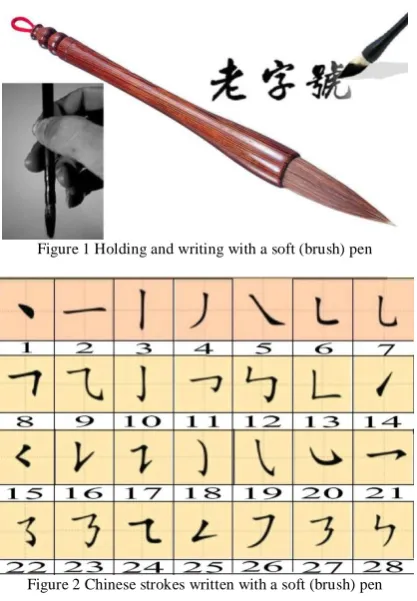
With the society progress and the communication between countries, more and more people who live in non Chinese-Speaking countries are interested in learning Chinese language. For the purpose of fun, some people imitated Chinese pronunciation and were able to speak a few short sentences. Some want to learn more so as to tour China. Some are going to learn more and more in order to study in China. Nevertheless, most of them do not know how to start and they feel difficult to learn. It is well known that learning English begins with 26 alphabetic letters. Hence, it should be started from (28) strokes to learn Chinese as the words are composed of strokes.
Figure 1 Holding and writing with a soft (brush) pen
Figure 2 Chinese strokes written with a soft (brush) pen
American Wartman invented (hard) pen in early nineteenth century. It spread all over the world because it was easy to carry, fluent and rapid in writing (Chen Wei, 1993). Many Chinese people also began to write with (hard) pens (figure 3). Therefore, a good way for foreigners to get start quickly is firstly differentiating strokes and imitating with a hard pen (pencil) secondly.
Figure 3 Writing with a hard pen
II. WRITING METHOD OF CHINESE STROKES
There are commonly 28 strokes in Chinese words (Fu Yonghe, 1992). The tone of words has totally 4 levels from low to high (simplified as TL1, 2, 3 and 4). The same tone has different words and different meanings.
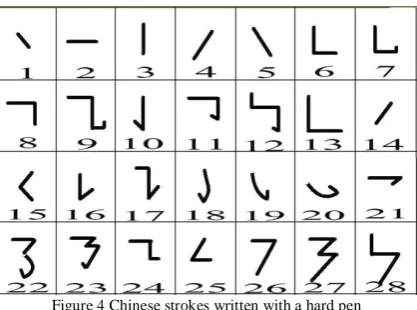
Figure 4 Chinese strokes written with a hard pen
No.2, sounding heng (TL2), writing from left side, moving towards east and about 0.4cm long. No.3, sounding shu (TL4), writing from upper side, moving towards south and about 0.4cm long. No.4, sounding pie (TL3), writing from upper side, moving towards southwest and about 0.4cm long. No.5, sounding na (TL4), writing from upper side, moving towards southeast and about 0.4cm long.
No.6, sounding shu wan (TL4 and 1), writing from upper side, moving towards south, about 0.3cm long; turning towards east and about 0.3cm long.
No.7, sounding shu wan gou (TL4, 1 and 1), writing from upper side, moving towards south, about 0.4cm long; turning towards east, about 0.3cm long; turning towards north and about 0.1cm long. It looks like a fishhook.
No.8, sounding heng zhe (TL2 and 2), writing from left side, moving towards east, about 0.4cm long; turning towards south and about 0.3cm long.
No.9, sounding heng zhe wan gou (TL2, 2, 1 and 1), writing from left side, moving towards east, about 0.3cm long, turning towards south, about 0.4cm long; turning towards east, about 0.2cm long; turning towards north and about 0.1cm long. It is almost comprised of No.2 and No.7.
No.10, sounding shu gou (TL4 and 1), writing from upper side, moving towards south, about 0.4cm long; turning towards northwest and about 0.1cm long.
No.11, sounding heng zhe gou (TL2, 2 and 1), writing from left side, moving towards east, about 0.4cm long, turning towards south, about 0.2cm (0.4cm) long; turning towards northwest and about 0.1cm long.
No.12, sounding shu zhe zhe gou (TL4, 2, 2 and 1), writing from upper side, moving towards south, about 0.2cm long; turning towards east, about 0.4cm long; turning towards south, about 0.4cm long; turning towards northwest and about 0.1cm long.
No.13, sounding shu zhe (TL4 and 2), writing from upper side, moving towards south, about 0.4cm long; turning towards east and about 0.4cm long. It is a little larger than No.6.
No.14, sounding ti (TL 2), writing from southwest, moving towards northeast and about 0.3cm long.
No.15, sounding pie dian (TL3 and 3), writing from upper side, moving towards southwest, about 0.2cm long; turning towards southeast and about 0.2cm long.
No.16, sounding shu ti (TL4 and 2), writing from upper side, moving towards south, about 0.3cm long; turning towards northeast and about 0.3cm long.
No.17, sounding heng zhe ti (TL2, 2 and 2), writing from left side, moving towards east, about 0.3cm long; turning towards south, about 0.4cm long; turning towards northeast and about 0.3cm long.
No.18, sounding wan gou (TL1 and 1), writing from upper side, moving along an arc line towards south (the hypothetic center is at left side), about 0.5cm long; turning towards northwest and about 0.1cm long.
No.19, sounding xie gou (TL2 and 1), writing from upper side, moving along an arc line towards southeast (the hypothetic center is at right side), about 0.5cm long; turning towards north and about 0.1cm long.
No.20, sounding wo gou (TL4 and 1), writing from northwest, moving along an arc line towards southeast and east (the hypothetic center is at north side), about 0.5cm long; turning towards northwest and about 0.1cm long.
No.21, sounding heng gou (TL2 and 1), writing from left side, moving towards east, about 0.4cm long; turning towards southwest and about 0.1cm long.
No.22, sounding heng pie wan gou (TL2, 3, 1 and 1), writing from left side, moving towards east, about 0.3cm long; turning towards southwest, about 0.3cm long; turning along an arc line towards southeast (the hypothetic center is at left side), about 0.4cm long; turning towards northwest and about 0.1cm long.
No.23, sounding heng zhe zhe zhe gou (TL2, 2, 2, 2 and 1), writing from left side, moving towards east, about 0.4cm long; turning towards southwest, about 0.2cm long; turning towards east, about 0.3cm long; turning towards southwest, about 0.4cm long; turning towards northwest and about 0.1cm long.
No.25, sounding pie zhe (TL3 and 2), writing from upper side, moving towards southwest, about 0.3cm long; turning towards east and about 0.2cm long.
No.26, sounding heng pie (TL2 and 3), writing from left side, moving towards east, about 0.2cm long; turning towards southwest and about 0.4cm long.
No.27, sounding heng zhe zhe pie (TL2, 2, 2 and 3), writing from left side, moving towards east, about 0.4cm long; turning towards southwest, about 0.2cm long; turning towards east, about 0.2cm long; turning towards southwest and about 0.4cm long. It is almost equal to No.23 without the last step.
No.28, sounding shu zhe pie (TL4, 2 and 3), writing from upper side, moving towards south, about 0.2cm long; turning towards east, about 0.3cm long; turning towards southwest and about 0.4cm long.
III. COMMON FRAGMENTS OF CHINESE WORDS
It is found that some English alphabetic letters always get together. The example is ch-, de-, in-, -ment, -or, -tion and so on. The similar phenomenon also appears in Chinese words. Some strokes always get together, too.
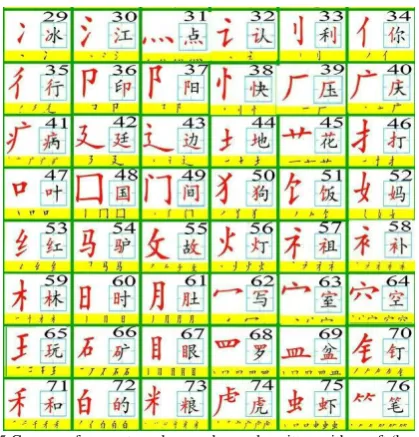
No.29, equal to (No.1 + No.14), called as two drops of water; the example word is bing (TL1), meaning ice. There is a word shui (TL 3, meaning water) at the right side (Figure 5). Ancient Chinese people regarded the two drops of (liquid) water contacting with water as bin (ice) when the temperature was below zero.
Figure 5 Common fragments and example words written with a soft (brush) pen
No.30, equal to (No.1 + No.1 + No.14), called as three drops of water; the example word is jiang (TL1, meaning river). Another word he (TL2) also means river, but shorter or narrower than jiang. The word at the right of jiang is gong (TL 1, meaning work). When a lot of work was done and much water appeared, it called as jiang or river, which thought to be finished by digging manually.
No.31, equal to (No.1 + No.1 + No.1+ No.1), called as four drops of water; the example word is dian (TL3), meaning dot. There is kou (TL3, meaning mouth) inside the word, which suggested that much saliva (4 drops of water) fell down out of mouth when speaking.
No.32, equal to (No.1 + No.17), called as speaking fragment; the example word is ren (TL4), usually accompanied with another word such as ren shi (TL4 and 2, meaning know) and bian ren (TL4 and 4, meaning identify or recognize). The word at the right side of ren (TL 4) is ren (TL 2, meaning person). If a person could speak near another person, it could be judged that the person know him (another person).
No.33, equal to (shorter No.3 + longer No.10), the example word is li (TL4), usually accompanied with another word such as li yong (TL4 and 4, meaning utilize), li yi (TL4 and 4, meaning benefit) and bian li (TL4 and 4, meaning convenience).
No.34, equal to (No.4 + No.3), called as single person fragment; the example word is ni (TL3), meaning you. The word at the right side is er (TL 3) which also means you in ancient Chinese language.
No.35, equal to (No.4 + No.4 + No.3), called as double person fragment; the example word is xing (TL2), meaning (it’s OK). Xing wei (TL2 and 2) means behavior and xing dong (TL2 and 4) means act or action.
No.36, equal to (No.8 + No.3), the example word is yin (TL4, means signet), yin shua (TL4 and 1, means print), yin xiang (TL4 and 4, means impression).
No.37, equal to (No.23 + No.3), the example word is yang (TL2), yang guang (TL2 and 1) means sunshine, tai yang (TL4 and 2) means sun.
No.39, equal to (No.2 + No.4), the example word is ya (TL1, means press).
No.40, equal to (No.1 + No.2 + No.4) or (No.39 + No.1), the example word is qing (TL4), qing he (TL4 and 4, meaning congratulate), qing zhu (TL4 and 1, meaning celebrate).
No.41, equal to (No.1 + No.2 + No.4 + No.1 + No.14) or (No.40 + No.1 + No.14), the example word is bing (TL4), meaning illness or sickness.
No.42, equal to (No.27 + No.5), the example word is ting (TL2), jia ting (TL1 and 2, means family or home), ting yuan (TL2 and 4, means courtyard).
No.43, equal to (No.1 + No.27 + No.5) or (No.1 + No.42), the example word is bian (TL1), bian yuan (TL1 and 3, means remote or far from the centre), bian yuan (TL1 and 2, means edge or margin).
No.44, equal to (No.2 + No.3 + No.14), called as soil fragment; the example word is di (TL4), tu di (TL3 and 4, means land), di qiu (TL3 and 2, means the earth or the globe), di li (TL3 and 3, means geographical features of a place), di zhu (TL3 and 3, means landlord).
No.45, equal to (No.2 + No.1 + No.4), called as grass fragment; the example word is hua (TL1), meaning flower. No.46, equal to (No.2 + No.10 + No.14), the example word is da (TL3), meaning beat.
No.47, equal to (No.3 + No.8 + No.2), called as mouth fragment; the example word is ye (TL4), shu ye (TL4 and 4, meaning tree leaf).
No.48, equal to (No.3 + No.8 + No.2), larger than No.47, called as country fragment; the example word is guo (TL2), guo jia (TL2 and 1, meaning country), zhong guo (TL1 and 2, meaning China).
No.49, equal to (No.1 + No.3 + No.11), called as door fragment; the example word is jian (TL1), shi jian (TL2 and 1, meaning time), fang jian (TL2 and 1, meaning room), jian duan (TL2 and 4, meaning be disconnected), jian xi (TL2 and 1, meaning gap).
No.50, equal to (No.4 + No.18 + No.4), the first No.4 is crossed with No.18, but the second only contacted. The example word is gou (TL3) and means dog.
No.51, equal to (No.4 + No.21 + No.16), the example word is fang (TL4), meaning cooked rice. A popular greeting sentence in China is ‘ni chi fang mei you’ (TL3, 1, 4, 2 and 3), directly meaning ‘Have you finished eating cooked rice?’ and indirectly meaning ‘How are you?’ or ‘How do you do?’.
No.52, equal to (No.15 + No.2 + No.4), called as female fragment; the example word is ma (TL1) and meaning mother.
No.53, equal to (No.25 + No.25 + No.14), called as silk fragment; the example word is hong (TL2) and means red color.
No.54, equal to (No.8 + No.12 + No.14), called as horse fragment; the example word is lv (TL2) and means donkey. No.55, equal to (No.4 + No.2 + No.4 + No.5), the example word is gu (TL4), gu shi (TL4 and 4) means story, gu xiang (TL4 and 1) means native place or hometown.
No.56, equal to (No.1 + No.4 + No.1 + No.1), called as fire fragment; the example word is deng (TL1) and means lamp.
No.57, equal to (No.1 + No.26 + No.3 + No.1), called as clothing fragment; the example word is zu (TL3), zu xian (TL3 and 1) means ancestor, zu guo (TL3 and 2) means mother country.
No.58, equal to (No.1 + No.26 + No.3 + No.15) or (No.57 + short No.4), the example word is bu (TL3), bu chong (TL3 and 1) means supplement, feng bu (TL2 and 3) means sew and mend.
No.59, equal to (No.2 + No.3 + No.4 + No.1), called as wood fragment; the example word is lin (TL2) and belongs to one of Chinese family names (or second names); sen lin (TL1 and 2) means forest.
No.60 equal to (No.3 + No.8 + No.2 + No.2), called as sun fragment; the example word is shi (TL2), shi jian (TL2 and 1) means time, shi ji (TL2 and 1) means an opportune moment.
No.61, equal to (No.4 + No.2 + No.10 + No.2 + No.2), called as moon fragment; the example word is du (TL3) and means stomach.
No.62, equal to (short No.4 + No.21), the example word is xie (TL3) and means write.
No.63, equal to (No.1 + short No.4 + No.21) or (No.1 + No.62), the example word is shi (TL2), shi nei (TL2 and 4) means indoor, shi wai (TL2 and 4) means outdoor, jiao shi (TL4 and 2) means classroom.
No.64, equal to (No.1 + short No.4 + No.21 + short No.4 + No.1) or (No.63 + short No.4 + No.1), the example word is kong (TL1) and means empty, kong jian (TL1 and 1) means space, kong qi (TL1 and 4) means air.
No.65, equal to (No.2 + No.2 + No.3 + No.2 or No.14), called as king fragment; the example word is wan (TL2) and means play, wan you xi (TL2, 2 and 4) means playing game.
No.66, equal to (No.2 + No.4 + No.47), called as stone fragment; the example word is kuang (TL4) and means ore. No.67, equal to (No.3 + No.8 + No.2 + No.2 + No.2) or (No.60 + No.2), called as eye fragment; the example word is yan (TL3) and means eye, yan guang (TL3 and 1) means eye light or foresight.
No.68, equal to (No.3 + No.8 + No.3 + No.3 + No.2), the example word is luo (TL2), which belongs to one of Chinese family names.
No.70, equal to (No.4 + No.2 + No.2 + No.2 + No.16), called as metal fragment; the example word is din (TL1) and means (iron) nail.
No.71, equal to (No.4 + No.2 + No.3 + No.4 + No.1), the example word is he (TL2), meaning and.
No.72, equal to (short No.4 + No.60), called as white color fragment; the example word is de (TL1), ni de (TL3 and 1) means your, wo de (TL3 and 1) means mine, ta de (TL1 and 1) means his, her or its.
No.73, equal to (No.1 + short No.4 + No.2 + No.3 + No.4 + No.1), called as uncooked rice (sounding mi-TL3) fragment; the example word is liang (TL2) and means grain.
No.74, equal to (short No.3 + short No.2 + No.21 + No.4 + No.2 + No.7), called as tiger fragment; the example word is fu (TL3) and means tiger.
No.75, equal to (No.47 + No.3 + No.2 + No.1), called as insect fragment; the example word is xia (TL1) and means shrimp.
No.76, equal to (short No.4 + short No.2 + No.1 + repeating previous 3 steps), called as bamboo fragment; the example word is bi (TL3) and means (writing) pen.
IV. CHARACTERISTICS OR REGULARITIES OF CHINESE WORDS
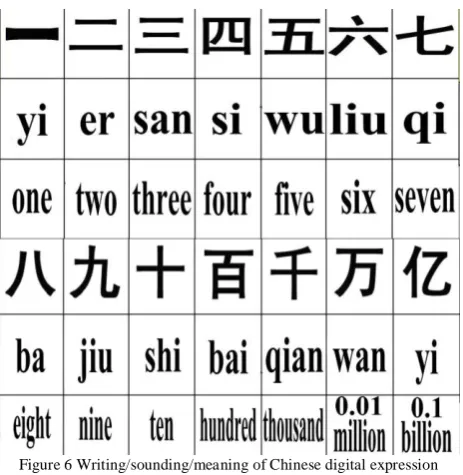
Chinese digital expression (Figure 6) is simpler than that of English. There are obviously regularities from shi (TL2, meaning ten) onwards for Chinese (shi plus cardinal numbers or cardinal numbers plus shi) whereas from thirteen onwards (-teen, -ty) for English. Week and month expression (Figure 7) are much easier than that of English. The first two words (xing qi, week) or the last word (yue, month) is the same, which is similar to week in English (-day), but the months are different.
Figure 6 Writing/sounding/meaning of Chinese digital expression
Figure 7 Expression of week and month in Chinese
Compared with English words, Chinese words or vocabularies are easy to be guessed and remembered, for example, niu (TL 2) means cattle, gong niu (TL 1and 2) means bull, mu niu (TL 3and 2) means cow, xiao niu (TL 3and 2) means calf, niu jiao (TL 2 and 3) means horn, niu rou (TL 2 and 4) means beef and niu nai (TL 2 and 3) means milk. There is a common word (niu) which the meaning must be related with cattle and can be guessed when the accompanied word is read (Figure 8). But no regularities can be found in the seven English words and have to be memorized mechanically.
Figure 8 Writing/sounding/meaning of Chinese words (A)
Chinese words initially evolved from pictures. Ren (TL 2, meaning person) and ma (TL 3, meaning horse) are two typical examples (Figure 9 and Figure 10). It reflected the ancient social form, social system or mode of production. For example, nan (TL 2, meaning man) is composed of tian (TL 2, meaning field) and li (TL 2, meaning physical strength). It consumed physical strength for ancient men to fell (trees), hunt and plant crops in a field. Fu (TL 4, meaning rich) and qiong (TL 2, meaning poor) showed that it was rich when there was a field in a family whereas poor when only physical strength in. Ren (TL 2, meaning person) was initially the shape of greeting someone and secondly the shape of two legs’ when walking, which suggested that there was no bicycle or car and had to go on foot. Cong (TL 2, meaning follow) was one person following another or two persons getting together. Zhong (TL 4, meaning the masses) was three persons getting together and one person (as a leader) heading (on upper side). Qiu (TL 2, meaning prisoner) referred to a person being closed in a box or all around walls (Figure 11).
Figure 10 Evolution procedures of ma (TL 3, meaning horse)
Figure 11 Writing/sounding/meaning of Chinese words (B)
Each Chinese word has a voice, some of them have meanings but others have not and should accompany with another word (s). There is relevance in most Chinese words. For example, bi (TL 3, fragment No.76 + stroke No. 4 + stroke No. 2 + stroke No. 2 + stroke No. 7) means (brush) pen, which is composed of bamboo fragment and (animal) hair (Figure 12). Lei (TL 2, meaning thunder) has yu (TL 3, meaning rain) at the upper side and tian (TL 2, meaning field) at the below side, which the ancient Chinese people thought that the huge voice was lei (thunder) when it was raining in a field. Sha (TL 1, meaning sand) has three drops of water at the left and shao (TL 3, meaning lack) at the right, the matter was sha (sand) when much water gradually disappeared or lacked. Mu (TL 4, meaning grazing) has niu (TL 2, meaning cattle) at the left and fragment No.55, meaning two hands crossed together) at the right. A person with two hands crossed together was following a cattle, it reflected that the animal was grazing. Wen (TL 2, meaning hear or smell) has er (TL 3, meaning ear) in men (TL 2, meaning door). When a person with his ear hided in a door, he was hearing somebody outside saying. When his ear was near to a cooking place indoor, he smelled the food in the pot. Wen (TL 4, meaning ask) has kou (TL 3, meaning mouth) in men (TL 2, meaning door). When a person got in a door and (opened his) mouth, he wanted to ask something. Men (TL 4, meaning depressed) has xin (TL 1, meaning heart) in men (TL 2, meaning door). When a person with his heart was in a door, he (heart) never went out door and he could be depressed because of frustration.
Figure 12 Writing/sounding/meaning of Chinese words (C)
Chinese words teaching always lagged behind phonetic teaching when teaching Chinese language to foreigners. Many of them remained stagnant in learning because of wrong or difficult writing (Wan Yexin, 2004). Chinese Phonetics and words were two tasks faced by foreigners. It should begin with basic and simple strokes of Chinese words (Wan Yexin, 2009). Characteristics of Chinese words could only be found by comparing with other country language. Difficult to write and remember could only be solved by analyzing the characteristics of Chinese words (Li Yunfu, 2014).
In this article, 28 basic strokes of Chinese words are firstly introduced. It is pointed out that the difficulty for foreigners to learn Chinese words is their grotesque shapes written by brush (soft) pen and printed in books. The special writing method with a hard pen and 8 directions moving steps are invented and firstly shown, which is easy for foreigners to try. The size (length) of strokes will guide them to control the proportion of a word. It could be changed according to paper size and how large they want to write. Secondly, 48 common fragments derived from 28 basic strokes are listed and the writing method described. It could help foreigners to separate and re-write unknown Chinese words and even guess out the meanings. Lastly, many characteristics or regularities of Chinese words will have great attraction for foreign language learners. Some Chinese cultures or amusing stories are also exposed in fragments and example words.
REFERENCES
[1] Chen Wei. (1993). A brief talk on the development of hard pen calligraphy. Journal of Jinan University, 2, 79-81. [2] Fu Yonghe. (1992). Strokes of Chinese words. Improvement of Chinese Language, 1, 8-10.
[3] He Xin. (2012). Historical investigation and contemporary thinking on writing tools of Chinese words. Journal of Qiqihar University -philosophy & social scienceedition, December, http://www. kreader. cnki.net (accessed 30/5/2017).
[4] Li Yunfu. (2014). Characteristics of Chinese words and teaching Chinese words to foreigners. World Chinese Language Teaching, 3, 356-357.
[5] Wan Yexin. (2004). From Chinese words research to Chinese words teaching. World Chinese Language Teaching, 2, 40-41. [6] Wan Yexin. (2009). A brief talk on the overall design of Chinese words teaching. Language Teaching and Research, 5, 59-60.
Baixin Wu was born in Changsha County, Hunan Province, China in 1963. He received his bachelor degree in animal husbandry from Hunan Agricultural University, China in 1985. He is currently an associate researcher in Hunan Institute of Animal Husbandry and Veterinary Medicine, Changsha, China.
His research interests include extension of animal scientific and traditional agricultural technology. He worked in USA (1993-1994) as a member of WFE (world farmers’ exchange). He taught animal scientific technology in English in Ethiopia (2001-2004) and Liberia (2005-2006) as an instructor and agricultural expert respectively. He also had a short period investigation in Sierra Leone, Republic of Congo, Mali and Kenya.
Mr. Wu’s representative articles entitled ‘Efficient ploughing or reclaiming tools applied in cropland preparation’, African Journal of Geo-Science Research, Vol. 4, No.3; ‘Better living facilities for African farmers’, African Journal of Science and Research, Vol. 5, No.4 (Zambia); ‘Manually produce clay-based housing materials in rural area’, Journal of Agricultural Science, Vol. 9, No.2 (Canada) expressed his sympathy and help to farmers in developing regions.
Dahui Huang was born in Qianyang County, Hunan Province, China in 1965. He received his master degree in extension of agriculture from Hunan Agricultural University, China in 2007. He is currently a chief trainer and vice dean in Longping High-Tech international Training College, Changsha, China.
His research interests include hybrid rice breeding, technology training, programme organization and coordination. As an expert in the field of hybrid rice, he worked in USA and Puerto Rico (1996-1999) , Sri Lanka, Indonesia, Thailand, Liberia, Uzbekistan, India, Egypt, Vietnam, Brunei, the Philippines, Burma, Bangladesh, Nigeria, Zambia, Brazil, Nepal, Congo, Ethiopia, Fiji, Vanuatu and East Timor 2000-2013.
On releasing a hybrid rice combination ‘Weiyou 647’, Mr. Huang won the Second Prize of Hunan Provincial Science and Technique Innovation in 2000.
Bojun Huang was born in Cili County, Hunan Province, China in 1964. He received his PH.D. degree in agroecology from Hunan Agricultural University, China in 2007. He is currently a senior agronomist and associate director in Foreign Economic Cooperation Center of Hunan Provincial Agricultural Committee, Changsha City, China.
His research interests include soil fertilizer and foreign economic cooperation. He worked in USA in 1996 as a member of WFE (world farmers’ exchange). He taught agricultural technology in English in Ethiopia (2001-2003) as an instructor.
Haifeng Yan was born in Taoyuan County, Hunan Province, China in 1969. He received his Ph.D. degree in animal genetics, breeding and reproduction from Hunan Agricultural University, China in 2009. He is currently a researcher in Hunan Institute of Animal Husbandry and Veterinary Medicine, Changsha, China.
His research interests include poultry reproduction and animal nutrition. He had been to Czech Pharmaceutical Research Institute and the basic biological research institute of Russian Academy of Sciences for 4 times.
Dr. Yan has published 60 articles so far, won 4 prizes of progress in science and technology and 5 invention patents.
Meizhen Zhu was born in Liuyang County, Hunan Province, China in 1965. She received her bachelor degree in highway and bridge engineering from Hunan University, China in 1998. She is currently a senior engineer and director of chief engineer office in Changsha Highway Bridge Construction Co., Ltd.
Her research interests include highway bridge construction, field management and Chinese words. She had served as general engineer and manager of the highway and municipal road engineering project for many times. She obtained national first class registered architect on the specialty of highway engineering and municipal engineering. She is also a registered cost engineer and certified safety engineer.
MS Zhu is a member of Hunan Provincial Traffic Association.
Gilles Perret was born in Montbrison, France in 1945. He graduated in agriculture engineering from National School of Agriculture in Bordeaux, France in 1968. He is now retired at home in France.
His research interests include genetic improvement of small ruminants (sheep). He had been engaged in a variety of breeding project evaluation in Algeria, Morocco, Tunisia, Greece and Portugal. He had been to Shandong (2012-2014), Gansu and Hunan (2015), Hunan (2016), China as an expert on sheep and goats production.