ARTIGO ORIGINAL
Parathyroid Hormone as a Predictor of
Post-Thyroidectomy Hipocalcemia: A
Prospective Evaluation of 100 Patients
Hormona Paratiróideia Como Factor Predictivo de Hipocalcemia Após
Tiroidectomia: Estudo Prospectivo em 100 Doentes
1. Serviço de Cirurgia B. Centro Hospitalar e Universitário de Coimbra. Coimbra. Portugal. 2. Departamento de Cirurgia. Faculdade de Medicina. Universidade de Coimbra. Coimbra. Portugal.
Autor correspondente: Fernando Melo. [email protected]
Recebido: 11 de Junho de 2014 - Aceite: 21 de Abril de 2015 | Copyright © Ordem dos Médicos 2015
Fernando MELO1, António BERNARDES1,2, Ana VELEZ1,2, Catarina CAMPOS DE MELO1, Fernando José DE OLIVEIRA1,2
Acta Med Port 2015 May-Jun;28(3):322-328
RESUMO
Introdução: A hipocalcemia é uma complicação frequente após tiroidectomia total e o principal motivo pelo internamento prolongado destes doentes.
Material e Métodos: Estudaram-se prospectivamente 112 doentes submetidos a tiroidectomia total ou restante entre Junho de 2012 e Novembro de 2013. Foram excluídos 12 casos por apresentarem alterações pré-operatórias da função da paratiróide. Doseou-se a paratormona e cálcio pré-operatórios, imediatamente após a cirurgia, no primeiro dia e no 14º dia após a cirurgia.
Resultados: Dos 100 doentes incluídos 60 desenvolveram hipocalcemia (60%), revelando-se sintomática em 14. Surgiu, maioritari-amente, 24 horas após a cirurgia (76,7%). Foi definitiva em três doentes e transitória nos restantes. Nos 60 doentes com hipocalcemia, verificou-se hipoparatiroidismo em 19 doentes no doseamento imediatamente após a cirurgia, 14 no doseamento no primeiro dia mas apenas três mantiveram hipoparatiroidismo após 14 dias (doentes com hipocalcemia definitiva). Comparando o grupo de doentes com e sem hipocalcemia constatou-se uma diminuição da paratormona em ambos (imediatamente após a cirurgia e no primeiro dia) mas foi mais importante no grupo com hipocalcemia (p = 0,004 e p < 0,001). O decréscimo da paratormona foi mais acentuado no grupo com hipocalcemia, com maior significado no primeiro dia (50,29% vs 22,47% - p < 0,001). O melhor factor preditivo de hipocalcemia identificado foi o decréscimo da paratormona no primeiro dia após a cirurgia > 19,4% (sensibilidade = 82%; especificidade = 63%).
Discussão: No nosso estudo verificou-se uma incidência elevada de hipocalcemia (60%), que se manifestou maioritariamente 24 horas após a cirurgia e que condicionou, nesses doentes, um tempo de internamento mais prolongado. No entanto, em apenas três doentes (3%) a hipocalcemia foi definitiva. Constatou-se ainda uma correspondência na oscilação dos valores séricos do cálcio e da paratormona que permitiu identificar o decréscimo da paratormona no primeiro dia após a cirurgia como um fiável factor predictivo de hipocalcemia.
Conclusão: O decréscimo da paratormona no primeiro dia após a cirurgia > 19,4% é um bom factor preditivo de hipocalcemia após tiroidectomia total/restante, permitindo identificar os doentes com maior risco, medicá-los profilaticamente e obter altas precoces e seguras.
Palavras-chave: Hipocalcemia; Paratormona; Período Pós-Operatório; Tiroidectomia.
ABSTRACT
Introduction: Hypocalcemia is a frequent complication after total thyroidectomy and the main reason for prolonged hospitalization of these patients.
Material and Methods: We studied prospectively 112 patients who underwent total or completation thyroidectomy between June 2012 and November 2013. Twelve patients with preoperative changes in parathyroid function were excluded. Parathyroid hormone and calcium levels were determined pre-operatively, immediately after surgery, on 1st day and on 14th day after surgery.
Results: Of the 100 patients enrolled, 60 have developed hypocalcaemia (60%) but only 14 patients had symptomatic hypocalcaemia. It mostly occurs 24 hours after surgery (76.7%). It was permanent in 3 patients and temporary in the others. In the 60 patients with hypocalcaemia, it has been found hypoparathyroidism in 19 patients immediately after surgery, in 14 patients on 1st day but only 3 had
hypoparathyroidism (patients with permanent hypocalcaemia). Comparing the group of patients with and without hypocalcaemia we found a decrease of parathyroid hormone in both (immediately after surgery and on 1st day) but was more important in the hypocalcaemia
group (p = 0.004 and p < 0.001). The decrease of PTH levels was more pronounced in the hypocalcaemia group, with significance on the first day (22.29% vs 50.29%, p < 0.001). The best predictor of hypocalcaemia identified was the decrease of parathyroid hormone levels > 19.4% determined on the 1st day (sensitivity = 82%; specificity = 63%).
Discussion: In our study there was a high incidence of hypocalcemia (60%), expressed predominantly 24 hours after surgery and conditioned, in these patients, a longer hospital stay. However, only 3 patients (3%) had permanent hypocalcemia. We still found a match in the oscillation of serum calcium levels and parathyroid hormone which identified the decrease in parathyroid hormone on the first day after surgery as a reliable predictor of hypocalcemia.
Conclusion: Decrease of parathyroid hormone levels > 19.4% determined on 1st day is a good predictor of hypocalcemia after total /
completation thyroidectomy, allowing to identify patients at higher risk of hypocalcemia, medicate them prophylactically and get early and safe discharges.
ARTIGO ORIGINAL INTRODUCTION
Hypocalcaemia (HPC) is one of the most frequent complications after total thyroidectomy.1-8 Its incidence varies between 20 to 50%2,4,10,11 and despite its multifactorial aetiology, most cases are associated to secondary hypoparathyroidism related to excision, injury or parathyroid gland iatrogenic de-vascularization during surgery.2
Post-thyroidectomy HPC is usually temporary, a permanent disorder occurring in 2% of patients.3,4
Unlike other post-thyroidectomy complications occurring on the first 24 hours (vocal cord paralysis, laryngeal oedema, bruising), HPC typically occurs between 24 to 48 hours after surgery.2 This delayed manifestation, found in patients who undergo total thyroidectomy, is the major cause for longer hospital stays, allowing for blood calcium concentrations and possible clinical manifestations of HPC to be monitored.2 Many strategies are followed in the diagnosis and treatment of HPC. The traditional method includes serial blood calcium determinations in the first 48 hours after surgery, still used in several hospitals worlwide,5-7 including ours. Some recommend routine oral calcium and vitamin D supplementation in patients who undergo total thyroidectomy, allowing for short-term hospital stays and minimizing the risk of HPC upon discharge.8 In the last few years, some studies have actually suggested parathyroid hormone (PTH) determination upon thyroidectomy as a predictive factor of the risk of HPC.1,2,9-12,23-30 This test may have an important role in the identification of patients at a higher risk of post-thyroidectomy HPC and therefore assisting the surgeon’s decision regarding the need to maintain hospital monitoring or instead, to use a calcium + vitamin D supplementation according to short-term blood calcium monitoring (< 24 hours upon surgery).13
Different protocols of PTH assessment as a HPC predictive factor post thyroidectomy have been described. Beyond pre-surgery determination of patient’s basal level, different post-surgery assessments are used: immediately upon surgery, six-hour, 24-hour and even 48-hours postsurgery.14 Regardless of the time of PTH determination, its concentration or decrease from basal level have both been shown to be as good for predicting HPC after total/ remnant thyroidectomy.14
MATERIAL AND METHODS
This was a prospective study involving all patients submitted to total (TT) or remnant (RT) thyroidectomy
between June 2012 and November 2013 at the Surgical Department B of the Centro Hospitalar e Universitário de Coimbra. Patients presenting with any pre-operative parathyroid gland disorder, chronic kidney failure (serum creatinine > 2 mg/dl or creatinine clearance < 40 ml/ min) or any disease/therapy interfering with calcium homeostasis were excluded. From the 112 patients that were assessed, 12 were excluded due to the presence of one of the abovementioned exclusion criteria. The 100 patients included in the study (88 females) had on average 47.9 years of age (range: 24-80). Most patients underwent total thyroidectomy (87%) and the presence of multinodular goitre was the most frequent surgical indication (45%). Other surgical indications included the presence of thyroid nodules with follicular (20%) or papillary carcinoma (22%) cytology. Patients who underwent remnant thyroidectomy related to thyroid carcinomas found in previous lobectomies (13%) were also included, as the risk of HPC and hypoparathyroidism (HPT) in these patients overlaps the risk of patients who underwent total thyroidectomy. On average three parathyroid glands (minimum 1; maximum 4) were identified during surgery. Parathyroid glands (subcapsular or intra-parenchymal) were identified in eight patient’s pathological specimens.
Patient’s pre-operative basal PTH and blood calcium levels were obtained together with immediate post-operative PTH levels (PTH0), as well as calcium concentrations six-hours, on the first and 14th day (PTH1, PTH14) post-surgery. Phosphate and magnesium levels were also obtained together with calcium levels due to the importance of these two ions on calcium homeostasis (Table 1). The proportional immediate post-surgical decrease in PTH levels (PTH0) and on the first post-operative day (PTH1) were calculated using the formula: (pre-op PTH – post-op PTH) x 100 /pre-op PTH).
PTH levels were obtained by use of immunochemical luminescent assay labelled with acridine ester – CENTAUR (Siemens).
HPC and HPT were considered when blood calcium and serum PTH levels were below 8.8 mg/dL and 9 pg/ mL, respectively. Phosphate levels between 2.5 – 4.5 mg/ dL and magnesium levels between 1.8-2.5 mg/dL were considered as normal. Transitory HPC was considered when it resolved within 12 months upon surgery, with no need for oral calcium supplementation to be maintained. Table 1- Lab-tests included in our study
Pre-operative PTH, Calcium, Phosphate, Magnesium
Upon surgery PTH
6-hours post-surgery Calcium, Phosphate, Magnesium
1st POD PTH, Calcium, Phosphate, Magnesium
14th POD PTH, Calcium, Phosphate, Magnesium
ARTIGO ORIGINAL HPC was considered permanent when it persisted after 12 months, requiring oral calcium supplementation. Statistical analysis used SPSS version 20.0 software. Comparison between groups – patients with HPC vs.
patients with normocalcaemia (NC) – was established using the Mann-Whitney’s, Student’s t, U and chi-square tests. A level of significance of p< 0.05 was established. Areas under the ROC (receiver operating characteristic) curves were estimated in order to calculate the predictive power of PTH measurement.
RESULTS
From the 100 patients that underwent TT or RT, 60 developed HPC (60%). However, HPC was symptomatic in only 14 patients (14/60 or 23.3%) with the need for calcium and vitamin D supplementation. Blood calcium levels remained normal during the entire post-operative period in 40 of the 100 patients.
A 2.67 post-operative days (POD) average hospital stay was found in the 100 patients and was higher in the HPC group (2.93 POD vs. 2.27 POD). A 4.21 POD hospital stay for symptomatic HPC patients was also found, significantly higher than in the remaining patients.
All the 100 patients showed a decreased calcium level both at 6-hours post-surgery and on the first day upon surgery, although the latter was higher in HPC patients (p
< 0.001) (Table 2). HPC was found, in most patients, 24 hours upon surgery (76.7%) and was transitory in almost all patients – 97% (confirmed on the 14th POD), with only
three patients presenting with definitive HPC (confirmed on the 14th POD and on the 6th and 12th month upon surgery), requiring sustained calcium and vitamin D supplementation after the 14th POD.
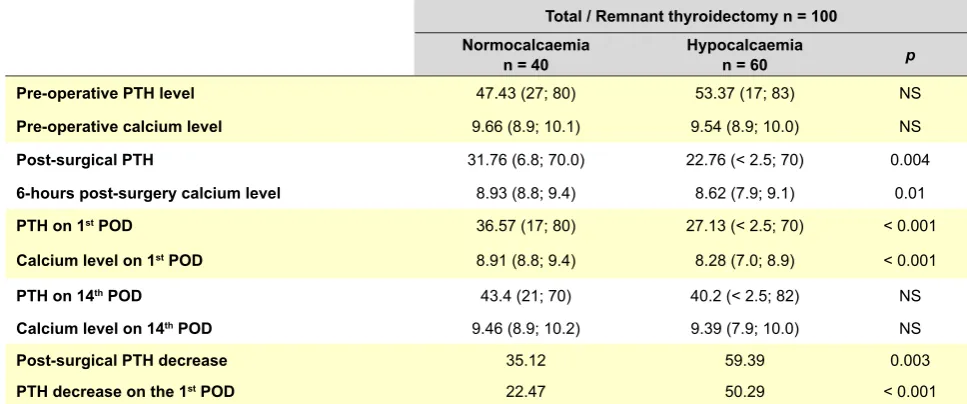
As regards phosphate and magnesium monitoring, an inversely proportional relationship was found between phosphate and calcium levels and the highest phosphate levels were found in the HPC group of patients [HPC group: phosphate = 4.2 mg/dL (3.3 – 5.7) versus NC group: phosphate = 3.5 mg/dL (2.6 – 4.4), p = 0.24]; magnesium levels remained within the normal range, with no statistically significant differences between NC [magnesium = 2.1 mg/ dL (1.8 – 2.4)] and HPC groups [magnesium = 2.2 mg/dL (1.8 – 2.5)]. When comparing HPC (n = 60) to NC patients (n = 40), a reduction in serum PTH levels was found in both (in immediate post-surgery as in 24-hour upon surgery). This reduction was higher in the HPC group (p = 0.004 and p <
0.001 respectively) (Table 3). Only three patients were found with HPT on the 14th POD determination, corresponding to the patients with definitive HPC. A new PTH determination was obtained at the 6th and the 12th month upon surgery in these three patients and remained below normal levels, therefore confirming definitive HPT (Fig. 1).
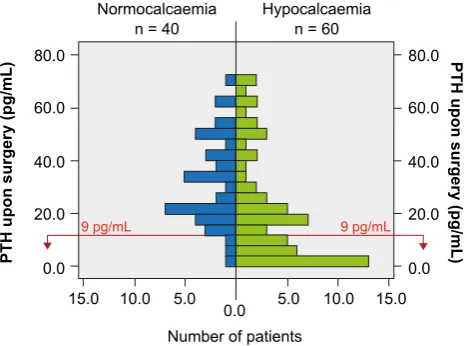
The presence of HPT was found in 19 patients in the immediate post-surgical determination in HPC patients (n = 60). Only 14 maintained PTH levels below 9 pg/mL after the first 24-hours (corresponding to the 14 patients with symptomatic HPC that needed calcium and vitamin D outpatient supplementation) (Fig. 1 and 2). However,
Table 2 - Patients with definitive HPC
Patient 1 Patient 2 Patient 3
Nº Parathyroid glands identified during surgery 2 2 2
Nº Parathyroid identified in pathological examination 1 1 2
Table 3 - Average PTH and blood calcium levels in the 100 patients submitted to total or remnant thyroidectomy
Total / Remnant thyroidectomy n = 100 Normocalcaemia
n = 40 Hypocalcaemian = 60 p
Pre-operative PTH level 47.43 (27; 80) 53.37 (17; 83) NS
Pre-operative calcium level 9.66 (8.9; 10.1) 9.54 (8.9; 10.0) NS
Post-surgical PTH 31.76 (6.8; 70.0) 22.76 (< 2.5; 70) 0.004
6-hours post-surgery calcium level 8.93 (8.8; 9.4) 8.62 (7.9; 9.1) 0.01
PTH on 1st POD 36.57 (17; 80) 27.13 (< 2.5; 70) < 0.001
Calcium level on 1st POD 8.91 (8.8; 9.4) 8.28 (7.0; 8.9) < 0.001
PTH on 14th POD 43.4 (21; 70) 40.2 (< 2.5; 82) NS
Calcium level on 14th POD 9.46 (8.9; 10.2) 9.39 (7.9; 10.0) NS
Post-surgical PTH decrease 35.12 59.39 0.003
PTH decrease on the 1st POD 22.47 50.29 < 0.001
ARTIGO ORIGINAL
0.0 0.0
0.0 0.0
only three patients presented with HPC on the 14th day determination and needed to maintain a calcium and vitamin D supplementation (Fig. 1). The presence of parathyroid glands in the pathological examination of thyroidectomy surgical samples was found in these three patient (Table 2). Only three NC patients (n = 40) presented with PTH levels below 9 pg/mL on the immediate post-surgical determination and were normal on the first POD. None of these patients had PTH levels below the normal range on the 14th POD (Fig 1, 2 and 3).
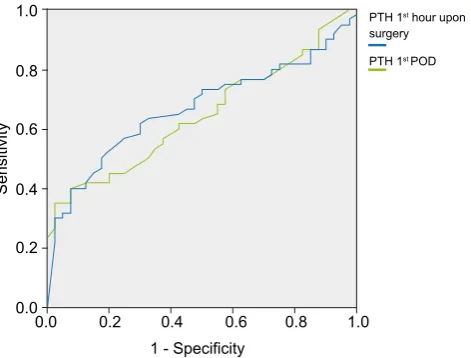
When comparing PTH decrease between both groups, we found that these were higher in the HPC group, more significantly as regards the values obtained on the first day upon surgery (50.29% vs. 22.47% - p < 0.001 ) (Table 3). The ROC curves regarding the absolute value of PTH0, PTH1, PTH0 decrease and PTH1 decrease showed that only the PTH1 decrease curve had an AUC (0.853) allowing for a good predictive power (Fig. 4 and 5).
The best HPC predictive factor (best relationship between sensitivity and specificity) upon analysing the ROC curves was a PTH1 reduction with an area above the ROC curve above 19.4% (sensitivity = 83% and specificity = 63%). The post-operative PTH absolute value (PTH0 or PTH1), according to our analysis, did not show a good predictive value (AUC of 0.669 and 0,649, respectively). The impact of pre-operative diagnosis (benign vs.
malignant), surgeon’s experience (specialist vs. resident) and the number of parathyroid glands found during surgery (≤ 2 vs. > 2 glands) on HPC’s incidence was also analysed. No statistically significant differences were found (p = 0.22,
p = 0.515 and p = 0.28 respectively).
DISCUSSION
The importance of parathyroid glands and their vulnerability during thyroid’s surgery has been recognized since the end of the XIX century. When all parathyroid
glands are put at risk, as in total or remnant thyroidectomy, patients may develop transitory or permanent HPT with HPC. Despite a careful and thorough surgical technique, parathyroid glands may be removed or de-vascularized during surgery.15,16 This is even more serious with non-negligible frequent anatomical variations, namely an ectopic, subcapsular or intra-thyroid location. The incidence of post-thyroidectomy temporary or permanent HPC is considerably variable and may reach high percentage (20 – 50%). 2-4,10,11,22-29 Its real incidence may be underestimated as prophylactic calcium administration is a common practice in many healthcare centres for all patients, in order to allow for early hospital discharges.1 Despite this variability in incidence, HPC is the most usual complication upon thyroidectomy1,17 and one the main reasons for the long hospital stay of these patients. As it is not an immediate manifestation (it usually occurs 24-48 hours upon surgery)2,22-27 clinical and analytical monitoring is required, increasing the hospital Figure 1 – Distribution of the 100 patients according to PTH values
obtained on the 14th post-operative day Figure 2determination obtained on the 1 – Distribution of the 100 patients according to PTH level st post-operative day
100.0 100.0 80.0 80.0 80.0 80.0 60.0 60.0 60.0 60.0
40.0 40.0 40.0 40.0
20.0 20.0 20.0 20.0
9 pg/mL 9 pg/mL 9 pg/mL 9 pg/mL
0.0 0.0
2.0
2.0 4.0 5.0 5.0
4.0 6.0 10.0 10.0
6.0
Normocalcaemia
n = 40 Normocalcaemian = 40
Number of patients Number of patients
PTH14 – 14
th POD (pg/mL)
PTH1 – 1
st POD (pg/mL)
PTH14 – 14
th
POD (pg/mL)
PTH1 – 1
st
POD (pg/mL)
Hypocalcaemia
n = 60 Hypocalcaemian = 60
8.0
8.0 15.0 15.0
0.0
0.0
Figure 3– Distribution of the 100 patients according to PTH level determination obtained upon surgery
80.0 80.0
60.0 60.0
40.0 40.0
20.0 20.0
9 pg/mL 9 pg/mL
0.0
5.0 5.0
10.0 10.0
Normocalcaemia n = 40
Number of patients
PTH upon surgery (pg/mL)
PTH upon surgery (pg/mL)
Hypocalcaemia n = 60
ARTIGO ORIGINAL
Figure 4 – ROC-curves regarding the absolute values of PTH levels
obtained upon surgery and on the 1st POD Figure 5and on the 1 – ROC-curves regarding PTH level decrease after surgery st POD
stay. As costs of each hospital day are significant to hospital budgets, the use of procedures allowing for early and safe clinical discharges become an important contribution to the aim of the current study.
Our study showed a high incidence of HPC – 60%. However, only 14 from the 100 patients involved in the study presented with symptomatic HPC and the need for calcium and vitamin D supplementation during the hospital stay and upon discharge. The clinical and analytical control carried out on the 14th POD showed that only three patients still had HPC secondary to HPT, those in whom oral calcium and vitamin D therapy were maintained. The first-year follow-up of these three patients showed the persistence of HPC and HPT, corresponding to a 3% rate of definitive HPC/HPT, close to the values obtained in other clinical series.3,4 The phosphate and magnesium monitoring taken simultaneously with calcium levels was not relevant in our study. The phosphate levels followed an expected progression, i.e. increased in the patients with HPC and normalized when calcium returned back to normal. The magnesium levels were maintained within the normal range in all the patients and therefore did not influence the calcium levels.
The average global time of hospital stay was 2.67 POD, longer in HPC patients (2.93 POD vs. 2.27 POD in NC patients), mainly when HPC was symptomatic (4.21 POD in patients with symptomatic HPC). These data support the importance of HPC in estimating the time of hospital stay of patients who undergo total/remnant thyroidectomy.22,23,26 Some authors recommend the prophylactic supplementation with calcium and vitamin D in all patients submitted to total or remnant thyroidectomy, in order to insure early and safe hospital discharges.8,13 Despite being a safe strategy with a good cost-benefit relationship, as shown in the study by Michel Singer et al.,13 some experts raised concerns regarding the high number of patients who
are unnecessarily treated and therefore exposed to the risk, even theoretical, of constipation, kidney stones and changes in iron and zinc absorption.1,13
Recommendations differ as regards the use of PTH determinations as HPC predictive, allowing for the identification of patients at higher risk of HPC, who require prophylactic treatment with calcium, aiming for early and safe discharge1,2,9-12,22-29 This strategy is based on the fact that transitory or definitive HPT is the major factor for HPC after thyroidectomy, as shown in the study by Lindblom et al.12
Several studies with different protocols have been published but all aimed to assess PTH as predictive factor of HPC upon thyroidectomy. The timing of PTH measurements varies between the studies. Those by Grodski and Serpell found that PTH determination may be obtained at any moment from 10 minutes to several hours upon surgery, with results similarly accurate for predicting HPC (Level C recommendation).2,3
Our study aimed to assess the predictive power of PTH concentration or its reduction to predict HPC upon total or remnant thyroidectomy, as well as to determine the most efficient or predictive timing for the assay. In our analysis we were not able to determine an absolute PTH value, with a good HPC predictive power, both immediately post-surgery or on the first POD. This was related to the variability in PTH levels in the group of HPC patients. However, we found that a PTH reduction above 19.4% is a good HPC predictive factor upon total or remnant thyroidectomy, especially when obtained on the first day after surgery (area under the ROC curve 0.853 – Sensitivity = 82% and Specificity = 63%). We believe that a larger group of patients would allow for an improvement in sensitivity and specificity of the value of PTH decrease, as well as for establishing an absolute PTH level predictive of HPC.
Published studies have shown a relationship between
0.0 0.00.0
0.0
0.2 0.2
0.4 0.4
0.6 0.6
0.8 0.8
1.0 1.0
0.2 0.4 0.6 0.8 1.0 0.2 0.4 0.6 0.8 1.0
Sensitivity Sensitivity
1 - Specificity 1 - Specificity
PTH 1st hour upon
surgery 1st day decrease, %
ARTIGO ORIGINAL
a lower morbidity after thyroidectomy, according to the surgeon’s expertise and specialized training.14 However, we were not able to find any statistically significant differences in HPC’s incidence between patients operated by a specialist vs. a resident general surgeon. We should point out that in our centre, although the main surgeon in several surgeries was a resident and therefore with lower surgical experience, he was always supervised and actively assisted by an experienced surgeon, which may have explained this unexpected result.
We found several factors associated to a higher risk of HPC as previously described. Two factors frequently identified are a pre-operative diagnosis of malignancy and the number of parathyroid glands identified during surgery.19-21 These factors had no influence in the incidence of HPC in our study.
CONCLUSION
PTH determination in patients submitted to total or remnant thyroidectomy, especially the value of PTH reduction observed on the first day upon surgery plays a useful role as it allows for the identification of patients at a higher risk of HPC, for prophylactic treatment and for early and safe discharge thereby reducing a patient’s hospital stay.
HUMAN AND ANIMAL PROTECTION
The authors declare that the followed procedures were according to the regulations established by the responsible body of the Ethics and Clinical Research Committee and according to the Helsinki Declaration of the World Medical Association.
DATA CONFIDENTIALITY
The authors declare that they have followed the protocols of their work centre on the publication of patient data.
CONFLICTS OF INTEREST
The authors declare that there were no conflicts of interest in writing this manuscript.
FINANCIAL SUPPORT
The authors declare that there were no financial support in writing this manuscript.
REFERENCES
1. Alia P, Moreno P, Rigo R, Francos JM, Navarro MA: Postresection parathyroid hormone and parathyroid hormone decline accurately predict hypocalcemia after thyroidectomy. Am J Clin Pathol. 2007;127:592-97. 2. Del Rio L, Castro A, Bernaldez R, Del Palácio A, Giraldez CV, Lecumberri
B, et al. Parathyroid hormone as a predictor of post-thyroidectomy hypocalcemia, Acta Otorrinolaringol Esp. 2011;62:265-73.
3. Grodski S, Serpell J. Evidence for the role of perioperative PTH measurement after total thyroidectomy as a predictor of hypocalcemia. World J Surg. 2008;32:1367-73.
4. Roh JL, Park CI. Intraoperative parathyroid hormone assay for management of patients undergoing total thyroidectomy. Head Neck. 2006;28:990-7.
5. Fahmy FF, Gillett D, Lolen Y, Shotton JC. Management of serum calcium levels in post-thyroidectomy patients. Clin Otolaryngol Allied Sci. 2004;29:735-9.
6. Husein M, Hier MP, Al-Abdulhadi K, Black M. Predicting calcium status post thyroidectomy with early calcium levels. Otolaryngol Head Neck Surg. 2002;127:289-93.
7. Nahas ZS, Farrag TY, Lin FR, Belin RM, Tufano RP. A safe and cost-effective short hospital stay protocol to identify patients at low risk for the development of significant hypocalcemia after total thyroidectomy. Laryngoscope. 2006;116:906-10.
8. Grodski S, Serpell J. Evidence for the role of perioperative PTH measurement after total thyroidectomy as a predictor of hypocalcemia. World J Surg. 2008;32:1367-73.
9. Lombardi CP, Raffaelli M, Princi P, Dobrinja C, Carrozza C, Di Stasio E, et al. Parathyroid hormone levels 4 hours after surgery do not accurately predict post-thyroidectomy hypocalcemia. Surgery. 2006;140:1016-23. 10. Payne RJ, Hier MP, Cote V, Tamilia M, MacNamara E, Black MJ.
Postoperative parathyroid hormone levels in conjunction with corrected calcium values as a predictor of post-thyroidectomy hypocalcemia: review of outcomes 1 year after the implemen- tation of a new protocol. J Otolaryngol. 2005;34:323-7.
11. Scurry Jr WC, Beus KS, Hollenbeak CS, Stack Jr BC. Perioperative parathyroid hormone assay for diagnosis and management of post-thyroidectomy hypocalcemia. Laryngoscope. 2005;115:1362-6. 12. Lindblom P, Westerdahl J, Bergenfelz A. Low parathyroid hormone
levels after thyroid surgery: a feasible predictor of hypocalcemia. Surgery. 2002;131:515-20.
13. Singer MC, Bhakta D, Seybt MW, Terris DJ. Calcium management after thyroidectomy: a simple and cost-effective method. Otolaryngol Head Neck Surg. 2012;146:362.
14. Noordzij JP, Lee SL, Bernet VJ, Payne RJ, Cohen SM, McLeod IK, et al. Early prediction of hypocalcemia after thyroidectomy using parathyroid hormone: an analysis of pooled individual patient data from nine observational studies. J Am Coll Surg. 2007;205:748-54.
15. Mehanna HM, Jain A, Randeva H, Watkinson J, Shaha A. Post-operative hypocalcemia — the difference a definition makes. Head Neck. 2010;32:279-83.
16. Pisaniello D, Parmeggiani D, Piatto A, Avenia N, d’Ajello M, Monacelli M, et al. Which therapy to prevent post-thyroidectomy hypocalcemia? G Chir. 2005;26:357-61.
17. Bergamaschi R, Becouarn G, Ronceray J, Arnaud JP. Morbidity of thyroid surgery. Am J Surg. 1998;176:71-5.
18. Ganzález-Sánchez C, Franch-Arcas G, Gómez-Alonso A. Morbidity following thyroid surgery: does surgeon volume matter? Langenbecks Arch Surg. 2013;398:419-22.
19. Sousa AA, Salles JM, Soares JM, Carvalho JR, Savassi-Rocha PR. Predictors factors for post-thyroidectomy hypocalcemia. Rev Col Bras Cir. 2012;39:476-82.
20. Ali S, Yu C, Palmer FL, Ganly I, Shaha A, Shah JP, et al. Nomogram to aid selection of patients for short-stay thyroidectomy based on risk of postoperative hypocalcemia. Arch Otolaryngol Head Neck Surg. 2011;137:1154-60.
21. Sheahan P, Mehanna R, Basheeth N, Murphy MS. Is sistematic identification of all four parathyroid glans necessary during total thyroidectomy?: A prospective study. Laryngoscope. 2013;123:2324-8. 22. Raffaelli M, Crea C, Carrozza C, D’Amato G, Zuppi C, Bellantone R,
et al. Combining early postoperative parathyroid hormome and serum calcium levels allows for an efficacious selective post-thyroidectomy supplementation treatment. World J Surg. 2012;36:1307-13.
ARTIGO ORIGINAL
24. Le TN, Kerr PD, Sutherland DE, Lambert P. Validation of 1-hour post-thyroidectomy parathyroid hormone level in predicting hypocalcemia. J Otolaryngol Head Neck Surg. 2014;43:5.
25. Cayo AK, Yen TW, Misustin SM, Wall K, Wilson SD, Evans DB, et al. Predicting the need for calcium and calcitriol supplementation after total thyroidectomy: results of a prospective, randomized study. Surg. 2012;152:1059-67.
26. Chapman DB, French CC, Leng X, Dale Brown J, Waltonen JD, Sullivan CA. Parathyroide hormone early percent change: an individualized approach to predict postthyroidectomy hypocalcemia. Am J Otolaryngol
Head Neck Med Surg. 2012;33:216-20.
27. Lecerf P, Orry D, Perrodeau E, Lhommet C, Charretier CC, Mor C, et al. Parathyroid hormone decline 4 hours after total thyroidectomy accurately predicts hypocalcemia. Surg. 2012;152:863-8.
28. Kim JH, Chung MK, Son YS. Reliable early prediction for different types of post-thyroidectomy hypocalcemia. Clin Experim Otorhinol. 2011;4:95-100.
Fernando MELO, António BERNARDES, Ana VELEZ, Catarina CAMPOS DE MELO, Fernando José DE OLIVEIRA