Volume 30 (2010)
International Colloquium on Graph and Model
Transformation - On the occasion of the 65th birthday of
Hartmut Ehrig
(GraMoT 2010)
Towards Theorem Proving Graph Grammars using Event-B
Leila Ribeiro, Fernando Luís Dotti, Simone André da Costa and Fabiane Cristine Dillenburg
16 pages
Guest Editors: Claudia Ermel, Hartmut Ehrig, Fernando Orejas, Gabriele Taentzer Managing Editors: Tiziana Margaria, Julia Padberg, Gabriele Taentzer
Towards Theorem Proving Graph Grammars using Event-B
∗Leila Ribeiro1, Fernando Luís Dotti2, Simone André da Costa3and Fabiane Cristine Dillenburg4
1[email protected] 4[email protected]
Instituto de Informática
Universidade Federal do Rio Grande do Sul, Brazil
Faculdade de Informática
Pontifícia Universidade Católica do Rio Grande do Sul, Brazil
Institudo de Física e Matermática Universidade Federal de Pelotas, Brazil
Abstract: Graph grammars may be used as specification technique for different kinds of systems, specially in situations in which states are complex structures that can be adequately modeled as graphs (possibly with an attribute data part) and in which the behavior involves a large amount of parallelism and can be described as reactions to stimuli that can be observed in the state of the system. The verification of properties of such systems is a difficult task due to many aspects: the systems in many situations involve an infinite number of states; states themselves are complex and large; there are a number of different computation possibilities due to the fact that rule applications may occur in parallel. There are already some approaches to verification of graph grammars based on model checking, but in these cases only finite state systems can be analyzed. Other approaches propose over- and/or under-approximations of the state-space, but in this case it is not possible to check arbitrary properties. In this work, we propose to use the Event-B formal method and its the-orem proving tools to analyze graph grammars. We show that a graph grammar can be translated into an Event-B specification preserving its semantics, such that one can use several theorem provers available for Event-B to analyze the reachable states of the original graph grammar. The translation is based on a relational definition of graph grammars, that was shown to be equivalent to the Single-Pushout approach to graph grammars.
Keywords:Graph Grammars, Theorem Proving, Event-B
1
Introduction
Graph grammars [Ehr79,Roz97] are a formal description technique suitable for the specification of distributed and reactive systems. The basic idea of this formalism is to model the states of a system as graphs and describe the possible state changes as rules (where the left- and right-hand sides are graphs). The operational behavior of the system is expressed via applications of these rules to graphs depicting the current states of the system. Graph grammars are appealing as specification formalism because they are formal and based on simple, but powerful, concepts to describe behavior. At the same time they also have a nice graphical layout that helps even non-theoreticians to understand a specification. At the same time they also have a nice graphical layout that helps even non-theoreticians to understand a specification.
The verification of graph grammar models through model-checking is currently supported by various approaches. Although model checking is an important analysis method, it has as disadvantage the need to build the complete state space, which can lead to the state explosion problem. Much progress has been made to deal with this difficulty, and a lot of techniques have increased the size of the systems that could be verified [CGJ+01]. Baldan and König proposed [BK02] approximating the behavior of (infinite-state) graph transformation systems by a chain of finite under- or over- approximations, at a specific level of accuracy of the full unfolding [BCMR07] of the system. However, as [DHR+07] emphasizes, these approaches that derive the model as approximations can result in inconclusive error/verification reports.
Besides model checking, theorem proving [RV01, CW96] is another well-established ap-proach used to analyze systems. Theorem proving is a technique where both the system and its desired properties are expressed as formulas in some mathematical logic. A logical descrip-tion defines the system, establishing a set of axioms and inference rules. The verificadescrip-tion process consists in finding a proof of the required property from the axioms or intermediary lemmas of the system. In contrast to model checking, theorem proving can deal directly with infinite state spaces and it relies on techniques such as structural induction to construct proofs over infinite domains. The use of this technique may require interaction with a human; however, via this interactive process the user often gains very useful perceptions into the system or the property being proved.
Each verification technique has arguments for and against its use, but we can say that model-checking and theorem proving are complementary. Most of the existing approaches use model checkers to analyze properties of computations, that is, properties over the sequences of steps a system may engage in. Properties about reachable states are handled, if at all possible, only in restricted ways. In this work, our main aim is to provide a means to prove properties of reachable graphs using the theorem proving technique.
In previous work [CR09a] we proposed a relational approach to graph grammars, providing an encoding of graphs and rules into relations. This enabled the use of logic formulas to express properties of reachable states of a graph grammar. This encoding was shown to be equivalent to the Single-Pushout approach to graph grammars, and was inspired by Courcelle’s research about logic and graphs [Cou97].
in monadic second-order logic is proposed. However, these works are not particularly interested in effectively verifying the properties of graph transformation systems (GTSs). Since theorem provers, in general, works efficiently with specifications in relational style, we extended the re-lational representation of graphs to graph grammar models and use such representation for the formal analysis of reactive systems through the theorem proving technique. Other authors have investigated the analysis of GTSs based on relational logic or set theory. Baresi and Spoletini [BS06] explore the formal language Alloy to find instances and counterexamples for models and GTSs. With Alloy, they only analyze the system for a finite scope, whose size is user-defined. Strecker [Str08], aiming to verify structural properties of GTSs, proposes a formalization of graph transformations in a set-theoretic model. His goal is to obtain a language for writing graph transformation programs and reasoning about them. Nevertheless, the language has only two statements, one to apply a rule repeatedly to a graph, and another to apply several rules in a specific order to a graph. Until now, the work just presents a glimpse of how to reason about graph transformations.
In this paper we use Event-B to analyze properties of graph grammars. Event-B [AH07] is a state-based formal method closely related to Classical B [Abr05]. It has been success-fully used in several applications, and there is tool support for both model specification and analysis. There are a series of powerful theorem provers that can be used to analyze event-B specifications[ABHV06,DEP]. Due to the similarity between event-B models and graph gram-mar specifications, specially concerning the rule-based behavior, in this paper we propose to translate graph grammar specifications in event-B structures, such that it is possible to use the event-B provers to demonstrate properties of a graph grammar. This translation is based on the relational definition of graph grammars.
The paper is organized as follows. Section2presents the relational approach of graph gram-mars. Section3briefly introduces the event B formalism. Section4shows how a graph grammar can be translated into an Event-B program. Section5contains some final remarks.
2
Relational Approach to Graph Grammars
Graph Grammars are a generalization of Chomsky grammars from strings to graphs suitable for the specification of distributed, asynchronous and concurrent systems. The basic notions behind this formalism are: states are represented by graphs and possible state changes are modeled by rules, where the left- and right-hand sides are graphs.
We use a relational and logical approach for the description of Graph Grammars: graphs and graph morphisms are described as relational structures [CR09a,CR10], that is, they are defined as tuples formed by a set and by a family of relations over this set. Proofs about the well-definedness of these definitions were detailed in [CR09b].
Definition 1(Relational Structures) LetRbe a finite set of relation symbols, where eachR∈R has an associated positive integer called its arity, denoted byρ(R). AnR-structureis a tuple S=hDS,(RS)R∈Ri such that DS is a possible empty set called the domain of S and each RS
is a ρ(R)-ary relation on DS, i.e., a subset of Dρ( R)
S . R(d1, . . . ,dn) holds in S if and only if
A relational graph|G|is a tuple composed of a set, the domain of the structure, representing all vertices and edges of|G|and by two finite relations: a unary relation,vertG, defining the set
of vertices of|G|and a ternary relationincGrepresenting the incidence relation between vertices
and edges of|G|. The uniqueness edge condition assures that the same edge doesn’t connect different vertices.
Definition 2(Relational Graph) LetRgr={vert,inc}be a set of relations, wherevert is unary
andincis ternary. Arelational graphis aRgr-structure|G|=hDG,(RG)R∈Rgri, where:
• DG=VG∪EGis the union of sets of possible vertices and edges of|G|, respectively (we
always assume thatVG∩EG=∅);
• vertG⊆VG, withvertG(x)iffxis a vertex of|G|;
• incG⊆EG×VG×VG, withincG(x,y,z)iffxis a directed edge that links vertexyto vertex
zin|G|.
such that the following condition is satisfied:
• Uniqueness Edge Condition.∀x,y,z,y0,z0, [incG(x,y,z)∧incG(x,y0,z0)⇒y=y0∧z=z0].
A relational graph morphism |g|from a relational graph|G|to a relational graph|H|is ob-tained through two binary relations: one to relate vertices (gV) and other to relate edges (gE). The
type consistency conditionsstate that if two vertices are related bygV then the first one must be a
vertex of|G|and the second one a vertex of|H|, and if two edges are related bygE, then the first
one must be an edge of|G|and the second one an edge of|H|. The(morphism) commutativity conditionassures that the mapping of edges preserves the mapping of source and target vertices.
Definition 3 (Relational Graph Morphism) Let |G|=hVG ∪ EG,{vertG,incG}i and |H|=
hVH∪EH,{vertH,incH}ibe relational graphs. Arelational graph morphism |g|from |G|to
|H|is defined by a set|g|={gV,gE}of binary relations where:
• gV ⊆VG×VH is a partial function that relates vertices of|G|to vertices of|H|;
• gE ⊆EG×EHis a partial function that relates edges of|G|to edges of|H|;
such that the following conditions are satisfied:
• Type Consistency Conditions.∀x,x0, [gV(x,x0)]⇒vertG(x)∧vertH(x0); and
[gE(x,x0)]⇒ ∃y,y0,z,z0[incG(x,y,z)∧incH(x0,y0,z0)];
• Morphism Commutativity Condition.∀x,y,z,x0,y0,z0,
[gE(x,x0)∧incG(x,y,z)∧incH(x0,y0,z0)⇒ gV(y,y0) ∧ gV(z,z0)].
|g|is called total/injective if relationsgV andgE are total/injective functions.
Definition 4(Relational Typing Morphism) Let|G|and|T|be relational graphs. Arelational typing morphism from |G| over |T|is defined by a total relational graph morphism |tG|= {tVG,tEG}from|G|to|T|.
A relational typed graph is defined by two relational graphs together with a relational typing morphism. A relational typed graph morphism between graphs typed over the same graph is defined by a relational graph morphism. A(typed morphism) compatibility condition assures that the mappings of vertices and edges preserve types.
Definition 5(Relational Typed Graph, Relational Typed Graph Morphism) Arelational typed graph is given by a tuple |GT|=h|G|,|tG|,|T|i where |G| and|T| are relational graphs and |tG|={tVG,tEG}is a relational typing morphism from|G|over|T|. Arelational (typed) graph morphism from|GT|to|HT|is defined by a relational graph morphism|g|={gV,gE}from|G|
to|H|, such that the typed morphism compatibility condition is satisfied:
• (Typed Morphism) Compatibility Condition.∀x,x0,y, [gV(x,x0)∧tVG(x,y)⇒t
H V(x
0,y)]; and
[gE(x,x0)∧tEG(x,y)⇒t H E(x
0,y)].
A relational rule specifies a possible behaviour of the system. It consists of a left-hand side |LT|, describing items that must be present in a state to enable the application of the rule and a right-hand side|RT|, expressing items that will be present after the application of the rule. We require that rules do not collapse vertices or edges (are injective) and do not delete vertices.
Definition 6(Relational Rule) Arelational ruleα is given by a tupleh|LT|,|α|,|RT|iwhere:
• |LT|=h|L|,|tL|,|T|iand|RT|=h|R|,|tR|,|T|iare relational typed graphs;
• |α|={αV,αE} is an injective relational typed graph morphism from|LT|to|RT|, such
thatαV is a total function on the set of vertices.
A relational graph grammar is composed by arelational type graph, characterizing the types of vertices and edges allowed in a system, aninitial relational graph, representing the initial state of a system anda set of relational rules, describing the possible state changes that can occur in a system.
Definition 7 (Relational Graph Grammar) Let RGG={vertT, incT, vertG0,incG0, tVG0, tEG0,
(vertLi,incLi, tVLi, tELi,vertRi,incRi, tVRi, tERi, αiV, αiE)i∈{1,...,n}} be a set of relation symbols. A
relational graph grammaris aRGG-structure|GG|=hDGG,(r)r∈RGGiwhere
• DGG=VGG∪EGG is the set of vertices and edges of the graph grammar, where: VGG∩
EGG=∅,VGG=VT∪VG0∪(VLi∪VRi)i∈{1,...,n}andEGG=ET∪EG0∪(ELi∪ERi)i∈{1,...,n}.
• |T|=hVT∪ET,{vertT,incT}idefines a relational graph(the type of the grammar).
• |G0T|=h|G0|,|tG0|,|T|i, with|G0|=hVG0∪EG0,{vertG0,incG0}iand|tG0|={tVG0,tEG0},
• Each collection(vertLi,incLi,tVLi,tELi,vertRi,incRi,tVRi,tERi,αiV,αiE)defines arule:
– |LiT|=h|Li|,|tLi|,|T|i, with|Li|=hVLi∪ELi,{vertLi,incLi}iand|tLi|={tVLi,t Li E},
de-fines a relational typed graph(the left-hand side of the rule).
– |RiT|=h|Ri|,|tRi|,|T|i, with |Ri|=hVRi∪ERi,{vertRi,incRi}iand |tRi|={tVRi,tERi},
defines a relational typed graph(the right-hand side of the rule).
– h|LiT|,|αi|,|RiT|i, with|αi|={αiV,αiE}, defines a relational rule.
Given a relational rule and a state, we say that this rule is applicable in this state if there is a match, that is, an image of the left-hand side of the rule in the state. The operational behaviour of a graph grammar is defined in terms of applications of the rules to some state graph.
Definition 8(Relational Match) Leth|LT|,|α|,|RT|ibe a relational rule, with|LT|=h|L|,{tVL, tEL},|T|iand|RT|=h|R|,{tVR,tER},|T|i. Let|GT|=h|G|,|tG|,|T|ibe a relational typed graph with tG={tVG,tEG}. Arelational match|m|of the given rule in|GT|is defined by a total relational typed graph morphism|m|={mV,mE}from|LT|to|GT|, such that the following conditions are
satisfied:
• mE is injective;
• Match Compatibility Condition.∀x,x0,y [mV(x,x0)∧tVL(x,y)⇒t
G V(x
0,y)],
[mE(x,x0)∧tEL(x,y)⇒tEG(x0,y)].
Since we restrict our approach to injective rules that can not delete vertices and matches that can no identify edges, the application of a given rule to a match in a state essentially removes from the state all elements that are in the left-hand side of the rule that are not mapped to the right-hand side, and creates in the state all new elements of the right-hand side of the rule. The rest of the state remains unchanged.
Given a ruleh|LiT|,|αi|,|RiT|iof a graph grammar and a corresponding match|m|={mV,mE}
in the initial state of the graph grammar, formulasθvertG0,θincG0,θtG0 V ,θtG
0
E described below define the graph resulting of the rule application. The elements that satisfy the stated formulas θrel
are those that define the relationsrel of the resulting typed graph |G0T|. Table 1presents the explanations for the notation used inθ specifications.
θvertG0(x) = vertG0(x) ∨ nvertRi(x)
θincG0(x,y,z) = nincG0(x,y,z) ∨ nincRi(x,y,z).
θtG0 V (
x,t) = nvertG0(x,t) ∨
nvertRi(x) ∧ tVRi(x,t)
.
θtG0 E (
x,t) = ntEG0(x,t) ∨tERi(x,t).
Table 1: Formulas used inθ specifications
Notation Formula Intuitive Meaning
vertG0(x) vertG0(x) xis a vertex of graph|G0|.
tVRi(x,y) tVRi(x,y) xis a vertex of|Ri|of typey.
tERi(x,y) tERi(x,y) x is an edge of graph|Ri|of
typey.
nvertRi(x) vertRi(x)∧@y
αiV(y,x)
xis a vertex of graph|Ri| cre-ated by rule|αi|.
nincG0(x,y,z) incG0(x,y,z)∧@w
mE(w,x)
xis an edge of graph|G0|that is not image of the match. n(r,y)
(
∃vαiV(v,r)∧mV(v,y)
ifr6=y
@vαiV(v,r)ifr=y
nrelates verticesrandyif (i) r=yandris created by rule |αi|, or (ii) there is a vertexv
preserved by the rule whose images inRiandG0 arerand y, resp.
nincRi(x,y,z) ∃r,s
h
incRi(x,r,s)∧n(r,y)∧n(s,z)
i
x is an edge created by rule |αi| (connecting existing or
newly created vertices. nvertG0(x,t) vertG0(x)∧tVG0(x,t) xis a vertex of|G0|of typet.
nvertRi(x,t) vertRi(x)∧tVRi(x,t) xis a vertex of|Ri|of typet.
ntEG0(x,t) ∃y,z
incG0(x,y,z)
∧ @w
mE(w,x)
∧
∧ tEG0(x,t)
3
Event-B
Event-B [AH07] is a state-based formalism closely related to Classical B [Abr05] and Action Systems [BS89].
Definition 9 (Event-B Model, Event) An Event-B Model is defined by a tuple EBModel= (c,s,P,v,I,RI,E) where c are constants and s are sets known in the model; v are the model
variables1; P(c,s) is a collection of axioms constrainingcands; I(c,s,v) is a model invariant limiting the possible states ofvs.t. ∃c,s,v·P(c,s)∧I(c,s,v) - i.e. PandI characterise a non-empty set of model states;RI(c,s,v0) is an initialisation action computing initial values for the
model variables; andEis a set of modelevents.
Given statesv,v0 an event is a tuplee= (H,S)whereH(c,s,v)is the guard andS(c,s,v,v0)is the before-after predicate that defines a relation between current and next states. We also denote an event guard by H(v), the before-after predicate by S(v,v0) and the initialization action by RI(v0).
An event-B model is assembled from two parts, acontextwhich defines the triple(c,s,P)and amachinewhich defines the other elements(v,I,RI,E).
Model correctness is demonstrated by generating and discharging a collection of proof obliga-tions. The modelconsistencycondition states that whenever an event on an initialisation action is attempted, there exists a suitable new statev0such that the model invariant is maintained -I(v0). This is usually stated as two separate proof obligations: a feasibility (I(v)∧H(v)⇒ ∃v0·S(v,v0)) and an invariant satisfaction obligation (I(v)∧H(v)∧S(v,v0)⇒ I(v0)). The behaviour of an Event-B model is the transition system defined as follows.
Definition 10(Event-B Model Behaviour) GivenEBModel= (c,s,P,v,I,RI,E), its behaviour
is given by a transition system BST = (BState,BS0,→) where: BState={hvi|v is astate} ∪ U nde f,BS0=U nde f, and→⊆BState×BStateis the transition relation given by the rules:
start RI(v
0)∧I(v0)
U nde f → hv0i
transition
∃(H,S)∈E·I(v)∧H(v)∧S(v,v0)∧I(v0) hvi → hv0i
According to rulestartthe model is initialized to a state satisfyingRI∧Iand then, as long as
there is an enabled event (ruletransition), the model may evolve by firing an enabled event and computing the next state according to the event’s before-after predicate. Events are atomic. In case there is more than one enabled event at a certain state, the choice is non-deterministic. The semantics of an Event-B model is given in the form of proof semantics, based on Dijkstra’s work on weakest preconditions [Dij76].
An extensive tool support through the Rodin Platform makes Event-B especially attractive [DEP]. An integrated Eclipse-based development environment is actively developed, and open to third-party extensions in the form of Eclipse plug-ins. The main verification technique is
theorem proving supported by a collection of theorem provers, but there is also some support for model checking.
4
Verification of Graph Grammars using Event-B
The behavior of an event-B model is similar to a graph grammar: there is a notion of state (given by a set of variables in event-B, and by a graph in a graph grammar) and a step is defined by an atomic operation on the current state (an event that updates variables in event-B and a rule application in a graph grammar). Each step should preserve properties of the state. In event-B, these properties are stated as invariants. In a graph grammar, the properties that are inherently guaranteed to be preserved are related to the graph structure (only well-formed graphs can be generated).
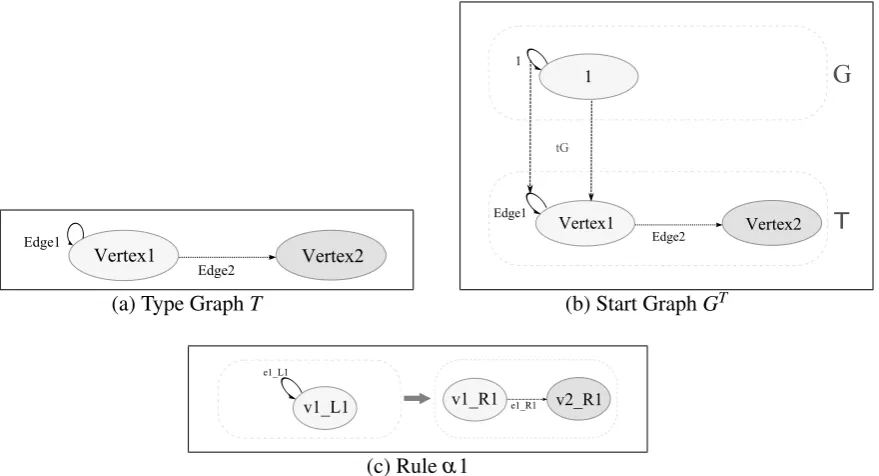
Now, we present a way to model each structure of a graph grammarGGin event-B such that it is possible to use the event-B provers to demonstrate properties of a graph grammar. We will use an example to describe how graphs, typed graphs and rules can be defined in Event-B. The example is depicted in Figure1.
Vertex1 Vertex2
Edge2 Edge1
(a) Type GraphT
Vertex2 Edge2
Edge1
G
T
tG 1
1
Vertex1
(b) Start GraphGT
e1_R1
v1_R1 v1_L1
e1_L1
v2_R1
(c) Ruleα1
Figure 1: Example of Graph Grammar
Graphs: According to Def. 2and Def. 7, setsVGG andEGG contain all possible vertices and
edge names that may appear in graphs of this relational structure. We will define these sets as
thatvertT∩N=∅);
EGG=edgeT∪N, whereedgeT is the set of names used as edge types inGG(we assume
thatedgeT∩N=∅).
Moreover, we assume thatvertT∩edgeT=∅.
The type graphT is defined in an event-B context as described in Figure 2, where we define all vertex and edge types as constants. In the axioms, we define these sets explicitly (for example, axiomaxm1 means thatvertT ={Vertex1,Vertex2}). We also define the functionssourceT andtargetT that respectively designate the source and target vertex of each edge. Text after a// is a comment. Here, instead of using the ternaryinc relation we used a set of edges and two binary relations (sourceandtarget) to define the edges of a graph. This is an equivalent formulation that is convenient to use in Event-B because it eases the proof of some proof obligations.
CONTEXT ctx_GG
SETS
vertT // (Type Graph ) Vertices edgeT // (Type Graph ) Edges
CONSTANTS
Vertex1 Vertex2 Edge1 Edge2
sourceT // (Type Graph ) Source Function targetT // (Type Graph ) Target Function
AXIOMS
axm1: partition(vertT,{Vertex1},{Vertex2}) axm2: partition(edgeT,{Edge1},{Edge2})
axm3: sourceT∈edgeT→vertT
axm4: partition(sourceT,{Edge17→Vertex1},{Edge27→Vertex1})
axm5: targetT∈edgeT→vertT
axm6: partition(targetT,{Edge17→Vertex1},{Edge27→Vertex2})
END
Figure 2: Event-B Type Graph
Instances of vertices and edges that appear in graphs representing states will be described by natural numbers. It is not necessary to have distinct numbers for vertices and edges: a graph may have a vertex with identity 1 as well as an edge with identity 1, these elements will be different because one will be mapped to a vertex type and the other to an edge type.
are used to define the types of the variables (for example,tG_V is a total function from vertGtovertT andtG_Eis a total function fromedgeGtoedgeT).
MACHINE mch_GG
SEES ctx_GG
VARIABLES
vertG // (Graph) Vertices edgeG // (Graph) Edges
sourceG // (Graph) Source Function targetG // (Graph) Target Function tG_V // Typing of vertices
tG_E // Typing of edges
INVARIANTS
inv_vertG: vertG∈P(N)
inv_incG: edgeG∈P(N)
inv_sourceG: sourceG∈edgeG→vertG inv_targetG: targetG∈edgeG→vertG inv_tG_V: tG_V∈vertG→vertT inv_tG_E: tG_E∈edgeG→edgeT
EVENTS Initialisation
begin
act1: vertG:={10}
act2: edgeG:={20}
act3: sourceG:={207→10}
act4: targetG:={207→10}
act5: tG_V:={107→Vertex1}
act6: tG_E:={207→Edge1} end
Figure 3: Event-B GraphG
There is special event in an event-B model that is executed before any other. This is the initialization event. In our encoding, this event will be used to create the start graph of a graph grammar. This is done by assigning initial values to the variables that correspond to graphG(see Figure3). Within an event, the order in which attributions occur in non-deterministic.
Rules: Left- and right-hand sides of rules are graphs, and thus will have representations as defined previously. Additionally, we have to define the partial morphism (αV,αE) that
maps elements from the left- to the right-hand side of the rule. The Event-B enconding of ule α1 depicted in Figure 1is shown in Figure 4. Since rules do not change during execution, their structures will be defined as constants.
SETS vertL1 edgeL1 vertR1 edgeR1 CONSTANTS
v1_L1 // vertex of LHS e1_L1 // edge of LHS
v1_R1 v2_R1 // vertices of RHS e1_R1 // edge of RHS
sourceL1 targetL1 sourceR1 targetR1
tL1_V // (Rule 1) Typing vertices of LHS tL1_E // (Rule 1) Typing edges of LHS tR1_V // (Rule 1) Typing vertices of RHS tR1_E // (Rule 1) Typing edges of RHS
alpha1V // (Rule 1) Rule morphism: mapping vertices alpha1E // (Rule 1) Rule morphism: mapping edges AXIOMS
// GRAPH L1:
axm7: partition(vertL1,{v1_L1}) axm8: partition(edgeL1,{e1_L1}) axm9: sourceL1∈edgeL1→vertL1
axm10: partition(sourceL1,{e1_L17→v1_L1}) axm11: targetL1∈edgeL1→vertL1
axm12: partition(targetL1,{e1_L17→v1_L1}) axm13: tL1_V∈vertL1→vertT
axm14: partition(tL1_V,{v1_L17→Vertex1}) axm15: tL1_E∈edgeL1→edgeT
axm16: partition(tL1_E,{e1_L17→Edge1}) // GRAPH R1:
axm17: partition(vertR1,{v1_R1},{v2_R1}) axm18: partition(edgeR1,{e1_R1}) axm19: sourceR1∈edgeR1→vertR1
axm20: partition(sourceR1,{e1_R17→v1_R1}) axm21: targetR1∈edgeL1→vertR1
axm22: partition(targetR1,{e1_R17→v2_R1}) axm23: tR1_V∈vertR1→vertT
axm24: partition(tR1_V,{v1_R17→Vertex1},{v2_R17→Vertex2}) axm25: tR1_E∈edgeR1→edgeT
axm26: partition(tR1_E,{e1_R17→Edge2}) // Rule morphism alpha1:
axm27: alpha1V∈vertL1→vertR1
axm28: partition(alpha1V,{v1_L17→v1_R1}) axm29: alpha1E∈edgeL1 7→edgeR1
axm30: alpha1E=∅
END
rule to the state graphG(see Def. 8). Guard conditionsgrd3 andgrd4 assure thatnewV andnewE are new fresh elements (a new vertex and a new edge identifier, not belonging to graphG). The actions update the state graph (graphG) according to the rule. In this example one loop edge is deleted and a new vertex and a new edge are created. A vertex newV with typeVertex2, and an edge newE with typeEdge2 are generated. The source of this new edge is the image of the only vertex in the left-hand side of the rule in G and the target is the newly created vertex. The relational operators2used in the definition of the actions implement the formulas that define rule application in Sect. 2. This is an encoding of ruleα1, there is a concrete choice for identifiers of elements created by the rule (newV andnewE). For this reason and to obtain a more efficient encoding, we did not use explicitly the functionssourceR1,targetR1,al pha1V andal pha1E to define this event (but they were implicitly used to define the actions). For example, to obtain the set of vertices of the resulting graph we used the existing set of verticesvertGand added a set containingnewV, instead of taking a vertex of R1 that was not in the image ofal pha1V (there is a vertex ofR1 that is not in the image ofal pha1V, that isv2_R2, and by giving it the namenewV in the generated graph we assure that this name did not occur already in vertG). Note that this choice of representation was dependent on the Event-B language, if we were to translate graph grammars to a different language, other encodings of the relational representation might be more suitable.
Proving Properties: Once the start graph and all rules are represented in the event-B model, the property to be proved can be stated as an invariant. For example, we could add the invariantcard(edgeG)≤2, meaning that no reachable graph can have more than 2 edges. For the given example, this property is true, and this can be easily proven automatically by the Rodin platform.
5
Final Remarks
In this paper we have defined an event-B model that faithfully describes the behavior of a given graph grammar. To define this model, we used the relational definition of graph grammars, that was proven to be equivalent to the SPO approach. Now, it is possible to use the existing theorem provers for event-B to prove properties of graph grammars, for example, using the Rodin platform.
This is an initial work in using event-B to help proving properties of graph grammars. Be-sides implementation, case studies are necessary to evaluate and improve the proposed approach. Another interesting topic for further research is to investigate to which extent the theory of re-finement, that is very well-developed in event-B, can be used to validate a stepwise development based on graph grammars.
2 The relational operators used to define this event are:\(minus),∪(union),
C
EVENTS Event alpha1=b
any
mV mE newV newE
where
grd1: mV∈vertL1→vertG // total on vertices
grd2: mE∈edgeL1edgeG // total and injective on edges grd3: newV∈N\vertG // newV is a fresh vertex name
grd4: newE∈N\edgeG // newE is a fresh edge name grd5: ∀v·v∈vertL1⇒tL1_V(v) =tG_V(mV(v))
// vertex type compatibility
grd6: ∀e·e∈edgeL1⇒tL1_E(e) =tG_E(mE(e)) edge type compatibility
grd7: ∀e·e∈edgeL1⇒mV(sourceL1(e)) =sourceG(mE(e))∧mV(targetL1(e)) =targetG(mE(e)) source/target compatibility
then
act1: vertG:=vertG∪ {newV}
act2: edgeG:= (edgeG\ {mE(e1_L1)})∪ {newE}
act3: sourceG:= ({mE(e1_L1)}C−sourceG)∪ {newE7→mV(v1_L1)} act4: targetG:= ({mE(e1_L1)}C−targetG)∪ {newE7→newV} act5: tG_V:=tG_V∪ {newV7→Vertex2}
act6: tG_E:= ({mE(e1_L1)}C−tG_E)∪ {newE7→Edge2}
end END
Bibliography
[ABHV06] J.-R. Abrial, M. J. Butler, S. Hallerstede, L. Voisin. An Open Extensible Tool En-vironment for Event-B. In Liu and He (eds.),ICFEM. Lecture Notes in Computer Science 4260, pp. 588–605. Springer, 2006.
[Abr05] J. R. Abrial.The B-Book: Assigning Programs to Meanings. Cambridge University Press, 2005.
[AH07] J.-R. Abrial, S. Hallerstede. Refinement, Decomposition, and Instantiation of Dis-crete Models: Application to Event-B.Fundam. Inform.77(1-2):1–28, 2007.
[BCMR07] P. Baldan, A. Corradini, U. Montanari, L. Ribeiro. Unfolding semantics of graph transformation.Inf. Comput.205(5):733–782, 2007.
doi:http://dx.doi.org/10.1016/j.ic.2006.11.004
[BK02] P. Baldan, B. König. Approximating the behaviour of graph transformation systems. InProceedings of ICGT ’02 (International Conference on Graph Transformation). LNCS 2505, pp. 14–29. Springer, 2002.
[BS89] R.-J. Back, K. Sere. Stepwise Refinement of Action Systems. In Snepscheut (ed.), Proceedings of the International Conference on Mathematics of Program Construc-tion, 375th Anniversary of the Groningen University. Pp. 115–138. Springer, Lon-don, UK, 1989.
[BS06] L. Baresi, P. Spoletini. On the Use of Alloy to Analyze Graph Transformation Sys-tems. In Corradini et al. (eds.),ICGT. LNCS 4178, pp. 306–320. Springer, 2006.
[CGJ+01] E. M. Clarke, O. Grumberg, S. Jha, Y. Lu, H. Veith. Progress on the State Explo-sion Problem in Model Checking. InInformatics - 10 Years Back. 10 Years Ahead. Pp. 176–194. Springer, London, UK, 2001.
[Cou94] B. Courcelle. Monadic Second-Order Definable Graph Transductions: A Survey. Theoretical Computer Science126(1):53–75, 1994.
[Cou97] B. Courcelle. The Expression of Graph Properties and Graph Transformations in Monadic Second-Order Logic. Pp. 313–400 in [Roz97].
[Cou04] B. Courcelle. Recognizable Sets of Graphs, Hypergraphs and Relational Structures: A Survey. In Calude et al. (eds.),Developments in Language Theory. LNCS 3340, pp. 1–11. Springer, 2004.
[CR09a] S. A. da Costa, L. Ribeiro. Formal Verification of Graph Grammars using Math-ematical Induction. Electronic Notes Theoretical Computer Science 240:43–60, 2009.
doi:http://dx.doi.org/10.1016/j.entcs.2009.05.044
[CR10] S. A. da Costa, L. Ribeiro. Formal Verification of Graph Grammars using Mathe-matical Induction.Science of Computer Programming, 2010.
doi:http://dx.doi.org/10.1016/j.scico.2010.02.006
[CW96] E. M. Clarke, J. M. Wing. Formal methods: state of the art and future directions. ACM Computing Surveys28(4):626–643, 1996.
doi:http://doi.acm.org/10.1145/242223.242257
[DEP] DEPLOY. Event-B and the Rodin Platform. http://www.event-b.org/ (last accessed 16 March 2010). Rodin Development is supported by European Union ICT Projects DEPLOY (2008 to 2012) and RODIN (2004 to 2007).
[DHR+07] M. B. Dwyer, J. Hatcliff, R. Robby, C. S. Pasareanu, W. Visser. Formal Software Analysis Emerging Trends in Software Model Checking. InFOSE ’07: 2007 Future of Software Engineering. Pp. 120–136. IEEE Computer Society, 2007.
doi:http://dx.doi.org/10.1109/FOSE.2007.6
[Dij76] E. Dijkstra.A Discipline of Programming. Prentice-Hall International, 1976.
[Ehr79] H. Ehrig. Introduction to the algebraic theory of graph grammars. In1st Interna-tional Workshop on Graph Grammars and Their Application to Computer Science and Biology. Lecture Notes in Computer Science 73, pp. 1–69. Springer-Verlag, Germany, 1979.
[Roz97] G. Rozenberg (ed.). Handbook of Graph Grammars and Computing by Graph Transformations, Volume 1: Foundations. World Scientific, 1997.
[RV01] J. A. Robinson, A. Voronkov (eds.).Handbook of Automated Reasoning (in 2 vol-umes). Elsevier and MIT Press, 2001.
[Str08] M. Strecker. Modeling and Verifying Graph Transformations in Proof Assistants. Electronic Notes in Theoretical Computer Science203(1):135–148, 2008.