Volume 39 (2011)
Graph Computation Models
Selected Revised Papers from the
Third International Workshop on
Graph Computation Models (GCM 2010)
Construction of Pushout Complements in the Category of Hypergraphs
Marvin Heum¨uller, Salil Joshi, Barbara K¨onig, Jan St¨uckrath
20 pages
Guest Editors: Rachid Echahed, Annegret Habel, Mohamed Mosbah Managing Editors: Tiziana Margaria, Julia Padberg, Gabriele Taentzer
Construction of Pushout Complements in the Category of
Hypergraphs
Marvin Heum ¨uller1, Salil Joshi2, Barbara K¨onig1, Jan St ¨uckrath1
1Abteilung f¨ur Informatik und Angewandte Kognitionswissenschaft,
Universit¨at Duisburg-Essen, Germany
2Carnegie Mellon University, USA
Abstract: We describe a concrete construction of all pushout complements for two given morphisms f:A→B,m:B→Din the category of hypergraphs, valid also for the case where f,mare non-injective. It is based on the generation of suitable equivalence relations. We also give a combinatorial interpretation and show how well-known coefficients from combinatorics, such as the Bell numbers, can be re-covered. Furthermore we present a formula that can be used to compute the number of pushout complements for two given morphisms.1
Keywords:graph transformation, pushout complements, combinatorics
1
Introduction
Pushout complements are an integral part of double-pushout rewriting [2,4,5]: they implement the deletion of elements, whereas the creation of new elements is implemented via a pushout. Hence the construction of pushout complements is needed for many tools based on double-pushout graph rewriting. Most of the time the left leg of a rule is considered to be injective and thus the construction of pushout complements is greatly simplified compared to the general case, where both morphisms might be non-injective. A thorough study of the expressiveness of injective and non-injective rules and matches can be found in [6].
In [7] we considered a backwards analysis technique for graph transformation systems where rewriting steps have to be applied backwards. That is we are interested inall predecessors of a given graph, which is a common scenario in verification techniques. In this setting pushout complements have to be constructed for the right leg of a rule and in many applications this morphism isnotinjective, especially in cases where graph nodes and edges are fused by rewrit-ing. In [7] we considered in fact single-pushout rewriting [3] with pushouts in the category of partial morphisms. The problem of computing such pushout complements can be reduced to the construction of pushout complements for total morphisms, hence the construction given in this paper can also be adapted to the scenario in [7].
Taking pushout complements for morphisms which are non-injective means—intuitively—to “unmerge” or split nodes in all possible ways, which can lead to a combinatorial explosion and serious efficiency problems.
In the literature the general case has so far received little attention. In the 70s the papers in-troducing and studying the notion of pushout complement [4,5,9] restricted themselves to cases where either a vertical or a horizontal morphism is injective. Furthermore there are some in-vestigations into taking pushout complements in more general categories [1,8], but they usually assume that the first morphism is a mono or consider only the minimal pushout complement. Since a construction of general pushout complements does not seem to be available in the lit-erature, we specified this construction ourselves and found it surprisingly complex. Hence we believe that it is of general interest.
We will in the following define the construction which computes all pushout complements for two given morphisms f: A→B, m:B→D. This is done by defining an auxiliary graph
A⊕D˜ which is the disjoint union ofA and a disjoint collection of all nodes and edges of D, which are not in the image ofm. Then we enumerate all equivalences onA⊕D˜ satisfying certain conditions and factor through these equivalences. In this way we obtain all pushout complements and our main theorem proves this fact. Furthermore—since the enumeration of all equivalences onA⊕D˜ is very costly and there are serious issues with efficiency—we consider optimizations. We show how some coefficients from combinatorics, such as Bell numbers or Stirling numbers of the second kind arise as the number of pushout complements for certain pairs of arrows. This also shows that there can be a combinatorial explosion in the number of constructed pushout complements. Finally we present a general formula that can be used to compute the number of pushout complements for two given morphisms.
2
Preliminaries
We first define the usual notions of hypergraph and hypergraph morphism.
Definition 1(Hypergraph) LetΛbe a finite set of labels and a functionar:Λ→N0that assigns
anarityto each label.
A(Λ-)hypergraph is a tuple(VG,EG,cG,lG) whereVG is a finite set of nodes,EG is a finite
set of edges,cG:EG→VG∗is a connection function andlG:EG→Λis the labelling function for
edges. We require that|cG(e)|=ar(lG(e))for each edgee∈EG.
Definition 2(Hypergraph morphism) LetG,G0be (Λ-)hypergraphs. Ahypergraph morphism
(or simplymorphism)ϕ:G→G0consists of a pair of functions(ϕV :VG→VG0,ϕE :EG→EG0)
such that for everye∈EGit holds thatlG(e) =lG0(ϕE(e))andϕV(cG(e)) =cG0(ϕE(e)).
In the following, we will simply usegraphto denote a hypergraph.
We will work extensively with equivalence relations and one required operation is equivalence closure that turns an arbitrary relation into an equivalence.
Definition 3(Equivalence closure) LetAbe a set andRbe a relationR⊆A×A. The equiva-lence closureRofRis the smallest equivalence containingR.
In the following, equivalence closure is mainly used if R is the union of two equivalences
can be written as
R = {(x,y)∈A×A| ∃x1,y1, . . . ,xn,yn∈A:
x=x1≡1y1≡2x2≡1· · · ≡1yn−1≡2xn≡1yn=y}
Definition 4(Pushout) LetA,B,Cbe graphs with graph morphisms f:A→Bandn:A→C.
A
n
f //
B
m
m
C g //
g ++
D
h
D0
The graphDtogether withg:C→Dandm:B→Dis a pushout of f,nif the following condi-tions are satisfied:
(1) m◦f=g◦n.
(2) For allm:B→D0, g:C→D0 satisfyingm◦f =g◦n there exists a unique morphism
h:D→D0such thath◦m=mandh◦g=g.
There is a well-known construction of pushouts [5] in the category of hypergraphs, where pushouts are obtained by taking the disjoint union ofBandCand factoring through an equiva-lence obtained from the morphisms f,n.
Proposition 1(Pushout via equivalence classes) Let A,B,C be graphs with graph morphisms f:A→B, n:A→C. We also assume that all node and edge sets are disjoint.2
Let≡be the equivalence closure of the relation ≡˜ on VB∪EB∪VC∪EC which is defined as
f(x)≡˜ n(x)for all x∈VA∪EA. The gluing of B,C over A (written as D= (B⊕C)/≡) is defined
as D= (VD,ED,cD,lD)with:
• VD= (VB∪VC)/≡,
• ED= (EB∪EC)/≡,
• cD:E→V∗where cD([e]≡) = [v1]≡. . .[vk]≡and v1. . .vk=
cB(e) if e∈EB
cC(e) if e∈EC
• lD:E→Λwhere lD([e]≡) =
lB(e) if e∈EB
lC(e) if e∈EC
The resulting morphisms are m:B→D, g:C→D with:
g(x) = [x]≡ m(x) = [x]≡
Then D together with the morphisms g,m is the pushout of f,n.
Note that the functionscDandlDin Proposition1are well-defined due to the morphism
prop-erties of Definition2.
Definition 5(Pushout complement) Given morphisms f: A→B,m:B→Dapushout com-plementof f,mis a graphCand a pair of morphismsn:A→C,g:C→Dsuch thatg,mform the pushout of f,n. We say that two pushout complementsCi withni:A→Ci,gi:Ci→Dfor
i=1,2 areisomorphicif there exists an isomorphism j:C1→C2withj◦n1=n2andg2◦j=g1.
There is a well-known characterization of the existence of pushout complements (see for in-stance Proposition 3.3.4 of [2]).
Proposition 2(Existence of pushout complements) A pushout complement of f,m exists if and only if the following two conditions are satisfied:
• Identification condition:for all x,y∈VB∪EB with m(x) =m(y)there exist x0,y0∈VA∪EA
with f(x0) =x, f(y0) =y.
• Dangling condition:for every node v∈VBwhere m(v)is attached to an edge e∈EDwhich
is not in the range of m, there exists a node v0∈VAwith f(v0) =v.
3
Construction of pushout complements
In this section we will give a concrete construction for pushout complements, i.e., given mor-phisms f:A→Bandm:B→D, we constructallpairs of morphismsn:A→C,g:C→Dand graphsC(up to isomorphism) such that the resulting square is a pushout.
A f //
n
B
m
C g //D
We use the following abbreviations: since it is often not necessary to distinguish between edges and nodes of a graph, we will usex∈Aas shorthand for (x∈EA orx∈VA) and f(x)as
shorthand for fV(x)ifx∈VAand fE(x)ifx∈EArespectively.
Construction 1(Pushout complements)
(1) Construct a graph ˜Das follows:
• For every nodev∈VDthat is not in the range ofm, add a copy ofvto ˜D. The copy
ofvwill be denoted byv0.
• For every edgee∈ED that is not in the range ofm, add a copy of ewith the same
This means that ˜Dis a collection of disjoint nodes and edges.
(2) Now constructA⊕D˜, the disjoint union of A and ˜D, with morphismsn0: A→A⊕D˜,
g0:A⊕D˜ →Das follows:
• n0is the canonical embedding ofAintoA⊕D˜.
• For an item xofA⊕D˜ we define g0(x) =m(f(x))ifx is contained inA. If x=y0
for some itemyofDwe defineg0(x) =y. Finally ifx= (e0,i)for some edgeeofD
we haveg0((e0,i)) = [cD(e)]i.3 (See Step (1) of this construction where items of the
formy0were created.)
Clearlyg0◦n0=m◦f.
(3) Define two equivalences on the items ofA⊕D˜:
• x≡g0 yif and only ifg0(x) =g0(y).
• x≡f yif eitherx=yorx,yare both items ofAand f(x) = f(y).
It can easily be seen that≡f is a refinement of≡g0, i.e.,x≡f yimpliesx≡g0 y.
(4) Now consider all equivalences ≡on A⊕D˜ such that ≡g0 is the equivalence closure of
≡f ∪ ≡. Furthermore whenevere1≡e2for two edgese1,e2, we require that[cA⊕D˜(e1)]i≡
[cA⊕D˜(e2)]ifor all 1≤i≤ar(lG(e1)) =ar(lG(e2)). For each such equivalence≡construct
the graphC= (A⊕D˜)/≡with morphismsn:A→C,g:C→Das specified below:
n(x) = [n0(x)]≡ g([x]≡) =g0(x)
Note thatgis well-defined since≡refines≡g0.
Example1 Consider for instance the situation on the left below. We have a single binary edge, which is unlabeled (labels do not play a role for this example). The identities of nodes and edges are illustrated by the letters next to them.
A B
D f
m b
a
c
d
a,b
c,d
f e
A B
A⊕D˜ D
f
n0 m
g0
b a
c
d
a,b
c,d
b a
c
d
(e0,1) (e0,2)
e0
f e
3For a sequenceswe denote by[s]
On nodes we have the equivalences≡g0,≡f, represented by their equivalence classes:
• ≡g0:{a,b,c,d,(e0,1),(e0,2)}
• ≡f:{a,b},{c,d},{(e0,1)},{(e0,2)}
Now there are many possible equivalences≡. First, we have to relate at least one node from
{a,b}to one node from{c,d}. Furthermore we have to relate each of the two nodes(e0,1),(e0,2)
to an equivalences class containing one ofa,b,c,d. For instance the following three equivalences
≡are all permissible:
• {a,c},{b,(e0,1)},{d,(e0,2),}
• {a,c,(e0,1),(e0,2)},{b},{d}
• {a,b,c,d,(e0,1),(e0,2)}
This results in the following three graphs:
e0
a,c
b,(e0,1) d,(e0,2)
a,c,(e0,1),(e0,2) e0
b
d
e0
a,b,c,d,(e0,1),(e0,2)
But there are many more possibilities. In order to enumerate them more systematically we consider all15equivalences on the set{a,b,c,d}, given by equivalence classes (a better way of
enumeration is describes in Section4.2). The ones that do not satisfy the requirement above are
crossed out.
{a,b,c,d} {a},{b,c,d} {b},{a,c,d} {c},{a,b,d} {d},{a,b,c} {a,b},{c,d} {a,c},{b,d} {a,d},{b,c} {a,b},{c},{d} {a,c},{b},{d}
{a,d},{b},{c} {b,c},{a},{d} {b,d},{a},{c} {c,d},{a},{b} {a},{b},{c},{d}
Now fork equivalence classes there arek2 possibilities to associate(e0,1)and (e0,2) to these
equivalence classes. Hence in total there are1+6·22+4·32=61equivalences. Some of them
result in isomorphic graphs, however they are all non-isomorphic in the sense of Definition5
(see also Proposition4). How the equivalences can be counted in the arbitrary case is further
discussed in Section5.
We now show that every graph C constructed as specified in Construction 1 is a pushout complement and that all pushout complements can be obtained in this way.
Proof. Assume that≡is one of the equivalences of Construction1and thatCandn,ghave been obtained by factoringA⊕D˜ through this equivalence.
As a first step we show thatm◦f =g◦n, i.e., the resulting square commutes: becausen0is the canonical embedding ofAintoA⊕D˜ (and therefore injective) andg0(x)is defined asm(f(x))if
x∈A,m(f(x)) =g0(n0(x))holds. Furthermore by definition ofn,gwe have:
m(f(x)) =g0(n0(x)) =g([n0(x)]≡) =g(n(x))
Now we show thatCis indeed a pushout complement by verifying that the second condition of Definition4are satisfied: we have to prove that for every other commuting pair of morphisms
g:C→D0,m:B→D0there is a unique morphismh:D→D0such thath◦g=gandh◦m=m.
A
n
f //
B
m
m
C g //
g ++
D
h
D0
We define the required morphismhas follows:
h(x) =
g(x˜) if∃x˜∈C:g(x˜) =x m(x˜) if∃x˜∈B:m(x˜) =x
By definition ofgevery element ofDhas a preimage either undergorm. It remains to be shown thath is a well-defined morphism, and that it is the unique morphism such that the triangles commute.
Commutativity. By definitionh(m(x)) =m(x)andh(g(x)) =g(x)hold.
Uniqueness. Leth0 be another morphism withh0◦g=gandh0◦m=m. Each element ofD
has a preimage either undergorm:
(1) ifx=g(x0)thenh0(x) =h0(g(x0)) =g(x0) =h(g(x0)) =h(x)
(2) ifx=m(x0)thenh0(x) =h0(m(x0)) =m(x0) =h(m(x0)) =h(x)
Well-definedness. As seen beforehis defined for all elements ofD. To show well-definedness it is therefore only necessary to prove that different ˜xhaving the same image undergormalso have the same image undergorm.
Every element ofCis an equivalence class of≡. Therefore, letx= [x0]≡andy= [y0]≡. In the following we do not strictly distinguish between an element ofAand its image undern0because
n0is a canonical embedding. Hence forx0∈A⊕D˜ the propertyx0∈Aholds if and only ifx0has a preimage undern0.
Thefirst propertywe show is thatg(x) =g(y)⇒g(x) =g(y)holds for allx,y∈C. Forx6=y
(1) x0,y0∈A, i.e., we assume that the equivalence classesx,yhave representatives inA(which also impliesn(x0) =xandn(y0) =y).
x0≡g0y0holds because ofg0(x0) =g([x0]≡) =g(x) =g(y) =g([y0]≡) =g0(y0). Due to this
equivalence there arex1,y1, . . . ,xn,yn∈Asuch thatx0≡f x1,xi≡yi,yi≡f xi+1andyn≡f y0
for 1≤i<n. Using the definition ofnand the fact thatxi andyi are elements ofAit can
be shown that the equivalencexi≡yi impliesn(xi) = [n0(xi)]≡= [n0(yi)]≡=n(yi). These
properties lead to the following equality
m(f(xi)) =g(n(xi)) =g(n(yi)) =m(f(yi)) =m(f(xi+1))
for everyi. Together with the equalitiesg(n(x0)) =m(f(x0)) =m(f(x1))andg(n(yn)) =
m(f(yn)) =m(f(y0)) =g(n(y0))it follows thatg(x) =g(y).
(2) xcontains no elements ofA(implyingx0∈/A)
Becausexcontains no elements ofA, it also has no preimage undern. As already shown
g([x0]≡) =g([y0]≡)impliesx0≡g0y0. Because of this equivalence there arex1,y1, . . . ,xn,yn∈ Asatisfyingx0≡f x1,xi≡yi,yi≡f xi+1,yn≡f y0for 1≤i<n. Due to the definition of≡f
it holds thatx0=x1becausex0is not inA. Alsoy1can not be an item ofAbecause
other-wise[x0]≡would contain items ofA. This property can be extended toyi=xi+1andyn=y0,
which leads toxi≡xi+1. Because ofx0=x1andxn≡y0,x0andy0are equivalent according
to≡and hencexandymust be equal. This clearly impliesg(x) =g(y)⇒g(x) =g(y).
Thesecond propertyneeded for well-definedness ism(x) =m(y)⇒m(x) =m(y). The identifi-cation condition (see Proposition2) states that because ofm(x) =m(y)there arex0,y0∈Asuch that f(x0) =xand f(y0) =y. Using this and the first property the desired equality can easily be shown by:
m(x) =m(y) ⇒ m(f(x0)) =m(f(y0)) ⇒ g(n(x0)) =g(n(y0)) ⇒
g(n(x0)) =g(n(y0)) ⇒ m(f(x0)) =m(f(y0)) ⇒ m(x) =m(y)
Thelast propertyto show isg(x) =m(y)⇒g(x) =m(y). We first show thatg(x) =m(y)implies that there is ay0with f(y0) =y: the only items ofDwhich are in the range of bothgandmare the images of elements ofAand nodes in the range ofmwhich are attached to edges which are not in the range of m. However, due to the dangling condition (see Proposition2) such nodes must have a preimage inA. Together with the first property this implies:
g(x) =m(y) ⇒ g(x) =m(f(y0)) ⇒ g(x) =g(n(y0)) ⇒
g(x) =g(n(y0)) ⇒ g(x) =m(f(y0)) ⇒ g(x) =m(y)
Morphism. Finally it is straightforward to prove thath satisfies indeed the morphism prop-erties. For instance in order to show that h(cD(e)) =cD0(h(e))for an edgee∈Dwe have to
distinguish two cases: if there exists an edge ˜e∈Cwithg(e˜) =e, then—sincegis a morphism— we haveg(cC(e˜)) =cD(e). Henceh(cD(e)) =h(g(cC(e˜))) =g(cC(e˜)) =cD0(g(e˜)) =cD0(h(e))
by definition ofh. The case ˜e∈Bwithm(e˜) =eis analogous.
Proposition 4 Assume that f:A→B, m: B→D are given. Then every pushout complement n:A→C, g:C→D of f,m can be obtained via Construction1. Furthermore two isomorphic pushout complements give rise to the same equivalence≡.
Proof. Assume thatCwith morphismsn,gis a pushout complement of f,m. We will show that there is an equivalence≡, as specified by Construction 1, such thatC is obtained by factoring
A⊕D˜ through this equivalence.
A
n
f //
n0
B
m
C g //D
A⊕D˜
k
<<
g0
;;
For the given pushout of f,nwe will define a surjective morphismk: A⊕D˜ →C(see diagram above). Our next step is then to define an equivalence relation≡wherex,y∈A⊕D˜ are equivalent if and only ifk(x) =k(y). The factorization ofA⊕D˜ through≡then results inCand it has to be shown that the equivalence relation ≡ is one of the equivalence relations obtained by the presented construction.
Let≡∗be the equivalence closure of the relation ˜≡ where f(a)≡˜ n(a)for alla∈A. Due to the construction of pushouts using equivalence classes we can assume without loss of generality thatD= (B⊕C)/≡∗(see Proposition1). Furthermore forb∈Bwe havem(b) = [b]
≡∗ and for c∈Cwe haveg(c) = [c]≡∗.
We definekas follows: ifx∈A, thenk(x) =n(x). Ifxis of the formy0 for some itemyofD, then — sinceyis not in the image ofm— there must be ac∈Cwithg(c) =y. In this case we definek(x) =c. Ifxis of the form(e0,i)for some edgeeofD, thenk(x) = [cC(k(e))]i.
Well-definedness. Problems with well-definedness may arise only in the second case of the definition ofk, wherexis of the formy0for some itemyofD. In this caseyis not in the range of
mdue to the construction ofA⊕D˜. Thereforeyas an equivalence class does not contain elements ofB. Because of the definition of≡∗every equivalence class containing elements of eitherBor
C(but not both) only contains one element, henceycontains exactly one elementcofC. Because
g(c) = [c]≡∗ =ythe preimage ofyunder gis unique and therefore k(x)is well-defined in this
case.
Morphism. Note thatk is obviously a morphism on the elements of A. Furthermore ˜D is a disjoint collection of nodes and edges and the third case in the definition ofkensures that it is indeed a valid morphism.
Surjectivity. We now show thatkis surjective. Let therefore c∈Cbe any element ofCand we distinguish the following two cases:
(2) @y∈A:n(y) =c: Without a preimage undernthe equivalence class[c]≡∗ contains onlyc
becausecis not equivalent to any element ofBaccording to≡∗. Therefore[c]≡∗ is not in
the range ofmsince otherwise the equivalence class would contain elements ofB. Because of the definition ofkthere is ay0∈D˜ withg0(y0) =y= [c]≡∗=g(c), hencek(x) =c.
Commutativity. We have to show that both triangles commute: (1) We first check thatk(n0(x)) =n(x)for anyx∈A:
As already seenn0(x) =xifx∈A. Using the definition ofkwe obtaink(n0(x)) =k(x) =
n(x).
(2) Now we show thatg(k(x)) =g0(x)for anyx∈A⊕D˜. There are two cases:
(a) x∈A: Usingk(x) =n(x)ifx∈Aandm◦f=g0◦n0due to the definition ofg0andn0
it can be shown that:
g(k(x)) =g(n(x)) =m(f(x)) =g0(n0(x)) =g0(x)
(b) x∈D˜: In this casek(x) =candg(c) =g0(x), thereforeg(k(x)) =g(c) =g0(x).
The equivalence≡is generated. We will now show that the equivalence≡, where two ele-mentsx,y∈A⊕D˜ are equivalent if and only ifk(x) =k(y), is generated by the given construction. Hence we have to show that the equivalence closure of≡ ∪ ≡f is≡g0, i.e., that≡ ∪ ≡f =≡g0.
• ≡ ∪ ≡f ⊆ ≡g0:
As already mentioned in Construction1,≡f implies≡g0, i.e.≡f is clearly a subset of≡g0.
The equivalence≡is also a subset of≡g0 because of:
x≡y⇒k(x) =k(y)⇒g0(x) =g(k(x)) =g(k(y)) =g0(y)
• ≡ ∪ ≡f ⊇ ≡g0:
Let x,y be elements of A⊕D˜ with x≡g0 y, hence g0(x) =g0(y). As shown above the
equivalence classes g0(x) andg0(y) of ≡∗ contain k(x) and k(y) respectively, therefore
k(x) ≡∗ k(y). Hence there are c
0,b1,c1, . . .bm,cm such that bi≡˜ ci for 1≤i≤m and
bj+1≡˜ cj for 0≤ j<mwith k(x) =c0 andk(y) =cm. Using the definition of ˜≡ leads
to the following properties:
bi≡˜ ci ⇒ ∃ai∈A: f(ai) =bi∧n(ai) =ci
bi+1≡˜ ci ⇒ ∃a0i∈A: f(a0i) =bi+1∧n(a0i) =ci
This implies thatai+1anda0ihave the same image under f, henceai+1≡f a0i, and thatai
anda0i have the same image undern, henceai≡a0i. This leads tox≡a00≡f a1≡a01≡f
· · · ≡a0m−1≡f am≡y, hencex≡ ∪ ≡f y.
Isomorphism of pushout complements. It is left to show that, given two isomorphic pushout complementsni:A→Ci,gi:Ci→Dwithi=1,2 and an isomorphism j:C1→C2with j◦n1= n2,g2◦j=g1, the corresponding equivalences≡are the same. For this it is sufficient to show
that j commutes with the morphismsk1,k2, where ki: A⊕D˜ →Ci and k1,k2 are constructed
analogously to the morphismkabove. That is, we have to show that j◦k1=k2. Thenk1,k2give rise to the same equivalence≡.
We distinguish the following cases (as in the definition of k): if x ∈A, then j(k1(x)) = j(n1(x)) =n2(x) =k2(x). Ifxis of the formy0for some itemyofD, then we defineki(x) =cifor
ciwithgi(ci) =y. Sinceg2(j(c1)) =g1(c1) =ywe obtainc2=j(c1). Hence j(k1(x)) = j(c1) = c2=k2(x). Finally, ifx is of the form(e0, `) for some edge e ofD, then ki(x) = [cC(ki(e))]`
and so j(k1(x)) = j([cC(k1(e))]`) = [cC(j(k1(e)))]`= [cC(k2(e))]`=k2(x). This completes the
proof.
The fact that two isomorphic pushout complements give rise to the same equivalence means that the number of generated (valid) equivalences is exactly the number of different pushout complements. However, if we consider only isomorphisms onC—without requiring commu-tativity of the triangles consisting of morphisms j,n1,n2 and j,g1,g2 (in the terminology of
Definition5)—there will usually be fewer different pushout complements. The examples in Sec-tions5.1and5.2are chosen in such a way that both interpretations give rise to the same number.
4
Optimizations
In the given construction there exist several possibilities for optimization. These lie in the con-struction ofA⊕D˜ and in the method used to enumerate all possible equivalences≡.
4.1 Possible Simplifications
In Step (1) of Construction1the graph ˜Dis constructed by inserting all nodes and edges ofD
which are not in the range ofm. Additionally for every edgeeofDfor every node connected withea new node is inserted. This ensures that every node attached toeis also in ˜D. However, if
eis connected to a nodexnot in the range ofm, another copy of this node has been added earlier to ˜D. Both are equivalent with respect to≡g0 but not with respect to≡f since they do not have a
preimage undern0. Therefore these two copies have to be equivalent according to every possible equivalence≡. Hence the first copy was superfluous and it was unnecessary to create it in the first place.
˜
D D alternative ˜D
n0 n00
w1
w2
v2
v3
v1
e
e0
w v
e
e0
w1
w2
v0
e
e0
vin the middle graph and all have to be in the same≡-class. The construction would therefore still be correct if the right graph is generated instead of the left graph.
In general it is only necessary to add one node toA⊕D˜ for every node not in the range ofmand for every node in the range ofmas many nodes as there are edges not in the range ofmconnected with the node (it depends on f whether the latter copies are really needed). This improvement can help to manage the combinatorial explosion when determining all possible equivalences≡.
4.2 Enumerating Equivalences
A problem not addressed earlier is how to generate all permissible equivalences≡. The straight-forward way would be to enumerate all possible equivalences over A⊕D˜ and to store every equivalence satisfying≡ ∪ ≡f = ≡g0. This method is however not recommended because of
combinatorial explosion and in addition many of these equivalences will not satisfy the required conditions. In the following we explain how the generation of equivalences could be handled more efficiently.
If f is injective there is only one permissible equivalence ≡. This is true since in this case
gmust necessarily also be injective and hence≡equals≡g0 (alsox≡f y⇔x=yholds). It is
already known that in this case the pushout complement is unique, if it exists [5].
A non-injective morphism f produces several permissible equivalences≡. In this case it is sufficient to look at each equivalence class of≡g0 separately. We further distinguish between
equivalence classes which contain elements ofAand those which do not. In either case every equivalence class of≡f is entirely contained in exactly one equivalence class of≡g0 due to the
definition ofg0.
If an equivalence class c of ≡g0 contains no elements of A, every equivalence class of ≡f
contained inconly contains one element. Thereforecmust also be an equivalence class of≡, i.e., all elements ofcmust be merged.
≡f ≡f
∈A
6∈A
≡f
≡g0
≡f
≡f
≡f
If an equivalence classcof≡g0 contains elements ofA, the equivalence classes of≡f inc
con-tain either only elements ofAor no elements ofA(see figure above). Only equivalence classes of≡f containing elements ofAcan consist of more than one element. Elements already
equiv-alent according to≡f do not have to be equated via≡because they will anyway be equivalent
the remaining elements (contained in equivalence classes of≡f with only one element) to the
resulting equivalence classes in every possible way. The results are all equivalences≡restricted to elements ofc. If we perform these steps for all other equivalence classes of≡g0, a complete
equivalence≡can be obtained by taking arbitrary combinations of such (restricted) equivalences
≡for each classc.
5
Combinatorial Interpretation
Some coefficients from combinatorics arise naturally as the number of pushout complements for a (parameterized) pair of arrows. We first present some examples, all of them for hypergraphs with unary edges only, and later give a formula for calculating the number of pushout comple-ments arising from given graphs and morphisms.
5.1 Bell Numbers
Then-th Bell numberBn is the number of equivalence relations on the set{1, . . . ,n}. The first
Bell numbers (starting withB1) are: 1, 2, 5, 15, 52, 203, 877, 4140, . . . (see the On-Line
Ency-clopedia of Integer Sequences4).
Now takeΛx={x1, . . . ,xn}as a label set. Assume thatXΛx is the graph withnnodes, where
to each node we attach a unary hyperedge and each hyperedge has a different label. Furthermore
ZΛx is the graph with one node to whichnhyperedges are attached, where each hyperedge has a
different label.
We consider the unique morphism f: XΛx →ZΛx and the identity m=idZΛx: ZΛx → ZΛx.
Then—if we apply our construction—the graph A⊕D˜ will consist only of A=XΛx and all
equivalences≡on the nodes ofXΛx are admissible (for the edges each edge must be in a separate equivalence class). Hence there areBndifferent pushout complements up to isomorphism.
XΛx f //ZΛx
m
ZΛx
. . .
x1 xn
f // xn
x1
. . .
m
xn
x1
. . .
5.2 Stirling Numbers of the Second Kind
The Stirling number of the second kindSn,kis the number of equivalence relations withk
equiv-alence classes on the set{1, . . . ,n}. It holds thatBn=∑nk=1Sn,k.
The Stirling numbers satisfy the following recursive equation: Sn,k = Sn−1,k−1
+k·Sn−1,k, which is based on a case distinction according to the elementn: eithernis in an
equivalence class of its own and the remainingn−1 elements have to be grouped ink−1 equiv-alence classes; or the remaining n−1 elements have to be grouped in k equivalence classes and there are k possibilities to assignn to one of these classes. Our implemented method for enumerating equivalences follows the same pattern.
Now we setΛx={x1, . . . ,xn},Λy={y1, . . . ,ym}andΛ=Λx∪Λy. We take the unique
mor-phism f:XΛx→ZΛx and the unique morphismm:ZΛx→ZΛ.
XΛx f //ZΛx
m
ZΛ
. . .
x1 xn
f // xn
x1
. . .
m
xn
x1
. . .
. . .
y1
ym
Then A⊕D˜ is the disjoint union of XΛx and separate copies of m edges which are labelled
y1, . . . ,ym. Now we take all permissible equivalences on the nodes of the copy ofXΛx. Assume
that we havek equivalence classes. Then there arekmpossibilities to distribute themnodes of the separate edges over the equivalence classes. Hence the total number of pushout complements is
n
∑
k=1
Sn,k·km
Note that for the special case ofm=0 we obtain again the Bell numbers.
5.3 Counting pushout complements with only node fusions
With the examples above we have shown the worst cases for the number of pushout complements by looking at only one equivalence class of≡g0. We now present a more accurate formula for
calculating this number, still looking at the classes of≡g0 individually. We will give this formula
for the general case – independent of our construction – where an equivalence on an arbitrary set is given and a second, coarser, equivalence is searched for. We will in the following exploit the fact that the equivalences on a given setX coincide with the partitions on a set and we will switch between both representations.
LetPall(X)⊂P(P(X))be the set of all partitions of the given setX. We also defineCnt(Y,Z)
ofY they connect, i.e. which partition they induce onY. For any induced partitionI onY we can calculate the number of partitions onZ inducingI by calculating the possibilities for each element ofIindividually and forming the product of the results. These possibilities can in turn be calculated byCnt. For any partitionY of a setZwe obtain the following formula:
B|Z|=
∑
X∈Pall(Y)
∏
N∈X
Cnt N, [
M∈N
M
!
Example2 LetY ={{1,2},{3,4},{5}}be a partition onZ={1,2,3,4,5}. All partitions on
Z will induce one of the partitions (or equivalences) onY displayed below. For instance the
top right case (where {3,4} and{5} are connected) represents six equivalences: 5 can either
be equivalent to3, to4or to both. In all three cases1 and2 can be equivalent or not, but can
not be equivalent to3,4 or5, because this would induce another equivalence. In the end, we
want to count the number of equivalences inducing the top left partition by counting the rest and subtracting it from the number of all equivalences (given by the Bell numbers).
2
1 3 4
5
2
1 3 4
5
2
1 3 4
5
2
1 3 4
5
2
1 3 4
5
IfCnt(Y,Z)is the number of partitions to be counted, we obtain the following proposition by reorganizing the formula above to obtain a recursive formula. We obtainCnt(Y,Z)by subtracting the partitions not resulting in{Z}when constructing the closure from the upper boundB|Z|.
Proposition 5 For any set Z and any partition Y on Z the number of partitions on Z which result in{Z}when constructing the closure with Y , can be computed by the following recursive formula:
Cnt({Z},Z) =B|Z|
Cnt(Y,Z) =B|Z|−
∑
X∈Pall(Y)\{{Y}}
∏
C∈X
Cnt C, [
C0∈C C0
!
with|Y| ≥2
The evaluation of the formula above will always terminate because everyChas at most|Y| −1 elements.
We now extend the formula to the case where two equivalences ≡0f and≡0g0 are given. The
prime indicates that these equivalences are two “normal” equivalences and not a pair of equiva-lences such as≡f, which in our setting consists of≡Vf and≡Ef.
• We definePart(≡)as the partition consisting of the equivalence classes of a given equiv-alence≡.
• LetEqcoll
≡0f,≡0g0
be the set of all equivalences such that the equivalence closure of that
equivalence and≡0f results in≡0g0.
Note that the subscriptcollstands for “collapsing”, i.e., we want to collapse≡0
f in order
to obtain ≡0g0. The connection to the earlier notation is the following. For an arbitrary
equivalence≡on a setX we have that|Eqcoll(≡,X×X)|=Cnt(Part(≡),X).
• Given an equivalence≡on a setX andY ⊆X, we define[≡]X as the equivalence which results when we restrict≡to elements ofX, i.e.,[≡]X =≡ ∩(X×X).
Regardless of≡0
f, only elements in the same class according to≡0g0may and must be merged.
Hence we split the calculation and apply the previous formula to the classes of≡V
g0 individually.
The total number of possibilities is the product of the individual results, resulting in the following proposition.
Proposition 6 For any pair of equivalences≡0
f and≡0g0, where≡
0
f is a refinement of≡0g0, the
number of equivalences≡0with≡0∪ ≡0
f =≡
0
g0 can be computed as:
Eqcoll ≡0f,≡0g0
=
∏
Y∈Part≡0 g0 Pcoll Part
≡0f
Y
with|Pcoll(Z)|=Cnt Z,
[
Z0∈Z Z0
!
Note that this formula can be used to calculate the equivalences on nodes and on edges. Using
≡V
f and≡
V
g0 as initial values will result in the number of equivalences on nodes, whereas≡ E
f and
≡E
g0 will result in the number of equivalences on edges.
When calculating the number of equivalences on nodes this formula does not take equivalences on edges into account, and vice versa. Fusion of edges would imply fusion of the connected nodes because of the properties of morphisms. Hence the number of equivalences on nodes is only equal to the number of equivalences on nodes and edges, and thus to the correct number of pushout complements, if no edges are merged. In the next section we will extend this formula to the general case.
5.4 Counting pushout complements with node and edge fusions
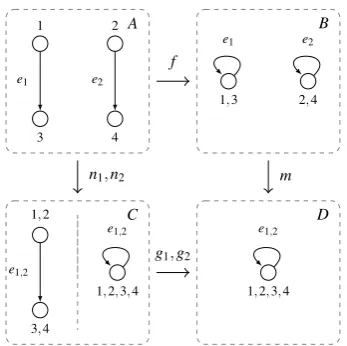
A B
C D
f
n1,n2 m
g1,g2
1 2
3 4
e1 e2
1,2
3,4
e1,2
1,2,3,4 1,2,3,4
e1 e2
e1,2
1,2,3,4
e1,2
(a) optional edge fusion
A B
C D
f
n1,n2 m
g1,g2
1 2
3 4
e1 e2
1,3 2,4
e1 e2
1,2
3,4
1,2,3,4
e1,2
e1,2
1,2,3,4
e1,2
(b) mandatory edge fusion
Figure 1: Examples of edge fusions
mandatory for any possible morphismnresulting in only two possible pushout complements. To compute the number of possibilities in the general case we first have to consider any possible equivalences on edges and then the problem can be solved using the results of Section5.3.
LetV be the node set andE the edge set of the graph on which≡f and≡g0 are defined. Note
that both equivalences are pairs consisting of one equivalence on nodes and one on edges. Taking into account the connection between these equivalences, we defineind(≡)as an equivalence on the node setV for an equivalence≡on the edge setE as the induced equivalence on the nodes, i.e. two nodes are equivalent if and only if there are equivalent edges connected to the two nodes at the same index. Any equivalence we want to consider is coarser than this equivalence.
The computation of all possibilities can be divided into the sum of all possibilities assuming a valid equivalence on edges. Although each summand corresponds to a different equivalence on edges, the equivalence on nodes can be the same. For each such equivalence≡E we have to take
into account the induced equivalence on nodes ind ≡E
before calculating the actual equiva-lences. UsingPart ind ≡E
instead of the node set is equivalent to requiring that any possible equivalence must be coarser thanind ≡E
. For this≡V
f has to be extended toPart ind ≡
E
such that two elements ofPart ind ≡E
are equivalent iff they contain some equivalent nodes. We combine these ideas in the following proposition.
Proposition 7 The number of equivalences on a graph such that the equivalence closure with
≡f (on nodes and edges) results in ≡g0, which corresponds to the number of pushout comple-ments for given morphisms f,m, can be computed by the following formula:
∑
≡E∈Eq coll
≡E f,≡Eg0
Eqcoll
≡Pf(≡E),≡Pg0(≡E)
where ≡Ph(≡E) for h∈ {f,g0} is the equivalence ≡V
h lifted to the induced partition P(≡ E) =
Part ind ≡E
on nodes, i.e.:
X1≡
P(≡E)
h X2⇔ ∃Z∈Part
ind(≡E)∪ ≡V h
:X1⊆Z∧X2⊆Z for X1,X2∈Part ind ≡E
Example3 In the following we apply the above formula to the graphs and morphisms shown below. A B D f m 1 2 3 4 5 e1 e2 e3
1,2
3
4,5
e1,2
e3
1,2,3 4,5
e1,2,3
All edges are equivalent according to≡g0 and onlye1ande2are equivalent according to≡f
re-sulting in three possible equivalences on the edges. These equivalences are listed below together
with their induced equivalence on the nodes and their lifting of≡f and≡g0. We denote the set
containing the nodes1and2byS1,2to indicate that these sets are no longer seen as sets but as
objects (i.e. nodes) for later calculation.
Part ≡V f
={{1,2},{3},{4,5}} Part
≡V g0
={{1,2,3},{4,5}}
• Case 1:
Part ≡E1
={{e1,e2,e3}} Part
≡P(≡E1)
f
={{S1,2,3},{S4,5}}
P(≡E1) ={S1,2,3,S4,5} Part
≡P(≡E1)
g0
={{S1,2,3},{S4,5}}
In this case every equivalence class of≡P(≡E1)
g0 contains only one element, hence nothing
can be merged and only one equivalence is possible, because the edge fusions force the
nodes to be merged as well. The resulting pushout complement is then identical to D,
wheren=m◦f andgis the identity.
• Case 2:
Part ≡E
2
={{e1,e3},{e2}} Part
≡P(≡E2)
f
={{S1,3,S2},{S4,5}}
P(≡E
2) ={S1,3,S2,S4,5} Part
≡P(≡E2)
g0
={{S1,3,S2},{S4,5}}
Any valid equivalence can relateS1,3andS2but need not because they are already related
by ≡P(≡E2)
f . Nothing can be merged in the second class of ≡
P(≡E
2)
g0 , hence there are two
C1
1,3
2
4,5
e1,3
e2
C2
1,2,3 4,5
e1,3
e2
• Case 3:
Part ≡E3
={{e1},{e2,e3}} Part
≡P(≡E3)
f
={{S1,S2,3},{S4,S5}}
P(≡E3) ={S1,S2,3,S4,S5} Part
≡P(≡E3)
g0
={{S1,S2,3},{S4,S5}}
For{S1,S2,3}equivalence is similar to that of case two. AdditionallyS4andS5can either
be merged or not merged resulting in four different equivalences.
All in all we get seven possible equivalences on nodes and edges resulting in seven different pushout complements.
6
Conclusion
We have shown how to construct pushout complements when both given morphisms might be non-injective. Such a construction is necessary for performing backwards analysis and com-puting the set of predecessors of a given graph. We have implemented this construction (in a tool that performs backwards search in well-structured transition systems, based on [7]) and we presented the optimizations that we used in the implementation.
We gave some result on combinatorics that illustrate the potential combinatorial explosion in the number of pushout complements for an arbitrary pair f,mof morphisms. The computations needed to compute this number are quite involved and we tried to simplify the formulas as much as possible. It is unclear whether any further simplification or an easier theory is feasible.
Furthermore it is an open question whether the construction could be transferred to a more categorical setting, similar to [1].
Acknowledgements:We would like to thank Benjamin Braatz for our discussions on this topic.
Bibliography
[1] Benjamin Braatz, Ulrike Golas, and Thomas Soboll. How to delete categorically - two pushout complement constructions. Journal of Symbolic Computation, 46(3):246–271, March 2011.
[3] H. Ehrig, R. Heckel, M. Korff, M. L¨owe, L. Ribeiro, A. Wagner, and A. Corradini. Algebraic approaches to graph transformation—part II: Single pushout approach and comparison with double pushout approach. In G. Rozenberg, editor, Handbook of Graph Grammars and Computing by Graph Transformation, Vol.1: Foundations, chapter 4. World Scientific, 1997.
[4] H. Ehrig, M. Pfender, and H. Schneider. Graph grammars: An algebraic approach. InProc. 14th IEEE Symp. on Switching and Automata Theory, pages 167–180, 1973.
[5] Hartmut Ehrig. Introduction to the algebraic theory of graph grammars. InProc. 1st Inter-national Workshop on Graph Grammars, pages 1–69. Springer-Verlag, 1979. LNCS 73.
[6] Annegret Habel, J¨urgen M¨uller, and Detlef Plump. Double-pushout graph transformation revisited. Mathematical Structures in Computer Science, 11(5):637–688, 2001.
[7] Salil Joshi and Barbara K¨onig. Applying the graph minor theorem to the verification of graph transformation systems. InProc. of CAV ’08, pages 214–226. Springer, 2008. LNCS 5123.
[8] Yasuo Kawahara. Pushout-complements and basic concepts of grammars in toposes. Theo-retical Computer Science, 77:267–289, 1990.