Volume 54 (2012)
Proceedings of the
7th International Workshop on Graph Based Tools
(GraBaTs 2012)
Visual Modeling and Analysis of EMF Model Transformations
Based on Triple Graph Grammars
Claudia Ermel, Frank Hermann, J¨urgen Gall and Daniel Binanzer
12 pages
Guest Editors: Christian Krause, Bernhard Westfechtel
Managing Editors: Tiziana Margaria, Julia Padberg, Gabriele Taentzer
Visual Modeling and Analysis of EMF Model Transformations
Based on Triple Graph Grammars
Claudia Ermel1, Frank Hermann2, J ¨urgen Gall1and Daniel Binanzer1
1Institut f¨ur Softwaretechnik und Theoretische Informatik, TU Berlin, Germany
[email protected],[email protected],[email protected]
2Interdisciplinary Center for Security, Reliability and Trust, Universit´e du Luxembourg
Abstract:The tool HENSHINis an Eclipse plug-in supporting visual modeling and execution of rule-based EMF model transformations. This paper describes the re-cent extensions of HENSHINby a visual editor for triple graph grammars (TGGs). The visual editor (called HENSHINTGG) supports a compact visualization of triple rules in an integrated editor panel. Internally, triple graph rules are represented as HENSHINrules and can be simulated using the HENSHINEMF model transforma-tion engine. Our extension supports the automatic generatransforma-tion of forward translatransforma-tion rules for transforming source into target models. A converter from HENSHINTGG rules to the graph transformation analysis tool AGG allows a systematic check for conflicts of forward translation rules in AGG based on critical pair analysis.
Keywords:EMF, model transformation tool, triple graph grammar, Henshin
1
Introduction
Model transformations play an important role in model driven development. In graph transfor-mation based approaches and tools, rules express basic transfortransfor-mation steps. In particular, triple graph grammars (TGGs) [Sch94] are a formal technique to specify and reason about bidirec-tional model transformations. Using graph triples, the relations of source and target models is specified declaratively, by mapping the elements of a correspondence model to corresponding elements of the source and target model. A TGG describes how consistent graph triples are de-rived synchronously by applyingtriple rules. From such a TGG, so-calledoperational rulescan be derived automatically to perform unidirectional forward or backward model transformations. TGGs have shown to be a suitable formal basis for model transformations and to reason about properties such as correctness, completeness, or functional behaviour [HEGO10,EEHP09].
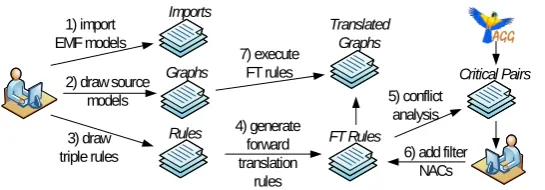
1) import EMF models
Imports
3) draw triple rules
Rules
2) draw source models
Graphs
4) generate forward translation
rules
FT Rules Translated
Graphs
7) execute FT rules
5) conflict analysis
Critical Pairs
6) add filter NACs
Figure 1: Workflow overview of using HENSHINTGG for EMF model transformation
HENSHIN is an Eclipse plug-in supporting visual modeling and execution of EMF model transformations, i.e., transformations of models conforming to a meta-model given in the EMF
Ecoreformat.1 The transformation approach is based on algebraic graph transformation ac-cording to the double pushout (DPO) approach [EEPT06] which are lifted to EMF model trans-formation by also taking containment relations in meta-models into account [BET12,ABJ+10].
Structure of the Paper: We present our visual TGG editor inSec. 2and describe the genera-tion of forward translagenera-tion rules based on [HEGO10] inSec. 3. An example for a conflict analysis of forward translation rules converted to AGG based on critical pairs is presented inSec. 4, while Sec. 5explains the automatic EMF model translation. InSec. 6, we compare related approaches and tools to our tool and conclude the paper with an outlook to future work.
2
The Visual TGG Editor
Using triple graph grammars [Sch94], models are defined as pairs of source and target graphs, which are connected via a correspondence graph together with its embeddings into these graphs. In this section, we review main constructions and results of model transformations based on TGGs and introduce our visual TGG editor HENSHINTGG.
A triple graphG=(GS←−s−G GC−−t→G GT)consists of three graphsGS,GC, andGT, called source,
correspondence, and target graphs, together with two graph morphismssG:GC→GSandtG:
GC→GT. A triple graph morphismm= (mS,mC,mT):G→H between triple graphsGandH
consists of three graph morphismsmS:GS→HS,mC:GC→HC andmT :GT→HT. A typed
triple graphGis typed over a triple type graphTGby a triple graph morphismtypeG:G→TG.
Example 1 (Triple Type Graph) Fig. 2 shows the type graph TG of the triple graph gram-marTGGfor our example model transformation from class diagrams to database models. The source component TGS defines the structure of class diagrams while in the target component
the structure of relational database models is specified. Classes correspond to tables, attributes to columns, and associations to foreign keys. Morphisms starting at a correspondence part are indicated by dashed arrows.
The HENSHINTGG editor uses EMF models as type graphs and EMF instance models
con-1Note that we use the termsmeta-modelandmodelin this paper, which are calledEMF modelandmodel instance
TGS TGC TGT
Figure 2: Triple type graph forCD2RDBMas triple EMF model
1
2 3
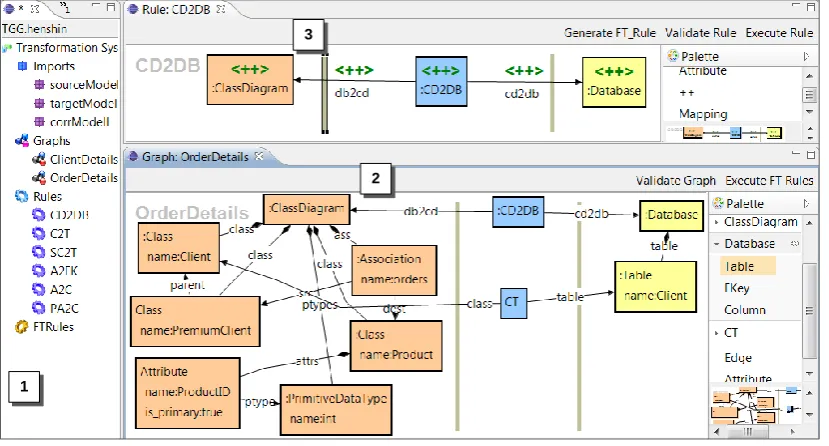
Figure 3: Graphical user interface of the visual TGG editor
forming to the respective EMF models as typed (attributed) graphs2. The three EMF models in Fig. 2have been edited outside the visual TGG editor using the graphical GMF editor for EMF, but any other EMF model editor or generator can be used as well. The morphisms are imple-mented as references between the types of the three different EMF models. EMF models are imported into the visual TGG editor which enables the use of previously produced EMF models. The names of the three imported EMF modelssource, correspondenceandtargetthat comprise the triple type graph, are shown in the top compartmentImportsof the tree view 1 inFig. 3.
Once a triple type graph is available (i.e., the three EMF models have been imported), triple graphs typed over this type graph may be edited, e.g. for modifying inputs and intermediate
states when testing model transformations3. The visual TGG editor supports editing of triple graph nodes and edges by offering the available types in the palette of the triple graph panel 2. Only triple graphs conforming to the triple type graph can be created. Moreover, only source triple graph elements (colored in red) can be created and modified in the left-hand part of the editor, correspondence graph elements (blue) in the center, and target graph elements (yellow) in the right part. The separators between the different triple panels can be moved using the mouse. Morphisms from correspondence to source and target elements are drawn as edges across the separators. Fig. 3shows a sample triple graphOrderDetailscontaining a complete source part (the class diagram) but incomplete corresponding target and correspondence graphs.
(LS trS
L LC
sL
oo
trC
tL //
LT) trT
(RS
R
tr
RC sR
oo
tR //RT)
L
m
tr //
R
n
(PO)
G
t //H
Figure 4: Triple rule (left) and triple transformation step (right)
Triple graphs can be generated by applyingtriple rulesto the start graph. Triple rules syn-chronously build up their source, target and correspondence graphs, i.e., they are non-deleting. A triple ruletr(left part ofFig. 4) is an injective triple graph morphismtr= (trS,trC,trT):L→R
and w.l.o.g. we assumetrto be an inclusion. Given a triple graph morphismm:L→G, a triple graph transformation (TGT) step G===tr,m⇒ H (right part of Fig. 4) from Gto a triple graph H is given by a pushout of triple graphs. A grammarTGG= (TG,S,TR) consists of a triple type graphTG, a triple start graphS=∅and a setTRof triple rules.
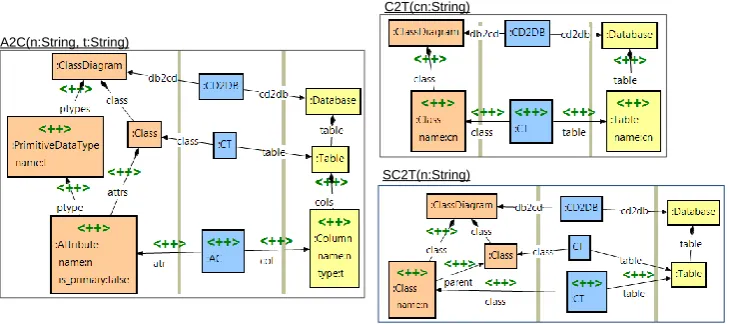
C2T(cn:String)
SC2T(n:String) A2C(n:String, t:String)
Figure 5: Some rules for the model transformationCD2RDBM (HENSHINTGG screenshots)
Example2 (Triple Rules) The triple rules shown inFig. 5are part of the rules of the grammar TGG for the model transformationCD2RDBM. In HENSHINTGG, triple rules are drawn in
3Moreover, the triple graph editor can be used for resolving inconsistencies within a future extension of the tool to
short notation, i.e. left and right hand side of a rule are depicted in one triple graph. Elements which are created by the rule are labeled by ”++”. RuleCD2DB(see 1 inFig. 3) synchronously creates a class diagram together with the corresponding database. Analogously, ruleC2Tcreates a class with name “n” together with the corresponding table in the relational database. A subclass is connected to the table of its superclass by rule SC2T. Attributes with type “t” are created together with their corresponding columns in the database component via ruleA2C.
The visual HENSHINTGG editor for triple rules consists of three panel parts like the visual
triple graph editor (see 3 inFig. 3). But in addition to the triple graph editor, the rule editor palette offers a green ”++” to mark elements as created (and to unmark marked elements if necessary). Note that HENSHINTGG checks triple rules for consistency at editing time, i.e. if a node is ”++”-marked, all incident edges are marked automatically, as well.
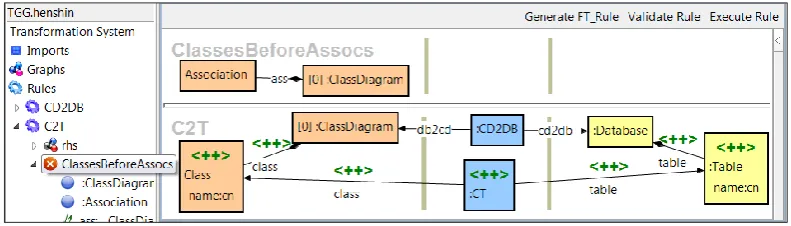
Figure 6: Triple ruleC2Twith NACClassesBeforeAssocs
HENSHINTGG supports negative application conditions for triple rules that forbid the pres-ence of certain structures when applying a rule [EEHP09,GEH11]. A visual NAC editor can be opened via the tree view and consists of a three-panel triple graph editor again. A rule may have several NACs, the one to be shown in the visual NAC editor has to be selected in the tree view. Fig. 6shows ruleC2T with an additional NAC that forbids the synchronous creation of a class and a table if there are associations in the class diagram. The morphism from the rule to one of its NACs is indicated by equal numbers for mapped nodes (inFig. 6, theClassDiagramnode is mapped to the NAC). Edges are mapped accordingly automatically. The rule palette entry Map-pingsupports the definition of a mapping from the triple rule to a NAC. Note that only unmarked elements (without ”++”) can be mapped to NAC elements, a consistency property which is also checked automatically by the editor.
A triple rule can be applied by clicking the buttonExecute Rule in the rule’s tool bar (the upper right corner inFig. 6), and selecting the graph the rule should be applied to. The result is shown in the view of the selected graph.
3
Generation of Forward Translation Rules
(LS trS ∅ oo //∅)
(RS oo ∅ //∅)
source ruletrS
(∅
∅
oo
//LT)
trT
(∅oo ∅ //RT)
target ruletrT
(RS id
LC trS◦sL
oo
trC
tL//
LT) trT
(RS RC
sR
oo tR//
RT)
forward ruletrF
(LS trS
LC sL
oo
trC
trT◦tL//
RT) id (RS RC
sR
oo tR //
RT)
backward ruletrB
Figure 7: Derived operational rules of a TGG
According to [HEGO10], the extension of forward rules toforward translation rulesis based on additional Boolean attributes for all elements in the source component, called translation attributesthat control the translation process by keeping track of the elements which have been translated so far. This ensures that each element in the source graph is translated at most once.
The algorithm for constructing forward translation rules from triple rules is as follows (see [HEGO10] for its formal definition): For each triple ruletr, initialize the forward translation rule trFT =trF by the forward ruletrF. Add an additional Boolean attribute isTranslatedto each
source element (node, edge or attribute) oftrFT. In the left-hand side oftrFT, for each source
element, the value of theisTranslatedattribute is set to falseif the element is generated by the source ruletrS oftr, otherwise it is set totrue. In the right-hand side oftrFT, the value of all
isTranslatedattributes is set totrue. For all source elements in NACs, the attributeisTranslated is set totrueas well.
Note that in contrast to forward translation rules, pure forward rules need additional control conditions, such as the source consistency condition in [EEHP09], to ensure correct execu-tions. In HENSHINTGG, forward translation rules are computed automatically. The translation attributes for nodes and edges4 are kept separately as an external pointer structure in order to keep the source model unchanged. In the source graph editor panel of a forward translation rule, all elements that are still to be translated are marked by a ”<tr>” tag.
Figure 8: Forward translation ruleFT SC2T generated from triple ruleSC2T
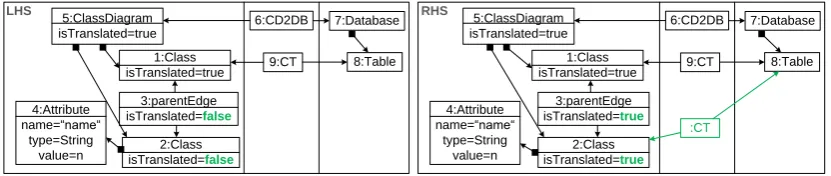
Example3 (Forward translation rule) Fig. 8shows the forward translation ruleFT SC2T gen-erated from triple ruleSC2T. The Classnode and its incident edge are marked by a ”<tr>” tag as to be translated, since these model elements correspond to the model elements generated by the source rule of triple ruleSC2T.
4:Attribute name=“name“ type=String value=n 1:Class isTranslated=true 2:Class isTranslated=false 3:parentEdge isTranslated=false 5:ClassDiagram isTranslated=true 6:CD2DB 7:Database 8:Table 4:Attribute name=“name“ type=String value=n 1:Class isTranslated=true 2:Class isTranslated=true 3:parentEdge isTranslated=true 5:ClassDiagram isTranslated=true 6:CD2DB 7:Database 8:Table 9:CT 9:CT :CT RHS LHS
Figure 9: RuleFT SC2T in abstract HENSHINsyntax
Forward translation rules can be edited in a restricted visual triple rule edtior which allows for a manual extension of additional NACs. All other rule editor operations are blocked because forward translation rules are generated automatically and should not be changed manually.Fig. 9 shows the abstract syntax of the forward translation ruleFT SC2TfromFig. 8, as it is represented in HENSHIN, where left-hand and right-hand sides of a rule are kept separately, with morphisms
inbetween. We can see how the translation attributes of source elements are switched fromfalse
totrue.
For matching, we internally keep two tables (hashmaps) “TranslatedNodes” und “Translated-Edges” based on the IDs of the elements of an EMF instance model. These tables are constructed and updated dynamically during transformation execution. A match is valid if for each matched element we have one of the following cases: 1) its translation attribute is true and its ID is present in the corresponding table of translated elements, or 2) its translation attribute isfalse
and its ID is not present in the corresponding table of translated elements.
4
Conflict Analysis Based on AGG
According to [HEGO10], a forward translation sequenceG0= tr∗FT
==⇒Gnis calledcompleteifGnis
completely translated, i.e. all translation attributes ofGnare set to true. A model transformation
based on forward translation rules with NACs (consisting of a source graphGS, a target graph
GT, and a complete forward translation sequence G0= trFT∗
==⇒Gn) is terminating if each forward
translation rule changes at least one translation attribute fromfalsetotrue; it iscorrectif each forward translation results in a triple graph that can be generated by triple rules, and it iscomplete if for each source graph there is a forward translation sequence that results in a triple graph that can be generated by triple rules.
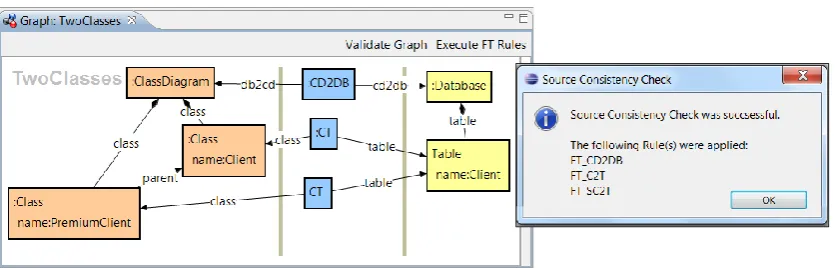
However, not all terminating forward translation sequences are complete. A counter example is a forward translation rule sequence applied to the triple graph TwoClasses consisting of a parent class namedClientand a subclass namedPremiumClient connected to classClientby a parentedge (see source graph inFig. 10).
Figure 10: Incomplete forward translation sequence:parentedge could not be translated
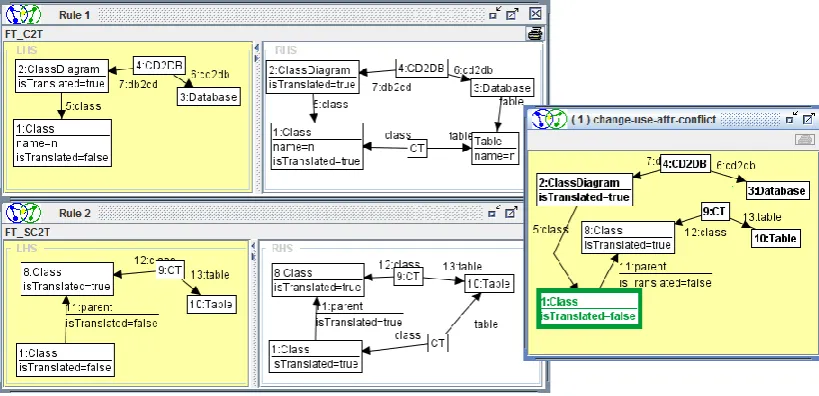
In HENSHINTGG, elements that could not be translated are reported as error message in the triple graph panel showing the (partial) translation result (see Fig. 10). This allows the user to reason about possible conflicts between rule applications. The reason why theparent edge was not translated by the given forward translation sequence is a conflict between rule FT C2T (applied to class PremiumClient) and FT SC2T which could not be applied to class PremiumClientafter the application of ruleFT C2T.
In order to ensure completeness in the general case, the execution of model transforma-tions may require backtracking (not implemented in HENSHINTGG). However, as shown in [HEOG10], backtracking is not necessary, if the significant critical pairs between transfor-mation rules are strictly confluent and the system is terminating, i.e., a system satisfying this condition does not have to be confluent in the general sense. HENSHINTGG implements a converter from triple rules in HENSHIN to the graph transformation analysis tool AGG, which
provides a critical pair analysis engine. A critical pair is a conflict between two rules in minimal context and it is significant, if the overlapping graph can be embedded in a possible intermediate state of a model transformation sequence. In particular, it is not significant if a fragment in the source component cannot be embedded into a valid source model due to language constraints.
Fig. 11shows the (only) critical pair between the rulesFT C2TandFT SC2T as depicted by the AGG critical pair analyzer. In the window to the right, the critical overlapping graph of both rules’ left-hand sides is shown, and it is indicated that we have achange-use-attrconflict, since both rules want to access and change theisTranslatedattribute of the subclass.
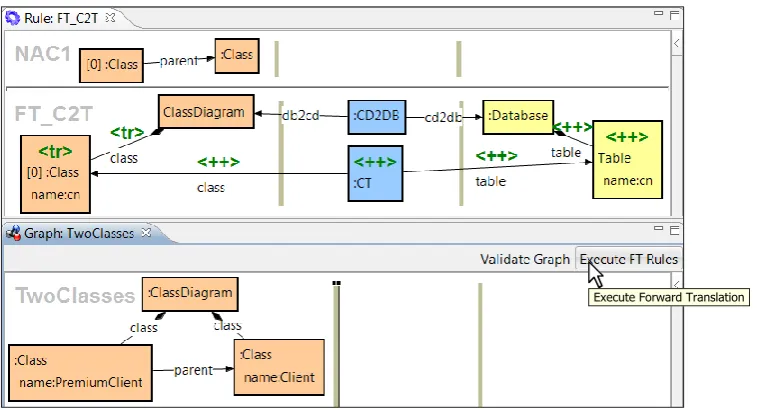
In order to avoid the conflict shown inFig. 11, the easiest way is to add a NAC to ruleFT C2T that forbids its application to classes which have a parent class. According to [HEGO10], such additional conflict-avoiding NACs are called filter NACs and can be generated automatically. Note, however, that the generation of filter NACs is not yet supported by HENSHINTGG.
5
Performing Model Transformation in H
ENSHINTGG
Using a set of confluent forward-translation rules, we can be sure to always get a complete forward translation sequence, i.e., all elements are translated and the result is unique. The upper part of Fig. 12shows rule C2T, now extended by a filter NAC. With this extension, the set of forward-translation rules now is confluent, since there are no critical pairs any more.
Execute Forward Translation
Figure 12: RuleFT C2T with filter NAC (top) and input graphTwoClasses(bottom)
Figure 13: Result of the Forward Translation of Source ModelTwoClasses
6
Related Work and Conclusion
General model transformation tools such as ATL [JABK08] and MOMENT2-MT [MOM12] are usually used to perform in-place model transformations and do not restrict the structure of transformation rules. Thus, they do not ensure TGG-specific properties like preservation of source models [Sch94] and syntactical correctness and completeness [EEHP09]. Moreover, the forward and backward transformations are manually specified and not generated from a single specification. While ATL and MOMENT2-MT use textual specification techniques, graph transformation tools like HENSHIN(in-place) [ABJ+10] and FUJABA [Fuj12] offer the visual specification of transformation rules, i.e., a form of visual programming interface.
In addition to HENSHINTGG, further TGG tools based on EMF are available. The TGG
in-terpreter [GK10] provides a feature to define OCL expressions as rule conditions, while formal application conditions cannot be specified. However, the formal results concerning correctness and completeness [EEHP09] are not available for systems with OCL conditions. The TGG tools MOTE (model transformation engine) [GW09] and eMoflon [ALPS11] perform a compilation to the FUJABA tool suite [BGH+05,Fuj12] for the execution of model transformations. While eMoflon supports the specification of TGGs with negative application conditions (NACs), this is not the case for MOTE. MOTE offers certain optimization strategies concerning efficiency. Since correctness cannot be ensured for optimizations, the tool executes dynamic run-time checks to validate that a model transformation sequence was executed correctly [GHL12]. Moreover, MOTE uses a relaxed notion of correspondences for triple graphs, where correspondence nodes may link an arbitrary numer of source and target nodes [GHL12].
handled separately by one rule [HEEO12], and the second condition excludes the well-studied case study on the object relational mapping [EEHP09] used in this article. The tool was extended by a prototypical export [GHL12] of so-called bookkeeping rules to AGG for conflict analysis, but it does not provide re-import and evaluation.
HENSHINTGG is based on the formal definitions for TGGs [Sch94, EEHP09, HEGO10] and supports conflict analysis via the converter to AGG. The explicit marking of edges over-comes the restriction in [GHL12] that rules are required to create at least one node. The implementation of a re-import feature for displaying and evaluating the critical pairs is work in progress. HENSHINTGG allows the user to manually use the analysis and optimizations
tech-niques presented in [HEGO10] in order to improve efficiency. The automated generation of filter NACs [HEGO10] can be implemented as a direct extension and is future work. A further line of future work is the extension of the tool to support also backward transformations, model synchronization [HEEO12], critical pair analysis directly in the HENSHINGUI, and the import of EMF instances. Moreover, we plan to use HENSHINTGG within an industrial case study for software translation for satellite systems and in further case studies to evaluate the results concerning correctness and efficiency.
References
[ABJ+10] T. Arendt, E. Biermann, S. Jurack, C. Krause, G. Taentzer. Henshin: Advanced Con-cepts and Tools for In-Place EMF Model Transformations. InProc. 13th Int. Conf. on Model Driven Engineering Languages and Systems (MoDELS’10). LNCS 6394, pp. 121–135. 2010.
[AGG12] TFS-Group, TU Berlin. AGG. 2012.http://tu-berlin.de/tfs/agg.
[ALPS11] A. Anjorin, M. Lauder, S. Patzina, A. Sch¨urr. eMoflon: Leveraging EMF and Pro-fessional CASE Tools. In INFORMATIK 2011. Lecture Notes in Informatics 192, p. 281. Gesellschaft f¨ur Informatik, 2011. Extended abstract.
[BET12] E. Biermann, C. Ermel, G. Taentzer. Formal Foundation of Consistent EMF Model Transformations by Algebraic Graph Transformation.Software and Systems Model-ing (SoSyM)11(2):227–250, 2012.
[BGH+05] S. Burmester, H. Giese, M. Hirsch, D. Schilling, M. Tichy. The Fujaba Real-Time Tool Suite: Model-Driven Development of Safety-Critical, Real-Time Systems. In Proc. 27th Int.. Conf. on Software Engineering (ICSE). 2005.
[EEHP09] H. Ehrig, C. Ermel, F. Hermann, U. Prange. On-the-Fly Construction, Correctness and Completeness of Model Transformations based on Triple Graph Grammars. In Proc. 12th Int. Conf. on Model Driven Engineering Languages and Systems (MOD-ELS’09). LNCS 5795, pp. 241–255. Springer, 2009.
[Fuj12] University of Paderborn. Fujaba Tool Suite. 2012.http://www.fujaba.de/.
[GEH11] U. Golas, H. Ehrig, F. Hermann. Formal Specification of Model Transformations by Triple Graph Grammars with Application Conditions.ECEASST 39, 2011.
http://journal.ub.tu-berlin.de/index.php/eceasst/issue/archive
[GHL12] H. Giese, S. Hildebrandt, L. Lambers. Bridging the gap between formal seman-tics and implementation of triple graph grammars.Software and Systems Modeling, pp. 1–27, 2012.http://dx.doi.org/10.1007/s10270-012-0247-y.
[GK10] J. Greenyer, E. Kindler. Comparing relational model transformation technologies: implementing Query/View/Transformation with Triple Graph Grammars.Software and Systems Modeling (SoSyM)9(1):21–46, 2010.
[GW09] H. Giese, R. Wagner. From model transformation to incremental bidirectional model synchronization.Software and Systems Modeling (SoSyM)8(1), 3 2009.
[HEEO12] F. Hermann, H. Ehrig, C. Ermel, F. Orejas. Concurrent Model Synchronization with Conflict Resolution Based on Triple Graph Grammar. InProc. Intern. Conf. on Fun-damental Aspects of Software Engineering (FASE’12). LNCS. Springer, 2012.
[HEGO10] F. Hermann, H. Ehrig, U. Golas, F. Orejas. Efficient Analysis and Execution of Correct and Complete Model Transformations Based on Triple Graph Grammars. In Proc. Int. Workshop on Model Driven Interoperability (MDI’10). Pp. 22–31. ACM, 2010.http://doi.acm.org/10.1145/1866272.1866277.
[HEOG10] F. Hermann, H. Ehrig, F. Orejas, U. Golas. Formal Analysis of Functional Behaviour of Model Transformations Based on Triple Graph Grammars. In Ehrig et al. (eds.), Proc. Int. Conf. on Graph Transformation (ICGT’ 10). LNCS 6372, pp. 155–170. Springer, 2010.
[JABK08] F. Jouault, F. Allilaire, J. B´ezivin, I. Kurtev. ATL: A model transformation tool. Science of Computer Programming72(1-2):31 – 39, 2008.
[KLKS10] F. Klar, M. Lauder, A. K¨onigs, A. Sch¨urr. Extended Triple Graph Grammars with Efficient and Compatible Graph Translators. InGraph Transformations and Model Driven Enginering. LNCS 5765, pp. 141–174. Springer, 2010.
[LAVS12] M. Lauder, A. Anjorin, G. Varr´o, A. Sch¨urr. Bidirectional Model Transformation with Precedence Triple Graph Grammars. In Proc. of the 8th European Conf. on Modelling Foundations and Applications. LNCS. Springer, 2012. Accepted.
[MOM12] University of Leicester. MOMENT2-MT. 2012. http://www.cs.le.ac.uk/people/ aboronat/tools/moment2-gt/.