PRECONCENTRATION AND RECOVERY OF PESTICIDES
FROM SOIL AND WATER BY DISPERSIVE LIQUID-LIQUID
EXTRACTION
Rajib Joarder,
[a]Dhiman Santra,
[a]Srimanta Marjit
[a]and Mitali Sarkar
[a]*Keywords: Dispersive liquid-liquid microextraction; soil; water; pesticides; UV-Vis spectrophotometry
A simple method for the extraction and preconcentration of pesticides such as imidacloprid, flusilazole and atrazine from soil and water using dispersive liquid-liquid microextraction (DLLME) was described. The process was optimized by suitable selection of dispersive and extraction solvent. The sample was extracted by methanol (dispersive solvent) containing chloroform (extraction solvent) (3:7, v/v). Important factors such as the volume of extraction solvent, equilibration time, pH, and ionic strength were studied. pH and ionic strength found to have, significant influence for recovery and enrichment of solute. Extraction recovery value was found to be 98, 81 and 92 % respectively from water sample. The corresponding enrichment factor was found to be 742.01, 613.28 and 696.57 for imidacloprid,
flusilazole and atrazine, respectively. The process was applied for extraction and recovery of the pesticides from soil and water system.
* Corresponding Authors
E-Mail: [email protected]
[a] Department of Chemistry, University of Kalyani, Kalyani 741 235, West Bengal
Introduction
With the advent of chemical technology and synthesis of new materials some plant protecting chemicals are designed for the development of agricultural products. One among the classes is classified in different ways in terms of their origin, use or action popularly herbicide, fungicide and insecticide are collectively called as pesticides. Although the use of pesticide can be considered as one of the prime factors for green revolution their persistence in the environment poses a threat to the ecological balance. The interaction of pesticides with environmental parameters in addition may results in the alteration of their physicochemical properties. The pesticides as such or theirs residues and degradation products1,2 may generate the toxicity with high residence
times in different compartment of the ecosystem such as soil, water and organisms. Migration of pesticides into ground water via soil layers has serious consequences on the ecological balance.3-6
The identification and trace level determination of pesticide and residue becomes a challenging task to the analytical chemists. The enrichment of pesticides via separation and removal demands a high sensitive, selective and precise technique with wide range of applications.
The common chromatographic techniques such as HPLC,7-15 GC,16-19 capillary electrophoresis (CE)20-22 and
thin layer chromatography are applied for the determination of pesticide from different sample such as water, soil, food and vegetables. Among the well known enrichment techniques liquid-liquid extraction (LLE)23-25 and solid
phase extraction (SPE)13,26,27 have some disadvantages viz.
use of large volume of toxic organic solvent and generation
of secondary pollutants respectively. Dispersive liquid-liquid extraction as an extension of liquid-liquid-liquid-liquid extraction utilizes extraction and dispersive solvent which are introduced in the aqueous solute sample. A very small volume of solvent requirement, quick equilibration time and high extraction efficiency makes the process very useful. The large contact surface area of immiscible phase assists the transfer of solute yielding high extraction efficiency while very small volume (μL) of extraction solvent ensures high enrichment factor.28-37
In the present communication the dispersive liquid-liquid extraction of imidacloprid, flusilazole and atrazine as the representative of insecticide, fungicide and herbicide respectively is described. The process was optimized for different operational variables such as nature and volume of dispersive and extraction solvent, time of equilibration, pH and ionic strength of the solution. The effect of different salts on the extraction efficiency and enrichment of the solute from water was determined. The applicability of process was judged from the extraction of solute from soil and water sample. Almost quantitative extraction (>80 %) and high enrichment factor (>630) offers the process quite applicable for trace analysis from complex matrices.
E
xperiment
al
Reagents and materials
Instrumentation
A Shimadzu model UV-2401 PC UV-Vis recording spectrophotometer with quartz cells was used for recording absorption spectra. All spectral measurements were performed using the blank solution as reference. A Rotofix centrifuge was used to accelerate the phase separation process. Measurement of solution pH was done by Systronic digital pH meter. A Cecil (CE 4201) HPLC coupled with UV-Vis detector was used for analysis of the solutes.
Extraction procedure
For the DLLME, 5.0 ml of aqueous sample was placed in a 10 ml screw cap glass test tube with conical bottom. In a typical experiment 0.3 ml of methanol (as disperser solvent) containing 0.7 ml chloroform (as extraction solvent) were rapidly injected into the sample solution and the mixture was gently shaken. A cloudy solution was formed when the solute in the water sample was extracted into fine droplets. The mixture was centrifuged for 5 min at 4000 rpm and CHCl3 was sedimented in the bottom of the conical test tube.
The upper phase was withdrawn by a micropipette. The sediment phase was diluted to 6 ml using MeOH and the solute was analysed.
Critical parameter for extraction
In order to judge the feasibility and find out the extent of extraction two critical parameters viz. enrichment parameter and recovery parameter are of prime importance. The enrichment parameter (EP) may be defined as the ratio of analyte concentration in the sediment phase (Csed) to the
initial concentration of the analyte (C0) as,
(1)
The recovery parameter (RP) is defined as the fraction of solute transferred to the sediment phase, and is expressed in percentage as,
(2)
where,
Vsed and V0 are the volume of sediment phase and
aqueous phase, respectively.
Wsed and W0 are the amount of solute in sediment and
aqueous phase respectively.
On combining equation (1) and (2) EP and RP can be correlated as,
(3)
Results and Discussion
Dispersive liquid-liquid extraction (DLLE) as an extension and improvement of conventional liquid-liquid utilizes a pair of solvents viz dispersive (DS) and extraction solvent (ES). Solute initially dissolved in aqueous phase if put in such a pair will tend to distribute between DS and ES in an equilibrium fashion depending on the nature as well as solubility criteria of the solute in the chosen pair of solvents. The mutual miscibility and density difference of DS and ES makes the phase separation effective .The factors that govern the extraction (both the extent and efficiency) are the nature and volume of DS and ES, time of equilibration, pH and ionic strength of the solution. Thus, optimization of the operational variables constitutes the first step of DLLE.
Influence of type and volume of dispersive solvent
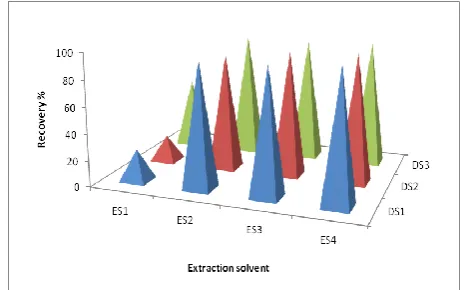
The dispersive solvent is essentially be miscible with both the aqueous and extraction solvent. Further, it must disperse ES as very fine droplets in aqueous phase. In the present study acetone (DS1), methanol (DS2), and acetonitrile (DS3) were chosen as the DS. A typical experiment was performed using 0.3 vol. of each DS containing 0.7 vol. of a definite ES. Five replicate tests were performed for each combination of DS-ES to improve the precision of the operation.
Figure 1. Effect of extraction solvent on the extraction recovery of imidacloprid.
The result indicates that CH3CN (DS3) acts as the
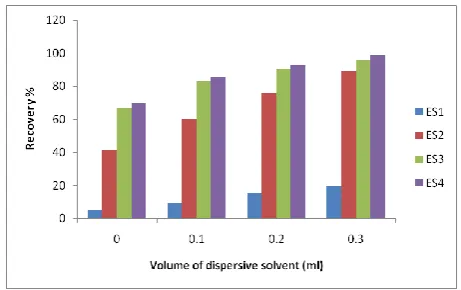
effective DS (Fig. 1) for imidacloprid. As the volume of DS is found to influence the formation of cloudy solution (aqueous-DS-ES) the optimization of the volume of DS is essential to maximize the degree of dispersion and extraction efficiency. The volume of DS was varied from 0.1 ml to 0.3 ml for a fixed volume 0.7 ml of ES.
In the typical study the extraction behavior of imidacloprid is illustrated for CH3CN as DS and C2H4Cl4 as
ES.
sed
0
C
C EP
sed sed sed
0 0 0
100W 100C V
RP
W C V
sed
0
100V
RP EP x
V
It is found that for a fixed volume of ES, percent recovery increases with increasing volume of DS which then decreases with further volume of DS. The optimum volume of CH3CN was chosen as 0.3 ml. At low volume DS cannot
disperse ES properly and inhibits formation of the cloudy solution which results incomplete or poor extraction. On the other hand the solubility of imidacloprid in water increases as volume of DS increases. Similar trend is observed by changing either the ES or DS and for each combination a fixed optimum volume is needed to maximize the extraction. Again, different solutes show similar but distinct behavior.
Figure 2. Effect of the volume of acetonitrile (DS) on the extraction recovery of imidacloprid
Influence of type and volume of extraction solvent
In order to achieve the transfer of solute to ES the solute must have higher solubility in ES compared to that in water. The hydrophobicity and higher density, low solubility in water and the formation of the stable ternary phase system are the important parameters for selection of ES. Owing to the high density chlorinated solvents such as CCl4 (ES1),
CH2CL2 (ES2), CHCl3, (ES3) and C2H4Cl4 (ES4) are found
to be the potential ES. In order to study the effect of the ES volume on the efficiency of the solute transfer the volume of the ES was varied (0.1-0.7 ml) for a fixed volume (0.3 ml) of a definite DS. It is inferred that high density solvents are effective due to quick settling at the bottom of the test tube. It is found that extraction increases with increase of volume of the extraction solvent for a fixed volume of the dispersive solvent.
Figure 3. Effect of the volume of tetrachloroethane (ES) on the extraction recovery of imidacloprid
Figure. 3. demonstrates a typical situation for C2H4Cl4 as
ES for extraction of imidacloprid using acetone (DS1), methanol (DS2) and acetonitrile (DS3) as dispersive solvent.
However, the volume requirement of ES and extraction efficiency vary with change of the DS. Similar situation arises for a fixed DS and varying ES (Figure .2).
Effect of pH
The important parameters governing extraction with variation of solution pH are (a) solubility and (b) stability of the solute due to ionization. It is found (Figure .4) that with increase in pH the extraction of imidacloprid increases, reaches a maximum and decreases subsequently. The pH corresponding to maximum recovery is taken as the optimum pH for extraction.
Figure 4. Effect of pH on the extraction recovery of imidacloprid
The extraction extent and pattern of the solute has distinct character in respect to variation of solution pH for a fixed combination of ES-DS. Figure 4. describes the pH effect of imidacloprid for C2H4Cl4 as ES with CH3CN as DS. The
optimum pH was found to be 6, 10 and 5, for imidacloprid, flusilazole and atrazine, respectively.
Effect of the extraction time
In order to have the present operation effective the solute transfer from aqueous to the extraction phase must be fast and thermodynamically feasible. The DLLE can be thought of as a two steps process viz,
(a) transfer of solute from aqueous to ES in an equilibrium fashion and
(b) formation of solute rich sediment phase.
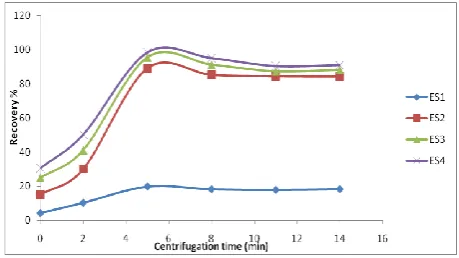
It is expected that as the surface area between the aqueous and extraction solvent (in presence of DS at the cloudy state) is appreciably high the extraction is quite rapid and the equilibrium is reached within a very short time. Thus, aqueous-DS cloud formation and sedimentation of solute rich phase improves the efficiency of the said process. With CH3CN as the DS, extraction profile of imidacloprid is
presented in Figure 5.
Figure 5. Effect of centrifugation time on the extraction recovery of imidacloprid
The effect of ionic strength
The ionic strength of the solution has some important influence governing the extraction efficiency. The ionic strength of the solution was varied by adding different salts of varying concentration. With salt addition the aqueous phase solubility of the extraction solvent and the solute will change affecting the extractability. It is found that the volume of the sediment phase and the extraction extent depend on the nature of the added electrolyte. Presence of chloride, sulfate, and carbonate typically decreases aqueous solubility of both the ES and the solute due to salting out effect. Thus, volume of sediment phase and the solubility of the solute in ES increase resulting EP decrease and RP
increase. The extent of EP and RP vary with the nature of ES in presence of salt. The lower the lyotropic number of the salt, pronounced is the effect. In a typical study NaCl, KCl, KNO3, (NH4)2SO4, were examined. The carbonate salt
was avoided due to the possibility of solution pH change. In all the cases electrolyte concentration was kept at 1x10⁻³ M.
It is found that recovery percent increases in the order,: (NH4)2SO4 > KNO3 > KCl > NaCl. However, the volume of
the sediment phase does not change appreciably with variation of electrolyte.
Table 1. Characteristic features for DLLE.
Parameters Compounds
Imida-cloprid
Flusi-lazole
Atra-zine Limit of detection, LOD,
μg L–1
0.1 0.08 0.05
Limit of quantification, LOQ, μg L –1
0.3 0.24 0.15
Linear range, LR, μg L–1 0.1-100 0.1-100 0.1-100 Correlation coefficient (r) 0.9924 0.9981 0.9944 Intra-day precision*, RSD % 2.1 2.9 2.7 Inter-day precision*, RSD % 3.8 4.2 4.0 Recovery Prameter, RP % 98 80.59 91.81 Enrichment Parameter, EP 742 610.18 695.13 *Five replication
The concentration of (NH4)2SO4 was next varied from 10-2
to10-4 M. It is found that volume of sediment phase
increased from 25 to 28.5 μl and RP increased from 80.49 to 98.56 % corresponding to salt concentration of 10-3 M. In all
subsequent experiment the salt concentration was kept at 10 -3 M.
Efficiency of the method
At the optimized condition the analytical characteristics of the method, such as limit of detection (LOD), limit of quantification (LOQ), linear range (LR), correlation coefficient (r), repeatability (intra-day precision), reproducibility (inter-day precision), recovery parameter, (RP) and enrichment parameter (EP) are shown in Table 1.
The feasibility of the process was evaluated from the free energy change of the process.
Application of the method
The DLLE described so far was applied for the recovery of the studied pesticides from soil and water samples. Each sample was analysed 5 times and the results are presented as the mean.
Table 2. Recovery of imidacloprid, flusilazole and atrazine from soil and water.
Compounds Sample Conc., μg L–1
(mean ± SD#)
Recovery, % (mean ± SD#)
Imidacloprid soil 11.7 ± 0.02 96.8 ± 0.05 water 4.1 ± 0.02 97.8 ± 0.04 Flusilazole soil 20.1 ± 0.01 78.2 ± 0.05 water 1.5 ± 0.02 79.7 ± 0.04 Atrazine soil 27.8 ± 0.02 90.5 ± 0.04 water 3.1 ± 0.01 90.9 ± 0.03
# standard deviation
Acknowledgment
The authors sincerely acknowledge the assistance and support received from the UGC-SAP, FIST and DST-PURSE programs. One of the authors (RJ) is thankful to the UGC for providing Teacher fellowship.
References
1Liu, W.-P., Zheng, W., Ma, Y. and Liu, K. K., J. Environ. Sci.
Health B, 2006, 41, 623-634.
2Yu, S., Qin, D., Wu, Q., Guo, X., Han, L. and Jiang, S., Bull.
Environ. Contam. Toxicol., 2011, 86, 319–322.
3Pang, G.-F., Fan, C.-L., Liu, Y.-M., Cao, Y.-Z, Zhang, J.-J., Fu,
B.-L., Li, X.-M., Li, Z.-Y. and Wu, Y.-P., Food Addit. Contam., 2006, 23, 777–810.
4Lehotay, S. J., De Kok, A., Hiemstra, M. and Van Bodegraven, P.,
J. AOAC Int., 2005, 88, 595–614.
5Anagnostopoulos, C., Bourmpopoulou, A. and Miliadis, G., Anal.
Lett., 2013, 46, 2526–2541.
6Liu, H., Song, J., Zhang, S., Qu, L., Zhao, Y., Wu, Y. and Liu, H.,
Pest Manag. Sci., 2005, 61, 511-514.
7Mauldin, R. E., Primus, T. M., Buettgenbach, T. A., John, J.,
Johnston, J. J. and Linz, G. M., J. Liq. Chromatogr. R. T., 2006, 29, 339–348.
8Kumar, P., Singh, S. P., Shrikant, K. and Madhukar, D., Turk. J.
9Kukusamude, C., Santalad, A., Boonchiangma, S., Burakham, R.,
Srijaranai, S. and Chailapakul, O., Talanta, 2010, 81, 486– 492.
10Zhang, Q., Zhu, L., Han, C., Wang, J., Xie, H., Wang, J. and Sun,
S., J. Food Agric. Environ.,2011, 9, 659-662.
11Wang, Y., You, J., Ren, R., Xiao, Y., Gao, S., Zhang, H. and Yu,
A., J. Chromatogr. A, 2010, 1217, 4241–4246.
12Rancan, M., Rossi, S. and Sabatini, A. G., J. Chromatogr. A,
2006, 1123, 60–65.
13Wang, P., Yang, X., Wang, J., Cui, J., Dong, A. J., Zhao, H. T.,
Zhang, L. W., Wang, Z. Y., Xu, P, Li, R. B., Zhang, W. J., Zhang, Y. C. and Jing, H., Food Chem., 2012, 134, 1691– 1698.
14Chen, L., Chen, J. M. and Xia, F. L., Agro-environ. Protect.,
2002, 21, 150–152.
15Farouk, M., Hussein, L. A. A. and Azab, N. F. E., Intern. J.
Environ. Anal. Chem., 2014, 94, 194-209.
16Wang,C., Qiu, L., Zhao, H., Wang, K. and Zhang, H., Environ.
Monit. Assess., 2013, 185, 9169–9176.
17Zang, X., Wang, J., Wang, O., Wang, M., Ma, J., Xi, G. and
Wang, Z., Anal. Bioanal. Chem., 2008, 392, 749–754.
18Amvrazi, E. G. and Tsiropoulos, N. G., J. Chromatogr. A, 2009,
1216, 2789–2797.
19Faria, A. M., Dardengo, R. P., Lima., C. F., Neves, A. A. and
Queiroz, M. E. L. R., Inter. J. Environ. Anal. Chem., 2007,
87, 249–258.
20Pico, Y., Rodríguez, R. and Mañes, J., Trends Anal. Chem.,2003,
22, 133-151.
21Simpson Jr, S. L., Quirino, J. P. and Terabe, S., J. Chromatogr.
A, 2008, 1184, 504–541.
22Palmer, J., Munro, N. J. and Landers, J. P., Anal. Chem., 1999,
71, 1679–1687.
23Xie, S., Paau, M. C., Li, C. F., Xiao, D. and Choi, M. M. F., J.
Chromatogr. A, 2010, 1217, 2306–2317.
24Lambropoulou, D. A. and Albanis, T. A., J. Biochem. Biophys.
Methods, 2007, 70, 195–228.
25Jansson, C., Pihlstrom, T., Oterdahl., B. G., and Markides, K. E.,
J. Chromatogr. A, 2004, 1023, 93–104.
26Stajnbaher, D. and Zupancic-Kralj, L., J. Chromatogr. A, 2003,
1015, 185–198.
27Watanabe, E., Baba, K. and Eun, H., J. Agric. Food Chem., 2007,
55, 3798–3804.
28Rezaee, M., Assadi, Y., Milani Hosseini, M. R., Aghaee, E.,
Ahmadi, F. and Berijani, S., J. Chromatogr. A, 2006, 1116, 1–9.
29Wang, Y., You, J., Ren, R., Xiao,Y., Gao, S., Zhang, H.and Yu.,
A., J. Chromatogr. A, 2010, 1217, 4241–4246.
30Zacharis, C. K., Rotsias, I., Zachariadis, P. G.and Zotos, A., Food
Chem., 2012, 134, 1665–1672.
31Qiao, F., Zhang, X., Wang, M. and Kang, Y., Chromatographia,
2010, 72, 331–335.
32Wu, Q., Li, Z., Wang, C., Wu, C., Wang, W. and Wang, Z.,
Foods Anal. Meth., 2011, 4, 559–566.
33Zhang, S., Yang, X., Yin, X., Wang, C. and Wang, Z., Food
Chem., 2012, 133, 544–550.
34Jovanov, P., Guzsvány, V., Franko, M., Lazić, S., Sakač, M.,
Šarić, B. and Banjac, V., Talanta, 2013, 111, 125–133.
35Campillo, N.,Viñas, P., Férez-Melgarejo, G. and
Hernández-Có rdoba, M., J. Agric. Food Chem., 2013, 61, 4799−4805.
36Vichapong, J., Burakham, R. and Srijaranai, S., Talanta, 2013,
117, 221–228.
37Pirsaheb, M., Fattahi, N., Shamsipur, M. and Khodadadi, T., J.
Sep. Sci., 2013, 36, 684–689.