ISSN-L: 2501 - 1235 Available on-line at: www.oapub.org/edu
doi: 10.5281/zenodo.2745181 Volume 5 │ Issue 8 │ 2019
FASTEST BOWLING DELIVERY IS ASSOCIATED WITH SELECTED
KINEMATIC FACTORS IN JUNIOR PACE BOWLERS
Abhijit Thander1i, Shambhu Saran Prasad2
1Assistant Professor Department of Physical Education
Visva-Bharati, Santiniketan, India 2Research Scholar Department of Physical Education
Visva-Bharati, Santiniketan, India
Abstract:
The purpose of this study was to determine whether there are significant relation exists between ball release velocity and kinematics factors when bowls fastest delivery by U-19 pace bowlers. 10 male injury free junior pace bowlers (18.1±0.94 years) were enrolled from Ghazipur, Uttar Pradesh and filmed in an outdoor turf pitch (20.12 mtrs.) having sufficient area for run-up by four HD video cameras of 50 Hz and 60 fps frame rate were positioned at sagittal and frontal plane at a distance of 11 mtrs. For the digitization of data Kenovea 8.24 was used. The Pearson Product Moment Method was calculated through IBM-SPSS 20. The result of the study shows that fastest ball release velocity has a positive significant association (0.638); inverse significant association 0.747) and (-0.666,) among the shoulder angle at ball release, run-up velocity and trunk lateral flexion (TLF) respectively. In conclusion, kinematic factors like shoulder angle, run-up velocity and trunk lateral flexion are important issues to generate ball speed in junior pace bowlers.
Keywords: fastest delivery, kinematic factors, pace bowlers, cricket
1. Introduction
Batting against fastest bowling is always a matter of trusting on instincts. Every fast bowler tries to release the ball as faster as they can to surprise the batsman. Increasing bowling speed is not only relies on having good fitness level, but also on having a sound technique. To have an overall sound bowling technique can assist to bowl faster.
The mechanical aspects which develop the bowling speed without increasing the possibility of harms will better train and prepare pace bowlers to gain the art of pace bowling. This paper will analyze the mechanical principles of fast bowling predominantly on the bowling technique of junior pace bowlers when they deliver the fastest ball in their respective spell. This paper will highlight the principles of the pace bowling sequence (the run-up, delivery stride, and release). This paper will show how the fastest delivery is facilitated by kinematic factors. These influencing factors of fast bowling technique may have a relationship with the fastest delivery bowls by the pace bowlers and as limited research has been attempted to establish this fact the researcher carry out this study to find out the association between the two significant factors in pace bowling. The study was delimited to five (N=10) male U-19 players age ranged between (14- 19) years of Ghazipur, U.P. The bowling technique was recorded in two planes only.
2. Methods
For the purpose of study 10 male U-19 fast-medium pace bowlers (mean ball release speed 30.43±4.03 m/s) of Uttar Pradesh were selected as the subject for the study. Their age range was 14- 19 years. The subjects were selected from Uttar Pradesh Cricket under 19 cricket team from different clubs at random who at least played for state level.
2.1 Pre-Testing
Prior to the beginning of the experimental protocol subjects standing heights and weights were measured by using stadiometer, weighing machine and history of injury information were taken from the bowlers.
2.2 Experimental Protocol
Prior to the vigorous bowling trials, the subjects were under a specific warm-up protocol of pace bowling. In the dynamic bowling trials, the subjects were asked to bowl and were instructed to give their best possible performance to hit a target area as viewed from the bowler’s end. The subjects were bowled two sets of six deliveries; a slight gap between the two sets was given to create real match situations. The bowlers have bowled deliveries at their normal match pace, where they were instructed to bowl a very fast delivery at their own, which is the bowler’s fastest possible delivery speed. The selected deliveries which are ‘very fast’ were be used for analysis.
3. Data Collection
3.1 Filming Procedures
plane of all cameras and such that at least two cameras may track these landmarks throughout the delivery stride.
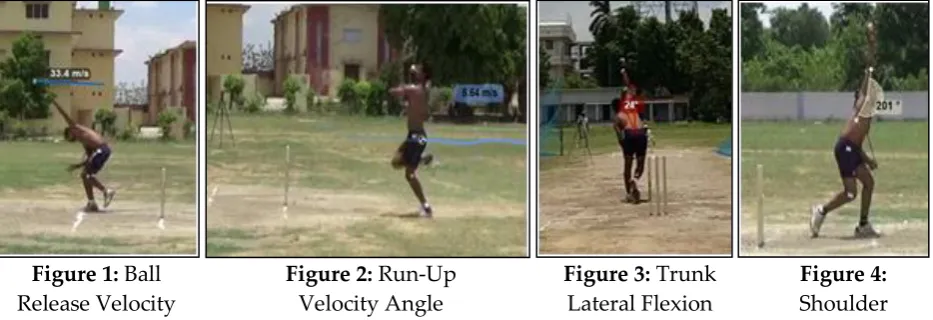
Figure 1: Ball Release Velocity
Figure 2: Run-Up Velocity Angle
Figure 3: Trunk Lateral Flexion
Figure 4: Shoulder
3.2 Analytical Procedure used
Descriptive statistics were applied to test the homogeneity of the pace bowlers; Pearson’s product moment correlations were calculated and used to identify the associations between each dependent variable and fastest ball velocity. For testing hypothesis, the level of significance will be set at 0.05.
4. Result and Discussion
General and anthropometric characteristics of the subjects at baseline were presented below.
Table 1: General and Anthropometric Characteristics of the Junior Pace Bowlers (N=10)
Sl.No Variables Mean±SD
1 Age (yrs.) 18.1±0.94
2 Height (cm) 1.70±0.02
3 Weight (kg) 57.8±5.38
4 BMI (kg/m2) 19.82±1.92
Table 2: Mean Correlations (R) for Fastest Ball Release Velocity and Kinematic Variables
Kinematic variables Range Mean±SD Coefficient (r)
Approach run (m/s) 4.12-5.32 4.76±0.67 -0.747*
Knee angle at back-foot strike (deg.) 149-173 156.8±6.89 -0.211 Knee angle at front-foot strike (deg.) 158-177 166±6.30 -0.368 Front knee angle at ball release (deg.) 156-179 166.6±7.25 -0.53
Ball release height (mt.) 1.78-2.14 1.93±0.08 -0.494
Trunk lateral flexion (deg.) 36-47 39.56±3.01 -0.666*
The result of the study shows that the mean value of the fastest deliveries (n=10; 34.2 m/s ± 2.84) was shown to be negatively significant relation (-0.747, p <0.05) with the approach run and positive significant associations were also found between fastest ball release velocity and shoulder angle at ball release (0.638, p<0.05). There was a moderately high but not significant positive relationship was found between ball release height and fastest ball release velocity (Table 2). However, significant negative relationships were also found (-0.666, p<0.05) between trunk lateral flexion (TLF) and ball release velocity in the fastest bowling velocity.
5. Discussion
The result of the present study shows that the fastest velocity category and Approach Velocity have a significant inverse relationship which seems that lesser run-up velocity bowlers can bowl at higher ball release velocities. The previous findings were in agreement with the results of Brees (1989), as cited by Bartlett et al. (1996) where they found a negative correlation between run-up velocity and accuracy, suggesting that bowlers adopt a self-regulated run-up velocity that aids in producing optimal ball release velocity and accuracy. Increasing running speed throughout the run-up on the approach to the wicket is links into Newton’s second law. This law states that ‘The acceleration of an object is proportional to the net force acting on it and inversely proportional to the mass of the object’ (Blazevich, 2012). Brees (1989), stated that bowlers decreasing or increasing their run-up velocity depending on the required delivery intensity. Further the result of the study shows significantly negative correlation between ball release velocity and trunk lateral flexion (TLF) when bowlers bowl the fastest delivery and shows a less fell away laterally have remained capable to bowl at higher ball release velocities, the findings are in agreement with previous the study of Kane J. Middleton, Bruce C. Elliott, Jacqueline A. Alderson, 2009 who also found significantly moderate inverse association between faster ball release velocity and TLF.
6. Recommendations
Further research can be done in the same topic with different with larger subjects of male and female cricketers and also can be done with spin bowling. This research could be useful to the coaches of both genders in identifying the areas in which more efforts needed in developing junior pace bowlers.
7. Conclusion
Based on the result and the limitation of the study it may be concluded that:
1) A quicker run-up velocity has a significant impact on faster ball release velocity. 2) Less trunk lateral flexion can support faster ball release speed as well as
decreased the risk lower back injury.
3) Increased shoulder angle at ball release can facilitate the fastest bowling delivery.
References
Bartlett, R., Stockill, N., Elliott, B., & Burnett, A. (1996). The biomechanics of fast bowling in men's cricket: A review. Journal of Sports Sciences, 14(5), Pp 403-424. Blazevich, A., (2012), ‚Sports biomechanics, the basics: Optimising human performance,
A & C Black, Pp 44-202.
Brees A. J. (1989) A cinematographical analysis of the effect of varying the run-up speed on ball release velocity, accuracy and body kinematics of fast bowling in cricket. Unpublished undergraduate dissertation, Crewe and Alsager College of Higher Education.
Burden A. M. (1990) An electromyographical and cinematographical analysis of fast-medium bowling in cricket. Unpublished Master’s thesis, University of Salford. Davis, K., and Blanksby, B. (1976). A cinematographic analysis of fast bowling in
cricket. Australian Journal for Health, Physical Education and Recreation, 71(suppl.): 9-15.
Elliott B. C., Foster D., Gray S. (1986) Biomechanics and physical factors affecting fast bowling. Aust J Sci Med Sport; 18:16–21.
Elliott, B., Plunkett, D. and Alderson, J. (2005). The effect of altered pitch length on performance and technique in junior fast bowlers. Journal of Sports Sciences, 23, 661-667.
Elliott, B. C. (2000). Back injuries and the fast bowler in cricket. Journal of Sports Sciences, 18, 983- 991.
Ferdinands R., Marshall R. N., Kersting U. (2010) Centre of mass kinematics of fast bowling in cricket. Sports Biomech; 9:139–152. PubMed doi:10.1080/14763141.2010. 523844.
Foster D., John D., Elliott B., Ackland T., Fitch K. (1989) Back injuries to fast bowlers in cricket: A prospective study. Br J Sports Med.; 23:150–154. PubMed doi:10.1136/ bjsm.23.3.150.
Glazier P. S., Paradisis G. P., Cooper S. M. (2000) Anthropometric and kinematic influences on release speed in men’s fast-medium bowling. J Sports Sci.; 18: 1013–1021. PubMed doi:10.1080/026404100446810.
Middleton, K., Chauhan, P., Elliott, B., & Alderson, J. (2009). The velocity dependence of techniques commonly linked with lower back injury in cricket fast bowling. In ISBS-Conference Proceedings Archive (Vol. 1, No. 1).
Worthington, P. J., King, M. A., & Ranson, C. A. (2013). Relationships between fast bowling technique and ball release speed in cricket. Journal of applied biomechanics, 29(1), 78-84.
Thandar, A., & Khan, M. (2017). A study on front foot placement and its effect on bowling action in cricket. IJAR, 3(6), 578-580.
Creative Commons licensing terms