STRUCTURE AND SPECTROSCOPY OF
3-CHLORO-4-FLUORO-1,2,5-THIADIAZOLE
Bálint Pacsai
[a], Gábor Vass
[a], and Tibor Pasinszki
[a]*Keywords: thiadiazoles, ionization energy, infrared spectroscopy, photoelectron spectroscopy, IR, UPS, DFT, ab initio.
3-Chloro-4-fluoro-1,2,5-thiadiazole has been synthesized and investigated in the gas phase by IR spectroscopy and UV photoelectron spectroscopy. The ground-state geometry of the neutral molecule has been obtained from quantum-chemical calculations using the B3LYP/aug-cc-pV(T+d)Z method. Ionization potentials have been determined and the electronic structure has been discussed within the frame of molecular orbital theory. IR and photoelectron spectroscopies, supported by quantum-chemical calculations at the B3LYP and SAC-CI/aug-cc-pV(T+d)Z levels, provide a detailed investigation into the vibrational and electronic character of the molecule.
* Corresponding Author Fax: (+36)-1-372-2909 E-Mail: [email protected]
[a] Department of Inorganic Chemistry, Institute of Chemistry, Eötvös Loránd University of Sciences, Budapest, Pázmány Péter sétány 1/A, H-1117, Hungary.
1. Introduction
1,2,5-Thiadiazoles are important compounds in various fields of chemistry and biology due to their potential use as synthetic precursors, drugs in human medicine, agricultural protectors, organic conductors, and components of solar cells.1,2 In addition, small derivatives received attention
re-cently as precursors of reactive nitrile sulfide intermediates in photochemical processes.3 The physical and chemical
properties of the thiadiazole moiety can be finely modified by substituents attached to the thiadiazole ring, thus studying substituent effects is important in context of novel applications.
Small 1,2,5-thiadiazoles, mainly the symmetrically substituted derivatives (X2C2N2S, where X= H, halogen,
cyano, or alkyl), have been studied earlier.4–9 The geometry
of the dihydrogen and dichloro derivatives have been deter-mined experimentally by microwave spectroscopy4 and
electron diffraction,5,6 and the equilibrium geometries of the
dihydrogen, difluoro, dichloro, dimethyl, and dicyano derivatives have been calculated by quantum chemical methods.6,7,8,9 The structures of ionic states, considering the
three lowest energy cationic states, have also been com-puted.7 According to experiments and theory, the neutral
thiadiazoles and the investigated radical cations have planar equilibrium structures. The vibrational and electronic properties of small 1,2,5-thiadiazoles have been studied by IR and Raman spectroscopies,9, 10 and UV photoelectron
spectroscopy.7 Studies on unsymmetrically substituted
thiadiazoles (XYC2N2S, where X≠Y) are relatively rare. The
chloro and methyl derivatives (XHC2N2S, where X= Cl or
CH3) are known and the chloro derivative has been studied
by IR/Raman11 and photoelectron12 spectroscopies.
3-Bromo-4-chloro-1,2,5-thiadiazole, 13
3-iodo-4-chloro-1,2,5-thiadiazole,13 and 3-chloro-4-fluoro-1,2,5-thiadiazole14
have been synthesized, but their structures have not been thoroughly investigated by any experimental or theoretical means to date. The NMR data and IR band positions, supplementing the synthesis, have been published. 13,14
In this work we present the gas-phase characterization of 3-chloro-4-fluoro-1,2,5-thiadiazole molecule and an investi-gation of its electronic and geometric structure by quantum-chemical methods and gas-phase spectroscopy. The latter includes He I and He II ultraviolet photoelectron spectros-copy (UPS) and mid-infrared (IR) spectrosspectros-copy.
2. Experimental section
3-Chloro-4-fluoro-1,2,5-thiadiazole was synthesized by modifying a known literature procedure14 as follows. 10 g
(64.5 mmol) 3,4-dichloro-1,2,5-thiadiazole and 4.5 g (77.6 mmol) anhydrous KF were suspended in 20 ml sulfolane and the mixture was refluxed overnight using an oil bath temperature of 180 ºC. Volatiles were then removed by distillation using vigorous stirring and an oil bath temperature of 200 ºC. 4.6 g raw product was obtained, which contained only small amounts of the side product difluoro and dichloro derivatives. Pure 3-chloro-4-fluoro-1,2,5-thiadiazole was obtained by distillation using a short Vigreoux column. The product (3.6 g, yield 40 %) is a colourless liquid with a boiling point of 109 °C at atmospheric pressure. 13C-NMR (CDCl
3, 301 K): 133 ppm
(C(Cl), d, 2J
CF 163 Hz), 157 ppm (C(F), d, 1JCF 1106 Hz). 19F-NMR (CDCl
3): –99 ppm.
NMR spectra of 3-chloro-4-fluoro-1,2,5-thiadiazole were recorded on a Bruker Avance 250 spectrometer using TMS and CFCl3 as internal references.
The IR spectrum (resolution 1.0 cm–1) of gaseous
KBr windows, gave a spectral range from 4000 to 400 cm–1.
The effluent from the sample container was pumped continuously through the cell using a rotary vacuum pump while maintaining the pressure at 0.8 mbar.
The He I and He II ultraviolet photoelectron spectra (UPS) of the gaseous thiadiazole derivative were recorded using an Atomki ESA-32 photoelectron spectrometer described in detail elsewhere.15 Photoelectron spectra were recorded
using the constant transmission energy mode of the electron energy analyzer and were calibrated with the Ar+(2P
3/2,1/2)
spin-orbit doublet. The resolution of the analyzer was 30 meV in He I measurements (fwhm for the Ar 2P
3/2 line).
During the He II measurements the resolution of the electron energy analyzer was lowered to 80 meV (fwhm for the Ar
2P
3/2 line) in order to gain higher electron count rates.
3. Computational methods
The geometry of the ground state neutral molecule was calculated using the B3LYP method and harmonic vibrational frequencies were obtained to identify the structure as real minimum (zero imaginary frequencies) on the potential energy surface. The stability of B3LYP wave function was checked, and B3LYP wave function was found to be stable. Infrared intensities were calculated using the harmonic force field. Anharmonic vibrational wavenumbers were calculated at the B3LYP level within the framework of second-order vibrational perturbational theory. Vertical ionization energies (IEs) were calculated using the Symmetry Adapted Cluster/Configuration Interaction (SAC-CI) method using the geometry obtained at the B3LYP level. Calculations were done using the aug-cc-pVTZ basis set on C, F, N, and O atoms and aug-cc-pV(T+d)Z on Cl and S. Only valence electrons were correlated in SAC-CI calculation. All calculations were performed with the GAUSSIAN-09 quantum chemistry package.16 References
to original theoretical methods are listed in the program package manual.17 For characterization of the normal
vibra-tional modes of 3-chloro-4-fluoro-1,2,5-thiadiazole, the total energy distribution (TED), which provides a measure of the internal coordinate contributions, was determined.18
4. Results and discussion
4.1. Calculated equilibrium structure
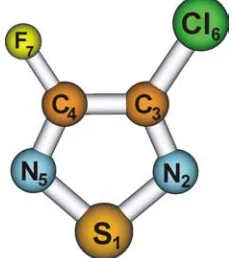
Calculated structural data of 3-chloro-4-fluoro-1,2,5-thiadiazole is presented in Table 1 and the structure and numbering of atoms are shown in Figure 1. According to calculation, the molecule is planar and has CS symmetry.
The local C2v symmetry of the thiadiazole ring is distorted
due to unsymmetrical substitution by fluorine and chlorine atoms. The CN bond on the fluorine side is shorter than the CN bond connected to the chlorine atom. This is in agreement with the calculated structure of the difluoro and dichloro derivatives.7 In general, bond lengths of the
chloro-fluoro-derivative are between those of difluoro and dichloro derivatives. Bond orders can be calculated using the Gordy’s rule19 and by comparing the calculated bond lengths of the
3-chloro-4-fluoro-1,2,5-thiadiazole with those of molecules having typical single/double CC, CN, and NS bonds (H3C–
CH3(1.527 Å)/H2C=CH2(1.325 Å), H3C–NH2(1.464 Å)/
calculated at the B3LYP/aug-cc-pV(T+d)Z level). C–N bonds, nominally double bonds, are between a single and a double bonds (bond order 1.76–1.81), and C–C and N–S bonds, nominally single bonds, are shorter than a C–C or N– S single bond (bond order 1.43 and 1.46, respectively). This tendency to bond order equalization is in agreement with the aromaticity of thiadiazoles.
Figure 1. Structure of 3-chloro-4-fluoro-1,2,5-thiadiazole and numbering of atoms
Table 1. Calculateda equilibrium structure of
3-chloro-4-fluoro-1,2,5-thiadiazole
bond lengths / Å bond angles /º S1–N2
N2–C3 C3–C4 C4–N5 N5–S1 C3–Cl6
C4–F7
1.642 1.305 1.430 1.296 1.643 1.714 1.321
S1N2C3 N2C3C4 C3C4N5 C4N5S1 N5S1N2 C4C3Cl6 C3C4F7
107.0 113.1 115.1 106.2 98.6 123.9 123.1
aCalculated at the B3LYP/aug-cc-pV(T+d)Z level. See Figure 1 for
numbering of atoms.
4.2. Gas-phase IR spectrum
The IR spectrum of gaseous 3-chloro-4-fluoro-1,2,5-thia-diazole is shown in Figure 2 with calculated and experi-mental vibrational wavenumbers listed in Table 2. IR bands of the molecule have been noted before14 and are in general
accord with the data given here. The calculated wave-numbers and IR intensities are in good agreement with experiment and support the band assignments. The calculated values indicate that twelve of the fundamentals should give rise to infrared bands above the 400 cm–1 cutoff
of the instrument used in this experiment, however, two of them are not observed due to low IR intensity.
Using the calculated B3LYP/aug-cc-pV(T+d)Z rotational constants of 3-chloro-4-fluoro-1,2,5-thiadiazole, the asym-metry parameter κ is –0.52 and thus the molecule is a prolate asymmetric rotor (ρ*= 1.36 and β= 1.03). The nonlinear planar structure, belonging to the CS molecular point group,
results in the species having fifteen normal modes of vibration, eleven of which are in the molecular plane (a') and four which are out-of-plane (a"). All vibrational modes are infrared active. The experimental fundamentals of a' symmetry are of A-type, B-type, or A/B-hybrid type, while those of a" symmetry modes are C-type bands with pronounced Q-branches. Using the equations of Seth-Paul20
16 cm–1, respectively. In the gas-phase IR spectrum the PQR
structure is clearly observed on many bands. The experimental PR separations for all A, B, and A/B type bands are in the range of 8–11 cm–1, in good agreement with
the predicted separations, and C-type bands are easily identified by their strong Q branch, notably at 713 and 531 cm–1. The other two fundamentals of a" symmetry are not
observed due to their low wavenumbers (below our detection limit of 400 cm–1). Total energy distribution
(TED) of the normal vibrational modes indicates that vibrations are strongly mixed. Detailed assignment is given in Table 2, and the simplified assignment below is based on the major internal coordinate contribution.
The highest energy fundamental of 3-chloro-4-fluoro-1,2,5-thiadiazole is observed at 1527 cm–1. The
corres-ponding IR band shows a B-type band structure with PR separation of 8 cm–1 and is assigned to one of the CN
stretches. The second CN stretch, according to the calculation, must be assigned to the strong A/B type band at 1422 cm–1. The weak B type band at 1334 cm–1 and the
medium and weak A/B type bands at 873 and 813 cm–1 can
be unambiguously assigned to thiadiazole-ring stretches. The band at 1334 cm–1 has significant CC character and the
bands at 873 and 813 cm–1, especially the latter, have
dominant NS contribution. Molecules containing C–F bonds provide, in general, strong IR absorptions in the 1100 – 1300 cm–1 region due to CF stretches.21 In the case of
3-chloro-4-fluoro-1,2,5-thiadiazole, a strong A/B type band is observed in the IR spectrum at 1121 cm–1. Although the
cor-responding normal mode is strongly mixed (see TED), we assign this band to the CF stretch. The remaining four bands from very weak to weak at 768, 713, 599, and 531 cm–1
originate from in-plane and out-of-plane ring deformations.
Figure 2. Gas-phase IR spectrum of 3-chloro-4-fluoro-1,2,5-thiadiazole
Table 2. Experimental and calculated vibrational wavenumbers (cm–1) of 3-chloro-4-fluoro-1,2,5-thiadiazole Experimentala Calculatedb,c Intensityb,d Assignment and
description
TEDe 1527 s
1422 vs 1334 w 1121 Q, s 873 Q, m 813 w 768 Q (?), vw
713 Q, vw 599 Q, vw 531 Q, w
n.o. n.o. n.o. n.o. n.o.
1517 (1551) a' 1405 (1433) a' 1327 (1356) a' 1105 (1123) a' 860 (874) a' 804 (819) a' 765 (776) a' 726 (737) a" 597 (608) a' 536 (543) a" 503 (509) a' 411 (414) a' 312 (316) a" 215 (215) a' 197 (201) a"
80 210
39 96 48 22 0.3 2 9 16
3 1 0.02
0.2 0.1
ν1 C=N ring st
ν2 C=N ring st
ν3 C–C ring st
ν4 ip vibr (CF st)
ν5 N–S ring st
ν6 N–S ring st
ν7 ip ring bend
ν12 oop ring def
ν8 ip ring bend
ν13 oop ring def
ν9 ip CF bend
ν10 C–Cl st
ν14 oop CF wag
ν11 ip CCl bend
ν15 oop CCl wag
C4N5 st(60), N2C3 st(13), CF st(17) N2C3 st(51), CF st(22), CC st(16) CC st(37), N2C3 st(28), C4N5 st(21) r.b.(32), CF(23), CCl(19), C4N5(11), CC(11)
N5S1 st(59), ring bend(15), CF ip rock(11) S1N2 st(83)
ring bend(50), CC st(24) r.t.(45), CF oop wag(36), CCl oop wag(19)
r.b.(57), CF st(20), N5S1 st(15) r.t.(75), CF oop wag(12), CCl oop wag(12)
CF ip bend(45), CCl st(19) CCl(39), CF ip bend(14), r.b.(12), S1N2(11) CF oop wag(45), r.t.(24), CCl oop wag(22)
CCl ip bend(67), CF ip bend(21) CCl oop wag(48), r.t.(45) a Gas phase. Position of the most intense Q-band or the band centre is given. Abbreviations: s (strong), m (medium), w (weak), v (very). Additional very weak bands at 2648, 1244(Q) and 912 may belong to combination or overtone bands. b Calculated at the B3LYP/aug-cc-pV(T+d)Z level. Isotopes: 12C, 14N, 19F, 35Cl, 32S. Asymmetric top parameters: κ= –0.5165, σ = 7.2723. c Anharmonic vibrational wavenumbers. Harmonic wavenumbers are in parenthesis. d In km mol–1. Calculated using the harmonic force field. e Total vibrational energy distribution from force field analysis based on harmonic force constants. Contributions larger than 10% are provided.
Abbreviations: st (stretching), r.b. (ring bend), r.t. (ring torsion), wag (wagging), oop (out-of-plane), ip (in-plane), def (deformation).
4.3. He I and He II photoelectron spectra
The He I and He II photoelectron spectra of 3-chloro-4-fluoro-1,2,5-thiadiazole are shown in Figure 3, and experi-mental and calculated ionization energies are listed in Table 3. SAC-CI calculations for vertical IEs give good agreement with experiment. From the calculated IEs, from the comparison of the He I and He II spectra utilizing relative ratios of photoionization cross sections, and from the
comparison of the spectra of difluoro and dichloro derivatives,7 the assignment is relatively straightforward.
The ground state electronic structure of 3-chloro-4-fluoro-1,2,5-thiadiazole is 1A
1. The sequence of molecular orbitals
(MOs) deduced are
…..(8a')2(1a")2(9a')2(10a')2(2a")2(11a')2(12a')2(3a")2(13a')2
Molecular orbital plots are shown in Figure 3. A possible starting point to describe the electronic structure is to consider the MOs of a five-membered aromatic ring, modified with the two exocyclic fluorine and chlorine atoms. Three π orbitals, two nitrogen ‘lone pair’ orbitals (nN), one
on each N atom, and one sulfur ‘lone pair’ orbital (nS) can
be deduced from the thiadiazole moiety as low IE MOs, as well as five σ orbitals corresponding to five σ bonds of the ring. Ionization from some of these σ orbitals will produce photoelectron bands in the investigated IE region. These MOs are augmented, and mix to some extent, with MOs of substituents attached to the thiadiazole frame. The two nitrogen ‘lone pairs’ are best described as linear combi-nations, nN– and nN+. MO plots show that nN– is largely
localised on N atoms, and hence it is well described as ‘nitrogen lone pair’, but nN+ strongly mixes with nS. MOs in
general are far from localised (see Figure 3), but in order to keep discussion simple we use the notations above.
Figure 3. He I and He II photoelectron spectra of 3-chloro-4-fluo-ro-1,2,5-thiadiazole and schematics of the corresponding MOs
According to calculations, the first band in spectra at 9.97 eV can be unambiguously assigned to the π3 MO. This PE
band shows vibrational fine structure with a strong adiabatic transition. The band shape thus indicates a relatively small geometrical change due to ionization. The vibrational fine structure is not entirely resolved, but our best estimates indicate ionic vibrational wavenumbers of 1350±50 and 590±50 cm–1. These values, comparing to the wavenumbers
of the neutral molecule (see above), can be assigned to one of the ring stretches and one of the ring deformations of the ground state radical cation, respectively. The ionization energy of 3-chloro-4-fluoro-1,2,5-thiadiazole, 9.97 eV, is
between the IEs of the dichloro and difluoro analogue,7
which is in agreement with substituent effects of fluorine and chlorine atoms. The assignment of the next PE band at 11.66 eV is less straightforward. Calculations predict that ionization from nN– and π2 MOs requires similar energy, and
thus ionizations from two MOs are assigned to this PE band. The same situation has been observed in the spectra of difluoro and dichloro derivatives at 11.97 and 11.36 eV, respectively.7 We note that the n
N– and nCl MOs are strongly
mixed (see SAC-CI coefficients in Table 3 and MO plots in Figure 3), but the assignment of this and the third band at 12.33 eV is supported by the relative intensity change of the corresponding bands comparing the He I and He II spectra. The assignment of the third band to one of the chlorine lone pair MOs is unambiguous considering the relatively narrow band shape and the relative intensity in the He II spectrum. The next band at 13.21 eV with a shoulder at 13.0 eV is assigned to two MOs, the first the second nitrogen lone pair, nN+, and the second the second chlorine lone pair MO. The
next band at 13.99 eV is unambiguously assigned to nS. The
band has a vibrational fine structure, it is relatively strong in the He I spectrum, and its relative intensity is strongly reduced in the He II spectrum. All of these three characteris-tics have been observed in spectra of the parent and substitu-ted 1,2,5-thiadiazoles investigasubstitu-ted earlier.7 It is thus a
cha-racteristic band of 1,2,5-thiadiazoles in the 13–15 eV region.
Table 3. Experimental and calculateda vertical ionization energies
(eV) of 3-chloro-4-fluoro-1,2,5-thiadiazole
experimental SAC-CIb orbital
character 9.97c
11.66 12.33 (13.0) 13.21 13.99d
(14.3) 15.86 16.6 (17.4) 18.1
9.62 [0.98 (5a")]
11.13 [–0.76 (14a'), 0.58 (13a')] 11.32 [–0.97 (4a")]
12.02 [–0.72 (13a'), –0.54 (14a')] 12.78 [0.83 (12a'), –0.33 (11a')] 13.17 [0.96 (3a")]
13.69 [0.87 (11a'), 0.39 (12a')] 15.08 [0.92 (2a")]
15.76 [–0.82 (10a'), 0.49 (9a')] 16.60 [–0.82 (9a'), –0.49 (10a')] 17.65 [0.91 (1a")]
18.28 [0.93 (8a')]
π3 nN– π2 nCl nN+ nCl nS π1 nF nCl,term nF σring
aCalculated at the SAC-CI//B3LYP/aug-cc-pV(T+d)Z level. bOpen-shell occupancy for single excitations and SAC-CI
coeffi-cients (|ci > 0.3) are provided in parenthesis. cCationic vibrational
wavenumbers: 1350±50 and 590±50 cm–1. dCationic vibrational
wavenumber: 860±50 cm–1; adiabatic IE: 13.89 eV.
There is a relatively low intensity band at 14.3 eV, which strongly overlaps with the nS band. A similar band, also with
low intensity, has been observed in the photoelectron spectra of other 1,2,5-thiadiazole derivatives in the 14-16 eV region,7 thus according to this and CAS-CI calculations the
5. Conclusion
The electronic, geometric, and vibrational properties of 3-chloro-4-fluoro-1,2,5-thiadiazole have been investigated in the gas phase by infrared spectroscopy, photoelectron spectroscopy, and theoretical calculations. According to calculations, the molecule has planar structure and CS
symmetry. The infrared and photoelectron spectroscopy has provided information on the fundamental vibrations and on the valence occupied levels of the neutral molecule, and on the sequence and fundamental vibrations of the low-lying cationic states.
Acknowledgments
We thank the Hungarian Scientific Research Fund for a research grant (grant no. OTKA K101164) in support of this work.
References
1 Todres, Z. V. Chalcogenadiazoles – Chemistry and Applications, CRC Press, Taylor & Francis Group, Boca Raton, FL, 2012, p. 153.
2 Koutentis, P. A., Nicosia, C. Sci. Synth., 2004, 13, 297. 3 Krebsz, M., Pasinszki, T. Curr. Org. Chem., 2011, 15, 1734. 4 Stiefvater, O. L. Z. Naturforsch., 1978, 33A, 1511.
5 Momany, F. A., Bonham, R. A. J. Am. Chem. Soc., 1964, 86, 162. 6 Schirlin, J. T., Wann, D. A., Bone, S. F., Robertson, H. E.,
Rankin, D. W. H. J. Mol. Struct., 2009, 922, 103.
7 Pasinszki, T., Krebsz, M., Vass, G. J. Mol. Struct., 2010, 966, 85.
8 Hegelund, F., Larsen, R. W., Aitken, R. A., Palmer, M. H. J. Mol.
Spectrosc., 2005, 233, 256.
8 Richardson, A. W. Can. J. Chem., 1973, 51, 680.
9 (a) Glossman-Mitnik, D. J. Mol. Struct: THEOCHEM, 2005, 725, 27. (b) Palmer, M. H. Chem. Phys., 2008, 348, 130.
9 Hegelund, F., Larsen, R. W., Aitken, R. A., Palmer, M. H. J. Mol.
Spectrosc., 2005, 233, 256.
10 Richardson, A. W. Can. J. Chem., 1973, 51, 680. 11 Richardson, A. W. Can. J. Chem., 1972, 50, 627.
12 Cao, X. Y., Wu, W., Wang, D., Ge, M. F., Wang, D. X. Acta
Physico-Chimica Sinica (Wuli Huaxue Xuebao), 2000,16, 491.
13 Merschaert, A., Gorissen, H. J. Heterocycles, 2003, 60, 29. 14 Geisel, M., Mews, R. Chem. Ber., 1982, 115, 2135.
15 Csákvári, B., Nagy, A., Zanathy, L., Szepes, L. Magy. Kém.
Foly., 1992, 98, 415.
16 Frisch, M. J. et al. GAUSSIAN 09 (Revision B.01), Gaussian, Inc., Wallingford CT, 2010.
17 http://www.gaussian.com/g_tech/g_ur/l_keywords09.htm 18 (a) Pongor, G. Program Scale 3, Department of Theoretical
Chemistry, Eötvös Loránd University, Budapest, Hungary, 1993. (b) Pulay, P., Török, F. Acta. Chim. Acad. Sci. Hung. 1965, 47, 273. (c) Keresztury, G., Jalsovszky, G. J. Mol. Struct.1971, 10, 304.
19 Gordy, W. J. Chem. Phys., 1947, 15, 305. 20 Seth-Paul, W. A. J. Mol. Struct., 1969, 3, 403.
21 Havasi, B., Pasinszki, T., Westwood, N. P. C. J. Phys. Chem. A, 2005, 109, 3864.