Eur. Chem. Bull. 2013, 2(3), 144-148 DOI: 10.17628/ECB.2013.2.144
144
REMOVAL OF Cr(III) BY ACTIVATED ACACIA NILOTICA
LEAF POWDER
Magan Lal
[a], Sumit
[a], Shobha Sharma
[a]and Vikal Gupta
[a]*
Keywords: Cr(III), adsorption isotherm, desorption.
The present work describes the removal of Cr(III) by adsorption on activated Acacia nilotica leaf powder using batch process. This plant is locally available in arid and semi arid zone of Rajasthan (local name-Babul). Parameters like adsorbent mass, pH, shaking speed, particle size, contact time were studied at different initial Cr(III) concentrations. The adsorption process of Cr(III) was tested with Langmuir and freundlich models. Desorption studies were also performed.
Corresponding Authors*
E-mail: vikal_[email protected]
[a] Department of chemistry, Jai Narian Vyas University, Jodhpur-342001, Rajasthan, India.
Introduction
Population growth, couples with industrialization and urbanization, has resulted in an increasing demand for water thus leading to water crisis and serious consequences on the environment. The effluent stream released from the industries mainly comprises of hazardous chemicals and heavy metal ions like lead, mercury, copper, cadmium, chromium, nickel etc. These heavy metals are highly toxic even in trace amount. In India and all over the world, chromium (Cr) is dominant in most of the effluent streams as compared to other heavy metal ions. Chromium is one of the toxic substances which occur in aqueous system in both the trivalent form (Cr3+) and the hexavalent form (Cr6+).
Chromium and its compounds are widely used in many industries such as metal finishing, dyes, pigments, inks, glass, ceramics and certain glues. It is also used in chromium tanning, textile, dyeing and wood preserving industries. The effluent from these industries contain trivalent chromium, (Cr3+), at concentrations ranging from
tens to hundreds of mgL-1. Cr(III) is considered by the IARC
(international agency for research on cancer) as a powerful carcinogenic agent that modifies the DNA transcription process causing important chromosomic aberrations2. On the
other hand, the presence of Cr(III) in water causes significant environmental problems. The US environmental protection agency recommends that the levels of Cr(III) in drinking water should be less than 0.1 mg/L consequently, the removal of Cr(III) from industrial waste water becomes a research topic of great interest in the recent times.
Different alternatives for treating effluents as described in literature are electrochemical precipitation3, membrane
filtration4 and ion exchange treatment5, but these methods
are expensive and not applicable in local conditions. Therefore, it is necessary to develop easily available inexpensive and equally effective alternatives for waste water treatment. In India Acacia nilotica is abundantly found in dry zones and easily available. Adsorption is proved to be a cost effective and versatile method for the removal of heavy metals. The uptake of metals by adsorbents has been attributed to the biochemical constituents namely, proteins, carbohydrates and lignin that
contain many functional groups including carboxyl, hydroxyl and amine moieties which are responsible for metal sorption6.
In recent years, several studies have been reported on various low cost adsorbents such as sawdust7, wool8, sugar
industry waste9, wheat straw10, tea factory waste11, activated
neem leaves12, pine needles13, activated tamarind seeds14,
sphagnum moss peat15, soya cake16, red mud17 etc. However
many of these natural adsorbents low adsorbing capacity and most of them have are not locally available.
The present work describes the role of Acacia nilotica leaf powder for the removal of Cr(III) from effluent streams. The effects of various parameters such as adsorbent mass, pH, shaking speed, particle size, contact time and initial metal ion concentration were investigated.
Materials and methods
Preparation of adsorbent
Acacia nilotica leaves were collected from the campus of
Jai Narayan Vyas University, Jodhpur (Rajasthan) India. The Collected leaves were then washed with distilled water for several times to remove water soluble impurities and surface adhered particles. The washed materials were dried in a hot air oven at 110oC for 50 h. Dry Acacia nilotica
leaves were crushed into small particles by using Jaw crusher and the resulting crumbs were sieved to different particle sizes: 100-175, 175-250, 250-325 and 325-400 μm.
Acacia nilotica leaf powder of different particle size was
activated separately by heat treatment and with concentrated Sulphuric acid. Finally, the products obtained were stored in glass bottle for further use.
Preparation of Cr(III) solutions
A stock solution of Cr(III) was prepared by dissolving 1.585 gm of 99.9% chromium chloride (CrCl3) in one liter
of solution. This solution was diluted as required to obtain the standard solution containing 50-350 mgL-1 of Cr(III).
Eur. Chem. Bull. 2013, 2(3), 144-148 DOI: 10.17628/ECB.2013.2.144
145
Characterization of adsorbent
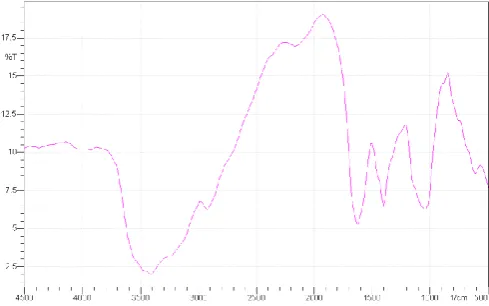
FTIR spectra of the adsorbent samples were recorded to characterize the main functional groups that might be involved in adsorption. As shown in Fig. 1 the spectra displayed a number of absorption peaks.
Figure 1. FT-IR spectra of activated Acacia nilotica leaf powder
The FT-IR spectroscopy analysis indicated bands at 3410 cm-1, representing bonded –OH groups. The bands observed
at 2940 cm-1, could be assigned to the aliphatic –C-H group.
The peak around at 1620 cm-1 corresponded to -C=O
stretching. The peak around at 1404 cm-1 corresponded to
CH3 bending vibration. The peak at 1049 cm-1 was due to –
C-OH stretching of carboxylic group. The peak at 617 cm-1
is due to -C-H bending vibration of more than four -(CH2)-
groups.
Batch adsorption experiments
Adsorption experiments were studied in batch mode at room temperature. Sorption studies were carried out in batch experiment as function of adsorbent mass, pH, shaking speed, particle size, contact time and initial metal ion concentration. Parameter was changed at a time and all other were maintained constant according to Table 1.
After completion of every set of experiments the residual was separated by filtration using whatman filter paper no. 42 and only 10 ml of each sample was stored for residual Cr(III) analysis. The concentration of residual Cr(III) after adsorption was directly measured by atomic adsorption spectrophotometer with an air acetylene flame.
Eq. (1) is used to determine the percentage adsorption of the metal (, in %) by adsorbent.
where Co is initial metal concentration, Ce is metal
concentration after shaking.
Adsorption mechanism
The ion exchange or hydrogen bonding may be the principal mechanism for the removal of heavy metal ions from industrial effluent by Acacia nilotica leaf powder. It
has long been recognized that the heavy metal cations readily form complexes with O-,N-,S- or P- containing functional group in adsorbent.
Adsorption process quite is dependent on pH of the aqueous solution. In most cases, the % of adsorption of metal ions is increased with an increase in pH up to a certain value and decreased with further increase of pH. Due to different properties of various heavy metal ions, the maximum adsorption takes place in a slightly different pH range for different metals.
In a specific pH range, for one specific heavy metal there may be a species present in solution, such as M(OH)3. At
lower pH, the positive charged metal ion species are adsorbed at the surface of the adsorbent by ion exchange mechanism. With increasing pH, metal ion species mainly neutral, may be adsorbed by hydrogen bonding mechanism. These mechanisms are shown in the following equation:
Ion exchange
3 (R-COOH) + M3+ → (R-COO)
3M + 3H+ (2) Hydrogen bonding
3(R-COOH) + M(OH)3 →(R-COOH)3 M(OH)3… (3)
Results and discussion
Effect of adsorbent mass
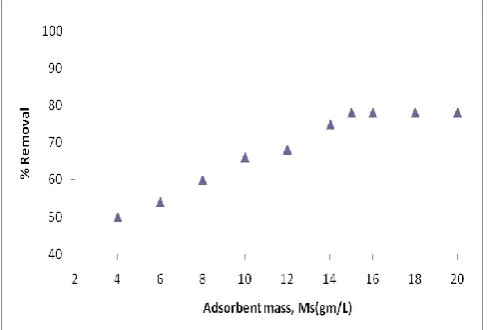
The influence of biosorbent material dosage on % biosorption and uptake of Cr(III) is shown in Fig. 2. The percent removal of Cr(III) was increased up to 78% when the dosage of biosorbent material was increased from 4-15 gL-1. After this maximum, there was no effect of mass of
adsorbent on removal efficiency due to equilibrium formation.
Effect of pH
The effect of the initial pH of solution on Cr(III) removal is shown in Fig. 3. Removal efficiency was found decreasing with an increase in the initial pH. The maximum removal efficiency of 81% was obtained when initial pH was maintained between 1 and 3. Hence, the low pH value of 2 results in higher percentage removal of Cr(III) using activated Acacia Nilotica leaf powder. The decrease in adsorption of Cr(III) by increasing the value of pH may be due to decrease in H+ ion on the adsorbent surface that
results in less strong electrostatic attraction.
Effect of shaking speed
Shaking speed is an important parameter which affects the removal efficiency. Studied were conducted at different values of shaking speed from 50-250 rpm. The maximum removal efficiency was obtained when shaking speed was 200 rpm (Fig. 4). This is due to the fact when we increase shaking speed, the energy is librated and this energy is used in the formation of bond between adsorbent and metal ions.
100 (1)
Co Ce
Co
Eur. Chem. Bull. 2013, 2(3), 144-148 DOI: 10.17628/ECB.2013.2.144
146
However after 200 rpm (shaking speed) the removal efficiency decreases (2 to 10%) due to the fact that high shaking speed provides extra energy, which is used in
breaking the bond between adsorbent and metal ions.
Figure 2. Effect of Adsorbent mass on adsorption of Cr(III) by activated Acacia Nilotica leaf powder
Figure 3. Effect of pH on adsorption of Cr(III) by activated Acacia Nilotica leaf powder
Figure 4. Effect of shaking speed on adsorption of Cr(III) by activated Acacia Nilotica leaf powder
Effect of particle size
The fixed bed adsorption experiments were carried out using four different particle sizes (100-175, 175-250, 250-325 and 250-325-400 of the adsorbent) by using all other parameters keeping constant. The result shown in fig.5 shows that by decreasing the size of adsorbent, removal efficiency increases.
Effect of contact time
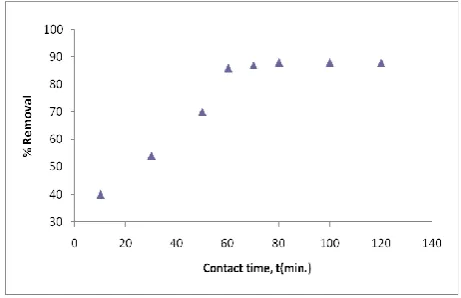
Fig.6 shows the percentage removal of Cr(III) as a function of time for the initial Cr(III) concentration 50 mgL-1 at pH value of
2. It is apparent from the figure that till a time of 60 min., the percentage removal from aqueous solution increases rapidly and reaches up to 86%. After that, the percentage removal of Cr(III) increases slowly till a time of 80 min and then subsequently becomes constant. A further increase in contact time has a negligible effect on the percentage removal of Cr(III). Therefore, the contact time 80 min. is considered for the adsorption of Cr(III) on activated Acacia
Nilotica leaf powder for the entire batch studies.
Effect of initial metal ion concentration
The Cr(III) adsorption is significantly influenced by initial concentration of Cr(III) in aqueous solutions. The initial Cr(III) concentration was varied from 50-300 mgL-1 while
maintaining the adsorbent amount 15 gL-1 at an initial pH
value of 2. Fig.7 shows that the effect of initial Cr(III) concentration on the percentage removal of Cr(III). The percentage removal decreases from 88% to 60% with an increase in the initial Cr(III) concentration from 50 to 300 mgL-1 respectively. The decrease in the percentage removal
of Cr(III) can be explained with the fact that all the adsorbents has a limited number of active sites, which would have become saturated above a certain Cr(III) concentration. It indicates that if the initial Cr(III) concentration increases, more and more Cr(III) ions compete for the same given active sites and thus the percentage removal decreases.
Adsorption Equilibrium Study
Adsorption isotherm are important to describe the adsorption mechanism for the interaction of Cr(III) on the adsorbent surface. A variety of isotherm equations have been in use, some of which have a strong theoretical base and some being of mere empirical nature. It is needed to examine the obtained experimental equilibrium data for Cr(III) removal using activated Acacia Nilotica leaf powder with different isotherm modals available in literature. In the present work Langmuir and Freundlich isotherm modals are tested with the experimentally obtained equilibrium data.
Langmuir isotherm
The Langmuir isotherm equation is given by the equation (4)
max (4)
1
q bCe
qe
bCe
Eur. Chem. Bull. 2013, 2(3), 144-148 DOI: 10.17628/ECB.2013.2.144
147
Table 1. Experimental conditions
where qe is the solid phase adsorbate concentration in
equation (mg g-1), q
max is the maximum adsorption
capacity corresponds to complete monolayer coverage on the surface (mg g-1) and b is the Langmuir constant (mg
L-1). Equation (4) can be rearrange to the following linear
form:
The plot of Ce/qe versus Ce gives the straight line of
intercept 1/qmaxb and slope 1/qmax (Fig. 8). The Langmuir
constants are represented in Table 2. The correlation coefficient showing that data correctly fit the Langmuir relation.
Table 2. Isotherms parameters for adsorption of Cr(III) on ACLP
Freundlich isotherm
It is an empirical equation used to describe heterogeneous system given by following equation
where qe is the amount of adsorbate adsorbed per unit
mass of adsorbent (mg g-1), C
e the equilibrium
concentration of adsorbate (mg/L), Kf the freundlich
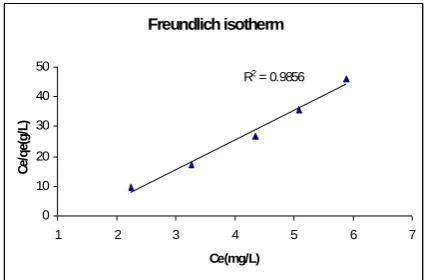
constant related to the adsorption capacity and 1/n is the heterogeneity factor. A linear form of the freundlich equation is obtained by taking the logarithm of the equation (6).
The plot of lnqe versus lnCe gives a straight line of
intercept lnKf and slope 1/n (fig 9). The Freundlich
constant are represented in table 2.
Desorption studies
The desorption of Cr(III) from previously Cr(III) loaded Acacia Nilotica leaf powderusing distilled water was attempted but Cr(III) desorption was not observed. Hence experiments were conducted with acid and alkali solutions to desorb Cr(III) ions. The results indicated that the desorption of Cr(III) ions with acid was not achieved even when 0.1, 0.2 and 0.3 N HCl were used (not shown). However, there was little desorption with basic solutions. It was observed that desorption of Cr(III) was 25.3 % with 0.2 N NaOH. The results of desorption studies have revealed that either ion exchange or hydrogen bonding as the possible mechanism for Cr(III) binding on the Acacia
Nilotica leaf powder.
Ms (g L-1) pH S (rpm) Ps(µm) t (min.) C0 (mg L-1)
Effect of adsorbent mass, Ms(g L-1) 4-20 4 150 100-175 60 50
Effect of pH 15 1-10 150 100-175 60 50
Effect of shaking speed, S (rpm) 15 2 50-250 100-175 60 50
Effect of particle size, Ps (µm) 15 2 200 100-175 to
325-400
60 50
Effect of contact time, t (min.) 15 2 200 100-175 10-120 50
Effect of metal concentration, C0 (mg L-1) 15 2 200 100-175 80 50-350
Langmuir constants
qmax (mg g-1) B ( mg-1 L) R2
10.15 0.065 0.997
Freundlich constants
Kf n R2
0.239 2.565 0.985
Figure 5. Effect of Particle Size on adsorption of Cr(III) by activated Acacia Nilotica leaf powder
Figure 6. Effect of contact time on adsorption of Cr(III) by activated Acacia Nilotica leaf powder
1
(5)
max b qmax
C Ce e
q e q
1/
(6)
n
q K Ce f e
1
Eur. Chem. Bull. 2013, 2(3), 144-148 DOI: 10.17628/ECB.2013.2.144
148
Conclusions
The present study shows that the Acacia nilotica leaf powder is an effective adsorbent for the removal of Cr(III) from aqueous solution. Ion exchange and hydrogen bonding are the principal mechanism for the removal of Cr(III) ions.
Experimental data indicate that the adsorption efficiency is dependent on operating variables such as adsorbent mass, pH, shaking speed, particle size, contact time and initial metal ion concentration. The adsorption data fit well with Langmuir and freundlich adsorption isotherm model.
Acknowledgements
Sumit and Magan Lal are grateful to the CSIR, New Delhi for the award of a Senior Research Fellowship (SRF).
References
1Kumar, R., Bishnoi, N. R. and Bishnoi, G. K. J. Chem. Eng.,
2007, 135, 202.
2Sheng, P. X., Tan, L. H., Chen, J. P. and Ting, Y.P. J. Disp. Sci. and Technol., 2004, 25, 681.
3Meunier, N., Drougi, P., Montance, C., Hausler, R., Mercier,
G. and Blais, J. F. J. Hazard. Mater., 2006,137, 581.
4Pehlivan, E. and Altun, T. J. Hazard. Mater., 2006,B-134, 149. 5Uysal, M. and Irfan, A. J. Hazard. Mater., 2007, 149, 482. 6Gupta, V., Sumit, Lal, M. and Bhati, M. J. Indian Chem. Soc.,
2012, 89,1253.
7Argun, M. E., Dursun, S., Ozdemir, C. and Karatas, M. J. Hazard. Mater., 2006, 141(1), 77.
8Dakiky, M., Khamis, M., Manassra, A., Mereb, M. Adv. Environ. Res., 2002, 6, 533
9Gupta, V. K and Ali, I. J. Colloid Inter. Sci.,2004, 271, 321. 10Li, C., Chen, H. and Li, Z. Proc. Biochem., 2004, 39, 541. 11Malkoc, E. and Nuhoglu, Y. Sep.Purif. Techno.l, 2007, 54,
291.
12Ho, Y. S., Wase, D. A. J. and Forster, C. F. Water Res., 1995, 29(5), 1327.
13Hadmohammadi, M. R., Salary, M. and Biparva, P. J. Appl. Sci. Environ. San., 2011, 6(1), 1.
14Babu, B. V. and Gupta, S. J. Environ. Eng. Sci., 2008b, 7,
553.
15Babu, B. V. and Gupta, S. Adsorption, 2008a,14,85.
16Daneshvar, N., Salari, D. and Aber, S. J. Hazard Mater.,2002, B-94, 49.
17Gupta, V. K. and Sharma, S. Environ Sci. Technol., 2002, 36,
3612.
Received: 15.11.2012. Accepted: 02.01.2013.
Figure 7. Effect of Metal ion concentration on adsorption of Cr(III) by activated Acacia Nilotica leaf powder
R2 = 0.9973
0.3 0.4 0.5 0.6 0.7 0.8 0.9 1
0.7 0.9 1.1 1.3 1.5 1.7 1.9
ln Ce(mg/L)
ln
q
e(
m
g
/L
)
Figure 8. Langmuir isotherm for the adsorption of Cr(III) by Acacia Nilotica leaf powder
Freundlich isotherm
R2 = 0.9856
0 10 20 30 40 50
1 2 3 4 5 6 7
Ce(mg/L)
C
e/
q
e(
g
/L
)