Asian J Pharmaceut Res Health Care Volume 5 Issue2 89-99
AJPRHC
Research Article
DEVELOPMENT AND IN VITRO EVALUATION OF GASTRORETENTIVE HIGH DENSITY TABLET OF PROPAFENONE HCL
CHORDIYAMAYUR ASHOKA*, SENTHIL KUMARAN K B, GANGURDE HEMANT HIRAMANC
a)Department of Pharmaceutics, C. L. Baid Metha College of Pharmacy, Chennai, India. b)Department of Pharmaceutics, K.K. College of Pharmacy, Chennai, India.
c)Department of Pharmaceutics, Nandha College of Pharmacy, Erode, TamilNadu, India. *Corresponding author
E-mail: [email protected]
This paper is available online at www.jprhc.in
ABSTRACT
A novel Propafenone HCl gastric-resident tablet was developed. A controlled release matrix tablet was prepared by using various controlled release polymers i.e. HPMC E5 and HPMC K100M. Pharmaceutical zinc oxide powder was used as a density-increasing agent. The formulations were evaluated for pharmacopoeial quality control tests and all the physical parameters evaluated were within the acceptable limits. Prepared high density tablet showed density up to 1.63 gm/cm3 which is higher than the gastric fluid. Also it shows good dimensional stability till the 12 h. In vitro release study shows the good drug release up to the 12 h. Stability studies were carried out on the optimized formulation for period of 3 months at 400c / 75%RH. Finally it was observed that there was no change in physiochemical and physical properties as well as in drug release profile even after storage at 45 °C and 75 % for three months. Zinc oxide increases the system density, making the system resident in stomach to prolong the drug delivery time in absorption zone.
Keywords: Propafenone HCl, high density tablet, dimensional stability, zinc oxide
INTRODUCTION
Oral controlled release drug delivery system has overcome every one of the disadvantages of conventional drug delivery system and for this reason is the mainly ideal route. However, due to a number of physiological difficulties, such as an incapability to restrain and localize the drug delivery system in preferred regions of the GIT and the very much changeable nature of gastric emptying process, predictable and increased bioavailability of drugs cannot be achieved. 1-4
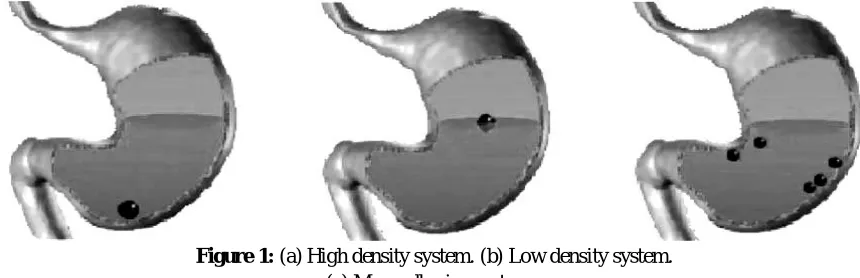
A variety of systems such as mucoadhesive, swelling, floating system and high density, have been developed to enhance GRT of a dosage form. Physiological features of the upper gastrointestinal tract shows significant challenge to develop such systems. However, in vivo studies of some systems shown promising results. High-density systems are proposed to lodge in the rugae of the stomach withstand the peristaltic activities. Dosage form with a density of 1.3 g/ml or higher are likely to be retained in the lower part of the stomach.
Asian J Pharmaceut Res Health Care Volume 5 Issue2 89-99
Devreux et al reported that the pellets have density of at least 1.5 g/ml have considerably higher GRT both in fed and fasted state.
Figure 1: (a) High density system. (b) Low density system. (c) Mucoadhesive systems.
Propafenone HCl is one of the antiarrhythmic agents, which is a Class 1C antiarrhythmic drug with local anesthetic effects, and direct stabilizing action on myocardial membranes. It has less half-life of about 2-10 hours and oral bioavailability very less, i.e. 10 %. Due to this reason it has to be taken frequently, i.e. 150 mg 3 times a day or 300 mg twice a day. To increase the bioavailability of Propafenone, gastroretentive drug delivery system was selected in which the dosage form is retained in the stomach so that it can be released for an extended period of time.
The drugs should have following properties to be the ideal candidates for gastroretention, a) narrow absorption window b) less bioavailability c) less plasma half life
Propafenone HCl an antiarrhythmic agent has a narrow absorption window i.e. it is erratically absorbed through GIT, less bioavailability of about 10 % and hence requires frequent dosing. It also has less plasma half-life. Drugs having pH dependent solubility i.e. highly soluble at low pH (gastric pH) and poorly soluble at high pH (intestinal pH) are the suitable drug candidates for the gastroretentive drug delivery system. In the treatment of angina, hypertension, cardiac arrhythmias, a loading as well as maintenance dose is required. Thus, Propafenone HCl has all the properties required for gastroretention and hence it was selected as the candidate drug for gastroretentive drug delivery system. 5-7
MATERIAL AND METHODS Material
Propafenone Hydrochloride as reference substances were supplied by Glenmark Pharmaceuticals Ltd., Mumbai. HPMC E5, HPMC K100M, Zinc oxide, Magnesium stearate, Lactose and isopropyl alcohol were purchased from Loba Chemie Pvt. Ltd. Mumbai. PVP K-30 was purchased from Signet Chemical Corporation, Mumbai.
Methods
Preparation of high density Propafenone HCl tablet
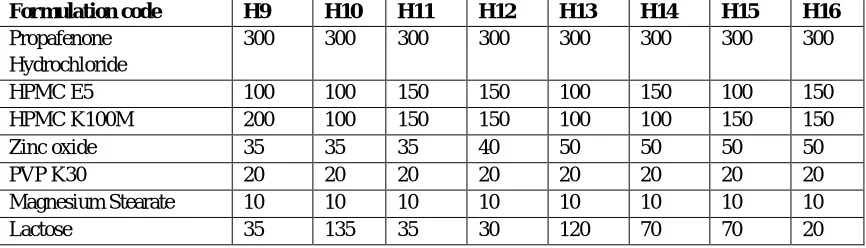
Asian J Pharmaceut Res Health Care Volume 5 Issue2 89-99 Table 1: Composition of gastroretentive high density Tablet (quantities in mg)
Formulation code H1 H2 H3 H4 H5 H6 H7 H8
Propafenone Hydrochloride
300 300 300 300 300 300 300 300
HPMC E5 100 150 200 - - - 150 100
HPMC K100M - - - 100 150 200 100 150
Zinc oxide 35 35 35 35 35 35 35 35
PVP K30 20 20 20 20 20 20 20 20
Magnesium Stearate 10 10 10 10 10 10 10 10
Lactose 235 185 135 235 185 135 85 85
Table 2: Composition of gastroretentive high density Tablet (quantities in mg)
Formulation code H9 H10 H11 H12 H13 H14 H15 H16
Propafenone Hydrochloride
300 300 300 300 300 300 300 300
HPMC E5 100 100 150 150 100 150 100 150
HPMC K100M 200 100 150 150 100 100 150 150
Zinc oxide 35 35 35 40 50 50 50 50
PVP K30 20 20 20 20 20 20 20 20
Magnesium Stearate 10 10 10 10 10 10 10 10
Lactose 35 135 35 30 120 70 70 20
Evaluation of granules Angle of repose
Granules flowability was determined by calculating angle of repose by funnel technique.A funnel with 10 mm inner diameter of stem was fixed at a height of 2 cm above theplatform. About 20 g of granules was slowly passed along the wall of funnel till thetip of the pile produced and touches the stem of the funnel. A rough circle was drawnabout the pile base and the radius of the sample cone was measured.9 Angle of reposewas calculated from average radius using formula:
= tan-1 (h/r) Where,
= angle of repose h = height of the pile
r = average radius of the powder cone.
Bulk Density
Apparent bulk density of granules was determined by the graduated cylinder andmeasuring the volume and weight “as it is”.10 Bulk density was calculated by using following formula:
Weight of sample in grams Bulk density (g/mL) =
Volume occupied by the sample
Tapped Density
Tapped density was determined with the aid of tapped density tester apparatus. In this method 20 gm of sample was
poured gently through a glass funnel in to a 100mL graduated cylinder. The cylinder was then placed in the
apparatus and parameters were set to carry out the test.10 Volume occupied by the sample after tapping were
recorded andtapped density was calculated by following formula: Weight of sample in grams
Asian J Pharmaceut Res Health Care Volume 5 Issue2 89-99
After tapping volume occupied by the sample
Hausner ratio
It provides an indication of the degree of densification which could result from vibrationof the feed hopper. Hausner ratio closer of less than 1.25 indicates good flow, while greater than 1.5 indicates poor flow materials.11
Tapped density
Hausner ratio =
Bulk density
Carr’s index or % compressibility
Carr’s index or % compressibility11 was calculated by using following equations: Tapped density - Bulk density
Carr’s index = × 100
Evaluation of high density tablets Tablet thickness and diameter
Tablet Thickness and diameter were accurately measured by using digital vernier caliper in mm. 12 Results were expressed as mean values ± SD.
Hardness and Friability
Hardness of tablet was determined by Monsanto hardness tester. Friability test was done by Roche friabilator. Ten tablets were weighed and were subjected to the combined effect of attrition and shock by utilizing a plastic chamber that revolve at 25 rpm dropping the tablets at distance of 6 in. with each revolution. Operated for 100 revolutions, the tablets were de dusted and reweighed.13 The percentage friability was calculated.
W1 W2
F = × 100
W1
Where F represents the percentage weight loss, and W1 and W2 are the initial and final tablet weights, respectively.
Weight variation
Twenty tablets were selected at random and average weight was determined. Then individual tablets were compared with the average weight.13
Tablet density
The density (D) of tablets was calculated from tablet thickness, diameter, and weight by using the following equation:
w D =
(m/2)2 × × h
Here, m is the diameter of a tablet, is the circular constant, h is the thickness of a tablet, and w is the weight of a tablet.14 All measurements were performed in three replicates. The averages and standard deviations were calculated and reported.
Drug content
Asian J Pharmaceut Res Health Care Volume 5 Issue2 89-99 Dimensional stability
The dimensional stability of the formulations was studied by using USP dissolution Apparatus II. The dissolution medium was 0.1N HCL and the volume being 900mL, the temperature was maintained at 37 °C. The rotation speed was 100 rpm. The dimensional stability of gastroretentive high density tablet was observed visually.16
Drug release study
Three tablets of each formulation were used in the release experiment. The release rates of Propafenone HCl were determined using USP apparatus I (basket apparatus) at 37 °C in 900 ml of 0.1N HCl solution (pH, 1.2) with the rotation speed of 100 rpm. At appropriate time intervals 0.25. 0.5, 1, 2, 3, 4, 6, 8, 10, 12 h, 5ml of sample was withdrawn and an equal volume of medium was added to keep the volume constant. Samples were analyzed spectrophotometrically at 301 nm.16
Accelerated stability study of optimized formulations
Accelerated stability study was carried out for optimized formulations, to assess its stability as per ICH guidelines. The optimized formulation were wrapped in the laminated aluminum foils and was placed in the accelerated stability
chamber (6CHM-GMP, Remi Instrument Ltd., Mumbai) at elevated temperature and humidity conditions of 400C/
75% RH and a control sample was placed at an ambient condition for a period of three months. Sampling was done at a predetermined time of initial 0, 1, 2 and 3 months interval respectively.At the end of study, samples were analyzed for the drug content, in vitro drug release profile and other physicochemical parameters.17-19
RESULT AND DISCUSSION Granules evaluation
The physical characteristics of the granules (H1 to H16) such as bulk density, tapped density, carr's index, husners ratio, angle of repose were determined. The results are given in Table 3. The bulk densities were ranged from 0.963-1.060 gm/ml. The tapped densities were ranged from 1.104-1.220 gm/ml. The carr's compressibility index were ranged from 10.77-20.61%. The housners rations were found to be in the limit 1.12-1.25. The angles of repose of all formulation were found to be between the limit 22.19°-26.61°. All the formulation shows excellent flow properties. So, the granule passes the evaluated tests and subjected to next stage of work compression.
Table 3: Evaluation and characterization of granules
Formulation code Bulk density
x
gm/ml
Tapped density
x
gm/ml
Carr's index x
( % )
Hausner’s ratio x
Angle of repose
x
( ° )
H1 0.970±0.05 1.131±0.02 14.23±0.19 1.17±0.06 23.68±0.99
H2 0.966±0.07 1.124±0.01 14.05±0.11 1.16±0.03 23.30±2.04
H3 0.971±0.02 1.115±0.04 12.91±0.13 1.14±0.05 25.15±2.65
H4 1.060±0.01 1.220±0.03 13.11±0.10 1.15±0.03 24.68±2.17
H5 0.976±0.05 1.185±0.04 17.63±0.21 1.23±0.02 26.39±1.49
H6 0.963±0.06 1.185±0.04 18.73±0.26 1.24±0.04 23.16±1.38
H7 0.985±0.07 1.104±0.02 10.77±0.15 1.12±0.04 22.19±2.76
H8 0.981±0.03 1.111±0.01 11.70±0.09 1.13±0.03 26.61±2.09
H9 0.909±0.02 1.145±0.06 20.61±0.18 1.25±0.01 25.43±2.44
H10 0.981±0.06 1.117±0.03 12.17±0.08 1.13±0.07 22.61±2.27
H11 0.985±0.03 1.146±0.04 14.04±0.09 1.16±0.03 23.68±1.97
H12 0.978±0.06 1.115±0.02 12.28±0.09 1.14±0.07 25.72±1.44
H13 0.988±0.01 1.136±0.02 13.02±0.06 1.15±0.02 24.14±2.89
H14 0.969±0.04 1.116±0.05 13.17±0.10 1.15±0.08 23.71±2.68
H15 0.973±0.06 1.113±0.01 12.57±0.11 1.14±0.06 24.05±2.63
H16 0.983±0.02 1.121±0.03 12.31±0.15 1.14±0.09 23.18±2.79
Asian J Pharmaceut Res Health Care Volume 5 Issue2 89-99 Tablet thickness and diameter
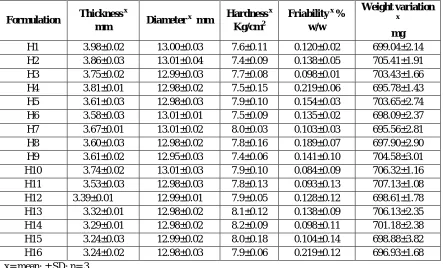
The thickness of the tablets range from 3.24-3.98 mm respectively. The diameter of the tablet in the range of 12.95-13.01mm.There is no variation in tablet thickness and diameter between the formulations. The results are given in Table 4.
Hardness, friability and weight uniformity of tablets
The hardness of the tablet were within the range and optimum for controlled release, and ranging from 7.4-8.2 Kg/cm2 for all H1-H16 formulations.The friability of all formulations was ranging from 0.084-0.219 % w/w and passes as per IP limit should not be more than 1 % w/w. The weight uniformity of tablet in all formulation was observed to be within the IP limit 10 %. All formulations were complying with the official test. The values were mentioned in Table 4.
Table 4: Evaluation of Propafenone HCl high density tablet
Formulation Thickness
x
mm Diameter
x
mm Hardness
x
Kg/cm2
Friability x % w/w
Weight variation
x
mg
H1 3.98±0.02 13.00±0.03 7.6±0.11 0.120±0.02 699.04±2.14
H2 3.86±0.03 13.01±0.04 7.4±0.09 0.138±0.05 705.41±1.91
H3 3.75±0.02 12.99±0.03 7.7±0.08 0.098±0.01 703.43±1.66
H4 3.81±0.01 12.98±0.02 7.5±0.15 0.219±0.06 695.78±1.43
H5 3.61±0.03 12.98±0.03 7.9±0.10 0.154±0.03 703.65±2.74
H6 3.58±0.03 13.01±0.01 7.5±0.09 0.135±0.02 698.09±2.37
H7 3.67±0.01 13.01±0.02 8.0±0.03 0.103±0.03 695.56±2.81
H8 3.60±0.03 12.98±0.02 7.8±0.16 0.189±0.07 697.90±2.90
H9 3.61±0.02 12.95±0.03 7.4±0.06 0.141±0.10 704.58±3.01
H10 3.74±0.02 13.01±0.03 7.9±0.10 0.084±0.09 706.32±1.16
H11 3.53±0.03 12.98±0.03 7.8±0.13 0.093±0.13 707.13±1.08
H12 3.39±0.01 12.99±0.01 7.9±0.05 0.128±0.12 698.61±1.78
H13 3.32±0.01 12.98±0.02 8.1±0.12 0.138±0.09 706.13±2.35
H14 3.29±0.01 12.98±0.02 8.2±0.09 0.098±0.11 701.18±2.38
H15 3.24±0.03 12.99±0.02 8.0±0.18 0.104±0.14 698.88±3.82
H16 3.24±0.02 12.98±0.03 7.9±0.06 0.219±0.12 696.93±1.68
x= mean; ± SD; n= 3
Tablet density
The tablet densities of all the formulation were in the range of 1.32-1.63 gm/cm3, which was the greater than the gastric fluid and optimum for the gastroretentive high density system.
Drug content
The assays of all formulation from H1-H16 were found to be between 99.19-99.71 %. The result shows that all formulation containing drug were within the limit (99-101 %).
Dimensional Stability
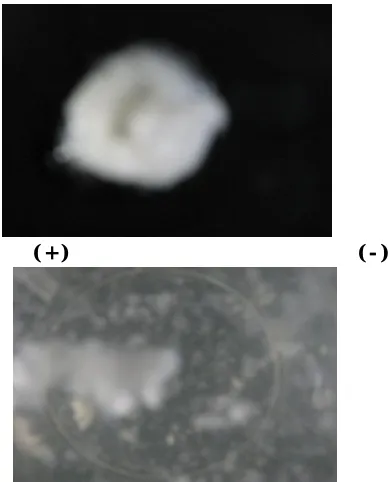
It is important to maintain the physical integrity of the tablet up to 12 h in case of once daily formulations. In all formulations the concentrations of polymers also act as release retardant was increased in ascending order to achieve the in vitro release. So increasing concentrations the dimensional integrity of tablet also increased respectively. The dimensional integrity of formulations was represented with code (+++) excellent, (++) very good, (+) good, (-) lack of integrity, along with picture representation in Table 5 and Figure 2.
The formulation H2-H16 shows excellent dimensional stability, except formulation H1 shows the good dimensional stability.
Asian J Pharmaceut Res Health Care Volume 5 Issue2 89-99
( + ) ( - )
Figure 2: Picture representation coding for dimentional stability
Table 5: Tablet density and drug content of Propafenone HCl high density tablet
Formulation Tablet density x (gm/cm3)
Drug content x (%)
Dimensional stability
H1 1.32±0.02 99.31±0.21 ++
H2 1.37±0.01 99.39±0.15 +++
H3 1.41±0.03 99.49±0.09 +++
H4 1.38±0.02 99.20±0.18 +++
H5 1.47±0.02 99.27±0.12 +++
H6 1.46±0.03 99.59±0.19 +++
H7 1.42±0.01 99.24±0.05 +++
H8 1.46±0.01 99.56±0.11 +++
H9 1.48±0.01 99.39±0.14 +++
H10 1.42±0.02 99.19±0.06 +++
H11 1.51±0.04 99.52±0.09 +++
H12 1.55±0.02 99.37±0.13 +++
H13 1.60±0.03 99.43±0.11 +++
H14 1.61±0.01 99.62±0.06 +++
H15 1.63±0.02 99.71±0.28 +++
H16 1.63±0.02 99.25±0.07 +++
x= mean; ± SD; n= 3
In vitro drug release study
Asian J Pharmaceut Res Health Care Volume 5 Issue2 89-99 Table 6: Cumulative % drug release of formulated high density tablet
Time (h)
Cumulative % drug release x
H1 H2 H3 H4 H5 H6 H7 H8
0.25 7.31± 0.58 6.84±0.61 6.61±0.09 6.53±0.85 5.38±1.01 5.51±0.91 5.05±0.69 3.43±0.44
0.5 12.38±0.91 11.74±1.73 8.58±0.98 9.27±1.03 9.40±1.68 7.73±1.13 8.43±1.26 7.14±0.96 1 21.85±1.68 17.58±2.37 16.66±1.55 15.72±2.16 14.43±1.97 10.41±1.65 9.71±1.75 11.53±1.51 2 37.73±2.43 32.67±3.55 28.04±2.31 29.90±2.73 23.74±2.13 19.73±2.38 17.49±2.01 19.47±2.84 3 49.92±3.58 42.92±3.06 38.16±3.76 41.58±2.94 31.48±2.47 27.51±3.29 30.78±2.90 25.73±2.93
4 64.17±3.96 53.84±4.17 46.43±3.43 49.38±3.25 41.79±2.61 38.33±2.77 43.82±3.83 35.07±3.07 6 89.62±3.68 76.37±3.89 61.79±3.13 64.66±4.78 56.28±2.84 52.71±3.08 60.75±3.85 52.89±3.81
8 - 84.76±3.52 88.65±3.79 89.39±4.47 69.31±3.98 61.02±3.51 73.44±3.89 69.30±3.47
10 - - - - 90.33±2.83 84.88±4.72 81.86±2.15 83.44±3.26
12 - - - 91.85±1.42 92.41±1.04
x= mean; ± SD; n= 3
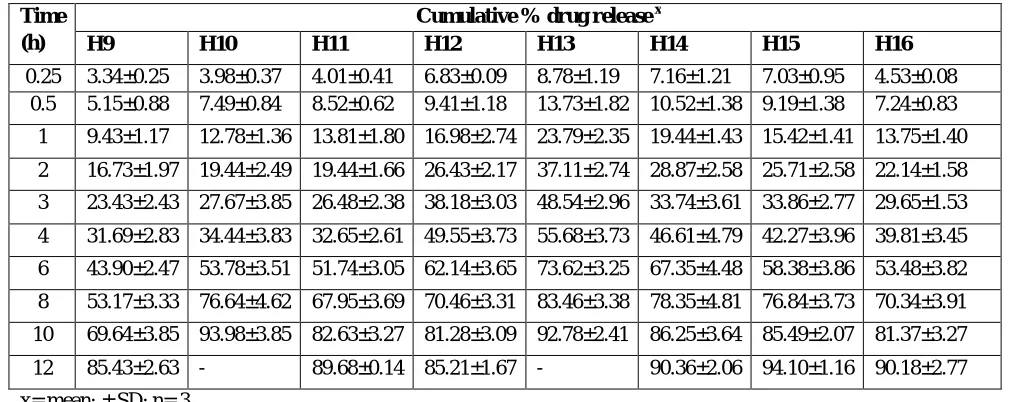
Table 7: Cumulative % drug release of formulated high density tablet
Time (h)
Cumulative % drug release x
H9 H10 H11 H12 H13 H14 H15 H16
0.25 3.34±0.25 3.98±0.37 4.01±0.41 6.83±0.09 8.78±1.19 7.16±1.21 7.03±0.95 4.53±0.08 0.5 5.15±0.88 7.49±0.84 8.52±0.62 9.41±1.18 13.73±1.82 10.52±1.38 9.19±1.38 7.24±0.83
1 9.43±1.17 12.78±1.36 13.81±1.80 16.98±2.74 23.79±2.35 19.44±1.43 15.42±1.41 13.75±1.40
2 16.73±1.97 19.44±2.49 19.44±1.66 26.43±2.17 37.11±2.74 28.87±2.58 25.71±2.58 22.14±1.58
3 23.43±2.43 27.67±3.85 26.48±2.38 38.18±3.03 48.54±2.96 33.74±3.61 33.86±2.77 29.65±1.53
4 31.69±2.83 34.44±3.83 32.65±2.61 49.55±3.73 55.68±3.73 46.61±4.79 42.27±3.96 39.81±3.45
6 43.90±2.47 53.78±3.51 51.74±3.05 62.14±3.65 73.62±3.25 67.35±4.48 58.38±3.86 53.48±3.82
8 53.17±3.33 76.64±4.62 67.95±3.69 70.46±3.31 83.46±3.38 78.35±4.81 76.84±3.73 70.34±3.91
10 69.64±3.85 93.98±3.85 82.63±3.27 81.28±3.09 92.78±2.41 86.25±3.64 85.49±2.07 81.37±3.27
12 85.43±2.63 - 89.68±0.14 85.21±1.67 - 90.36±2.06 94.10±1.16 90.18±2.77
x= mean; ± SD; n= 3
Accelerated stability study
Asian J Pharmaceut Res Health Care Volume 5 Issue2 89-99 Table 8: Results of Accelerated stability study of optimized formulations
Optimized formulation
Drug content
(%) % drug release
Tablet density
(gm/cm3)
Initial 99.71 94.10 1.63
One month
Ambient 99.65 93.73 1.63
400c / 75%RH 99.61 93.68 1.63
Two month
Ambient 99.56 92.18 1.63
400c / 75%RH 99.48 91.73 1.62
Three month
Ambient 99.49 91.58 1.63
400c / 75%RH 99.36 91.08 1.62
CONCLUSION
The present study concludes that the Propafenone HCl high density tablet pH could be successful option for the gastroretentive drug delivery system for cardiac arrhythmias. Loading and maintenance dose was maintained with the proper selection of controlled release polymers such as, HPMC E5 and HPMC K100M. Zinc oxide highly increases density of the tablet. Thus, the designed formulation can be considered as one of the promising formulation techniques for preparing Propafenone HCl high density tablet for the gastroretentive drug delivery system in management of cardiac arrhythmias and other diseases.
REFERENCES
1.Narendra C, Srinath M, Ganesh B. Optimization of bilayer floating tablets containing metoprolol tartrate as a model drug for gastric retention. AAPS Pharm Sci.Tech. 2006; 7: E1-E7.
2.Karande A, Dhoke S, Yeole P. Formulation and evaluation of bilayer tablet with antihypertensive drugs
having different release pattern. Indian drugs. 2005; 43(1): 44-50.
3.Amidon LG, Lobenberg R, Kim JS. Pharmacokinetics of an immediate release, a controlled release and a two pulse dosage form in dogs. Eur J Pharm Biopharm. 2005; 60: 17-23.
4.Rekhi GS, Nellore RV, Hussain AS, Tillman LG. Development of metoprolol tartrate extended release matrix tablet. J Control Release. 1198; 50: 247-256.
5.Bechgaard H, Baggesen S. Propoxyphene and norpropoxyphene: influence of type of controlled release
formulation on intra-and inter-subject variations. J Pharm Sci. 1980; 69(11): 1327-1330.
6.Clarke GM, Newton JM, Short MB. Comparative gastrointestinal transit of pellet systems of varying desnsity. Int J Pharm. 1995; 114(1): 1-11.
7.Devereux JE, Newton JM, Short MB. The influence of density on the gastrointestinal transit of pellets. J Pharm Pharmacol. 1990; 42: 500-501.
8.Lachman L, Liberman HA, Kanig JL. The theory and practice of industrial pharmacy. 3rd ed. Bombay;
Varghese publishing house; 1987;294-342.
9. Fiese EF, Hagen TA. Preformulation In: The Theory and Practice of Industrial Pharmacy. Lachman L,
Lieberman HA, Kanig JL. 3rd Ed. Varghese Publishing House. 1990; p. 183-84
10. Wells JI, Aulton ME. Pharmaceutical Preformulation, In: Aulton’s Pharmaceutics, Churchill Livingstone Elsevier., 3rd Ed, p. 355-56.
Asian J Pharmaceut Res Health Care Volume 5 Issue2 89-99
12.Khan FN, Dehghan MH. Enhanced bioavailability of atorvastatin calcium from stabilized gastric resident formulation. AAPS Pharm Sci Tech. 2011; 12(4): 1077-1086.
13.Veerareddy PR, Nama M, Gonugunta CR. Formulation and evaluation of gastroretentive dosage forms of
clarithromycin. AAPS Pharm Sci Tech. 2008; 9(1): 231-237.
14.Fukuda M, Peppas NA, McGinity JW. Floating hot-melt extruded tablets for gastroretentive controlled drug release system. J Control Release. 2006; 115: 121-129.
15.Gowda DV, Ram AS, Gupta VK, Ahmad A. Formulation and evaluation of Propafenone hydrochloride
matrix pellets for controlled release. Inventi Impact: NDDS. 2012; 2: 124-129.
16.Chavanpatil M, Jain P, Chaudhari S, Shear R, Vavia P. Development of sustained release gastroretentive drug delivery system for ofloxacin: In vitro and in vivo evaluation. Int J Pharm. 2005; 304: 178-184. 17.Kanvide SA, Kulkarni MS. Stability of oral solid dosage form-A global persective. Phama Times. 2005; 37:
9-16.
18.Banker GS, Rhodes CT. Modern Pharmaceutics. Marcel Dekker; 1979; p. 203.
19.Schellekens RCA, Stuurman FE, Van der Weert FHJ, Kosterink JGW, Frijlink HW. A novel dissolution