Förnamn Efternamn
Developing the concept for an affiliate
shopping site: a case study
Defining the customer segment acquisition and pricing
stra-tegy for a two-sided platform
Anna Forsten
Master’s Thesis
Master of Culture and Arts: Media Management
2015
MASTER’S THESIS Arcada
Degree Programme: Media Management Identification number:
Author: Anna Forsten
Title: Developing the concept for an affiliate shopping site: a case study. Defining the customer segment acquisition and pricing strategy for a two-sided platform.
Supervisor (Arcada): Owen Kelly
Commissioned by: -
Abstract:
The aim of the thesis is to complete the business plan for an affiliate shopping site, which goes under the working title of Sopimo. The research question is to find out, what kind of a revenue strategy is profitable, attracts the Shoppers to the portal and makes sure that the merchants approve the request to do affiliate co-operation. Because the shopping site in question generates value for the shoppers only when the buyable products are in place, co-operation with the merchants is necessary. This interdependency between customer seg-ments differentiates shopping sites from most other types of affiliate publishers and it is the reason why the theory of multi-sided (or two-sided) markets was chosen as the theoret-ical framework for this thesis. It is analyzed, how the theorettheoret-ical framework can be applied to the specific case of Sopimo and the findings are validated with practical examples of affiliate marketing and studies about affiliate marketing from merchants’ and publishers’ perspectives. The practical sources are also used to examine the risks involved in an affili-ate marketing model. The analysis reveals that the business plan should involve at least three phases. In the launch phase, it is important to get the first anchor merchant on board with a free trial period and to acquire the first shoppers through careful examination of the target market. In the second phase, new merchants will be obtained through the affiliate network with three selling points: there are shoppers on the site, there is an anchor on board, there is validated data about the target market. Also, in phase two the revenue streams will be diversified by joining an advertisement network. In phase three, growth should be sought by selling premium campaigns to the merchants and third party advertisers. After the initial phases, odds are the affiliate model has proven an unprofitable foundation for a business model. The possibilities for a pivot are: integrating the conversion path in the platform, developing the platform into a personalized style service (which would add value for the shoppers so much that they would be willing to pay for the service) or sell the validated business concept to a third party.
Keywords: affiliate marketing, economics of two-sided markets, e-com-merce, shopping platforms, pricing, acquisition strategy, bu-siness plan, Sopimo
Number of pages: 39
Language: English
CONTENTS
1 Introduction ... 4
1.1 Aim of the study and research question ... 4
1.2 Methodology, theoretical context and sources ... 5
1.3 The tentative business concept of Sopimo ... 5
2 Defining the terms ... 7
2.1 Affiliate marketing ... 7
2.1.1. Problem discussion: affiliate marketing ... 10
2.2 Limiting the definition of an Affiliate platform in this study ... 12
3 Theoretical context and sources ... 12
3.1 Theoretical context: Two-sided markets ... 13
3.1.1 Pricing in two-sided markets ... 14
3.1.2 Network effects and winner-take-all dynamics ... 16
3.2 Sources about affiliate marketing ... 17
4 Analysis ... 18
4.1 Pricing as a part of acquisition strategies ... 19
4.2 The risks, which are related to the affiliate provisions as the only revenue source .... 22
4.2.1 The Merchant is in control of the co-operation ... 22
4.2.2 Last click CPA model ... 24
4.2.3 Low level and long acceptance time of the commissions ... 24
4.3 Other possible revenue sources than affiliate commissions ... 25
4.3.1 Charging the Merchants more than just the affiliate commissions ... 25
4.3.2 Charging the Shoppers... 26
4.3.3 Charging third parties ... 27
5 Conclusion ... 28
5.1 Next steps ... 30
References ... 32
4
1 INTRODUCTION
I have several years of experience in affiliate marketing from a merchant’s viewpoint, and recently I came up with a business idea for a shopping platform which pulls product information from clothing stores’ product feeds and generates profits from affiliate sales commissions. The platform serves two customer segments. Firstly, it is aimed at women who need assistance in finding suitable clothes. Secondly, the platform serves online clothing shops interested in getting paying customers who are less likely to return their purchases. I stumbled across two major problems when I was filling the business model canvas (see appendix I). Key activities: in the beginning it is important to get customers; business partners and shoppers. The question is how and in which order to do it. Then there is the question about revenue streams. Affiliate provisions will generate profit but are there other possibilities like charging the shoppers or generating revenue through other sources?
1.1 Aim of the study and research question
The research question has arisen from the process of designing a business model for an online shopping portal which goes under the working title of Sopimo, www.sopimo.fi (henceforward: Sopimo). The answer will serve to complete the business model and will help put the business concept successfully into practice.
Research question:
In the case of Sopimo, which revenue strategy is most profitable and can attract shoppers and merchants for the purpose of business affiliation?
5
1.2 Methodology, theoretical context and sources
There are no previous academic studies about this niche subject which is why the writer opts for a case study. In this study the process of completing a business model and busi-ness plan for a tentative busibusi-ness idea will be documented.
Customer segment acquisition and pricing strategies will be examined primarily in the theoretical framework of the economics of multi-sided markets. The approaches, which the economics of multi-sided markets suggest to take, will be evaluated next to academic studies and practical examples about conducting affiliate marketing. After evaluating these, it will analysed, how they can be applied in the case of Sopimo. In the end of the study, the conclusions of the analysis will be used to complete the business model and create a business plan for Sopimo.
1.3 The tentative business concept of Sopimo
On Sopimo’s platform, the customer is assisted in finding her correct body type and she will be provided with a manually selected collection of clothes that flatter this specific figure. The body types are categorized in five main types: apple, pear, straight, inverted triangle and hourglass. The items can be bought directly from online stores, just one click away from the platform. The problems addressed by this concept emerge from the fact that there are features and services in physical clothing stores which either do not exist or are inadequate in online stores:
There is no fitting room
Because there is no possibility for the online shopper to try on the fit of a garment online, she must evaluate the size and fit by the given online product information, like pictures, measurements and user evaluations. A recent Finnish study (Jokiniitty 2014) suggests that the home is turning into a fitting room. Because it is hard to figure out the right fit and size in an online environment, more and more customers are ordering sev-eral sizes and versions of the same clothes with the intention of trying them on and then return the ones they are not pleased with (Jokiniitty 2014:24-30). While virtual fitting rooms exist, like Fits.me and Stylewhile app, their key value propositions seem aimed at providing a way to “try on” any of the available garments rather than proactively
6
providing the customer with a preselected clothes collection that flatter her specific body type.
There is no personal sales assistance
In physical clothing stores, the sales assistants can be of great help for the customer in regards to finding her right cut, length, fabric, fit, size etc. Usually, in online stores, the customer is left alone to make her decision without any personal assistance.
The rate at which purchased clothes are returned (from now one: ‘return rates’) in the online clothing stores are on the rise. Zalando founders revealed in an interview that their return rate is about 50% (die Welt 2013). In a recent study, the German speaking coun-tries’ online physical goods retailers were interviewed and it was found that the average return rate in the clothing and textiles sector is essentially higher than the average return rate in that of all sectors combined (26% vs. 13%). One third of the online clothing and textile retailers estimate that a decrease of 5% in the return rate would lead to 10% higher profits. However the retailers expect the return rates to increase in the future and retailers also assume that customers will expect a free return policy. (Pur et al. 2013:6-8, 34, 39, 45.) The same study claims that size and fit problems are among the top reasons for prod-uct returns in the clothing sector. The most common reason is “the prodprod-uct does not fit”, the second is “the item does not please me”, the third “I ordered several product variants to choose from”. (see columns “Bekleidung / Textilien / Schuhe” in appendix II.)
The concept behind Sopimo is aimed at helping shoppers find clothes they feel confident in but also offering online clothing stores a way to decrease their return rates and improve sales. The concept is aimed at any online clothing store with women’s clothes in their product selection and at female shoppers between 25-65 who have either returned clothes bought online before due to inadequate fit or size, or who have never purchased clothes online before because they were unsure of which style and size to choose. The exact con-sumer target market will be validated with an A/B marketing test process when the service has been launched.
7
Sopimo is not an online store but a link portal that gathers product information from sev-eral online stores’ product feeds. The items are manually categorized in the content man-agement tool by how well they flatter different body types. A service story will go through the shopping process from one customer’s viewpoint in appendix III. The clickable pro-totype of Sopimo is pictured in appendix IV.
2 DEFINING THE TERMS
2.1 Affiliate marketing
Affiliate marketing is a result-based marketing method where an Affiliate performs online marketing on behalf of a Merchant (Cabage & Zhang 2013:137). When a Shopper clicks a link in the Affiliate platform and makes a purchase in the Merchant’s web shop, orders a newsletter or makes some other desired action, the Merchant compensates the Affiliate with a commission through an Affiliate network (see Gregori et al. 2014:197; IAB UK 2014b; Affiliate Marketing: Are affiliates friend or foe? 2007). The compensation can be given for certain actions (cost-per-action or CPA); newsletter subscriptions (cost-per-lead or CPL); for every thousand advertisement impressions (cost-per-mille or CPM) or for every click (cost-per-click or CPC) (Gregori et al. 2014:197), etc.
Affiliate marketing is revenue-wise a low-risk marketing method for Merchants, as they usually compensate the Affiliate only if it manages to bring in buying Shoppers (IAB UK 2014b). The revenue share model encourages the Affiliate publishers to generate closed sales deals and generate profits for both themselves and for the Merchants (see figure 3; Parsons 2015; Affiliate Marketing: Are affiliates friend or foe? 2007).
8 Figure 3.How affiliate marketing works. Parsons, 2015.
The terms used in this thesis to describe different parties, networks and platforms in af-filiate marketing:
Affiliate: Publishes the Merchants’ advertisements or otherwise con-ducts marketing on behalf of the Merchant with the aim to gen-erate actions, such as sales, clicks, or newsletter subscriptions.
9
Affiliate platform: A platform (such as website) where there are tracked links to the Merchant’s web page. The platform is operated by the Af-filiate.
Merchant: An online store or other online advertiser which has joined an Affiliate network to perform affiliate marketing.
Affiliate network: Introduces Affiliates to Merchants, provides tracking of online traffic and sales and facilitates the payment of the commis-sions. Examples of Affiliate networks are: Affiliate Window, Affilinet, Commission Junction, TradeDoubler, TradeTracker and Webgains. (IAB UK 2014a; IAB UK 2014b.)
Shopper: Individual customer who clicks the links placed in the Affiliate platforms or other marketing material set up by the Affiliate and completes a purchase on the Merchant’s website.
The Internet Advertising Bureau UK, or IAB UK (2014b), recognizes four different ways for an Affiliate to attract sales. The key methods are by offering through websites, email, mobile app or by other means (quotes in italic):
(a) an incentive, like cashback or redeemable points
Several cashback and loyalty services use affiliate marketing in their business model, such as PINS.fi or Ostohyvitys.fi. Their business model is based on return-ing a part of the affiliate commissions in form of cash or redeemable points for the customers.
(b) discounts in the form of vouchers
There are several examples of voucher code sites, such as Cuponation.com. The value proposition is providing visitors with coupons and tips for using them to save money (Johnston 2014).
10 (c) a service, such as a price comparison,
Affiliates can offer a directory, meta search or comparison site as a service for Shoppers. They usually aggregate Merchants’ product and pricing information from automated product feeds in a clearly presentable way (see Johnston 2014). Examples of such sites are Rantapallo.fi and Shopalike.fi.
and/or (d) quality content.
Bloggers and product reviewers have traditionally been using affiliate marketing as an extra income (see Johnston 2014).
The above mentioned methods are not exclusive and can be overlapping. For instance quality content could refer to destination descriptions on a travel site or user experience reviews of gadgets on a comparison site.
2.1.1. Problem discussion: affiliate marketing
An affiliate marketing model was chosen for Sopimo because it is easy to set up and makes it possible to validate the service concept quickly. In general, it is recommended for well-known brands to work directly with the advertisers but affiliate marketing is a good way to start a business (See Benediktová & Nevosad 2012:79; Niche Affiliate Site or Online Store – Which Should I Launch? 2015; Phillips, time of publishing not known). It would be possible to create a web shop and take over the order funnel entirely, instead of relying on the Merchant’s web shops converting the traffic, or sell the concept to online stores. Such an approach might be a next step after validating the business idea and gen-erating a nest egg for the next strategic move.
The Affiliate publisher, in this case the platform owner of Sopimo, balances between catering for two customer segments which have completely different kinds of needs and
11
expectations. The key activities towards the Shoppers are developing an appealing plat-form and acquiring and retaining customers. The key activities towards the Merchants are delivering Shoppers’ actions through the platform or other marketing activities. In order to do this, however, the Merchants must first accept the invitation for affiliate co-opera-tion.
In my personal experiences, getting acceptance from Merchants – in this case online clothing stores – to do the affiliate co-operation can be difficult. There are a number of reasons for this. Hills writes that affiliate marketing is often in a direct competition with the online marketing strategy of a company because it increases their acquisition costs (Hills 2008). Beside the competitive situation, affiliate marketing has an image problem. Still a decade ago, affiliate marketing was celebrated as a saviour of result based online advertising (see Duffy 2005), whereas nowadays the industry suffers from quite a bad reputation. It comes for instance from cases where an Affiliate has damaged the Mer-chant’s brand by buying ad inventory in illegal or disreputable sites (Hills 2008) and voucher code sites have used misleading marketing tactics to get their tracking cookie on sites without actually contributing to the sales (Hargrave 2009). There have even been cases of an Affiliate bidding on forbidden keywords outside normal working hours, when it is more likely to go unnoticed (Affiliate Marketing: Are affiliates friend or foe? 2007). Cabage & Zhang summarise the reasoning behind the Affiliates’ aggressive marketing tactics: because the Affiliates only aim at generating sales to get their share of the revenue, the Affiliates have no accountability if the brand is damaged (Cabage & Zhang 2013:137).
It is a risk to build a platform without being sure if any Merchant would be interested in a co-operation. Therefore there is a need to find a way to build trust and get the first advertiser(s) on board. Another challenge for the Affiliate publisher is to avoid certain pitfalls in order not to lose all or a reasonable amount of their sales commissions. Espe-cially in the beginning of the affiliate co-operation, the Merchant is in a strong position to define the level, structure and conditions of the commissions. To avoid the risks of using affiliate commissions as the only revenue stream, it is important to find what other
12
pricing strategies could also be used in the business model. Here, the answers to the fol-lowing questions are sought: is it recommendable to charge the Merchants more than just affiliate commissions, to charge the Shoppers for using the platform, or to generate reve-nue from third parties in a way where the pricing strategies go in line with the acquisition strategies?
2.2 Limiting the definition of an Affiliate platform in this study
In referral to IAB UK’s categorisation (IAB UK 2014b), Sopimo uses methods C (a ser-vice) and D (quality content) to attract sales. It provides the Shoppers with a way to re-search body types and gives them a way to buy flattering clothes for their own type. At the same time, it provides quality content about clothing and style. Because the possibility to buy suitable clothes is a key value proposition for the Shoppers, the involvement of the online stores is important: the platform absolutely needs to attract and serve both of the customer segments – Shoppers and Merchants – to create value.The need to get the Merchants on board makes the business model crucially different from the business models of lifestyle sites, blogs and other content sites, because they can be operated without the co-operation with the Merchants. For instance a blog can be op-erated for years and it can have a large pool of readers before the writer takes an initiative to reach out to potential advertisers.
The business model is also different than that of incentive and voucher code type sites. Firstly, these offer the Shoppers a unique value proposition of incentives. It influences the possibilities for revenue streams. (see Johnston 2014.) Secondly, they can also be seen as rivals of shopping platforms, because of the last click CPA model (see chapter 4.2.2., Last click CPA model).
13
“Uber, the world’s largest taxi company, owns no vehicles. Facebook, the world’s most popular media owner, creates no content. Alibaba, the most val-uable retailer, has no inventory. And Airbnb, the world’s largest accommoda-tion provider, owns no real estate. Something interesting is happening.” Tom Goodwin, senior vice president of strategy and innovation, Havas Media. (Goodwin 2015.)
3.1 Theoretical context: Two-sided markets
In “Business model generation”, Osterwalder & Pigneur (2010) give an example of a business model which caters for several distinct customer segments: multi-sided markets. Evans describes multi-sided markets as markets that link together “two or more distinct but interdependent groups of customers” (Evans 2003:1). Rysman describes a two-sided market as a market where two groups interact through a platform or an intermediary. The decisions of each customer group have an effect on the outcomes of the other customer group, and this typically happens through an externality. He points out that almost any advertiser supported media uses the economics of two-sided markets. (Rysman 2009:125.) Whereas Evans (2003), Evans et al. (2006), Hagiu (2014), Osterwalder & Pigneur (2010), Rochet & Tirole (2003) and Rysman (2009) write about two-or multi-sided markets, Chris Anderson refers to the model in his book Free: the future of a radical price as a “three-party market”, where the platform itself is considered as one of the par-ties (Anderson 2009:24-25).
Because of the interdependency between customer groups, a business absolutely must serve two types of customers in order to generate demand from any of them, (Evans et al. 2006:60), and the more there are members in a group, the more the members in the other customer group value the platform (Evans 2003:2). According to Rysman, the externali-ties can involve either usage or membership: a payment card user cares about how many merchants are members in the card network, but the merchant cares more about which
14
networks the consumers actually use in contrast to which cards the consumer holds (Rys-man 2009:126).
3.1.1 Pricing in two-sided markets
According to Eisenmann et al. the value moves from the left of the company (cost) to the right (revenue) in the traditional system, but in two-sided networks the platform has a distinct group of users on each side which is why they have cost and revenue both to the left and right. Serving both of the customer groups incurs costs and it is possible to collect revenue from each side although usually only one side is subsidized. They describe the pricing strategy with terms “subsidy side” and “money side”: a subsidy side is a group of users who are highly valued by the money side when attracted in volume. (Eisenmann et al. 2006:2-3.)
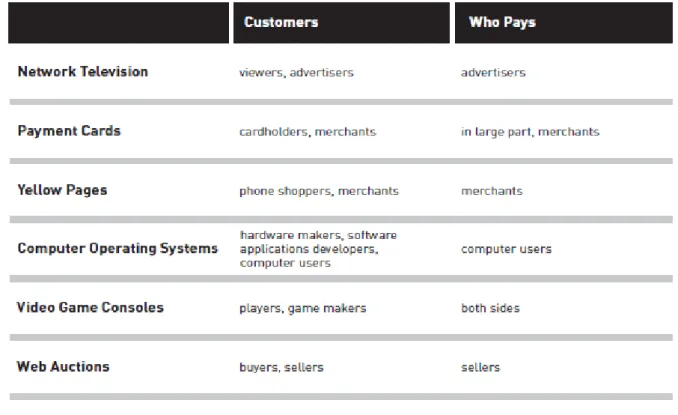
According to Eisenmann et al., deciding which group to charge and which group to sub-sidize – and for how long – is one of a two-sided platform manager’s key decision (Ei-senmann et al. 2006:3). Thus the strategic decisions do not only comprise deciding the right pricing levels but also the appropriate pricing structure (Rochet & Tirole 2003:990-991). According to Evans it must be analysed how much each customer group values the other and prices must be determined in a manner so that both customer groups come on board in the right numbers. He gives examples of pricing strategies in multi-sided markets in table 1. (Evans 2003:2-3.) The example of Web Auctions, Yellow Pages and Network Television go in line with a business model, which Pedersen (2014) describes with a term “Free, advertising”. It signifies a model based on a specific type of multi-sided platform where the platform is free for customers to use and where the advertiser covers expenses. (Pedersen 2014:27-28.) As noted, Anderson refers to the same business model as “media model of Free” (Anderson 2009:137).
15 Table 1: A Sampling of Multisided markets. Evans 2003:2.
Although the “Free, advertising” -business model is a very common model in platforms, which connect sellers and buyers, there are several other possibilities for pricing strate-gies. Evans et al. point out that sometimes generating a large pool of the subsidized cus-tomer group is done even by negative pricing (Evans et al. 2006:59). It is also possible to charge both sides: for instance PayPal charges both customer segments a transaction fee and offers a value proposition of “secure transactions” (Pedersen 2014:26-27).
Because each group values the portal only if there are a number of participants from the other group involved, the platform owner faces what is called as a “chicken-and-egg – problem” – an actual term used by several academic sources (Evans 2003:3; Hagiu 2014; Shapiro & Varian 1999:189; Osterwalder & Pigneur 2010:78; Rochet & Tirole 2003:990). For one type of early validation of the market, and a way to get the first mem-ber on board, Evans and Eisenmann et al. suggest what they call a marquee strategy. Getting a highly valuable partner – an “anchor” – on board will attract other customers to
16
join as well. (Evans 2003:3, Eisenmann et al. 2006:1.) Eisenmann et al. suggest providing incentives for marquee users to participate exclusively in the platform (Eisenmann et al. 2006:1). Rysman suggests using a “penetration pricing” in the early product life cycle. He uses the “Yellow book”, an independent Yellow Pages publisher, as an example: when it enters a new city, it offers advertisement for free during the first year. (Rysman 2009:132.)
3.1.2 Network effects and winner-take-all dynamics
Successful platforms have what is called network effects where the platform’s value for a user is dependent on the number of members of the other group on board (Eisenmann et al. 2006:2-4; see also Shapiro & Varian 1999:174-175). In other words, it is better to be connected to a bigger network instead of connecting to a smaller one (Shapiro & Var-ian 1999:174-175). According to Ries, the network effects are working when the platform has high retention rates of new buyers and sellers: if the parties stick with the platform, the marketplace will grow (Ries 2009:117).
As discussed, it is important to decide whether the subsidized group should be charged at some point (see Eisenmann et al. 2006:3): Evans (2003:3) states that pricing low to build market share and lock in customer does not work, “a lesson learned the hard way by dozens of dot-coms operating in multisided markets.” He does not open the case more than this. The Wikipedia article (2015) about Network effects explains that during the dot-com era, network effects were used as a justification for some business models. Com-panies operated believing that when a company experiences strong network effects, they should care more about growing the market share than about becoming profitable. (Wik-ipedia 2015.)
When cross-side network effects are strong and positive, network users tend to adopt a single platform which Eisenmann et al. describe with a term “winner-take-all dynamics”. Not all two-sided markets will eventually be served by just a single platform but it is
17
important for a platform owner to recognize if there is a probability for winner-take-all dynamics in the business he operates in. (Eisenmann et al. 2006:1, 7.)
3.2 Sources about affiliate marketing
There are several academic studies on affiliate marketing but only a few which have spe-cifically taken the publisher’s perspective and concentrate on planning a business model for an affiliate shopping platform. According to Gregori et al. (2014:196) there has been several studies of affiliate marketing which have mainly adopted a Merchant’s perspec-tive. Only more recently have there been studies from Affiliate’s perspecperspec-tive. They men-tion a study by Benediktová & Nevosad from 2008, Affiliate Marketing. Perspective on content providers, where the question of whether the affiliate model provides a good foundation of an online business model in the first place is also largely under researched. This specific study repeats the observation which Gregori et al. (2014:196) made in their study: that there are several studies on the benefits of affiliate marketing from the Mer-chant’s perspective but that they fail to answer, for example, why content providers (in this case Affiliates) should prefer affiliate marketing to other forms of revenue sources. (Benediktová & Nevosad 2008:5-6.)
Other academic sources, which are used in this study, are chosen as they provide useful insights on affiliate marketing’s advantages and disadvantages as a business model and ways to make an affiliate business model function from the Affiliate’s perspective. The sources are academic journal articlesAffiliate marketing: false economy? by Hargrave in New Media Age (2009), Affiliate Marketing in Tourism: Determinants of Consumer Trust by Gregori et al. in Journal of Travel Research (2014), How to make affiliate marketing work by Hills in Media (2008) and Affiliate marketing: Are affiliates friend or foe?, article in Marketing week (2007).
Guidelines and blog posts from the Internet Advertising Bureau (IAB) – the trade associ-ation for online and mobile advertising – provide means for categorizing different types of affiliate publishers and provide up-to-date information about the industry.
18
Non-academic sources include articles and blog posts, which are written by affiliate mar-keting consultants and other experts who have practical experiences in the monetization strategies and operational execution of affiliate marketing projects. The sources also in-clude articles, where representatives of both Affiliate and Merchant parties have been interviewed. The sources provide strategic suggestions, such as 5 proven affiliate market-ing strategies, a blog post by Michael Johnston on Monetizepros.com (2014), CPA vs Affiliate Marketing: What You Need to Know by Parsons (2015) and Chares Belissen of Shopalike: Even if the market slows this year, we still believe in Russia’s huge potential in ewdn.com (2015). Critical views on affiliate marketing will also be examined. Sources providing information on the disadvantages on affiliate marketing or suggest alternatives for affiliate marketing: Affiliate Marketing in Travel is Dead (Or Should Be)by Martin MacDonald in tnooz.com (2012), Niche Affiliate Site or Online Store – Which Should I Launch? in mywifequitherjob.com (time of publishing not known) and Why Is Affiliate Marketing Not a Good Business plan? by Isobel Phillips in smallbusiness.chron.com (time of publishing not known).
4 ANALYSIS
In this chapter, the research question is divided into three secondary questions. The first question is about starting the business: What kind of a pricing model ensures that both of the customer segments will get on board? The question will be first examined in the con-text of the economics of multi-sided markets, and the analysis results will then be vali-dated with a case example from non-academic online sources. The second question fo-cuses on affiliate marketing: What kinds of risks are involved in having affiliate provi-sions as the only revenue source? Primarily, the answer will be looked from sources about affiliate marketing. The theoretical framework will also be used as a source of information in regards to generating strategies against losing customer relationships for Merchants. The third question seeks to find revenue streams after both customer segments have adopted the service: What other revenue sources than just affiliate commissions can be used in the business model without risking the attractiveness of the portal for both of the customer segments? It will be analysed what kind of pricing strategies can be applied for
19
both of the customer segments and if it is justifiable to adopt third party revenue streams at some point in the business plan.
4.1 Pricing as a part of acquisition strategies
What kind of a pricing model ensures that both of the customer segments will get on board?
According to economics of multi-sided markets, Merchants are on the money side and Shoppers on the subsidy side per se. Merchant value the Shoppers so much that they are already structurally willing to pay for their actions. This pricing model enables the gath-ering of a large pool of Shoppers which in turn will attract Merchants as well.
The Free, advertising –model (see Pedersen 2014:27-28; Anderson refers to the model as “media model of Free”, 2009:137), where the seller pays and the buyer uses the portal for free is typical in advertising based two-sided platforms. In the table 1, A Sampling of Multisided Markets by Evans (2003:2), there are three examples of trading platforms, which have opted for Free, advertising –model: Yellow pages, Web auctions and Net-work Television. And as Evans et al. point out, sometimes the platforms can even under-take so aggressive an approach to their subsidized customer acquisition that they attract customers by negative pricing (Evans et al. 2006:59). This is the case, for instance, with cashback sites: they return a part of the affiliate sales commissions to the Shoppers.
In any case, it is important for a shopping platform to be as appealing to Shoppers as possible in order to attract the money side and for the platform to start experiencing net-work effects. Pricing Shoppers free or in some cases negative pricing is beneficial for both the Affiliate and the Merchant. The Merchant benefits directly from a large number of buyers by being able to sell more or to reach out to a big number of potential buyers, and the Affiliate benefits indirectly from the buyers in the form of increased advertise-ment spending from the Merchants. The more Shoppers the platform attracts, the more Merchants value the portal.
20
As Rysman described, the network externalities can involve either usage or membership (Rysman 2009:126). The Merchant is interested in how much and how often the Shoppers use the Affiliate portal (usage), but the Shoppers are interested in how many Merchants are present in the portal (membership). In general the Merchants have a passive role in the business. The Affiliate acquires each Merchant just once and after that the Merchant does not necessarily need to be active in the Affiliate-Merchant relationship. The role of the Shoppers is largely different: the Affiliate must acquire them again and again, espe-cially as the technical and contractual limitations prevent effective customer retention activities. (see technical and contractual limitations in chapter 4.2.1.; Merchant is in con-trol of the co-operation; MacDonald 2012; Phillips, time of publishing not known.)
But how to get the first Merchant on board without any Shoppers? In the beginning get-ting just one or a few Merchant(s) on board can be enough to start the business. Econom-ics of multi-sided markets suggest the marquee strategy; getting an “anchor”, a well-known partner, who attracts the other Merchants to join the co-operation. (see Evans 2003:3; Eisenmann et al. 2006:1.) This could be done by giving an incentive for the Mer-chant.
Here is an example of how to get an anchor on board and letting the Merchant test co-operation with a low risk. The comparison site Shopalike.ru offers a free trial period to shops that are interested in joining the platform (East-West Digital News 2015). This indicates the importance of getting the merchants on board even by giving up the possi-bility of earning commissions for a certain period of time (keeping the service free for both of the customer groups, Shoppers and Merchants).
A marquee strategy provides a secure way to let Merchants test the co-operation and it gives a head start for the Affiliate to start acquiring Shoppers to the portal so that it starts experiencing network effects. This way, both customer groups can be attracted to get on
21
board, although the free-free model does not have an immediate positive impact on reve-nues.
It would also, in theory, be possible to add online stores’ products to the portal without giving notice. The Affiliate could first acquire Shopper traffic and then ask if the Mer-chant would be willing to pay for this traffic. Such strategy is, however, not recom-mended: as discussed in the introduction chapter, Merchants usually want to have control over their brand and visibility. Showing up in a new and unknown portal could be seen as a serious damage to the brand and could lower the Merchants’ willingness to do affil-iate (or any) co-operation with the Affilaffil-iate. Therefore generally it is recommended to be as open and straightforward with the Merchants from the beginning as possible.
What does this all mean in the case of Sopimo? It makes sense for Sopimo to contact a well-known online clothing store and offer free visibility on the portal for a certain period of time as a trial period and let the Merchant decide after the trial, if it is willing to con-tinue the co-operation with the affiliate model. This strategy makes it possible to
validate the Merchant and Shopper markets; test if both the advertisers and the custom-ers find the service interesting;
start acquiring the pool of shoppers and start network effects;
use tactical acquisition marketing efforts as a market investigation method; for instance targeted A/B testing enables the validation of assumed target markets;
develop the technical side of the platform (tracking, back office, user experience etc.) and finalising the service for the next round of Merchant acquisitions.
After the initial launch phase there are three unique selling points which can be used when acquiring the next Merchants:
There is an anchor on board;
There already is Shopper traffic on the site; The target market has been profiled.
22
4.2 The risks, which are related to the affiliate provisions as the
only revenue source
What kinds of risks are involved in having affiliate provisions as the only revenue source? In this chapter the post-launch phase of the business plan will be examined along with the risks involved in building a business model entirely on affiliate provisions.
According to a blog post by Isobel Phillips, building growth can be difficult for an Affil-iate. Because the payable actions take place in the Merchant’s web page and cookie times can be short, the affiliate is forced to constantly seek new sources of traffic. (Phillips, time of publishing not known.) In a blog post Niche Affiliate Site or Online Store – Which Should I Launch?, it has also been pointed out that only a few people can make a living as a pure affiliate marketer, and it is advised to diversify the affiliate sources in order to “not put all of eggs in one basket” (Niche Affiliate Site or Online Store – Which Should I Launch? 2015). Achieving a scalable business with affiliate marketing can be difficult, and for most businesses it is also not cheap. Content production and marketing costs can go high even for a reasonably basic affiliate site, like Martin McDonald (2012) writes.
4.2.1 The Merchant is in control of the co-operation
Some sources point out that the control over the very existence of the affiliate co-opera-tion is on Merchants. Merchants can decrease the level of compensaco-opera-tion or even quit the affiliate program one-sidedly and with short notice. A new affiliate publisher does not usually have control over cookie time, compensation type and amount of the compensa-tion. Only established and highly successful affiliate publishers are in the position of ne-gotiating higher compensations or longer cookie times. (Niche Affiliate Site or Online Store – Which Should I Launch? 2015; Phillips, time of publishing not known.)
Another problem described in literature is connected to the problems with low conversion rates. When the Shopper’s desired action takes place on Merchant’s web page, the Affil-iate cannot influence the customer’s journey after the Shoppers have left the AffilAffil-iate
23
platform (Benediktová & Nevosad 2008:78). And as the purchase takes place on the Mer-chant’s site, it is not uncommon that the affiliate cannot market or remarket directly to its qualified leads. As the Affiliate sends the traffic to convert into sales in the Merchant’s website, the Affiliate is less likely to receive benefits from repeat orders. (MacDonald 2012.) The Merchant holds the customer details so it is difficult for the Affiliate to build customer relationships (Phillips, time of publishing not known).
Because it can be challenging or even impossible for the Affiliate to manage customer relationships, and because the affiliate marketing field is highly competed, there is a need to create lock-in and to create ways to build lasting relationships with the customers. In an example provided by Shapiro & Varian, one way of locking in a customer can be created by developing a unique service the customer is not willing to let go. In their ex-ample, changing an internet service provider to another requires changing the email ad-dress. The service provider, which the customer is leaving, may refuse to forward an email from the old address to the new one. (Shapiro & Varian 1999:109-110.) The users face lock-in, when the costs of “switching from one brand of technology to another are sub-stantial” (Shapiro & Varian 1999:104). Sopimo could use similar techniques of personal-izing the service and influencing the user behaviour. Creating switching costs for the cus-tomer could be, for instance, providing a personalized shopping experience where the Shopper faces switching costs by simply letting go from a portal that remembers customer preferences and shopping history. Such a user experience could be developed after the first phases of the business plan.
Another source of lock-in is the winner-take-all dynamics. In the economics of two-sided markets, the winner-take-all dynamics are described as a phenomenon where two-sided market will eventually be served by a single platform. (Eisenmann et al. 2006:1, 7.) This usually takes place in the case of technical innovations such as operating systems or busi-ness card providers. In theory, a shopping site could face similar dynamics (for instance Amazon has largely become the dominant online shop), but in this industry the winner-take-all dynamics are not nearly as clear as in other the provided examples. However, it is possible to steer the concept of Sopimo into an exclusive style destination with personal services for which the Shoppers could be willing to pay for.
24
4.2.2 Last click CPA model
Clicking a tracked link on Affiliate platform sets a cookie on Shopper’s browser. If the customer clears the cookies from the browser, the tracking code is lost. (Phillips, time of publishing not known.) In the case of several Affiliates referring the same potential Shop-per to the same Merchant, the Affiliate with the most recently served cookie will usually override the cookie from the previous Affiliates. Thus the Affiliate which has generated the latest click to Merchant’s site will receive the commission. Clicks and impressions, which help assist a sale, but don’t close it, are usually not compensated. (IAB UK 2014b.)
Cashback, loyalty, reward and voucher sites can use different tactics to override the Af-filiate platform’s cookie. Some voucher code sites even pretend they have codes just to ensure a click through from a visiting customer. In this case they earn a commission for a sale for which the site has not contributed. Some voucher sites may even promote offers for a service such as “free delivery” which would be available for all visitors, whether they came through the voucher site or not. (Hargrave 2009.)
The last click CPA model calls for actions from Affiliate networks. Affiliate publishers themselves cannot make an influence on how other Affiliates are (mis-)behaving. There might be change in the near future though. According a blog post by Kevin Edwards on iabuk.net, in year 2015 there will be a discussion in Affiliate Window network on finding a commercial model, where publishers who influence in buying decision but do not close it will be compensated (Edwards 2015). If plans for tracking and compensating traffic, which influences or assist a buying decision, become standard in the Affiliate networks in the future, the competitive situation between the Affiliate publishers will change.
4.2.3 Low level and long acceptance time of the commissions
As most of the commissions are one-time payments and the conversion rates for online sales are typically low (about 1-3%), there is limited potential for income and growth for most of the affiliates (Phillips, time of publishing not known). According to a study by Benediktová & Nevosad, content providers that use affiliate marketing in their business
25
model mention the conversion rate problems as the biggest disadvantage of affiliate mar-keting (Benediktová & Nevosad 2008:78).
Not only are the commissions generally low, the return rates are high in clothing business as indicated in the introduction section. Affiliates are compensated with provisions only from closed, unreturned sales. That is why the sales approval times can be very long es-pecially in online clothing stores. In Sopimo’s business model, the key value proposition for the Merchants is to decrease the return rate but this does not have an effect on sales acceptance time – it just increases the acceptance rate. That is why the Affiliate is forced to wait for sale approval before it can receive its commission. The acquisition spend is an immediate cost for the Affiliate but the compensation comes much later which can result in problems in the revenue flow.
4.3 Other possible revenue sources than affiliate commissions
What other revenue sources than just affiliate commissions can be used in the business model without risking the attractiveness of the portal for both of the customer segments? In this section, it will be analysed what kinds of pricing models can be applied to the two different customer segments without risking the attractiveness of the portal for both par-ties, and if it is possible to incorporate revenues from third parties in the business model. There are two reasons for seeking further revenue sources in addition to the affiliate pro-visions. Diversifying the revenue streams helps protect against the discussed risks in af-filiate marketing. Also, as the lessons from the dot-com era indicate (Evans 2003:3; Wik-ipedia 2015), simply attracting a large pool of Shoppers, and assuming that they in turn will attract the Merchants, may not be enough to build a profitable business. Therefore it is worth considering further pricing strategies, such as charging the subsidised user group at some point.4.3.1 Charging the Merchants more than just the affiliate commissions
Merchants have been defined as the “money side” in the business model. As they are willing to pay for the Shoppers’ actions, it may be possible to up-sell premium campaigns
26
to the Merchants with which they gain more exposure among potential customers. But as the economics of multi-sided markets indicate, the Portal only is valuable to the Merchant when Shoppers are on board. Thus charging extra fees should be a step to take after the launch and growth phase when there is a considerable amount of the Shoppers on board.
Selling extra campaigns past the Affiliate network also allows the Affiliate to tackle some of the problems in affiliate marketing, which were discussed in previous chapters:
Instead of paying fees to the Affiliate network, the Affiliate can collect advertising spend in total;
Instead of the Merchant and Affiliate network being in control over tracking, billing and conditions of the co-operation, the Affiliate can take control over more directly;
Instead of being forced to wait for the approval of sales, the Affiliate can collect the marketing spending sooner;
Instead of being in contact mainly over Affiliate network, a mutual co-operation is a good opportunity to get to know and build trust between the Affiliate and the Merchant.
4.3.2 Charging the Shoppers
In the affiliate model, Merchants are automatically on the money side but this does not necessarily prevent the Affiliate from charging Shoppers as well. In some business mod-els, the portal itself is a service for which the Shoppers are willing to pay for. A diverse revenue strategy creates possibilities for more revenue and also helps the Affiliate protect itself from the risks inherent in a pure affiliate model.
The idea of developing Sopimo into a personalised shopping experience came up already in chapter 4.2.1., The merchant is in control of the co-operation. Instead of providing a simple shopping site, a unique, personalized style service could create the needed cus-tomer lock-in and provide options for making the service itself a revenue source by charg-ing Shoppers. As discussed, this is an approach which should be undertaken after the initial phase of the business operations of Sopimo and requires a separate, profound study and design process.
27
4.3.3 Charging third parties
When starting up the business, there will be a situation, where neither Merchants nor Shoppers generate any revenue for the Affiliate. Third parties provide the option of earn-ing revenues already in the beginnearn-ing of business operations and diversify revenue sources. Benediktová & Nevosad studied online content providers’ income streams and found that out of three income streams – affiliate marketing, direct advertising and adver-tising networks – content providers expect highest profits from direct marketing, second highest from affiliate marketing and lowest from advertisement networks (Benediktová & Nevosad 2008:79).
Benediktová & Nevosad assume that it is especially beneficial for an affiliate to work in a niche market. Advertisement networks can take targeted marketing to the next level as they can target the advertisements to particular visitors. (Benediktová & Nevosad 2012:79.) According to Shapiro & Varian, targeted advertising also costs more than bulk advertising (Shapiro & Varian 1999:32-33). Andersen describes the way Google targets its advertisements as selling “intentions” instead of selling space (Anderson 2009:143). User-targeted advertising in a niche site is a combination that can result in high click through and conversion rates for display advertisements. Next to advertisement networks, another option is to sell advertisement space directly to an advertiser that is not in a direct competition with the Portal itself but which shares the same target market – such as life-style or weight control products in this case.
Involving third parties in the business model adds more key tasks for the Affiliate. In the beginning, other key tasks (such as acquiring the Shoppers and Merchants) can be time-consuming, so involving a third party should be considered as a secondary task to take in the phase when the business is seeking growth.
28
5 CONCLUSION
The primary research task was to complete a business model and create a business plan for a shopping platform which goes under the working title of Sopimo. The task will be met by answering the following research question: In the case of Sopimo, which revenue strategy is most profitable and can attract shoppers and merchants for the purpose of business affiliation?
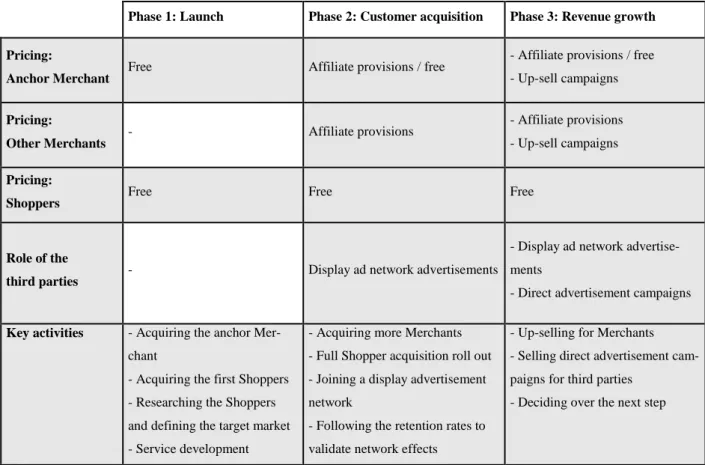
The analysis has revealed that the business plan should involve at least three phases.
In phase 1 the first Merchant will be taken on board by giving it a free trial period. The sales, which will be generated through the platform on the Merchant’s web page, will not generate provisions for Sopimo. Also the Shoppers can use the portal without any addi-tional cost. The goal of the first phase is to get both members on board even if it is in a small numbers, to enable the portal to experience network effects and to be able to profile the Shoppers.
In phase 2 more Merchants will be acquired by three unique selling points: there already is one Merchant on board (building trust & lower risk of brand damage), the Shoppers are interested in the portal (the “commodity” which the Merchants are willing to pay for in the form of sales provisions) and the Shoppers have been profiled (detailed data about the target market & lower risk of brand damage). The affiliate provisions will be
charged from all Merchants, also from the anchor Merchant if it has experienced the launch phase as successful. In this phase, the portal should also join a display advertise-ment network.
In phase 3 there will be aggressive seek for revenue growth which will strengthen and diversify revenue sources. The key activities involve selling one-to-one marketing cam-paigns for the Merchants and other advertisers. In this phase, key decisions on the next
29
big step will be taken. The affiliate model is suitable for starting and validating a busi-ness idea but after the first three initial phases, it is time to define whether to persevere the existing business model or pivot for a change.
30 Table 2: Business plan for Sopimo, phases 1-3.
5.1 Next steps
The aim of the study was to create a plan for the initial phases of the business. Based on the findings in the analysis, four options were found that could follow the business’ rev-enue growth phase. These observations refer back to the introduction where it was dis-cussed whether a pure affiliate model is a good business model in the first place.
The first possibility is to continue with the Free, advertisement –model and the same key tasks as in phase three. However, odds are the affiliate model will prove out to be an unsuccessful foundation for a profitable business model. There will also be a need to create ways of locking in Shoppers. The second option is to give up on the affiliate model and transform the portal into a niche online store, integrate the conversion path in the
Phase 1: Launch Phase 2: Customer acquisition Phase 3: Revenue growth Pricing:
Anchor Merchant Free Affiliate provisions / free
- Affiliate provisions / free - Up-sell campaigns
Pricing:
Other Merchants - Affiliate provisions
- Affiliate provisions - Up-sell campaigns Pricing:
Shoppers Free Free Free
Role of the
third parties - Display ad network advertisements
- Display ad network advertise-ments
- Direct advertisement campaigns Key activities - Acquiring the anchor
Mer-chant
- Acquiring the first Shoppers - Researching the Shoppers and defining the target market - Service development
- Acquiring more Merchants - Full Shopper acquisition roll out - Joining a display advertisement network
- Following the retention rates to validate network effects
- Up-selling for Merchants - Selling direct advertisement cam-paigns for third parties
31
portal and to take full control over conversion and customer relations. The third possibil-ity is to develop the portal into a personal service which adds so much value for the Shop-pers that they could be charged for using it. The fourth possibility would be to sell the validated concept to a third party.
32
REFERENCES
AFFILIATE MARKETING: Are affiliates friend or foe? Marketing week, Nov 29, 2007.Page 37. London: Centaur Communications Ltd.
Anderson, C., 2009. Free: the future of radical price. United States of America: Hype-rion.
Benediktová, B. & Nevosad, L., 2008. Affiliate Marketing. Perspective on content pro-viders. Luleå: Luleå University of Technology.
Cabage, N & Zhang, S. 2013. The Smarter Startup: A Better Approach to Online Business for Entrepreneurs. United States of America: New Riders.
Die Welt, 2003. “Wir machen Verlust – bei Amazon war das auch so” http://www.welt.de/wirtschaft/webwelt/article112851544/Wir-machen-Verlust-bei-Amazon-war-das-auch-so.html Accessed 17.5.2015. Published 18.1.2013.
Duffy, D. L. 2005. Affiliate marketing and its impact on e-commerce. Journal of Con-sumer Marketing 22/3, 2005. Pages 161–163.
East-West Digital News. 2015. Chares Belissen of Shopalike: Even if the market slows this year, we still believe in Russia’s huge potential. http://www.ewdn.com/2015/03/10/charles-bellissen-of-shopalike-even-if-the-market-slows-down-this-year-we-still-believe-in-russias-huge-potential/ Accessed 10.5.2015. Published 10.3.2015.
Edwards, K. 2015. Top 10 trends for affiliate marketing in 2015. http://www.iabuk.net/blog/top-10-trends-for-affiliate-marketing-in-2015. Accessed 26.2.2015. Published 8.1.2015
Eisenmann, T. R., Parker, G. & Van Alstyne, M. W. 2006. Strategies for Two-Sided Mar-kets. Harward Business Review. October 2006.
33
Evans, D. S.. 2003. Managing the Maze of Multisided Markets. Strategy+Business. Fall 2003. PwC Strategy& LLC.
Evans, S. E. & Hagiu, A. & Schmalensee, R., 2006, Invisible Engines. How Software Platforms Drive Innovation and Transform Industries. Massachusetts Institute of Tech-nology.
Goodwin, T. 2015. The battle is all for the customer interface. http://techcrunch.com/2015/03/03/in-the-age-of-disintermediation-the-battle-is-all-for-the-customer-interface/ Accessed 21.4.2015. Published 3.3.2015.
Gregori, N. & Daniele, R. & Altinay, L., 2014. Affiliate Marketing in Tourism: Determi-nants of Consumer Trust. Journal of Travel Research 2014, Vol. 53(2) 196–210. SAGE Publications.
Hagiu, A. 2014. Strategic Decisions for Multisided Platforms. MIT Sloan Management Review 55, no. 2, Winter 2014
Hargrave, S., 2009. AFFILIATE MARKETING: False economy? New media age, October 8, 2009. pages 25-26.
Hills, R., 2008. How to make affiliate marketing work. Media, September 4, 2008. Page 15. Hong Kong: Haymarket Business Publications Ltd.
IAB UK 2014a. IAB Affiliate Marketing Council. Advertiser Standards Charter. http://www.iabuk.net/sites/default/files/Advertiser%20Standards%20Charter.pdf Ac-cessed 12.3.2015. Published February 2014.
IAB UK, 2014b. IAB Affiliate Marketing Council. Publisher Standards Charter. http://www.iabuk.net/sites/default/files/Publisher%20Standards%20Charter.pdf Ac-cessed 12.3.2015. Published February 2014.
Johnston, M. 2014. 5 proven affiliate marketing strategies. http://monetize-pros.com/blog/2014/5-proven-affiliate-marketing-strategies/ Accessed 10.5.2015. Pub-lished 6.1.2014.
34
Jokiniitty, S. 2014. Sovituskoppi kotona – nuorten naisten palautuskäyttäytyminen verk-kokauppaympäristössä. Finland: University of Tampere.
MacDonald, M. 2012. Affiliate Marketing in Travel is Dead (Or Should Be). http://www.tnooz.com/article/affiliate-marketing-in-travel-is-dead-or-should-be/ Ac-cessed 10.5.2015. Published 2012.
Mywifequitherjob.com. Time of publishing not known. Niche Affiliate Site or Online Store – Which Should I Launch? http://mywifequitherjob.com/niche-affiliate-site-or-online-store-which-should-i-launch-if-i-want-to-quit-my-job/ Accessed 10.5.2015.
Network effect. Wikipedia article. 2015. http://en.wikipedia.org/wiki/Network_effect Last modified 13.3.2015. Accessed 1.4.2015.
Osterwalder,A. & Pigneur, Y., 2010. Business model generation: A handbook for visinaires, game changers and challengers. New Jersey: John Wiley and Sons, Inc., Hoboken
Parsons, J. 2015. CPA vs Affiliate Marketing: What You Need to Know. http://growtraf-fic.com/blog/2015/03/cpa-affiliate-marketing-what-you-need-know Accessed 10.5.2015. Published 19.3.2015.
Pedersen, A. T, 2014. How to Make a Successful Online Business Model – an Entre-preunial Perspective. Denmark: Aalborg University
Phillips, I. Time of publishing not known. Why Is Affiliate Marketing Not a Good Busi-ness plan? http://smallbusiBusi-ness.chron.com/affiliate-marketing-not-good-busiBusi-ness-plan- http://smallbusiness.chron.com/affiliate-marketing-not-good-business-plan-60217.html Accessed 10.5.2015.
Pur S. & Stahl E. & Wittmann G. & Wittmann M. & Weinfurtner S. 2012. Retourenman-agement im Online-Handel – Das Beste daraus machen. Germany: Ibi Research an der Universität Regensburg.
35
Ries, E. 2011. The lean startup. How Today’s Entrepreneurs Use Continuous Innovation to Create Radically Succesful Businesses. New York: Crown Business.
Rochet, J-C. & Tirole, J., 2003. Platform competition in two-sided markets. Journal of the European Economic Association. June 2003, volume 1, issue 4, pages 990–1029
Rysman, M. 2009. The Economics of Two-Sided Markets. The Journal of Economic Per-spectives, Vol. 23, No. 3 (summer 2009), pages 125-143. American Economic Associ-ation.
Shapiro, C & Varian, H. R., 1999. Information rules. A strategic guide to the network economy. Boston, Massachusetts: Harward Business School Press
APPENDICES
Appendix I: First version of Sopimo’s business model.
Figure 2: First version of Sopimo’s business model. Business model canvas by Osterwalder & Pigneur (2010).
Appendix II: Reasons for returns from the retailers’ perspective
Appendix III: Example of a service story of a shopper in Sopimo
1. Laura, 35, had her first child 10 months ago. Taking care of the baby has taken all her attention in the past months. Recently she has started thinking of pampering her-self for a change by buying clothes for herher-self. Because the baby is still taking most of her time and attention, it’s difficult to go out to a mall and do the shopping. Instead she decides to buy clothes online, conveniently in the evening, when the baby is sleeping.
2. Laura browses through online clothing stores and feels insecure: because she has gone through big changes in her life and having a baby, she’s not sure if she can still pick the same clothes she would have chosen before getting pregnant. She cannot be sure, if those clothes would still look good on her.
3. She looks for guidance and peer support online and types in Google searches “clothes after birth” and “which clothes fit my body”.
4. A search result comes up: Find clothes which flatter your body type.
5. Laura clicks the result and she’s directed to a page, where there are five body types to choose from and a guide to find her own body type.
6. Laura clicks “Find your own body type” and answers the questions regarding upper body to lower body and hip to waist ratio.
7. She finds out her body type is A. Before getting pregnant she thought she has quite a straight body type, and she’s surprised to find out her body has changed with preg-nancy.
8. The portal suggests clothes, which flatter Laura’s body type: Shirts, jackets, skirts, dresses and trousers. Laura categorizes the search results by price and her favourite clothing label.
9. Laura clicks a garment she likes. A new tab will open in the browser: the click leads to the respective product page in Nelly.com. Laura clicks a few more clothes sugges-tions in Sopimo, and more tabs will be opened.
10. Laura likes a pair of trousers in Nelly.com and a shirt on Zalando.com. She buys the items in the online stores.
11. Laura is more confident in her buying decision than she would have been without opting for Sopimo. She learned that new clothes are being constantly added to Sop-imo, and she orders the newsletter to find out about new garment additions.
Appendix IV: Screen shot of 1st clickable prototype of Sopimo