CHEMICAL COMPOSITION AND BIOLOGICAL ACTIVITY OF
CALOTROPIS GIGANTEA LEAF ESSENTIAL OIL
Minakshi Singh,
[a*]Menka Surana
[a*]and Kalim Javed
[a,b]Keywords:Calotropis gigantea, Essential oil; Phytol; Antimicrobial activity.
Essential oil from Calotropis gigantea (L) leaves was extracted by hydrodistillation method followed of solvent extraction and characterized by GC-FID and GC-MS techniques. The chemical profiling estimated the presence of 42 components, representing 82.5 % of the total oil composition. Phytol (17.94 %), phenylacetaldehyde (9.16 %), 4-methyl-1-heptanol (4.98 %), benzyl alcohol (4.10 %), 4-vinyl guaiacol (3.87 %), 4-methyl-3-penten-1-ol (3.83%), Gentanol (2.93 %), 2-hexyn-1-ol (2.86 %) and phenethyl alcohol (2.52 %) were found to be the major constituents. Further, biological activities of the extracted oil were studied on the fungal (Candida albicans) and bacterial (Escherichia Coli, Pseudomonas aeruginosa and Staphylococcus aureus) pathogens. 100 μl essential oil extracted from leaf shows effective antimicrobial activity against selective bacterial and fungal pathogens. Among bacterial pathogens, leaf oil showed highest antimicrobial activity against Pseudomonas aeruginosa followed by Escherichia coli and Staphylococcus aureus.
* Corresponding Authors
E-Mail: [email protected],
Cell: +91 9891474586, 9887442725
[a] Department of Chemistry, Mewar University, Chittorgarh, Rajasthan (India), PIN-312901
[b] Department of Chemistry, Jamia Hamdard, New Delhi (India), PIN-110062
INTRODUCTION
Calotropis is a genus belonging to family Asclepiadaceae, comprised of six species of perennial shrubs distributed in tropical and subtropical Asia, and Africa.1 Similar to
Calotropis procera, Calotropis gigantea is found in the Indian subcontinent and have great economic importance.2
The root bark is used to treat dysentery and elephantiasis, while the flowers in small doses give relief in colds, coughs, asthma, and indigestion.1 The latex and roots are reported as
indigenous medicine in birth control.3 The bark can be used
in fiber industries for manufacturing weave carpets, ropes, sewing thread and fishing nets.4 Leaf extracts are used in
agriculture to protect Oryza sativa from pathogenic fungus,5
and in material science to synthesize nanomaterials.6
Interestingly, the plant is used as traditional biopesticides in controlling mollusks and mosquitoes.7,8 Moreover, variety
of chemical groups including cardenolides, steroids, flavonoids, terpenoids, cardiac glycosides, resins, fatty acids and non-protein amino acids etc. have also been identified in C. gigantea,9 which leads to various applications in food,
flavour and pharma industries to transformed into promising biologically active molecules for chemicals and drugs synthesis. For example, eugenol and guaiacol are important constituents of Calotropis essential oil, which is recently being explored as a substitute for fossil-based chemicals for making biobased materials and green chemicals.10,11
Interestingly, Ashori et al. extensively studied different parts of C. gigantea in terms of chemical, morphological, and mechanical properties, and the results show that bark
materials have comparatively higher cellulose content than the latex and flower12.
Consequently, the bark and another woody part of this plant can be utilized and explored as a resource for green chemicals and biofuels as reported in previous literature.13,14
With diverse chemical functionalities, essential oils (EO) are considered to be promising “green” alternative in the food, pharmaceutical, and agriculture industries10,11,15 resulted to
give effective antimicrobial, nematicidal, antiviral, insecticidal as well as antifungal properties.16 EO constitutes
about 20–60 components from fairly high concentrations (20–70 %) to traces. The products of higher concentrations (e.g. terpenes, terpenoids, aromatics, etc.) are responsible for a biological activities17 while, minor components of EO
shows synergism with major constituents.15 Variety of plant
species and their corresponding parts such as methanol extract of the root bark of C.gigantea is reported as potent antifeedant for the desert locust,18 alcoholic root (100 mg kg -1 day-1) and flower extracts are reported correspondingly for
pregnancy interceptive and analgesic activities in the rats,19
while the stem and flower extracts resulted in various chemical and biological activities.9
MATERIALS AND METHODS
Source of the plant
Fresh leaves of Calotropis gigantea were collected during flowering season from the roadsides (April 2014), dry wasteland area adjacent to Muzaffarnagar (29.4723° N, 77.7089° E) having weather (29°C, Wind W at 6 km h-1,
80 % humidity), Uttar Pradesh State, India. Collected plant materials were submitted for identification at National Institute of Science Communication and Information Resources (NISCAIR), New Delhi. A voucher specimen is available in the herbarium division of the NISCAIR.20
Isolation of essential oil
Leaves were washed properly three times with fresh water and dried in shade till constant weight (difference between two consecutive weight not more than 0.05 mg) in properly ventilated room under fan in ambient conditions (27 °C) to prevent loss of essential oil. Dried leaves were crushed, weighed and subjected to hydro-distillation in 5 batches of 170 g each in 600 mL distilled water in Clevenger type apparatus for 4-5 h. The distillated product was further extracted with n-hexane and passed through anhydrous sodium sulphate to remove residual water. The product was concentrated by evaporating hexane under reduced pressure. Total oil obtained was 0.95 g. The yield of essential oil obtained was found to be 0.11 % (w/w).
Essential oil composition analysis by gas-chromatography (GC)/mass spectrometry (MS)
Essential oil composition of Calotropis gigantea was analyzed using Shimadzu GC-2010 equipped with flame ionization detector using Rtx-5MS (30 m x 0.25 mm ID x 0.25 µm) column. Nitrogen was used as carrier gas at 234.6 kPa inlet pressure. Oven temperature was programmed from 50 ºC for 3.0 minutes, 3.0 ºC min-1 to 200 ºC for 2.0 minutes,
10 ºC min-1 to 280 ºC for 7 minutes. The injector and
detector temperature were 250 ºC and 260 ºC respectively. The oil was injected neat with split ratio of 10. Relative amount of individual components are based on GC peak area percentage obtained without FID response factor correction. The retention Indices were obtained from GC by logarithmic interpolation between bracketing n-alkanes. The homogenous series of n-alkanes (C8-C22, Polyscience, Niles,
USA) were used as standard.
GC-MS data were obtained on Shimadzu GCMS-QP2010 plus using same chromatographic conditions and column used for GC-FID i.e. Rtx-5MS (30 m x 0.25 mm ID x 0.25
µm) column and helium as carrier gas. Temperature programming was 50 ºC for 3.0 minutes, 3.0 ºC min-1 to 200
ºC for 2.0 minutes, 10 ºC min-1 to 280 ºC for 7 minutes.
Identification of constituents
The individual peaks in GC of Calotropis gigantea leaf oil were identified by comparison of their retention indices on
the SP Rtx-5MS (30 m x 0.25 mm ID x 0.25um) column with literature values5 and were reported based on its area %
response by GC-FID. The essential oil constituents were confirmed by matching of mass spectra of peaks with FFNSC2, NIST08 and Wiley8 library. Identification was done by MS while RI and quantification done by GC-FID.
Antimicrobial activity
Microbial strains used
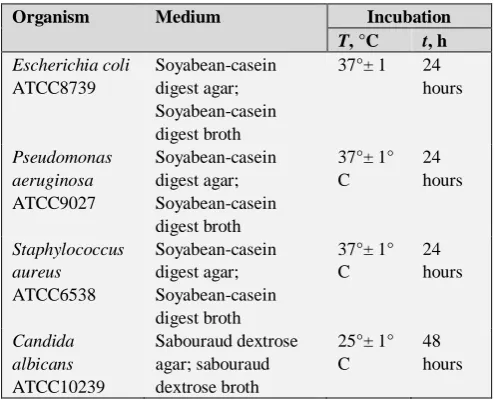
The antimicrobial activity of essential oil was performed using the following microbial stains procured from the Institute of Microbial Technology, Chandigarh, India. Details of the bacterial and fungal cultures used in the study are given in the Table 1.
Table 1. Lists of microbial stains and their corresponding medium Organism Medium Incubation
T, °C t, h Escherichia coli ATCC8739 Soyabean-casein digest agar; Soyabean-casein digest broth
37°± 1 24 hours Pseudomonas aeruginosa ATCC9027 Soyabean-casein digest agar; Soyabean-casein digest broth 37°± 1° C 24 hours Staphylococcus aureus ATCC6538 Soyabean-casein digest agar; Soyabean-casein digest broth 37°± 1° C 24 hours Candida albicans ATCC10239 Sabouraud dextrose agar; sabouraud dextrose broth 25°± 1° C 48 hours Inoculum preparation
Working cultures were prepared from the glycerol culture stocks maintained in the laboratory. A loopful of individual culture from agar slant was inoculated in to the broth medium aseptically and incubated as per the temperature and time combination mentioned in the Table 1. Cultures grown in the broth medium were harvested by centrifugation, washed and resuspended in sterile saline solution (0.85 %) to obtain a culture concentration in the range of 1x 10⁵ and 1
x 106 cfu mL-1. Culture concentrations were standardised
turbidometrically.
Antimicrobial activity
Antibacterial activity by well diffusion method:
few minutes, and using well cutter, wells were made in center of each section under aseptic condition. A fixed volume 100 µl of Calotropis gigantea leaf essential oil was then introduced into the well. The plate with bacteria was incubated at 37 ˚C for 24 h. The activity of essential oil was determined by measuring the diameter of zone of inhibition.
Antifungal activity by well diffusion method:
The essential oil obtained from hydrodistillation of shade dried leaves was also screened for antifungal activity in vitro using well diffusion method. Lawn culture was used using the test organism on Sabouraud dextrose agar in triple section plate. The inoculated plates were kept aside for few minutes, and using well cutter, wells were made in center of each section under aseptic condition. A fixed volume 100 µl of C. gigantea leaf essential oil was then introduced into the well. The plate of fungi was incubated at room temperature for 48 h. The activity of essential oil was determined by measuring diameter of zone of inhibition.
RESULTS AND DISCUSSION
Chemical investigation of essential oil of traditionally useful Calotropis gigantea which is reported for the first time in the literature and total ion chromatogram (TIC) of this oil showed 42 compounds corresponding to 82.5 % total area percentage. The yield of essential oil obtained by hydro distillation from C. gigantea was 0.11 % (w/w) with respect to total dry mass of the leaves. In order to explore useful products of C. gigantea, significant contributions have been made to identify phytochemical constituents and important activities2,9,19 studied in different parts of the plant except for
the leaves. In addition to the beneficial effect of latex,3,7,8
root, and flowers,1,2,9 Kumar et al. recently studied aqueous
leaf extract of C. gigantea for antibacterial activity and found effective against Staphylococcus aureus, Escherichia coli, Bacillus cereus, Pseudomonas aeruginosa, Micrococcus luteus and Klebsiella pneumonia species.22
Motivated from this study, the extraction and identification of chemical composition of C. gigantea leaf essential oil was performed and analyzed on GC-FID and GC-MS for further structural confirmation under similar chromatographic conditions as mentioned in the material method section. The chemical profiling of the EO reveals the dominance of oxygenated diterpenes (phytol), aromatic alcohol (benzyl alcohol) and linear chain alcohol (4-methyl-1-heptanol) as shown in the Table-2 (Supplementary Information). Among major constituents of leaf essential oil, the main peaks were dominated with phytol (17.94 %), phenylacetaldehyde (9.16 %), 4-methyl-1-heptanol (4.98 %), benzyl alcohol (4.10 %), vinyl guaiacol (3.87 %), 4-methyl-3-penten-1-ol (3.83 %), gentanol (2.93 %), 2-hexyn-1-ol (2.86 %) and phenethyl alcohol (2.52 %).
The result of C. gigantea leaf is in good agreement with the result of Schmelzer et al. on another species (Gongronema lantifilium) of the same family Asclepiadaceae where phytol was measured to be 15.5% along with 19.5 % linalool. The compositional changes may be due to the geographical areas, a method of extraction as
well as species of the plant. For example, the essential oil extracted from Calotropis procera from Nigeria is reported to be 33.6 % phytol while the same species from Iran shows about 5 % more phytol content (38.2%).23,24
Phytol, phenylacetaldehyde and 4-vinylguaiacol are an important fragrant ingredient used in many house-hold products including cosmetics, fine fragrances, shampoos, toilet soaps and detergents.25,26,27 In addition to that, the
derivatives of phytol show crucial pharmacological effects in humans and other animals,25 while 4-vinylguaiacol can
act as a green source to produce acetovanilline and ethyl guaiacol (used in perfumery) as well as biodegradable polystyrene.27
The phytochemical analysis of leaf EO was investigated using nonpolar solvent, n-hexane. Nonpolar solvents are mostly used for defatting the dried plant material.29 During
the chromatographic analysis of EO, the compound eluted in order of their molecular weight, boiling point, and chemical structures. The molecule with low boiling point eluted first followed by the increasing boiling point/molecular weight of the molecule. As a result, phytol with higher molecular weight (296.53 g mol-1) eluted at the end (Table 2, Fig 1).
Linear chain and the aromatic compound have a chain in their structure. Gentanol (116.2 g mol-1), for example, is a
linear chain alcohol with seven carbon chain eluted before benzyl alcohol (108.14 g mol-1). This could be due to its
interaction with the stationary phase column. Similarly, 4-methyl-3-penten-1-ol (100.16 g mol-1) eluted before
2-hexyn-1-ol (98.15 g mol-1) since it has single covalent bond
whereas 2-hexyn-1-ol has a triple bond.
Figure 1. GC/MS spectra of essential oil from leaf of Calotropis gigantea
Moreover, a number of other odor-active compounds such as ±linalool (0.49 %), hexanol (0.48 %), α-citral (0.06 %), eugenol (0.30 %) etc. are identified in this study. These minor products are used extensively in chemical industries as perfumery or precursors for making value-added products along with some pharmaceutical purposes.28,11,29 α-Citral,
essential oil. These products can also show repellent properties against some insects, and thereby being used
extensively as an important ingredient in insecticide formulation.
Table 2. Major identified products of Essential oil from Calotropis gigantea Leaf EO as measured by GC-FIDa
Peak# R.Time Area Area% RI Structure and Name M/Z
1 4.848 431538 2.4992 1026 O
O
2-Furancarboxaldehyde
96
2 5.619 661265 3.8296 1058
OH
4-Methyl-3-penten-1-ol
100
3 7.002 494423 2.8634 1112 OH
2-Hexyn-1-ol
98
4 8.164 506301 2.9322 1148 OH
Gentanol
116
5 9.183 324934 1.8818 1180
O
Benzaldehyde
106
6 10.483 273777 1.5855 1214 OH
Phenol
94
7 11.694 241298 1.3974 1225
β-Citronellene
138
8 11.953 859671 4.9787 1251
OH
4-Methyl-1-Heptanol
130
9 12.625 708290 4.102 1258
OH
Benzyl alcohol
108
10 12.922 1582376 9.1641 1266
O
Phenyl acetaldehyde
120
11 13.675 114682 0.6642 1276
OH
alpha-Methylbenzyl alcohol
122
12 14.671 185932 1.0768 1304 OH
p-Cresol
108
13 14.976 148515 0.8601 1310
O OH
Guaiacol
14 15.462 85003 0.4923 1316 HO
Linalool
154
15 15.77 215671 1.249 1329 OH
Oct-3-en-2-ol
128
16 16.117 435391 2.5215 1337
OH
Phenethyl alcohol
122
17 17.114 109729 0.6355 1350
O O
Gardenol
164
18 17.918 125137 0.7247 1367
HO
H H
cis-Myrtanol
154
19 18.283 144493 0.8368 1392
α-Terpinene
136
20 18.828 49071 0.2842 1413
HO
Menthol
156
21 19.658 110346 0.6391 1431
OH
Alpha-Terpineol
154
22 20.047 285531 1.6536 1436
n-Undecane
156
23 21.008 95278 0.5518 1457
O
β-Cyclocitral
152
24 21.779 43108 0.2497 1492
HO
Isocyclogeraniol
154
25 23.697 79634 0.4612 1529
O H
H
Dill ether
26 25.324 667795 3.8674 1546
O OH
4-Vinylguaiacol
150
27 25.881 10643 0.0616 1583
O
α-Citral
152
28 26.536 83596 0.4841 1606 O
Heptylidene acetone
154
29 26.957 199462 1.1552 1613 OH
Artemisia alcohol
154
30 27.179 52433 0.3037 1621
O HO
Eugenol
164
31 27.873 166014 0.9614 1676 O
Z-Amyl cinnamaldehyde
216
32 28.474 67332 0.3899 1692
Spathulenol
220
33 28.904 52044 0.3014 1704
n- Tetradecane
198
34 31.147 90802 0.5259 1768 O
Nerylacetone
194
35 32.522 316913 1.8354 1808 O
β-Ionone
36 32.718 426348 2.4691 1814 O
Hex-2-enal (5-methyl-, 2-phenyl-)
188
37 33.87 167676 0.9711 1848 O
Cyclohexyl ketone
194
38 38.794 66462 0.3849 1939
O O
O
Methyl-Jasmonate
224
39 45.662 51359 0.2974 2228
O
Phytone
268
40 50.088 116506 0.6747 2362 O
OH Stearic acid
284
41 50.654 122057 0.7069 2378
n-Tetracosane
338 42 54.28 3097846 17.9408 2659
HO
Phytol
296
where RT = Retention time, RI = Retention index, a List of products as confirmed by GC-MS
Since the plant is reported effectively against fungal and bacterial infections such as leprosy, tuberculosis and lupus, hence there is a need to investigate products that can serve as an effective antimicrobial and anti-biotic agent. In order to test these properties in leaf extracts of C. gigantea EO, a fixed volume 100 μl of leaf EO was used by well plate method against Candida albicans, a fungal pathogen as well as bacterial pathogens such as Pseudomonas aeruginosa, Escherichia Coli, and Staphylococcus aureus respectively. The activities of EO was determined by measuring zone of inhibition (mm). The results show that extracted EO gave promising biological activities and thereby exhibit strong inhibitory effect (5mm) against fungal pathogen, Candida albicans as presented in Table 3.
Table 3. Antifungal activity of essential oil from leaves of Calotropis gigantea
Microbial Strains Fungus/Bacteria ZOI (mm)
Candida albicans fungus 5
Staphylococcus aureus bacterium 4
Escheriachia coli bacterium 5
Pseudomonas areuginosa bacterium 7 ZOI, zone of inhibition
This is probably due to high benzyl alcohol (+)-β -citronellene, p-cresol, and guaiacol content. Similarly, the oil shows good activity against bacteria Pseudomonas aeruginosa followed by Escherichia Coli and Staphylococcus aureus which cover 7 mm, 5 mm and 4 mm zone of inhibition (ZOI) respectively.
CONCLUSION
eugenol and guaiacol are important building block chemicals in the range of traditionally produced molecules from fossil resources. The production/isolation of these chemicals from Calotropisgigantea could help in exploring biobased chemicals production to fulfill future energy and chemical demands.
ACKNOWLEDGMENTS
Authors acknowledge Dr. Imteyaz Alam of Department of Chemical Engineering, Institute of Technology (IIT) Delhi, Dr. Ovais Rizvi and Dr. Pooja Sharma of Department of Chemistry, Jamia Hamdard for their continuous support and scientific discussions.
REFERENCES
1Pari, K., Rao, P. J., Devakumar, C., Rastogi, J. N. A novel insect antifeedant nonprotein amino acid from Calotropis gigantea. J. Nat. Prod.,1998, 61, 102–104.
2Kadiyala, M., Ponnusankar, S., Elango, K. Calotropis gigantiea (L.) R. Br (Apocynaceae): A phytochemical and pharmacological review. J. Ethnopharmacol., 2013, 150, 32– 50.
3Srivastava, S. R., Keshri, G., Bhargavan, B., Singh, C., Singh, M. M. Pregnancy interceptive activity of the roots of Calotropis gigantea Linn. in rats. Contraception, 2007, 75, 318–322. 4Meena, A. K, Yadav. A., Rao, M. M., Ayurvedic uses and
pharmacological activities of Calotropis procera Linn. Asian J Trad. Med. 2011, 6, 45–53.
5Viji, R., Alaguraja, S. P. M. V. Biological control of Calotropis gigantea leaf extracts against pathogenic fungus , infecting Oryza sativa. Int. J. Res. Pure Appl. Microbiol.2013, 3, 107– 112 (2013).
6Sharma, J. K., Akhtar, M. S., Ameen, S., Srivastava, P., Singh, G. Green synthesis of CuO nanoparticles with leaf extract of Calotropis gigantea and its dye-sensitized solar cells applications. J. Alloys Compd., 2015, 632, 321–325.
7Bakry, F. A., Use of some plant extracts to control Biomphalaria alexandrina snails with emphasis on some biological effects. Pestic. Biochem. Physiol., 2009, 95, 159–165.
8Suresh Kumar, P., Chezhian, A., Senthil Raja, P., Sathiyapriya, J., Computational selections of terpenes present in the plant Calotropis gigantea as mosquito larvicide’s by blocking the sterol carrying protein, AeSCP-2. Bangladesh J. Pharmacol. 2012, 7, 1–5.
9Kumar, D., Kumar, S. Calotropis gigantea ( L .) Dryand – A review update. Indian J. Res. Pharm. Biotechnol., 2015, 3(3), 218–235 .
10Wang, C., Sun, J., Liu, X., Sudo, A. & Endo, T. Synthesis and copolymerization of fully bio-based benzoxazines from guaiacol, furfurylamine and stearylamine. Green Chem., 2012, 14, 2799.
11Gao, D., Schweitzer, C., Hwang, H. T., Varma, A. Conversion of Guaiacol on Noble Metal Catalysts: Reaction Performance and Deactivation Studies. Ind. Eng. Chem. Res.2014, 53(49), 18658-18667; doi:10.1021/ie500495z
12Ashori, A., Bahreini, Z. Evaluation of Calotropis gigantea as a Promising Raw Material for Fiber-reinforced Composite. J. Compos. Mater., 2009,43, 1297–1304.
13Imteyaz Alam, M., De, S., Dutta, S. & Saha, B. Solid-acid and ionic-liquid catalyzed one-pot transformation of biorenewable substrates into a platform chemical and a promising biofuel. RSC Adv. 2012, 2, 6890-6896.
14Alam, M. I., De, S., Singh, B., Saha, B. & Abu-Omar, M. M. Titanium hydrogenphosphate: An efficient dual acidic catalyst for 5-hydroxymethylfurfural (HMF) production. Appl. Catal. A Gen.,2014,486, 42–48.
15Perricone, M., Arace, E., Corbo, M. R., Sinigaglia, M. & Bevilacqua, A. Bioactivity of essential oils: a review on their interaction with food components. Front. Microbiol. 2015,6, 1–7.
16Turek, C. & Stintzing, F. C. Stability of essential oils: A review. Compr. Rev. Food Sci. Food Safety,2013, 12, 40–53.
17Bakkali, F., Averbeck, S., Averbeck, D. & Idaomar, M. Biological effects of essential oils - A review. Food Chem. Toxicol.2008,46, 446–475.
18Rao, P. J.; Mehrotra, K. N. Indian J. Exp. Biol. Indian J. Exp. Biol.,1977, 15, 148– 150.
19Agrawal, A., Singh, N., Kannojia, P., Garg, V. K. Pharmacological Aspects of Calotropis gigantea on Various Health Problems: A Review. Int. J. Adv. Pharm. Res., 2011, 2, 613–620.
20Rastogi P Ram, M. B. N. Compendium of Indian Medicinal Plants. CDRI, Lucknow and NISCAIR, New Delhi 5, 2005. 21Van Thanh, B., Dai D. N., Thang, T. D., Binh, N. Q., Anh, L. D.,
Ogunwande, I. A., Composition of essential oils of four Hedychium species from Vietnam. Chem. Cent. J. 2014, 8, 54.
22Kumar G, Karthik L, B. R. K. Antibacterial activity of aqueous extract of Calotropis gigantea leaves – an in vitro study. Int. J. Pharm. Sci. Rev. Res.2010, 4, 141–144.
23Neto, M. C. L. de Vasconcelosm C. F. B., Thijan, V. N., Caldas, G. F. R., Araújo, A. V., Costa-Silva, J. H., Amorim, E. L. C., Ferreira, F., de Oliveira, A. F. M., Wanderley, A. G., Evaluation of antihyperglycaemic activity of Calotropis procera leaves extract on streptozotocin-induced diabetes in Wistar rats. Braz. J. Pharmacogn. 2013, 23, 913–919. 24Nikbin, M., Kazemipour, N., Valizadeh, J., Ghaderi, F. M. S.
Essential oil composition and antioxidant activities of Calotropis procera from Iran.
5
th Int. Congr. Biochem. Mol. Biol., and 13th Iranian Congr. Biochem., (ICBMB and ICB), 2013.25Islam, M. T. de Alencar M. V., da Conceição, M. K, da Conceição M. K., de Carvalho, M.-C. A. A, de Sousa, D. P., de Freitas R. M., Phytol in a pharma-medico-stance. Chem. Biol. Interact., 2015, 240, 60–73 (2015).
26Samira Jandoust, A. K. Bioinformatics Analysis of Phenylacetaldehyde Synthase (PAAS), a Protein Involved in Flower Scent Production, in Rose. J. Phys. Chem. Biophys. 2014, 5, 1–4.
27Mathew, S., Abraham, T. E., Sudheesh, S. Rapid conversion of ferulic acid to 4-vinyl guaiacol and vanillin metabolites by Debaryomyces hansenii. J. Mol. Catal. B Enzym. 2007,44, 48–52 (2007).
28Rao, B. R. R., Kaul, P. N., Syamasundar, K. V., Ramesh, S. Chemical profiles of primary and secondary essential oils of palmarosa (Cymbopogon martinii (Roxb.) Wats var. motia Burk.). Ind. Crops Prod., 2005, 21, 121–127.
29Devi, K. P., Nisha, S. A., Sakthivel, R. & Pandian, S. K. Eugenol (an essential oil of clove) acts as an antibacterial agent against Salmonella typhi by disrupting the cellular membrane. J. Ethnopharmacol., 2010,130, 107–115.