Available online throug
ISSN 2229 – 5046
EFFECT OF MAGNETIC FIELD ON FLOW AND HEAT TRANSFER
OF A DUSTY FLUID OVER AN EXPONENTIALLY STRETCHING SURFACE
ANITHA.V
*, RAMAKRISHNA PRASAD.K
*Department of Mathematics, Sir. M. V. Science College,
Bommanakate-577 302, Bhadravathi, Shimoga, Karnataka, India.
Department of Mathematics, S. V. University, Tirupati, Andra Pradesh, India.
(Received On: 03-07-15; Revised & Accepted On: 30-07-15)
ABSTRACT
T
he boundary layer flow and heat transfer towards an exponential stretching sheet in presence of a magnetic field is presented in this analysis. The velocity and temperature on the surface are assumed to vary with specific exponential forms. Similarity transformations are used to convert the partial differential equations corresponding to the momentum and energy equations into non-linear ordinary differential equations. Numerical solutions of these equations are obtained by Runge-Kutta-Fehlberg fourth-fifth order method. The obtained numerical solutions are compared with the exits results and it shows the influence of different physical parameters on velocity and temperature fields are discussed in detail and are shown graphically.Keywords: Magneto hydrodynamics, boundary layer flow, exponentially stretching sheet, dusty fluid, numerical solution.
AMS Subject Classification (2010): 76T15, 80A20.
1. INTRODUCTION
Boundary layer flow due to a stretching sheet is very significant due to its huge applications in many manufacturing processes. Such applications include polymer extrusion, drawing of copper wires, continuous stretching of plastic films and artificial fibers, hot rolling, wire drawing, glass fiber and in metallurgical process like metal extrusion and metal spinning. Few examples of such technological processes are the cooling of an infinite metallic plate in a cooling bath, the boundary layer along material handling conveyers, the boundary layer along a liquid film in condensation processes. So the study of two-dimensional boundary layer flow and heat transfer over a stretching sheet has gained much interest. In all these cases, the quality of the final product depends on the rate of heat transfer at the stretching surface.
The boundary layer behavior was initially investigated by Sakiadis [15, 16] and encouraged many researchers. Among them Crane [6] has obtained the exact solutions for boundary layer flow caused by stretching surface. The effect of
temperature field in flow over a stretching sheet with uniform heat flux was analyzed by Dutta et. al [8]. Some of the
authors made attempts with non-standard stretching, known as exponential stretching. A new model on exponentially
stretching sheet was given by Magyari et. al [11] by considering the boundary layers on continuous surface with an
exponential temperature distribution. The numerical analysis was investigated by Al-odat et. al [1] and they introduce a
local similarity solution of an exponentially stretching surface. Bidin et. al [5] numerically solved the boundary layer
flow problem over an exponentially stretching sheet by considering thermal radiation effect.
Recently Partha et. al [13] and Dulal Pal [7] investigated the effect of viscous dissipation and magnetic field on the
mixed convection heat transfer in the boundary layers on an exponentially stretching surface respectively. On the other hand, Anuar Ishak [2] carried out a flow due to an exponentially stretching sheet problem under the effect of magnetic
and radiation parameter. Later Bikash et. al [4] discussed the flow and heat transfer analysis of a third grade fluid past
an exponentially stretching sheet with partial slip boundary condition.
Corresponding Author: Anitha.V
*A numerical solutions are obtained by Reddy et. al [3] for the effect of thermal radiation on hydro-magnetic flow due to an exponentially stretching sheet. Recently, the radiation effects on hydromagnetic Newtonian liquid flow due to an
exponential stretching sheet was discussed by Kameswaran et. al [10].
These investigations deals with the flow and heat transfer analysis only for pure fluids induced by stretching sheet. The study of the flow of dusty fluid has an important applications in the fields of fluidization, combustion, use of dust in gas cooling systems, centrifugal separation of matter from fluid, petroleum industry, purification of crude oil, electrostatic precipitation, polymer technology and fluid droplets sprays. Initially Saffman [14] describes the fluid-particle system
and obtained the motion of fluid equations carrying the dust particles. Vajravelu et. al [17] obtained the solution for the
hydromagnetic flow of a dusty fluid over a stretching sheet. The heat transfer effects on dusty gas flow past a
semi-infinite inclined plate was analyzed by Palani et. al [12]. Recently, Gireesha et. al [9] have discussed the flow and heat
transfer analysis of a dusty fluid over a stretching sheet in presence of MHD and viscous dissipation.
The MHD boundary layer flow and heat transfer of a fluid over an exponentially stretching sheet with the effect of viscous dissipation has received little attention. Hence, the main objective of the present chapter is to study the effect of magnetic field and viscous dissipation on flow and heat transfer of a dusty fluid over an exponentially stretching sheet. The governing partial differential equations are converted into non-linear ordinary differential equations by applying similarity transformations. Obtained equations are solved numerically using Runge-Kutta-Fehlberg-45 method with the help of Maple. The governing parameters which are of physical and engineering interest are discussed graphically and tabularly.
2. MATHEMATICAL FORMULATION
Consider a steady two-dimensional laminar boundary layer flow and heat transfer of an incompressible viscous dusty fluid near an impermeable plane wall stretching sheet. It is assumed that an impermeable surface is stretched with
exponential velocity 𝑈𝑈𝑤𝑤 =𝑈𝑈0𝑒𝑒𝑥𝑥/𝐿𝐿 in quiescent fluid and the surface is maintained at a temperature
𝑇𝑇𝜔𝜔 =𝑇𝑇∞+�𝑇𝑇0 – 𝑇𝑇∞�𝑒𝑒𝑥𝑥/2𝐿𝐿. The 𝑥𝑥 − 𝑎𝑎𝑥𝑥𝑎𝑎𝑎𝑎 is chosen along the sheet and y-axis normal to it. Two equal and opposite
forces are applied along the sheet so that the wall is stretched exponentially. A uniform magnetic field B is assumed to
be applied in the 𝑦𝑦 −direction. The geometry of the flow configuration is as shown in the figure 1.
Figure-1: Schematic representation of boundary layer flow.
Under these assumptions, the two dimensional boundary layer equations can be written as,
𝜕𝜕𝜕𝜕 𝜕𝜕𝑥𝑥+
𝜕𝜕𝜕𝜕
𝜕𝜕𝑦𝑦= 0, (2.1)
𝜕𝜕𝜕𝜕𝜕𝜕𝜕𝜕𝑥𝑥 +𝜕𝜕𝜕𝜕𝑦𝑦𝜕𝜕𝜕𝜕 =𝜕𝜕𝜕𝜕𝑦𝑦𝜕𝜕2𝜕𝜕2+ 𝐾𝐾𝐾𝐾
𝜌𝜌 �𝜕𝜕𝜌𝜌− 𝜕𝜕� − 𝜎𝜎𝐵𝐵2𝜕𝜕
𝜌𝜌 , (2.2)
𝜕𝜕𝜕𝜕𝑝𝑝
𝜕𝜕𝑥𝑥 + 𝜕𝜕𝜕𝜕𝑝𝑝
𝜕𝜕𝑦𝑦 = 0, (2.3)
𝜕𝜕𝑃𝑃𝜕𝜕𝜕𝜕𝜕𝜕𝑥𝑥𝑝𝑝+𝜕𝜕𝑝𝑝𝜕𝜕𝜕𝜕𝜕𝜕𝑦𝑦𝑝𝑝=𝑚𝑚𝐾𝐾�𝜕𝜕 − 𝜕𝜕𝑝𝑝�, (2.4)
Where 𝑥𝑥 and 𝑦𝑦 represents coordinate axes along the continuous surface in the direction of motion and perpendicular to
it, respectively. (𝜕𝜕,𝜕𝜕) and (𝜕𝜕𝑝𝑝,𝜕𝜕𝑝𝑝) denotes the velocity components of the fluid and particle phase along the x and y
directions respectively, 𝜕𝜕 is the coefficient of viscosity of fluid, 𝜌𝜌 is the density of the fluid phase, 𝐾𝐾 is the Stoke’s
resistance, 𝐾𝐾 is the number density of dust particles, 𝑚𝑚 is the mass concentration of dust particles, 𝑇𝑇𝜕𝜕 = 𝑚𝑚/𝐾𝐾 is the
Stretching Surface / IJMA- 6(7), July-2015.
In order to solve the governing boundary layer equations consider the following appropriate boundary conditions on velocity:
𝜕𝜕=𝑈𝑈𝑤𝑤(𝑥𝑥),𝜕𝜕= 0 𝑎𝑎𝑎𝑎 𝑦𝑦= 0,
𝜕𝜕 →0,𝜕𝜕𝑝𝑝→0, 𝜕𝜕𝑝𝑝 → 𝜕𝜕, 𝑎𝑎𝑎𝑎 𝑦𝑦 → ∞, (2.5)
where 𝑈𝑈𝜔𝜔(𝑥𝑥) = 𝑈𝑈0 𝑒𝑒𝑥𝑥𝐿𝐿 is the sheet velocity, 𝑈𝑈0 is reference velocity and 𝐿𝐿 is the reference length.
Equations (2.1) to (2.4) are subjected to boundary conditions (2.5), admits self-similar solutions in terms of the
similarity function 𝑓𝑓 and the similarity variable 𝜂𝜂 as
𝜕𝜕=𝑈𝑈0𝑒𝑒 𝑥𝑥
𝐿𝐿𝑓𝑓′(𝜂𝜂), 𝜕𝜕=−�𝑈𝑈0𝜕𝜕
2𝐿𝐿 𝑒𝑒
𝑥𝑥
2𝐿𝐿[𝑓𝑓(𝜂𝜂) +𝜂𝜂𝑓𝑓′(𝜂𝜂)],
𝜕𝜕𝑝𝑝=𝑈𝑈𝑜𝑜𝑒𝑒
𝑥𝑥
𝐿𝐿𝐹𝐹′(𝜂𝜂), 𝜕𝜕𝑝𝑝 =−�𝑈𝑈0𝜕𝜕
2𝐿𝐿 𝑒𝑒
𝑥𝑥
2𝐿𝐿[𝐹𝐹(𝜂𝜂) +𝜂𝜂𝐹𝐹′(𝜂𝜂)],
𝜂𝜂=�𝑈𝑈0𝜕𝜕 2𝐿𝐿 𝑒𝑒
𝑥𝑥
2𝐿𝐿𝑦𝑦, 𝐵𝐵=𝐵𝐵0𝑒𝑒2𝑥𝑥𝐿𝐿, (2.6)
Where 𝐵𝐵0 is magnetic field flux density.
These equations identically satisfies the governing equation (2.1) and (2.3). Substitute (2.6)into (2.2) and (2.4)and on
equating the co-efficient of � 𝑥𝑥
𝐿𝐿� 0
on both sides then one can get
𝑓𝑓′′′(𝜂𝜂) +𝑓𝑓(𝜂𝜂)𝑓𝑓′′(𝜂𝜂)−2𝑓𝑓′(𝜂𝜂)2+ 2𝑙𝑙𝑙𝑙[𝐹𝐹′(𝜂𝜂)− 𝑓𝑓′(𝜂𝜂)]− 𝑀𝑀𝑓𝑓′(𝜂𝜂) = 0, (2.7)
𝐹𝐹(𝜂𝜂)𝐹𝐹′′(𝜂𝜂)−2𝐹𝐹′(𝜂𝜂)2+ 2𝑙𝑙[𝑓𝑓′(𝜂𝜂)− 𝐹𝐹′(𝜂𝜂)] = 0, (2.8)
where prime denotes the differentiation with respect to 𝜂𝜂 and 𝑙𝑙 =𝑚𝑚𝐾𝐾
𝜌𝜌 is the mass concentration, 𝑙𝑙=
𝐿𝐿
𝑇𝑇𝜕𝜕𝑈𝑈0 is the
fluid-particle interaction parameter for velocity and 𝑀𝑀=2𝜎𝜎𝐵𝐵02𝐿𝐿
𝜌𝜌𝑈𝑈0 is the magnetic parameter.
Similarity boundary conditions (2.5) will become,
𝑓𝑓′(𝜂𝜂) = 1, 𝑓𝑓(𝜂𝜂) = 0 𝑎𝑎𝑎𝑎 𝜂𝜂= 0,
𝑓𝑓′(𝜂𝜂) = 0, 𝐹𝐹′(𝜂𝜂) = 0, 𝐹𝐹(𝜂𝜂) =𝑓𝑓(𝜂𝜂+𝜂𝜂𝑓𝑓′(𝜂𝜂)− 𝜂𝜂𝐹𝐹′(𝜂𝜂) 𝑎𝑎𝑎𝑎 𝑛𝑛 → ∞. (2.9)
3. HEAT TRANSFER ANALYSIS
The governing steady, dusty boundary layer heat transport equations with viscous dissipation are given by,
𝜌𝜌𝑐𝑐𝑝𝑝�𝜕𝜕𝜕𝜕𝑇𝑇𝜕𝜕𝑥𝑥+𝜕𝜕𝜕𝜕𝑇𝑇𝜕𝜕𝑦𝑦�=𝑘𝑘𝜕𝜕 2𝑇𝑇
𝜕𝜕𝑦𝑦2+
𝐾𝐾𝑐𝑐𝑝𝑝
𝑇𝑇𝑇𝑇 �𝑇𝑇𝑝𝑝− 𝑇𝑇�+
𝐾𝐾
𝑇𝑇𝜕𝜕�𝜕𝜕𝑝𝑝− 𝜕𝜕� 2
+𝜇𝜇 �𝜕𝜕𝜕𝜕𝜕𝜕𝑦𝑦�2, (3.1)
𝐾𝐾𝑐𝑐𝑚𝑚�𝜕𝜕𝑝𝑝𝜕𝜕𝑇𝑇𝜕𝜕𝑥𝑥𝑝𝑝+𝜕𝜕𝑝𝑝𝜕𝜕𝑇𝑇𝜕𝜕𝑦𝑦 �𝑝𝑝 =−𝐾𝐾𝑐𝑐𝑇𝑇𝑝𝑝
𝑇𝑇 �𝑇𝑇𝑝𝑝− 𝑇𝑇�, (3.2)
where 𝑇𝑇 and 𝑇𝑇𝑝𝑝are the temperatures of the fluid and dust particle inside the boundary layer, 𝑐𝑐𝑝𝑝and cm are the specific
heat of fluid and dust particles, 𝑇𝑇𝑇𝑇is the thermal equilibrium time i.e., it is time required by a dust cloud to adjust its
temperature to the fluid, 𝑘𝑘 is the thermal conductivity and 𝑇𝑇𝜕𝜕 is the relaxation time of the dust particle i.e., the time
required by adust particle to adjust its velocity relative to the fluid.
To solve the temperature equations (3.1) and (3.2) we employ the following temperature boundary conditions:
𝑇𝑇=𝑇𝑇𝜔𝜔(𝑥𝑥) 𝑎𝑎𝑎𝑎 𝑦𝑦= 0,
𝑇𝑇 → 𝑇𝑇∞, 𝑇𝑇𝑝𝑝 → 𝑇𝑇∞ 𝑎𝑎𝑎𝑎 𝑦𝑦 → ∞, (3.3)
Where 𝑇𝑇𝜔𝜔=𝑇𝑇∞+𝑇𝑇0𝑒𝑒2𝑥𝑥/𝐿𝐿is the temperature distribution is in the stretching surface, 𝑇𝑇0 is a reference temperature.
Introduces the dimensionless for the temperature 𝜃𝜃(𝜂𝜂) and 𝜃𝜃𝑝𝑝(𝜂𝜂) as follows:
𝜃𝜃(𝜂𝜂) =𝑇𝑇𝑇𝑇 − 𝑇𝑇∞
𝜔𝜔− 𝑇𝑇∞, 𝜃𝜃𝑝𝑝(𝜂𝜂) =
𝑇𝑇𝑝𝑝− 𝑇𝑇∞
𝑇𝑇𝜔𝜔− 𝑇𝑇∞, (3.4)
Where 𝑇𝑇 − 𝑇𝑇∞ =𝑇𝑇0𝑒𝑒2𝐿𝐿𝑥𝑥𝜃𝜃(𝜂𝜂).
Using the similarity variable 𝜂𝜂 and (3.9) into (3.1) to (3.2) and on equating the co-efficient of �𝑋𝑋
𝐿𝐿� 0
on both sides, one
can arrive the following system of equations:
𝜃𝜃"(𝜂𝜂) + Pr[𝑓𝑓(𝜂𝜂)𝜃𝜃′(ŋ)−4𝑓𝑓′(𝜂𝜂)𝜃𝜃(𝜂𝜂)] +𝐾𝐾𝜌𝜌𝑙𝑙𝑇𝑇𝑃𝑃𝑃𝑃[𝜃𝜃𝑝𝑝(𝜂𝜂)− 𝜃𝜃(𝜂𝜂)] +𝐾𝐾𝜌𝜌𝑙𝑙𝑃𝑃𝑃𝑃𝛽𝛽𝑐𝑐[𝐹𝐹′(𝜂𝜂)− 𝑓𝑓′(𝜂𝜂)]2+𝑃𝑃𝑃𝑃𝛽𝛽𝑐𝑐[𝑓𝑓(𝜂𝜂)′′]2= 0,
(3.5)
4𝐹𝐹′(𝜂𝜂)𝜃𝜃
Where 𝑃𝑃𝑃𝑃=𝜇𝜇𝐶𝐶𝑝𝑝
𝑘𝑘 Prandtl number, 𝛽𝛽𝑐𝑐=
𝑈𝑈02
𝐶𝐶𝑝𝑝𝑇𝑇0 Eckert number, 𝛾𝛾=
𝐶𝐶𝑝𝑝
𝐶𝐶𝑚𝑚 is the ratio of specific heat, 𝑙𝑙=
𝐿𝐿 𝜏𝜏𝜕𝜕𝑈𝑈0 and
𝑙𝑙𝑇𝑇 =𝜏𝜏𝑇𝑇𝐿𝐿𝑈𝑈0 are the fluid-particle interaction parameter for velocity and heat transfer respectively.
Corresponding thermal boundary conditions reduces to, 𝜃𝜃(𝜂𝜂) = 1 𝑎𝑎𝑎𝑎 𝜂𝜂= 0,
𝜃𝜃(𝜂𝜂)→0, 𝜃𝜃𝑝𝑝(𝜂𝜂 →0) 𝑎𝑎𝑎𝑎 𝜂𝜂 →∞, (3.7)
The important physical parameters for the boundary layer flow are the skin-friction coefficient and heat transfer coefficient. The non-dimensional form of skin-friction at the stretching surface is given by,
𝐶𝐶𝑓𝑓=−2(𝑅𝑅𝑒𝑒)− 1
2𝑓𝑓"(0) (3.8)
The rate of heat transfer coefficient in terms of the Nusselt number at the stretching surface is given by, 𝐾𝐾𝜕𝜕 =−(𝑅𝑅𝑒𝑒)−
1
2𝜃𝜃′(0) (3.9)
Where 𝑅𝑅𝑒𝑒=𝑈𝑈𝑜𝑜𝐿𝐿
𝜕𝜕 is the Reynolds number.
4. NUMERICAL SOLUTION
The non-linear differential equations (2.7) to (2.8) and (3.5) to (3.6) under the boundary conditions (2.9) and (3.7)
have been solved numerically by applying a Runge-Kutta-Fehlberg 45 scheme with the help of Maple software. We
have chosen suitable finite values of 𝜂𝜂 →∞ say 𝜂𝜂= 5. Results of skin friction coefficient and local Nusselt number for
various values of parameters which are tabulated in table 1.
Table-1: Values of skin friction –𝑓𝑓"(0) and the rate of heat transfer –𝜃𝜃′(0).
Table2 provides the values of the skin friction coefficient for different values of the magnetic parameter 𝑀𝑀.
Comparison of our results of 𝑓𝑓"(0) with those obtained by Kameswaran et al [10] in absence of fluid-interaction
parameter and Number of dust particles. From the Table 2, one can notice that there is a close agreement with these
approaches and thus verifies the accuracy of the method used.
Table-𝟐𝟐: Comparison of the results of skin friction coefficient −𝑓𝑓"(0) for various values of 𝑀𝑀 with 𝑙𝑙=𝐾𝐾= 0.
𝑙𝑙 𝑀𝑀 𝑃𝑃𝑃𝑃 𝛽𝛽𝑐𝑐 𝐾𝐾 −𝑓𝑓"(0) −𝜃𝜃′(0)
0.2 −1.73673 −1.47513
0.6 0.5 0.72 0.5 0.5 −1.7505 −1.46670
1.0 −1.75956 −1.46393
0.5 −1.75075 −1.46670
0.6 1.0 0.72 0.5 0.5 −1.91137 −1.40026
1.5 −2.05718 −1.34098
0.72 −1.75075 −1.46670
0.6 0.5 1.0 0.5 0.5 −1.75075 −1.80740
1.5 −1.75075 −2.32719
0 −1.75075 −1.71692
0.6 0.5 0.72 0.5 0.5 −1.75075 −1.46670
1.0 −1.75075 −1.21647
0.5 −1.75075 −1.46670
0.6 0.5 0.72 0.5 1.0 −1.75075 −1.58495
1.5 −1.75075 −1.69174
M Kameswaran et al Present Study
0 −1.28181 −1.28268
1.0 −1.62918 −1.62919
2.0 −1.91262 −1.91262
3.0 −2.15874 −2.15873
Stretching Surface / IJMA- 6(7), July-2015.
Further, we study the effect of magnetic field on velocity and temperature profiles and are depicted graphically for
different values of fluid-particle interaction parameter 𝑙𝑙, Magnetic parameter (𝑀𝑀), Prandtl number (𝑃𝑃𝑃𝑃) and Eckert
number (𝛽𝛽𝑐𝑐).
5. RESULTS AND DISCUSSION
Numerical calculations are performed for velocity and temperature profiles for various values of physical parameters
such as fluid-particle interaction parameter 𝑙𝑙, magnetic parameter (𝑀𝑀), Prandtl number (𝑃𝑃𝑃𝑃) and Eckert number (𝛽𝛽𝑐𝑐)
and are depicted graphically (from figure 2 to 8).
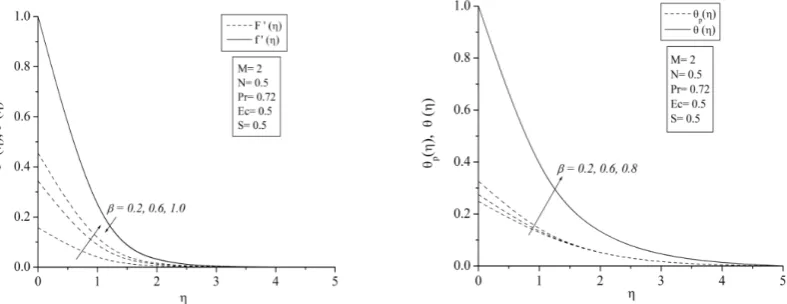
Figure 2 illustrates the effects of fluid-particle interaction parameter 𝑙𝑙 on the velocity profiles 𝑓𝑓′(𝜂𝜂) and 𝐹𝐹′(𝜂𝜂) with 𝜂𝜂.
It is noticed from the figure that the velocity profiles decreases with increasing values of 𝑙𝑙 for fluid phase and increases
for dust phase in the boundary layer. The effect of increasing value of 𝑙𝑙 is to reduce the velocity 𝑓𝑓′(𝜂𝜂) and thereby
increases the boundary layer thickness as clearly seen from figure 2. The temperature profiles 𝜃𝜃(𝜂𝜂) and 𝜃𝜃𝑝𝑝(𝜂𝜂) versus 𝜂𝜂
for different values of the fluid-particle interaction parameter 𝑙𝑙 is presented in figure 3. It shows that the temperature
increases with increases in 𝑙𝑙.
Figure-2 & 3: Effect of fluid-particle interaction parameter on velocity and temperature profiles.
Figure-4 & 5: Effect of magnetic parameter on velocity and temperature profiles.
Further, from Figure 4, can be seen that the horizontal velocity𝑓𝑓′(𝜂𝜂),𝐹𝐹′(𝜂𝜂) decreases with an increase in the magnetic
field parameter 𝑀𝑀. This is due to the fact that, the introduction of transverse magnetic field (normal to the flow
direction) has a tendency to create a drag, known as the Lorentz force which tends to resist the flow. This behavior is even true in the case of increasing values of fluid-particle interaction parameter for fluid phase. Now we discussed the
effects of magnetic field parameter 𝑀𝑀 on the temperature profiles 𝜃𝜃(𝜂𝜂)and 𝜃𝜃𝑝𝑝(𝜂𝜂) and are depicted in figure 5. We infer
from this figure that temperature increases with increases in magnetic field parameter 𝑀𝑀 and also it indicates that both
Figure-6 & 7: Effect of Prandtl number and Eckert number on temperature profiles.
The profiles in Figure 6 exhibit the role of Prandtl number on temperature profile 𝜃𝜃′(𝑛𝑛) .The effect of increasing values
of 𝑃𝑃𝑃𝑃 results in decrease of the temperature distribution and hence thermal boundary layer thickness decreases as 𝑃𝑃𝑃𝑃
increases. Figure 7 explains the effect of Eckert number 𝛽𝛽𝑐𝑐 on temperature profiles with 𝜂𝜂. From this one can see that
the temperature increases with increase in the value of 𝛽𝛽𝑐𝑐. This is due to the heat energy is stored in the liquid due to
the frictional heating.
We have used throughout our thermal analysis the values of 𝑙𝑙𝑇𝑇 =0.6, 𝜌𝜌=1, 𝑙𝑙=0.1.
6. CONCLUSION
The present chapter deals with the effect of thermal radiation on MHD boundary layer flow and heat transfer of an incompressible viscous dusty fluid over an exponentially stretching surface. The similarity transformations are used to reduce the given problem into set of nonlinear ordinary differential equations.
The transformed equations are then solved numerically using Runge-Kutta-Fehlberg fourth-fifth order method. The effects of thermal radiation are carried out for two cases of heat transfer analysis. Some of the interesting observations of the study are listed as follows;
• Fluid phase temperature is higher than the dust phase temperature.
• Thermal boundary layer thickness reduces for fluid particle interaction parameter and increases for magnetic
parameter.
• Prandtl number 𝑃𝑃𝑃𝑃 stabilizes the boundary layer growth.
• The boundary layers are highly influenced by Eckert number Ec.
• It is found that the skin friction coefficient decreases and the local Nusselt number increases as the magnetic
parameter increases.
• If 𝑙𝑙 →0 and 𝐾𝐾 →0 then our results coincide with the results of Kameswaran et.al [10] for different values of
magnetic parameter.
REFERENCES
1. M.Q.Al-Odat, R.A.Damseh and T.A.Al-Azab, Thermal boundary layer on an exponentially stretching
continous surface in the presence of magnetic field effect, Int. J. of Appl. Mech. Eng., 11 (2) (2006) 289-299.
2. Anuar Ishak, MHD Boundary layer flow due to an exponentially stretching sheet with radiation effect, Sains
Malaysiana, 40(4) (2011) 391−395.
3. P.Bala Anki Reddy and N.Bhaskar Reddy, Thermal radiation effects on hydro-magnetic flow due to an
exponentially stretching sheet, Int. J. Appl. Math. Comput., 3(4) (2011) 300−306.
4. Bikash Sahoos, Sbastien Poncet, Flow and heat transfer of a third grade fluid past an exponentially
stretching sheet with partial slip boundary condition, Int. J. of Heat Mass Tran., 54 (2011) 5010−5019.
5. Biliana Bidin and Roslinda Nazar, Numerical solution of the boundary layer flow over an exponentially
stretching sheet with thermal radiation, Eur. J. Sci. Res., 33(4) (2009) 710−717.
6. L.J.Crane, Flow past a stretching plate, Z. Angew. Math. Phy., 21(4) (1970) 645−647.
7. Dulal Pal, Mixed convection heat transfer in the boundary layers on an exponentially stretching surface with
magnetic field, Appl. Math. Comput. , 217 (2010)2356−2369.
8. B.K.Dutta, P.Roy, Temperature field in flow over a stretching sheet with uniform heat flux, Int. Comm. Heat
Mass Transfer,12(1) (1985), 89−94.
9. B.J.Gireesha, G.K.Ramesh and C.S.Bagewadi, Heat transfer in MHD flow of a dusty fluid over a stretching
Stretching Surface / IJMA- 6(7), July-2015.
10. P.K.Kameswaran, M.Narayana, P.Sibanda and G.Makanda, On radiation effects on hydromagnetic
Newtonian liquid flow due to an exponential stretching sheet, Boundary Value Problems (Springer), Article
in press (2012).
11. E.Magyari and B.Keller, Heat and mass transfer in the boundary layers on an exponentially stretching
continuous surface, J. Phys. D: Appl. Phys. , 32 (1999) 577−585.
12. G.Palani and P.Ganesan, Heat transfer effects on dusty gas flow past a semi-infinite inclined plate, Forsch
Ingenieurwes, 71 (2007) 223−230.
13. M.K.Partha, P.V.S.N.Murthy and G.P.Rajasekhar, Effect of viscous dissipation on the mixed convection heat
transfer from an exponentially stretching surface, Com. Non. Sci. Num. Simul., 14 (2009) 1064−1068.
14. P.G.Saffman, On the stability of laminar ow of a dusty gas, J. Fluid Mechanics, 13 (1962) 120−128.
15. B.C.Sakiadis, Boundary layer behaviour on continuous solid surface i. boundary-layer equations for two
dimensional and axisymmetric flow, AIChE J. , 7(1) (1961) 26−28.
16. B.C.Sakiadis, Boundary layer behaviour on continuous solid surface ii, boundary layer behaviour on
continuous flat surface, AIChE J., 7(2) (1961) 221−235.
17. K.Vajravelu and J.Nayfeh, Hydromagnetic flow of a dusty fluid over a stretching sheet, Int. J. Non-linear
Mech. , 27(6) (1992) 937−945.
Source of support: Nil, Conflict of interest: None Declared