SYNTHESIS OF BIOACTIVE HETEROCYCLES FROM
6-
AMINO-4-(2-CHLORO-5-NITROPHENYL)-3-METHYL-1,4-DIHYDROPYRANO[2,3-c]PYRAZOLE-5-CARBONITRILE
A. K. Elziaty,
[a]G. Bassioni,
[b]A. M. A. Hassan
[a]and H. A. Derbala
[a]Keywords: Enaminonitrile, pyranopyrazole, pyrimidinone, oxazinone, antimicrobial agents.
Enaminonitrile derivative, 6-amino-4-(2-chloro-5-nitrophenyl)-3-methyl-1,4-dihydropyrano[2,3-c]pyrazole-5-carbonitrile (1) was synthesized. This compound was utilized as a building block for the synthesis of new 3-methylpyrazolopyran moiety incorporated with different heterocycles involving pyrimidinone, oxazinone, and iminopyrimidine, in addition to novel derivatives including diacetyl derivative (5), benzoyl derivative (6), carbamodithioic acid (10) and urea derivative (13). Spectral techniques, FT-IR, 1H-NMR and mass spectroscopy and elemental analysis were used to characterize the synthesized compounds. Screening and evaluation of these products as antimicrobial agents showed that the derivatives 5, 6, 10, and 13 possess a potent activity.
* Corresponding Authors Fax:
E-Mail:
[a] Chemistry department, Faculty of Science, Ain Shams University, Abbassia, Cairo Egypt 11566
[b] Chemistry department, Faculty of Engineering , Ain Shams University, Abbassia, Cairo Egypt 11566
Introduction
It has been reported that pyran derivatives posses hypotensive effect,1 anticancer activity,2 antifungal effect,3,4
plant growth regulation activity.5 Pyranopyrazoles are
important compounds for the preparation of many biological active heterocyclic compounds6 and they proved to have
useful properties as therapeutics in clinical application.7-9 A
literature survey revealed that pyrazole derivatives have received much attention during the recent years on account of their utilization as antioxidant,10 antihypertensive,11
antifungal12,13 and vasodilator.14 As well as, pyrimidinone
derivatives have extensive applications as structural units of various biologically important molecules and as useful intermediates in medicinal chemistry15 and
pyranopyrimidinones compounds showed considerable pharmaceutical and biological activities, including anticancer, antitumor, antimalarial, antibacterial, antihypertensive, anti‐inflammatory, hepatoprotective, cardiotonic, vasodilator, bronchiodilator, antifolate, and antiallergic activities.16-28 They are also used in the
preparation of dyes and pigments flavoring agents,29,30 and
in luminescence chemistry.31 Over the past decades,
significant efforts have been devoted to develop the synthesis of pyrimidinethione derivatives,32,33 as they are
considered versatile synthons for the construction of many heterocycles of synthetic and biological importance.34-37
Thus, in view of the above facts and in continuation of our efforts to construct heterocyclic compounds from pyran derivatives, and to study their biological potency,38-45 it was
of interest to synthesize a ring system combine both the pyrazole and the pyran moieties which might have good biological activity.
Results and Discussion
Syntheses
The previously reported46 pyranopyrazole derivative (1)
was allowed to react with different reagents aiming to synthesize antimicrobial heterocycles. Reaction of 1 with formic acid afforded the pyrimidinone derivative 2 whose structure was confirmed from IR spectral data which revealed the absence of absorption bands of C≡N and NH2
groups and the appearance of bands characteristic to carbonyl and NH groups at υ1682 cm-1 and 3182 cm-1,
respectively. The 1H-NMR spectrum showed a singlet at
δ11.08 ppm, disappeared by D2O due to NH group proton.
Acid hydrolysis of the cyano functionality was carried out by addition of concentrated sulphuric acid onto pyranopyrazole derivative 1 at room temperature to give the amide derivative 3. The structure of the amide 3 was elucidated by the FTIR spectra which showed no absorption band of C≡N and appearance of a new band due to C=O group at υ1685 cm-1.
In our previously reported work for the synthesis of oxazinone derivatives,46 the pyranopyrazole derivative 1
was allowed to react with acetic anhydride and/or benzoyl chloride under solvent-free conditions and afforded the pyrazolopyranooxazinones 4a, b. On the contrary, herein, the reaction of 1 with acetic anhydride in pyridine gave the diacetyl derivative 5 and benzoylation with benzoyl chloride in dry toluene as a solvent afforded the benzoyl derivative 6. The IR spectra of both products 5 and 6 revealed the presence of cyano group absorption that proved no cyclization has occurred (Scheme 1).
Scheme 1. Reactions of pyranopyrazole derivative.
Scheme 2. Further reactions of pyranopyrazole derivatives
1 O N
N H
Ar CN
NH2
HCOOH
N NH O
2
reflux
H2SO4
CONH2
NH2
3
r.t.
O Ar
N X O
R 4a,b
4a: R= CH3, X= O
4b: R= Ph , X= NH Ac2O/ or PhCOCl
reflux
CN
N(COCH3)2
5
6 O N
N Ar
CN
NH
O Ph O
Ph
Ac2O/ Pyridine reflux reflux PhCOCl / Toluene
Cl
NO2 Ar =
1 O N
N H
Ar CN
NH2
CS2
DMF reflux N
H NH S
S
11
CN
NHCSSH 10
X
N H
N NH
Ph
O
CN
NHCONHPh PhNCO
13 Pyridine/ reflux
12 X
NC N
C2H5OHC
7
NH2NH2
N N NH
8
NH2 CN
NHCHO
9
NH3/ CH3OH
N NH O
Further, the 1H-NMR spectrum showed a singlet at δ12.36
ppm which disappeared in D2O and is due to NH group, a
quartet peak owing to CH2 group at δ 4.34-4.28 ppm and a
triplet peak at δ 1.31-1.28 ppm due to CH3 protons.
The structure of 8 has been elucidated on the basis of IR spectrum which showed a coupling band at 3188, 3119 cm -1due to NH
2 group and two peaks for NH pyrazole and NH
imino at 3349 and 3309 cm-1, respectively. Its 1H-NMR
spectrum showed a singlet at δ 12.57 ppm NH of pyrazole group and 10.25 ppm for C=NH. However, when the imidoformate derivative 7 was subjected to react with ammonium hydroxide in methanol, hydrolysis of the imidoformate functionality to the formamide derivative 9
occurred instead of the formation of the pyrimidinone derivative 2.
Further, treatment of the enaminonitrile 1 with carbon disulfide afforded carbamodithioic acid 10 instead of pyrimidenedithione derivative 11.The IR spectrum of 10
revealed the absorption band attributable to C≡N group at 2215 cm−1 and a sharp band at 1390 cm−1due to C=S group. The reaction of the compound 1 with phenylisocyanate in pyridine provided the urea derivative 13 instead of the pyrimidinone derivative 12. The structure of 13 was confirmed from its elemental and spectral analysis(Scheme 2).
Antimicrobial Study
The antibacterial activity of the synthesized compounds 2,
3, 7, 8, 10 and 13 was tested against a panel of two gram positive bacteria (Staphylococcus aureus and Bacillus subtilis) and two Gram-negative bacteria (Escherichia coli
and Pseudomonas aeuroginosa). The antifungal activities of the compounds were tested against two fungi (Candida albicans and Aspergillus flavus).
Each compound was dissolved in DMSO and a solution of concentration 1 mg mL-1 were prepared. Separately paper
discs (5cm) were cut and sterilized in an autoclave. The paper discs, soaked in the solution of the compound, were placed aseptically in the petri dishes containing nutrient agar media (agar 20g + beef extract 3g +peptone 5g) seeded with
Staphylococcus aureus, Bacillus subtilis, Escherichia coli,
Pseudomonas aeuroginosa, Candida albicans and Aspergillus flavus. The petri dishes were incubated at 36 C and the inhibition zones were recorded after 24 h of incubation. Each treatment was replicated three times. The antibacterial activity of a common standard antibiotic ampicillin and antifungal colitrimazole was also recorded using the same procedure as above at the same concentration and solvents.
The % activity index for the complex was calculated by the formula as shown below:
The antimicrobial activity of the synthesized heterocycles was shown in Table 1.
Minimum inhibitory concentration (MIC) measurements
The MIC was determined using the disc diffusion technique by preparing discs containing 1.9-1000 µg/ml of each compound against gram positive Staphylococcus aureus and Bacillus subtilis and gram negative Escherichia coli and Pseudomonas aeuroginosa
.
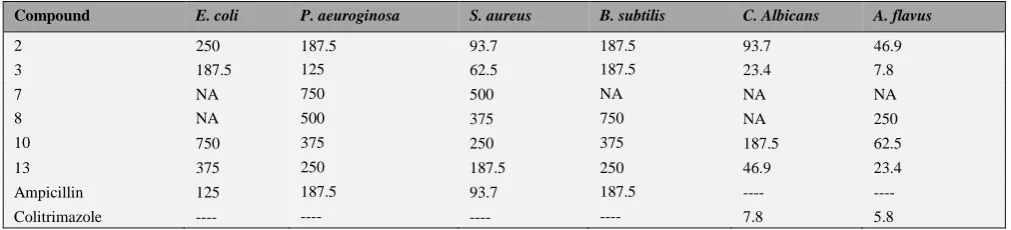
The antifungal activities of the compounds were tested against two fold fungi Candida albicans and Aspergillus flavus and applying the protocol. The two fold dilutions of the solution were prepared. The microorganism suspensions at 10 CF-U/ mL (colony forming unit/ml) concentration were inoculated to the corresponding wells. The plates were incubated at 36C for 24 h. for the bacteria.The standard antibiotic ampicillin and Antifungal Colitrimazole was also recorded using the same procedure as above at the same concentration and solvents. At the end of the incubation period, the minimum inhibitory concentration (MIC) values were recorded as the lowest concentration of the substance that had no visible turbidity. Control experiments with DMSO and uninoculated media were run parallel to the test compounds under the same condition. The results of MIC measurements of the synthesized heterocycles compounds are shown in Table 2.Experimental
All melting points were determined on an electrothermal apparatus and are uncorrected. The FT-IR were recorded in potassium bromide disks on Pye Unicam SP3-300 and Shimdazu FTIR 8101PC Infrared spectrophotometers. The
1H-NMR was recorded on a Varian Mercury VX-300 NMR
spectrometer. 1H-NMR spectra were run at 300 MHz and on
a Varian Gemini 200 MHz, Bruker AC 200 MHz using TMS as internal standard in deuterated chloroform (CDCl3)
or deuterated dimethyl sulfoxide (DMSO-d6). Chemical
shifts are quoted in 𝛿 and were related to that of the solvents. The mass spectra were recorded on a Shimadzu GC-MS QP1000 EX mass spectrometer at 70 eV. Elemental analyses were carried out at the Micro analytical Center of Cairo University. All the reactions and the purity of the new compounds were followed and cheeked by TLC.
Synthesis
4-(2-Chloro-5-nitrophenyl)-3-methyl-4,6-dihydropyrazolo-[4',3':5,6]pyrano[2,3-d]pyrimidin-5(1H)-one (2)
A mixture of 1 (5 mmol, 1.66 g) and formic acid (20 mL) was refluxed for 2 h, the reaction mixture was poured after cooling into water and crushed ice, the solid formed was filtered off, washed with cold water and crystallized from ethanol to give compound 2 as a pale yellow solid (72 %). m.p. 229-230 C. IR (KBr): 3403 (NH pyrraz.), 3182 (NH pyrim.), 1682 (CO) cm−1. MS m/z (%) 359 (M∙+, 7.35), 360 (3.42), 230 (74.53), 179 (2.15), 43(100). 1H-NMR (DMSO-d6) 𝛿 = 11.4 (s, 1H, NH), 11.08 (s, 1H, NH), 8.49 (s, 1H,
CH, N = C2-H), 8.07–7.70 (m, 3H, aromatic), 4.64 (s, 1H, benzylic), 2.12 (s, 3H, CH3). Anal. Calcd. for C15H10N5O4Cl
(359.73): C, 20.08; H, 2.80; Cl, 9.85; N, 19.47. Found: C, 20.06; H, 2.82; Cl, 9.83; N, 19.48.
zone of inhibition by test compound Activity index (%) = 100
Table 1. Antimicrobial study of the synthesized heterocycles compounds
Compound E. coli, mg mL-1
P. aeuroginosa, mg mL-1
S. aureus mg mL-1
B. subtilis mg mL-1
C. albicans mg mL-1
A. flavus mg mL-1
DIZ, mm
% AI DIZ, mm
% AI DIZ, mm
% AI DIZ, mm
% AI DIZ, mm
% AI DIZ, mm
% AI
2 9 36.0 16 69.6 14 60.9 16 69.6 8 30.8 12 48.0
3 13 52.0 20 86.9 15 65.2 18 78.3 21 80.8 20 80.0
7 NA ---- 2 8.7 2 8.7 NA ---- NA ---- NA ----
8 NA ---- 5 21.7 4 17.4 6 26.1 NA ---- 7 28.0
10 5 20.0 9 39.1 9 39.1 10 43.5 5 19.2 9 36.0
13 7 28.0 11 47.8 10 43.5 13 56.5 10 38.5 18 72.0
Ampicillin 25 100 23 100 23 100 23 100 NA ---- NA ----
Colitrim-azole NA ---- NA ---- NA ---- NA ---- 26 100 25 100
DIZ = Diameter of inhibition zone; % AI = % Activity index; NA = No activity
Table 2. Antimicrobial and antimycotic activities in terms of MIC (µg mL-1).
Compound E. coli P. aeuroginosa S. aureus B. subtilis C. Albicans A. flavus
2 250 187.5 93.7 187.5 93.7 46.9
3 187.5 125 62.5 187.5 23.4 7.8
7 NA 750 500 NA NA NA
8 NA 500 375 750 NA 250
10 750 375 250 375 187.5 62.5
13 375 250 187.5 250 46.9 23.4
Ampicillin 125 187.5 93.7 187.5 ---- ----
Colitrimazole ---- ---- ---- ---- 7.8 5.8
6-Amino-4-(2-chloro-5-nitrophenyl)-3-methyl-1,4-dihydro-pyrano[2,3-c]pyrazole-5-carboxamide (3)
Compound 1 (5 mmol, 1.66 g) was added drop wise with stirring to concentrated cold sulphuric acid (6 mL) at 20 C, the temperature did not exceed 40 C during the addition, then the solution was stirred for further 1 h at room temperature and poured onto ice cold water (10 mL). The reaction mixture was left overnight in the refrigerator. The yellow precipitate was filtered off and crystallized from water to give compound 3 as apale yellow solid (68 %). m.p. 175-176 C. FTIR (KBr): 3588 (NH pyrraz.), 3567-3370 (NH2), 3191-3108(amide NH2), 1685 (CO) cm-1. MS m/z
(%): 350(M∙+;1.36), 351(4.93), 307 (67.39), 230(70.44), 151 (43.39), 43(100). 1H-NMR (DMSO-d
6) 𝛿 = 11 (s, 1H, NH,
pyraz., exchanged with D2O), 7.38- 6.67 (s, 4H, C2-NH2 ;
CONH2, exchanged with D2O), 8.63–7.60 (m, 3H, aromatic),
4.68 (s, 1H, benzylic), 2.1 (s, 3H, CH3). Anal. Calcd. for
C14H11N4O5Cl (350.72): C, 47.95; H, 3.16; Cl, 10.11; N,
15.98. Found: C, 47.93; H, 3.15; Cl, 10.11; N, 15.99.
N-Acetyl-N-[4-(2-chloro-5-nitrophenyl)-5-cyano-3-methyl-1,4-dihydropyrano[2,3-c]pyrazol-6-yl]acetamide (5)
A solution of 1 (5 mmol, 1.66 g) in acetic anhydride-pyridine mixture (30 mL, 2:1 v/v) was heated on a water bath for 8 h, then cooled and poured into ice/ water mixture. The precipitate thus formed was filtered off, washed several times with water, dried and crystallized from dioxane to give compound 5, as a deep brown solid (50 %). m.p. > 300
C. FTIR (KBr): 3355(NH pyrrazole), 1787, 1739 (C═O), 2223(C ≡N) cm-1. 1H-NMR (DMSO-d
6) 𝛿 = 11.28 (s, 1H,
NH, pyrazole, exchanged with D2O), 8.42-7.70 (m, 3H,
aromatic), 4.62 (s, 1H, benzylic), 2.12 (s, 6H, 2CH3), 2.55 (s,
3H, CH3). MS m/z (%): 415 (M∙+;100), 417(32), 416 (19.5).
Anal. Calcd. for C18H14N5O5Cl (415.79): C, 52; H, 3.39; Cl,
8.53; N, 16.84. Found: C, 52.01; H, 3.38; Cl, 8.52; N, 16.85.
N-[4(2-Chloro-5-nitrophenyl)-5-cyano-3-methyl-1,4-dihydro-pyrano[2,3-c]pyrazol-6-yl]benzamide (6)
A mixture of 1 (5 mmol, 1.66 g) and benzoyl chloride (5 mmol) in toluene was refluxed for 24 h. The excess of solvent was removed under vacuum, the remaining solid was crystallized from ethanol-dioxane (1:1) to give compound 6 as a brown solid (53 %). m.p. 261-262 C. FTIR (KBr): 3452 (NH pyrrazole), 3168 (NH-amide), 1708 (C═O, cyclic amide), 2193 (C≡N), 1641 (C═O, amide) cm-1. 1H-NMR (DMSO-d
6) 𝛿 = 8. 35 (s, 1H, NH, amide),
8.19-7.40 (m, 13H, aromatic), 5.41 (s, 1H, benzylic), 1.79 (s, 3H, CH3). MS m/z (%): 539 (M∙+; 3.40), 541 (2.38), 426 (15.76),
220 (28.65), 41(100). Anal. Calcd. for C28H18N5O5Cl
(539.93): C, 62.29; H, 3.36; Cl, 6.57; N, 12.97. Found: C, 62.27; H, 3.35; Cl, 6.56; N, 12.98.
Ethyl-4-(2-chloro-5-nitrophenyl)-5-cyano-3-methyl-1,4-dihyd-ropyrano[2,3-c]pyrazol-6-ylimidoformate (7)
compound 7 as a pale brown solid (60 %). m.p. 233-234 C. FTIR (KBr,): 3180 (NH pyrrazole), 1632 (C═N), 2210 (C≡N) cm-1. 1H-NMR (DMSO-d
6) = 12.36 (s, 1H, NH,
pyrazole, exchanged with D2O), 8.59 (s, 1H, N═CH), 8.17–
7.77 (m, 3H, aromatic), 5.47 (s, 1H, benzylic), 4.34-4.28 (q, 2H, CH2), 1.77 (s, 3H, CH3, pyrazole), 1.31-1.28 (t, 3H,
CH3). MS m/z (%): 386.87(M∙+; 11.08), 389(5.67),
283(25.01), 259(34.62), 202(32.17), 146 (82.33), 82 (100). Anal. Calcd. for C17H14N5O4Cl (387.78): C, 52.66; H, 3.64;
Cl, 9.14; N, 18.06. Found: C, 52.64; H, 3.62; Cl, 9.13; N, 18.08.
4-(2-chloro-5-nitrophenyl)-5-imino-3-methyl-1,4-dihydropyr-azolo-[4',3':5,6]pyrano[2,3-d]pyrimidin-6- (5H)-amine (8)
To a well stirred cold solution of compound 7 (20 mmol, 7.76 g) in ethanol (20 mL), hydrazine monohydrate (99 %) (3 mL) was added drop wise and then the mixture was stirred at room temperature for 6 h and left overnight. The solid that precipitated was filtered off and and crystallized from ethanol to give compound 8 as a pale yellow solid (66 %). m.p. > 300 C. FTIR (KBr,): 3349 (NH pyrrazole), 3309 (NH, imino), 3188, 3119 (NH2), 1638 (C═N) cm-1. 1
H-NMR (DMSO-d6) = 12.57 (s, 1H, NH, pyrazole), 10.25 (s,
1H, C═NH), 8.44 (s, 1H, CH═N), 8.18-7.67 (m, 3H, aromatic), 5.89 (s, 1H, benzylic), 4.40 (s, 2H, NH2), 1.93 (s,
3H, CH3). MS m/z (%): 373 (M∙+; 2.43), 290 (13.60), 221
(21.71), 161 (65.56), 60 (100). Anal. Calcd. for C15H12N7O3Cl (373.76): C, 48.20; H, 3.24; Cl, 9.48; N,
26.23. Found: C, 48.21; H, 3.23; Cl, 9.47; N, 26.24.
4-(2-Chloro-5-nitrophenyl)-5-cyano-3-meth- yl-1,4-dihydro-pyrano[2,3-c]pyrazol-6-yl formamide (9)
Compound 7 (2 mmol, 0.78 g) was added to a mixture of methanol (15 mL) and 25% aqueous ammonia solution (15 mL). The reaction mixture was stirred for 24 h, cooled, and the precipitated solid was filtered off and crystallized from toluene to give compound 9 as a pale brown solid (51 %). m.p. > 300 C. FTIR (KBr,): 3271(NH pyrrazole), 2205 (C≡N), 1669 (CO) cm-1. 1H-NMR (DMSO-d
6) = 12.57 (s,
1H, NH, pyrazole), 8.21 (s, 1H, CHO), 8.32-7.68 (m, 3H, aromatic), 7.2 (s, 1H, NH), 4.74 (s, 1H, benzylic), 1.9 (s, 3H, CH3). Anal. Calcd. for C15H10N5O4Cl (359.73): C, 50.08; H,
2.80; Cl, 9.48; N, 26.23. Found: C, 48.21; H, 3. 2 3; Cl, 9.47; N, 26.24.
4-(2-Chloro-5-nitrophenyl)-5-cyano-3-methyl-1,4-dihydro-pyrano[2,3-c]pyrazol-6-yl carbamodithioic acid (10)
To a solution of 1 (10 mmol, 3.31 g) in DMF (20 mL), carbon disulfide (15 mmol) and 10 mL of sodium methoxide (prepared from 0.59 gm of sodium metal and 30 ml methanol) were added. The mixture was refluxed for 20 h and then poured into ice cold water. A solution of sodium hydroxide (20 mL, 1M) was added to it and left overnight. The solution was filtered and acidified with dilute acetic acid to give yellow precipitate, which was collected, washed with dilute acetic acid, dried and crystallized from ethanol to give compound 11 as a deep yellow solid (52 %). m.p. > 300
C. FTIR (KBr): 3261 (NH pyrrazole), 3151(NH), 2966 (SH), 2215 (C≡N), 1390 (C═S) cm-1. 1H-NMR (DMSO-d
6)
= 12.02 (s, 1H, NH, pyrazole), 7.70-7.14 (m, 3H,
aromatic), 5.52 (s, 1H, benzylic), 10.89 (s, 1H, NH), 1.2(s, 1H, SH), 1.9 (s, 3H, CH3). MS m/z (%):406.9 (M∙+; 6.07),
409 (4.64), 358 (32.16), 281 (25.37), 64 (100). Anal. Calcd. for C15H10N5O3S2Cl (407.85): C, 44.17; H, 2.47; Cl, 8.69; N,
17.17. Found: C, 44.16; H, 2.46; Cl, 8.68; N, 17.18.
N-[4-(2-Chloro-5-nitrophenyl)-5-cyano-3-methyl-1,4-dihydro-pyrano[2,3-c]pyrazol-6-yl]-N'-phenyl- urea (13)
A mixture of 1 (10 mmol, 3.31 g) and phenylisocyanate (10 mmol) in pyridine (20 mL) was refluxed for 12 h. The reaction mixture was cooled and poured onto ice/ water mixture and neutralized with diluted HCl. The solid product so formed was collected by filtration and crystallized from methanol to give compound 13 as a deep yellow solid (56 %). m.p. > 300 C. FTIR (KBr): 3371 (NH pyrrazole), 3213, 3101 (2NH, amide), 1745 (C=O), 2210 (C≡N) cm-1. 1H-NMR (DMSO-d
6) 𝛿 = 11.5 (s, 1H, NH, pyrazole),
8.58-7.11 (m, 8H, aromatic), 4.7(s, 1H, benzylic), 8.9 (s, 1H, NH), 6.7 (s, 1H, NH), 1.9 (s, 3H, CH3). MS m/z (%):450 (M∙+;
3.47), 451.85 (4.90 ), 244 (22.11), 219 (41.50), 198 (79.99). Anal. Calcd. for C21H15N6O4Cl (450.84): C, 55.95; H, 3.35;
Cl, 7.86; N, 18.64. Found: C, 55.94; H, 3.33; Cl, 7.87; N, 18.65.
References
1Goel, A., Singh, F. V., Tetrahedron Lett.,2005, 46, 5585-5587. https://doi.org/10.1016/j.tetlet.2005.06.034
2EL-Far, M., EL megeed, F. V. G. A., Eskander, E. F., Rady, H. M., Tantawy, M. A., Eur. J. Med. Chem., 2009, 44 (10), 3936-3946. https://doi.org/10.1016/j.ejmech.2009.04.020
3Pasternak, P. V., Averkiev, Antipin, B. B. M. Y., Peregudov, A. S., Chkanikov, N. D. J. Fluorine Chem., 2004, 125, 1853-1868.https://doi.org/10.1016/j.jfluchem.2004.06.008 4Ballini, R., Sartori, G., Sartorio, R., Tetrahedron Lett., 2004, 45,
2297-2299. https://doi.org/10.1016/j.tetlet.2004.01.115 5Abdel hamid, A. O., Afifi, M. A. M., J. Adv. Res.,2010, 1,
137-144. https://doi.org/10.1016/j.jare.2010.03.005
6Al-Amiery, A. A., Al-Bayati, R. I., Saed, F. M., Ali, W. B., Kadhum, A. A. H., Mohamad, A. B., Molecules, 2012, 17, 10377-10389. 10.3390/molecules170910377
7El-Gazzar, A. B. A., El-Enany, M. M., Mahmoud, M. N., Bioorg. Med. Chem., 2008, 16, 3261-3273. https://doi.org/10.1016/j.bmc.2007.12.012
8Fayed, A. A., Hosni, H. M., Flefel, E. M., Amr, A. E. E., World J. Chem., 2009, 4, 58-65.
9Sondhi, S. M., Singh, N., Johar, M., Kumar, A., Bioorg. Med. Chem., 2005, 13, 6158-6166. https://doi.org/10.1016/j.bmc.2005.06.063
10Abu-Hashem, A. A., El-Shehry, M. F., Badria, F. A., Acta Pharm., 2010, 60, 311-323. https://doi.org/10.2478/v10007-010-0027-6
11Svetlik, J., Veizerova, L., Liptaj, T., Kubista, J., ARKIVOC,2009, 2009, 79-86.
http://dx.doi.org/10.3998/ark.5550190.0010.a09
12Fathalla, O. A., Zeid, I. F., Haiba, M. E., Soliman, A. M.; Abd-Elmoez, S. I.; Serwy, W. S. World J. Chem., 2009, 4, 127-132.
14Li, M., Wang, S. W., Wen, L. R., Qi, W. Y., Yang, H. Z., J. Chin. Chem. Soc., 2005, 52, 1021-1028. 10.1002/jccs.200500143 15Wannberg, J., Dallinger, D., Kappe, C.O., Larhed, M. J., Comb.
Chem., 2005, 7, 574-583.
http://dx.doi.org/10.1021/cc049816c
16Alqasoumi, S. I., Al‐Taweel, A. M., Alafeefy, A. M., Noaman, E., Ghorab, M. M., Eur. J. Med. Chem., 2010, 45, 738-744. https://doi.org/10.1016/j.ejmech.2009.11.021
17Broom, A. D., Shim, J. L., Anderson, G. L., J. Org. Chem., 1976, 41, 1095-1099.10.1021/jo00869a003
18Joshi, A. A., Viswanathan, C. L., Anti‐Infect. Agents Med. Chem.,
2006, 5, 105-122.
https://doi.org/10.2174/187152106774755626
19Ghorab, M. M., Hassan, A. Y., Phosphorus, Sulfur Silicon Relat. Elem., 1998, 141, 251-261.
https://doi.org/10.1080/10426509808033737
20Sharma, P., Rane, N., Gurram, V. K., Bioorg. Med. Chem. Lett.,
2004, 14, 4185-4190.
https://doi.org/10.1016/j.bmcl.2004.06.014
21El‐Gazzar, A. B. A., Hafez, H. N., Nawwar, G. A. M., Eur. J. Med. Chem.,2009, 44, 1427-1436.
https://doi.org/10.1016/j.ejmech.2008.09.030
22De la Cruz, J. P., Moreno, A., Mérida, F., García‐Campos, J., de la Cuesta, F. S., Pharmacol. Toxicol., 1994, 75, 250-254.10.1111/j.1600-0773.1994.tb00356.x
23Gupta, R., Jain, A., Joshi, R., Jain, M., Bull. Korean Chem. Soc.,
2011, 32, 899-904. 10.5012/bkcs.2011.32.3.899
24Hanna, M. M., Eur. J. Med. Chem., 2012, 55, 12-22. https://doi.org/10.1016/j.ejmech.2012.06.048
25Shinde, S. V., Jadhav, W. N., Karade, N. N., Orient. J. Chem.,
2010, 26, 307-317.
26Lichtner, R. B., Hutchinson, G., Hellmann, K., Eur. J. Cancer Clin. Oncol., 1989, 25, 945-951.
https://doi.org/10.1016/0277-5379(89)90152-1
27DeGraw, J. I., Christie, P. H., Clowell, W. T., Sirotnak, F. M., J. Med. Chem., 1992, 35, 320-324. 10.1021/jm00080a017 28Thomas, H. D., Saravanan, K., Wang, L. Z., Lin, M. J., Northen,
J. S., Barlow, H., Barton, M., Newell, D. R., Griffin, R. J., Golding, B. T., Curtin, N. J., Mol. Cancer Therapy, 2009, 8, 1828-1837. 10.1158/1535-7163.MCT-08-1208
29Petal, N. C., Mehta, A. G., Asian J. Chem., 2001, 13, 1385-1388. 30Holla, B. S., Mahalinga, M., Karthikeyan, M. S., Akberali, P. M.,
Shetty, N. S., Bioorg. Med. Chem., 2006, 14, 2040-2047. https://doi.org/10.1016/j.bmc.2005.10.053
31Całus, S., Gondek, E., Danel, A., Jarosz, B., Pokładko, M., Kityk, A. V., Mater. Lett., 2007, 61, 3292-3295. https://doi.org/10.1016/j.matlet.2006.11.055
32Yousif, N. M., Gad, F. A., Sayed, H. H., Egypt. J. Chem., 1992, 35, 101-110.
33Yousif, N. M., Gad, F. A., Sayed, H. H., Egypt. J. Pharm. Sci.,
1996, 37, 145-156.
34Sayed, H. H., Indian J. Chem., 1998, 37B, 1054-1058.
35Sayed, H. H., Fahmy, F. A., Egypt. J. Chem., 2001, 44, 365-372. 36Rashad, A. E., Sayed, H. H., Shamroukh, A. H., Awad, H. M.,
Phosphorus Sulfur, 2005, 180, 2767-2777. https://doi.org/10.1080/104265090968118
37Abdel-Megeid, F. M. E., Hassan, N. A., Zahran, M. A., Rashad, A. E., Sulfur Lett., 1998, 21, 269-284.
38El-Ziaty, A. K., Abdalha, A. A., Hamed, A. A., Shiba, S. A., Abdulalh, A. A., Eur. J. Chem., 2012, 3(1), 65-70. 10.5155/eurjchem.3.1.65-70.518
39El-Ziaty, A. K., Shiba, S. A., Synth. Commun.,2007, 27,
4043-4057. https://doi.org/10.1080/00397910701575491
40Abou-Elmagd, W. S. I., EL-Ziaty, A. K., Abdalha, A. A.,
Heterocycl. Commun., 2015, 21(13), 179-185.
https://doi.org/10.1515/hc-2015-0008
41Elziaty, A. K.; Mostafa, O. E. A.; El-Bordany, E. A.; Nabil, M.;
Madkour, H.M.F. Int. J. Sci. Eng. Res. 2014,5, 727-735.
42Ismail, M. F., Mahmoud, M. R., Shiba, S. A., El-Ziaty, A. K.,
Abu El-Azm, F. S. M., Synth. Commun., 2014, 44,
1094-1102. https://doi.org/10.1080/00397911.2013.846381
43El-Ziaty, A. K., Hussein, A. M., Mahmoud, M. R., World Appl.
Sci. J., 2012, 17(1), 101-108.
44Morsy, J. M., Aly, A. F., Elshahawi, M. M., EL-Ziaty, A. K., J.
Heterocycl. Chem., 2016, 53 (5), 1443-1448.
10.1002/jhet.2445
45EL-Ziaty, A. K, El-Shahawi, M. M., J. Chem. 2017.
https://doi.org/10.1155/2017/5610707
46EL-Ziaty, A. K., Abdel-Aziz, M. S., Bassioni, G., Hassan, A. M.
A., Derbala, H. A., J. Chem., 2016.
http://dx.doi.org/10.1155/2016/5286462