
Proceedings of the
XIII Spanish Conference on Programming
and Computer Languages
(PROLE 2013)
Analyzing Fuzzy Logic Computations with Fuzzy XPath
Jesús M. Almendros-Jiménez, Alejandro Luna, Ginés Moreno and Carlos Vázquez
19 pages
Guest Editors: Clara Benac Earle, Laura Castro, Lars-Åke Fredlund Managing Editors: Tiziana Margaria, Julia Padberg, Gabriele Taentzer
Analyzing Fuzzy Logic Computations with Fuzzy XPath
Jesús M. Almendros-Jiménez1, Alejandro Luna2, Ginés Moreno3and Carlos Vázquez4
Dept. of Informatics Universidad de Almería
04120 Almería (Spain)
3[email protected] 4[email protected]
Dept. of Computing Systems University of Castilla-La Mancha
02071 Albacete (Spain)
Abstract: Implemented with a fuzzy logic language by using the FLOPER tool developed in our research group, we have recently designed a fuzzy dialect of the popular XPath language for the flexible manipulation of XML documents. In this paper we focus on the ability of Fuzzy XPath for exploring derivation trees generated by FLOPER once they are exported in XML format, which somehow serves as a debugging/analizing tool for discovering the set of fuzzy computed answers for a given goal, performing depth/breadth-first traversals of its associated derivation tree, finding non fully evaluated branches, etc., thus reinforcing the bi-lateral synergies between Fuzzy XPath and FLOPER.
Keywords: XPath; Fuzzy (Multi-adjoint) Logic Programming; Debugging
1
Introduction
Logic Programming (LP) [Llo87] is being widely used from several decades ago for problem solving and knowledge representation, thus providing a great amount of foundations and tech-niques devoted to produce real world applications. Some steps beyond, during the last years im-portant research efforts have been performed for introducing inside the LP paradigm some tech-niques/constructs based on fuzzy logic in order to explicitly treat with uncertainty and approxi-mated reasoning in a natural way. Following this trail, several fuzzy logic programming systems have been developed [Lee72, KS92, BMP95, Voj01, GMV04, VP05, Str08, RR10, MCS11], where the classical inference mechanism of SLD–Resolution has been replaced by a fuzzy vari-ant which is able to handle partial truth in a comfortable way.
classical modus ponens inference rule) are systematically applied by a backward reasoning pro-cedure in a similar way to classical resolution steps in pure logic programming. More precisely, in an admissible step, for a selected atom A in a goal and a rulehH←B; viof the program, if there
is a most general unifierθ of A and H, then atom A is substituted by the expression(v&B)θ,
where “&” is an adjoint conjunction evaluating modus ponens. Finally, the operational phase re-turns a computed substitution together with an expression where all atoms have been exploited. This last expression is then interpreted under a given lattice during what we call the interpretive phase, hence returning a pair htruth degree; substitutioni which is the fuzzy counterpart of the classical notion of computed answer traditionally used in pure logic programming.
On the other hand, the eXtensible Markup Language (XML) is widely used in many areas of computer software to represent machine readable data. XML provides a very simple language to represent the structure of data, using tags to label pieces of textual content, and a tree structure to describe the hierarchical content. XML emerged as a solution to data exchange between appli-cations where tags permit to locate the content. XML documents are mainly used in databases. The XPath language [BBC+07] was designed as a query language for XML in which the path of the tree is used to describe the query. XPath expressions can be adorned with Boolean conditions on nodes and leaves to restrict the number of answers of the query. XPath is the basis of a more powerful query language (called XQuery) designed to join multiple XML documents and to give format to the answer. In [ALM11,ALM12a] we have presented an XPath interpreter (together with a debugger, as documented in [ALM12b,ALM13]) extended with fuzzy commands which somehow rely on the implementation based on fuzzy logic programming by using FLOPER.
Whereas in Sections 2 and 3 we summarize the main features of both the fuzzy XPath in-terpreter and the fuzzy logic programming environment FLOPER, respectively, in Section 4 we go deeper on the feedbacks between both tools. More exactly we show that, even when FLOPER was used for implementing fuzzy XPath, now this last language is very useful for formulating queries to be executed againts XML documents representing derivation trees de-picted by FLOPER, thus becoming into a “debugging” technique which can be embedded into the programming environment for analyzing some interesting details (fuzzy computed answers, tree traversals, partial branches, etc.) about fuzzy logic computations. Finally, in Section5we conclude and present future work.
2
Fuzzy XPath
enable to impose Boolean requirements on the answers. XPath Boolean conditions can be re-ferred to attribute values and node content, in the form of equality and range of literal values, among others. However, the and and or operators applied to two Boolean conditions are not precise enough when the programmer does not give the same value to both conditions. For in-stance, some answers can be discarded when they could be of interest by the programmer, and accepted when they are not of interest. Besides, programmers would need to know in which sense a solution is better than another. When several Boolean conditions are imposed on a query, each one contributes to satisfy the programmer’s preferences in a different way and perhaps, the programmer’s satisfaction is distinct for each solution.
We have enriched the arsenal of operators of XPath with fuzzy variants of and and or. Partic-ularly, we have considered three versions of and: and+, and, and- (and the same for or : or+, or, or-) which make more flexible the composition of fuzzy conditions. Three versions for each operator that come for free from our adaptation of fuzzy logic to the XPath paradigm. One of the most known elements of fuzzy logic is the introduction of fuzzy versions of classical Boolean operators. Product, Łukasiewicz and Gödel fuzzy logics are considered as the most prominent logics and give a suitable semantics to fuzzy operators. Our contribution is now to give sense to fuzzy operators into the XPath paradigm, and particularly in programmer’s preferences. We claim that in our work the fuzzy versions provide a mechanism to force (and debilitate) condi-tions in the sense that stronger (and weaker) programmer preferences can be modeled with the use of stronger (and weaker) fuzzy conditions. The combination of fuzzy operators in queries permits to specify a ranked set of fuzzy conditions according to programmer’s requirements.
Furthermore, we have equipped XPath with an additional operator that is also traditional in fuzzy logic: the average operator avg. This operator offers the possibility to explicitly give weight to fuzzy conditions. Rating such conditions by avg, solutions increase its weight in a proportional way. However, from the point view of the programmer’s preferences, it forces the programmer to quantify his(er) wishes which, in some occasions, can be difficult to measure. For this reason, fuzzy versions of and and or are better choices in some circumstances.
Finally, we have equipped our XPath based query language with a mechanism for thresholding programmer’s preferences, in such a way that programmer can request that requirements are satisfied over a certain percentage.
The proposed fuzzy XPath is described by the following syntax:
xpath := [‘[’deep-down‘]’ ]path
path := literal | text() | node | @att | node/path | node//path node := QName | QName[cond]
cond := xpath op xpath | xpath num-op number deep := DEEP=number
down := DOWN=number
deep-down := deep | down | deep ‘;’ down num-op := > | = | < | <>
fuzzy-op := and | and+ | and- | or | or+ | or- | avg | avg{number,number} op := num-op | fuzzy-op
Figure 1: Fuzzy Logical Operators
&P(x,y) = x∗y |P(x,y) = x+y−x∗y Product: and/or
&G(x,y) = min(x,y) |G(x,y) = max(x,y) Gödel:
and+/or-&L(x,y) = max(x+y−1,0) |L(x,y) = min(x+y,1) Łuka.: and-/or+
– Structural constraints. A given XPath expression can be adorned with «[DEEP= r1;DOWN = r2]» which means that the deepness of elements is penalized by r1and that the order of
elements is penalized by r2, and such penalization is proportional to the distance (i.e., the
length of the branch and the weight of the tree, respectively). In particular, «[DEEP= 1; DOWN= r2]» can be used for penalizing only w.r.t. document order. DEEPworks for//, that is, the deepness in the XML tree is only computed when descendant nodes are explored, whileDOWNworks for both/and//. Let us remark thatDEEPandDOWNcan be used several times on the main path expression and/or any other sub-path included in conditions.
– Flexible operators in conditions. We consider three fuzzy versions for each one of the classical conjunction and disjunction operators (t-norms and t-conorms, respectively [SS83,KMP00]), also called connectives or aggregators, describing pessimistic, realistic and optimistic scenarios, see Figure 1. In XPath expressions the fuzzy versions of the connectives make harder to hold Boolean conditions, and therefore can be used to debil-itate/force Boolean conditions. Furthermore, assuming two given RSV’s (Retrieval Status Values) r1and r2, the avg operator is obviously defined with a fuzzy taste as(r1+r2)/2,
whereas its priority-based variant, i.e. avg{p1,p2}, acts as(p1∗r1+p2∗r2)/(p1+p2).
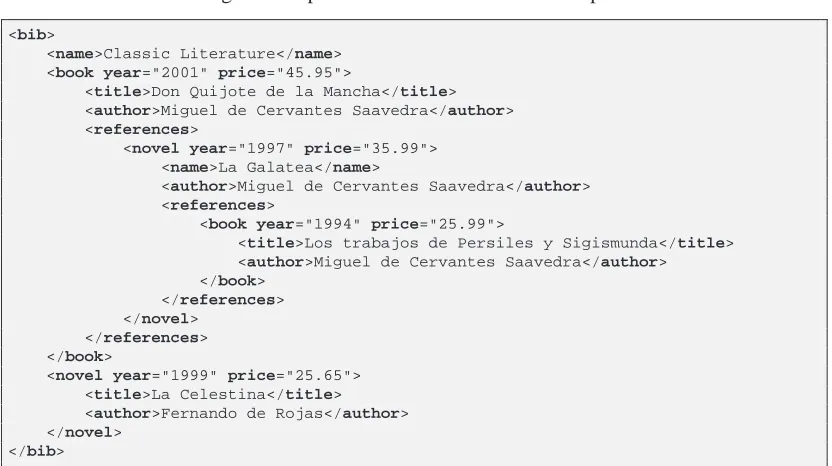
Figure 2: Input XML document in our examples
<bib>
<name>Classic Literature</name> <book year="2001" price="45.95">
<title>Don Quijote de la Mancha</title> <author>Miguel de Cervantes Saavedra</author> <references>
<novel year="1997" price="35.99"> <name>La Galatea</name>
<author>Miguel de Cervantes Saavedra</author> <references>
<book year="1994" price="25.99">
<title>Los trabajos de Persiles y Sigismunda</title> <author>Miguel de Cervantes Saavedra</author> </book>
</references> </novel>
</references> </book>
<novel year="1999" price="25.65"> <title>La Celestina</title> <author>Fernando de Rojas</author> </novel>
Figure 3: Execution of query «/bib[DEEP=0.8;DOWN=0.9]//title»
Document RSV computation
<result>
<title rsv="0.8000">Don Quijote de la Mancha</title> <title rsv="0.7200">La Celestina</title>
<title rsv="0.2949">Los trabajos de Persiles...</title> </result>
0.8000=0.8 0.7200=0.8∗0.9 0.2949=0.85∗0.9
Figure 4: Execution of query «//book[@year<2000 avg{3,1} @price<50]/title»
Document RSV computation
<result>
<title rsv="1.00">Los trabajos de Persiles...</title> <title rsv="0.25">Don Quijote de la Mancha</title> </result>
1.00= (3∗1+1∗1)/(3+1) 0.25= (3∗0+1∗1)/(3+1)
Figure 5: Execution of query «/bib[DEEP=0.5]//book[@year<2000 avg{3,1} @price<50]/title»
Document RSV computation
<result>
<title rsv="0.25">Don Quijote de la Mancha</title> <title rsv="0.0625">Los trabajos de Persiles...</title> </result>
0.25= (3∗0+1∗1)/(3+1) 0.0625=0.54∗(3∗1+1∗1)/(3+1)
In general, a fuzzy XPath expression defines, w.r.t. an XML document, a sequence of subtrees of the XML document where each subtree has an associated RSV. XPath conditions, which are defined as fuzzy operators applied to XPath expressions, compute a new RSV from the RSVs of the involved XPath expressions, which at the same time, provides a RSV to the node. In order to illustrate these explanations, let us see some examples of our proposed fuzzy version of XPath according to the XML document shown of Figure2.
Example 1 Let us consider the fuzzy XPath query of Figure3requesting title’s penalizing the occurrences from the document root by a proportion of 0.8 and 0.9 by nesting and ordering, respectively, and for which we obtain the file listed in Figure 3. In such document we have included as attribute of each subtree, its corresponding RSV. The highest RSVs correspond to the main books of the document, and the lowest RSVs represent the books occurring in nested positions (those annotated as related references).
Example 2 Figure4 shows the answer associated to a search of books, possibly referenced directly or indirectlyfrom other books, whose publishing year and price are relevant but the year is three times more important than the price. Finally, in Figure 5 we combine both kinds of (structural/conditional) operators, and the ranked list of solutions is reversed.
3
Fuzzy Logic Programming with MALP and FLOPER
Multi-Adjoint Logic Programming [MOV04], MALP in brief, can be thought as a fuzzy ex-tension of Prolog and it is based on a first order language, L, containing variables,
func-tion/constant symbols, predicate symbols, and several arbitrary connectives such as implica-tions (←1,←2, . . . ,←m), conjunctions (&1,&2, . . . ,&k), disjunctions (∨1,∨2, . . . ,∨l), and gen-eral hybrid operators (“aggregators” @1,@2, . . . ,@n), used for combining/propagating truth val-ues through the rules, and thus increasing the language expressiveness. Additionally, our lan-guageL contains the values of a multi-adjoint lattice in the formhL,,←1,&1, . . . ,←n,&ni,
equipped with a collection of adjoint pairsh←i,&iiwhere each &i is a conjunctor intended to the evaluation of modus ponens [SS83,KMP00,MOV04]. A rule is a formula “A←iBwithα”, where A is an atomic formula (usually called the head),B(which is called the body) is a formula
built from atomic formulas B1, . . . ,Bn (n≥0 ), truth values of L and conjunctions, disjunctions and general aggregations, and finallyα ∈L is the “weight” or truth degree of the rule. The set of truth values L may be the carrier of any complete bounded lattice, as for instance occurs with the set of real numbers in the interval [0,1] with their corresponding orderingR. Consider, for instance, the following program,P, with associated multi-adjoint latticeh[0,1],R,←P,&Pi
(where labelPmeans for Product logic with the following connective definitions for implication and conjunction symbols, respectively: “←P(x,y) =min(1,x/y)”, “&P(x,y) =x∗y”, as well as
“@aver(x,y) = (x+y)/2”):
R1: oc(X) <- s(X)&prod (f(X) @aver w(X)) with 1. R2: s(madrid) with 0.8. R5: s(tokyo) with 0.9. R3: f(madrid) with 0.8. R6: f(tokyo) with 0.7. R4: w(madrid) with 0.9. R7: w(tokyo) with 0.6. R8: s(istambul) with 0.3. R11: s(baku) with 0.3. R9: f(istambul) with 0.4. R12: f(baku) with 0.2. R10: w(istambul) with 0.8. R13: w(baku) with 0.5.
This program models, through predicateoc/1, the chances of a city for being an “olympic city” (i.e., for hosting olympic games). Predicateoc/1 is defined in ruleR1, whose body collects the
information from three other predicates, s/1,f/1 andw/1, modeling, respectively, the security level, the f acilities and the good weather of a certain city (other criteria like continental rotation, political/economical aspects, etc... can be easily “aggregated” to the definition ofoc/1). These predicates are defined in rulesR2toR13for four cities (Madrid, Istambul, Tokyo and Baku), in
such a way that, for each city, the feature modeled by each predicate is better the greater the truth value of the rule.
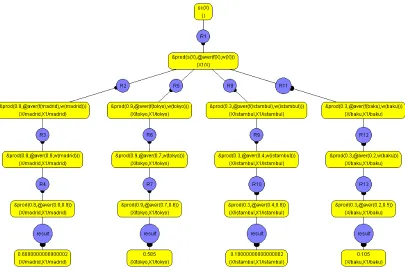
Figure 6: Execution tree for programPand goaloc(X)
The FLOPER system is able to manage programs with very different lattices. In order to asso-ciate a certain lattice with its corresponding program, such lattice must be loaded into the tool as a pure Prolog program. As an example, the following clauses show the program modeling the lattice of the real interval[0,1]with the usual ordering relation and connectives (where the meaning of the mandatory predicatesmember,top,botandleqis obvious):
member(X):- number(X), 0=<X, X=<1. bot(0).
leq(X,Y):- X=<Y. top(1).
and_prod(X,Y,Z):- pri_prod(X,Y,Z). pri_prod(X,Y,Z):- Z is X * Y. or_prod(X,Y,Z):- pri_prod(X,Y,U1),pri_add(X,Y,U2),pri_sub(U2,U1,Z). pri_add(X,Y,Z):- Z is X+Y. pri_sub(X,Y,Z):- Z is X-Y.
FLOPER includes two main ways for evaluating a goal, given a MALP program and its cor-responding lattice. Option “run” translates the whole program into a pure Prolog program and evaluates the (also translated) goal, thus obtaining a set of fuzzy computed answers, whereas, on the other hand, option “tree” displays the execution (or derivation) tree for the intended goal1.
For the purpose of this paper, we will focus on this last option in order to obtain a tree (detailing the whole computational behaviour) for being afterwards analyzed with fuzzy XPath.
Let us consider the previously described program P, and goal “oc(X)”, that asks for the
eligibility of each one of the four cities inP as “Olympic City”. We use option “tree” to
obtain the execution tree, which is generated by FLOPER in three different formats. Firstly the tree is displayed in graphical mode, as a PNG file, as shown in Figure6. The tree is composed by two kinds of nodes. Yellow nodes represent states reached by FLOPER following the state transition system that describes the operational semantics of MALP [MOV04]. The up-most node represents the first state (that is, the goal and the identity substitution), and subsequent lower nodes are its children states (that is, states reached from the goal). A state contains a formula in the upper side and a substitution (the record of substitutions applied from the original goal to reach that state) at the bottom. A final state, if reached, is a fuzzy computed answer, that is, its formula is an element of the lattice. Blue rounded nodes that intermediate between a pair of yellow nodes (a pair of states) represent program rules; specifically, the program rule that is exploited in order to go from one state (the upper state) to another (the lower one). These rules are named with letter “R” plus its position in the program. For example, observe that from the initial state to the next state, ruleR1 of the program has been exploited, as shown in the blue
intermediate node. As an exception, when all atoms have been exploited in (the formula of) a certain state, the following blue node indicates “result”, informing that the next state is a fuzzy computed answer.
FLOPER can also generate the execution tree in two textual formats. The first one contains a plain description of the tree, while the second one provides an XML structure to that descrip-tion, therefore becoming the focus of interest of this paper. In this XML format we define the tag “node” to contain all the information of a node, such as the rule performed to reach that state (that is “R0” in the case of the first state), the formula of the state, the accumulated sub-stitution and the children nodes, given by the tags “rule”, “goal”, “substitution” and “children”, respectively. The content of tags “rule”, “goal” and “substitution” is a string, while the content of the tag “children” is a set of tags “node”, as seen in the following lines, corresponding to the XML file associated to the the tree depicted in Figure6.
<node>
<rule>R0</rule> <goal>oc(X)</goal>
<substitution>{}</substitution> <children>
<node>
<rule>R1</rule>
<goal>and_prod(s(X),agr_aver(f(X),w(X)))</goal> <substitution>{X1/X}</substitution>
<children> <node>
<rule>R2</rule>
<goal>and_prod(0.8,agr_aver(f(madrid),w(madrid)))</goal> <substitution>{X/madrid,X1/madrid}</substitution>
<children> <node>
<rule>R3</rule>
<node> <rule>R4</rule> <goal>and_prod(0.8,agr_aver(0.8,0.9))</goal> <substitution>{X/madrid,X1/madrid}</subtitution> <children> <node> <rule>result</rule> <goal>0.6800000000000002</goal> <substitution>{X/madrid,X1/madrid} </substitution> <children> </children> </node> </children> </node> </children> </node> </children> </node> ... <node> <rule>result</rule> <goal>0.585</goal> <substitution>{X/tokyo,X1/tokyo} </substitution> <children> </children> </node> ... </node> </children> </node>
4
Exploring Derivation Trees with Fuzzy XPath
In this section we present a very powerful method to automatically exploring the behaviour of a MALP program using the fuzzy XPath tool described in Section2. The idea is to use fuzzy XPath over the execution tree generated by FLOPER for a certain program and goal. That tree is obtained through option “tree” using the XML format just explained before in Section3. For instance, an easy but interesting XPath query should be “//node/rule” which lists all the rules exploited along the execution of a goal (in the case of the tree depicted in Figure6, we would obtain the whole set of rules defined in the programPof our running example).
Figure 7: Executing queries «//node[/rule/text()=result]» and «//node[children[not(text())]]»
<result>
<node rsv="1.0"> <rule>result</rule>
<goal>0.6800000000000002</goal>
<substitution>{X/madrid, X1/madrid}</substitution> <children></children>
</node>
<node rsv="1.0"> <rule>result</rule> <goal>0.585</goal>
<substitution>{X/tokyo, X1/tokyo}</substitution> <children></children>
</node>
<node rsv="1.0"> <rule>result</rule>
<goal>0.18000000000000002</goal>
<substitution>{X/istambul, X1/istambul}</substitution> <children></children>
</node>
<node rsv="1.0"> <rule>result</rule> <goal>0.105</goal>
<substitution>{X/baku, X1/baku}</substitution> <children></children>
</node> </result>
Figure 8: Executing query «[FILTER=0.5][DEEP=0.9]//node/goal»
<result>
<goal rsv="1.0">oc(X)</goal>
<goal rsv="0.81">and_prod(s(X),agr_aver(f(X),w(X)))</goal>
<goal rsv="0.6561">and_prod(0.8,agr_aver(f(madrid),w(madrid)))</goal> <goal rsv="0.6561">and_prod(0.9,agr_aver(f(tokyo),w(tokyo)))</goal> <goal rsv="0.6561">and_prod(0.3,agr_aver(f(istambul),w(istambul)))</goal> <goal rsv="0.6561">and_prod(0.3,agr_aver(f(baku),w(baku)))</goal>
<goal rsv="0.531441">and_prod(0.8,agr_aver(0.8,w(madrid)))</goal> <goal rsv="0.531441">and_prod(0.9,agr_aver(0.7,w(tokyo)))</goal> <goal rsv="0.531441">and_prod(0.3,agr_aver(0.4,w(istambul)))</goal> <goal rsv="0.531441">and_prod(0.3,agr_aver(0.2,w(baku)))</goal> </result>
in the previous paragraph, this is not the general case. In fact, we can formulate a query like “//node[children[not(text())] and rule/text()<>"result"]/goal”, helping us to know whether the tree has any partially evaluated leaf (i.e., non reporting a fuzzy computed answer) since it returns nodes at the end of a branch that are not labeled with the rule tag con-taining “result”. The important meaning of this query resides on its capability for finding possible sources of infinite loops. So, consider the example of Figure9, where an infinite branch (leaf in orange) is clearly observable between two leaves (in yellow) containing fuzzy computed answers. This figure corresponds to the execution tree (since it is infinite in depth, FLOPER allows us to fix the number of levels to be drawn) for goal “p(X)” w.r.t. program:
p(a) with 0.8.
Figure 9: Example of tree with an infinite branch
Executing query «//node[children[not(text())]]/goal»
<result>
<goal>0.8</goal>
<goal>and_prod(0.9,and_prod(0.9,and_prod(0.9,and_prod(0.9,and_prod(0.9,p(s(s(s(s(s (s(s(s(s(s(s(s(s(s(s(X)))))))))))))))))))))</goal>
<goal>0.6</goal> </result>
Executing query «//node[children[not(text())] and rule/text()<>"result"]/goal»
<result>
<goal>and_prod(0.9,and_prod(0.9,and_prod(0.9,and_prod(0.9,and_prod(0.9,p(s(s(s(s(s (s(s(s(s(s(s(s(s(s(s(X)))))))))))))))))))))</goal>
</result>
Executing query «//node[rule/text()="result"]/goal»
<result>
Figure 10: Executing query «[FILTER=0.5][DOWN=0.7]//node/goal»
<result>
<goal rsv="1.0">oc(X)</goal>
<goal rsv="1.0">and_prod(s(X),agr_aver(f(X),w(X)))</goal>
<goal rsv="1.0">and_prod(0.8,agr_aver(f(madrid),w(madrid)))</goal> <goal rsv="1.0">and_prod(0.8,agr_aver(0.8,w(madrid)))</goal> <goal rsv="1.0">and_prod(0.8,agr_aver(0.8,0.9))</goal> <goal rsv="1.0">0.6800000000000002</goal>
<goal rsv="0.7">and_prod(0.9,agr_aver(f(tokyo),w(tokyo)))</goal> <goal rsv="0.7">and_prod(0.9,agr_aver(0.7,w(tokyo)))</goal> <goal rsv="0.7">and_prod(0.9,agr_aver(0.7,0.6))</goal> <goal rsv="0.7">0.585</goal>
</result>
Note that, in this figure, the search for nodes with an empty “children” field by using query “//node[children[not(text())]]/goal” returns three solutions, i.e., the three leaves of the tree without distinguishing whether they correspond to fully or partially evaluated goals. Query “//node[rule/text()="result"]/goal” allows us to retrieve only the fca’s of the tree, as seen in Figure9. Finally, in order to obtain the final node in the central (infinite) branch, we must use the more involved second query shown in the Figure, that is, “//node[children[not(text())] and rule/text()<>"result"]/goal”.
the tree are represented deeper in the input XML file.
Figure 11:«node[/goal[contains(text(),“w(”)] aver{1,2} substitution[contains(text(),“istambul”)]]//goal»
<result>
<goal rsv="1.0">and_prod(0.3,agr_aver(f(istambul),w(istambul)))</goal> <goal rsv="1.0">and_prod(0.3,agr_aver(0.4,w(istambul)))</goal>
<goal rsv="0.6667">and_prod(0.3,agr_aver(0.4,0.8))</goal> <goal rsv="0.6667">0.18000000000000002</goal>
<goal rsv="0.3333">and_prod(s(X),agr_aver(f(X),w(X)))</goal>
<goal rsv="0.3333">and_prod(0.8,agr_aver(f(madrid),w(madrid)))</goal> <goal rsv="0.3333">and_prod(0.9,agr_aver(f(tokyo),w(tokyo)))</goal> <goal rsv="0.3333">and_prod(0.3,agr_aver(f(baku),w(baku)))</goal> <goal rsv="0.3333">and_prod(0.8,agr_aver(0.8,w(madrid)))</goal> <goal rsv="0.3333">and_prod(0.9,agr_aver(0.7,w(tokyo)))</goal> <goal rsv="0.3333">and_prod(0.3,agr_aver(0.2,w(baku)))</goal> </result>
Analogously, in Figure10we use “DOWN” instead of “DEEP” for producing partial depth-first traversals on execution trees. In this case, our query segregates the nodes from left to right in columns, since the more left the node appears in the tree, the upper is it in the XML output and, thus, the less penalized by “DOWN”. As previously, 10 nodes have been selected again with “rsv” ranging from 1 -upper nodes in the XM file- in the left column, till 0.7, as shown in the second column.
In order to illustrate the high expressive power of the fuzzy XPath language, in the following we try to model queries joining several concepts (for instance, the topics of “weather” and “Is-tambul” modeled inPas predicate “w” and constant “istambul”, respectively). Assume that we
In order to join these two constraints, instead of using crisp “or/and” operators (or even differ-ent fuzzy variants of such connectives already implemdiffer-ented in fuzzy XPath), we prefer to use an arithmetical average giving twice importance to the second requirement than to the first one. The fuzzy XPath formulation of our query entitles Figure11, where we graphically show the set of solutions as well as the output in the resulting XML file.
We finish this section by commenting some related works. The investigation of fuzzy ex-tensions of the XQuery/XPath language for providing flexible mechanisms to XML querying, has provided a wide range of approaches in which the main goal is the handling of crisp in-formation by fuzzy concepts [GT10, CDG+09, DMP07, FFP09, FFF10, LAAE06, DMP08], as our proposal does. But an alternative way focuses on the introduction of fuzzy informa-tion in data (similarity, proximity, vagueness, etc) [US12,ÜYG07,BDW06, BDHH06,GA06, YML09,OP08,OP10] for which our recent advances described in [JMPV14] (devoted to ex-tend the FLOPER platform with expressive resources to comfortably handle with similarity relations), promise new improvements in the implementation of fuzzy XPath. Moreover, in [ALM14] we have highlighted the benefits obtained with the FILTER command used along this paper, for filtering the set of ranked answers in a dynamic way, in order to reduce the runtime/complexity of computations when dealing with large files and connecting our frame-work with the well-known “top-k ranking problem” (i.e. determining the top k answers to a query without computing the -usually wider, possibly infinite- whole set of solutions) inspired by [BCG02,CH02,CGM04,MBG04,RDS07,IBS08].
5
Conclusions and Future Work
In this paper we have shown the mutual benefits between two different fuzzy tools developed in our research group, that is, the FLOPER programming environment and the fuzzy XPath interpreter. Initially FLOPER was conceived as a tool for implementing flexible software ap-plications -as it is the case of fuzzy XPath- coded with the fuzzy logic language MALP and offering options for compiling fuzzy rules to standard Prolog clauses, running goals and drawing execution trees. Such trees, once modeled in XML format inside the proper FLOPER tool, can be then analyzed by the fuzzy XPath interpreter -by means of simple XPath queries augmented with fuzzy commands- in order to discover details (such as fuzzy computed answers, possible infinite branches and so on) of the computational behaviour of MALP programs after being exe-cuted into FLOPER. In this sense, we plan to integrate an option inside the FLOPER menu for allowing the possibility of performing debugging tasks based on fuzzy XPath.
Acknowledgements:
Carlos Vázquez and Ginés Moreno received grants for International mobility from the Uni-versity of Castilla-La Mancha (CYTEMA project and “Vicerrectorado de Profesorado”). This research was also supported by the EU (FEDER), and the Spanish MINECO Ministry (Ministerio de Economía y Competitividad) under grants TIN2013-45732-C4-2-P and TIN2013-44742-C4-4-R, as well as Andalusian Regional Government (Spain) under Project P10-TIC-6114.
Bibliography
[ALM11] J. Almendros-Jiménez, A. Luna, G. Moreno. A Flexible XPath-based Query Lan-guage Implemented with Fuzzy Logic Programming. In Proc. of 5th International Symposium on Rules: Research Based, Industry Focused, RuleML’11. Barcelona, Spain, July 19–21. Pp. 186–193. Springer Verlag, LNCS 6826, 2011.
[ALM12a] J. M. Almendros-Jiménez, A. Luna, G. Moreno. Fuzzy Logic Programming for Im-plementing a Flexible XPath-based Query Language. Electr. Notes Theor. Comput. Sci. 282:3–18, 2012.
[ALM12b] J. M. Almendros-Jiménez, A. Luna, G. Moreno. A XPath Debugger Based on Fuzzy Chance Degrees. In On the Move to Meaningful Internet Systems: Proceedings OTM 2012 Workshops, Rome, Italy, September 10-14. Pp. 669–672. Springer Ver-lag, LNCS 7567, 2012.
[ALM13] J. Almendros-Jiménez, A. Luna, G. Moreno. Annotating Fuzzy Chance Degrees when Debugging XPath Queries. In Advances in Computational Intelligence - Proc of the 12th International Work-Conference on Artificial Neural Networks, IWANN 2013 (Special Session on Fuzzy Logic and Soft Computing Application), Tenerife, Spain, June 12-14. Pp. 300–311. Springer Verlag, LNCS 7903, Part II, 2013.
[ALM14] J. Almendros-Jiménez, A. Luna, G. Moreno. Dynamic Filtering of Ranked Answers When Evaluating Fuzzy XPath Queries. In Rough Sets and Current Trends in Soft Computing 2014. Pp. 319–330. Springer Verlag, LNAI 8536, 2014.
[BBC+07] A. Berglund, S. Boag, D. Chamberlin, M. Fernandez, M. Kay, J. Robie, J. Siméon. XML path language (XPath) 2.0. W3C, 2007.
[BCG02] N. Bruno, S. Chaudhuri, L. Gravano. Top-k selection queries over relational databases: Mapping strategies and performance evaluation. ACM Trans. Database Syst. 27(2):153–187, 2002.
[BDHH06] P. Buche, J. Dibie-Barthélemy, O. Haemmerlé, G. Hignette. Fuzzy semantic tag-ging and flexible querying of XML documents extracted from the Web. Journal of Intelligent Information Systems 26(1):25–40, 2006.
[BMP95] J. F. Baldwin, T. P. Martin, B. W. Pilsworth. Fril- Fuzzy and Evidential Reasoning in Artificial Intelligence. John Wiley & Sons, Inc., 1995.
[CDG+09] A. Campi, E. Damiani, S. Guinea, S. Marrara, G. Pasi, P. Spoletini. A fuzzy ex-tension of the XPath query language. Journal of Intelligent Information Systems 33(3):285–305, 2009.
[CGM04] S. Chaudhuri, L. Gravano, A. Marian. Optimizing Top-k Selection Queries over Multimedia Repositories. IEEE Trans. Knowl. Data Eng. 16(8):992–1009, 2004.
[CH02] K. C.-C. Chang, S. won Hwang. Minimal probing: supporting expensive predi-cates for top-k queries. In Franklin et al. (eds.), SIGMOD Conference. Pp. 346–357. ACM, 2002.
[DMP07] E. Damiani, S. Marrara, G. Pasi. FuzzyXPath: Using fuzzy logic and IR features to approximately query XML documents. Foundations of Fuzzy Logic and Soft Com-puting, pp. 199–208, 2007.
[DMP08] E. Damiani, S. Marrara, G. Pasi. A flexible extension of XPath to improve XML querying. In Proceedings of the 31st annual international ACM SIGIR conference on Research and development in information retrieval. Pp. 849–850. 2008.
[FFF10] On the expressiveness of generalization rules for XPath query relaxation. 2010.
[FFP09] Top-k Answers to Fuzzy XPath Queries. 2009.
[GA06] A. Gaurav, R. Alhajj. Incorporating fuzziness in XML and mapping fuzzy relational data into fuzzy XML. In Proceedings of the 2006 ACM symposium on Applied computing. Pp. 456–460. 2006.
[GMV04] S. Guadarrama, S. Muñoz, C. Vaucheret. Fuzzy Prolog: A New Approach Using Soft Constraints Propagation. Fuzzy Sets and Systems 144(1):127–150, 2004.
[GT10] M. Goncalves, L. Tineo. Fuzzy XQuery. In Soft Computing in XML Data Manage-ment. Pp. 133–163. Springer, 2010.
[IBS08] I. F. Ilyas, G. Beskales, M. A. Soliman. A survey of top-k query processing tech-niques in relational database systems. ACM Comput. Surv. 40(4), 2008.
[JMPV14] P. Julián-Iranzo, G. Moreno, J. Penabad, C. Vázquez. A Fuzzy Logic Programming Environment for Managing Similarity and Truth Degrees. In PROLE’14 (submit-ted). Pp. 1–10. Universidad de Cádiz, 2014.
[KMP00] E. Klement, R. Mesiar, E. Pap. Triangular Norms. Trends in logic, Studia logica library. Springer, 2000.
http://books.google.es/books?id=rIyqcjfKMN4C
[LAAE06] H. Li, S. Aghili, D. Agrawal, A. El Abbadi. FLUX: fuzzy content and structure matching of XML range queries. In Proceedings of the 15th international confer-ence on World Wide Web. Pp. 1081–1082. 2006.
[Lee72] R. Lee. Fuzzy Logic and the Resolution Principle. Journal of the ACM 19(1):119– 129, 1972.
[Llo87] J. Lloyd. Foundations of Logic Programming. Springer-Verlag, Berlin, 1987.
[MBG04] A. Marian, N. Bruno, L. Gravano. Evaluating top-k queries over web-accessible databases. ACM Trans. Database Syst. 29(2):319–362, 2004.
[MCS11] S. Muñoz-Hernández, V. P. Ceruelo, H. Strass. RFuzzy: Syntax, semantics and implementation details of a simple and expressive fuzzy tool over Prolog. Inf. Sci. 181(10):1951–1970, 2011.
[MM08] P. Morcillo, G. Moreno. Programming with Fuzzy Logic Rules by using the FLOPER Tool. In al. (ed.), Proc of the 2nd. Rule Representation, Interchange and Reasoning on the Web, International Symposium, RuleML’08. Pp. 119–126. Springer Verlag, LNCS 3521, 2008.
[MMPV10] P. Morcillo, G. Moreno, J. Penabad, C. Vázquez. A Practical Management of Fuzzy Truth Degrees using FLOPER. In al. (ed.), Proc. of 4nd Intl Symposium on Rule In-terchange and Applications, RuleML’10. Pp. 20–34. Springer Verlag, LNCS 6403, 2010.
[MOV04] J. Medina, M. Ojeda-Aciego, P. Vojtáš. Similarity-based Unification: a multi-adjoint approach. Fuzzy Sets and Systems 146:43–62, 2004.
[MV14] G. Moreno, C. Vázquez. Fuzzy Logic Programming in Action with FLOPER. Jour-nal of Software Engineering and Applications 7:237–298, 2014.
[OP08] B. Oliboni, G. Pozzani. Representing fuzzy information by using XML schema. In Database and Expert Systems Application, 2008. DEXA’08. 19th International Workshop on. Pp. 683–687. 2008.
[OP10] B. Oliboni, G. Pozzani. An XML Schema for Managing Fuzzy Documents. Soft Computing in XML Data Management, pp. 3–34, 2010.
[RDS07] C. Re, N. N. Dalvi, D. Suciu. Efficient Top-k Query Evaluation on Probabilistic Data. In Chirkova et al. (eds.), ICDE. Pp. 886–895. IEEE, 2007.
[RR10] M. Rodríguez, C. A. Romero. A declarative semantics for CLP with qualification and proximity. Theory and Practice of Logic Programming 10(4-6):627–642, 2010.
[Str08] U. Straccia. Managing Uncertainty and Vagueness in Description Logics, Logic Programs and Description Logic Programs. In Reasoning Web, 4th International Summer School, Tutorial Lectures. Pp. 54–103. Springer Verlag, LNCS 5224, 2008.
[US12] P. Ueng, S. Skrbic. Implementing XQuery fuzzy extensions using a native XML database. In Computational Intelligence and Informatics (CINTI), 2012 IEEE 13th International Symposium on. Pp. 305–309. 2012.
[ÜYG07] E. Üstünkaya, A. Yazici, R. George. Fuzzy data representation and querying in xml database. International Journal of Uncertainty, Fuzziness and Knowledge-Based Systems 15(supp01):43–57, 2007.
[Voj01] P. Vojtáš. Fuzzy Logic Programming. Fuzzy Sets and Systems 124(1):361–370, 2001.
[VP05] P. Vojtáš, L. Paulík. Query Answering in Normal Logic Programs Under Uncer-tainty. In Godó (ed.), Proc. of 8th. European Conference on Symbolic and Quantita-tive Approaches to Reasoning with Uncertainty (ECSQARU-05), Barcelona, Spain. Pp. 687–700. Springer Verlag, LNCS 3571, 2005.
![Figure 7: Executing queries «//node[/rule/text()=result]» and «//node[children[not(text())]]»](https://thumb-us.123doks.com/thumbv2/123dok_us/7802440.2084405/11.595.90.506.189.668/figure-executing-queries-node-rule-text-result-children.webp)
![Figure 8: Executing query «[FILTER=0.5][DEEP=0.9]//node/goal»](https://thumb-us.123doks.com/thumbv2/123dok_us/7802440.2084405/12.595.100.503.186.539/figure-executing-query-filter-deep-node-goal.webp)

![Figure 10: Executing query «[FILTER=0.5][DOWN=0.7]//node/goal»](https://thumb-us.123doks.com/thumbv2/123dok_us/7802440.2084405/14.595.92.506.185.535/figure-executing-query-filter-down-node-goal.webp)
![Figure 11: «node[/goal[contains(text(),“w(”)] aver{1,2} substitution[contains(text(),“istambul”)]]//goal»](https://thumb-us.123doks.com/thumbv2/123dok_us/7802440.2084405/15.595.92.507.213.575/figure-node-goal-contains-text-substitution-contains-istambul.webp)
