Volume 63 (2014)
Proceedings of the
Eighth International Workshop on
Software Clones
(IWSC 2014)
Robust Parsing of Cloned Token Sequences
Ole Jan Lars Riemann and Rainer Koschke
20 pages
Guest Editors: Nils G ¨ode, Yoshiki Higo, Rainer Koschke
Managing Editors: Tiziana Margaria, Julia Padberg, Gabriele Taentzer
Robust Parsing of Cloned Token Sequences
Ole Jan Lars Riemann1and Rainer Koschke2
1[email protected] 2[email protected]
http://www.informatik.uni-bremen.de/st/ Software Engineering Group University of Bremen, Germany
Abstract: Token-based clone detection techniques are known for their scalability, high recall, and robustness against syntax errors and incomplete code. They, how-ever, may yield clones that are syntactically incomplete and they know very little about the syntactic structure of their reported clones. Hence, their results cannot immediately be used for automated refactorings or syntactic filters for relevance.
This paper explores techniques of robust parsing to parse code fragments reported by token-based clone detectors to determine whether the clones are syntactically complete and what kind of syntactic elements they contain.
This knowledge can be used to improve the precision of token-based clone detection.
Keywords: software clones, lexical analysis, syntactic analysis, token-based clone detection, syntax-based clone detection
1
Introduction
Syntax analysis, however, requires parsing and may not always work when code is incomplete or syntactically incorrect. In particular, for languages with a preprocessor such as C or C++ detecting clones based on the non-preprocessed code is difficult for syntax-based detectors.
In this paper, we explore ways to enrich token-based clone detectors with syntax information. We do that by parsing the output of a token-based clone detector, that is,afterthe clones were detected, while traditional syntax-based techniques run the syntax analysis before the clones are detected. All token-based detectors can benefit from this strategy, that is, this strategy is independent of the actual clone detector and can be implemented once for all.
Because we parse only fragments, a full syntax analysis that attempts to derive the root non-terminal of the underlying grammar will hardly ever work. Also, because we do not assume that the fragment is syntactically complete, that is, is derived from any of the syntax rules of the underlying grammar, normal parsing approaches will fail in most cases. We need parsing that is robust against syntactically incomplete code. We also need a way to deal with preprocessor statements in the code to be able to handle C and C++.
Contributions. To this end, this paper explores different strategies of robust parsing to parse code fragments reported by token-based clone detectors to determine whether the clones are syntactically complete and what kind of syntactic elements they contain.
Overview. The remainder of this paper is organized as follows. Section2introduces Earley parsing, a very flexible technique that handles all types of grammars including ambiguous ones. Section 3describes alternative extensions to the classical Earley parser for robustness against syntax errors. Section 4describes our idea to handle preprocessor statements based on island grammars. Section 5evaluates the different alternatives for robust Earley parsing. Section6, finally, concludes.
2
Earley Parsing
Our goal is to parse isolated cloned code fragments written in complex languages such as C and C++ without their context and without semantic analysis. The grammar of C is ambiguous. Hence, we need a parsing technique that copes with ambiguous grammars. Earley’s parsing technique is a very flexible technique that handles all types of grammars including ambiguous ones [Ear70]. For this reason, our parsing technique is based on a simplified version of Earley’s general parsing technique. We implemented a simpler variant, with the aid of the remarks by Aycock and Horspool [AH02] instead of Earley’s original look-ahead mechanism. This section describes the details of this approach.
2.1 Recognizing a Sentence
As most parsing techniques, an Earley parser is based on a context-free grammar defined as G=hN,T,P,φiwhereNdenotes the set of non-terminal symbols,T the set of terminal symbols (or tokens), andPthe set of productions. Adopting the notation of Earley, each production ofP has the formDp→Cp1. . .Cppwith 1≤p≤P∧Dp∈N∧Cp j∈(N∪T)wherePis the number of
defined by the grammarGis denoted byL(G). The sequence of input symbols is represented by X1. . .Xn+1withnas the number of actual input symbols. The artificial last symbolXn+1is used to mark the end of input denoted bya.
Given an input in this form, for each input symbolXian associated item setSiis created. Each
set contains unique items represented by a triple of a production, a position on the right-hand side of the production indicating how many symbols of that production have been read, and a reference to an earlier item set. Hereafter, this reference shall be known asstart index and is described shortly. In favor of better readability, an item is written ashu→α•vβ,ciwithu∈N, v∈(N∪T), α,β ∈(N∪T)∗ and 1≤c≤n+1, where c denotes the start index. They are classified infinalitems, that is, items with the dot (•) at the end of the production, andactive items, that is, items with symbols of the production left to be read.
Initially all sets are empty except the first setS1, which is initialized with the so-calledstart itemhφ→ •Cφ1. . .Cφ φ,1i. After that, the items of a set are processed successively in order of their creation. After all items of a set are handled, the algorithm advances to the items of the successive set.
Given the current item set Si. For each item in Si, one of the three operations Predictor,
Scanner, orCompleteris executed.
ThePredictoroperation applies toactiveitems of the formhu→α•vβ,ciwhose next sym-bol is a non-terminalv∈N. For each productionp∈Psuch thatv=Dp, this operation adds the
itemhDp→ •Cp1. . .Cpp,iitoSi. BecauseSiis uniquely associated with the input symbolXi, the
start indexcaptures the token that triggered the attempt to derive productionDp→ •Cp1. . .Cpp.
This information will later be used by theCompleteroperation.
TheScanneroperation is used if the next symbol of anactiveitemhu→α•vβ,ciis a
termi-nal symbolv∈T. It adds the itemhu→αv•β,cito the next setSi+1, but only ifv=Xi.
The Completeroperation is executed forfinalitems hu→α•,ci. That means a production
was successfully applied. The step adds an itemhu0→α0v0•β0,c0ito the current setSifor each
itemhu0→α0•v0β0,c0i ∈Scsuch thatv0=u. While a scanner operation moves the dot•past a
terminal, the completer moves it past a non-terminal.
After there are no further unprocessed items the algorithm can decide whether the input se-quenceX1. . .Xnis a sentence of the languageL(G)or not. The input sequence is a sentence of
the language iff∃I∈Sn+1:I=hφ →α•,1i. Suchfinalitems shall be calledaccept items here-after. In case of a syntax error, it is possible that some of the sets remain empty. The location of the first unexpected input symbol can be determined by the index of the first empty set. If none of the sets are empty but the last one does not contain an accept item, the input sequence is an incomplete sentence of the language.
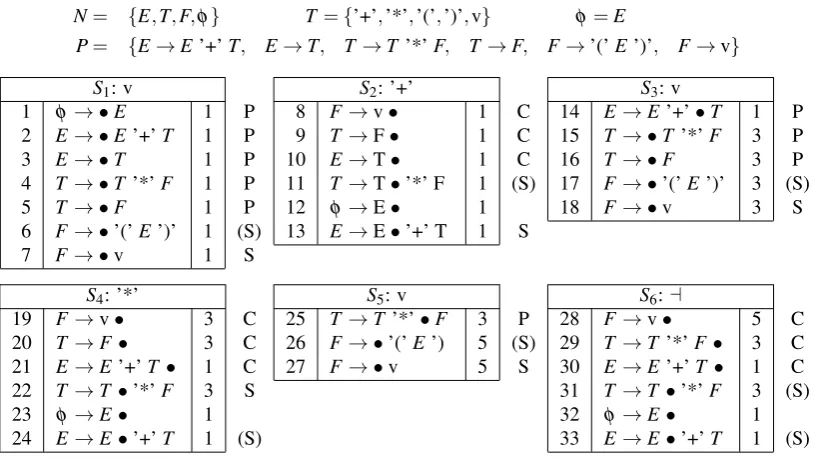
Figure 1 shows a complete run of the algorithm for a simple example1. The first column denotes the id of each item. It is followed by the production and thestart index. Each item has attached a letter that indicates, which one of the operationsPredictor,Scanner orCompleterit has triggered. Sin parentheses indicates that theScanneroperation was conducted but the next symbol of the item did not match the corresponding input symbol, so that no additional item was created.
1At first sight, it resembles the example given by Earley. Actually it yields slightly different sets, since the presented
N= {E,T,F,φ} T ={’+’,’*’,’(’,’)’,v} φ=E
P= {E→E’+’T, E→T, T →T ’*’F, T →F, F→’(’E’)’, F→v}
S1: v
1 φ→ •E 1 P 2 E→ •E’+’T 1 P 3 E→ •T 1 P 4 T→ •T ’*’F 1 P 5 T→ •F 1 P 6 F→ •’(’E’)’ 1 (S) 7 F→ •v 1 S
S2: ’+’
8 F →v• 1 C 9 T →F• 1 C 10 E→T• 1 C 11 T →T•’*’ F 1 (S) 12 φ →E• 1 13 E→E•’+’ T 1 S
S3: v
14 E→E’+’•T 1 P 15 T → •T ’*’F 3 P 16 T → •F 3 P 17 F→ •’(’E’)’ 3 (S) 18 F→ •v 3 S
S4: ’*’
19 F→v• 3 C 20 T →F• 3 C 21 E→E’+’T • 1 C 22 T →T•’*’F 3 S 23 φ→E• 1 24 E→E•’+’T 1 (S)
S5: v
25 T →T ’*’•F 3 P 26 F → •’(’E’) 5 (S) 27 F → •v 5 S
S6:a
28 F→v• 5 C 29 T →T ’*’F• 3 C 30 E→E’+’T • 1 C 31 T →T •’*’F 3 (S) 32 φ→E• 1 33 E→E•’+’T 1 (S)
Figure 1: Simple example grammar and the sets of items created for the input1 + 2 * 3. The symbolvforvaluedenotes the token type of a literal.
2.2 Constructing Syntax Trees
The described algorithm is only a recognizer, that is, it decides only whether an input sequence is a sentence of the language. To gain syntactic information, however, a syntax tree is required. It is impossible to construct a syntax tree with only the items given. The parser has to know which item participated in the creation of which other item. We follow the proposal of Aycock and Horspool [AH02] and store two different types of links during the recognizing step. If an item Iis created by aScanneroperation triggered by itemIp, a predecessor linkI
Λ
−−→Ipis recorded.
Items created by aCompleteroperation trigger the creation of apredecessor link I−−I→c Ip and
acausal link I→Ic, whereI is the item created by the operation and Ipis the item depending
on the completion ofIc. ThePredictoroperation records no links because this relation between
items is not required for the syntax tree.
3
Robust Earley Parsing
Earley’s algorithm described in Section2handles ambiguity of identifiers and type names in C successfully. Yet, in its original form, it cannot handle syntax errors and incomplete code.
3.1 Partial Syntax Trees
We first address code fragments containing syntactic structures cut off at the back, that is, code fragments that are a prefix of a sentence of the language. Originally, the algorithm requires at least oneaccept itemin the last set to construct a complete syntax tree. Obviously we can search for such an item in prior sets if it is not already present in the last set. This approach is also applicable in the case of an empty set caused by a syntax error. Traversing the sets in reverse order to find anaccept item, the algorithm can use the first foundaccept itemto construct the maximally large partial syntax tree of a particular code fragment.
3.2 Multiple Start Symbols
Another issue are code fragments with syntactic structures cut off at the beginning, that is, code fragments that are a suffix of a sentence of the language. In this case, it is very likely that the fragment is no sentence that can be derived from the start symbol of the grammar. Due to its predictive nature of the algorithm, inherent by thePredictor operation, it is not straight-forward to let it consider sentences that are derived from other non-terminal symbols of the grammar. As an ad-hoc approach, the parser can be modified easily to allow multiple start sym-bols. It requires to define additional suitable start symbols explicitly. For the used grammar of C,block-item-listwas chosen as sole additional start symbol beyond the default root production oftranslation-unit. We selectedblock-item-listbecause it subsumes all structures contained in a function definition, more precisely, any list of statements and decla-rations, whiletranslation-unitcan be used to construct an arbitrary sequence of external declarations, that is, global variables, constants and function declarations and definitions.
3.3 Panic Mode
Both approaches mentioned above could be combined in order to try to recover from syntax errors. Yet, it would require to restart the parser at each occurrence of a syntax error and it is unlikely that this restarted parser succeeds to parse the remaining code after the error without further restarts. A more systematic attempt that tries to correct errors is more reasonable.
Aho and Peterson introduced the concept of covering grammar [AP72] to cover expected errors in the grammar. Our own initial tests with short input showed that this heavy-weight approach is too slow for large grammars such as C. The so-called panic mode, on the other hand, is described by Grune and Jacobs as “probably the simplest error recovery method that is still somewhat effective” [GJ08]. So, we decided to adopt this simplepanic modestrategy as a promising alternative.
Synchronizing symbolsare chosen from the set ofterminalsymbols. If such a symbol was found within the sequence of input symbols, the panic mode puts the parser into a state in which it can process the symbol.
Applied to the Earley Parser, the panic mode becomes active as soon as the parser advances to an empty item set. The index of the item set before this set is marked aspanic index ip. The
following sets are skipped until the first set with a synchronizing input symbol is found. This item set is referred to as recovery set in the following. Since the parsing algorithm can trace multiple alternative derivations in parallel, it is somewhat more complex to restore a valid state than, for instance, in a recursive descent parser. For that type of parser it would suffice to ascend the prediction stack until a production with a matching symbol on the right-hand side is found. The panic mode for Earley’s algorithm copies all items of the set Sip to the recovery set. To reduce the amount of uselessly copied items, FIRST andFOLLOW sets (see [AU77]) can be used to determine if at least the input symbol of therecovery setcan be read with a specific item. This strategy cannot guarantee that the entire production of the item can be read. Furthermore, the panic mode can distinguish between different types of syntax errors. If the next symbol of an item copied into therecovery setequals the input symbol of this set, it indicates the correction of aninsertion errorand the•will not be moved. In contrast, the•is advanced if the symbols do not match, which means that adeletionor areplacementerror is corrected. It is possible that the panic mode cannot find suitable items for therecovery set. In this case, the parser has to report an error and terminate. However, it could still be possible to create a partial syntax tree from a potentialaccept item of one of the non-empty sets as described before. When the parser with panic mode fails at some input symbol not at the end, it is restarted from this point. Combined with multiple start symbols it still has the chance to parse some symbols of the remainder.
We chose;,(,),{,}, and all keywords as thesynchronizing symbolsfor C.
3.4 Suffix Parsing
The described panic mode seems to be an acceptable solution for code fragments with simple syntax errors anywhere in the middle of the sequence of symbols. However, it shows weaknesses when it ought to process fragments which are cut off at the beginning. This drawback can be re-duced with additional start symbols but only for a limited selection. Since it is likely that cloned fragments are cut off at the beginning, it would be useful to have a parser that deals with this problem specifically. Nederhof and Bertsch [NB96] present a so-calledsuffix parser based on Earley’s algorithm. The general version of this parser is primarily used as a tool for the develop-ment of a linear suffix parsing technique forLL(1) languages but it can also be used to parse a suffix of a sentence of ageneralcontext-free language, as shown by Grune and Jacobs [GJ08].
modification, the start index of these items is not allowed to be set to 1 as done before. Because these items represent suffixes of sentences, at this point it is not known how many symbols of the input sequence are cut off, that is, the start position of a later found suffix is unknown and lies somewhere in front of the beginning of the parsed code fragment. This fact is represented by a special placeholder start indexΛforsuffix items.
After the first set has been initialized with suffix items, Earley’s algorithm is applied. The operationsPredictor andScannerremain unchanged, since they ignore thestart index. Solely theCompleteroperation uses thestart indexand requires an adaptation. Forsuffix itemsit has to deal with an undefinedstart indexΛ. TheCompleteroperation identifies items depending on the completion of the currently processed item. Thestart indexof the currently processed item is used to determine the set which contains these items. Because allsuffix itemsare created in the first set, theCompleteroperation can assume astart indexof 1 forsuffix items. However, the operation may only considersuffix itemsof the first set if the currently processed item is asuffix item, too. Otherwise, asuffixwould contribute to the completion of aprefixof a sentence.
Beyond the modification of theCompleter operation, it is required to change the condition that is used to determine if an input is a sentence of a given language. If there is anaccept item inSn+1, it still means that the input is a sentence of the language. But there is no such item, if the input is no sentence of the language, but only a suffix of a sentence of the language. In this case, the algorithm looks forfinal suffix items. Sincesuffix itemsare created only in the first set, afinal suffix itemin the last set implies that the input is a complete suffix of a sentence.
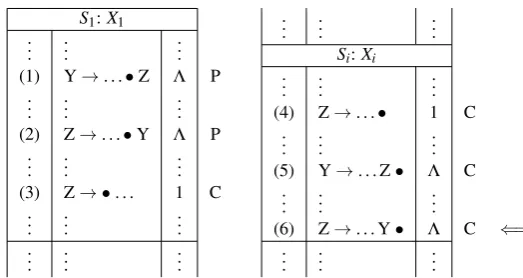
The Suffix Parsercan be seen as an implicit modification of the given grammar. Would this modification be explicit, it would make all symbols of the right-hand side of all productions optional. This can lead easily to an infinitely ambiguous grammar. Such ambiguities cause cycles in the data structures used to create syntax trees after the recognition process. Applied to theSuffix Parser, the problematic situation is outlined in Figure2.
S1:X1
..
. ... ...
(1) Y→. . .•Z Λ P ..
. ... ...
(2) Z→. . .•Y Λ P
..
. ... ...
(3) Z→ •. . . 1 C ..
. ... ...
..
. ... ...
..
. ... ...
Si:Xi ..
. ... ...
(4) Z→. . .• 1 C ..
. ... ...
(5) Y→. . . Z• Λ C
..
. ... ...
(6) Z→. . . Y• Λ C ⇐= ..
. ... ...
Figure 2: Suffix items causing cycles during the creation of syntax trees
operation, which searches foractiveitems whose next symbol isZ. InS1 it finds item (1) and copies it as item (5) toSi. Item (5) is againfinaland causes aCompleteroperation which creates
item (6). At this point the cycle occurs. TheCompleter operation required by item (6) would create an item which would be exactly the same as item (5). The set properties of the set prevent the reinsertion of that item, but for the later creation of syntax trees, a link between item (5) and item (6) is added, which forms a cycle together with the link from item (6) to item (5) created by theCompleteroperation of item (5). The algorithm used to create syntax trees (see Section2.2) cannot detect such cycles and would not terminate in this case.
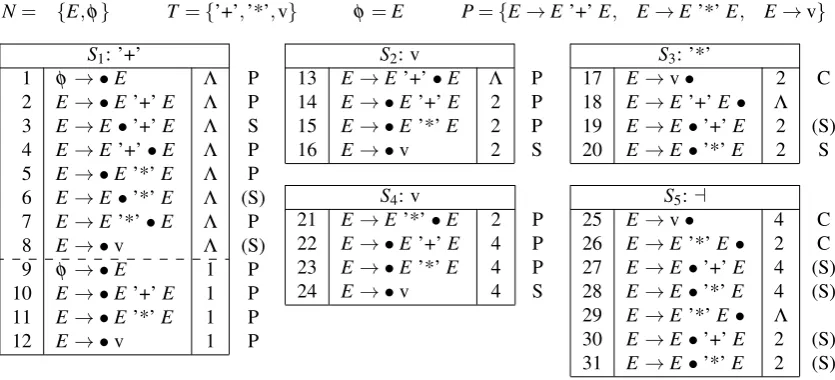
In order to still be able to gather results with the given syntax tree creation, a simplified version of the suffix parsing algorithm was implemented. Instead of modifying theCompleteroperation, final suffix itemsare just skipped. This leads to the disadvantage that only suffixes of a production of the grammar are recognized and not general suffixes of the language. An exemplary run of the simplified suffix parsing algorithm is given in Figure3. It uses the same notation as Figure1 except for the additional dashed line that separates the initially created suffix items from the regular items of the first set. FurthermoreΛis used to marksuffix items.
N= {E,φ} T ={’+’,’*’,v} φ=E P={E→E’+’E, E→E’*’E, E→v}
S1: ’+’
1 φ→ •E Λ P 2 E→ •E’+’E Λ P 3 E→E•’+’E Λ S 4 E→E’+’•E Λ P 5 E→ •E’*’E Λ P 6 E→E•’*’E Λ (S) 7 E→E’*’•E Λ P 8 E→ •v Λ (S) 9 φ→ •E 1 P 10 E→ •E’+’E 1 P 11 E→ •E’*’E 1 P 12 E→ •v 1 P
S2: v
13 E→E’+’•E Λ P 14 E→ •E’+’E 2 P 15 E→ •E’*’E 2 P 16 E→ •v 2 S
S4: v
21 E→E’*’•E 2 P 22 E→ •E’+’E 4 P 23 E→ •E’*’E 4 P 24 E→ •v 4 S
S3: ’*’
17 E→v• 2 C 18 E→E’+’E• Λ 19 E→E•’+’E 2 (S) 20 E→E•’*’E 2 S
S5:a
25 E→v• 4 C 26 E→E’*’E• 2 C 27 E→E•’+’E 4 (S) 28 E→E•’*’E 4 (S) 29 E→E’*’E• Λ 30 E→E•’+’E 2 (S) 31 E→E•’*’E 2 (S)
Figure 3: Simple example grammar and the sets of items created for input+ 2 * 3
3.5 Error Correcting Suffix Parsing
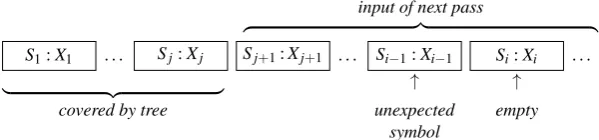
The index of the set after the set of the item picked for the syntax tree construction (SjandSj+1) is stored as starting point for the restarted suffix parser. This assures that the algorithm tries to reparse the already read part of the input that cannot be covered with a complete syntax tree. Before the parser is restarted, all sets have to be reset, that is, all their items have to be deleted. Additionally, the new starting setSj+1has to be initialized with the initialsuffix items. Since the computation of these items is independent of the current input symbol, a template set is prepared before the first parse and copied when needed. It is expected that this restarting strategy works quite well with some syntax errors, while it has to restart several times with other syntax errors. This seems not to be a big drawback, because in this case probably only a few input symbols are skipped until another suffix is found for which a syntax tree can be created. As mentioned, the selection ofaccept items for the syntax tree construction is very similar to the procedure described in Section3.1, but now we are interested in suffixes as well. So we have to choose between regularaccept itemsandfinal suffix items. Since the syntax tree of a complete sentence, represented by anaccept item, appear more valuable than one of a suffix of a sentence of the same length, regularaccept itemsare preferred overfinal suffix itemswithin the same set. Only if none of those items are found, a prior set is considered.
input of next pass
z }| {
S1:X1 . . . Sj:Xj Sj+1:Xj+1 . . . Si−1:Xi−1 Si:Xi . . .
| {z }
↑ ↑
covered by tree unexpected empty
symbol
Figure 4: Restart of error-correcting suffix parser
4
Preprocessor
As already mentioned, one objective is to preserve the robustness of token-based clone detec-tors, in particular also with regard to unprocessed preprocessor statements. Usually, token-based clone detectors operate on non-preprocessed source code in order to report clones in the original code as viewed by the developer. So the parser for the clone fragments has to deal with prepro-cessor statements. The problem is that the preproprepro-cessor in C is not part of the actual grammar of C. As Baxter and Mehlich [BM01] state: “. . . C preprocessor directives can occur between any pair of tokens.” Baxter and Mehlich, hence, modify the basic grammar of C to allow prepro-cessor statements at places where they occur frequently in software systems. This solution may work well for systems with an orderly used preprocessor but will probably fail to process code fragments without those restrictions. Furthermore, it requires informed manual modifications of the grammar.
Because only the code fragments yielded by a clone detector are given without their embedding syntactic context in our case, this requirement cannot be satisfied.
The output of the preprocessor depends upon macro definitions within the code and passed to the preprocessor by way of command-line arguments. The latter are not known without knowl-edge about the build process. The former are neither known if they are set in header files not accessible to the parser. Only for macro definitions within the code visible to the parser, there would be a possibility of evaluation. It would require us to integrate a preprocessor to han-dle these visible directives. The benefit of that would be marginal, however, as we parse only fragments without further context and chances are very high that these do not contain sufficient preprocessor information to leverage an integrated preprocessor. That is why we decided to follow a different path.
For this worst-case scenario we instead use an island parser to identify the pieces of source code to be passed to the C parser. A so-called island grammar distinguishes betweenislands, that is, the part that is covered by the grammar, andwater, that is, parts of the input the grammar for which no detailed productions exist [Moo01].
In order to apply island grammars on code fragments with preprocessor directives, it is re-quired to decide which language is treated as island and which is treated aswater. The first thought is to skip the problematic preprocessor part and define it aswater but this would dis-card a lot of information we could gather. If a preprocessor statement is contained completely in a fragment, it is straightforward to construct a syntax tree that represents the structure of the fragment from the perspective of the preprocessor. Following this strategy, the parts between the preprocessor tokens arewater and that way not examined by the island parser. Actually, they have not to be processed by the island parser because, we have an error correcting parser that is able to parse fragments of C code and each skipped fragment can be passed to an instance of this C parser. In fact, this makes the job of the C parser a little easier, because, with the exception of macro calls, the smaller fragments contain no preprocessor code. The similarity of macro and function calls makes it impossible for the island parser to distinguish between them. Therefore, they are treated as function calls.
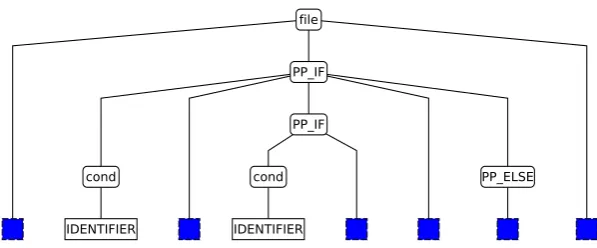
For each of these subfragments, the error correcting parser constructs one complete or multiple partial suffix trees, if possible. These trees are inserted into the syntax tree created by the island parser afterwards. To get the right positions for those insertions, the island parser uses sentinel nodes which are replaced by the syntax trees of the subfragments, as depicted in Figure5.
5
Evaluation
Figure 5: Syntax tree of preprocessor code with sentinel nodes
coverage of the syntax trees as described in Section3.5. Thus,rpanicrestarts at the first token that is not part of the partial syntax tree. All parsers are called by the island preprocessor parser.
The research questions addressed are:
RQ1 How much syntactic information can be gathered from the cloned token sequences using the alternative approaches for robust parsing?
RQ2 What are the recall and precision of the alternative approaches?
RQ3 What are the runtime costs of the alternative approaches?
5.1 Clone Detector
Our approach parses the token sequences gathered by any type of token-based clone detector. That is, the approach is technically independent of a particular detector. In this study, we used our own token-based clone detectoriClones2[GK09] because we are familiar with it. We speculate that it is representative for token-based clone detectors in general, at least, for those based on suffix trees because they all share the same detection algorithm and differ only in their pre- and postprocessors. Whether the results obtained are actually comparable to those we would obtain with a different token-based clone detector is future work.
From the point of view of parsing, type-1 and type-2 clones are not different because the parser does not depend upon token values (e.g.,foo) but only its token type (e.g., identifier). Further-more we wanted to make sure that the same fragment is not entered twice in the evaluation. One simple solution to achieve this is to detect only type-1 clone classes and to select only one rep-resentative from each class as input for the robust parser. By definition, type-1 clone classes are true partitions of clone sequences. If we had mixed type-1 and type-2 clone classes, we could have had a fragment that is both in a type-1 and a different type-2 clone class. We excluded type-3 clones because the fragments in a type-3 clone class are all different and the results would have depended upon the choice of one of the fragments, which is arbitrary.
system version SLOC # clone classes /0 fragment size
Handbrake 0.9.9 70.617 67 158.22
Apache HTTPD 2.4.4 146.715 80 152.68
GNU Wget 1.14 68.059 149 798.52
Table 1: Subject Systems; # denotes the number and /0 the average size of fragments
Consequently, we usediCloneswith the following settings. Tokens were not transformed in any way; we gathered only type-1 clones, the input language was C; and clones had to have at least 100 tokens to be reported.
5.2 Subject Systems
We gathered our results for the systems listed in Table1. The table gives their size in terms of source lines of code (SLOC) – counting only those lines that have at least one token as measured by David A. Wheeler’s toolSLOCCount–, their number of type-1 clone classes, and their aver-age number of tokens of cloned fragments.Handbrake3is a tool to convert video formats with a graphical user interface.Apache HTTPD4is a web server.GNU Wget5is a command-line tool to download files from the Internet. All systems are written in C and were used in previous studies by other authors, too.
5.3 Research Question RQ1
To assess RQ1, we gather the following measures for a token sequence S:
• coverageCmaxof the maximally large syntax tree that can be derived from S
• coverageCall of all syntax trees that can be derived from S
The sequence of tokensst covered by a syntax treetis the sequence of leaves oftread from
left to right. The coverage of a syntax tree t derived from a token sequence s is defined as Cmax(s) =|st|/|s|. IfCmax(s) =1, the token sequencec was fully parsed. The coveragesT of
a set of syntax trees, T, derived from a token sequences is as follows: |S
t∈T :st|/|s|. This
measure captures cases where the token sequence is not a complete syntactic structure but rather contains many smaller complete syntactic structures. It tells how well the combination of these smaller syntactic units explains the token sequence.
To ignore tiny, usually meaningless and ambiguous syntax trees, we used a threshold of 10 tokens forCall. For instance, the relatively trivial token sequence10,20could be an initializer
or parameter list. The threshold of 10 tokens was determined by manual inspection.
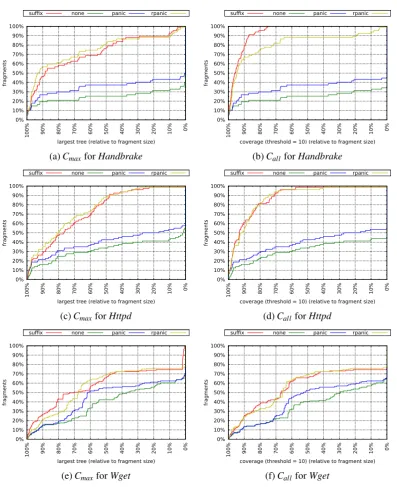
The results are shown in Figure6. The x axis in the charts on the left showCmax and on the
right they showCall. The y axis in all charts show the relative cumulative number of fragments
of the respective coverage measure.
0% 10% 20% 30% 40% 50% 60% 70% 80% 90% 100% 0% 10% 20% 30% 40% 50% 60% 70% 80% 90% 100% fragments
largest tree (relative to fragment size) suffix none panic rpanic
(a)CmaxforHandbrake
0% 10% 20% 30% 40% 50% 60% 70% 80% 90% 100% 0% 10% 20% 30% 40% 50% 60% 70% 80% 90% 100% fra g men ts
coverage (threshold = 10) (relative to fragment size)
suffix none panic rpanic
(b)CallforHandbrake
0% 10% 20% 30% 40% 50% 60% 70% 80% 90% 100% 0% 10% 20% 30% 40% 50% 60% 70% 80% 90% 100% fragments
largest tree (relative to fragment size) suffix none panic rpanic
(c)CmaxforHttpd
0% 10% 20% 30% 40% 50% 60% 70% 80% 90% 100% 0% 10% 20% 30% 40% 50% 60% 70% 80% 90% 100% fra g men ts
coverage (threshold = 10) (relative to fragment size)
suffix none panic rpanic
(d)CallforHttpd
0% 10% 20% 30% 40% 50% 60% 70% 80% 90% 100% 0% 10% 20% 30% 40% 50% 60% 70% 80% 90% 100% fragments
largest tree (relative to fragment size) suffix none panic rpanic
(e)CmaxforWget
0% 10% 20% 30% 40% 50% 60% 70% 80% 90% 100% 0% 10% 20% 30% 40% 50% 60% 70% 80% 90% 100% fra g men ts
coverage (threshold = 10) (relative to fragment size)
suffix none panic rpanic
(f)Call forWget
We can observe that the strategiesnoneandpanicare always worse than the other two strate-gies, wherepanicis able to gather about 10 % larger trees thannone. Strategyrpanicimplements a more sophisticated restart and as the charts show is capable to cover more tokens than the sim-plerpanicmode as a consequence.
The strategies suffix andrpanicare close to each other. Sometimes rpanicis slightly better than suffix in terms of Cmax, sometimes it is slightly worse. Strategy rpanic skips tokens in
case of syntax errors and is still able to construct a tree, while suffixwill always restart. As a consequence, the largest trees ofsuffixtend to be smaller. The best results are obtained forHttpd where both strategies are able to fully parse a fragment in more than 20 % of the cloned token sequences.
The values for Call capture not only the largest tree but also smaller trees after a restart of
the parser. Consequently, one should expect that the curve ofCall should always be above the
corresponding curve forCmaxfor each strategy and system. Yet, that is not the case fornoneand
panicforHandbrakeand fornoneforHttpd as well as for all strategies forWget (generally in the range of 0–10 % on the x axis). The reason for that is that we ignore trees smaller than the threshold of 10 tokens only forCall and notCmaxand these strategies created many such small
trees.
Wgetis different from the other systems also for the strategiesrpanicandsuffix. It contains an automatically generated parser, which consists of many repetitive comma-separated literals used to initialize parser tables and also several lists of case labels. All of them were reported by the clone detector as syntactically incomplete sequences. The following code snippet illustrates the problem: S =,10,20,1,20,15,0,0,0. Thepanicmodes will skip all tokens in S until it reaches a synchronizing symbol (see Sections3.3and3.4). Because there is no synchronizing symbol in S, both panic modes will skip the complete sequence and fail to parse it. Interestingly, the suffix strategy fails as well. The simplified C grammar rule for such initializer lists is as follows: L→L0,0E|E. With respect to this rule, S is syntactically incomplete from the left. Suffix parsers are designed for such situations (see Section 3.4). Hence, a full suffix parser should be able to pick up these cases successfully. The suffix parser we used, however, is a lightweight variant and fails in such situations, too (see Section 3.4). As a result, the suffix strategy yields syntax trees that consist of only two tokens, which are then ignored. About 75 % of the 118,979 cloned tokens ofWgetparsed in our study stem from this generated parser code. These reasons explain why the coverage for Wget is worse. We did not exclude this type of automatically generated code because the code could have been written manually, too, (lists of literals are not uncommon in handwritten C code). This case hints at a general problem with incomplete repetitive structures.
5.4 Research Question RQ2
whether the syntax tree itself is a correct derivation from the given sequence. One may argue that every such syntax tree derived from an Earley parser is correct by construction as the Ear-ley parser will correctly apply the syntax rules. Yet, this tree might not be the tree expected by a human. A strategy may skip tokens after syntax errors (panic modes) or even at the begin-ning (suffix mode). They are heuristics to find a recovery point after which normal parsing is restarted. The starting point, however, decides what kind of tree will be recovered from then on. A suboptimal starting point may trigger suboptimal syntax analysis.
RQ2 addresses the issue of correctness and completeness of the strategies in terms of precision and recall. Precision and recall are measured against an OracleOof expected syntax trees for given token sequences. LetE be the set of syntax trees extracted by applying a certain strategy S. Then precision ofSis defined as the fraction of derived syntax trees derived by applyingS that are correct: |O∩E|/|E|. Recall is the fraction of expected syntax trees actually extracted:
|O∩E|/|O|.
Recall and precision require an oracle. In case the compilation unit is syntactically correct, we could create a syntax tree for the whole unit and compare the results of the partial syntax analysis to subtrees of the whole-unit syntax tree. That will not work in many cases, however, if the code contains preprocessor statements or is syntactically wrong. If there were an algorithm to create an oracle for syntactically incorrect code or code with preprocessor directives, that is, compute correct syntax trees for arbitrary token sequences, we would not need our strategies in the first place. Furthermore, we do not even know an operational definition of correct syntax trees for such arbitrary token sequences. For this reason, we use a human oracle. One of the authors, namely, Riemann determined the syntactic categories for a sample of the cloned token sequences manually. The syntactic category of a subsequence of tokens is the grammar non-terminal from which the subsequence is derived. In terms of syntax trees, it is the root node of a subtree. Specifically, we considered struct, union, and enum specifiers as well as labeled, compound, selection, iteration, and jump statements plus function definitions from the C grammar as relevant and meaningful syntactic constructs for such roots.
An extracted syntax tree is considered matched with a syntax tree from the oracle when both have the same syntactic category and the positions of their respective left-most and right-most tokens do not differ by more than 5 characters. The positions are not required to be identical but only close enough to mitigate possible errors the human oracle has made in deciding the positions manually. These types of errors may have been caused by imprecisely picking source positions with the mouse cursor.
drawn fromP0.
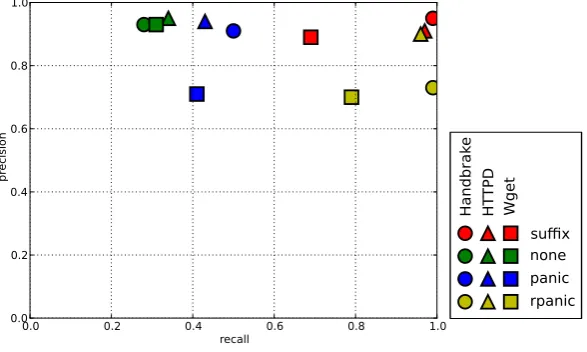
Recall and precision gathered for the sample are shown in Figure7and Table2. As we can see, precision is fairly high for all strategies, but the more elaborate strategiessuffixandrpanic provide much better recall thanpanic andnone, where panicis only slightly better than none. When we comparesuffixandrpanic, we find that both are almost equally good forHttpd, while suffixhas better precision thanrpanicfor the other two system but also worse recall.
Han
dbr
a
ke
HT
TP
D
Wget
suffix none panic rpanic
Figure 7: Recall and precision
Handbrake Apache HTTPD GNU Wget
recall precision recall precision recall precision
suffix 0.99 0.95 0.97 0.91 0.69 0.89
none 0.28 0.93 0.34 0.95 0.31 0.93
panic 0.50 0.91 0.43 0.94 0.41 0.71
rpanic 0.99 0.73 0.96 0.90 0.79 0.70
Table 2:Recall and precision
5.5 Research Question RQ3
repetitive initializer lists.
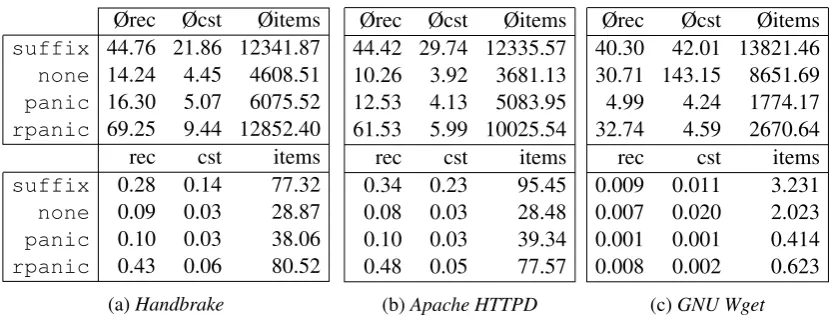
It is remarkable that the actual parsing step requires more time than the creation of the syntax tree forHandbrakeandHTTPD. In case ofWgetit is opposite, except forpanicandrpanic. The larger fragments inWgetcan be made responsible for this behavior as the worst-case of syntax tree construction is exponential. This argument is backed up by the fact that this behavior cannot be observed forpanicandrpanic, which both failed to parse the three largest fragments. Those three largest fragments had so many syntax errors that the program ran out of memory for the two panic modes. The size of these fragments were about 77,000, 1,750, and 1,000 tokens, respectively. All of them were found in a file that was automatically generated and, hence, they may be considered atypical. Nevertheless they hint at deficiencies for the two panic modes. Strategiessuffixandnonedid not have any problem with these large clones.
Overall we find that the more elaborate strategiessuffixandrpanicrequire generally also more time.
Ørec Øcst Øitems
suffix 44.76 21.86 12341.87
none 14.24 4.45 4608.51
panic 16.30 5.07 6075.52
rpanic 69.25 9.44 12852.40
rec cst items
suffix 0.28 0.14 77.32
none 0.09 0.03 28.87
panic 0.10 0.03 38.06
rpanic 0.43 0.06 80.52
(a)Handbrake
Ørec Øcst Øitems 44.42 29.74 12335.57 10.26 3.92 3681.13 12.53 4.13 5083.95 61.53 5.99 10025.54
rec cst items
0.34 0.23 95.45 0.08 0.03 28.48 0.10 0.03 39.34 0.48 0.05 77.57
(b)Apache HTTPD
Ørec Øcst Øitems
40.30 42.01 13821.46 30.71 143.15 8651.69 4.99 4.24 1774.17 32.74 4.59 2670.64
rec cst items
0.009 0.011 3.231 0.007 0.020 2.023 0.001 0.001 0.414 0.008 0.002 0.623
(c)GNU Wget
Table 3:Resource consumption
Ørecis the average time for parsing a token sequence andØcstthe average time for constructing the syntax tree in milliseconds;Øitemsis the average number of Earley items. The numbers for these in the lower part of the tables are the same characteristics normalized by the respective length of a fragment in terms of number of tokens.
6
Conclusion
applications in general. Yet, we also experienced a few cases where the exponential worst-case nature of the algorithm hit the limits of available memory. These were cases of automatically generated sequences of repetitive code structures (e.g., lists of case labels or literals) that were syntactically incomplete. Such cases should already be filtered by a clone detector able to rec-ognize repetitions [Kos12].
Given these promising results of principal feasibility, we want to use robust parsing in future research as an aide for syntactic filters to improve the precision of token-based detectors or to rank their results. It is also worthwhile to extend our study to larger code bases in order to encounter other language constructs that make C/C++ a difficult language to parse. Other researchers analyzing C/C++ code may benefit from this approach. For instance, Merlo et al. [MLPB13] had to preprocess a large telecommunication software to remove all preprocessor directives and then run an island parser to gather their metrics for clone detection.
Bibliography
[AH02] J. Aycock, N. R. Horspool. Practical Earley Parsing. The Computer Journal 45(6):620–630, Nov. 2002.
[AP72] A. Aho, T. Peterson. Minimum Distance Error-Correcting Parser for Context-Free Languages.SIAM Journal on Computing1(4):305–312, 1972.
[AU77] A. V. Aho, J. D. Ullman.Principles of Compiler Design. Addison-Wesley Pub. Co., Reading, Massachusetts, 1977.
[Bak92] B. S. Baker. A program for identifying duplicated code. InComputer Science and Statistics 24: Proceedings of the 24th Symposium on the Interface. Pp. 49–57. Mar. 1992.
[BKA+07] S. Bellon, R. Koschke, G. Antoniol, J. Krinke, E. Merlo. Comparison and Evalu-ation of Clone Detection Tools.IEEE Computer Society Transactions on Software Engineering33(9):577–591, Sept. 2007.
[BM01] I. D. Baxter, M. Mehlich. Preprocessor Conditional Removal by Simple Partial Eval-uation. InReverse Engineering, 2001. Proceedings. Eighth Working Conference on. Pp. 281–290. 2001.
[BYM+98] I. D. Baxter, A. Yahin, L. Moura, M. Sant’Anna, L. Bier. Clone Detection Using Abstract Syntax Trees. In Koshgoftaar and Bennett (eds.),International Conference on Software Maintenance. Pp. 368–378. IEEE Computer Society Press, 1998.
[Ear70] J. Earley. An efficient context-free parsing algorithm.Communications of the ACM 13(2):94–102, Feb. 1970.
[GG12] P. Gazzillo, R. Grimm. SuperC: Parsing All of C by Taming the Preprocessor. SIG-PLAN Not.47(6):323–334, June 2012.
[GJ08] D. Grune, C. J. H. Jacobs.Parsing Techniques: A Practical Guide. Springer, New York, second edition, 2008.
[GK09] N. G¨ode, R. Koschke. Incremental Clone Detection. In European Conference on Software Maintenance and Reengineering. Pp. 219–228. IEEE Computer Society Press, 2009.
[HJHC10] B. Hummel, E. Juergens, L. Heinemann, M. Conradt. Index-Based Code Clone De-tection: Incremental, Distributed, Scalable. InInternational Conference on Software Maintenance. Pp. 1–9. IEEE Computer Society Press, 2010.
[KFF06] R. Koschke, R. Falke, P. Frenzel. Clone Detection Using Abstract Syntax Suffix Trees. InWorking Conference on Reverse Engineering. Pp. 253–262. IEEE Com-puter Society Press, 2006.
[KGO11] C. K¨astner, P. G. Giarrusso, K. Ostermann. Partial preprocessing C code for vari-ability analysis. In Proceedings of the 5th Workshop on Variability Modeling of Software-Intensive Systems. Pp. 127–136. ACM Press, 2011.
[KGR+11] C. K¨astner, P. G. Giarrusso, T. Rendel, S. Erdweg, K. Ostermann, T. Berger. Variability-Aware Parsing in the Presence of Lexical Macros and Conditional Com-pilation. In Proceedings of the 2011 ACM International Conference on Object Oriented Programming Systems Languages and Applications. Pp. 805–824. ACM Press, 2011.
[KKI02] T. Kamiya, S. Kusumoto, K. Inoue. CCFinder: A Multi-Linguistic Token-based Code Clone Detection System for Large Scale Source Code.IEEE Computer Society Transactions on Software Engineering28(7):654–670, 2002.
[Kos12] R. Koschke. Large-Scale Inter-System Clone Detection Using Suffix Trees. In Euro-pean Conference on Software Maintenance and Reengineering. Pp. 309–318. IEEE Computer Society Press, 2012.
[KRC11] I. Keivanloo, J. Rilling, P. Charland. SeClone – A Hybrid Approach to Internet-Scale Real-Time Code Clone Search. InInternational Conference on Program Compre-hension. Pp. 223–224. IEEE Computer Society Press, 2011.
[LHMI07] S. Livieri, Y. Higo, M. Matushita, K. Inoue. Very-Large Scale Code Clone Analysis and Visualization of Open Source. InInternational Conference on Software Engi-neering. Pp. 106–115. ACM Press, 2007.
[Moo01] L. Moonen. Generating Robust Parsers using Island Grammars. InWorking Confer-ence on Reverse Engineering. Pp. 13–22. 2001.