ISSN-L: 2501 - 1235 Available on-line at: www.oapub.org/edu
doi: 10.5281/zenodo.2526321 Volume 5 │ Issue 2 │ 2018
THE EFFECT OF 6 WEEKLY TABATA TRAINING
ON SOME PHYSICAL AND MOTOR CHARACTERISTICS
ON FEMALE VOLLEYBALL PLAYERS
Yakup Akif Afyon1i, Olcay Mülazimoğlu1, Mehmet Altun2 1Mugla Sitki Kocman University,
Faculty of Sport Sciences, Mugla, Turkey
2Sitki Kocman University,
Health Sciences Institute, BES ABD Graduate, Mugla, Turkey
Abstract:
The aim of this study is to examine the effect of the Tabata Training Program (TAP), which has been applied for 6 weeks, on some physical and motoric characteristics of female volleyball player The players participated in the study voluntarily in 11 females (age = 15,27 ± 1,10 years, height = 170,27 ± 6,00 cm and body weight = 63,36 ± 6,96 kg) in the high school team. In the study, pretest-posttest experimental method was used. Tabata training is a type of High Intensity Interval Training (HITT) which aims to develop aerobic and anaerobic capacity in sports. The athletes were given 2 minutes of TAP (Tabata et al., 1996) for 2 weeks a week for 6 weeks in addition to their normal training, with a 4-minute exercise consisting of 8 movements followed by 10 sec rest after 20 s maximal load. To determine the effect of TAP; female volleyball's body weight, shuttle, push-up, vertical jump, long jump, 20 mt. speed, shuttle run, balance and flexibility tests were taken as pre-test, post-TAP post-test. The differences between pre-test and post-test (Paired-Samples t-test) were examined. The findings were evaluated at a 95% confidence interval of 5% significance (0.05). TAP before and after the tests conducted was found that there was a significant difference in values of body weight, shuttle, push-up, vertical jump, long jump, 20 m. sprint and 20 m shuttle run. (in order, X-pre-test ± ss, and X-post-test ± ss: 63.36 ± 6.96, 62.45 ± 6.61 kg: 25.73 ± 4.67, 27.91 ± 5.28 repeat: 16, 09 ± 4.50, 19.73 ± 5.85 repetition: 37.36 ± 4.52, 40.27 ± 5.06cm: 158.27 ± 16.11, 166.27 ± 16.14cm: 4, 22 ± 0,22; 4,05 ± 0,16: 584,27 ± 47,90; 635,45 ± 35,95m) p <0.05. Flamingo balance and sit and reach flexibility test did not show significant difference in pre-test and post-test values ((in order, X-pre-test ± ss, and X-post-test ± ss:
9,55 ± 3,72; 9,27 ± 3,61puan: 11,32 ± 7,11; 12,91 ± 5.43 cm), (p >0 0.05) In addition to the volleyball training that has been applied for 6 weeks, TAP has been shown to improve motor skills such as strength, speed and durability of female volleyball players. It will provide significant contributions to the work of the control group in individual and team sports to clarify the effect of these types of training.
Keywords: women's volleyball, Tabata training, physical and motoric skills
1. Introduction
Volleyball is a sport that involves complex movements in continuous development. In a five-set match, a total of 250-300 high-power movements are required (Fox et al., 1999). Volleyball sport; short interval exercise periods and rest period can be defined as an interval sports. It has an important place in the success of the physical structure required by this sport (Turnagöl, 1994). The structure of volleyball constitutes 50% slings, blocks, 50% planjon, cuffs, short sprints, direction change and service. The concept of power is the most important factor determining performance in volleyball. The force is the basis of power efficiency, but it is one of the two components that make up the power and speed (Cinemre et al. 2013).
In volleyball, which is a contact sport, a match can last for 2-2,5 hours. In order to be able to perform at the highest level during this period; athletes are required to have good training, very good preparation and motor skills (Günay et al., 1994). Volleyball sport can be defined as an interval sport consisting of short periods of loading and resting periods. There are four basic movements specific to volleyball at the time of training and competition: 1. Bounce 2. Shooting 3. Blok 4. Fall (Baltacı et al., 2003). Volleyball sport is also a sport that includes consecutive aerobic and anaerobic loading. Therefore, it may be thought that it requires high muscle strength and ability (Karacaoğlu, 2015). Interval training is the repetition of several exercise series at certain intervals. The feature of interval training is the regular exchange of work and rest or severe and low load circuits (Revan et al., 2008).
Tabata training is a High Intensity Interval Training (HITT) which aims to improve aerobic and anaerobic capacity in athletes and has become more popular in recent years. The term Tabata Training used, which is a synonym for HIIT, was used for the first time in 1996 by the Japanese scientist Izumi Tabata. (Tabata et al., 1996) They did a study comparing 70% of oxygen. In Tabata system, the selected movement is done within 20 seconds with maximum load and repetition. After 10 seconds of active rest and then move to the second move.
This high-intensity interval training is repeated 8 times and a total of 4 minutes of TAP training is completed. The study also found that HIIT improved aerobic capacity up to continuous training with moderate intensity, but also a 28% increase in anaerobic capacity. (Tabata et al., 1996) The aim of this study is to investigate the effects of the Tabata Training Program (TAP) on some physical and motoric characteristics of female volleyball players for 6 weeks.
2. Material and Methods
In the research, pretest-posttest was used experimentally. 11 women (age = 15,27 ± 1,10 years; height = 170,27 ± 6,00cm; body weight = 63,36 ± 6,96kg) participated in the study voluntarily. Necessary permissions were obtained from the school administration and parents.
2.1 Obtaining data
The athletes applied the Tabata Training Program (TAP) (Tabata et al. 1996) for 6 weeks in addition to their normal training. To determine the effect of TAP; players, body weight, shuttle, push-ups, vertical jump, long jump, 20 m. speed, 20 m. they applied shuttle run, flamingo balance and flexibility tests before and after TAP.
2.2 Statistical Analysis of the Data
Descriptive statistical methods when evaluating data; Average (X), Standard Deviation (ss) were used. The differences between the pre-test and post-test were analyzed by Paired-Samples t-test. The findings were evaluated at 5% significance level (0.05).
2.3 Tabata Training Program (TAP)
3. Results
Table 1: Identifier statistics of female volleyball players
The mean age of the participants was 15.27 ± 1.10 and the mean height of the body was 170.27 ± 6.00 and the mean body weight was 63.36 ± 6.96 (Table 1).
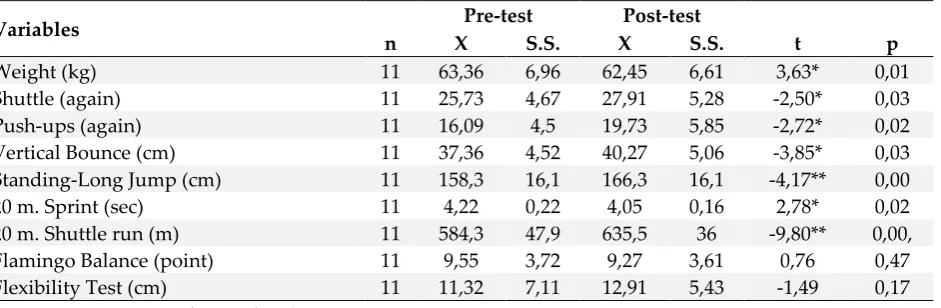
Table 2: Pre-test and post-test comparison analysis of female volleyball players
Variables Pre-test Post-test
n X S.S. X S.S. t p
Weight (kg) 11 63,36 6,96 62,45 6,61 3,63* 0,01
Shuttle (again) 11 25,73 4,67 27,91 5,28 -2,50* 0,03 Push-ups (again) 11 16,09 4,5 19,73 5,85 -2,72* 0,02 Vertical Bounce (cm) 11 37,36 4,52 40,27 5,06 -3,85* 0,03 Standing-Long Jump (cm) 11 158,3 16,1 166,3 16,1 -4,17** 0,00 20 m. Sprint (sec) 11 4,22 0,22 4,05 0,16 2,78* 0,02 20 m. Shuttle run (m) 11 584,3 47,9 635,5 36 -9,80** 0,00, Flamingo Balance (point) 11 9,55 3,72 9,27 3,61 0,76 0,47 Flexibility Test (cm) 11 11,32 7,11 12,91 5,43 -1,49 0,17 *p<0,05; **p<0,01 significance level
Table 2, before and after TAP tests applied body weight, shuttle, push-ups, vertical jump, standing long jump, 20 m. sprint and 20 m. There was a significant difference in shuttle run values(p<0.05). X pre-test ± ss; X post-test ± ss: 63,36 ± 6,96; 62,45 ± 6,61 kg: 25,73 ± 4,67; 27,91 ± 5,28: 16,09 ± 4,50; 19,73 ± 5,85 repeats: 37,36 ± 4,52; 40,27 ± 5,06cm; 158,27 ± 16,11; 166,27 ± 16,14cm; 4,22 ± 0,22; 4,05 ± 0,16s; 584,27 ± 47,90; 635,45 ± 35,95m.). No significant difference was found in the pre-test and post-test values of the Flamingo balance and sit-in flexibility test (p> 0.05). (in order: 9,55 ± 3,72; 9,27 ± 3,61 points: 11,32 ± 7,11; 12,91 ± 5,43cm).
4. Dıscussıon and Conclusion
At the end of the research; TAP female volleyball players body weight, shuttle, push-ups, vertical jump, standing long jump, 20m. sprint and 20m. have a positive effect on shuttle run values. We see that the developmental features are motoric properties such as force, speed and durability. No significant change was observed in the Flamingo balance and length-elasticity tests.
Aykora and Dönmez (2017) applied to women volleyball players with the Tabata
training method for 8 weeks and reported that the players improved their features such
Variables N Min. Max. X SS
Age 11 14 17 15,27 1,10
Height 11 163,00 182,00 170,27 6,00
Karahan (2012) applied a high-intensity interval training program with 8-week skill to female futsal players and reported significant improvement in aerobic and anaerobic performances.
Ekström et al. (2017) examined the changes in the coordination, balance and strength characteristics of the children between the ages of 7-9 years. As a result of the study, push-ups, push-ups in the knees and long standing performances reported significant improvement.
Tabata et al. (1996) compared the intensity of 70% VO2max high intensity interval training with 70% VO2Max consumption and 60% continuous training, they found that HIIT improved aerobic capacity up to continuous training with moderate intensity but also caused a 28% increase in anaerobic capacity.
Gibala et al. (2006) in their study, 2.5 hours of interval training 10.5 hours of continuous exercise with the same level of biochemical muscle showed that the difference.
Driller et al. (2009) According to the study, 4 weeks of high-intensity interval exercise in the rowing of 2000 meters in rowing sport improved 8.2 seconds. This result is equivalent to 2% significant improvement after seven trainings.
Altınkök (2015) consider that interval aerobic exercises significantly increase the maxVO2 data. In addition, there are studies showing that interval exercise method increases aerobic fitness more than continuous training method
Backous et al. (1990) found that there were statistically significant differences in
weight between non-smokers and adolescents who did not exercise regularly.
Günay et al. (1994) found a significant difference in the weight loss between
pretest and posttest values of eight-week strength trainings at 0.05 level.
Tortum (2017) after six weeks of core stabilization exercise program; there was a
statistically significant increase in anaerobic performance
As a result, in addition to the volleyball training performed for 6 weeks, no
increase was observed in the flexibility and balance parameters of female volleyball players at the end of TAP. In order to clarify the effects of this type of training, individual and team sports control group studies can provide important contributions. TAP can be offered to volleyball coaches to improve the force velocity, aerobic-anaerobic stability of women athletes.
References
Aykora, E. Dönmez, E. Kadın voleybolcularda tabata protokolüne göre uygulanan pliometrik egzersizlerin kuvvet parametrelerine etkisi. Journal of Bitlis Eren University Institute of Social Sciences, 6(1): 71-84,2017.
Backous D.D., Farrow J.A., Fridel K.E. Assessment of Maturity in Boys and Grip Strength. Journal Adolesc. Healt Care, 11, (6) 497-501,1990.
Baltacı G, Kohl H.W. Does proprioceptive training affect during knee and ankle rehabilitation outcomes? Physical Therapy Reviews, 8,5-16,2003.
Cinemre A, Ünver E. Voleybolda kuvvet ve güç antrenmanları, 5. Antrenman Bilimi Kongresi Özet Kitabı, Ankara. p.82.2013.
Driller M., Fell J. Gregory J, Shing, C., Williams A. The effects of high-intensity interval training in well-trained rowers. International Journal of Sports Physiology and Performance, 4(1),2009.
Ekström, A. Östenberg, A. H. Björklund, G. & Alricsson, M. The effects of introducing Tabata interval training and stability exercises to school children as a school-based intervention program. International journal of adolescent medicine and health. 2017.
Fox E.L., Bowers, R.W., Foss, M.L. Beden eğitimi ve sporun fizyolojik temelleri. (Çev: Cerit M.) Bağırgan Yayınevi, Ankara, 1999.
Gibala, M.J., Little, J.P., Essen M.V., Wilkin, G.P., Burgomaster, K.A., Safdar, A., Raha,
S., Tarnopolsky, M.A. Short‐term sprint interval versus traditional endurance
training: similar initial adaptations in human skeletal muscle and exercise
performance, The Journal of physiology, 575 (3),901-911,2006.
Günay, M. Erol, A.E. Savaş S. Futbolculardaki Kuvvet, Esneklik-Çabukluk ve anaerobic Gücün Boy, Vücut Ağırlığı ve Bazı antropometrik Parametreler İle İlişkisi, HÜ. Spor
Bilimleri Dergisi, 5(4),1994.
Karacaoğlu S. (Erkek Voleybolcularda Core Antrenmanın Fiziksel Uygunluk Özelliklerine Etkisi, Eğitim Bilimleri Enstitüsü, Beden Eğitimi ve Spor Öğretmenliği Ana Bilim Dalı Beden Eğitimi ve Spor Öğretimi Tezli Yüksek Lisans Programı, Yayınlanmamış Yüksek lisans tezi, Mehmet Akif Ersoy Üniversitesi, Burdur, 2015.
Karahan, M. The effect of skill-based maximal intensity interval training on aerobic and anaerobic performance of female futsal players. Biology of sport, 29(3) 2012. Revan, S., Balcı, Ş.S., Pepe, H., Aydoğmuş, M. Sürekli ve internal koşu antrenmanlarının
vücut kompozisyonu ve aerobik kapasite üzerine etkileri. Spormetre Beden Eğitimi ve Spor Bilimleri Dergisi, C.6, S.4, 193-197,2008.
Tabata I., Nischimura K., Kouzaki M., Hirai Y., Ogita F., Miyachi M., Yamamoto K. Effects of moderate-intensity endurance and high-intensity intermittent training on anaerobic capacity and VO2 max. Medicine & Science in Sports & Exercise 28(10), 1327-1330,1996.
Tortum A.C. Bayan Voleybolculara Uygulanan Kor Stabilizasyon Egzersizlerinin Denge ve anaerobic Performansa Etkisi, Sağlık Bilimleri Enstitüsü, Yüksek Lisans Tezi, Yıldırım Beyazıt Üniversitesi, Ankara, 2017.
Creative Commons licensing terms