Selected Revised Papers from the
4th International Workshop on
Graph Computation Models
(GCM 2012)
Co-Transformation of Type and Instance Graphs Supporting Merging of
Types and Retyping
Florian Mantz, Yngve Lamo, Gabriele Taentzer
24 pages
Co-Transformation of Type and Instance Graphs Supporting
Merging of Types and Retyping
∗Florian Mantz1, Yngve Lamo1, Gabriele Taentzer21
1[email protected],[email protected]
Institutt for data og realfag Høgskolen i Bergen, Norway
Fachbereich Mathematik und Informatik Philipps-Universit¨at Marburg, Germany
Abstract: Algebraic graph transformation is a well-known rule-based approach to manipulate graphs that can be applied in several contexts. In this paper we use it in the context of model-driven engineering. Graph transformation rules usually specify changes to only one graph per application, however there are use cases such as model co-evolution where not only a single graph should be manipulated but also related ones. The co-transformation of type graphs together with their instance graphs has shown to be a promising approach to formalize model and meta-model co-evolution. In this paper, we extend our earlier work on co-evolution by allowing transformation rules that have less restrictions so that graph manipulations such as merging of types and retyping of graph elements are allowed.
Keywords:Meta-model evolution, model migration, graph transformation
1
Introduction
Model-driven engineering (MDE) [BCW12] is a software engineering discipline that uses mod-els as the primary artifacts throughout the software development process and adopt model trans-formation for both, model optimization as well as model and code generation. In particular, MDE is a suitable approach for automating recurring development tasks in many areas of software en-gineering that require application-specific system designs. A commonly used technique to define modeling languages is meta-modeling. An effective means to describe the application-specific part of a software system are domain-specific modeling languages since they focus on the essen-tial concepts of a domain. In contrast to traditional software development where programming languages rarely change, domain-specific modeling languages, and therefore meta-models, can change frequently: modeling language elements may be, e.g., renamed, extended by additional attributes, merged, or refined by a hierarchy of sub-elements. The evolution of a meta- model re-quires the consistent migration of all its instance models (SeeFigure 1) which is still considered to be a research challenge in MDE see e.g. [SRVK10].
Previous work in e.g. [RKPP10, HBJ09, Mig] has mainly focused on the development of useful tools to define and execute model migrations. The relation between meta-model changes
Meta-model evolution //
Meta-model0
Model
conforms to
O
O
migration_ _ _ _ _+3
_ _
_ _ _ _ _ _ _ _
_ Model0
conforms to
O
O
Figure 1: Meta-model evolution and model migration
and model migrations has been studied little on a formal level.
In our work, we focus on a formal setting of meta-model and model co-evolution to study their relations. Models are specified in a suitable category of graphs while model relations are defined by graph morphisms. The type conformance of models to their meta-models is specified by morphisms from instance to type graphs. Graph manipulations can be described by graph transformation [EEPT06] and category theoretical constructs [BW95]. In particular, the pro-posed approach is based on the co-span double pushout [EHP09] approach which is a variant of the “traditional” double pushout (DPO) approach where transformation rules are co-spans. Equivalence between the two approaches has been shown in [EHP09]. We prefer the alternative DPO approach since migrations can be easier synchronized over an joint-type graph instead of a difference type graph [TML12a]).
The aim of our work is to understand the co-evolution problem better so that future tool support can profit from this formalization. In particular, we are interested under which conditions we can perform different manipulations on type graphs and its instances by categorical constructions so that we get a well-typed and unique result. A resulting graph is considered to be well-typed if there is a suitable morphism to its evolved type graph. A corresponding model migration has to fit to its meta-model evolution such that the resulting model is well-typed over the evolved meta-model. By our formalization, we get formal criteria for consistently defined meta-model evolutions and related model migrations.
2
Basic Co-evolution Actions
Domain-specific modeling languages are effective means to describe domain knowledge on an abstract level. Their models can be used to generate software artifacts such as executable pro-grams. Usually domain-specific modeling languages are defined by use of the concept of meta-modeling where one meta-model serves as language description for the next abstraction level. The most prominent meta-modeling architecture used for this purpose is Meta Object Facility (MOF) [Obj06] standardized by the Object Management Group (OMG) [Obj]. The syntax of MOF-based modeling languages is defined in terms of class diagrams. Elements of the language become classes that are related to other language elements by references. Models of these lan-guages are instances of these class models. For a more intuitive usage of modeling lanlan-guages, language elements are usually mapped to a different (visual) presentation. However, the con-crete presentation of modeling languages is basically syntactic sugar and will be neglected here. Class diagrams and hence meta-models can be naturally formalized by type graphs. Basic object-oriented concepts such as classes, references, attributes, and even, inheritance can be described by graph elements (e.g. using the category AIGraphs [EHP09]): classes are presented as nodes, references as arrows, inheritance relations as special arrows and attributes as arrows that have a data type as target. Hence changes in modeling languages and models can be represented by graph changes. Therefore, we specify meta-models and instance models by type and instance graphs.
In this section, we first present possible basic change actions on type and instance graphs. Afterwards, we assign the required basic change actions to typical meta-model evolutions found in related research and their migrations. We will see that a merge operation is highly desirable and should be supported by a co-evolution approach.
Graph transformation approaches support different kinds of basic change actions. Elements, i.e. nodes and edges may be:
1. Renamed (N) 2. Created (C) 3. Deleted (D)
4. Merged (M) or 5. Split (S)
Considering type graphs together with their instances, however, more kinds of changes can be distinguished since their typing relations may also be manipulated. A type graph change action may induce a retyping of instances. Elements may be retyped (T) for four reasons. Induced retypings are:
1. Types are renamed (TN).
2. Types are merged (TM) and instance elements have to be retyped accordingly.
In addition, graph elements may be optional retyped:
3. A graph element may be retyped to a subtype (Tsub) of its current type.
4. A graph element may be retyped to a supertype (Tsup) of its current type. This can trigger
deletion actions since the supertype need not support all references or attributes of its subtype.
calcu-lating a new value using a suitable data algebra. Since attribute values are usually considered as a given set of special nodes [EEPT06], the calculation of a new attribute value results into the deletion and creation of arrows: an arrow to an old value is replaced by an arrow to a new one.
Model co-transformation approaches may support a subset of these operations: The most simple change actions are renaming and retyping after type renaming. They do not change the graph structure, hence migration is trivial. In [TML12a], we introduce a co-transformation approach where the manipulation of graphs was restricted to renaming, creation, and deletion of graph elements. In this work, we extend the set of possible change actions to also include merging of graph elements.
However, meta-model evolutions are usually not considered on the level of such atomic changes but on the level of patterns. Some of these meta-model changes have been classified [GKP07] into non-breaking (NB), breaking and resolvable (BR), and breaking and unresolvable changes
(B¬R). In this classification, non-breaking changes do not require model migration while
break-ing and resolvable changes require model migration that can be fully automated. Breakbreak-ing and unresolvable changes can only be partially automated since they require user interaction. These patterns can be and have to be realized by the basic change actions above. To give some exam-ples of meta-model evolution patterns, consider the following list which is inspired by the one presented by Cicchetti et al. in [CDEP08]:
1. Add meta-element: An element e.g. class (node), reference (arrow), or attribute is added to the meta-model. As long as there is no constraint in addition that requires the existence of instance elements, its models do not need to be migrated, but nevertheless can be adapted. For example, default attribute values may be added.
2. Rename meta-element: A meta-element i.e. a type is renamed. The model migration is trivial since there is no structural change.
3. Eliminate meta-element: A meta-element is deleted and all its direct instances need to be deleted as well.
4. Push down meta-property: A meta-property being either a reference or an attribute (arrow), is cloned to all its subclasses (nodes). Migration is required, property instances have to be replaced by instances of the new types. If the superclass had direct instances, these instances loose their “value”.
5. Flatten hierarchy: A class and its superclass are merged. Their instances need to be retyped. 6. Move meta-property: A meta-property e.g. attribute (arrow) is copied from a class A (node) along a reference (arrow) to another class B. Models need to be migrated correspondingly: Property values have to be deleted from the instances of class A, and if existing, copied to all related instances of class B. Values may be duplicated. Instances of elements without an attribute value may get a default value.
7. Inline meta-class: Two associated meta-classes A and B are merged. Instances of type A and B have to be retyped. Linked instances of type A and B are merged. Optionally, the reference between A and B and its instances are deleted.
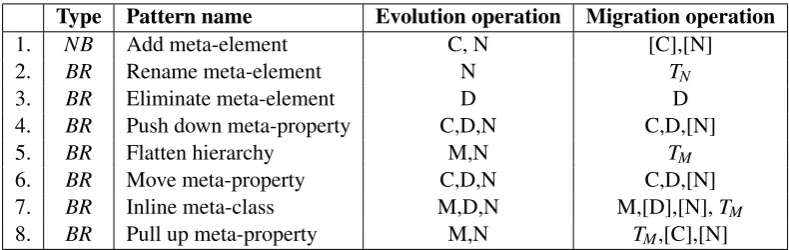
Table 1 shows how these changes can be related to the basic model change actions. The classification inTable 1differs from the one by Ciccetti et al. since they consider the KM3 meta-model [JB06] while we are working with a graph-based formalization. Furthermore, we do not consider constraints by now and summarize equivalent changes like e.g. “Eliminate meta-class” and “Eliminate meta-property” by “Eliminate meta-element”. While many patterns and migra-tions can be expressed by creamigra-tions and delemigra-tions of elements, we will show in the following how our new formalization facilitates the description of these patterns using merging in addi-tion. Note that optional model changes are given in squared brackets. E.g. if a new element is created, it does not have a name but may be (re)named afterwards. Evolution operation “Add meta-element” requires a renaming action since a new type should have a name but its migration operations do not need renaming since instances of a new type may be created without names.
Type Pattern name Evolution operation Migration operation
1. NB Add meta-element C, N [C],[N]
2. BR Rename meta-element N TN
3. BR Eliminate meta-element D D
4. BR Push down meta-property C,D,N C,D,[N]
5. BR Flatten hierarchy M,N TM
6. BR Move meta-property C,D,N C,D,[N]
7. BR Inline meta-class M,D,N M,[D],[N],TM
8. BR Pull up meta-property M,N TM,[C],[N]
Table 1: Classification of change patterns
In particular, change actions 5, 7, and 8 inTable 1above can be easier specified with merging since already existing elements may be retyped. The retyping of elements is always easier than recreating them together with their context. This would be necessary if we could only create and delete. Note that all evolution patterns of Table1can be expressed in our proposed formalization. In the next section, we will illustrate merging at an example.
3
Merging Meta-model Elements: An Example
In the following we illustrate an application of the proposed co-transformation framework in the context of meta-model evolution with model migration by a running example. In particular we will see the advantage of a merge operation.
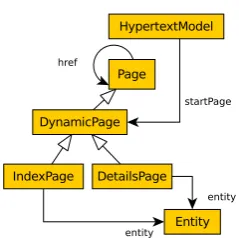
Figure 2a shows the meta-model of SWAL1, a simple domain-specific modeling language for development of interconnected web pages. The meta-model mainly distinguishes between different kinds of web pages which are connected by hyper references. There are two types of web pages, static and dynamic ones. While instances of static pages result in plain HTML pages after code generation i.e. in pages that contain HTML tags only, instances of dynamic
1The development of SWAL was initiated by Manuel Wimmer and Philip Langer at the Technische Universit¨at Wien
pages result in Java Server Pages (JSP). Note that static pages may contain static HTML forms. In addition, the meta-model defines two special types of dynamic pages, both referring to data entities being further specified in a data model not presented here. An instance of the type
IndexPageis translated to a JSP handling a list index needed to manage a data entity containing
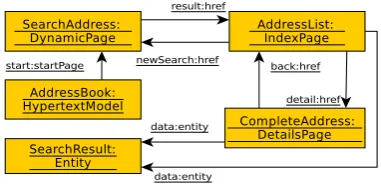
a list of values in a browsable table widget. Each instance of typeDetailsPageis translated to a JSP showing the full content of a data entity as well as offering the typically CRUD operations like insert and update. Figure 2bshows a SWAL model of a simple address book application. The application starts with a page for address search and prints its results to an address list page. Furthermore, the user can navigate to a page where address details may be updated and stored in a corresponding data entity.
(a) SWAL meta-model
SearchAddress:
StaticPage AddressList:IndexPage
AddressBook: HypertextModel
SearchResult: Entity
CompleteAddress: DetailsPage
result:href
newSearch:href back:href
detail:href
data:entity
data:entity start:startPage
(b) AddressBook model
Figure 2: Meta-model with instance model
The meta-model evolution step: Initially, it was decided that the start page should be a plain HTML page. However, we might realize that the distinction between dynamic pages and static ones is unnecessary and even annoying. For ex-ample, in the address book application the search page cannot show previous search parameters because of this decision. The search page is the start page and therefore must be aStaticPage which cannot save any information in the session environment. Therefore, we decide to merge classStaticPageand
Dynamic-Pagein the meta-model (seeFigure 3). Figure 3: Evolved meta-model
1. A new instance SearchAddress of type
Dy-namicPage is created together with its
con-text edges i.e. its incoming and outgo-ing arrows resembloutgo-ing the context of the old instanceSearchAddress. Afterwards the old instance SearchAddress is deleted to-gether with its context edges. This ap-proach is supported by our old formalization in [TML12a].
2. InstanceSearchAddressis retyped to Dynam-icPage. The context is not changed. This ap-proach is supported by the formalization pre-sented in this paper.
Figure 4: Migrated model
After the introductory example, co-transformations are presented on a formal level in the next section. We will pick up the example and show graph transformations with and without merging of types.
4
Merging of Elements in Theory
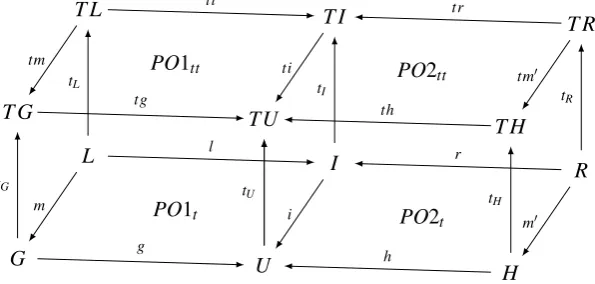
In this section, we extend the theory on co-transformations. Co-transformations are defined as coupled co-span transformations related by typing morphisms. First, we relax the defini-tion of co-span transformadefini-tion given in [TML12a] and hence also implicitly the definition of co-transformation. The relaxed co-span transformations also allow merging of elements. In [TML12a] co-span transformations support the creation and deletion of elements only. After-wards we show that the main results of [TML12a] hold also in this generalized setting. In partic-ular, we also presented a deduction algorithm for migration transformations in [TML12a] where the left-back face of the co-span transformation (seeFigure 5) is required to be a pullback. Here, we also relax this condition so that this face of the double cube only needs to be commuting. This gives us more freedom to define or derive migration rules.
Definition 1 (Co-span transformation rule) LetC be a (weak) adhesive HLR category (see Definition 12 in the appendix). A co-span transformation rule p=L−→l I←−r Rconsists of objectsL,IandRand two jointly epimorphic morphismslandrwhereris inM.
Note, thatlis not required to be inM anymore which makes merging of elements possible.
Definition 2(Co-span transformation)
Given a co-span transformation rule p=L−→l I ←−r R together with anM-morphismm:L→G, calledmatch, rule pcan be ap-plied toGif a co-span double-pushout exists as shown in the dia-gram on the right.t:G=p⇒,m His called aco-span transformation.
L
m
l //
(PO1) I
i
(PO2)
R m0 r o o
G g //U H
h
o
o
A co-span transformation rule is applied to a matchmby first constructing the pushoutPO1 before constructing a pushout complement of i◦r to makePO2 a pushout. A co-span trans-formation rule is only applicable iff the gluing condition is satisfied since pushout comple-ments are not in general unique. Furthermore co-span transformations are not allowed to in-troduce dangling edges by deleting nodes. The gluing condition presented here is the same as in [EHP09,TML12a].
Definition 3((Co-span) gluing condition)
Given morphismm:L→G, letb: B→Lbe the boundary ofm(i.e., the “smallest” morphism such that there is a pushout complement ofbandm, for details see
Definition 10 in the appendix), then m satisfies the co-span
glu-ing condition wrt. rule p=L−→l I ←−r Rif there is a morphism
b0:B→Rwithr◦b0=l◦b.
B
b //
(=)
b0
'
'
L
l //I oo r R
Based on co-span transformations (rules), we now define co-transformation (rules).
Definition 4(Co-transformation rule)
A co-span rule t p=T L−→tl T I←−tr T R and a co-span rule p=L−→l I←−r R form a co-transformation rule (t p,p), if there are graph morphismstL:L→T L,tI:I→T IandtR:R→T Rsuch
that both squares in the diagram on the right commute.
T L tl //
(1) T I
(2) T R
tr
o
o
L
l // tL O O I tI O O R r o o tR O O
In such a co-transformation rule (tp,p), rulet pis called anevolution rulewhile rulepis called a
migration rulewrt.t p. We also say that migration rule pis well-typed wrt.t p.
We now give properties that ensures that corresponding creations and deletions are reflected by the migration rule.
Definition 5(Reflecting migration rules) Consider aco-transformation rule(t p,p)like in the figure above. A co-transformation rule(t p,p)is called
1. creation-reflectingifT L−→tl T I←−tI I is a pushout (left square).
We also say that the migration rulepis creation-reflecting or deletion-reflecting wrt.t p.
A co-transformation rule applied to a meta-model and a model forms a co-transformation.
Definition 6(Match of a co-transformation rule)
A match (tm,m) of a co-transformation rule (t p,p) is given by the corre-sponding matchestm: T L→T Gof the evolution rulet pandm:L→Gof the migration rule pso that the matches together with the typing morphisms tL:L→T LandtG:G→T Gconstruct a commuting square:tm◦tL=tG◦m.
IfG←−m L−→tL T Lis a pullback then the match is called complete.
T L tm //T G
L m //
tL
O
O
G
tG
O
O
Definition 7(Co-transformation) A co-transformation(tt,t)is defined by graph transformation tt:T Gt p=⇒,tmT Hand graph transformationt:G=p⇒,m Hthat apply a co-transformation rule(t p,p)
via match(tm,m)simultaneously to type graphT Gand its instance graphG, so that there are morphismstU:U →TU andtH: H→T H such that all faces of Figure 5commute. In such
a co-transformation(tt,t), the type graph transformationtt:T Gt p=⇒,tmT H is called anevolution while the instance graph transformationt:G=p⇒,m H is called amigrationwrt.tt.
T G
T L
TU
T I
T H
T R
PO1tt PO2
tt tm
ti
tm0 tg
tl
th
tr
G
L
U I
H
R
PO1t PO2
t m
i
m0 g
l
h
r
tG
tL
tU
tI
tH
tR
Figure 5: Co-transformation
Note that PO2t exists only if the gluing condition is satisfied for p (see Definition 3). The
gluing condition has to hold for both transformations of the co-transformation. In specific cases, however, a satisfied gluing condition on the meta-model level implies a satisfied gluing condition on the model level [MTL12].
Proposition 1 Let(tt,t) with tt :T Gt p=,⇒tmT H and t :G=p⇒,m H be a co-transformation with migration rule p deduced by the following construction:
1. Construct G←−m L−→tL
T L as pullback of G−→tG T G←−tm T L.
2. Complete L−→tL
T L−→tl T I by L−→l I−→tI
T I to a commuting square.
If tm satisfied the gluing condition wrt. to rule t p, then m satisfies the gluing condition wrt. rule p.
Proof.
Iftmsatisfies the gluing condition wrt. rulet p, there is a boundarytb:T B→T Loftm, i.e., there is a morphismtbr:T B→T Rwithtr◦tbr=tl◦tb. LetT B
tB
←−B−→b Lbe the pullback oftband tL. In the diagram on the right (1) and (2) are commuting and (3) is a pullback (by assumption 3).
By assumptiontr◦tbr=tl◦tband since (1) and (2) are commuting,
we havetr◦tbr◦tB=tI◦l◦b. Thus, there is a unique morphism
br:B→Rwithr◦br=l◦b, according to the universal property of
pullback (3).
T B
tb //
(1)
(=) tbr
)
)
T L
tl //
(2)
T I
(3)
T R
tr
o
o
B b //
tB O O br 6 6
L l //
tL O O I tI O O R r o o tR O O
Note that in [TML12b], this proposition is shown for a slightly different migration deduction where both back faces inDefinition 7are pullbacks.
Example1 (Co-transformation) Now we pick up the example of the previous section to
illus-trate the concept of co-transformation. First we consider a meta-model change by creating and deleting elements only, i.e. with co-span rules consisting of injective morphism only following
the approach of [TML12a]. Hence, we have to replace elements in the type graph as well as in
the instance graph. In the instance graph we have to recreate nodes together with their context edges considering their new types. By using our new approach we will later give a simplified version of this particular transformation.
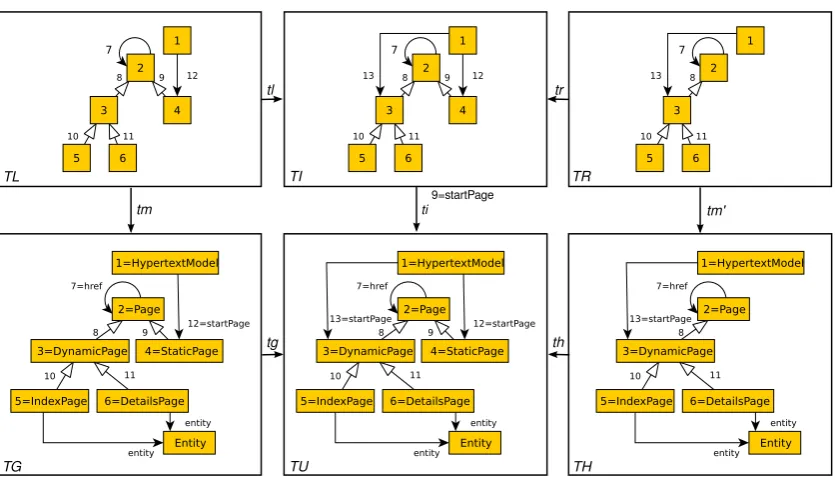
In Figure 6, a co-span graph transformation is shown describing the meta-model evolution
step fromFigure 2atoFigure 3using injective rule morphisms i.e. tlandtrare injective. Note
that morphismstm,ti andtm0 are always injective since we consider injective matchings only.
Mappings are indicated by numbers. Furthermore, all morphisms run between AIGraphs i.e.
attributed, typed graphs with node type inheritance (compare categoryAIGraphsin [HEE09]).
The co-span graph transformation inFigure 6shows how classStaticPageas well as reference
startPagein the SWAL meta-model are deleted and a new referencestartPageis created. This
is done in two steps: First, a second referencestartPageis created in the meta-model (seeTU).
Formally, this is done by a pushout construction. Second, the former referencestartPageand
classStaticPageare deleted from the meta-model (seeT H). This is done by subtractingT I−T R
fromTU. Formally, we construct a second pushout by its complement which results in a unique
graphT H(up to isomorphism) for the case of co-span transformation rules (see [EEPT06]). Note
that the additional subclasses with mapping 5 and 6 in the rule ofFigure 6are needed since the
formalization requires an AIGraph morphism to be “subtype”-reflective [HEE09]. In addition,
we add a further class and another reference to the rule to match classPageand referencehref
since we need to consider the full context ofStaticPageduring instance migrations. Since we
context elements, additional context elements are needed here, this solution for type restructuring is not convincing.
tl TI tr TL TR 9=startPage ti tm tm' tg TH th TU TG 1=HypertextModel 2=Page 3=DynamicPage 4=StaticPage Entity 5=IndexPage 6=DetailsPage entity 12=startPage 7=href 8 13=startPage 9 11 10 entity 2 4 3 5 6 9 11 10 8 1 13 12 7 1=HypertextModel 2=Page 3=DynamicPage 4=StaticPage Entity 5=IndexPage 6=DetailsPage entity 12=startPage 7=href 8 9 11 10 entity 2 4 3 5 6 9 11 10 8 1 12 7 1=HypertextModel 2=Page 3=DynamicPage Entity 5=IndexPage 6=DetailsPage entity 7=href 8 13=startPage 11 10 entity 2 3 5 6 11 10 8 1 13 7
Figure 6: Evolution co-span transformationDelete sub-class and create reference
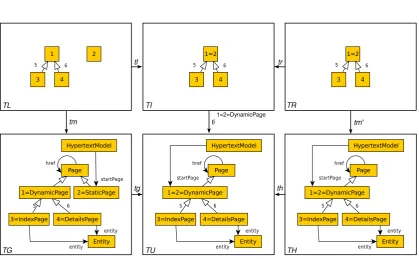
Figure 7 shows the new version of the meta-model evolution “Merge class”. The evolution
rule is more compact since the context of the classStaticPagee.g. referencestartPage, does not
need to be considered by the rule. The merge is achieved by the non-injective morphismstland
tg. The morphismsthandtrin the right pushout are identity morphisms i.e. nothing is deleted
here. Note that the outgoing inheritance arrows from classes DynamicPage and StaticPage
are also merged. This merge of inheritance arrows results from the property of the used category
AIGraphs(see [HEE09]). Using this revised approach, instance elements only need to be retyped
and we do not need to consider their context during the migration.
InFigure 8a model migration for the new meta-model evolution operation “Merge class” is
shown. The migration rule can be deduced in a similar way as discussed in [TML12a]. This
means by implementing a migration strategy that respects the formal properties as discussed in Proposition 1. The model migration (shown inFigure 8) basically does nothing except that class
SearchAddress is retyped. Retyping in the instance graph is performed in the first pushout.
Hence the graphs in the middle and the right side of the rule are the same. To save space we
do not show these graphs inFigure 8 twice. If we had no retyping facilities available, page
SearchAddresswould have to be recreated with the new typeDynamicPage. In addition, its
context references have to be recreated. Note that the corresponding migration rule would have
to be a classical graph transformation rule, while the rule inFigure 8is not: There, graphs are
not changed but only their typing morphisms. The migration rule contains two pages not being
changed. These are included since we derivedLby pullback, a construction that ensures that all
Figure 7: Evolution co-span transformationMerge class
together form a co-transformation.
Figure 8: Migration co-span transformationMerge class
In the following, we will prove that a match-complete co-transformation always exists.
Theorem 1(existence of match-complete co-transformation) In any (weak) adhesive HLR
cat-egory: given a co-span graph transformation tt:T Gt p=⇒,tmT H (describing the evolution of type
graph T G, seeFigure 5) and a graph G typed by T G with typing morphism tG:G→T G then
there exists a co-span graph transformation t:G=p⇒,m H (describing a corresponding model
1. migration rule p is deletion-reflecting wrt. evolution rule t p
2. (tt,t)forms a match-complete co-transformation
Proof.
• First, we show that, given an evolution transformationtt:T Gt p=⇒,tmT H with evolution rule t pand matchtm: T L→T G, we can always construct a deletion-reflecting migration rule p that is match-complete applicable to a given graphGwith type graphT G: A match-complete left-hand-sideLof migration rule pcan be deduced by lettingG←−m L−→tL T Lbe a pullback
of G−→tG T G←−tm T L. Sincetm is a M-morphism such a pullback always exists (see
Re-mark 1 in the appendix). The rest of the rule we get by constructing a commutative square usingl=id,I=LandtI=tl◦tLin the left back face, as well as a pullbackI
r
←−R−→tR T R of co-spanI−→tI T I←−tr T Rin the right back face. Note that we only need the left back face to be commuting, it does not need to be a pullback as required in [TML12a].
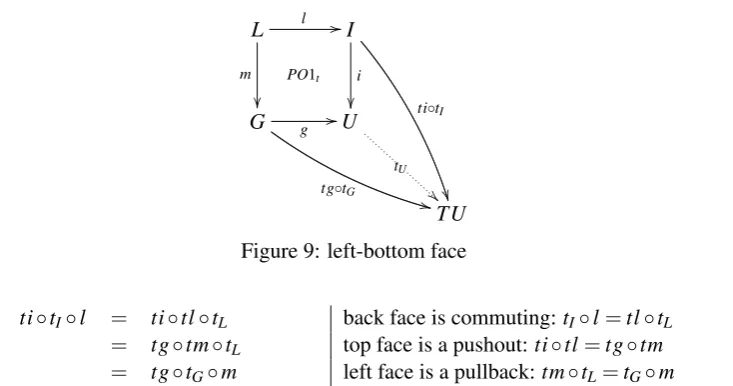
• Second, we show that the migration rulepis applicable so that(tt,t)forms a co-transformation. We now consider theleft cubeofFigure 5. PushoutPO1t of ruletcan be directly constructed,
however we have to show that there is a morphismtU:U→TU such that the cube commutes.
This we get by the pushout property ofPO1t (seeFigure 9):
L l //
m
PO1t I
i
ti◦tI
G g //
tg◦tG
+
+
U
tU
TU
Figure 9: left-bottom face
ti◦tI◦l = ti◦tl◦tL back face is commuting:tI◦l=tl◦tL = tg◦tm◦tL top face is a pushout:ti◦tl=tg◦tm = tg◦tG◦m left face is a pullback:tm◦tL=tG◦m
Due to the universal property of PO1t, there exists a unique morphism tU wrt. tg◦tG and
ti◦tI such that the front and the right faces of the left cube commute. Note the existence of
PO1t is ensured by properties of (weak) adhesive categories (seeRemark 1in the appendix):
pushouts along M-morphisms always exist and morphism m∈M sincetm∈M andM -morphisms are stable under pullback and the left face of the cube is a pullback.
get that the top face of the cube is also a pullback. Furthermore, we know thatm∈M (see above). This means that the bottom face is also a pullback since it is also a pushout along an
M-morphism. In addition, we know thattiandiareM-morphisms becausetm andm are
M-morphisms andM-morphisms are also stable under pushout in weak adhesive categories (see Remark 1in the appendix). Now considerFigure 10: we can compose the left (1) and the top face (2) of the left cube inFigure 5to a pullback (1+2). By special pushout-pullback decomposition (seeFigure 11andTheorem 2in the appendix) we get that the right face (4) of the left cube is a pullback since (3) is a pushout andm,i,ti∈M.
L tL //
(1)
m
T L tl //
(2)
tm T I ti G t G /
/T G
tg //TU
Figure 10: left face and top face of the left cube inFigure 5
L l //
(3)
m
I tI //
(4)
i T I ti
G g //U t
U
/
/TU
Figure 11: bottom face and right face of the left cube inFigure 5
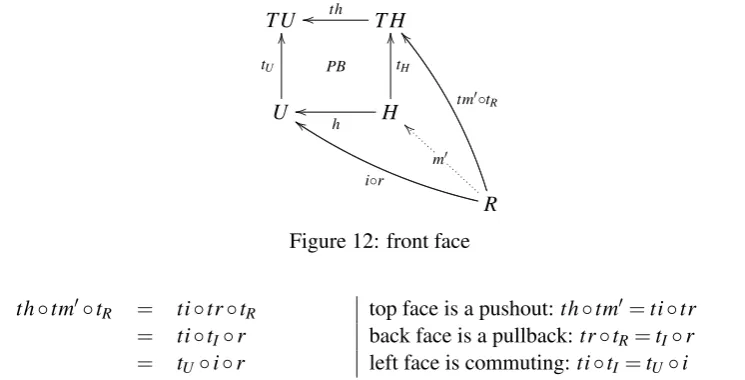
Now, we consider theright cubeofFigure 5and show that we can construct this cube with a pushout in the bottom face. The front face of the cube can be directly constructed as pullback of co-spanU −→tU TU ←−th T H. It remains to show that a morphismm0: R→H exists such that the cube commutes and the bottom face is a pushout. The existence of an unique m0 is shown by the pullback property (seeFigure 12) of the front face:
TU PB T H th o o U tU O O H h o o tH O O R
tm0◦tR
\
\
i◦r
d
d
m0
`
`
Figure 12: front face
th◦tm0◦tR = ti◦tr◦tR top face is a pushout:th◦tm0=ti◦tr = ti◦tI◦r back face is a pullback:tr◦tR=tI◦r = tU◦i◦r left face is commuting:ti◦tI=tU◦i
Note that the left face2 of the right cube commutes as shown above. This means it exists an unique m0 wrt. tm0◦tR andi◦r due to the universal property of pullbacks, moreover the
right face and hence the whole cube commutes.
It remains to show that the bottom face of the right cube is a pushout (PO2t). This follows by
the (weak) van Kampen property of the category. tr∈M by assumption, hence, the top face of the right cube is a pushout alonganM-morphism and therefore also a pullback. Because
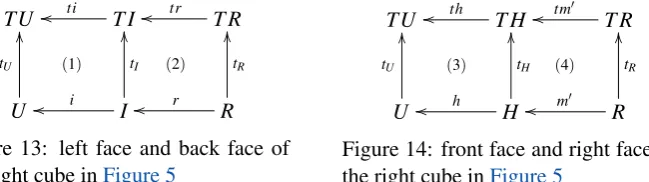
M-morphisms are also stable under pullback (seeRemark 1) andti∈M (see above) we get tm0∈M. Hence, the top face of the cube is a pushout alongtwoM-morphisms. Since the back and the front face of the cube are pullbacks by construction and we also showed that the left face of the cube is a pullback, we only need to show that the right face of the cube is also a pullback to apply the van Kampen property. ConsiderFigure 13, we know that we can compose the left (1) and back (2) face of the right cube inFigure 5to a pullback (1+2) by pullback composition. By pullback decomposition (seeFigure 14) follows that the right face (4) of the right cube inFigure 5is also a pullback since the front face (3) is pullback. Hence the bottom face is a pushout by the van Kampen property.
TU
(1) T I
ti
o
o
(2) T R tr o o U tU O O I i o o tI O O R r o o tR O O
Figure 13: left face and back face of the right cube inFigure 5
TU
(3) T H
th
o
o
(4) T R tm0 o o U tU O O H h o o tH O O R m0 o o tR O O
Figure 14: front face and right face of the right cube inFigure 5
Note that the evolution and migration given in the example inSection 3form a match-complete, deletion-reflecting co-transformation. SeeFigure 7together withFigure 8.
Corollary 1(unique typing of co-transformation) Given a deletion-reflecting co-transformation
rule(t p,p)with an applicable and complete match(tm,m): the migration t is uniquely typed by
evolution tt (up to isomorphism), i.e. tUand tHare uniquely determined (seeFigure 5).
Proof. The typing morphisms of the left face and the back faces of the cube inFigure 5are given,
moreover the double cube commutes as shown inTheorem 1. Furthermore it has been already shown in the proof ofTheorem 1that the right cube inFigure 5fulfills the van Kampen property. Hence the right front face of the cube inFigure 5is a pullback. It remains to prove thattU and
tH are unique. The uniqueness oftH follows directly from the fact thatU h
←−H−→tH T H is a pullback. However,tH is only unique with respect to morphismth:T H→TU and morphism
tU:U→TU. The uniqueness of morphismtU follows by the fact that the left cube is
commut-ing and by the universal pushout property of the bottom facePO1t (seeFigure 9and proof of
Theorem 1).
5
Related Work
5.1 Comparison to database schema evolution
However, the challenge of schema evolution differs slightly from meta-model evolution with model migration for various reasons. To mention a few: (1) While models usually are held in the main memory, database tables often cannot. Hence schema evolution is often considered on the level of implementation focusing on the efficiency of the migration. (2) Data should be retrieved from databases via queries. This means that the structure of stored information has to be considered when formulating a query, but the query response is one joint relation even con-taining duplicate entries. Hence, research considering schema evolution is often concerned with the relation between database queries and database schemes [CMHZ09, CMDZ10]. In MDE, structural information usually has to be reflected in generated artifacts. (3) The basic constraints of relational databases are only a few, i.e. primary key constraint, foreign key constraint and typing [CMDZ10]. In modeling, different constraints may be needed e.g., to specify business rules. (4) In relational models, retyping of tuples ( i.e. tables) is slightly different since there is no concept of inheritance. However, merging of types has been also considered in database schema evolution. For example in [Br´e96, PK97], list operators for the merging of types in object-oriented databases are presented. The mentioned approaches provide basic merge op-erators based on textual implementation descriptions using retyping, creation, and deletion of elements. In object-oriented database schema evolution, merging of types is considered on the level of set theory [AP03]. Furthermore, merging of types has also been considered in the con-text of relational databases [CMHZ09] and ontology evolution [NK04]. (5) Only two layers are considered in database schema evolution i.e., the schema definition and the actual tables with data entries, while modeling hierarchies may have several layers. Our formalization is stepwise applicable to more than two layers.
5.2 Related work to co-evolution of models and meta-models
Recently, research activities have started to consider meta-model evolution and to investigate the transfer of schema evolution concepts to meta-model evolution (see e.g. [HBJ09]). Her-rmannsdoerfer et al. provide an overview of approaches in [HVW10] that considers the coupled evolution of meta-models and models. In particular, the model migration challenge has been studied. Several approaches to (partially) automate the tedious and error-prone process of model evolution have been proposed. Generally, our work differs from other work on model co-evolution in the sense that we focus on formal criteria rather than tool development. Our focus is a formal framework supporting the specification of meta-model evolutions and related model mi-grations that guarantee modeling language consistency. In [RHW+10], co-evolution approaches are classified intometa-model matching, manual specification and operator-basedapproaches. In the following, we consider related work wrt. these approaches.
Meta-model differencing and the automatic detection of meta-model evolution operations has been considered by e.g. Ciccetti et al. in [CDEP08] and is also in the focus of the Atlas Matching Language (AML) [RHW+10]. Considering current modeling frameworks however, the detection of inter-related changes is a topic of on-going research [RKPP10,KKT11]. I.e. fully satisfying solutions are not yet available.
In [CDEP08,RHW+10], a predefined set of meta-model evolution operations can be detected. In both approaches, a migration script is generated using the textual model transformation lan-guage ATL (Atlas Transformation Lanlan-guage) [Atl]. If a meta-model change does not correspond to a pre-defined operation, a new matching strategy and a new migration definition have to be implemented. The customization of model migration scripts has to be done on the level of such ATL scripts. There are no formal criteria ensuring that migration scripts are consistently defined wrt. the meta-model evolutions detected. Furthermore, it is also not ensured that a migration is complete, e.g. covers the whole model, as in our approach. Merging of model elements is not supported by ATL and hence has to be simulated by “create” and “delete” change actions.
The tool EMFMigrate [Mig] is currently under development picking up ideas from [CDEP08]. It also aims at migrating other depending artifacts such as ATL transformations. EMFMigrate employs out-place transformations for migration. Migration rules can be assembled to reusable libraries as well as customized by overriding or refinement. However, there is no support to check that migration rules are defined consistently to a meta-model change. To the best knowledge of the authors, merging of elements is not natively supported and has to be implemented by “create” and “delete” change actions.
Manual specification approaches like [SK04,RKPP10] follow a different idea. Instead of de-tecting semantic changes, these approaches migrate models by copying as much as possible from a previous model version to a new one, according to the types of the evolved meta-model. Ele-ments are automatically copied if they have not changed or have compatibly changed types. New elements in the meta-model are basically not considered during model migration and have to be taken into account in manual migration scripts. In such approaches, well-typed migration results are ensured trivially by performing out-place transformations that create instances of evolved meta-models only. In-place transformations have the advantage that model elements may not be “forgotten” during model migrations but have to deal with the fact that all model elements need to be migrated. Our formalization abstracts from in-place and out-place transformations i.e., can be used as formal basis for both.
Rose et al. presents their tool Epsilon Flock in [RKPP10]. It offers also a manual specification approach that targets to the migration of models only. In contrast to MCL, textual migration scripts have to be written in Epsilon Flock. Similarly to MCL, rules for unchanged or slightly changed meta-model elements do not need to be defined. Such model elements are automatically copied to a new model conforming to the new meta-model if they pass a conformance test. In contrast to our formal framework, Epsilon Flock rules are not type checked. If a migration script is not valid according to the typing morphism, elements may be forgotten without any warning. Reuse of migration knowledge is supported by locally defined migration functions only. Flock does not support merging of model elements, however retyping of model elements by recreating them with a different type is supported.
Operator-based approaches evolve meta-models using pre-defined operators. The evolution history is tracked as a sequence of changes. Usually, a library of coupled evolution-migration operators is supported, similarly to database schema migration (see e.g. [HBJ09, CMHZ09]). Hence, traced changes are automatically bound to migration procedures. However, researchers in MDE realized that a fixed set of reusable coupled evolution-migration operations is not enough for model co-evolution [HBJ09]. Therefore, current approaches allow to extend model migration transformations by manually written code using a general purpose or transformation language.
In this paper, we propose a formalization fitting to an operator-based approach that supports the coupled evolution of meta-models and models where each coupled operator is given by two re-lated graph transformations. However, such operators may also be used in a meta-model match-ing approach if a sequence of applied meta-model evolution rules can be derived.
Cope/Edapt [HBJ09] is a meta-model evolution tool for EMF that have been used in industrial projects. As in our formal framework, Cope allows the coupled evolution of meta-models and models by operators. Coupled operations are implemented according to a textual specification in Groovy/Java. The tool provides a rich library of useful coupled operators which can be applied if the required preconditions are satisfied. If an evolution operation is missing or the migration is not the desired one, the migration operation has to be implemented in Groovy/Java without any support to ensure well-defined migration rules. Merging of types is partly supported by predefined operators that implements merging by “create” and “delete” actions. However, a real merge operation is not supported. Edapt supports in-place transformations. Even though the tool implements an operator-based approach, it can also be used in a meta-model matching manner.
5.3 Formal approaches to model co-evolution
trans-formations specified by a given set of MCL rules. MCL transtrans-formations always terminate but are not always confluent. However, confluence is decidable in MCL. In our framework we deduce each migration step from a meta-model evolution step, hence our migrations trivially terminate.
To the best of our knowledge, merging of types and related retyping of instances have not been considered in the context of algebraic graph transformations before.
6
Conclusion
After having introduced co-span co-transformations that allow creation and deletion of elements in type and instance graphs, this approach is extended by co-evolution rules that allow to specify also merging of types with corresponding retyping and optionally merging of model elements. By applying this extension to model co-evolution, meta-model evolutions as well as model mi-grations can be specified easier since the merging of elements does not have to be emulated by creation and deletion actions but is supported in a natural way. InTheorem 1we show that it is always possible to construct a match-complete and deletion-reflecting co-transformation for a given type graph evolution and an instance graph. In addition, we relaxed the conditions for such a construction so that we have more freedom when we define or derive migration rules. Corollary 1states that the application of a deletion-reflecting co-transformation always results in a unique typing.
The usefulness of a merge operation has been motivated by discussing change patterns that are easier formulated with merging. In addition, a running example has been presented which shows a typical co-evolution case where merging of types is useful. Basic change actions on (meta-)model elements arerenaming, creating,deleting,merging, andsplittingas well as four different retype change actions. We support all these change actions in our formalization except of splitting, subtyping, and supertyping. It is up to future work to extend our formalization to these remaining change actions. One approach to support element splitting can be to switch from the (co-span) DPO approach to the (co-span) Sesqui-Pushout approach [CHHK06].
While the presented formalization considers co-transformations on a theoretical level, provid-ing criteria for consistent model migrations, we plan to develop suitable tools in future. Further-more, we also plan to take meta-model constraints into account.
Bibliography
[AP03] R. Alhajj, F. Polat. Rule-based schema evolution in object-oriented databases.
Knowledge-Based Systems16(1):47–57, 2003.
DOI10.1016/S0950-7051(02)00051-5
[Atl] Atlas Transformation Language. User Guide. http://wiki.eclipse.org/ATL/User Guide.
[BCW12] M. Brambilla, J. Cabot, M. Wimmer.Model-Driven Software Engineering in Prac-tice. Synthesis Lectures on Software Engineering. Morgan & Claypool Publishers, 2012.
[Br´e96] P. Br´eche. Advanced Primitives for Changing Schemas of Object Databases. In Con-stantopoulos et al. (eds.), CAiSE 1996: Proceedings of the 8th International Con-ference on Advanced Information Systems Engineering. Lecture Notes in Computer Science 1080, pp. 476–495. May 1996.
DOI10.1007/3-540-61292-0˙26
[BW95] M. Barr, C. Wells.Category Theory for Computing Science (2nd Edition). Prentice
Hall, 1995.
[CDEP08] A. Cicchetti, D. Di Ruscio, R. Eramo, A. Pierantonio. Automating Co-evolution in Model-Driven Engineering. InProceedings of EDOC 2008: 12thInternational IEEE Enterprise Distributed Object Computing Conference. Pp. 222–231. IEEE Computer Society, 2008.
DOI10.1109/EDOC.2008.44
[CHHK06] A. Corradini, T. Heindel, F. Hermann, B. K¨onig. Sesqui-Pushout Rewriting. In Corradini et al. (eds.), Proceedings of ICGT 2006: 3nd International Conference on Graph Transformations. Lecture Notes in Computer Science 4178, pp. 30–45. Springer, September 2006.
DOI10.1007/11841883˙4
[CMDZ10] C. Curino, H. J. Moon, A. Deutsch, C. Zaniolo. Update Rewriting and Integrity Con-straint Maintenance in a Schema Evolution Support System: PRISM++.Proceedings
of VLDB 2010: 36thInternational Conference on Very Large Database Endowment
4(2):117–128, 2010.
[CMHZ09] C. Curino, H. J. Moon, M. Ham, C. Zaniolo. The PRISM Workwench: Database Schema Evolution without Tears. In Ioannidis et al. (eds.), Proceedings of ICDE
1999: 25thInternational Conference on Data Engineering. Pp. 1523–1526.
Proceed-ings of ICDE 1999: 25thInternational Conference on Data Engineering, 2009.
[EEPT06] H. Ehrig, K. Ehrig, U. Prange, G. Taentzer.Fundamentals of Algebraic Graph Trans-formation. Springer, March 2006.
DOI10.1007/3-540-31188-2
[EHP09] H. Ehrig, F. Hermann, U. Prange. Cospan DPO Approach: An Alternative for DPO Graph Transformation.EATCS Bulletin98:139–149, 2009.
http://tfs.cs.tu-berlin.de/publikationen/Papers09/EHP09.pdf
[Erm06] C. Ermel.Simulation and Animation of Visual Languages based on Typed Algebraic Graph Transformation. PhD thesis, Fakult¨at IV (Elektrotechnik und Informatik), Technische Universit¨at Berlin, Germany, July 2006.
[HBJ09] M. Herrmannsdoerfer, S. Benz, E. J¨urgens. COPE - Automating Coupled Evolu-tion of Metamodels and Models. In Drossopoulou (ed.), Proceedings of ECOOP
2009: 23rd European Conference on Object-Oriented Programming. Lecture Notes
in Computer Science 5653, pp. 52–76. Springer, 2009. DOI10.1007/978-3-642-03013-0˙4
[HEE09] F. Hermann, H. Ehrig, C. Ermel. Transformation of Type Graphs with Inheritance for Ensuring Security in E-Government Networks. InFundamental Approaches to Software Engineering, 12th Int. Conference, FASE 2009. Lecture Notes in Computer Science 5503, pp. 325–339. Springer, 2009. Long version as TR 2008-07 at TU Berlin.
[HVW10] M. Herrmannsdoerfer, S. Vermolen, G. Wachsmuth. An Extensive Catalog of Oper-ators for the Coupled Evolution of Metamodels and Models. In Malloy et al. (eds.),
Proceedings of SLE 2010: 3rd International Conference on Software Language
En-gineering. Lecture Notes in Computer Science 6563, pp. 163–182. Springer, 2010. DOI10.1007/978-3-642-19440-5˙10
[JB06] F. Jouault, J. B´ezivin. KM3: A DSL for Metamodel Specification. In Gorrieri and Wehrheim (eds.),Proceedings of FMOODS 2006: 8th International Conference on Formal Methods for Open Object-Based Distributed Systems. Lecture Notes in Com-puter Science 4037, pp. 171–185. Springer, June 2006.
DOI10.1007/11768869˙14
[KKT11] T. Kehrer, U. Kelter, G. Taentzer. A rule-based approach to the semantic lifting of model differences in the context of model versioning. InASE 2011, Lawrence, KS, USA, November 6-10, 2011. IEEE, 2011.
[KLS11] H. K¨onig, M. L¨owe, C. Schulz. Model Transformation and Induced Instance Migra-tion: A Universal Framework. In Silva Sim˜ao and Morgan (eds.), Proceedings of
SBMF 2011: 14thBrazilian Symposium on Formal Methods, Foundations and
Appli-cations. Lecture Notes in Computer Science 7021, pp. 1–15. Springer, 2011. DOI10.1007/978-3-642-25032-3˙1
[L¨am01] R. L¨ammel. Grammar Adaptation. In Oliveira and Zave (eds.),Proceedings of FME
2001: Formal Methods for Increasing Software Productivity: 1st International
Symposium of Formal Methods Europe. Lecture Notes in Computer Science 2021, pp. 550–570. Springer, 2001.
DOI10.1007/3-540-45251-6˙32
[LBN+13] T. Levendovszky, D. Balasubramanian, A. Narayanan, F. Shi, C. Buskirk, G. Karsai. A semi-formal description of migrating domain-specific models with evolving do-mains.Software and Systems Modeling, pp. 1–17, January 2013.
DOI10.1007/s10270-012-0313-5
[LS04] S. Lack, P. Sobocinski. Adhesive Categories. In Walukiewicz (ed.), Proceedings of
FoSSaCS 2004: 7th Foundations of Software Science and Computation Structures.
Lecture Notes in Computer Science 2987, pp. 273–288. 2004. DOI10.1007/978-3-540-24727-2˙20
[Mig] E. Migrate. Project Web Site.http://www.emfmigrate.org.
[MTL12] F. Mantz, G. Taentzer, Y. Lamo. Co-Transformation of Type and Instance Graphs Supporting Merging of Types with Retyping: Long Version. Techni-cal report, Department of Mathematics and Computer Science, University of Marburg, Germany, September 2012. http://www.uni-marburg.de/fb12/forschung/ berichte/berichteinformtk.
[NK04] N. F. Noy, M. C. A. Klein. Ontology Evolution: Not the Same as Schema Evolution.
Knowledge-Based Systems6(4):428–440, 2004.
[Obj] Object Management Group. Web site.http://www.omg.org.
[Obj06] Object Management Group. Meta-Object Facility Specification. January 2006.http: //www.omg.org/spec/MOF/2.0/.
[PJ07] M. Pizka, E. Juergens. Automating Language Evolution. InTASE ’07: Proceedings of the First Joint IEEE/IFIP Symposium on Theoretical Aspects of Software Engi-neering. Pp. 305–315. IEEE Computer Society, Washington, DC, USA, 2007. DOI10.1109/TASE.2007.13
[PK97] A. Pons, R. K. Keller. Schema Evolution in Object Databases by Catalogs. InIDEAS
1997: Proceedings of the 1st International Database Engineering and Applications
Symposium. Pp. 368–378. IEEE Computer Society, August 1997.
[RHW+10] L. Rose, M. Herrmannsdoerfer, J. R. Williams, D. Kolovos, K. Garc´es, R. F. Paige, F. A. C. Polack. A Comparison of Model Migration Tools. In Petriu et al. (eds.),
Proceedings of MoDELS 2010: 13thInternational Conference on Model Driven
En-gineering Languages and Systems. Lecture Notes in Computer Science 6394, pp. 61– 75. Springer, 2010.
DOI10.1007/978-3-642-16145-2˙5
[RKPP10] L. Rose, D. Kolovos, R. F. Paige, F. A. C. Polack. Model Migration with Epsilon Flock. In Tratt and Gogolla (eds.), Proceedings of ICMT 2010: 3rd International Conference on Theory and Practice of Model Transformation. Lecture Notes in Com-puter Science 6142, pp. 184–198. Springer, 2010.
DOI10.1007/978-3-642-13688-7˙13
[SRVK10] J. Sprinkle, B. Rumpe, H. Vangheluwe, G. Karsai. Metamodelling - State of the Art and Research Challenges. InModel-Based Engineering of Embedded Real-Time Systems. Lecture Notes in Computer Science 6100, pp. 57–76. Springer, 2010.
[TML12a] G. Taentzer, F. Mantz, Y. Lamo. Co-Transformation of Graphs and Type Graphs With Application to Model Co-Evolution. In Ehrig et al. (eds.),Proceedings of ICGT
2012: 6nd International Conference on Graph Transformations. Lecture Notes in
Computer Science 7562, pp. 326–340. Springer, 2012.
[TML12b] G. Taentzer, F. Mantz, Y. Lamo. Co-Transformation of Graphs and Type Graphs with Application to Model Co-Evolution: Long Version. Technical report, Dep. of Mathematics and Computer Science, University of Marburg, Germany, 2012. http: //www.uni-marburg.de/fb12/forschung/berichte/berichteinformtk.
Appendix
Definition 8(Pushout complement)
Leta:A→Bandb:B→Dbe two morphisms, morphismsc: A→C andd:C→Dare called apushout complementofaandbifbanddare the pushout ofaandc.
B b //D
A c //
a
O
O
C
d
O
O
Definition 9(Pullback complement)
Leta:A→Bandb:B→Dbe two morphisms, morphismsc: A→C andd:C→Dare called apullback complementofaandbifaandcare the pullback ofbandd.
B b //D
A c //
a
O
O
C
d
O
O
Definition 10(Initial pushout) Given a morphism f: A→A0 in a (weak) adhesive HLR cat-egory, a morphismb: B→Awithb∈M is called theboundary over f if there is a pushout complement of f andbsuch that (1) is a pushout which is initially over f. Initially of (1) over f means, that for every pushout (2) withb0∈M there exist unique morphismsb∗:B→Dand c∗:C→Ewithb∗,c∗∈M such thatb0◦b∗=b,c0◦c∗=cand (3) is a pushout. B is then called the boundary objectandandCthe context wrt f.
B b //
(1)
A
f
C c //A0
B b∗ //
b
$
$
(3)
D b0 //
(2)
A
f
C c∗ //
c
9
9
E c0 //A0
n f m g D C A B
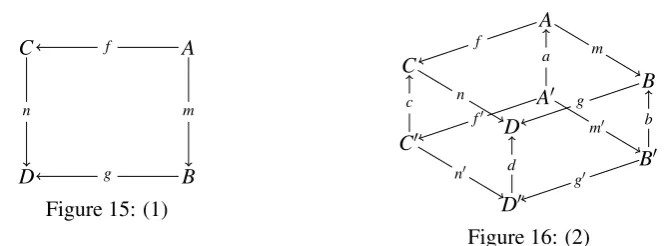
Figure 15: (1)
d c a b n0 f0 m0 g0 D0 C0 A0 B0 n f m g D C A B
Figure 16: (2)
For graph transformations (weak) Adhesive High-Level Replacement (HLR) categories are considered as suitable framework. Therefore we recall the definition of Adhesive HLR category from [EEPT06]:
Definition 12(Adhesive HLR category) A categoryCwith a morphism classM is called an adhesive HLR category if:
1. M is a class of monomorphisms closed under isomorphisms, composition (f:A→B∈M, g:B→C∈M ⇒g◦f ∈M), and decomposition (g◦f ∈M,g∈M ⇒ f∈M).
2. C has pushouts and pullbacks along M-morphisms, and M-morphisms are closed under pushouts and pullbacks.
3. Pushouts inCalongM-morphisms are VK squares.
Remark1
1. Recall Remark 4.10 from [EEPT06]: A pushoutalonganM-morphism is a pushout where
at least one of the given morphisms is inM. Pushouts are closed underM-morphisms if, for
a given pushout (1) (seeFigure 15),m∈M implies thatn∈M. Analogously, pullbacks are
closed underM-morphisms if, for a pullback (1),n∈M implies thatm∈M.
2. Weak adhesive HLR categories are adhesive HLR categories where the third condition is
replaced by a stricter one:
3. Pushouts inCalongM-morphisms are weak VK squares, i.e. the VK square property
holds for all commutative cubes withm∈M and f ∈M orb,c,d∈M.
3. Note that already in weak adhesive HLR categories pushouts alongone M-morphism are
pullbacks (compare Theorem 4.26 in [EEPT06]). This means if f ∈M or m∈M in
Fig-ure 16the pushout is also a pullback.
Theorem 2(Special pushout/pullback composition and decomposition)
Given the commutative diagram to the right with square (1)
being a pushout and square (1+2) being a pullback, and f1,
f2, f3 being monomorphisms. Then, squares (1) and (2) are
pullbacks.
A1
g1 //
(1)
f1
A2
g2 //
(2)
f2 A3 f3
B1 h
1
/
/B2 h
2
/
/B3