ARTIGO ORIGINAL
RESUMO
Introdução: A qualidade de vida é uma medida importante de avaliação de resultados em saúde. Embora a otite média seja uma das doenças mais comuns na infância, o seu impacto na qualidade de vida das crianças portuguesas não é conhecido. O objetivo deste estudo é determinar a qualidade de vida das crianças portuguesas com otite média crónica com efusão e/ou otite média aguda recorrente e o impacto a curto-prazo da colocação de tubos de ventilação transtimpânicos, utilizando a versão portuguesa do questionário OM-6, um instrumento válido, confiável e sensível para avaliar a qualidade de vida relacionada com saúde em crianças com otite média.
Material e Métodos: Este estudo foi realizado num hospital de nível terciário, para onde as crianças são referenciadas a partir dos cuidados de saúde primários e da consulta de pediatria hospitalar. O questionário OM-6 foi administrado em crianças com otite média crónica com efusão e/ou otite média aguda recorrente. O instrumento foi readministrado aos dois meses de pós-operatório a um grupo de crianças submetidas a colocação de tubos de ventilação transtimpânicos, para avaliar a alteração da qualidade de vida com o procedimento cirúrgico.
Resultados: O estudo envolveu uma amostra de 169 crianças, com idades entre os 6 meses e os 12 anos (média: 4,20 ± 2,05 anos). A pontuação média no questionário foi de 3,3 ± 1,47, num máximo de 7 (pior qualidade de vida). Os domínios ‘preocupações do cuidador’, ‘perda auditiva’ e ‘sofrimento físico’ apresentaram as pontuações mais elevadas. O domínio ‘perda auditiva’ correlacionou-se com o domínio ‘alterações da fala’ (rs = 0,41; p < 0,001) e o domínio ‘sofrimento físico’ correlacionou-se com o domínio ‘limitação da atividade’ (rs = 0,47; p < 0,001). Observou-se correlação entre a pontuação no domínio ‘perda auditiva’ e a presença de hipoacusia de condução (χ2 (6) = 24,662; p = 0,022). Crianças com otite média crónica com efusão apresentaram pontuação mais baixa no domínio ‘sofrimento físico’, ao passo que crianças com otite média aguda recorrente apresentaram pontuação mais baixa no domínio ‘perda auditiva’ e pontuação mais alta no domínio ‘sofrimento emocional’. Registou-se uma melhoria da qualidade vida em todas as dimensões estudadas pelo questionário após o procedimento cirúrgico. A melhoria foi considerada grande em 55%, moderada em 15% e pequena em 10% dos casos. A presença de otorreia no pós-operatório não mostrou comprometer a melhoria da qualidade de
Quality of Life of Children with Otitis Media and Impact
of Insertion of Transtympanic Ventilation Tubes in a
Portuguese Population
Qualidade de Vida das Crianças com Otite Média
e Impacto da Colocação de Tubos de Ventilação
Transtimpânicos numa População Portuguesa
1. Serviço de Otorrinolaringologia. Hospital de Egas Moniz. Centro Hospitalar de Lisboa Ocidental. Lisboa. Portugal. 2. Departamento de Anatomia. Nova Medical School. Universidade Nova de Lisboa. Lisboa. Portugal.
3. Departamento de Otorrinolaringologia. Nova Medical School. Universidade Nova de Lisboa. Lisboa. Portugal.
Autor correspondente: Ana Rita Lameiras. [email protected]
Recebido: 18 de julho de 2017 - Aceite: 12 de dezembro de 2017 | Copyright © Ordem dos Médicos 2018
Ana Rita LAMEIRAS1, Deodato SILVA1, Assunção O’NEILL2,3, Pedro ESCADA1,3
Acta Med Port 2018 Jan;31(1):30-37 ▪ https://doi.org/10.20344/amp.9457 ABSTRACT
Introduction: Quality of life is an important measure for health-outcome evaluation. Although otitis media is one of the most common childhood diseases, its impact on Portuguese children’s quality of life is unknown. The aim of this study is to determine the quality of life of Portuguese children with chronic otitis media with effusion and/or recurrent acute otitis media and the short-term impact of transtympanic ventilation tubes, using the Portuguese version of the OM-6 questionnaire, a valid, reliable and sensitive instrument to evaluate the health-related quality of life in children with otitis media.
Material and Methods: This study was conducted in a tertiary referral center, to where children are referred from primary care and hospital pediatric consultations. The Portuguese version of the OM-6 questionnaire was applied to children with chronic otitis media with effusion and/or recurrent acute otitis media. The instrument was re-administered at two months postoperatively to a group of children who underwent tympanostomy tube placement, to evaluate the change in quality of life with the surgical procedure.
Results: The study involved a sample of 169 children, aged between 6 months and 12 years (mean: 4.20 ± 2.05 years). The average score in the survey was 3.3 ± 1.47, of a maximum of 7 (worst quality of life). The domains ‘caregiver concerns’, ‘hearing loss’ and ‘physical suffering’ had the highest scores. The domain ‘hearing loss’ was correlated with the domain ‘speech impairment’ (rs = 0.41; p < 0.001) and the domain ‘physical suffering’ correlated with the domain ‘activity limitation’ (rs = 0.47; p < 0.001). There was a correlation between the score on ‘hearing loss’ and the presence of conduction hearing loss (χ2 (6) = 24.662; p = 0.022). Children with chronic otitis media with effusion had lower scores on the domain ‘physical suffering’, while children with recurrent acute otitis media had lower scores in the domain ‘hearing loss’ and higher scores in the domain ‘emotional distress’. There was an improvement in the quality of life in all the dimensions studied by the questionnaire after surgery. The improvement was large in 55%, moderate in 15% and small in 10% of the cases. The presence of otorrhea postoperatively did not decrease the quality of life improvement achieved with surgery.
Conclusion: Otitis media has a negative impact on Portuguese children quality of life. Tympanostomy tubes improve quality of life related to the middle ear in most children. The application of validated disease-specific questionnaires allows an enhanced understanding of the impact of otitis media on Portuguese children quality of life and of the success of therapeutic measures.
ARTIGO ORIGINAL INTRODUCTION
Health-related quality of life is a multidimensional con-cept and domains related to physical symptoms, functional capacity and the psycho-social impact of illness are in-volved in its measurement. Quality of life has been increas-ingly recognized in medical research as an important meas-ure for the assessment of health outcomes1 and improved healthcare is the aim of the measurement in childhood. Otitis media (OM) is a common occurrence in childhood and one of the major causes for medical examination in pre-school age.2 The development of disease-specific in-struments has allowed for the assessment of the impact of OM on children’s quality of life.3 Even though OM has been considered as an important cause for caregivers concern regarding other populations, as well as an association be-tween OM and health-related quality of life,4-7 its impact on Portuguese children’s quality of life is still unknown. Tympanostomy tube insertion is one of the most wide-spread surgical approaches to children with OM.8 Great im-provement in the quality of life of these patients has been described in previous studies on tympanostomy tube inser-tion.3,9,10 However, no studies have yet been published on the systematic assessment of the subjective impact of this surgical approach in the Portuguese paediatric population. This study aimed at the identification of the quality of life in Portuguese children with OM and the short-term impact of tympanostomy tube insertion.
MATERIAL AND METHODS
This was a prospective and longitudinal study carried out at the Department of Ear, Nose and Throat (ENT) Sur-gery of the Hospital de Egas Moniz, Centro Hospitalar de Lisboa Ocidental, E.P.E. and was approved by the Ethics Committee of the institution, in accordance with the Helsinki Declaration.
The Portuguese version of the OM-6 questionnaire, a valid, reliable and sensitive instrument for measuring health-related quality of life in children with OM, has been used for measuring ear-related quality of life.11 The OM-6 questionnaire was developed by Rosenfeld et al. (1997)3 and is the most widely used for measuring health-related quality of life in children with OM, aimed at children aged 6 months to 12 years with chronic otitis media with effu-sion (COME) (≥ 3 months) or recurrent acute otitis media (RAOM) (≥ 3 episodes over the past 12 months). The ques-tionnaire has to be completed by the patient’s caregiver and six domains regarding middle-ear infection or effusion are involved: physical suffering, hearing loss, speech impair-ment, emotional distress, activity limitations and caregiver concerns. OM impact on patient’s quality of life during the past four weeks is estimated by the questionnaire and each
domain is represented by questions on relevant symptoms and scores range from 1 - 7 (1 – no problem; 7 – extreme problem). Final score is obtained by taking the mean of the six domain scores and range from 1.0 - 7.0. The higher the final score the poorer the OM-related quality of life. A change score was obtained by subtracting the final score obtained from the questionnaire that was postop-eratively applied (follow-up score) from the final score ob-tained from the one that was preoperatively applied (base-line score) (base(base-line score – follow-up score). The change score allowed for measuring the response to a certain ther-apy within a four-week minimal interval. A negative change score corresponded to a clinical worsening and a positive to a clinical improvement. Intervals of change score were defined, aimed at measuring the level of change produced with a specific procedure: < 0.5 - trivial; 0.5 – 0.9 – mild; 1.0 – 1.4 - moderate; ≥ 1.5 – large change.
The OM-6 questionnaire was applied to a group of chil-dren attending the Department of ENT referred both from primary healthcare and paediatrics outpatient clinic. In-clusion criteria included (i) children aged 6 months to 12 years (ii) presenting with COME (≥ 3 months) or RAOM (≥ 3 episodes over the past 12 months), (iii) with a Portuguese speaking caregiver (European Portuguese). Exclusion cri-teria included the presence of (i) ruptured eardrum; (ii) tym-panostomy tubes in situ at study onset; (iii) other middle-ear pathology (cholesteatoma, for instance); (iv) developmental impairment or neurological pathology; (v) syndromic dis-ease or cleft palate; (vi) caregiver unable to read and/or un-derstand the Portuguese language (European Portuguese). Children with a history of tympanostomy tube insertion were not excluded from the study.
The questionnaire was re-applied at two months post-operatively (follow-up score) to a group of children with an indication for tympanostomy tube insertion, aimed at meas-uring any change in quality of life with surgery. The ques-tionnaire was self-administered and completed by caregiv-ers throughout the study. Follow-up and baseline scores were obtained from the same caregiver in all cases. Data regarding middle ear pathology and demographic data were obtained: age, gender, diagnosis (COME; RAOM; chronic otitis media with effusion and concomitant recurrent acute otitis media), results of tympanometry, presence of conductive hearing loss in pure-tone audiometry (air con-duction isolated threshold elevation, with air-bone gap ≥ 15 dB), history of tympanostomy tube insertion associated to postoperative otorrhoea.
Data were entered into an Excel® spreadsheet and Sta-tistical Package for The Social Sciences® (SPSS) version 21.0 software for Windows® has been used for the statistical vida obtida com o procedimento cirúrgico.
Conclusão: A otite média tem um impacto negativo na qualidade de vida das crianças portuguesas. A colocação de tubos de ventilação transtimpânicos melhora a qualidade de vida na maioria das crianças. A aplicação de questionários validados doença-específicos permite uma melhor compreensão do impacto que a otite média apresenta na qualidade de vida das crianças portuguesas e do sucesso do tratamento.
ARTIGO ORIGINAL analysis. Spearman’s correlation coefficient has been used for the identification of a correlation between each of the OM-6 different domains and between patient’s age and the likeli-hood of any perceived caregiver concerns regarding child’s hearing loss. Chi-square association test has been used for the identification of a relationship (i) between diagno-sis and the final score obtained from the OM-6 question-naire, (ii) between diagnosis and the scores obtained from the different domains of the questionnaire and (iii) between the score obtained in ‘hearing loss’ domain and the pres-ence of conductive hearing loss in pure-tone audiogram. Paired samples Student’s t-test was used for the analysis of the difference between final scores obtained pre (base-line) and post-operatively (follow-up score). Non-parametric Wilcoxon two-sample test was used for the analysis of the difference between the scores obtained within the different domains of the OM-6 questionnaire on the two moments of the assessment. Pearson’s correlation coefficient was used for the identification of a correlation between patient’s age and change score with the OM-6 questionnaire. Chi-square association test was used for the identification of a rela-tionship between change score and diagnosis, presence of conductive hearing loss and presence of post-operative otorrhoea, respectively. A 5% level of statistical significance has been considered.
RESULTS
A convenience sample of 169 patients and caregiv-ers was involved in the study, with patient’s age ranging 6 months to 12 years (M = 4.20; SD = 2.05), with a slight male predominance (53.3%; n = 90). Only 13.6% (n = 23) of the patients had a history of previous tympanostomy tube inser-tion.
COME was the most frequent diagnosis found (73.4% of the patients; n = 124), followed by recurrent acute oti-tis media concomitantly with chronic otioti-tis media with effu-sion (16.0%; n = 27) and isolated RAOM (10.7%; n = 18). Most patients with COME presented with a bilateral disease (92.7%; n = 140).
Tympanometry was carried out in 53.8% (n = 91) of the
patients and was more frequently requested for children diagnosed with COME (78.0%; n = 71) and with recurrent acute otitis media concomitantly with chronic otitis media with effusion (14.3%; n = 13). A type B tympanogram was obtained in 83.3% of these patients (n = 70) and type C in 16.7% (n = 14). A type A tympanogram was found in 57.1% (n = 4) of the patients with isolated RAOM and type C in 42.9% (n = 3). Pure-tone audiometry was carried out in 30.2% (n = 51) of the patients, 74.5% of whom presented with conductive hearing loss (n = 38).
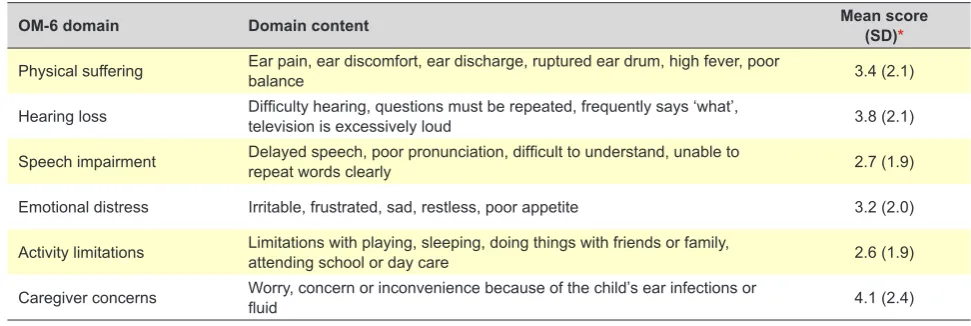
A mean 3.3 final score was obtained (SD = 1.47), for a maximum seven-point score (poorest quality of life). The highest scores were obtained in ‘caregiver concerns’, ‘hear-ing loss’ and ‘physical suffer‘hear-ing’ domains, followed by ‘emo-tional distress’, ‘speech impairment’ and ‘activity limitations’ (Table 1). At least some concern regarding patient’s middle-ear infection or effusion was described by 57.4% of caregiv-ers and great concern by 40.8%. Moderate concern regard-ing hearregard-ing loss and physical sufferregard-ing were perceived by 58.6% and 49.1% of caregivers, respectively. Minimal con-cern regarding emotional distress and speech impairment were perceived by 58.0% and 43.8% of caregivers, respec-tively. At least minimal concern regarding patient’s activity limitations was perceived by 39.6% of caregivers, while this was not described as a concern by 50.3% (Table 2) of car-egivers.
A statistically moderate correlation was found between ‘hearing loss’ and ‘speech impairment’ domains (rs = 0.41; p < 0.001), as well as between ‘physical suffering’ and activ-ity limitations’ domains (rs = 0.47; p < 0.001). Positive and statistically significant correlation has been found between ‘caregiver concerns’ domain and all the remaining domains, with Spearman’s correlation coefficients ranging between rs = 0.21, p = 0.006 (‘speech impairment’) and rs = 0.66; p <
0.001 (‘physical suffering’).
An association between the score from ‘hearing loss’ domain and the presence of conductive hearing loss in pure-tone audiogram (χ2 (6) = 24.662; p = 0.022) has been found. Positive and moderate statistically significant corre-lation has been found between patient’s age and ‘hearing loss’ domain score (rs = 0.43; p < 0.001), showing that the
Table 1 – Mean score obtained from each domain of the Portuguese version of the OM-6 questionnaire (n = 169)
OM-6 domain Domain content Mean score (SD)*
Physical suffering Ear pain, ear discomfort, ear discharge, ruptured ear drum, high fever, poor balance 3.4 (2.1)
Hearing loss Difficulty hearing, questions must be repeated, frequently says ‘what’, television is excessively loud 3.8 (2.1)
Speech impairment Delayed speech, poor pronunciation, difficult to understand, unable to repeat words clearly 2.7 (1.9)
Emotional distress Irritable, frustrated, sad, restless, poor appetite 3.2 (2.0)
Activity limitations Limitations with playing, sleeping, doing things with friends or family, attending school or day care 2.6 (1.9)
Caregiver concerns Worry, concern or inconvenience because of the child’s ear infections or fluid 4.1 (2.4)
ARTIGO ORIGINAL
older the patient the higher the likelihood of the caregiver describing a concern regarding child’s hearing loss. A statistically significant correlation between the final score obtained from the OM-6 questionnaire and patient’s diagnosis has been found (χ2 (12) = 23.318; p = 0.025). Children with RAOM showed higher scores with the OM-6 questionnaire, reflecting poorer ear-related quality of life, when compared to those presenting with COME.
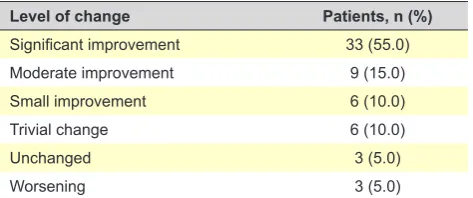
An association between diagnosis and the scores in the following domains of the OM-6 questionnaire has been found: ‘physical suffering’ (χ2 (12) = 27.154; p = 0.007), ‘hearing loss’ (χ2 (12) = 21.320; p = 0.046) and ‘emotion-al distress’ (χ2 (12) = 24.662; p = 0.017). A lower score in ‘physical suffering’ domain has been found in children with COME, while a lower score in ‘hearing loss’ and higher in ‘emotional distress’ were found in children with RAOM. In total, 152 children in our group underwent tympanos-tomy tube insertion (89.9% of the patients). Response to recommended medical treatment for COME and/or RAOM was found in the remaining patients, with a positive out-come. Surgery was mostly associated with adenoidectomy (92.1%; n = 140). The indication for adenoidectomy in chil-dren under the age of 4 included the presence of nasal ob-struction or chronic adenoiditis. The procedure revision was carried out in patients having already undergone adenoid-ectomy, whenever in the presence of adenoid hypertrophy. The questionnaire was re-applied two months postop-eratively to 60 caregivers for measuring any surgery-related change in patient’s quality of life. Data regarding 29 male (48.3%) and 31 female (51.7%) patients aged 1-12 years (M = 3.82; SD = 2.11) were obtained. All the patients pre-sented with unblocked tympanostomy tubes in situ. Statistically significant differences between final base-line scores and follow-up scores have been found (t (59) = 10.104; p < 0.001). A 1.70 mean overall change score has been found (variation range: -0.7 to 4.3; SD = 1.30), corresponding to a significant improvement in postopera-tive ear-related quality of life. Overall, most patients (55.0%) presented with a significant improvement in their quality of life. Only 5% (n = 3) of the patients presented with poorer quality of life, all of these with a mild clinical worsening (Ta-ble 3).
Statistically significant differences were found between the two assessment moments (baseline and follow-up) regarding the scores obtained from OM-6 questionnaire
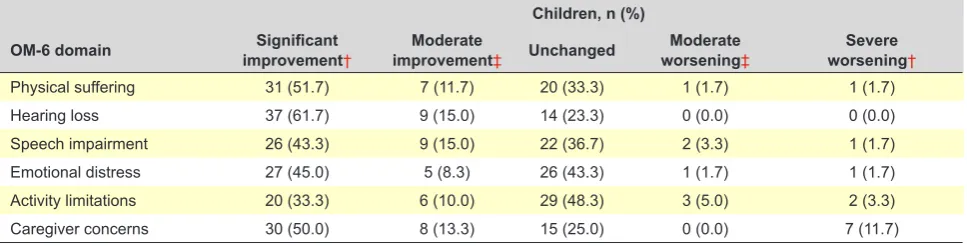
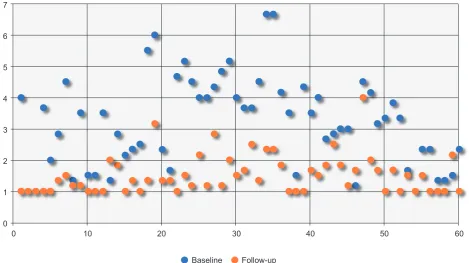
domains, with p-value < 0.001 (Table 4). The results have shown an improved mean postoperative ear-related qual-ity of life in all the dimensions of the OM-6 questionnaire. A significant improvement in quality of life has been found regarding ‘hearing loss’, ‘caregiver concerns’ and ‘emo-tional distress’ domains, with the following mean change scores: ‘hearing loss’ 2.4 (SD = 1.96); ‘caregiver concerns’ 2.0 (SD = 2.69); ‘physical suffering’ 1.9 (SD = 2.04); ‘emo-tional distress’ 1.5 (SD = 1.74). A moderate improvement in quality of life has been found in ‘speech impairment’ and ‘activity limitations’, with the following mean change scores: ‘speech impairment’ 1.3 (SD = 1.60); ‘activity limitations’ 1.1 (SD = 1.89). Poorer postoperative quality of life has been found in 0-11.7% of the patients regarding all the domains (Table 5, Fig. 1).
Over the study period, 25.0% (n = 15) of the patients having undergone tympanostomy tube insertion presented with postoperative otorrhoea and an association between this and change score has been found (χ2 (4) = 11.600; p = 0.021). The results have shown that the presence of postoperative otorrhoea had no impact on the improve-ment in patient’s quality of life obtained with tympanostomy tube insertion. No association has been found between the change score and patient’s age, diagnosis or the presence of conductive hearing loss, respectively.
DISCUSSION
Most studies on the measurement of the impact of OM are based on objective measures regarding the middle ear. The relevance of health-related quality of life has been in-creasingly recognized in medical research on OM.3 The measurement of the quality of life is even more relevant Table 2 – Level of awareness regarding the domains of the Portuguese version of the OM-6 questionnaire (n = 169)
Level of awareness during the past 4 weeks, n (%)
OM-6 domain Absent Hardly Minimal Moderate Significant High Very high
Physical suffering 58 (34.3) 12 (7.1) 16 (9.5) 24 (14.2) 19 (11.2) 27 (16.0) 13 (7.7) Hearing loss 42 (24.9) 10 (5.9) 18 (10.7) 28 (16.6) 26 (15.4) 27 (16.0) 18 (10.7) Speech impairment 75 (44.4) 20 (11.8) 22 (13.0) 15 (8.9) 15 (8.9) 15 (8.9) 7 (4.1) Emotional distress 57 (33.7) 14 (8.3) 25 (14.8) 25 (14.8) 20 (11.8) 16 (9.5) 12 (7.1) Activity limitations 85 (50.3) 17 (10.1) 13 (7.7) 20 (11.8) 15 (8.9) 11 (6.5) 8 (4.7) Caregiver concerns 45 (26.6) 16 (9.5) 11 (6.5) 18 (10.7) 10 (5.9) 27 (16.0) 42 (24.9)
Table 3 – Change in overall quality of life upon tympanostomy tube insertion (n = 60)
Level of change Patients, n (%)
Significant improvement 33 (55.0)
Moderate improvement 9 (15.0)
Small improvement 6 (10.0)
Trivial change 6 (10.0)
Unchanged 3 (5.0)
Worsening 3 (5.0)
ARTIGO ORIGINAL
regarding decision-making as well as therapy response considering the frequently found dissociation between mid-dle ear status and the measurement of quality of life.11 In fact, otitis media with effusion is frequently associated to scarce symptoms, even though the patient presents with obvious middle-ear signs. In addition, children with RAOM may present with normal middle ear while in remission and with a significant impact on the quality of life mainly related to clinical recurrence. Therefore, a combined use of objec-tive measures of the middle ear status and measurement of the quality of life allows for a better understanding on the impact of the disease and subsequently for improved healthcare.
OM is one of the most common diseases in childhood, with a relevant impact on health-related quality of life.4-7 This is the first study on the measurement of the impact of OM on the quality of life of Portuguese children and long-term outcome of tympanostomy tube insertion by using a dis-ease-specific instrument which was validated for European Portuguese language.11
OM has shown a negative impact on the quality of life of Portuguese children and has been considered as an im-portant cause for caregiver concerns. Physical suffering and caregiver concerns were two of the three most affected domains in children with OM, in line with previous stud-ies.3,7,9,10,12 A correlation has been found between caregiver concerns and all the other domains of the quality of life that were measured with the questionnaire. Previous
stud-ies have shown a correlation between total score in OM-6 questionnaire and the impact of OM on caregiver’s quality of life.6
COME is usually associated to a 25-30 dB conductive hearing loss.13 An association has been found in our study between the score obtained from ‘hearing loss’ domain and the presence of conductive hearing loss in pure-tone au-diogram. However, studies that have used this question-naire have shown a weak correlation between hearing loss awareness and audiology testing results.3,12,14 In addition, our results have shown that the older the child the higher the likelihood of caregiver concerns related to patient’s hearing loss. In fact, in earlier stages of its development, hearing loss may become difficult for caregivers to be aware of. Therefore, even though hearing awareness by caregivers is crucial for the identification of the quality of life in children with OM, it should always be supplemented with an audiol-ogy assessment.
Children with RAOM presented with higher mean scores with the OM-6 questionnaire, corresponding to a poorer quality of life, when compared to children with COME. Low-est scores in ‘hearing loss’ domain and highLow-est in ‘emotional distress’ domains were found in children with RAOM, while children with COME presented with the lowest scores ob-tained from the ‘physical suffering’ domain. In fact, COME is associated to the presence of discharge to the middle ear and no signs or symptoms of infection, even though it may lead to long-term complications, such as hearing loss and Table 4 – Difference between baseline and follow-up scores (n = 60)
Baseline Follow-up
OM-6 domain M SD M SD W
Physical suffering 3.30 2.03 1.37 0.86 -5.927***
Hearing loss 3.78 2.03 1.43 0.96 -5.933***
Speech impairment 2.83 1.85 1.52 1.16 -4.977***
Emotional distress 2.97 2.05 1.52 1.02 -4.872***
Activity limitations 2.45 1.88 1.32 0.65 -4.049***
Caregiver concerns 3.93 2.44 1.92 1.59 -4.563***
M SD M SD t
Final score 3.21 1.44 1.51 0.62 10.104***
*** p ≤ 0,001
Table 5 – Change in quality of life per domain upon tympanostomy tube insertion (n = 60)
Children, n (%)
OM-6 domain improvement†Significant improvement‡Moderate Unchanged worsening‡Moderate worsening†Severe
Physical suffering 31 (51.7) 7 (11.7) 20 (33.3) 1 (1.7) 1 (1.7)
Hearing loss 37 (61.7) 9 (15.0) 14 (23.3) 0 (0.0) 0 (0.0)
Speech impairment 26 (43.3) 9 (15.0) 22 (36.7) 2 (3.3) 1 (1.7)
Emotional distress 27 (45.0) 5 (8.3) 26 (43.3) 1 (1.7) 1 (1.7)
Activity limitations 20 (33.3) 6 (10.0) 29 (48.3) 3 (5.0) 2 (3.3)
Caregiver concerns 30 (50.0) 8 (13.3) 15 (25.0) 0 (0.0) 7 (11.7)
ARTIGO ORIGINAL
impaired language development.15,16 In addition, acute otitis media clinically presents with otalgia, fever, general malaise and otorrhoea17,18 and the recurrence of these symptoms, more than its severity, is associated to the impact on the quality of life of children with RAOM.7
A correlation between the scores in clinically-related do-mains has been shown by the results. A correlation between ‘hearing loss’ and ‘speech impairment’ has been found, which may be explained by the association between the presence of long-term hearing loss and delayed and/or im-paired language development.19 A correlation has been also found between ‘physical suffering’ and ‘activity limitations’, possibly due to the fact that an inability for the practice of normal activities is frequently found in children, including school or nursery attendance.
Improved short-term quality of life in Portuguese chil-dren with OM has been shown by the treatment with tympa-nostomy tube insertion, regarding all the domains that were assessed with the questionnaire and most patients have shown a significant improvement, in line with other stud-ies.9,11 However, our results were not aimed at explaining the general use of tympanostomy tube insertion, rather at understanding the impact of this surgery on the quality of life, whenever applied in patients with an indication for sur-gery.20
A slightly lower improvement in postoperative quality of life has been found in ‘speech impairment’ and ‘activity limi-tations’, when compared to the improvement found in the remaining domains of the questionnaire. A lower change in caregiver concerns was found in the ‘speech impairment’ domain, in line with the study by Rosenfeld et al. (2000).9 Even though our results regarded a short-term
measure-ment, other authors did not find any positive effect on lan-guage development of tympanostomy tubes 6 and 9 months postoperatively.21,22
A lower improvement in quality of life was found in ‘ac-tivity limitations’, which may have been due to the frequent recommendation by physicians regarding the prevention from water entering the ear canal, which is usually asso-ciated to a certain level of limitation or interruption in the practice of water activities. This has traditionally been rec-ommended to children with ventilation tubes by most ENT physicians,23 even though recent studies have shown that this recommendation is not usually required.24-27 Apart from not producing any significant medical benefit, preventing exposure to water may be considered as socially inconven-ient. Therefore, preventing from exposure to water is not in-cluded into current medical recommendations and it should be only recommended in patients presenting with active episodes of otorrhoea, recurrent or long-standing otorrhoea or with a history of problems with any previous exposure to water.20
Postoperative otorrhoea has been found in 25% of our patients, which is in line with literature in which a 26% mean incidence of otorrhoea (range, 4-68%) has been found.28 Most patients present with a sporadic, brief and moderately symptomatic otorrhoea,29 which may explain the fact that its occurrence is not associated to any significant impact on the quality of life obtained with the use of tympanostomy tubes.
Some limitations have been identified in our study, in-cluding the fact that a response-shift bias could not have been ruled out. Different studies have described that pre-treatment health-related quality of life is overestimated by Figure 1 – Distribution chart of final baseline and follow-up scores (n = 60)
0 0 1 2 3 4 5 7
6
10 20 30 40 50 60
ARTIGO ORIGINAL patient caregivers (response shift). Postoperatively, caregiv-ers perceived that pre-treatment quality of life was lower to what they have previously identified, due to the compari-son between child’s clinical status before and upon surgery (scale recalibration).12 However, no impact has been shown on the estimated improvement in quality of life that was ob-tained with surgery.
Short-term results have been obtained, preventing from ruling out the impact on the quality of life of any subsequent adverse event or complication associated to tympanostomy tube insertion. However, complications are rare, miringo-sclerosis being the most frequent. This is not associated to any clear functional impairment (hearing loss < 0.5 dB) and therefore this should not limit the surgery approach when-ever there is an indication for it.30,31
In addition, even though a postoperative improvement has been found in 90% of the patients regarding ear-relat-ed quality of life, a possible placebo effect associatear-relat-ed to surgery or influenced by the natural history of the disease could not have been entirely ruled out.32
CONCLUSION
OM has a negative impact on the quality of life in Por-tuguese children and is an important cause for caregiver concerns. Improved quality of life has been found in most children with OM with the use of tympanostomy tube inser-tion.
The application of validated disease-specific question-naires allowed for a better understanding on the impact of
the disease and therapy outcomes, with subsequently im-proved healthcare.
OBSERVATIONS
Part of the study was presented as a free communica-tion to the 64th Congresso da Sociedade Portuguesa de Otorrinolaringologia e Cirurgia Cérvico-Facial, held on the 7 May 2017 in Viana do Castelo and was awarded the 3th SPORL de Otologia, Otoneurologia e Cirurgia da Base do Crânio prize.
HUMAN AND ANIMAL PROTECTION
The authors declare that the followed procedures were according to regulations established by the Ethics and Clini-cal Research Committee and according to the Helsinki Dec-laration of the World Medical Association.
DATA CONFIDENTIALITY
The authors declare that they have followed the proto-cols of their work centre on the publication of patient data.
CONFLICTS OF INTEREST
The authors declare that there were no conflicts of inter-est in writing this manuscript.
FINANCIAL SUPPORT
The authors declare that there was no financial support in writing this manuscript.
REFERENCES
1. Guyatt GH, Feeny DH, Patrick DL. Measuring health-related quality of life. Ann Intern Med. 1993;118:622-9.
2. Speets A, Wolleswinkel J, Cardoso C. Societal costs and burden of otitis media in Portugal. J Multidiscip Healthc. 2011;4:53-62.
3. Rosenfeld RM, Goldsmith AJ, Tetlus L, Balzano A. Quality of life for children with otitis media. Arch Otolaryngol Head Neck Surg. 1997;123:1049-54.
4. Brouwer CN, Maillé AR, Rovers MM, Grobbee DE, Sanders EA, Schilder AG. Health-related quality of life in children with otitis media. Int J Pediatr Otorhinolaryngol. 2005;69:1031-41.
5. Grindler DJ, Blank SJ, Schulz KA, Witsell DL, Lieu JE. Impact of otitis media severity on children’s quality of life. Otolaryngol Head Neck Surg. 2014;151:333-40.
6. Blank SJ, Grindler DJ, Schulz KA, Witsell DL, Lieu JE. Caregiver quality of life is related to severity of otitis media in children. Otolaryngol Head Neck Surg. 2014;151:348-53.
7. Lee J, Witsell DL, Dolor RJ, Stinnett S, Hannley M. Quality of life of patients with otitis media and caregivers: a multicenter study. Laryngoscope. 2006;116:1798-804.
8. Schilder AG, Marom T, Bhutta MF, Casselbrant ML, Coates H, Gisselsson-Solén M, et al. Panel 7: otitis media: treatment and complications. Otolaryngol Head Neck Surg. 2017;156:S88-105. 9. Rosenfeld RM, Bhaya MH, Bower CM, Brookhouser PE, Casselbrant
ML, Chan KH, et al. Impact of tympanostomy tubes on child quality of life. Arch Otolaryngol Head Neck Surg. 2000;126:585-92.
10. Richards M, Giannoni C. Quality-of-life outcomes after surgical intervention for otitis media. Arch Otolaryngol Head Neck Surg. 2002;128:776-82.
11. Lameiras AR, Silva D, O´Neill A, Escada P. Validation of the otitis media-6 questionnaire for European Portuguese. Acta Med Port. 2017;30:381-7. 12. Timmerman AA, Anteunis LJ, Meesters CM. Response-shift bias
and parent-reported quality of life in children with otitis media. Arch Otolaryngol Head Neck Surg. 2003;129:987-91.
13. Fria TJ, Cantekin EI, Eichler JA. Hearing acuity of children with otitis media with effusion. Arch Otolaryngol. 1985;111:10-6.
14. Escada P. A capacidade de previsão, por parte dos familiares, da acuidade auditiva das crianças com otite média [Tese de Mestrado]. Lisboa: Faculdade de Ciências Médicas, Universidade Nova de Lisboa; 2002.
15. Paradise JL. Otitis media and child development: should we worry? Pediatr Infect Dis J. 1998;17:1076-83.
16. Paradise JL, Dollaghan CA, Campbell TF, Feldman HM, Bernard BS, Colborn DK, et al. Language, speech sound production, and cognition in three-year-old children in relation to otitis media in their first three years of life. Pediatrics. 2000;105:1119-30.
17. Heikkinen T, Ruuskanen O. Signs and symptoms predicting acute otitis media. Arch Pediatr Adolesc Med. 1995;149:26-9.
18. Kontiokari T, Koivunen P, Niemelä M, Pokka T, Uhari M. Symptoms of acute otitis media. Pediatr Infect Dis J. 1998;17:676-9.
19. Nittrouer S, Burton LT. The role of early language experience in the development of speech perception and phonological processing abilities: evidence from 5-year-olds with histories of otitis media with effusion and low socioeconomic status. J Commun Disord. 2005;38:29-63.
20. Rosenfeld RM, Schwartz SR, Pynnonen MA, Tunkel DE, Hussey HM, Fichera JS, et al. Clinical practice guideline: tympanostomy tubes in children. Otolaryngol Head Neck Surg. 2013;149:S1-35.
21. Berkman ND, Wallace IF, Steiner MJ, Harrison M, Greenblatt AM, Lohr KN, et al. Otitis media with effusion: comparative effectiveness of treatments. Rockville: Agency for Healthcare Research and Quality; 2013. AHRQ Publication No. 13-EHC091-EF
22. Paradise JL, Feldman HM, Campbell TF, Dollaghan CA, Colborn DK, Bernard BS, et al. Effect of early or delayed insertion of tympanostomy tubes for persistent otitis media on developmental outcomes at the age of three years. N Engl J Med. 2001;344:1179-87.
ARTIGO ORIGINAL tympanostomy tubes. AM J Otolaryngol. 1992;13:301-5.
24. Goldstein NA, Mandel EM, Kurs-Lasky M, Rockette HE, Casselbrant ML. Water precautions and tympanostomy tubes: a randomized, controlled trial. Laryngoscope. 2005;115:324-30.
25. Lee D, Youk A, Goldstein NA. A meta-analysis of swimming and water precautions. Laryngoscope. 1999;109:536-40.
26. Carbonell R, Ruiz-Garcia V. Ventilation tubes after surgery for otitis media with effusion or acute otitis media and swimming: systematic review and meta-analysis. Int J Pediatr Otorhinolaryngol. 2002;66:281-9.
27. Giannoni C. Swimming with tympanostomy tubes. Arch Otolaryngol Head Neck Surg. 2000;126:1507-8.
28. Rovers MM, Black N, Browning GG, Maw R, Zielhuis GA, Haggard MP. Grommets in otitis media with effusion: an individual patient data meta-analysis. Arch Dis Child. 2005;90:480-5.
29. Kay DJ, Nelson M, Rosenfeld RM. Meta-analysis of tympanostomy tube sequelae. Otolaryngol Head Neck Surg. 2001;124:374-80.
30. Tos M, Stangerup SE. Hearing loss in tympanosclerosis caused by grommets. Arch Otolaryngol Head Neck Surg. 1989;115:931-5. 31. Barati B, Hashemi SM, Golianian Tabrizi A. Otological findings ten
years after myringotomy with tympanostomy tube insertion. Iran J Otorhinolaryngol. 2012;24:181-6.