Original Research Article
A comparative study of smartphone based app with free field hearing
for possible use as a screening test
Himanshu Swami
1*, Aditya Bhargava
1, Sabarigirish K.
2, Arvind B. M.
1INTRODUCTION
Hearing loss is a common problem as 15% of worldwide population suffers from it. Out of this, one third have a disabling hearing loss which is described as more than 30 dB hearing loss in better ear in children and more than 40 dB hearing loss in better ear in adults. This problem increases with age; approximately 1.5% of children, 7% of population over 15 years and one-third above 65 years suffer from disabling hearing loss.1 According to a United States government report, the prevalence of hearing loss in US Army is 10.1% inspite of maintaining an excellent hearing conservation programme.2 One of the important
strategies in hearing conservation is early detection. Early detection can be carried out either by carrying out pure tone audiometry or performing Free Field Hearing Test. Testing the ‗Free Field Hearing‘ (FFH) is the primary assessment tool for hearing screening as it is considered quick and cheap. However, we need to reconsider utilizing FFH as primary means of testing hearing because it is a subjective test with poor predictive value. It lacks reproducibility, accuracy and a standard technique.3 The ‗Gold standard‘ for hearing assessment is pure tone audiometry (PTA). However, the equipment is costly; moreover it requires trained manpower and expensive infrastructure to conduct the test. In view of
ABSTRACT
Background: Hearing loss is an invisible injury that has been viewed as an acceptable by-product of military service.
It is imperative to detect hearing loss at early stage to take immediate remedial measures. In Indian armed forces the current method of assessment of hearing is primarily by Free Field Hearing which is obsolete and has numerous shortcomings. We contucted a study using free iOS application to detect hearing loss. The objectives of the study were to investigate the validity and reproducibility of app based hearing assement and free field hearing with clinical pure tone audiometer as gold standard. It is cross sectional intra-subject comparative study
Methods: The study was conducted at CHAF where 200 patients were accrued. Hearing assessment was carried out
by Pure Tone Audiometry (PTA) which is gold standard. Thereafter these patients were subjected to hearing assessment by using windows application ―freehearingtestsoftware.com‖ and by free field hearing (FFH).
Results: Hearing assessment by FFH and hearing check app was compared with PTA. Hearing check app was found
to be more sensitive than FFH (98% and 73%). Both modalities had high specificity (95% and 99%). The test retest reproducibility measured with Pearson correlation coefficient was high (0.99) with hearing check app.
Conclusions: Smart phone application like Hearing check app is a cheap and effective way to assess hearing with reasonable accuracy. It‘s high sensitivity and high test retest reproducibility makes it an ideal tool for screening and early detection of hearing loss replacing out-dated free field hearing.
Keywords: Hearing screening, Smart phone application
Department of ENT, 1Command Hospital Airforce, Bangalore, Karnataka, 2Army Hospital R&R, Delhi, India
Received: 15 May 2017
Revised: 06 June 2017
Accepted: 09 June 2017
*Correspondence:
Dr. Himanshu Swami,
E-mail: [email protected]
Copyright: © the author(s), publisher and licensee Medip Academy. This is an open-access article distributed under
the terms of the Creative Commons Attribution Non-Commercial License, which permits unrestricted non-commercial use, distribution, and reproduction in any medium, provided the original work is properly cited.
this we tested the accuracy and reproducibility of smart phone app based hearing assessment with objective of finding a quick, cheap and reliable method of hearing screening. The objective of the study was to investigate the validity and reproducibility of app based hearing assement and free field hearing with clinical pure tone audiometer as gold standard. It is cross sectional intrasubject comparative study.
METHODS
The objective of the study was (a) to find a screening tool for early detection of hearing loss which is accurate, reproducible and cheaper than PTA, (b) to validate the accuracy of new technique for hearing screening and (c) to validate the accuracy of FFH itself. In the second part of study, the reproducibility of the tests was assessed.
This was a prospective intra-subject comparative study to report diagnostic accuracy hearing screening test.
To perform the study, we conducted a search for smart phone applications available on the internet for hearing screening. After a consensus in the department, a smart phone hearing application based on windows platform was selected. The app was downloaded from website‖ freehearingtestsoftware.com‖ and is free for use. It is a self-explanatory diagnostic hearing test. The test can be performed offline once the software is down loaded. A normal insert headphone, Samsung® model- EHS61 was used for the test. The first step is to adjust the volume as close to silent when the amplitude displayed is at 1% and comfortably loud at 100%. The ear to be tested is selected. We selected the range of frequencies from 500 Hz to 4000 Hz in incremental steps of 500 Hz. The test is performed from low to high frequency by default. The results were stored in tabulated as well as graphic form.
The aim was to validate the accuracy and reproducibility of this application and compare it with FFH keeping pure tone audiometry as gold standard. Thus, the index tests were FFH and windows based smart phone application. The gold standard test was pure tone audiometry.
Medcalc® statistical software was used to analyse the data.
Validity tests
The selected sample size was 200 patients. These patients were selected consecutively in the ENT outpatient department, sent for evaluation of hearing by pure tone audiometry, in a tertiary care center. These patients were subjected to a hearing assessment after taking consent. The process was explained to 552 patients whereas the consent was given by 200 patients. Out of these, 84 patients had normal hearing, 84 had bilateral hearing loss and 32 had unilateral hearing loss. The total number of ears assessed was 400. All of them belonged to the age
group between 17 years to 65 years. The number of male patients was 152 and 48 were females.
These patients were subjected to hearing assessment by three different assessors blinded to each other, using the following:
1. Pure tone audiometry: A GSI 38 audiometer was used to conduct audiometry by a qualified audiologist. It was carried out in a standard audiometry room fulfilling BS EN ISO standards. 2. Windows application test: The equipment comprised
of laptop used in the department for carrying out audiometry with standard insert earphones. The test was carried out in outpatient department room and not in audiometry room so as to simulate environment where audiometry facility is not available.
3. Free field hearing (FFH): FFH was carried out in a quiet room at a distance of 600 cms. Bi-syllable standard words were used by assessors. 3 correct responses out of 5 was deemed as normal hearing
The criterion for abnormal hearing was predefined for the study as follows:
1. Pure tone audiometry: Average air conduction thresholds at 500Hz, 1000Hz, 2000Hz, 3000Hz more than 20 dB.
2. Windows application: Average air conduction thresholds at 500Hz, 1000Hz, 2000Hz, 3000Hz more than 20 dB.
3. Free field hearing: Patient not able to hear Conversational Voice and forced whisper at a distance less than 600 cm.
The data was compiled by author after receiving evaluation reports by all the assessors.
Reproducibility test
Randomly, 15 patients were chosen to conduct reproducibility test. Out of these, 8 patients had hearing loss and 7 had normal hearing. Free Field Hearing and assessment of hearing by using smart phone application was carried out. The tests were repeated after two days and tested for reproducibility using Pearson correlation coefficient.
To test the diagnostic accuracy, we selected 200 consecutive patients attending ENT outpatient department and subjected them to hearing assessment by pure tone audiometry, free field hearing and smartphone application.
was higher at 0.96 with use of smart phone application as compared to free field hearing at 0.76.
RESULTS
Validity test
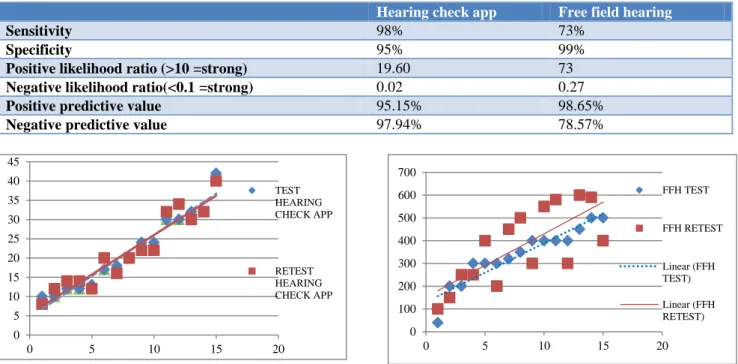
The validity test for smart phone application and Free Field Hearing is depicted in Table 1 and 2 respectively. The comparison of diagnostic accuracy between smart
phone application and free field hearing is shown in Table 3. The average time taken to conduct PTA, FFH and hearing assessment was 13 minutes, 3 minutes and 5 minutes respectively.
Reproducibility test
As seen in Fig 1 the Pearson Correlation Coefficient was high (0.96) using smart phone app whereas it was low (0.76) by Free field hearing as seen in Figure 2.
Table 1: Validity test: smart-phone app.
Hearing loss assessed by PTA
Present Absent
Hearing loss assessed by app
Present True positive False positive Positive predictive value
196 10 95.15%
Absent Flase negative True negative Negative predictive value
4 190 97.94%
Sensitivity Specificity
98% 95%
Table 2: Validity test: free field hearing test.
Hearing loss assessed by PTA
Present Absent
Hearing loss assessed by free field hearing
Present True positive False positive Positive predictive value
146 2 98.65%
Absent Flase negative True negative Negative predictive value
54 198 78.57%
Sensitivity Specificity
73% 99%
Table 3: Comparison of diagnostic accuracy: smart-phone app vs. FFH.
Hearing check app Free field hearing
Sensitivity 98% 73%
Specificity 95% 99%
Positive likelihood ratio (>10 =strong) 19.60 73
Negative likelihood ratio(<0.1 =strong) 0.02 0.27
Positive predictive value 95.15% 98.65%
Negative predictive value 97.94% 78.57%
Figure 1: Pearson correlation coefficient using smart
phone app. Figure 2: Pearson correlation coefficient using FFH.
0 5 10 15 20 25 30 35 40 45
0 5 10 15 20
TEST HEARING CHECK APP
RETEST HEARING CHECK APP
0 100 200 300 400 500 600 700
0 5 10 15 20
FFH TEST
FFH RETEST
Linear (FFH TEST)
DISCUSSION
The study revealed the accuracy and reproducibility of hearing screening by using conventional FFH test and by use of smart phone application. Both these methods were compared with PTA which is a gold standard test for assessment of hearing recognised by ASHA and BSA.4 In armed forces, FFH is the primary method of assessment of hearing. The aim of carrying out hearing assessment during annual medical examination is early detection and primary prevention. It also helps to determine individuals‘ functional capacity to carry out service tasks. FFH is a quick and inexpensive method to carry out hearing screening. However, it is a subjective test with poor predictive value, lack of reproducibility, accuracy & standard technique. Moreover, it is known to have low sensitivity and specificity.3
Pure tone audiometry is an ideal tool for assessment of hearing. However due to its high operating cost, requirement of trained manpower and expensive infrastructure it may not be ideal as a screening test for hearing. Thus keeping this in view, using PICO elements, the following clinical question was formulated: ―is screening for hearing by using free field hearing when compared to smart phone hearing app accurate and reproducible‖.5 Answers to above question would guide
the researchers to the ideal hearing screening tool.
Extensive review of literature using PubMed and Medlinewas conducted in search of a quick, inexpensive and accurate method for detecting hearing loss. The researchers were fascinated by couple of studies which used smart phone application and internet based hearing test for assessment of hearing respectively.6,7 It was decided to use one of the hundreds of smart phone application available for hearing test. The authors selected windows based application due to its friendly interface and simplicity to use. One of the chief advantages of the test was that it was free to download and no internet connection was required to carry out the test.
Pure tone audiometry was conducted by first assessor in audiometry room following British society of audiology (BSA) guidelines.8 The second assessor performed free field hearing test and the third assessor explained the process of using smart phone application to the patient who had to press the button on touch screen of the phone after hearing sound and follow the instructions on the screen. At the end results were displayed and stored in the phone in form of audiogram. All the three assessors were blinded to each other.
The results were analysed and comparison is shown in Table 3. It was evident by the results that hearing assessment with smart phone application had better sensitivity and negative predictive value then free field hearing. Overall hearing assessment using smart phone application was more accurate.
The results of the accuracy and validity tests confirmed that hearing screening by using smart phone application was more accurate and reproducible. Currently smart phone based applications are shown to be accurate in various studies.9 Some smart phone applications also provide accurate hearing thresholds in noisy environment by adjusting hearing threshold shift.10 One of the studies done in Sweden used internet based hearing screening and found the test to be valid.11 With the advance in technology, there are smart phone applications available which can become integral part of hearing conservation programme to prevent noise induced hearing loss, for example there are other applications available which have been studied to measure sound level and enabling use smart phone as hearing aid showing promising results.12
CONCLUSION
Hearing screening using smart phone application is valid and reproducible. As compared to free field hearing, it is more accurate. It is inexpensive, quick to perform and no special infrastructure or trained manpower in needed. Pure tone audiometry remains the gold standard test; however it is an expensive proposition for hearing screening and can be used as confirmatory test. The use of smartphone application can be particularly useful in places where facilities for pure tone audiometry are not available.
Funding: No funding sources Conflict of interest: None declared
Ethical approval: The study was approved by the Institutional Ethics Committee
REFERENCES
1. Muhr P, Rosenhall U. The influence of military service on auditory health and the efficacy of a Hearing Conservation Program. Noise Health. 2011;13:320–7.
2. Wilson RH, Noe CM, Cruickshanks KJ, Wiley TL, Nondahl DM. Prevalence and degree of hearing loss among males in Beaver Dam cohort: comparison of veterans and nonveterans. J Rehabil Res Dev. 2010;47:505-20.
3. Pirozzo S, Papinczak T, Glasziou P. Whispered voice test for screening for hearing impairment in adults and children: systematic review. BMJ. 2003;327(7421):967
4. Straus SE, Richardson WS Glasziou P, Haynes RB. RB. Evidence based medicine: How to practice and teach EBM. 3rd edition. Elsevier Churchill Livingstone; 2005.
5. Sackett DL, Rosenberg WM, Gray JA, Haynes RB, Richardson WS. Evidence based medicine: what it is and what it isn't. BMJ. 2006;312(7023):71–2. 6. Honeth L, Bexelius C, Eriksson M, Sandin S, Litton
Preliminary Validation and Proof of Principle. Otol Neurootol. 2010;31:708-14.
7. British Society of Audiology. Recommended procedure pure tone audiometry with and without masking. 2011. Available at: http://www.thebsa. org.uk/wp-content/uploads/2014/04/BSA_RP_ PTA_FINAL_24Sept11_MinorAmend06Feb12.pdf Accessed on 3 March 2017.
8. Swanepoel de W, Myburgh HC, Howe DM, Mahomed F, Eikelboom RH. Smartphone hearing screening with integrated quality control and data management. Int J Audiol. 2014c;53(12):841-9. 9. Na Y, Joo HS, Yang H, Kang S, Hong SH, Woo J.
Smartphone-based hearing screening in noisy environments. Sensors (Basel). 2014;14(6):10346-60.
10. Bexelius C, Honeth L, Ekman A, Eriksson M, Sandin S, Bagger-Sjöbäck D, et al. Evaluation of an
Internet-Based Hearing Test—Comparison with Established Methods for Detection of Hearing Loss. J Med Internet Res. 2008;10(4):32.
11. Nast DR, Speer WS, Le Prell CG. Sound level measurements using smartphone "apps": Useful or inaccurate? Noise Health. 2014;16:251-6.
12. Amlani A, Taylor B, Levy C, Robbins R. Utility of smartphone-based hearing aid applications as a substitute to traditional hearing aids. Hearing Review. 2013;12:16-23.
Cite this article as: Swami H, Bhargava A, Sabarigirish