VOLUME 16 ISSUE 4 (2018), Page 15 – 33
SPATIAL REGENERATION OF MUSLIM BURIAL PRACTICES IN THE METROPOLITAN AREAS OF KUALA LUMPUR AND JAKARTA
Mohamad Reza Mohamed Afla1
1
School of Housing, Building and Planning UNIVERSITI SAINS MALAYSIA
Abstract
This article focuses on the subject of burial practices which are performed by the Muslim population and the management at public cemeteries within the metropolitan areas of Kuala Lumpur and Jakarta. This research examines specifically, the conventional way of burial practice by the majority of the Muslim population. Unlike other major religions in Southeast Asia which are more open and flexible in the disposal of corpses, full body burial is mandatory in Islam. In response to the escalating issue of lack of space and land shortage for Muslim cemetery, local authorities of the two metropolitan areas have identified alternatives and solutions in handling these alarming situations. This research has recognised factors that lead to these problems, as well as discussing available methods to overcome these issues. The finding exhibits Muslim cemetery’s layout to be problematic due to abundance of burial practices accumulated by patrons which led to disorganisation of space and claustrophobia. This article concludes by providing proposals and design guidelines at the terrain level, together with recommendations that emphasise the long-term usage of the grave plots.
INTRODUCTION
This article explores alternative methods and strategies for burial practices within the context of rapid development of urban cemeteries. The main question of this research is how the metropolitan cities of Kuala Lumpur (KL) and Jakarta deal with the issue of burial. The intention of this research is to offer alternative solutions to the critical situation of overcrowding and land shortage in Muslim cemeteries (Rahim, 2011; “No more space”, 2011). This study argues that some aspects of Muslim funerary practices should be altered and indeed transformed, especially given the increasing pressure of urbanisation in Kuala Lumpur, Singapore and Jakarta (Hamnett & Forbes, 2011, Rimmer, & Dick, 2009; Forbes, 1996). In addressing the issue regarding the lack of space for Muslim burials in the cities, there are some modifications that could be employed in order to attain a higher level of efficiency in utilising the space inside cemeteries (Ely & Howe, 2002).
The objectives of this research are to analyse alternatives for graves arrangement by considering the burial practices of local Muslims and to explore adaptability of graves layout by examining the requirements of Islamic burials.
METHODOLOGY
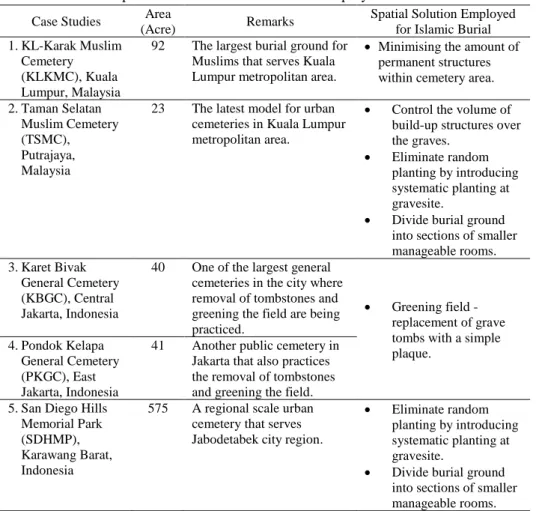
The case studies presented in this article will provide an insight into the current state of urban cemeteries and practices employed for Muslim burials within Kuala Lumpur and Jakarta. Site observation has been conducted at selective sites in each city in order to examine closely the current trends associated with Muslim burial practices and to provide a basis for potential improvements. These are identified as catalysts in changing the burial practices of Muslim communities in Kuala Lumpur and Jakarta. There are five case studies involved in this research as shown in Table 1. In Kuala Lumpur metropolitan area, KL-Karak Muslim Cemetery (KLKMC) and Taman Selatan Muslim Cemetery (TSMC) are among the sites that have been chosen. Meanwhile, Karet Bivak General Cemetery (KBGC), Pondok Kelapa General Cemetery (PKGC) and San Diego Hills Memorial Park (SDHMP) are the sites that have been chosen for the Jakarta metropolitan area. These sites have been selected as the case studies as they have each employed a spatial solution as a new approach in managing the grave plots for Islamic burial.
better utilisation of Muslim cemeteries. Lastly, the case studies are used to support ideas or arguments in this article.
Table 1: Table of spatial solution at the terrain level employed at selected case studies
Case Studies Area
(Acre) Remarks
Spatial Solution Employed for Islamic Burial 1.KL-Karak Muslim
Cemetery (KLKMC), Kuala Lumpur, Malaysia
92 The largest burial ground for Muslims that serves Kuala Lumpur metropolitan area.
• Minimising the amount of permanent structures within cemetery area.
2.Taman Selatan Muslim Cemetery (TSMC), Putrajaya, Malaysia
23 The latest model for urban cemeteries in Kuala Lumpur metropolitan area.
• Control the volume of build-up structures over the graves.
• Eliminate random planting by introducing systematic planting at gravesite.
• Divide burial ground into sections of smaller manageable rooms. 3.Karet Bivak
General Cemetery (KBGC), Central Jakarta, Indonesia
40 One of the largest general cemeteries in the city where removal of tombstones and greening the field are being practiced.
• Greening field - replacement of grave tombs with a simple plaque.
4.Pondok Kelapa General Cemetery (PKGC), East Jakarta, Indonesia
41 Another public cemetery in Jakarta that also practices the removal of tombstones and greening the field. 5.San Diego Hills
Memorial Park (SDHMP), Karawang Barat, Indonesia
575 A regional scale urban cemetery that serves Jabodetabek city region.
• Eliminate random planting by introducing systematic planting at gravesite.
• Divide burial ground into sections of smaller manageable rooms. Source: Author (2012)
STAGES IN MUSLIM BURIAL PRACTICE
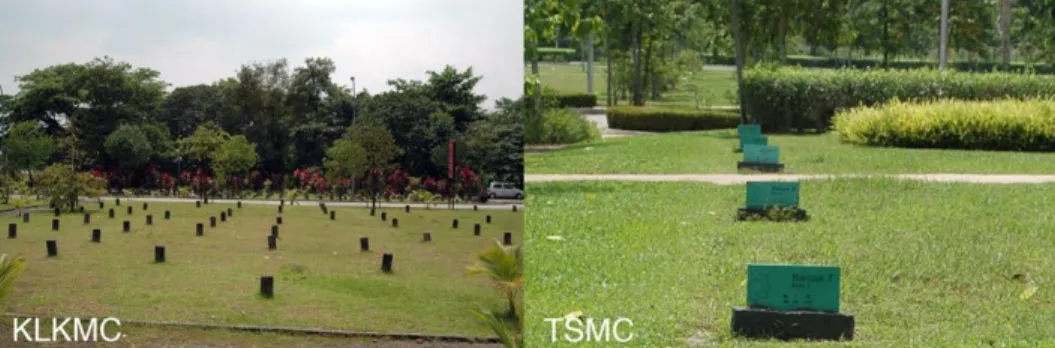
stone or its own special number for the purpose of identification in the future (Figure 2).
Figure 1: Conventional practices in burial rites as performed by Muslims at the terrain level
Source: Author (2012)
Figure 2: Grave marking stones are used at KLKMC to indicate the exact position of burial plots, whereas, a more systematic approach is practiced at TSMC to assist people
to locate their graves during a visit. Source: Author (2012)
At the latter stage of Muslim burial practice, the closing of the funeral ceremony begins with the Imam reciting talqin to the deceased accompanied by the mourners. When performing this ritual, the Imam will commonly be seated on the ground next to the grave, close to the head of the corpse (Hashim, 2007), while the crowd will generally occupy available spots around the grave. People are allowed to leave after the talqin recitation has finished. The ritual of the talqin recitation happens shortly after the burial, whereas the marking of the grave is an ongoing process as relatives and friendsvisit on various occasions over many years. During this time, gravestones will be erected as a way to properly mark the resting place of the deceased and in most cases, this activity will be accompanied or followed by a monument and various forms of permanent structures placed over the grave.
There are obviously some contradictions between the burial practice ordained by Islam and those that are performed by the surviving family members;
Part I: Before the burial 1. Grave orientation 2. Grave arrangement
Part II: After the burial 3. Talqin recitation
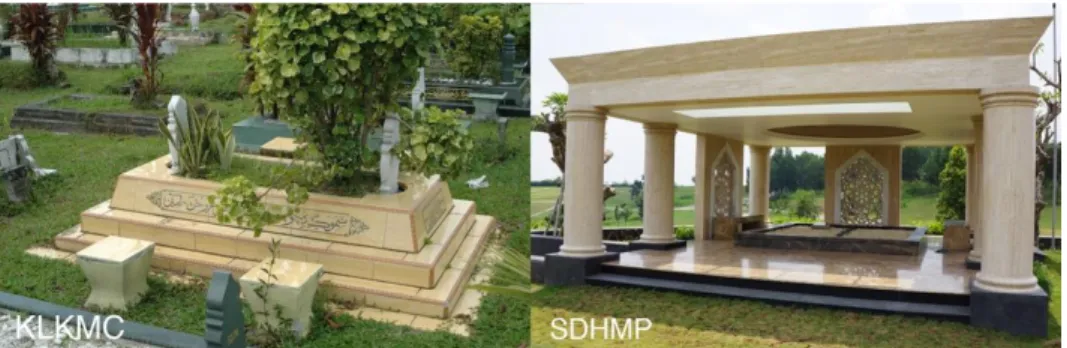
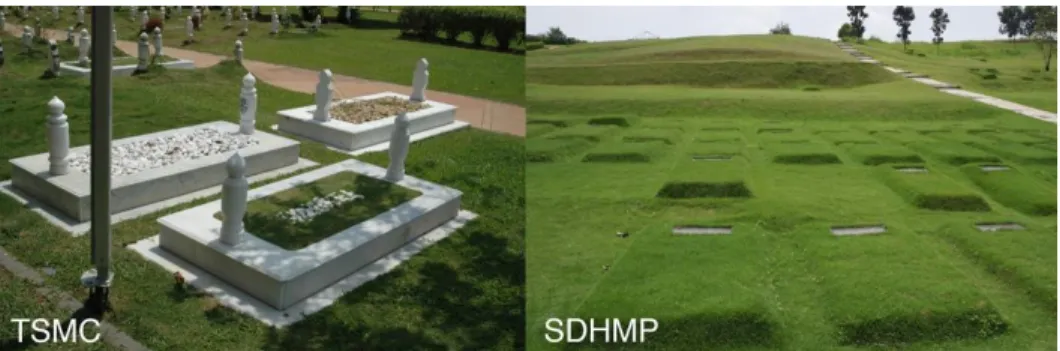
these require some explanation. It is important to differentiate between the custom of decorating the graves and the grave marking. The grave finish should not look the same as the grave marking, even though they share similar functions. This is because Islam has explicitly determined the way graves should be built. In terms of the grave’s physical appearance, there are three things prescribed by Islam that should be followed by Muslims. Firstly is the erection of the headstone with an inscription of the deceased’s details (Hashim, 2007; Omer, 2008); secondly is the planting of a smaller tree or shrub near the grave (Dafni, Lev, Beckmann, & Eichberger, 2006, Hashim, 2007); and finally, the grave’s surface is raised above the ground level to form a mound-like shape (Ismail, 2008; Omer, 2008). However, contrary to this religious teaching, intricate grave structures have become common practice and are regarded as part of the custom in Muslim funerary culture. In general, most Muslims today are inclined to have their graves built with extravagant monuments; the extent of detail of the embellishment varies from one grave to another (Figure 3). This can be attributed to personal preference, social status, as well as to the practical purpose of easy recognition of the grave which leads to overcrowding. Thus, there is a need for Muslim graves to be redesigned so as to provide a solution to this problem.
Figure 3: Examples of excessive grave markings and finishes at Muslim cemeteries at KLKMC and SDHMP which do not comply with Islamic burial requirements.
Source: Author (2011,2012)
Figure 4: Examples of simplified and moderately designed graves at TSMC and SDHMP, (2011, 2012).
Source: Author (2011, 2012)
From site observations there is a significant difference between conventional and simplified methods of building graves, in terms of the spatial quality and in improving the environment offering more breathing space for visitors. Apart from being low in cost, simple monuments require less maintenance and it would be sensible for the management of the cemeteries to erect them over Muslim graves. Moreover, the case studies have shown that there will be minimal grave markings by imposing a strict control on the way they are arranged such as is exemplified at TSMC. Therefore, elaborate and extensive grave structures should be re-examined in terms of their function in the cemeteries.
observed in some of the case studies such as KLKMC and KBGC (Figure 5). Apart from this, a common factor that has been observed on these sites is that there are gaps between the graves. These could be eliminated to maximise the use of land(see Figure 6). This raises the question, whether it is possible to arrange graves next to each other without decreasing people’s need to perform their rituals. A suggestion to remove the interval space between graves would probably create more room for burial plots. As mentioned before, these interval spaces are normally occupied. For instance, there have been many structures both permanent and temporary that have been found by the grave-sites in every visited site. Nevertheless, the issue of visibility and accessibility during the grave visits cannot simply be disregarded. There is a need to consider greater accessibility, as well as visibility, for the visitors. Visitors find it hard to search for their family graves due to the layout of burial plots. Therefore, a new approach has to be initiated in order to facilitate spatial efficiency and grave visit rituals.
Figure 5: A schematic plan shows typical chaotic landscape environment in public cemeteries, which results from Muslim burial practices.
Figure 6: Often there are gaps between the graves that could be eliminated to maximise the use of land in the cemeteries
Source: Author (2011)
THREE CATEGORIES OF MUSLIM BURIAL PRACTICE
The case studies show that Muslim cemeteries in KL and Jakarta share some definite similarities in terms of their funeral practices. Three categories of burial practices have been identified from each case study of Muslim cemeteries in each city. This burial practice is, firstly, made up of family plots, secondly, erected permanent structures, and lastly, the random planting over the graves. These burial practices are considered common traits of Muslim cemeteries.
Family Plots
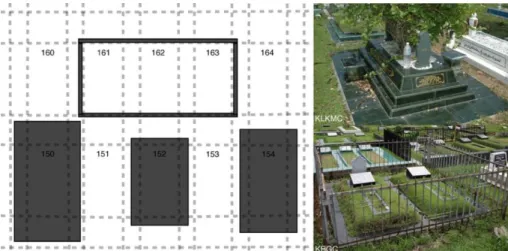
This practice has been mentioned in Bougas’ report on Muslim cemeteries in Patani (Bougas, 1988). Family plots have existed in the Islamic funerary tradition since the Prophet’s time (Omer, 2008). The logical reasoningbehind this practice is to make the grave visiting easier for the deceased’s family. Tending activities can be simultaneously done without having to move from one grave to another. This also applies to the practice of offering prayers to the dead during the grave visits. As a matter of fact, sharing a single grave with multiple bodies is permissible in the event where the area for burial is inadequate (Hashim, 2007). The problem in today’s public cemeteries is that this practice is hard to follow because most public cemeteries do not accommodate family plots, as people are not allowed to book burial plots in advance. There is also no guarantee that family members will be buried in the same spot nor at the same time. The need for burial has always been a priority for the family members of the deceased. However, this practice still exists in Muslim cemeteries such as KLKMC, KBGC, PKGC and SDHMP (Figure 7). The application of family plots is still relevant in Muslim society today, but somehow its significance has not been fully recognised.
the Islamic view which urges Muslims to have family plots in one spot. This religious misinterpretation should be eradicated from the current practice. Although grave reservation has already been made available to Muslims at SDHMP (Kurniawan, 2008), this is not widely practiced in public cemeteries around Jakarta and certainly not in KL.
Figure 7: Many forms of family plots have been encountered during the site visits. The diagram on the left depicts some of the arrangements of family plots found in the cemeteries. Pictures on the right show some of the actual family plots found at KLKMC
and KBGC. Source: Author (2011,2012)
Permanent Structures
Permanent structures at Muslim graves can be divided into three groups: seating, monuments and built up personal demarcation. These structures contribute to the problem of overcrowding in cemeteries because of the nature of a regimented grid layout in Muslim cemeteries.
Seating
be used to solve this matter and there have been some cases where the management of the cemetery provides this kind of service to visitors, for example in KLKMC and TSMC.
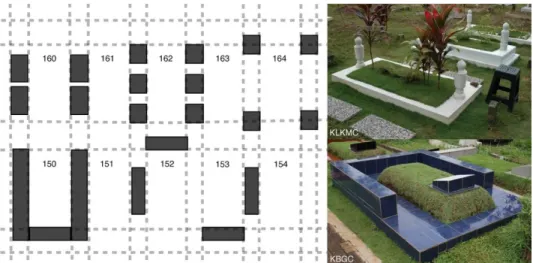
Figure 8: There are many forms of permanent structures that have been encountered during the site visits, including monumental structures and seating structures. The diagram on the left depicts some of the variations of seating structures found in the cemeteries. Pictures on the right show some of the actual seating structures found at KLKMC and KBGC. The top right picture shows the slab-like pieces that were used by
the grave's owners to sit on the ground during the visit. Source: Author (2011, 2012)
Monuments
However, most people tend to ignore these regulations.
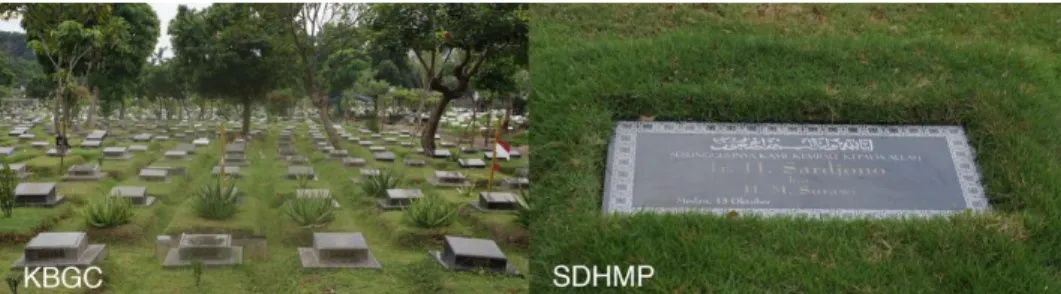
The decision to follow the Islamic precepts of low profile graves depends on individual belief and intention. It is a question of personal choice, which seems to fit more in the memorial park rather than in public cemeteries. The erection of monumental structures over graves is not only found in Muslim cemeteries, but is practiced in other cultures as well (Francis, 2003). However, there is a need to re-examine this as the impact that grand monuments have on available space is a serious problem. Public cemeteries have commonly refused to cater for the installation of large monuments. Local authorities insist on keeping grave monuments to a minimum size. However, some graves belonging to important figures are still allowed to have grand statues; this can be regarded as a privilege. Nevertheless, monumental structures are still considered as the main part of Muslim graves and people should have the right to choose. This has been exclusively granted to higher class people, but all people should be entitled to the same rights by having a memorial park version of Muslim cemeteries as has been demonstrated at SDHMP. Therefore, the initiative for a different kind of Muslim cemetery ownership is present in KL and Jakarta.
(2002), as an ongoing connection that continues to be performed by the bereaved. This serves as a medium to convey multiple meanings and purposes that usually are driven by personal motivations or historical events. A separation of burial sections between grave builders and self-made monuments will probably help to address the differences and needs of every individual.
Figure 9: Examples of simple plaques used at KBGC and SDHMP Source: Author (2012)
Built-Up Personal Demarcation
Extensive grave structures are used to indicate personal demarcation in Muslim cemeteries. In some cases, the personal demarcation can be seen as the extension of monumental structures where the materials are used along the perimeter (Figure 10). Muslims perform this practice for certain reasons - to protect the graves or simply for aesthetic reasons. This practice suggests that people are keen to mark the area of the deceased’s grave even though there seems to be a shortage of space. This implies that people have their own beliefs in demonstrating how the graves should look, based on individual taste and preference. According to Hashim (2007), this kind of practice is not permitted in the Islamic teaching and the structures should be demolished because they will disturb other people’s graves. However, some graves in Muslim cemeteries do not possess any form of demarcation at all. These graves are found to be modest, while others have nothing on top other than a gravestone. This suggests that some people prefer not to have any kind of demarcation over the graves due to the restriction of religious teaching, or because of insufficient funds.
because the stone markers are gradually disappearing from sight due to frequent human activity at the graves. As a result, the stone markers become useless after the gravestones have been erected. A clear marking of the grave plots should be imposed to indicate certain space limitations as well as to enhance a sense of ownership.
Figure 10: There are many forms of personal demarcation that have been encountered during the site visits. The diagram on the left depicts some of the variations of built-up personal demarcations. Pictures on the right show some of the actual structures found at
KLKMC and KBGC. Source: Author (2011,2012)
Random Planting
Figure 11: There are many forms of personal demarcation that have been encountered during the site visits. The diagram on the left depicts some of the variations of built-up personal demarcations. Pictures on the right show some of the actual structures found at
KLKMC and KBGC. Source: Author (2011, 2012)
The other function of plants in Muslim cemeteries is for aesthetic reasons. In some public cemeteries such as KLKMC, KBGC and PKGC there are many variations of plants grown at the graves from multi-coloured foliage to towering trunks. The combination of these plants and the permanent structures has turned each grave into its own unique niche garden. However, Muslim cemeteries display the idea of ‘garden’ mainly through the varieties of plants grown over the graves, rather than focusing on the overall surrounding area. Yet, there are some examples where Muslim cemeteries have begun to adopt the ‘garden’ theme as an overall concept such as TSMC and SDHMP where random planting no longer exists. Here, trees not only play the role of enhancing the beautiful landscape of the surrounding area, but are also used to divide burial grounds into manageable burial spaces. The trees have been used to divide burial spaces into smaller sections. Each section is treated as a room or space that is supposed to create a sense of direction within the cemetery. Each burial space consists of no more than twenty graves in TSMP. In contrast to the old cemeteries, the structural planting at TSMC and SDHMPhas been planned systematically since the beginning. This is a precautionary step that is necessary to create a pleasant experience for the visitors. Furthermore, the issue of visibility has been properly addressed at both sites. Trees are no longer allowed to be grown near the graves and therefore no longer perform their original function to pray for the dead. However, low height shrubberies and grasses are permitted and are still able to symbolise this spiritual purpose.
for visitors trying to locate graves. TSMP and SDHMP present an example of a Muslim cemetery that is both accessible and pleasant (Figure 12). The random planting in all cemeteries has to change into a systematic arrangement to avoid the sense of disorder. Both case studies are an example that can be promoted to other Muslim cemeteries in KL and Jakarta. The type of shrubs permitted for planting over the graves should also be limited to structural branches, rather than species that have dense foliage. Visitors have to acknowledge the types of plants that are allowed to grow over graves and management need to use plants to clearly define burial spaces within the cemetery. The role of plants in TSMP and SDHMP has been extended to create a more park-like cemetery, where it is more convenient for people to navigate the area without any sense of confusion. Moreover, the role of plants in Muslim cemeteries should be seen as accommodating more than just a cultural practice. For this reason, the specific role of plants in Muslim cemeteries should be divided between functionality and aesthetic values.
Figure 12: A new role of plants in defining the space at TSMC and SDHMP Source: Author (2011, 2012)
PROPOSALS AND DESIGN GUIDELINES
cemeteries by having two points of access for each grave. In terms of softscape, trees and shrubs could be used to form outdoor rooms as a means to provide emotional support for bereaved families. The landscape of Muslim cemeteries could also serve as utilitarian in accommodating the rituals that happen at the gravesite. Figure 14 shows the design guidelines in the form of diagrams that can be implemented in public cemeteries. These diagrams could serve as a planning guideline to strengthen the spatial regeneration in Muslim cemeteries.
Figure 13: On this plan, every grave is covered with grass to maintain the semblance of 'green factors' that is commonly associated with traditional Muslim graves. The plan
also shows the merging of footpaths and ritual spaces as one row rather than being separated.
Figure 14: Design guidelines for plan layouts and arrangement of public cemeteries. Source: Author (2012)
CONCLUSION
REFERENCES
Bougas, W. A. (1988). Islamic cemeteries in Patani. Kuala Lumpur: The Malaysian Historical Society.
Dafni, A., Lev, E., Beckmann, S., & Eichberger, C. (2006). Ritual plants of Muslim graveyards in northern Israel. Journal of Ethnobiology and Ethnomedicine, 2, 38.
Doss, E. (2002). Death, art and memory in the public sphere: The visual and material culture of grief in contemporary America. Mortality, 7, 63-82.
Ely, A., & Howe, M. (2002). Cemeteryscape. The Journal of the Institute of Burial & Cremation Administration, Summer 2002. Retrieved from http://www.mae-llp.co.uk/press/Citycemetery_essay.pdf
Forbes, D. K. (1996). Asian metropolis: Urbanisation and the Southeast Asian city. Melbourne: Oxford University Press.
Francis, D. (2003). Cemeteries as cultural landscapes. Mortality, 8, 222-227. Gibson, M. (2004). Melancholy objects. Mortality, 9, 285-299.
Hallam, E., & Hockey, J. L. (2001). Death, memory, and material culture. Oxford:Berg. Hamnett, S., & Forbes, D. K. (2011). Risks, resilience and planning in Asian cities. In S.
Hamnett, & D. K. Forbes (Eds.), Planning Asian cities: Risks and resilience (pp. 1-37). New York: Routledge.
Hashim, S. (2007). Kematian dan pengurusan jenazah [Death and funeral management]. Johor: Universiti Teknologi Malaysia.
Iqba, Z. (2011). McDonaldization, Islamic teachings, and funerary practices in Kuwait. OMEGA, 63(1), 95-112.
Ismail, F. (2008). Muslim burial practices. The Journal of the Institute of Cemetery & Crematorium Management, 76, 49-50.
Ismail, W. N. W., Arabi, F., Husini, E. M., Zolkifly, F. N. S., Darus, Z. M., Jaafar, N. H. A., & Manaf, A. A. (2017). The establishment of Islamic dwelling principles for the Malaysian communities. Advanced Science Letters, 23(7), 6289-6293. Kurniawan, K. R. (2008, August). Marketing graves: Changing paradigm of a burial
ground from a city of death to a city of amusement in San Diego Hills Cemetery in Cikarang West Java. ARTEPOLIS 2 International Conference and Workshop on Creative Communities and the Making of Place. August 8-9, 2008, Bandung, Indonesia.
Limited cemetery space prompts call to public to reuse graves (2011). The Jakarta Post. Retrieved from http://www.thejakartapost.com/news/2002/07/13/limited-ceme- tery-space-prompts-call- public-reuse-graves.html.
Nirmala, R., & Primanita, A. (2011). Jakarta’s grave need for green may be filled by cemeteries. The Jakarta Globe. Retrieved from http://www.thejakartaglobe.com/archive/jakartas- grave-need-for-green-may-be-filled-by-cemeteries/346983/
No more space in Central Jakarta cemeteries (2011). The Jakarta Post. Retrieved from http://www.thejakartapost.com/news/2011/03/12/no-more-space-c-jakarta-cemeter- ies.html
Rahim, S. (2011). More Muslim cemetery plots. New Straits Times. Retrieved from http://www.nst.com.my/life-times/health/more-muslim-cemetery-plots-1.9206 Rimmer, P. J., & Dick, H. W. (2009). The city in Southeast Asia: Patterns, processes and
policy. Honolulu: University of Hawaii Press.
Salim, W., & Firman, T. (2011). Governing the Jakarta city-region: history, challenges, risks, and strategies. In S. Hamnett, & D. K. Forbes (Eds.), Planning Asian cities: Risks and resilience (pp. 241–259). New York: Routledge.
Uslu, A., Baris, E., & Erdogan, E. (2009). Ecological concerns over cemeteries. African Journal of Agricultural Research, 4, 1505-1511
Received: 1st June 2018. Accepted:1st December 2018