Frequent Pattern-growth Algorithm on
Multi-core CPU and GPU Processors
Khedija Arour
1and Amani Belkahla
21Computer Science Department, National Institute of Applied Sciences and Technology, Tunis, Tunisia 2Computer Science Department, Faculty of Sciences of Tunis, Tunisia
Discovering association rules that identify relationships among sets of items is an important problem in data mining. It’s a two steps process, the first step finds all frequent itemsets and the second one constructs associ-ation rules from these frequent sets. Finding frequent itemsets is computationally the most expensive step in association rules discovery algorithms. Utilizing parallel architectures has been a viable means for improving FIM algorithms performance. We present two FP-growth implementations that take advantage of multi-core pro-cessors and utilize new generation Graphic Processing Units(GPU).
Keywords: association rule mining, frequent itemset mining, GPU computing, parallel computing, GPGPU
1. Introduction
Frequent Itemset Mining(FIM)also known as Frequent Pattern Mining is one of the most pop-ular problems in data mining, which consists of discovering frequently co-occurred itemsets and then generating rules used in many decision support applications. Frequent sets play an es-sential role in many data mining tasks that try to find interesting patterns from databases. A FIM algorithm scans the database and finds itemsets that occur in the transaction frequently then a user-specified threshold. The challenges in frequent itemsets mining derive from a large size of a search space, which corresponds, in the worst case, to the power of the set of items. To quickly explore a large dataset through a FIM tool, analysts ask for new techniques to improve algorithm performance, by taking advantage of the evolutions in parallel computing.
Thus, to exploit this opportunities, there is a need for a new generation of FIM algorithms,
able to exploit the parallelism on multi and many-core architectures by exploiting the per-formance of microprocessors, that has been steadily improved and the General-Purpose com-puting generation paradigm on Graphic Pro-cessing Units(GPGPU).
With the emergency of the GPU as a hard-ware accelerator for various non-graphics appli-cations and GPGPU programming frameworks that greatly reduce the complexity of GPGPU computing, developers must carefully design their algorithms in order to take full advan-tages of the GPU’s massively multi-threaded SIMD (Single Instruction, Multiple Data) ar-chitecture. Previous works have taken advan-tage of the massive computation power of the new architecture by accelerating database oper-ations[30, 31, 32], approximate stream mining of quantiles and frequencies [29], MapReduce [33]and k-means clustering[34].
In the best knowledge, there has been little work that focuses on accelerating FIM algorithms on the GPU, even though parallel FIM has been studied on simultaneous multi threading(SMT) processors [36], shared memory systems [37], and, most recently, multi-core CPUs[8]. The key issue for studying FIM problems on modern processors is how to fully exploit the performance of the multi-core CPU and fully utilize the GPU architectural features.
dereferences, which prevents it from achiev-ing satisfyachiev-ing performance on a modern pro-cessor. This structure still underutilizes the modern system due to poor data locality and insufficient parallelism expression. To alleviate these problems, we improve the cache perfor-mance through the FP-array (Frequent Pattern array)structure[8], proposed by Li andal. This structure not only reduces the cache misses for single-core processor, but alleviates also the off-chip memory accesses and improves the scala-bility of the multi-core processor.
The remainder of the paper is organized as fol-lows. Section 2 introduces the related works. We present FP-growth in Section 3. Section 4 develops the insufficiencies of pointer based structure on modern processors. We present FP-array structure and details of our two imple-mentations in Section 5. Detailed experimental evaluations are given in Section 6. Finally, we offer conclusion and future works in Section 7.
2. Related Works
Several algorithms have been proposed in the literature to overcome the scalability (size of databases) and run-time performance of se-quential algorithms. Apriori [10] is one of the most popular applications for enumerating fre-quent itemsets.
Many other FIM algorithms are proposed such as DHP [9], DIC [19], Eclat [18] and Partition [20]but they are I/O insufficient and suffer from multi-scan problem. Salvatore etal. proposed kDCI [21] (Direct Count and Intersect) and ParDCI [22] but it requires at least 3 datasets scan. FP-growth [1] proposed by Han et al.
consists of creating a compressed FP-tree struc-ture for mining a complete set of frequent item-sets without candidate generation. This struc-ture is significantly smaller than the original database, but its pointer based nature requires costly dereferences and is not cache friendly, which prevents it from achieving a good perfor-mance on modern processors.
For more improving the cache performance, Ghoting and al. [23] proposed a cache con-scious FP-tree (CC-tree), a reorganization of the original FP-tree by allocating the nodes in sequential memory space and a tiling strategy for temporal locality. This structure yields a
better cache performance than FP-growth, but it still experiences cache misses when travers-ing the CC-tree due to its tree structure. Razs presented nonordfp[24]which implements FP-growth without rebuilding the projected FP-tree recursively to improve the cache performance. Li et al. proposed an FP-growth implementa-tion[8]based on two techniques: a cache con-scious FP-array and a lock free parallelization enhancement to improve data locality perfor-mance and make use of the benefits from hard-ware and softhard-ware prefetching.
For performance improvement of this algorithm, most researchers [2, 5, 7, 8, 3, 4] have been made for parallelizing FP-growth. Pramudiono and Kitsuregawa[2]reported results for parallel FP-growth algorithm on shared nothing cluster environment. In [7], Li et al. proposed a Par-allel FP-growth that shard a large-scale mining task into independent parallel tasks. Osmar et
al.presented a MLFPT(Multiple Local FPtree) approach [3] that consists of two main stages: the first stage is the construction of a parallel FP-tree for each processor and the second stage is mining these data structures much like the FP-growth algorithm.
In[5], Manaskasemsak etal. presented a paral-lel version of FI-growth algorithm[6]that par-allelizes the association rule mining process by employing a data parallelism technique on a PC cluster.
GPGPU for FIM algorithms was for the first time addressed in [25], where Luo et al. pre-sented two GPU-based implementations of the well known Apriori algorithm, that takes ad-vantage of the GPU’s massively multi-threaded SIMD(Single instruction, multiple data) archi-tecture. Both implementations employ a bitmap data structure to exploit the GPU’s SIMD par-allelism. One implementation runs entirely on the GPU, since the other employs both the CPU and the GPU for processing. Another Apriori based FIM algorithm for GPU is presented in [26], GPApriori, which includes a set of fine-grained parallel data structures and algorithms design to achieve premising degree of speed up on modern GPU.
A different approach is proposed in [28] by Teodoro and al. based on the Tree Projection algorithm described in[35]. Nonetheless, Tree Projection is not a state of the art algorithm for FIM, as it is outperformed by FP-growth[1]. In [27], Orlando and Silvestri proposed gpuDCI, a parallel algorithm inspired by DCI[19]that ex-ploits GPUs to efficiently mine frequent item-sets. In [39], Zhang and al. proposed an improved data-parallel algorithm derived from the Equivalent Class Expansion(Eclat)method. After candidate generation on the CPU, the al-gorithm counts the support values of each can-didate on GPU by vertical list intersection. As our optimizations are presented in the con-text of FP-growth algorithm, we will give, in the next section, a description of this algorithm. We will then illustrate the optimization introduced in this algorithm for better implementation on modern processors. As current FP-tree based algorithms still under-utilize these systems due to poor data locality and insufficient parallelism expression, we propose a compact data structure (FP-array: Frequent pattern array)to make use of the benefits from multi-core and graphic ar-chitectures. Our contributions will be described in the following sections.
3. FP-growth Algorithm
FP-growth method proposed by Han et al. is a depth-first algorithm based on data structure called FP-tree(Frequent Pattern tree). The FP-tree is a projected dataset, which provides a compact representation of the original database.
Each node of the tree stores an item label and a count, representing the number of the trans-actions which contain all the items in the path from the root node to the current node.
For constructing the FP-tree, FP-growth re-quires two database scans when mining all fre-quent itemsets. The first scan of the database de-rives a list of the 1-itemsets, denoted asF, sorted by item’s support in descending order. In the second scan, the FP-tree is constructed, a com-pressed representation of the original database. For each transaction, its frequent items were inserted into the FP-tree with item’s support de-scending order. A new order is generated when the node with the appropriate label is not found; otherwise, the count of the existing nodes is increased.
Once the FP-tree has been constructed, the fre-quent itemsets mining can be performed. For each item in the FP-tree, FP-growth finds all frequent items in the conditional pattern base, it recursively constructs a new FP-tree for this conditional pattern base when it has at least two frequent items. By concatenating each 1-item with the frequent itemsets generated from con-ditional FP-trees, all of the frequent itemsets are discovered within the FP-tree.
4. Synthesis
Current pointer-based algorithms still under-utilize modern processors due to the irregular nature of this structure, its poor data locality and insufficient parallelism expression. To al-leviate this problem, exploit the thread level par-allelism and take advantage from the advanced characteristics of the graphic processor, we pro-pose FP-array structure propro-posed by Li et al.
[8], which efficiently improves the data locality performance.
due to the way that FP-tree is built. Third, two nodes with the same item label cannot reside in the same cache line due to the pointer based data structure in nodelink. The next node with the same item label can be represented in other cache line due to the lack of temporal locality. Transforming FP-tree into a compact and con-tiguous data structure can efficiently improve data locality performance.
5. Design and Implementations
In this section, we present our CPU and GPU implementations based on FP-array structure, presented in [8], which significantly improves the cache performance. This structure uses two simple static data structures; item array and
node array, which can efficiently improve data locality performance and permit to exploit a lot of data parallelism.
The two tables are allocated in contiguous mem-ory space. Theitem arrayworks essentially as a replication of the FP-tree. The node array
permits to record the occurrences of frequent items figured initem array. This structure is or-ganized as an array list. Each list is associated with one frequent item and each element innode array corresponds to a node in FP-tree, which has three fields; the begin position of an item in theitem array, reference count and transaction size.
5.1. Construction of FP-tree and FP-array
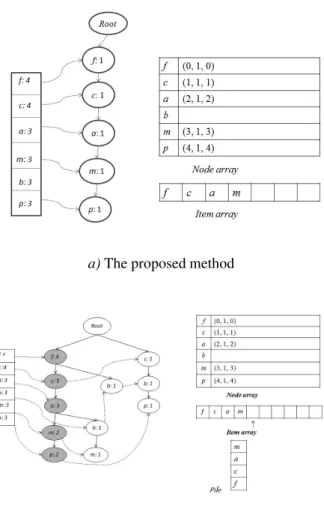
To construct FP-array, we have made some changes to the original process proposed by Li and al. In [8], to build FP-array, authors tra-verse FP-tree in depth-first order, copy the item in each node to theitem arraysequentially and then create array lists which record the occur-rences of the frequent items in the item array. In our approach called FP-growth+, FP-array is created in parallel while building FP-tree as described in algorithm 1.
The root of the tree is created and labelled as null. The scan of the first transaction in the database leads to create the first branch in the tree and the corresponding nodes innode array. While inserting a nodenin FP-tree, a label item of n is inserted in item array and a new node
is inserted innode array. For the second trans-action, if its item list shares a common prefix with the existing path in FP-tree, the count of each node along the prefix is incremented by 1 and a new node is created and linked as a child of the last node in the prefix. For each item in the common prefix, its label item is inserted in
a)The proposed method
b)Li andal.’s method
Figure 1. The difference between Li andal. method and our proposed method to construct FP-array.
The scan of the first transaction (f,c,a,m,p) in the database leads to the construction of the first node branch in FP-tree and its correspond-ing nodes in FP-array: the process starts from nodef, the first child node of the root. The la-bel item of the nodef, created and labeled into FP-tree, is inserted in item arrayand its corre-sponding node(0,1,0)is inserted then innode array. The rest of the first branch in FP-tree (c:1), (a:1),(m:1),(p:1)and its corresponding members (1,1,1), (2,1,2), (3,1,3), (4,1,4) are then inserted innode array. For the second transaction(f,c,a,b,m), since its frequent items share a common prefix(f,c,a)with the existing path, the count of each item in FP-tree, which appears in the common prefix, is incremented by 1 and the correspondingnode arraymembers are updated. A new node(b:1)is then created and linked as a child node of(a:2), its label item is inserted initem arrayand a new node(7,1,3) innode array. Another node(m:1), new child
node of(b:1), is also created in FP-tree, its label item and corresponding node(8,1,4) are then inserted respectively initem arrayandnode ar-ray.
This method eliminates redundancy initem ar-rayconstruction, which can decrease the mem-ory consumption and improve the cache perfor-mance.
5.2. CPU Parallel Implementation
We describe in this section the FP-growth im-plementation for multi-core processor.
The proposed solution employs transaction pro-cessing parallelism, which divides the transac-tions among different CPU threads to be in-serted in FP-tree, then in FP-array structure. Processing the transactions in parallel may need to update the same node in FP-tree and the same cell innode array.
This problem may be solved by creating critical section to avoid threads to update nodes con-currently. Our solution is to create a critical section associated with a level tree, thus only a thread can update a node in FP-tree and node array. This approach is simple and inexpensive in terms of overhead. It imposes barriers among threads accessing different nodes.
5.3. GPU Frequent Itemsets Discovering
The FP-growth is one of the most important FIM algorithms, which makes it an interesting candidate for GPU acceleration.
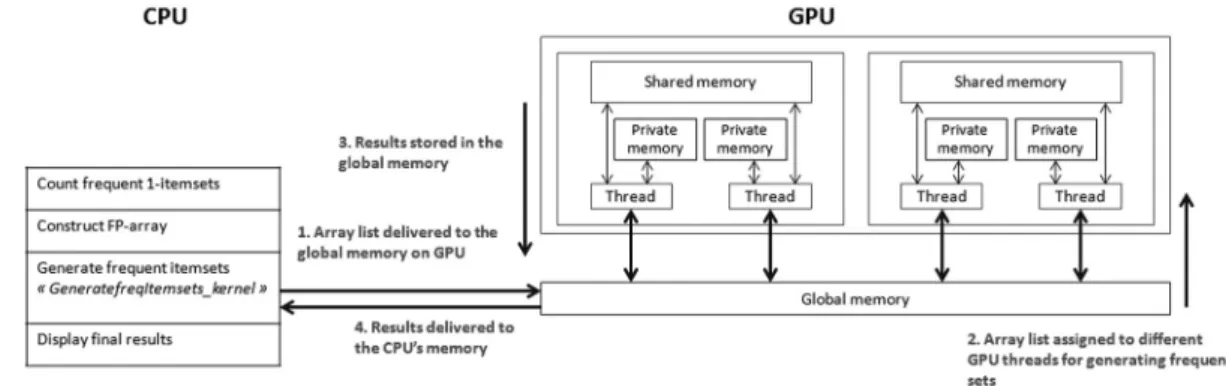
Figure 2.Process of FP-growth+on GPU.
The proposed parallelization of the Generate-FreqItemsets procedure is implemented as a GPU kernel, that processes the array lists in the FP-array, using OpenCL [40]. Since array lists are organized in lines, one dimension in-dex space is enough. Before launching the GPU
GenerateFreqItemsets kernel, the host program defines the kernel’s context and manages its ex-ecution. The largest possible contiguous block of free memory on the GPU is allocated to store generated new structures and results. When the kernel is submitted for execution, the CPU host defines the computation domain, while each in-dependent element of execution in this domain is a work-item (or thread). During the proce-dure, each array list in node arrayis delivered to global memory on GPU and is stored using a vector as shown in Figure 3. The work-items are organized into independent work-groups(or blocks), where each work-item executes con-currently within a single compute unit. Work-items into a work-group work on the same array
list to generate frequent sets corresponding to a giving item. Each work-item is in charge of a portion of the array list, in such way that threads having the consecutive indexes work on consec-utive parts of the array list. New frequent sets are generated by intersecting the old sets with the common prefix in the top of the stack. New projected node array, represented by a set of array lists, and item array corresponding to a given array list are then generated and stored using a vector. An auxiliary index is created to identify the beginning of each array list into the new projectednode arraywhere it is stored. The algorithm expands repeatedly the allocated index space by traversing the array list and con-structing the new projectednode arrayanditem arraystructures. The process is repeated until the projectednode arraycreated is empty. Afterwards, the generated sets are written back to global memory and then copied back to CPU memory. The array lists are deallocated by the
program in order to exploit the memory space to store the new projectednode arrayanditem arraystructures corresponding to the next array list in the originalnode arraymaintained by the host.
6. Experimental Evaluation
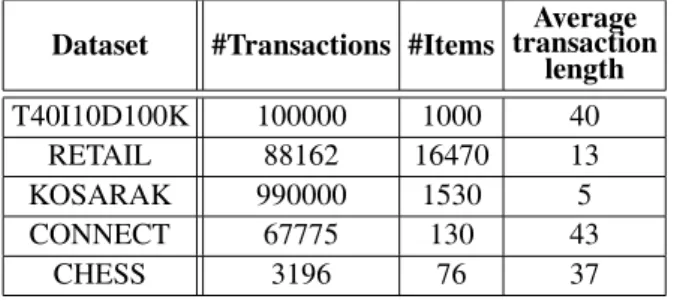
In this section, we evaluate the performance of our implementations. We used several real and synthetic data to compare the execution time of these implementations based on FP-growth al-gorithm with various thresholds. The datasets are downloaded from the Frequent Itemset Min-ing Implementation repository. Table 1 summa-rizes the characteristics of these datasets with different number of items, the number of trans-actions and the average transaction length in each dataset.
Dataset #Transactions #Items transactionAverage length
T40I10D100K 100000 1000 40 RETAIL 88162 16470 13
KOSARAK 990000 1530 5
CONNECT 67775 130 43
CHESS 3196 76 37
Table 1.Database characteristics.
All of the following tests were run on a dual 2.1 GHz Intel Core i3 processor with ATI Radeon GPU and 4 gigabytes of main memory, running on Windows7. The source code was written and compiled using the Visual Studio 2008. The version of OpenCL is 1.1. The running times of different implementations on the test datasets are displayed in Figures 4 and 5.
6.1. FP-growth+on Multi-core Processor
This section analyzes the FP-growth+on multi-core system. For more improving the perfor-mance of this implementation, we used FP-array data structure.
The code is analyzed using the Intel Vtune Am-plifier1, which collects profiling information with hardware-based event sampling. In our case, we consider the CPI ratio(Clock Per In-struction), used as a cumulative performance metric to determine if the execution on a multi-core processor is efficient and how it can be improved further. High values of CPI indicate that the code performs sub-optimally, which can be caused by execution stalls due to branch mis-predictions, cache misses, and other undesirable effects.
The result of analysis of our code is showed in Table 2. We compared the performance charac-teristics of the pointer based FP-growth and our implementation based on FP-array data struc-ture in terms of CPI.
Dataset FP-growth FP-growth+
T40I10D100K 3 1.5
CONNECT 3 1
KOSARAK 2 1.5
CHESS 1.5 1
RETAIL 2 1.5
Table 2.Cache performance: CPI metric.
From Table 2, it is evident that we achieve a sig-nificant performance improvement due to trans-forming FP-tree to the compact data structure FP-array. This result shows that FP-array is a cache friendly structure. It removes point-ers and stores all data sequentially in memory, which improves the cache locality performance. On the other hand, FP-tree based FP-growth employs a pointer based tree structure. These irregular data references will break the data spa-tial locality.
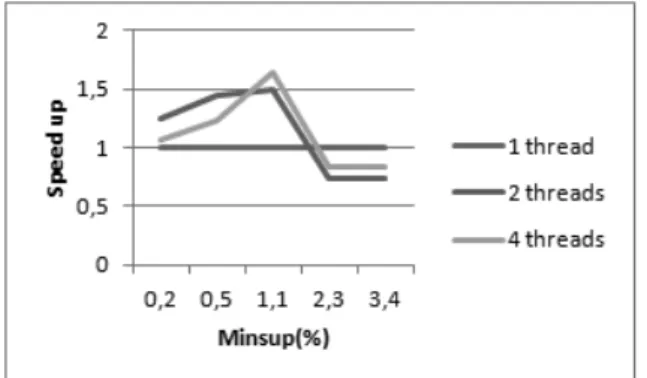
In this section, we compare also the parallel execution time between our proposed FP-array based FP-growth, FP-growth+, and the origi-nal implementation of the same algorithm. In Figure 4, we present the multi-core CPU im-plementation speedup over the sequential CPU version for the datasets Retail, T40I10D100K,
Kosarak and Chess as the support is varied. For the datasets, the proposed solution achieved good scalability while increasing the number of threads.
a)Retail
b)T40I10D100K
c)Chess
d)Kosarak
Figure 4.FP-growth+on multi-core processor.
6.2. FP-growth+on GPU
The FP-growth implementation to GPU is eval-uated in this section. Firstly, Table 3 and Fig-ure 5 present the proposed GPU based FP-growth speedup over the sequential CPU ver-sion as the support is varied. Table 3 and Figure 5 show the absolute execution times for each processor and the datasets Retail and
T40I10D100K.
Dataset Minsup(%) (CPU)Time (GPU) Speed upTime
RETAIL 0.9 4.6 0.26 17.7 1.1 1.75 0.2 8.75 1.7 0.35 0.04 8.75 2.7 0.15 0.03 5 T40I10D100K 15 1.6 0.05 32
16 0.94 0.03 31.3 18 0.19 0.02 9.5
Table 3.Speed up on multi-core processor vs. GPU.
a)Retail
b)T40I10D100K
These results show that our proposed GPU-based FP-growth is much more efficient when compared to the CPU-based version, and is also capable of scaling up the support decreases. Our experiments show that the GPU achi-eved speedup over the sequential FP-growth of 17x and 32x respectively for Retail and
T40I10D100Kdatasets.
Although gains of the GPU version of FP-growth over the CPU-based version still high as the support decreases. Figure 5 shows that the GPU relative performance is high as the support decreases forRetailandT40I10D100K
datasets. This behavior is due to the increasing of occupancy on GPU.
7. Conclusion and Future Works
In this paper, we show that the existing fre-quent itemset mining implementations like FP-growth are still under-utilized on modern pro-cessors due to poor data locality performance and low thread level parallelism. We used FP-array structure to resolve this problem and improve the data locality performance. We presented also a multi-core and a GPU-based implementation of FP-growth algorithm, and also a detailed analysis of algorithm’s perfor-mance on this modern processor. The experi-mentations showed that our proposed solution achieved good scalability while increasing the number of threads. Our GPU-based implemen-tation of the FP-growth algorithm, on the other hand, outperformed the CPU implementation in up to 32x when compared to the sequential ver-sion. As future work, we intend to evaluate the performance of our proposed GPU implemen-tation of FP-growth with less support threshold and to compare the results with the results of other authors.
References
[1] H. JIAWEI, P. JIAN, Y. YIWEN, Mining frequent
pat-terns without candidate generation. InProceedings of the 2000 ACM SIGMOD International Confer-ence on Management of Data,(2000)Dallas, Texas, USA, pp. 1–12.
[2] I. PRAMUDIONO, M. KITSUREGAWA, Parallel
FP-growth on PC Cluster. In Proceedings of the 7th Pacific-Asia Conference on Advances in Knowledge
Discovery and Data Mining, PAKDD’03, (2003)
Seoul, Korea, pp. 467–473.http://dl.acm.org/ citation.cfm?id=1760894.1760956
[3] O. R. ZAIANE, M. EL-HAJJ, P. LU, Fast parallel
association rules mining without candidacy gener-ation.Proceedings of the 2001 IEEE International Conference on Data Mining,(2001).
[4] A. JAVED, A. KHOKHAR, Frequent pattern mining on message passing multiprocessor systems. Dis-tributed and Parallel Databases, 16(3) (2004), 321–334.,
[5] B. MANASKASEMSAK, N. BENJAMAS, A. RUNG -SAWANG, A. SURARERKS, P. UTHAYOPAS, Parallel
association rule mining based on FI-growth algo-rithm. Parallel and Distributed Systems, Interna-tional Conference on,1(2007), 1–8.
http://doi.ieeecomputersociety.org/
10.1109/ICPADS.2007.4447743.
[6] K. AMPHAWAN, A. SURARERKS, An approach of
frequent item tree for association generation. In
Proceedings of Artificial Intelligence and Soft Com-puting,(2005).
[7] H. LI, Y. WANG, D. ZHANG, M. ZHANG, E. Y.
CHANG, Parallel Fp-growth for Query
Recommen-dation.Proceedings of the 2008 ACM Conference on Recommender Systems,(2008)Lausanne, Switzer-land, pp. 107–114.
[8] E. LI, L. LIU, Optimization of Frequent Itemset
Mining on Multiple-Core Processor.Proceedings of the 33rd International Conference on Very Large Data Bases,(2007)University of Vienna, Austria, pp. 23–27.
[9] J. S. PARK, M.-S. CHEN, P. S. YU, An effective hash-based algorithm for mining association rules. InProceedings of the 1995 ACM SIGMOD Interna-tional Conference on Management of Data,(1995), pp. 175–186.
[10] R. AGRAWAL, R. SRIKANT, Fast algorithms for
min-ing association rules. Proceedings of the 20th In-ternational Conference on Very Large Data Bases,
(1994).
[11] R. AGRAWAL, T. IMIELINSKI´ , A. SWAMI, Mining
As-sociation Rules Between Sets of Items in Large Databases.SIGMOD Rec.,22(2) (1993), 207–216.
http://doi.acm.org/10.1145/170036.170072
[12] S. BRIN, R. MOTWANI, C. SILVERSTEIN, Generaliz-ing association rules to correlations.Proceedings of the 1997 ACM SIGMOD international conference on Management of data,(1997), pp. 265–276.
[13] C. SILVERSTEIN, S. BRIN, R. MOTWANI, J. ULLMAN,
Scalable Techniques for Mining Causal Structures.
Data Min. Knowl. Discov.,4(2-3) (2000), 163–192.
http://dx.doi.org/10.1023/A:1009891813863
[14] R. AGRAWAL, R. SRIKANT, Mining Sequential
Pat-terns. Proceedings of the Eleventh International Conference on Data Engineering, ICDE ’95,
[15] H. MANNILA, H. TOIVONEN, A. INKERIVERKAMO,
Discovery of Frequent Episodes in Event Sequences.
Data Min. Knowl. Discov.,1(3) (1997), 259–289.
http://dx.doi.org/10.1023/A:1009748302351
[16] J. HAN, Efficient Mining of Partial Periodic Patterns in Time Series Database.Proceedings of the 15th In-ternational Conference on Data Engineering, ICDE ’99,(1999), pp. 106.http://dl.acm.org/ citation.cfm?id=846218.847205
[17] G. DONG, J. LI, Efficient Mining of
Emerg-ing Patterns: Discovering Trends and Dif-ferences. In Proceedings of the Fifth ACM SIGKDD International Conference on Know-ledge Discovery and Data Mining, KDD ’99,
(1999) San Diego, California, USA, pp. 43–52.
http://doi.acm.org/10.1145/312129. 312191
[18] M. J. ZAKI, S. PARTHASARATHY, M. OGIHARA, W.
LI, New Algorithms for Fast Discovery of
Associ-ation Rules. In Proceedings of the 3rd Intl. Conf. on Knowledge Discovery and Data Mining,(1997), pp. 283–286.
http://www.aaai.org/Library/KDD/1997/ kdd97-060.php
[19] S. BRIN, R. MOTWANI, C. SILVERSTEIN, Beyond
Market Baskets: Generalizing Association Rules to Correlations. SIGMOD Rec., 26(2) (1997), 265– 276.
http://doi.acm.org/10.1145/253262.253327
[20] A. SAVASERE, E. ASHOKANSKI, S. B. NAVATHE, An
Efficient Algorithm for Mining Association Rules in Large Databases. InProceedings of the 21th Interna-tional Conference on Very Large Data Bases, VLDB ’95,(1995), pp. 432–444.http://dl.acm.org/ citation.cfm?id=645921.673300
[21] S. ORLANDO, C. LUCCHESE, P. PALMERINI, R.
PEREGO, F. SILVESTRI, kDCI: a Multi-Strategy
Al-gorithm for Mining Frequent Sets. InProceedings of the Workshop on Frequent Itemset Mining Im-plementations, ICDM 2003, (2003), Melbourne, Florida, USA.http://SunSITE.Informatik. RWTH-Aachen.de/Publications/CEUR-WS// Vol-90/palmerini.pdf
[22] S. ORLANDO, P. PALMERINI, R. PEREGO, F. SIL -VESTRI, An efficient parallel and distributed
al-gorithm for counting frequent sets. InProceedings of VECPAR,(2002).
[23] A. GHOTING, G. BUEHRER, S. PARTHASARATHY, D. KIM, A. D. NGUYEN, Y.-K. CHEN, P. DUBEY, Cache-conscious Frequent Pattern Mining on a Modern Processor. InVLDB(K. B ¨OHM, C. S. JENSEN, L. M.
HAAS, M. L. KERSTEN, P.-A. LARSON, B. C. OOI,
Eds.),(2005)pp. 577–588. ACM.
[24] B. R ´ACZ, nonordfp: An FP-growth variation without
rebuilding the FP-tree. In FIMI, CEUR Workshop Proceedings, (R. J. BAYARDO, B. GOETHALS, M.
J. ZAKI, Eds.), (2004). http://sunsite.info-rmatik.rwth-aachen.de/Publications/ CEUR-WS/Vol-126/racz.pdf
[25] W. FANG, M. LU, X. XIAO, B. HE, Q. LUO,
Fre-quent itemset mining on graphics processors. In
Proceedings of the Fifth International Workshop on Data Management on New Hardware, DaMoN 2009,(2009)Providence, Rhode Island, USA, pp. 34–42.
[26] F. ZHANG, Y. ZHANG, J. D. BAKOS, GPApriori: GPU-Accelerated Frequent Itemset Mining. In Pro-ceedings of the 2011 IEEE International Conference on Cluster Computing (CLUSTER),(2011)Austin, TX, USA, pp. 590–594.
[27] C. SILVESTRI, S. ORLANDO, gpuDCI: Exploiting GPUs in Frequent Itemset Mining. InProceedings of the 20th Euromicro International Conference on Parallel, Distributed and Network-Based Pro-cessing, PDP 2012,(2012)Munich, Germany pp. 416–425.
[28] G. TEODORO, N. MARIANO, W. MEIRAJR., R. FER -REIRA, Tree Projection-Based Frequent Itemset
Mining on Multicore CPUs and GPUs. 22nd In-ternational Symposium on Computer Architecture and High Performance Computing, SBAC-PAD,
(2010)Petropolis, Brazil, pp. 47–54.
[29] N. K. GOVINDARAJU, N. RAGHUVANSHI, D.
MANOCHA, Fast and Approximate Stream
Min-ing of Quantiles and Frequencies UsMin-ing Graphics Processors. InProceedings of the ACM SIGMOD International Conference on Management of Data,
(2005)Baltimore, Maryland, USA, pp. 611–622.
[30] N. GOVINDARAJU, J. GRAY, R. KUMAR, D. MANOCHA, GPUTeraSort: high performance
graph-ics co-processor sorting for large database manage-ment. InProceedings of the 2006 ACM SIGMOD international conference on Management of data, SIGMOD ’06,(2006)Chicago, IL, USA, pp. 325– 336.
[31] N. K. GOVINDARAJU, B. LLOYD, W. WANG, M. C.
LIN, D. MANOCHA, Fast Computation of Database
Operations using Graphics Processors.Proceedings of the ACM SIGMOD International Conference on Management of Data, (2004) Paris, France, pp. 215–226.
[32] B. HE, K. YANG, R. FANG, M. LU, N. K. GOVIN -DARAJU, Q. LUO, P. V. SANDER, Relational joins on
graphics processors.Proceedings of the ACM SIG-MOD International Conference on Management of Data, SIGMOD 2008, (2008) Vancouver, BC, Canada, pp. 511–524.
[33] B. HE, W. FANG, Q. LUO, N. K. GOVINDARAJU, T.
WANG, Mars: a MapReduce framework on
graph-ics processors. 17th International Conference on Parallel Architecture and Compilation Techniques (PACT 2008),(2008)Toronto, Ontario, Canada, pp. 260–269.
[34] S. CHE, M. BOYER, J. MENG, D. TARJAN, J. W.
SHEAFFER, K. SKADRON, A performance study of
[35] R. C. AGARWAL, C. C. AGGARWAL, V. V. V. PRASAD,
A Tree Projection Algorithm for Generation of Frequent Item Sets. J. Parallel Distrib. Comput.,
6K1(3) (2001), 350–371.
[36] A. GHOTING, G. BUEHRER, S. PARTHASARATHY, D.
KIM, A. D. NGUYEN, Y.-K. CHEN, P. DUBEY,
Cache-conscious Frequent Pattern Mining on a Modern Processor. Proceedings of the 31st International Conference on Very Large Data Bases, (2005)
Trondheim, Norway, pp. 577–588.
[37] M. J. ZAKI, Y. GUO, R. GROSSMAN, Parallel Data
Mining for Association Rules on Shared-memory Systems. Knowledge and Information Systems,
(1998).
[38] J. TOMPSON, K. SCHLACHTER, An Introduction to
the OpenCL Programming Model, 2012.
[39] F. ZHANG, Y. ZHANG, J. D. BAKOS, Accelerating
fre-quent itemset mining on graphics processing units.
The Journal of Supercomputing,66(1) (2013), 94–
117.
http://dx.doi.org/10.1007/s11227-013-0887-x
[40] J. TOMPSON, K. SCHLACHTER, An Introduction to
the OpenCL Programming Model, 2012.
Received:February, 2014
Revised:June, 2014
Accepted:July, 2014
Contact addresses:
Khedija Arour Computer Science Department National Institute of Applied Sciences and Technology 1080 Tunis Tunisia e-mail:[email protected] Amani Belkahla Computer Science Department Faculty of Sciences of Tunis 1060 Tunis Tunisia e-mail:[email protected]
KHEDIJAAROURreceived his Engineering diploma and Ph.D. degree from the Department of Computer Science of the Science Faculty of Tunis, Tunisia in 1992 and 1996, respectively. She is currently an assistant professor in the Department of Computer Science and Math-ematics at National Institute of Science and Applied Technology of Tunis, Tunisia, Carthage University. Dr. Arour’s research interests are mainly in haute performance data mining and large scale information retrieval systems.