595
EXPLORING FUNCTIONAL AND NON-FUNCTIONAL
REQUIREMENTS OF SOCIAL MEDIA ON KNOWLEDGE
SHARING
1 LIMING WU, 2 NORAINI CHE PA, 3 RUSLI ABDULLAH, 4 WAN NURHAYATI AB.RAHMAN,
5
MCXIN TEE
1,2,3,4,5 Department of Software Engineering and Information System, Faculty of Computer Science and
Information Technology, Universiti Putra Malaysia (UPM), Selangor Serdang 43400, Malaysia
1 College of Management, HeBei University, BaoDing 071002, China
E-mail: 1 wlming2000 @126.com, 2[email protected], 3rusli @upm.edu.my, 4wnurhayati
@upm.edu.my, 5[email protected]
ABSTRACT
Social media (SM) are designed for easily online information sharing and communicating among people, and the sites relate to entertainment, educational and business domains. From requirement elicitation and analysis, social media provide effective communication and sharing on the knowledge and information of system development among stakeholders. This paper aims to identify the relevant functional and non-functional requirements for knowledge sharing (KS), and explore the relationships between the requirements and perceived social media to support knowledge sharing. Hence, a survey was conducted that involve software requirements practitioners in order to gather the requirements on KS. Besides that, partial least squares (PLS) method was used to evaluate the hypothesis and research model. The findings of this study represented that there was a positive and strong relationship between functional requirements and Perceived SM to support requirements knowledge sharing (RKS), however, non-functional requirements has a weak relationship with Perceived SM to support RKS.
Keywords: Social Media, Functional, Non-functional, Requirements, Knowledge Sharing
1. INTRODUCTION
At the edge of technology expansion, it seems that social media become a platform for individuals or organizations creating, sharing, exchanging, discussing information, ideas and pictures or videos [1,2]. There are some types of social media tools are widely used in this model society, which include Facebook, Twitter, LinkedIn, Google+, YouTube, WeChat, WhatsApp, Blogs and Email [3].
Todays, people expend their time by the use of social media to make friends with others, keep in touch with others, notice trend, express opinions, measure feelings on issues, check updates, and do business. These behaviors are allowed based on the following functions of social media, which are identity, conversations, presence, relationships and reputation [2].
Recently, social media has been applied for knowledge sharing based on the functions of communication and sharing. Knowledge sharing is a process of knowledge seeking, knowledge
acquiring, knowledge sharing, and knowledge transferring. The process is combined interaction and communication process together. During this process, the individuals are able to share experience, ideas of problem solution, information and resource, knowledge know-how, and knowledge know-what on social media [4,5,6]. Therefore, regarding social media as a platform, the related work on knowledge sharing has been discussed by many researchers. Via weblog, the factors that affect knowledge sharing behavior had been explored [7]. According to the functions of Blog, a design of individual knowledge sharing platform was developed [8]. The correlation between Wikipedia and knowledge sharing on job performance was examined [9]. The concept of Communities of Practice (CoPs) had been highlighted as an effective method for knowledge sharing by many organizations [25].
596 of posting, chatting, creating groups. However, the main objective of social media is designed for keeping social relationships among people, and it is not developed only for knowledge sharing. Therefore, it has limitations to use social media functions to support knowledge sharing. This gives us the motivation to examine the functional and non-functional requirements of social media that relate to supporting knowledge sharing. However, lack of research highlights this aspect.
In the field of requirements elicitation and analysis, there has involve communicating among stakeholders on requirements information such as functionalities and non-functionalities of the system. In order to obtain a correct, complete, reliability and understanding of requirements, the stakeholders and software developers should communicate and share their knowledge with each other. However, the main problem in requirements elicitation is lacking of adequate communication and shared understanding [11, 12]. Based on this premise, we noticed that several problems can be partially solved or mitigate by using social media for communicating on requirements information.
To resolve the problem in requirements elicitation and analysis, it needs to enhance the quality of communication and sharing of requirements knowledge. Social media has proven to be useful as a platform on which information can be shared during requirements elicitation and analysis [10]. The feasibility of using popular social media (i.e. Facebook) to support end users to participate in requirements elicitation and analysis was discussed [13]. The issues regarding social media-supported approaches need to be identified clearly. However, there is a lack of discussion by researchers on examining how the functional and non-functional requirements of social media to support knowledge sharing. To address this research gap, this paper aims to identify the requirements of social media towards supporting knowledge sharing. According to that identification of requirements, this paper will propose and evaluate a research model to investigate the relationships of functional and non-functional requirements with supporting knowledge sharing at social media. The following research questions (RQ) define the focus of this research:
RQ1: What are the functional requirements of social media towards supporting knowledge sharing?
RQ2: What are the non-functional requirements of social media towards supporting knowledge sharing?
RQ3: What are the functional requirements of social media towards supporting knowledge sharing?
This paper is organized as follows. In section 2, the related work on functional and non-functional requirements of social media, requirement elicitation and analysis, and knowledge sharing are given. Section 3 proposes research model and hypothesis. Section 4 describes research methodology. Data analysis and result are discussed in section 5. The paper concludes with future work in section 6.
2. LITERATURE REVIEW
2.1 Requirement Elicitation And Analysis
Requirement Elicitation is the first phase of requirement engineering which include four phases, namely requirements elicitation, requirements documentation, requirements validation and verification, and requirements management [14,20]. Requirement elicitation is the activity of eliciting the relevant requirements from different stakeholders. The raw requirements mainly gathered from the various viewpoints of customers, other requirements obtained from sponsors, developers, quality assurance teams, analyst, business objectives, system operating environment, the constraints, and marketing environment [14, 15].
Requirement analysis is the process of examining the high level requirements. In this process, the requirements are determined to see whether they are clear, complete, and free of contradictions. If there are some issues on that, it needs to define the strategy to resolve the issues [16]. There are a set of activities to check the obtained requirements in this phase, which involve checking the needs of stakeholders, the consistency of expressed requirements, the completeness of requirements, and the feasibility of requirements [17].
597 acquisition, knowledge sharing, knowledge negotiating, knowledge integration, and knowledge acceptance [19, 21].
The techniques for requirement elicitation comprise Interview, Use Case, Observation and social analysis, Focus group, Brainstorming and prototyping [17].
2.2 Knowledge Sharing
Knowledge sharing is a process to share and exchange knowledge among individuals, teams and organizations [4,5]. In this process, the knowledge or resource are given by one individual or organization and received by another, actually, the knowledge should be passed between knowledge source and recipient [22]. Hence, knowledge sharing involves senders, receivers and techniques [23].
The knowledge sharing behaviors are discussed on some social media platform. From the perspective of why people decide to give or acquire knowledge with others, the paper proposed knowledge sharing behaviors including knowledge contributing and knowledge collecting [24]. The shared knowledge derives from the knowledge owner, and received by knowledge demander, the behaviors are involved knowledge transfer, knowledge sending and knowledge receiving [8]. The communication path for exchanging knowledge, the identification of needs for knowledge, and the constraints for sharing knowledge are highlighted before knowledge sharing [26]. In order to keep continued knowledge sharing, the factors of driving knowledge contribution and knowledge seeking are discussed [27].
2.3 Functional Requirements Of Social Media
Social media are computer-mediated tools, and social media can be taken as high interactive platform for people to create, share and exchange information, knowledge, and other resources [1, 2].
Functional requirements describe what the software system should do. The functional requirements mainly are the statements of the services that the system should provide, how the system react to inputs, and how the system should behave in some particular situations [28].
There are six groups of functionalities of social network which are discussed to facilitate the modularization and integration of different social network applications. The six basic functionalities consist of identity management, expert finding, context awareness, contact management, network awareness, and exchange [29].
A survey was done to show the universal features of social network, the basic elements involved social actors, social relations, content, communication tools, privacy and content visibility, ratings, activities timeline, wall, home, and profile [30].
2.4 Non-Functional Requirements Of Social
Media
Non-functional requirements are the constraints of the services provided by software system. With different definition to functional requirements, the non-functional requirements are not directly describe the specific services of software system, and they usually describe how good the software system does. The constraints are involved of the constraints on development process, standards, and time [28].
The non-functional requirements in software engineering are discussed by some authors. They are involved in usability, reliability, security, availability, portability, operability, maintainability, flexibility, and efficiency [28, 31, 32, 33].
3. RESEARCH MODEL AND HYPOTHESIS
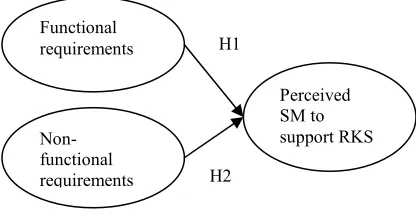
[image:3.612.323.531.595.700.2]The research model is provided in Figure 1. This model is comprised of three components which are Functional requirements, Non-Functional requirements, and Perceived social media (SM) to support knowledge sharing (KS). The purpose of this paper is to identify the functional requirements and non-functional requirements of social media towards supporting knowledge sharing. Furthermore, this model is divided into two parts. The first part is to explore the quantitative relationship between the functional requirements and perceived SM to support KS. The second part is to explore the quantitative relationship between non-functional requirements and perceived SM to support requirement knowledge sharing (RKS).
Figure 1: Research Model Functional
requirements
Non-functional requirements
Perceived SM to support RKS H1
598
3.1 Functional Requirements Of Social Media
Toward Knowledge Sharing
According to the definition of social media [1, 2], social media is taken as a tool to allow individuals or organizations share and exchange information or knowledge. The identification of information requirements is very important to enhance knowledge sharing [26]. For requirements elicitation and analysis, the developers and customers must collaborate to get the right requirements. They need to recognize the knowledge needed based on the tasks, the objectives, the constraints. The functionalities of new knowledge added, information changing, knowledge providing, knowledge searching are important for knowledge sharing. Offering a consultation service is highlighted as a functional requirement of knowledge sharing [34]. For sharing knowledge with others, the individuals need the functionalities of interaction, communication, discussion, commenting, and chatting. The functional requirements related to knowledge sharing are summarized as the followings: managing information, searching information, notification of information changing, exchanging information and knowledge, communicating information and knowledge, group discussion, comment, sharing and discussing. The set of functional requirements will lead to the successfully sharing behaviors of software developers and customers at social media. This leads to the following hypothesis.
H1: Functional requirements are positively related to Perceived social media to support knowledge sharing.
3.2 Non-functional Requirements Of Social
Media Toward Knowledge Sharing
According to the definition of non-functional requirements [28], these requirements are the critical constraints to show how good the system services are provided. Although knowledge sharing is a process of exchanging and sharing knowledge, to achieve that, some non-functional requirements are demanded by individuals. Usability, which describes how the software system designed to be easily understood, learned, and used, is an important non-functional requirement [35]. When individuals share knowledge through social media, they want the software system is secure for the shared information and knowledge. They also hope the responds from the software system are efficient. The software system need developed to be strong to
resist errors. Moreover, the software system need developed easily to add new functionalities and delete unwanted capabilities. The set of non-functional requirements leads to the following hypothesis.
H2: Non-Functional requirements are positively related to Perceived social media to support knowledge sharing.
4. RESEARCH METHODOLOGY
In this research, we carry out a primary study to propose a model. In order to test the research model, a survey of using questionnaire was done. Furthermore, the method of partial least squares (PLS) was used to evaluate the hypothesis and research model.
4.1 Measurements
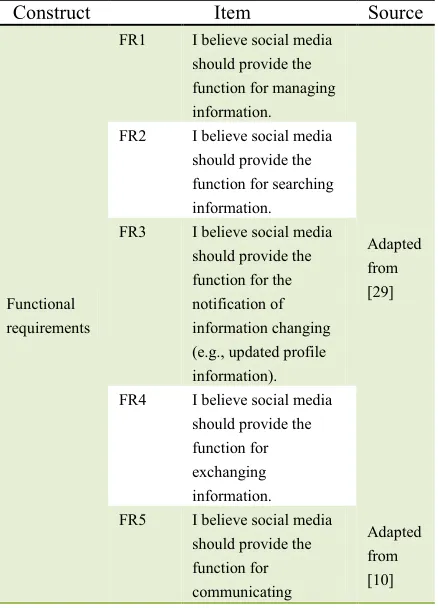
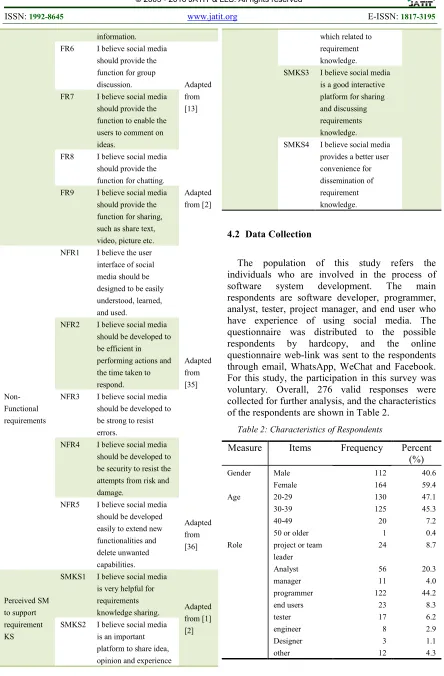
[image:4.612.310.529.422.726.2]The items in this questionnaire were developed based on literature review. Some items come from the core idea of other measures that were previously validated; other items were developed according to the relevant definition. There are three constructs and 18 items in the research model, as shown in table 1. All variables were measured using Likert scales (1= strongly disagree, 2=disagree, 3=agree, 4=strongly agree).
Table 1: Questionnaire Items
Construct Item Source
Functional requirements
FR1 I believe social media
should provide the function for managing information.
Adapted from [29]
FR2 I believe social media
should provide the function for searching information.
FR3 I believe social media
should provide the function for the notification of information changing (e.g., updated profile information).
FR4 I believe social media
should provide the function for exchanging information.
FR5 I believe social media
should provide the function for communicating
599
information.
FR6 I believe social media
should provide the function for group
discussion. Adapted
from [13]
FR7 I believe social media
should provide the function to enable the users to comment on ideas.
FR8 I believe social media
should provide the function for chatting.
Adapted from [2]
FR9 I believe social media
should provide the function for sharing, such as share text, video, picture etc.
Non-Functional requirements
NFR1 I believe the user interface of social media should be designed to be easily understood, learned, and used.
Adapted from [35] NFR2 I believe social media
should be developed to be efficient in performing actions and the time taken to respond.
NFR3 I believe social media should be developed to be strong to resist errors.
NFR4 I believe social media should be developed to be security to resist the attempts from risk and damage.
NFR5 I believe social media should be developed easily to extend new functionalities and delete unwanted capabilities.
Adapted from [36]
Perceived SM to support requirement KS
SMKS1 I believe social media is very helpful for requirements
knowledge sharing. Adapted
from [1] [2] SMKS2 I believe social media
is an important platform to share idea, opinion and experience
which related to requirement knowledge. SMKS3 I believe social media
is a good interactive platform for sharing and discussing requirements knowledge. SMKS4 I believe social media
provides a better user convenience for dissemination of requirement knowledge.
4.2 Data Collection
[image:5.612.86.530.65.741.2]The population of this study refers the individuals who are involved in the process of software system development. The main respondents are software developer, programmer, analyst, tester, project manager, and end user who have experience of using social media. The questionnaire was distributed to the possible respondents by hardcopy, and the online questionnaire web-link was sent to the respondents through email, WhatsApp, WeChat and Facebook. For this study, the participation in this survey was voluntary. Overall, 276 valid responses were collected for further analysis, and the characteristics of the respondents are shown in Table 2.
Table 2: Characteristics of Respondents
Measure Items Frequency Percent
(%)
Gender Male 112 40.6
Female 164 59.4
Age 20-29 130 47.1
30-39 125 45.3
40-49 20 7.2
50 or older 1 0.4
Role project or team
leader
24 8.7
Analyst 56 20.3
manager 11 4.0
programmer 122 44.2
end users 23 8.3
tester 17 6.2
engineer 8 2.9
Designer 3 1.1
600
SM using frequency
Almost everyday
262 94.9
Several times a week
10 3.6
Several times a month
2 0.7
Seldom 2 0.7
5. DATA ANALYSIS AND RESULTS
The suggested model in this study was evaluated via partial least squares (PLS). PLS-SEM is a common technique used to analyze the path coefficient between latent variables. PLS is involved in two phases: 1) the assessment of the measurement model, which includes the measures of reliability and discriminant validity. 2) The assessment of the structural model, which is comprise of the measurements on path coefficients and R square values.
5.1Measurement Model
Reliability is the consistency of a set of measurements, and it is the degree to which a variable or concept is measured consistently. Cronbach’s alpha is one of the most commonly used indicators of internal consistency. Values above 0.7 are considered acceptable; however, values above 0.8 are preferable [37]. From table 4, the Cronbach’s alpha values for each of the constructs range from 0.865 to 0.913, all of which exceeded the suggested threshold value of 0.7.
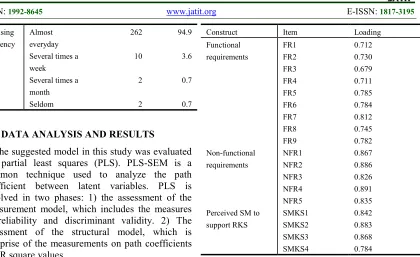
[image:6.612.107.527.70.327.2]Convergent validity and discriminant validity were evaluated to validate the measurement model. Using PLS, the composite reliability (CR), average variance extracted (AVE), and factor loadings were calculated to assess the convergent validity. The minimum recommended level of composite reliability is 0.708 [38], and 0.5 is the minimum acceptable level of the AVE [39], the loadings of each of indicators should be higher than 0.708 in PLS-SEM [38]. From Table 3, only one indicator (FR3-0.679) failed to meet the threshold value of 0.708, other factor loadings range from 0.711 to 0.891. However, this indicator with low loading is retained because, on average, convergent validity has been achieved for each of constructs. In this study, composite reliability and AVE were above the threshold values. As shown in Table 4, the composite reliability (CR) values range from 0.909 to 0.935, the AVE values range from 0.563 to 0.742. Therefore, the indicator FR3, was retained
Table 3: Factor Loading
Construct Item Loading
Functional requirements
FR1 0.712
FR2 0.730
FR3 0.679
FR4 0.711
FR5 0.785
FR6 0.784
FR7 0.812
FR8 0.745
FR9 0.782
Non-functional requirements
NFR1 0.867
NFR2 0.886
NFR3 0.826
NFR4 0.891
NFR5 0.835
Perceived SM to support RKS
SMKS1 0.842
SMKS2 0.883
SMKS3 0.868
SMKS4 0.784
Table 4: Internal Consistency and Convergent Validity of Research Model
Construct Cronba
ch’ Alpha
Composite reliability (CR)
AVE Convergent
Validity (AVE > 0.5) Functional
requirements
0.902 0.920 0.563 Yes
Non-functional requirements
0.913 0.935 0.742 Yes
Perceived SM to support RKS
[image:6.612.310.527.370.494.2]0.865 0.909 0.714 Yes
Table 5: Correlation Between Constructions
Perceived SM to support RKS
Functional requirements
Non-functional requirements
Perceived SM to support RKS
0.845
Functional
requirements 0.473 0.750
Non-functional requirements
0.356 0.614 0.861
Note: Diagonal elements shaded and highlighted in bold represent the square root of AVE. Off diagonal elements are simple bivariate correlations between the constructs.
601 variable and other latent variable (by row and by column). In Table 5, for each construct, the square root of the AVE value was larger than the correlation coefficient values with any other variable; consequently, it was verifying the discriminant validity of this study.
5.2Structural Model
In this section, we use PLS-SEM to examine the hypothesis. The structural model is useful in indicating the interrelationship between exogenous and endogenous variables. The path coefficients and R2 values were calculated to test the structural equation model. The path coefficients indicate the strengths of the relationships between the endogenous and independent variables. The R2 values represent the amount of variance explained by the independent variables. As shown in Fig.2, this model interprets 23.1% of the variance in the variable “Perceived SM to support RKS”. Fig.2 demonstrates the results of the path coefficients, and t value. For the level of acceptance, p value should less than 0.05, and t value need larger than 1.645 [38]. In Fig.2, the path coefficient (ß) from Functional requirements to Perceived SM to support RKS is positive, and it is statistically significant (ß=0.408, t value=5.757>1.645, p value=0.000<0.01). This means that Functional requirements have a positive effect on Perceived SM to support RKS, thus verifying hypothesis 1. The path coefficient (ß) from Non-functional requirements to Perceived SM to support RKS is positive, but, it is no statistically significant (ß=0.106, t value=1.509<1.645, p value=0.066>0.05). This means non-functional requirements have an insignificant effect on Perceived SM to support RKS. Therefore, hypothesis 2 is not supported. The results of hypothesis testing using PLS are summarized in Table 6.
Figure 2: Results of SEM analysis
Table 6: Results of hypothesis testing
Hypothesis Result
H1: Functional requirements are positively related to Perceived social media to support knowledge sharing
supported
H2: Non-Functional requirements are positively related to Perceived social media to support knowledge sharing.
Not supported
6. DISCUSSION AND CONCLUSIONS
Social media has been popular used for individuals and organizations to share and exchange information. The functionality of social media is highlighted for knowledge sharing. This paper discussed the functional and non-functional requirements of social media toward requirements knowledge sharing. The related functional requirements for supporting knowledge sharing are the notification of knowledge changing (i.e. new added knowledge, modification, new posting), knowledge managing, knowledge sharing, communicating, discussion, and knowledge searching. The non-functional requirements are involved of usability, security, efficiency, and robust. Then, this paper proposed research model and hypothesis, and using PLS-SEM to evaluate the model. The findings show that functional requirements of social media is positively related with Perceived SM to support KS, however, non-functional requirements has insignificant effect on that.
There are some functional requirements identified in this study are similar with some requirements described in current literature. The requirements of “knowledge changing notification”, “knowledge searching” and “knowledge communication and discussion” were pointed out in this study. Approximately, [34] indicated the functional requirements of knowledge sharing system including “alerting users about new added”, “offering a consultation service”, and “offering an efficient search engine”. For non-functional requirements, the “easy to use” and “reliability” were both emphasized in this and [34]. However, the fields of the two studies are different. This study discussed the requirements of knowledge sharing at social media in the requirements elicitation and analysis environment. [34] only discussed the requirements of a knowledge sharing system at public academic institution.
In addition, this study explored the general requirements of social media for knowledge sharing which could be used for various types of social
Functional requirements
Non-functional requirements
Perceived SM to support RKS
R2=0.231 0.408**
t=5.757
0.106 t=1.509
602 media. The functional and non-functional requirements analyzed in this study provide the examples of detail requirements which can be widely used at social media. It is important that functional requirements have positively significant effect on knowledge sharing. The non-functional requirements are important for software system; however, they have no significant effect on the supporting for knowledge sharing. The findings of this study are expected benefit to both researchers and practitioners. First, this study reveals an insight process to analyze and evaluate the relationship between the requirements of social media and perceived supporting knowledge sharing. Second, this study provides a guideline of what are the general requirements towards knowledge sharing for the software developers. From a theoretical point of view, this study address the gap that existing in the field of requirements of knowledge sharing on social media. From a practical point of view, the software developers can understand the requirements of knowledge sharing deeply, and get more experience of eliciting requirements of social media for supporting knowledge sharing.
Despite the usefulness of the findings, this study still has limitations. This study discussed the general requirements of social media. As there are many types of social media (Weblog, Facebook, YouTube, WeChat, WhatsApp, Virtual community of Practice, etc) which have different functionalities in detail, the requirements identified in this study cannot generalized to represent all requirements related to knowledge sharing on different social media. This study only analyzed the relationship between functional, non-functional requirements with Perceived SM to support KS as a whole, and it did not explore the relationships of each of requirements with supporting knowledge sharing.
In the future work, the requirements of social media for supporting knowledge sharing will be gathered from the real case of developing one type of social media. The research model will be evaluated using a large of data. In addition, the importance of each of requirements of social media for supporting knowledge sharing will be further examined using the large data.
ACKNOWLEDGMENTS
We are grateful for the ministry of education Malaysia for their financial support for this research
REFRENCES:
[1] A. M. Kaplan and M. Haenlein, “Users of the world, unite! The challenges and opportunities of Social Media,” Bus. Horiz., vol. 53, 2010, pp.
59–68.
[2] J. H. Kietzmann, K. Hermkens, I. P. McCarthy, and B. S. Silvestre, “Social media? Get serious! Understanding the functional building blocks of social media,” Bus. Horiz., vol. 54, no. 3,2011,
pp. 241–251.
[3] N. Eyrich, M. L. Padman, and K. D. Sweetser, “PR practitioners’ use of social media tools and communication technology,” Public Relat. Rev.,
vol. 34, no. 4, 2008, pp. 412–414.
[4] X. Chen, X. Li, J. G. Clark, and G. B. Dietrich, “Knowledge sharing in open source software project teams: A transactive memory system perspective,” Int. J. Inf. Manage., vol. 33, no. 3,
2013, pp. 553–563.
[5] M. Z. M. Nor, M. H. Selamat, R. Abdullah, and M. A. A. Murad, “Knowledge Sharing Interactions in Collaborative Software Maintenance Environment,” in Proceedings of the 2009 International Conference on Computer Technology and Development, Vol 2, 2009, pp.
201–205.
[6] R. Abdullah and A. M. Talib, “Knowledge management system model in enhancing knowledge facilitation of Software Process Improvement for Software House Organization,” Proc. - 2012 Int. Conf. Inf. Retr.
Knowl. Manag. CAMP’12, no. July 2015, 2012,
pp. 60–63.
[7] T. K. Yu, L. C. Lu, and T. F. Liu, “Exploring factors that influence knowledge sharing behavior via weblogs,” Comput. Human Behav.,
vol. 26, no. 1, 2010, pp. 32–41.
[8] Z. Qun and Z. Xiaocheng, “The Design of Individual Knowledge Sharing Platform Based on Blog for Online Information Literacy Education,” Phys. Procedia, vol. 33, 2012, pp.
1426–1432.
[9] S. M. Tseng and J. S. Huang, “The correlation between Wikipedia and knowledge sharing on job performance,” Expert Syst. Appl., vol. 38,
no. 5, 2011, pp. 6118–6124.
[10] A.Tapiador, & D.Carrera. A survey on social network sites’ functional features. IADIS International Conference WWW/Internet 2012,
2012, pp. 1–16.
603
Work in Design, 2007. CSCWD 2007. 11th International Conference on IEEE, 2007, pp.
734-739.
[12] J.Coughlan, & R. D.Macredie. Effective communication in requirements elicitation: a comparison of methodologies. Requirements Engineering, 7(2), 2002, pp. 47-60.
[13] N.Seyff , I.Todoran, K.Caluser, L.Singer, & M. Glinz. Using popular social network sites to support requirements elicitation, prioritization and negotiation. Journal of Internet Services and Applications, 6(1), 2015, pp. 1–16.
[14] D.Pandey, U.Suman, & A. K.Ramani. An effective requirement engineering process model for software development and requirements management. In Advances in Recent Technol ogies in Communication and Computing (ARTCom), 2010 International Conference on IEEE, 2010, pp. 287-291.
[15] L.Wu, N.C.Pa, R.Abdullah, W. N. W. A.Rahman, "An analysis of knowledge sharing behaviors in requirement engineering through social media." 2015 9th Malaysian Software
Engineering Conference (MySEC). IEEE,
2015. pp. 93-98.
[16] Sofia, “Software Development Process-activities and steps,” London: Springer London,
2010, pp. 1–42.
[17] F. Paetsch, A. Eberlein, and F. Maurer, “Requirements engineering and agile software development,” in WET ICE 2003. Proceedings. Twelfth IEEE International Workshops on Enabling Technologies: Infrastructure for Collaborative Enterprises, 2003, pp. 1–6.
[18] D.Zowghi, & C.Coulin. Requirements elicitation: A survey of techniques, approaches, and tools. In Engineering and managing
software requirements. Springer Berlin
Heidelberg, 2005, pp. 19-46.
[19] J.Coughlan, M.Lycett, & R. D. Macredie. Communication issues in requirements elicitation: a content analysis of stakeholder experiences. Information and Software Technology, 45(8), 2003, pp. 525-537.
[20] W. Wan Ab. Nurhayati , Asma B.Kamal, Hazliana.Talha, W.Liming, M.Sakinah, Nur Rosli. Software Quality Assurance – E-commerce Customers Satisfaction in Requirements Engineering Process.
International Journal of Software Engineering and Its Applications. Vol. 9, No. 3, 2015, pp.
57-70.
[21] D. B.Walz, J. J.Elam, & B. Curtis. Inside a software design team: knowledge acquisition,
sharing, and integration. Communications of the ACM, 36(10),1993, pp. 63-77.
[22] M.Sharratt, & A. Usoro. Understanding Knowledge-Sharing in Online Communities of Practice. Electronic Journal on Knowledge Management, 1(2), 2003, pp. 187–196.
[23] N., Nor, R. N. H.Che Pa, & Y. Y. Jusoh. A study on knowledge dissemination of hospital web-based application. International Journal of Computer and Information Technology, 2(1),
2013, pp. 152-157.
[24] C. J. Chen and S. W. Hung, “To give or to receive? Factors influencing members’ knowledge sharing and community promotion in professional virtual communities,” Inf. Manag., vol. 47, no. 4, 2010, pp. 226–236.
[25] S.J.Kim, J.Y.Hong, E.H.Suh, A diagnosis framework for identifying the current knowledge sharing activity status in a community of practice[J]. Expert Systems with Applications, 39(18) , 2012, pp.13093-13107.
[26] S. Garrett and B. Caldwell, “Describing functional requirements for knowledge sharing communities.,” Behav. Inf. Technol., vol. 21,
2013, pp. 359–364.
[27] W. He and K. K. Wei, “What drives continued knowledge sharing? An investigation of knowledge-contribution and -seeking beliefs,”
Decis. Support Syst., vol. 46, no. 4, 2009, pp.
826–838.
[28] I. Sommerville. SOFTWARE
ENGINEERING(Ninth Edition). (M. Horton, Ed.). Pearson Education, 2009. pp.
[29] A.Richter, & M.Koch. Functions of Social Networking Services. Proceedings of the Eighth International Conference on the Design of Cooperative Systems (COOP 08), 2008, pp. 87–
98.
[30] A.Tapiador, & D.Carrera. A survey on social network sites’ functional features. IADIS International Conference WWW/Internet 2012,
2012, pp.1–16.
[31] Martin Glinz. On Non-Functional Requirements. In Proceedings - 15th IEEE
International Requirements Engineering
Conference, RE 2007,2007, pp. 21–26.
[32] L.Chung. Non-Functional Requirements. IEEE Definition Development and Evaluate for the Customer prior to NFRs : NFRs :, 2000, pp. 1–
26.
604 from Text Categories and Subject Descriptors, 2014, pp. 1–8.
[34] S.Alsaleh, & H.Haron. The Most Important Functional and Non-Functional Requirements of Knowledge Sharing System at Public Academic Institutions: A Case Study. Lecture Notes on Software Engineering, 4(2), 2016, pp.
157–161.
[35] D.Alonso-Ríos, A.Vázquez-García, E.Mosqueira-Rey, & V.Moret-Bonillo. Usability: A Critical Analysis and a Taxonomy.
International Journal of Human-Computer Interaction, 26(1),2010, pp. 53–74.
[36] W.Ding, P.Liang, A.Tang, & H.van Vliet. Knowledge-based approaches in software documentation: A systematic literature review.
Information and Software Technology, 56(6),
2014, pp. 545–567.
[37] J. W. Creswell. Research design: Qualitative, quantitative, and mixed methods approaches. Sage publications, 2013.
[38] J. F.Hair, T. M.Hult, C. M.Ringle, & M. Sarstedt. A primer on partial least square structural equation modeling (PLS-SEM): Sage Publications, 2014.
605
APPENDIX A.
Survey Questionnaire Items in This Study
Part A: Respondent Background (Please √ the
answer)
1. What is your gender? Male
Female
2. What is your age? 19 or younger 20-29 30-39 40-49 50 or older
3. What is your role?
Project or team leader Analyst
Manager programmer End Users
others (please specify)
4. How often do you use social media? Almost everyday
Several times a week Several times a month seldom
never
Part B: Functional, non-functional
requirements of social media to support knowledge sharing
Please choose your answer according to the Likert scale given. 1-Strongly Disagree; 2-Disagree; 3-Agree; 4-Strongly Agree
No. Item
Functional requirements towards knowledge sharing
1 FR1. I believe social media should provide the function for managing information.
2 FR2. I believe social media should provide the function for searching information.
3 FR3. I believe social media should provide the function for the notification of information changing (e.g., updated
profile information).
4 FR4. I believe social media should provide the function for exchanging information.
5 FR5. I believe social media should provide the function for communicating information.
6 FR6. I believe social media should provide the function for group discussion.
7 FR7. I believe social media should provide the function to enable the users to comment on ideas.
8 FR8. I believe social media should provide the function for chatting. 9 FR9. I believe social media should
provide the function for sharing, such as share text, video, picture etc.
Non-Functional requirements towards
knowledge sharing
1 NFR1. I believe the user interface of social media should be designed to be easily understood, learned, and used. 2 NFR2. I believe social media should be
developed to be efficient in performing actions and the time taken to respond. 3 NFR3. I believe social media should be
developed to be strong to resist errors. 4 NFR4. I believe social media should be
developed to be security to resist the attempts from risk and damage.
5 NFR5. I believe social media should be developed easily to extend new functionalities and delete unwanted capabilities.
Perceived SM to support RKS
1 SMKS1. I believe social media is very helpful for requirements knowledge sharing.
2 SMKS2. I believe social media is an important platform to share idea, opinion and experience which related to requirement knowledge.
3 SMKS3. I believe social media is a good interactive platform for sharing and discussing requirements knowledge. 4 SMKS4. I believe social media provides