Quality of Service Issues for
Reinforcement Learning Based Routing
Algorithm for Ad-Hoc Networks
Shrirang Ambaji Kulkarni
1and G. Raghavendra Rao
21Gogte Institute of Technology, Karnataka, India 2National Institute of Engineering, Karnataka, India
Mobile ad-hoc networks are dynamic networks which are decentralized and autonomous in nature. Many rout-ing algorithms have been proposed for these dynamic networks. It is an important problem to model Quality of Service requirements on these types of algorithms which traditionally have certain limitations. To model this scenario we have considered a reinforcement learning algorithm SAMPLE. SAMPLE promises to deal effec-tively with congestion and under high traffic load. As it is natural for ad-hoc networks to move in groups, we have considered the various group mobility models. The Pursue Mobility Model with its superior mobility metrics exhibits better performance. At the data link layer we have considered IEEE 802.11e, a MAC layer which has provisions to support QoS. As mobile ad-hoc networks are constrained by resources like energy and bandwidth, it is imperative for them to cooperate in a reasonably selfish manner. Thus, in this paper we propose coop-eration with a moderately punishing algorithm based on game theory. The proposed algorithm in synchronization with SAMPLE yields better results on IEEE 802.11e.
Keywords: Quality of Service, reinforcement learning based routing protocol, group mobility models, routing metrics, game theory
1. Introduction
IEEE 802.11e provides Enhanced Distributed Coordination Function(EDCF)to support Qual-ity of Service (QoS) [1]. The traditional IEEE 802.11 Medium Access Control(MAC)is based on Distributed Coordination Function (DCF) which is based on Carrier Sense Multiple Ac-cess with Collision Avoidance (CSMA/CA). SAMPLE [2] a reinforcement learning based routing algorithm models its reward policy based on the number of attempts for successful uni-cast transmission on IEEE 802.11. The DCF is
2. Related Work
J. Dowling et al.[2]implemented and analyzed a reinforcement learning algorithm SAMPLE on IEEE 802.11. They considered the Random Waypoint Mobility Model which modeled node movement in random fashion. SAMPLE exhib-ited better performance as compared to Ad-Hoc On Demand Distance Vector(AODV)and Dy-namic Source Routing (DSR in terms of con-gestion handling capabilities. Thus, we consid-ered SAMPLE for modeling QoS related per-formances. Perkins and Belding [19]proposed extensions to the routing protocol AODV. These extensions were usually associated with mes-sages used during the route discovery. Their proposed draft explored as to how the service guarantees were met in AODV. Loscri[20]et al. considered AdHoc On-demand Multipath Dis-tance Vector Routing(AOMDV)for evaluation on IEEE 802.11 and Evolutionary–TDMA ( E-TDMA). The performance results showed a bet-ter output in bet-terms of throughput and average end-to-end delay of multipath(AOMDV)over E-TDMA. C. T. Calafate et al. [14] proposed a novel QoS architecture that was able to sup-port applications with the bandwidth, delay and jitter requirements in MANET environments. They relied on IEEE 802.11e technology to of-fer soft QoS support to MANETs. By consid-ering H.264/AVC reference software they ob-tained good video PSNR.
Puschita and Tudor[5] evaluated a layered ap-proach for QoS to offer the possibility of selec-tion of certain configuraselec-tion according to net-work capabilities and applications availability. They observed that traffic stream efficiency in-creases in case of using EDCF as compared to DCF. Also high priority traffic streams allow a high data transfer rate. EDCF enables traffic balancing offering transmission opportunities to all nodes in the network. C. T. Calafate et al.[15] observed considerable improvements in terms of throughput and normalized routing overhead to the increased routing responsiveness due to IEEE 802.11e. They observed that employing IEEE 802.11e improved performance of multi-media traffic and routing efficiency.
L. Khouki and S. Cherkaoui[21]proposed a new intelligent cross-layer QoS support for wireless mobile ad-hoc networks known as FuzzyQoS. FuzzyQoS exploited fuzzy logic for traffic reg-ulation and the control of congestion for both
of neighbors is avoided and the cooperative be-havior of node is considered dynamically and brought back into the mainstream operations of ad-hoc network.
3. IEEE 802.11 versus IEEE 802.11e
802.11 MAC uses DCF mode to access the channel for ad-hoc networks[4]. A basic form of QoS is achieved in 802.11 through collision avoidance [5]. The orientation of QoS support using DCF in IEEE 802.11 is via no service dif-ferentiation, a contention based media access along with a packet scheduler based on first in first out (FIFO) strategy. This imposes con-straint on QoS applications which require pri-ority packet scheduling. 802.11e on the other hand relies on EDCF to provide differentiated QoS services supporting around eight distinct traffic classes. EDCF supports per-class QoS services with contention based media access along with priority packet scheduling. Thus EDCF realizes the desired QoS services. The packet scheduler arbitrates virtual collisions by delivering a transmission opportunity (TxOP)
to the highest priority traffic[6].
4. SAMPLE
SAMPLE [2] is a collaborative reinforcement
(CRL)routing algorithm for MANETs. It heav-ily draws inspiration from prioritized sweeping learning technique [7]. Prioritized sweeping converges to optimal solutions by following in-teresting information in a given solution space. SAMPLE is based on a reward policy which ap-proximates the number of transmissions needed to transmit a packet on IEEE 802.11. Approxi-mately seven tries are required before a packet transmission failure occurs. Thus the rewards are set to −1 and −7 for success and failure of unicast transmissions. The model-based re-inforcement learning algorithm employed by SAMPLE is specified in Equation 1:
Qi(s,a) =R(s,a) +
s∈si
Pis/s,a
·Dis/s,a+DecayVjs,
(1)
where a ∈ Ad; R(s,a)is the MDP termination cost;Pi(s/s,a)is the state transition model that
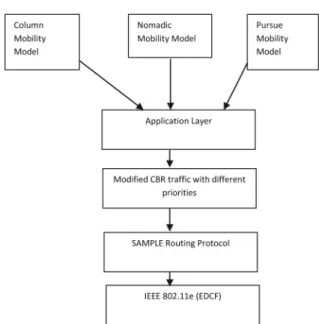
computes the probability of the actiona result-ing in a state transition s; Di(s/s,a) is esti-mated connection cost andVj(s)isri∈Cachei. In our experimental model we have replaced IEEE 802.11 by QoS enabled IEEE 802.11e as illustrated in Figure 1.
Figure 1.QoS based analysis of SAMPLE routing protocol.
IEEE 802.11e aids more successful packet trans-mission events by clubbing channel access with priority of packets thus delivering the required QoS services. Also the better channel access aids the packet delivery model of SAMPLE as less number of tries are required for successful transmission.
5. Group Mobility Models
Group mobility models have a better perfor-mance with less link breakages and they ex-hibit links which are up for a longer duration
[8], [9]and [10]. Thus, in our experimentation we have considered group mobility models like Column Mobility Model(CM), Nomadic Mo-bility Model(NM)and Pursue Mobility Model
5.1. Column Mobility Model
A Column Mobility Model [11] models a col-umn of soldiers moving in the forward direc-tion. In this model an initial reference grid is set. Each mobile node is then allowed to move randomly around its reference point. A new reference point is given by Equation 2
NewRP =OldRP+AdVect, (2) where OldRP is the mobile nodes previous ref-erence point andAdVectthe advance vector rep-resents the predefined offset that moves in the reference grid.
5.2. Nomadic Mobility Model
The Nomadic Mobility Model(NM) [12] mod-els nomadic societies which move in groups from one location to another. Each group has in-dividual mobile nodes which maintain their own personal spaces and move in random ways. The nomadic mobility model defines a common ref-erence point[13], thus the resulting movements of mobiles nodes is less constrained.
5.3. Pursue Mobility Model
The pursue mobility model (PM) [11], [12] at-tempts to model police officers attempting to catch a criminal. The pursue mobility model follows Equation 3 for each mobile node.
NewPos =OldPos+AccN(Target−OldPos) +RandVector
(3)
where AccN(Target−Old
Pos) is the informa-tion of the movement of the mobile node being pursued andRandVector is the random offset for each mobile node. The current position of a mobile node, acceleration and random vector are combined to calculate the next position of the mobile node.
5.4. Performance Analysis of Group Mobility Models
In this section we discuss the performance anal-ysis of Column, Nomadic and Pursue Mobility models as in[16]to understand their impact on the routing performance of reinforcement learn-ing based routlearn-ing algorithm SAMPLE.
5.5. Mobility Performance Analysis Metrics
We have considered the following mobility met-rics from[16]for our analysis of mobility mod-els.
• Average Link Duration: this metric spec-ifies the longest interval of time [t1,t2]for nodes i and j forming the link (i,j). This is then averaged for all node pairs for all existing links specifying Equation 4:
LD= T
t1=0 N
i=1 N
j=i+1
LD(i,j,t1)
P , (4)
wherePis no of tuples (i,j,t1)andLD(i,j, t1)=0.
• Average Relative Speed: relative speed is given by Equation 5:
RST(i,j,t) =|Vi(t)−Vj(t)|, (5) whereVi(t)andVj(t)is the velocity vector of nodeiandjat timet. The average value ofRST(i,j,t)is given by Equation 6:
RST = N
i=1 N
j=1 T
t=1RST(i,j,t)
P , (6)
wherePis no of tuples(i,j,t1)andRST(i,j,
t1)=0.
• Average degree of spatial dependence: it is a measure of the extent of similarity of ve-locities of given two nodes not so far apart, given byDs(i,j,t)and averaged over pair of nodes and time instants and formalized by Equation 7:
Ds= T
t=1 N
i=1 N
j=i+1Ds(i,j,t1)
P , (7)
wherePis no of tuples(i,j,t1)andDs(i,j,
t1)=0.
(NM)and Pursue Mobility Model(PM)are il-lustrated in Figure 2, Figure 3 and Figure 4. In Figure 2 it is seen that the average link dura-tion is least for Column Mobility Model. The Pursue Mobility Model exhibits better link du-ration and outscores Column and Nomadic
mo-Figure 2.Average link duration for Column, Nomadic and Pursue Mobility models.
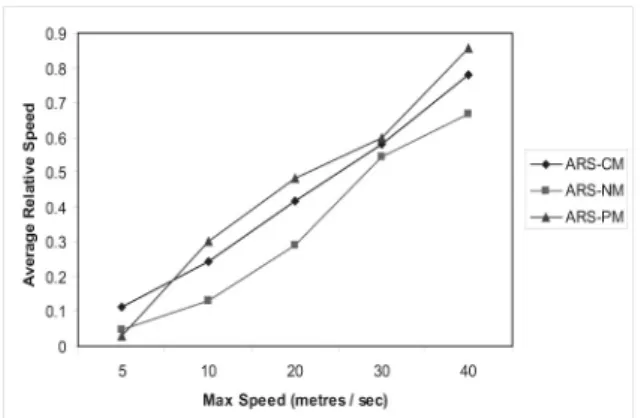
Figure 3.Average relative speed for Column, Nomadic and Pursue Mobility models.
Figure 4.Average spatial dependency for Column, Nomadic and Pursue Mobility models.
bility models by 50% and 4% respectively. This indicates that nodes in Pursue Model deviate by a small fraction in their groups and exhibit higher link duration.
The average relative speed indicates the mobil-ity pattern of various mobilmobil-ity models. It is ob-served in Figure 3, that average relative speed is least for Nomadic Model and relatively higher for Column and Pursue Mobility models. The overall values for Column, Nomadic and Pursue Mobility models are least as they are group mo-bility models and nodes move in synchronized fashion.
In Figure 4, it is seen that the average spatial de-pendency is highest for Pursue Mobility Model and it outperforms Column and Nomadic Mo-bility models by 95% and 98% respectively. Thus Pursue Mobility Model with higher av-erage link duration and higher spatial depen-dency performs relatively well as compared to Column and Nomadic Mobility models. These analyses help us to predict the relative perfor-mance of SAMPLE a reinforcement learning based routing algorithm on the experimented group mobility models.
6. Routing Metrics Simulation Environment and Results for QoS Based SAMPLE
6.1. Routing Metrics for Performance Evaluation
• Average latency: is defined as the latency of all packets created at the source divided by the actual application packets received. • Packet delivery overhead: is defined as
the number of transmissions made for every packet in terms of router packets and router broadcast packets, no matter whether that packet is actually delivered or not.
• Average application packet delay: this metric considers the latency of application packets divided by the total application pack-ets sent.
• Total packets dropped: this metric reflects the sum of all packets dropped, no matter whether they may be router generated or ap-plication generated packets.
6.2. Simulation Environment and Results
NS-2 simulator ver. 2.28 from [17] was used for the study of performance analysis of routing protocol SAMPLE. The underlying MAC Pro-tocol is defined by IEEE 802.11e. Constant bit rate(CBR)traffic sources with different traffic priorities like priority 0, priority 1 and priority 2. The mobility model used were Column Mo-bility Model (CM), Nomadic Mobility Model
(NM)and Pursue Mobility Model(PM)as pro-vided in the Bonn Motion Tool [18]. The field configurations are 1520 m×520 m. The traffic generator script called cbrgen.tcl was used to generate CBR scenario of 8 sources at the rate of 4.0 kbps and modified to reflect the correspond-ing traffic priorities. The number of nodes in the simulation environment was 20 nodes. At least 5 scenarios files for Column, Nomadic and Pursue Mobility models at different maximum speed of 5, 10, 20, 30 and 40 sec were used for testing protocol like SAMPLE on various QoS based traffic. The simulation based per-formance analysis results of SAMPLE [2] on QoS based traffic for Column, Nomadic and Pursue Mobility models are illustrated in Fig-ure 5, FigFig-ure 6, FigFig-ure7, FigFig-ure 8 and FigFig-ure 9.
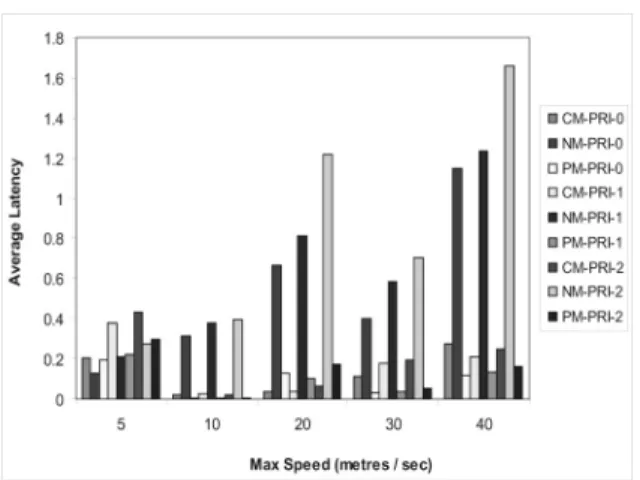
In Figure 5 it is shown that the average la-tency for SAMPLE is on the higher side, for Nomadic Mobility Model especially for lower priority traffic i.e. Priority 1 and Priority 2 traf-fic as compared to higher priority traftraf-fic Priority 0. It is also observed that the average latency is least for Pursue Mobility Model on all traffic priorities as it is substantiated by better mobility performance metrics.
In Figure 6 it is shown that packet delivery over-head is high for Column and Nomadic Mobility models. For high speed of 40 sec, it is ob-served that Nomadic Mobility model exhibits higher packet delivery overhead as compared to Column and Pursue Mobility Model. The Pur-sue Mobility Model with its superior mobility metrics exhibits least packet delivery overhead. Also higher mobility of nodes induces larger packet delivery overhead for Column and No-madic Mobility models.
In Figure 7 it is observed that at lower speed the average application delay is slightly higher for the Pursue Mobility Model at a maximum node speed of 5 sec. At higher maximum node speed Pursue Mobility Model performs relatively well as compared to Column and Nomadic Mobility
Figure 5.Average latency for SAMPLE with traffic of various priorities.
Figure 6.Packet delivery overhead for SAMPLE with traffic of various priorities.
Figure 7.Average application packet delay for SAMPLE with traffic of various priorities.
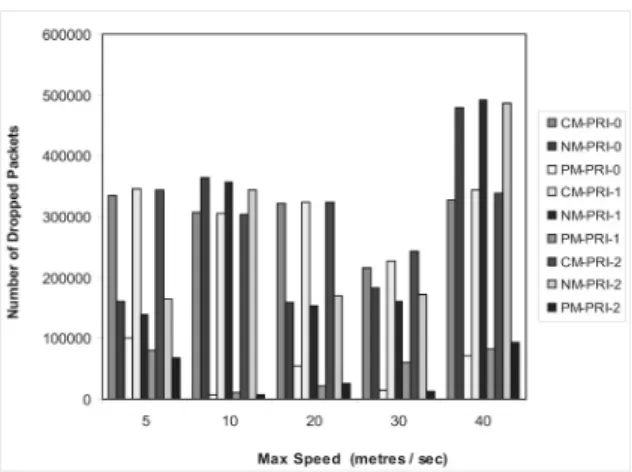
Figure 8.Number of dropped packets of SAMPLE on various traffic priorities.
Figure 9.Packet delivery fraction of SAMPLE on various traffic priorities.
In Figure 8, it is observed that the number of dropped packets is higher for SAMPLE on Col-umn Mobility Model and Nomadic Mobility Model. The Pursue Mobility Model has rela-tively low number of dropped packets because of its superior performance in terms of mobility metrics.
It is observed in Figure 9 that the packet deliv-ery ratio is highest for Pursue Mobility Model for all traffic priority classes. It is seen that for maximum node speed of 40 sec, Pursue Mo-bility Model clearly outscores Column and No-madic Mobility models by 25.8% and 27.4% re-spectively. This clearly indicates the robustness of the Pursue Mobility Model at high mobility speeds.
7. Moderate Punishing Algorithm
In this section we propose a moderate punish-ing algorithm as a game theoretic modelpunish-ing of SAMPLE in a temporary non-cooperative envi-ronment based on the punishing algorithm pro-posed[26].
Algorithm: Moderate Punishing Algorithm
1. LetN(i)be the set of neighbors of node. 2. Every node computes its forwarding policy
in a distributed manner using the reinforce-ment learning algorithm SAMPLE.
3. When a misbehaving neighboring node is detected by a node, the node computes its forwarding policy as follows in Equation 8:
βi∗=min
βi, min j∈N(i)βj
, (8)
whereβiandβjare the reinforcement learn-ing based forwardlearn-ing policy adapted by node
i and the reinforcement learning based for-warding policy available forj. βi∗represents the new policy adapted by nodei.
4. The network settles down by isolating the misbehaving node and punishing it.
5. The misbehaving node saynidecides to re-new cooperation. At this point in time the moderate punishing algorithm will accept its cooperation and the retaliatory punishment of the neighboring nodes ofniand its corre-sponding negative loop is avoided.
results are illustrated in Figure 10, Figure 11, Figure 12, Figure 13 and Figure 14.
In Figure 10 it is seen that the packet deliv-ery overhead is slightly higher for SAMPLE on IEEE 802.11 as compared to SAMPLE on IEEE 802.11e for the moderate punishing algorithm. This indicates that SAMPLE on IEEE 802.11 takes more effort to converge to optimal routes due to the presence of nodes which have stopped cooperation for a specified duration.
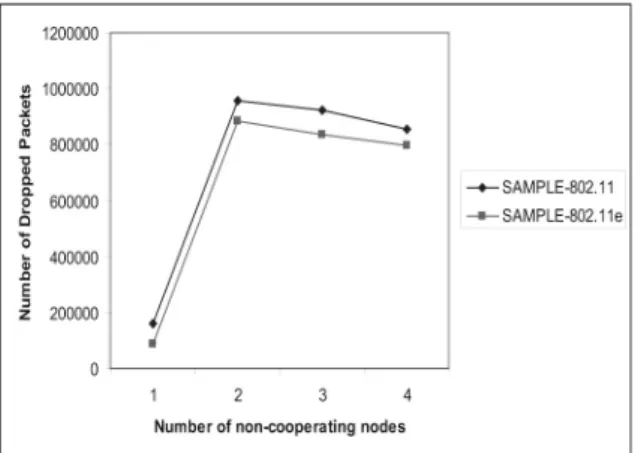
In Figure 11 it is observed that the number of dropped packets is slightly higher on SAMPLE with IEEE 802.11 as compared with SAMPLE on IEEE 802.11e. Thus, even in the presence of nodes which have stopped cooperation, SAM-PLE performs relatively well on IEEE 802.11e and adapts to newer topologies by forgiving nodes which have renewed their decision to co-operate at later stages. The support for QoS
traf-Figure 10.Packet delivery overhead for moderate punishing algorithm for SAMPLE on IEEE 802.11 and
IEEE 802.11e.
Figure 11. Number of dropped packets for moderate punishing algorithm for SAMPLE on IEEE 802.11 and
IEEE 802.11e.
fic enables SAMPLE to quickly adapt to newer shortest paths even in the presence of nodes which have stopped cooperation and have been punished with isolation for a specific duration.
In Figure 12 it is observed that for the imple-mentation of moderate punishing algorithm for SAMPLE, the average latency is initially higher for SAMPLE on 802.11e, but as the simulation progresses and nodes renew or stop their coop-eration, SAMPLE on IEEE 802.11e continues to perform well as compared to SAMPLE on IEEE 802.11e.
In Figure 13 it is seen that SAMPLE on IEEE 802.11e clearlyoutperforms SAMPLE on IEEE 802.11 in terms of average application packet delay. Thus IEEE 802.11e with better mech-anism to support QoS enabled traffic supports faster dissemination of application packets.
Figure 12.Average latency for moderate punishing algorithm for SAMPLE on IEEE 802.11 and IEEE
802.11e.
Figure 13.Average application packet delay for moderate punishing algorithm for SAMPLE on IEEE
Figure 14.Packet delivery fraction for moderate punishing algorithm for SAMPLE on IEEE 802.11 and
IEEE 802.11e.
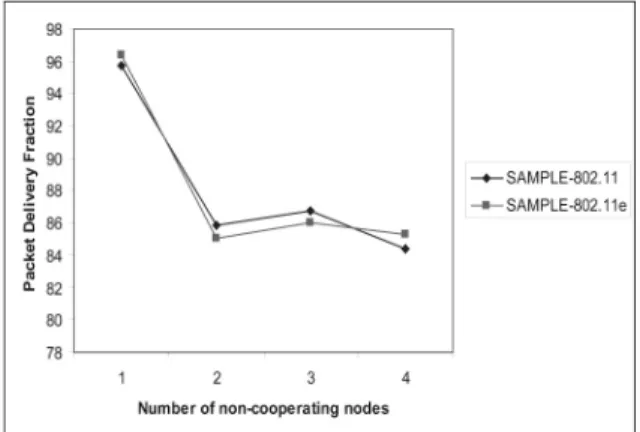
In Figure 14 it is observed that the packet deliv-ery fraction is more or less the same for SAM-PLE on IEEE 802.11 and IEEE 802.11e. Along with the increased number of nodes which stop or renew their cooperation, it is observed that SAMPLE on IEEE 802.11e exhibits more stable performances.
8. Conclusion
Routing algorithms form the backbone of ad-hoc networks. Providing Quality of service
(QoS) with different traffic priorities is an im-portant problem on such networks. QoS is not just the function of one layer; it can be visual-ized across the protocol stack. Thus at network layer we consider SAMPLE which has superior performance in terms of congestion capabili-ties for high load traffic. At the data link layer we consider IEEE 802.11e which has proven support for QoS as compared to IEEE 802.11. We also consider group mobility models, which due to their group movements have superior mobility metrics as compared to other models. Our experiments observed the superior perfor-mance of Pursue Mobility Model. The Pursue Mobility Model exhibited better link duration and outscored Column and Nomadic mobility models by 50% and 4% respectively. Also, the average spatial dependency was the high-est for Pursue Mobility Model and it outper-formed Column and Nomadic Mobility models by 95% and 98% respectively. SAMPLE on Pursue Mobility Model had better performance for various routing and QoS metrics on IEEE 802.11e. The operation of SAMPLE on Pur-sue Mobility Model has relatively low number
of dropped packets because of its superior per-formance in terms of mobility metrics. The packet delivery ratio of SAMPLE is the highest for Pursue Mobility Model for all traffic priority classes. It is observed that for maximum node speed of 40 sec, Pursue Mobility Model clearly outscores Column and Nomadic Mobility mod-els by 25.8% and 27.4% respectively. Ad-hoc networks are constrained by resources like bandwidth and energy. Thus we propose a mod-erately punishing algorithm for modeling the behavior of routing algorithm SAMPLE with resource constraints on IEEE 802.11e. Along with the increased number of nodes which stop or renew their cooperation, it is observed that SAMPLE on IEEE 802.11e exhibits more stable performances in terms of packet delivery ratio. In the future, we would like to extend our QoS study for video based traffic on MANET.
9. Acknowledgments
The authors would like to acknowledge the sup-port of Computer Society of India for the re-search work through a Mini Rere-search Grant
(File No. 1-14/2012-06).
References
[1] S. WEITHOLTER, C. HOENE, Design and Verification
of an IEEE 802.11e EDCF Simulation Model in NS 2.26,TKN Technical Report Series, Berlin,(2003). [2] J. DOWLING, E. CURRAN, R. CUNNINGHAM, V.
CAHILL, Using Feedback in Collaborative
Re-inforcement Learning to Adaptively Optimize MANET Routing,IEEE Transactions on Systems, Man and Cybernetics – Part A: Systems and Hu-mans, Vol. 35, No. 3, pp. 360–375,(2005). [3] J. YOON, M. LIU, B. NOBLE, Random Waypoint
Considered Harmful,Proceedings of IEEE INFO-COM 2003, San Francisco, CA,(2003).
[4] S. SARKAR, T. G. BASAVARAJU, C. PUTTAMADAPPA, Ad Hoc Mobile Wireless Networks, Principles, Pro-tocols and Applications, Auerbach Publications, pp. 267–273,(2008).
[5] E. D. PUSCHITA, T. P. PALADE, QoS Perspectives for
Wireless Scenarios,In the Proceedings of Broad-Band Europe,(2005).
[6] E. PUSCITA, T. PALADE, L. CHITRA, Performance
[7] A. W. MOORE, C. G. ATKENSON, Prioritized
Sweep-ing: Reinforcement Learning with Less data and Less Time,Machine Learning, Vol. 13,(1993). [8] S. A. KULKARNI, G. R. RAO, Applying Optimized
Mobility Model for Reinforcement Learning Based Routing Algorithm for Mobile Ad-Hoc Networks,
Journal of Computer Network and Internet Re-search, Vol. 10, No. 1, pp. 49–57,(2010).
[9] X. HONG, M. GERLA, G. PAI, C-C. CHIANG, A Group
Mobility Model for Ad Hoc Wireless Networks,
ACM/IEEE International Symposium on Modeling Analysis and Simulation of Wireless and Mobile Systems (MSWIM), Seattle, WA, USA,(1999). [10] S. A. KULKARNI, G. R. RAO, Mobility and
Energy-Based Performance of Temporally Ordered Routing Algorithm for Ad Hoc Wireless Network, IETE Journal of Technical Review, Vol. 25, No. 4, pp. 222–227,(2008).
[11] M. SANCHEZ, P. MANZONI, A java-based ad hoc network simulator, Future Generation Computer Systems, Vol. 17, No. 5, pp. 573–583,(2001). [12] M. SANCHEZ, Mobility models,http://www.
disca.upv.es/misan/mobmodel.htm
[13] T. CAMP, J. BOLENG, V. DAVIES, Survey of Mobility
Models, http://toilers.mines.edu/papers/ psgz/models.ps.gz
[14] C. T. CALAFATE, M. P. MALUMBERS, J. OLIVER, J. C.
CANO ANDP. MANZONI, QoS Support in MANETs:
A Modular Architecture Based on the IEEE 802.11e Technology, IEEE Transactions on Circuits and Systems for video technology, Vol. 19, No. 5, pp. 678-692,(2009).
[15] C. T. CALFATE, P. MANZONI, M. P. MALUMBRES, On the Interaction Between IEEE 802.11e and routing protocols in Mobile Ad-Hoc Networks,In the Pro-ceedings of 13th Euromicro Conference on Parallel Distributed and Network-based Processing (PDP), Lugano, Switzerland,(2005).
[16] F. BAI, N. SADAGOPAN, A HELMY, The
IMPOR-TANT framework for analyzing the Impact of Mo-bility on Performance of RouTing protocols for Adhoc NeTworks,Elsevier Ad Hoc Networks, 1, pp. 383–403,(2003).
[17] The Network Simulator – NS-2, http://www.isi.edu/nsam/ns/
[18] Bonn Motion v 1.5a – A mobility scenario gen-eration and analysis tool, http://net.cs.uni-bonn.de/wg/cs/applications/bonnmotion/
[19] C. E. PERKINS, E. M. BELDING-ROYER, Quality of Service for Ad-Hoc On-Demand Distance Vector Routing, Internet draft, (2001), http://tools. ietf.org/html/draft-perkins-manet-aodvqos-00
[20] V. LOSCR`I, F. D. RANGO, S. MARANO, Performance
Evaluation of On-Demand Multipath Distance Vec-tor Routing Protocol over two MAC layers in Mobile Ad Hoc Networks,In Proceedings of ICT,(2004).
[21] L. KHOUKHI, S. CHERKAOUI, Intelligent QoS
man-agement for multimedia services support in wireless mobile ad hoc networks, Computer Networks 54, pp. 1692–1706,(2010).
[22] A. MUNARETTO, M. FONSECA, Routing and quality
of service support for mobile ad hoc networks,
Computer Networks51, pp. 3142–3156,(2007). [23] T. BHEEMARJUNAREDDY, I. KARTHIGEYAN, B. S.
MANOJ, C. SIVARAMMURTHY, Quality of service provisioning in ad hoc wireless networks: a survey of issues and solutions, Ad Hoc Networks 4, pp. 83–124,(2006).
[24] M. A. IGARTUA, L. J.D LCLLOPIS, V. C. FR´IAS, E. S. GARGALLO, A game-theoretic multipath routing for video-streaming services over Mobile Ad Hoc Networks,Computer Networks55, pp. 2985–3000, (2011).
[25] D. LEVIN, Punishment in Selfish Wireless Networks
A Game Theoretic Analysis,In Proceedings of First Workshop on the Economics of Networked Systems (NetEcon06),(2006).
[26] E. ALTMAN, K. A. ARZAD, P. MICHIARDI, R. MOLVA,
Non cooperative forwarding in ad hoc networks,In Proceedings of IFIP Networking,(2005).
Received:July, 2012
Revised:November, 2012
Accepted:January, 2013
Contact addresses:
Dr. Shrirang Ambaji Kulkarni, Associate Professor Department of Computer Science and Engineering Gogte Institute of Technology Belgaum – 590008, Karnataka, India e-mail:[email protected] Dr. G. Raghavendra Rao, Professor Department of Computer Science and Engineering National Institute of Engineering Mysore-570008, Karnataka, India e-mail:[email protected]
SHRIRANGAMBAJIKULKARNIobtained his B.E. in Computer Science and Engineering from Karnataka University Dharwad, in the year 2000 and M. Tech. in Computer Network Engineering from Visvesvaraya Technological University India, in the year 2004. He obtained his Ph.D. in the faculty of Computer and Information Science from Visvesvaraya Technological University India in the year 2012. He is currently work-ing as Associate Professor, in the Department of Computer Science and Engineering, Gogte Institute of Technology, Belgaum India. He has published more than 20 papers in international and national journals and conferences. His current research interest includes reinforcement learning algorithms, wireless ad-hoc networks, cyber security. He is a member of ACM, CSI and ISTE.