On the Inverse Problem for Generalized One-Sided Concept Lattices
Jozef Pócs
Palacký University Olomouc, Department of Algebra and Geometry, Olomouc, Czech Republic and Mathematical Institute, Slovak Academy of Sciences, Košice, Slovakia
E-mail: [email protected]
Jana Pócsová
Technical University of Košice, BERG Faculty
Institute of Control and Informatization of Production Processes, Košice, Slovakia E-mail: [email protected]
Keywords:formal context, generalized one-sided concept lattice, Galois connection, closure system
Received:August 3, 2013
Generalized one-sided concept lattices represent a generalization of the classical concept lattices conve-nient for analysis of attribute models with different types of attributes. Formally, to each object-attribute model (represented by the notion of formal context) there is assigned a pair of concept-forming operators. Fixed points of these operators form a hierarchical structure consisting of extent-intent pairs. From the algebraic point of view this structure forms a complete lattice, called the generalized one-sided concept lattice. In this paper we deal with the inverse problem for generalized one-sided concept lattices. For a given generalized one-sided concept lattice we describe an algorithm for finding the corresponding formal context.
Povzetek: Predstavljen je algoritem za preslikavo enostranske mreže konceptov v pripadajoˇci formalni koncept.
1
Introduction
In mathematics, physics, computer science or engineering there are pairs of problems which are inverses of one an-other. As examples from mathematics we can mention the multiplication of integers and as the corresponding inverse problem the factorization of a given integer, differentiation and integration of real valued functions or Fourier trans-form and inverse Fourier transtrans-form. From physics we can mention scattering problem, which is to determine how ra-diation or particles are scattered based on the characteris-tics of some object (scatterer) and inverse scattering prob-lem of determining characteristics of an object based on data of how it scatters incoming radiation or particles.
At first glance, the meaning of the term ‘inverse prob-lem’ seems obvious. It is the problem which is associ-ated to some other (direct) problem, one that presumably preceded the inverse problem and which has been stud-ied extensively for some time and is better known. Our inverse problem concerns determination of characteristics of object-attribute models in fuzzy modification of Formal Concept Analysis (FCA), so called generalized one-sided concept lattices.
The theory of concept lattice, also called Formal Con-cept Analysis is a theory of data analysis for identification of conceptual structures among data sets. As an effective tool for data analysis, Formal Concept Analysis has been extensively applied to a variety of fields such as data
min-ing, decision makmin-ing, information retrieval, machine learn-ing and knowledge discovery. The main notion of this theory is the notion of a formal context, represented by a binary relation between the set of objects and the set of attributes, specifying which objects have what attributes. From a formal context, one can construct object-attribute pairs known as the formal concept. The family of all formal concepts forms an algebraic structure called the concept lattice, which reflects the relationship of generalization and specialization among particular concepts. The reader can find an extensive account of the mathematical foundations of FCA in [7].
truth degr ees (represented by complete lattices). From this point of view it is applicable to a very wide spectrum of the real object-attribute models where methods of the classical FCA are appropriate, cf. [1, 5, 4, 8, 14, 15].
As we have already mentioned, our aim is to deal with the inverse problem for generalized one-sided concept lat-tices. The paper is organized as follows: in the next section we give a brief overview of the notions concerning gener-alized one-sided concept lattices. We recall some algebraic notions like Galois connections, complete lattices or clo-sure systems. Our main result, i.e., an algorithm for the inverse problem is presented in Section 3. In particular we will deal with the decision problem, i.e., whether a given collection of pairs forms a generalized one-sided concept lattice, and consequently we describe a method for deter-mining the formal context (object-attribute model) corre-sponding to a given generalized one-sided concept lattice.
2
Generalized one-sided concept
lattices
In this section we describe a fuzzy generalization of clas-sical concept lattices, the so-called generalized one-sided concept lattices, cf. [6] and [13].
The main idea of fuzzifications of classical FCA is the usage of graded truth. The structure L of truth degrees forms a so-called complete lattice, i.e., it is partially or-dered, contains the smallest and the greatest element (rep-resenting the values false and true, respectively), more-over, for any subset H ⊆ Lthere exists W
H (the least upper bound or supremum) and V
H (the greatest lower bound or infimum). In classical logic, each proposition is either true or false, hence classical logic is bivalent. It is common to represent the classical logic truth value struc-ture as a two-element chain, i.e., the two-element set{0,1} with0 <1. In this case the value0represents false and1
represents true. In fuzzy logic, to each proposition there is assigned a truth degree from some richer scaleLof truth degrees. If to the propositionsΦandΨare assigned truth degrees kΦk = a andkΨk = b, then a ≤ b means that Φis considered less true thanΨ. In object-attribute models the typical propositions are of the form “object has attribute in degreea". The well-known examples of truth structures used in various modifications of fuzzy logic are: the real unit interval[0,1], Boolean algebras, MV algebras, or, more generally, residuated lattices.
The set of allL-fuzzy sets over some universeU is de-fined as the set of all functions
f:U →L,
denoted by symbolLU. In order to define generalized one-sided concept lattices we will use the notion of direct prod-uct. IfLifori∈Iis a family of lattices thedirect product
Q
i∈ILiis defined as the set of all functions
f :I→[ i∈I
Li
such thatf(i)∈Lifor alli∈Iwith the “componentwise” order, i.e,f ≤g iff(i)≤ g(i)for alli ∈ I. IfLi = L for alli ∈ I we get the direct powerLI. In this case the direct powerLI represents the structure of L-fuzzy sets, hence the direct product of lattices can be seen as a gener-alization of the notion ofL-fuzzy sets. The direct product of lattices forms a complete lattice if and only if all mem-bers of the family are complete lattices. Straightforward computations show that the lattice operations in the direct productQ
i∈ILi of complete lattices are calculated com-ponentwise, i.e., for any subset{fj : j ∈ J} ⊆ Qi∈ILi we obtain
_
j∈J fj
(i) = _
j∈J fj(i),
^
j∈J fj
(i) = ^
j∈J fj(i),
where these equalities hold for each indexi∈I.
In order to introduce the notion of generalized one-sided concept lattices as a generalization of FCA we will assume only one minimal condition, i.e., that the structures of truth degrees form complete lattices.
In the mathematical theory of fuzzy concept lattices, the main role is played by special pairs of mappings between complete lattices, commonly known as Galois connections. Hence, we provide necessary details regarding Galois con-nections and related topics.
Let (L,≤) and (M,≤) be complete lattices and let ϕ:L → M andψ:M → Lbe maps between these lat-tices. Such a pair(ϕ, ψ)of mappings is called aGalois connectionif the following condition is fulfilled:
p≤ψ(q) if and only if ϕ(p)≥q.
Galois connections between complete lattices are closely related to the notion of closure operator and closure system. LetLbe a complete lattice. By aclosure operatorinLwe understand a mappingc:L→Lsatisfying:
(a) x≤c(x)for allx∈L,
(b) c(x1)≤c(x2)forx1≤x2,
(c) c(c(x)) =c(x)for allx∈L(i.e.,cis idempotent).
A subsetXof the complete latticeLis called aclosure sys-teminLifX is closed under arbitrary meets. We note that this condition guarantees that(X,≤)is a complete lattice, in which the infima are the same as inL, but the suprema inX may not coincide with those fromL. For a closure operatorcinL, the setFP(c)of all fixed points ofc(i.e., FP(c) = {x ∈ L : c(x) = x}) is a closure system in L. Conversely, for a closure systemX inL, the mapping CX :L→Ldefined byCX(x) =V{u∈X:x≤u}is a
closure operator inL. Moreover these correspondences are inverses of each other, i.e.,FP(CX) =X for each closure systemX inLandCFP(c)=cfor each closure operatorc
inL.
definition of formal context, from which there is defined a pair of mappings forming a Galois connection.
A 4-tuple B, A,L, R
is said to be ageneralized one-sided formal context if B is a non-empty set of objects, Ais a non-empty set of attributes,L: A → CLis a map-ping from the set of attributes to the class of all complete lattices. In this caseL(a)represents a particular structure of truth value degrees for each attribute a ∈ A. Finally, R: B×A →S
a∈AL(a)withR(b, a)∈ L(a)is an inci-dence relation, which represents a degree from the struc-tureL(a)in which an elementb ∈Bhas a given attribute a∈A.
The power set (set of all subsets) of a setB will be de-noted by P(B). Let B, A,L, R be a generalized one-sided formal context. Then there is defined a pair of map-pings ⊥: P(B) → Q
a∈AL(a) and >:
Q
a∈AL(a) → P(B)as follows:
X⊥(a) = ^
b∈X
R(b, a), (1)
g>={b∈B :∀a∈A, g(a)≤R(b, a)}. (2)
The pair (⊥,>) forms a Galois connection between
P(B) and LA. The composition of mappings ⊥ and >
forms a closure operator inP(B)and similarly the compo-sition of> and⊥forms a closure operator inQ
a∈AL(a). Hence, subsets of the formX⊥>for anyX⊆Bare closed subsets with respect to the closure operator defined above. As it is known, the closed subsets of any closure operator form a complete lattice with respect to the inherited partial order from the underlying complete lattice structure (in this caseP(B)). This fact stands behind the formal definition and characterization of concept lattices.
For a given generalized one-sided formal context B, A,L, R
the symbolC B, A,L, R
will denote the set of all pairs(X, g)withX⊆B,g∈Q
a∈AL(a), satisfying
X⊥=g and X=g>.
In this case, the setX is usually referred to as theextent
andgas theintentof the concept(X, g). Further we define a partial order onC B, A,L, R
as follows:
(X1, g1)≤(X2, g2) iff X1⊆X2iffg1≥g2.
Let B, A,L, Rbe a generalized one-sided formal con-text. The setC B, A,L, R
with the partial order defined above forms a complete lattice, where
^
i∈I Xi, gi
= \
i∈I Xi,
_
i∈I gi
>⊥
_
i∈I
(Xi, gi) =
[
i∈I Xi
⊥>
,^ i∈I
gi
for each family (Xi, gi)i∈I of elements from C B, A,L, R
.
The latticeC B, A,L, Ris called thegeneralized one-sided concept lattice.
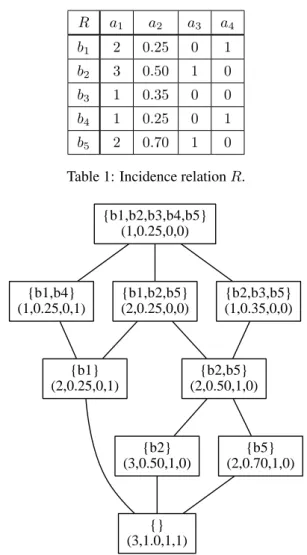
R a1 a2 a3 a4
b1 2 0.25 0 1
b2 3 0.50 1 0
b3 1 0.35 0 0
b4 1 0.25 0 1
b5 2 0.70 1 0
Table 1: Incidence relationR.
{} (3,1.0,1,1) {b1}
(2,0.25,0,1)
{b2} (3,0.50,1,0)
{b5} (2,0.70,1,0) {b1,b4}
(1,0.25,0,1)
{b2,b5} (2,0.50,1,0) {b1,b2,b5}
(2,0.25,0,0)
{b2,b3,b5} (1,0.35,0,0) {b1,b2,b3,b4,b5}
(1,0.25,0,0)
Figure 1: Generalized one-sided concept lattice corre-sponding to(B, A,L, R).
We provide a small example of a generalized one-sided formal context and the corresponding generalized one-sided concept lattice. Consider the five-element set of ob-jects B = {b1, b2, b3, b4, b5}, and the four-element set of
attributesA = {a1, a2, a3, a4}withL(a1) = 4,L(a2) = [0,1]andL(a3) = L(a4) = 2. In this case4denotes the
four-element chain0<1<2<3and2denotes the two-element chain0 < 1. Finally, the incidence relationRis given in Table 1. Obviously the triple(B, A,L, R)forms a generalized one-sided formal context. The corresponding generalized one-sided concept lattice is depicted in Figure 1.
3
The inverse problem for
generalized one-sided concept
lattices
the precise definition of our inverse problem. LetB 6= ∅ be a set of objects, A 6= ∅ be a set of attributes,L(a)be a system of complete lattices (truth structures under con-sideration) andCbe a set consisting of some pairs(X, g)
whereX ⊆Bandg ∈Q
a∈AL(a). Decide whether there exists (in affirmative case also find) an incidence relation R:B×A→S
a∈AL(a)such thatC=C(B, A,L, R). In order to decide the inverse problem for generalized one-sided concept lattices we will use the following well-known characterization of Galois connections involving dual isomorphism of closure systems, cf. [12]:
LetL, M be complete lattices. Any Galois connection betweenLandM is fully determined by dually isomorphic closure systems inLandM.
In order to provide more details, suppose that X1 and X2 are closure systems in L, M respectively, and f : X1 → X2 is a dual isomorphism between complete
lat-tices(X1,≤)and(X2,≤). Then a pair(cX1◦f, cX2◦f
−1),
wherecX1,cX2are the closure operators corresponding to
X1and toX2, forms a Galois connection betweenLand M.
GivenCas input, we want to decide if there exists a Ga-lois connection(ϕ, ψ)betweenP(B)andQ
a∈AL(a)such that
C=
(X, g) :X=ψ(g), g=ϕ(X) .
If this condition is satisfied, then one can find a cor-responding formal context such that C = C(B, A,L, R), hence this condition is equivalent to our decision problem. In order to solve this issue, we will use the previous re-sult concerning Galois connections, i.e., we verify that the projections ofCform dually isomorphic closure systems.
The first step is to decide whether the sets
C1={X ⊆B: (∃g)(X, g)∈C}
and
C2={g∈
Y
a∈A
L(a) : (∃X)(X, g)∈C}
form closure systems in P(B) and Q
a∈AL(a), respec-tively.
Hence we must check ifC1is closed under arbitrary
in-tersections andC2is closed under arbitrary meets.
The second step is to decide whether C1 andC2 form
dually isomorphic closure systems. We recall that a surjec-tive mappingf:C1→C2is a dual isomorphism if for all X1, X2∈C1it is true that
X1⊆X2 iff f(X1)≥f(X2). (3)
This condition will be satisfied if for allX1, X2 ∈ C1 it
holds thatX1 ⊆ X2 impliesg1 ≥ g2 whereg1 andg2
are such that(X1, g1) ∈ Cand(X2, g2) ∈ C. Similarly,
it must hold for all g1, g2 ∈ C2 that g1 ≥ g2 implies X1 ⊆ X2 whereX1 andX2 are such that(X1, g1) ∈ C
and(X2, g2)∈C.
Now we can summarize the whole procedure in the fol-lowing algorithm (Algorithm 1).
Algorithm 1for deciding existence of the incidence rela-tionR
Input: a set of pairsC Output: answerYESorNO
1: C1← {X : (X, g)∈C} .Set of first components
2: C2← {g: (X, g)∈C} .Set of second components
3: for allX1, X2∈C1do
4: ifX1∩X2∈/C1then. C1is not a closure system
5: returnNO 6: end if 7: end for
8: for allg1, g2∈C2do
9: ifg1∧g2∈/ C2then . C2is not a closure system
10: returnNO 11: end if 12: end for
13: for allX1, X2∈C1such thatX1⊆X2do
14: g1 ← g where (X1, g) ∈ C, g2 ← g where (X2, g)∈C
15: ifg1g2 then . C1andC2are not dually
isomorphic 16: returnNO 17: end if 18: end for
19: for allg1, g2∈C2such thatg1≥g2do
20: X1 ← X where(X, g1) ∈ C, X2 ← X where (X, g2)∈C
21: ifX1*X2 then . C1andC2are not dually
isomorphic 22: returnNO 23: end if 24: end for
25: returnYES . C1andC2are dually isomorphic
The correctness of this algorithm can be proved using the above-mentioned relationship between Galois connections and dually isomorphic closure systems.
Infor allloop (line 3 - 7) it is decided whetherC1forms
a closure system inP(B). Similarly,for allloop (line 8 - 12) decides whether C2 forms a closure system in the
direct product of latticesQ
a∈AL(a). If C1 andC2 form
closure systems, then the next step is to decide whether the correspondencef: X 7→ g,(X, g) ∈ Cis a dual iso-morphism betweenC1andC2. This is verified in the two
for allloops (line 13 - 18, line 19 - 24). Let us note that the condition (3) guarantees that the correspondencef is injective. Iff(X1) = f(X2)thenf(X1) ≥ f(X2) and f(X2) ≥ f(X1)which yieldsX1 ⊆ X2andX2 ⊆ X1.
Since the inclusion relation is antisymmetric, we obtain X1 = X2. Moreover, we deal with finite structures only,
hencefis surjective too, and consequently it is a bijection. The algorithm returns the affirmative answer if and only if C1 andC2 are dually isomorphic closure systems. In
this case, there is a Galois connection betweenP(B)and
Q
a∈AL(a)corresponding to the input setC.
all pairs inC. Obviously|C1| ≤ nand|C2| ≤ n. Since
there are n2
= n·(n2−1) different two-element subsets of ann-element set, we obtain that twofor allloops (line 3 - 7, line 8 - 12) have no more than c· n(n2−1) ∈ O(n2)
repetitions. Here we assume that the verification whether X1∩X2 ∈C1andg1∧g2 ∈C2can be done in constant
timec ∈ R. Similarly, the time complexity of other two for allloops isO(n2), hence Algorithm 1 is inO(n2)time
complexity class according to the size of the input setn. In what follows we will deal with the second problem, hence suppose that the decision problem is answered af-firmatively. We describe a procedure for finding the in-cidence relation corresponding toC. For this purpose we recall the following assertion concerning Galois connec-tions between power sets and direct products of complete lattices, cf. [6].
Let (φ, ψ)be a Galois connection betweenP(B) and
Q
a∈AL(a). Then there exists a generalized one-sided
for-mal context B, A,L, R
such that φ(X) = X⊥ for all
X ⊆Bandψ(g) =g>for allg∈Q
a∈AL(a).
According to the definition (1) of the mapping
⊥: P(B) → Q
a∈AL(a)we obtain for allb ∈ B and all a∈A
{b}⊥(a) = ^
b0∈{b}
R(b0, a).
Since the right side of this equality expresses the infimum over the one-element set{R(b, a)}we obtain
{b}⊥(a) = ^
b0∈{b}
R(b0, a) =R(b, a).
This yields that the value of the incidence relation R(b, a)is fully determined by thea-th projection of{b}⊥.
Moreover, due to [6] the following assertion is valid:
LetB be a non-empty set andL(a)be a system of com-plete lattices. Then any two Galois connections(φ1, ψ1), (φ2, ψ2)betweenP(B)andQa∈AL(a)are equal if and
only if
φ1 {b}
(a) =φ2 {b}
(a)
for allb∈Band for alla∈A.
Since we assume that particular projections of the ele-ments of C form dually isomorphic closure systems, we already know that there is a Galois connection (φ, ψ) be-tweenP(B)andQ
a∈AL(a)such that the corresponding fixed points of(φ, ψ)form the latticeC. Hence we define the incidence relationR:B×A→S
a∈AL(a)as follows:
R(b, a) :=φ({b})(a), for allb∈B, a∈A.
From this definition it follows that
φ({b})(a) =R(b, a) ={b}⊥(a)
for all b ∈ B, a ∈ A and, due to the above-mentioned assertion, this yields⊥ =φand> =ψ. In order to deter-mine all the valuesR(b, a)we must find the corresponding values of φ({b})(a)in the generalized one-sided concept latticeC.
For this purpose we use the characterization of the one part of Galois connectionsφ:P(B)→Q
a∈AL(a)as the composition of the closure operator c on the set B and the dual isomorphismfbetween closure systems inP(B)
andQ
a∈AL(a)respectively. In this caseφ = c◦f, i.e., φ(X) =f(c(X))for allX ⊆B.
The isomorphismfis given directly by the ordered pairs in the generalized one-sided concept latticeC. If(X, g)∈ C, then the dual isomorphismfis given by
f(X) =g, for allX⊆B.
Hence the main goal is to determine the values c({b})
for allb∈B.
From the definition of closure operator, it follows that for eachb ∈Bthe valuec({b})is the smallest subset ap-pearing inCwhich contains the given elementb. For this reason it is convenient to deal with minimal elements of the concept latticeC. If(X, g)is a minimal element ofCthen for allb∈Xit holdsc({b}) =Xand consequently
φ({b}) =f(c({b})) =f(X) =g
for allb ∈ X. In the next step, we can remove this con-cept from the concon-cept lattice Cand find another minimal element, say(X1, g1). Let us note that after removing any
of the concepts(X, g)fromCthe resulting structure in no longer a lattice in general. However it is still a partially or-dered set, thus the notion of a minimal element can be used again. In this casec({b}) = X1 for allb ∈ X1rX. In
this way we can proceed, until we exhaust all the elements in the object setB.
The whole procedure is described in more detail in Al-gorithm 2.
The correctness of this algorithm follows from the fact that for an objectband an attributeathe valueR(b, a)is uniquely determined by the valueφ({b})(a)whereφ repre-sents one part of the Galois connection(φ, ψ) correspond-ing to the input setC. Moreoverφ({b}) =φ(X)whereX is the closure of the elementbin Galois connection(φ, ψ), i.e.,X =ψ(φ({b})). Consequentlyφ({b}) =φ(X) =g with(X, g)∈ C. Closures of the one-element subsets are minimal with respect to the closure operator, hence in the whileloop (line 2 - 13) the algorithm works with the mini-mal concepts inC. In thefor allloop (line 5 - 12) the values R(b, a)forb∈XrS,a∈Aare determined (for allloop (line 7 - 9)). Letb∈Bbe an object,(X, g)∈Cbe a min-imal concept such thatb∈X and suppose thatb /∈S, i.e., the valuesR(b, a)fora∈Aare not determined yet. Then X is unique with this property and for alla∈Athe value R(b, a)is determined correctly. By contrary assume that there is another subsetX0with(X0, g0)∈C,b ∈X0 and X *X0. Thenb ∈X∩X0 (X and(X∩X0, g00)∈C
for someg00∈Q
a∈AL(a)since the first components ofC form a closure system inP(B). This yields a contradiction to the fact that X is the minimal concept inC for which R(b, a)is not determined.
Algorithm 2for finding the incidence relationR Input: a generalized one-sided concept latticeC Output: the incidence relationR
1: S← ∅ .Set of objectsbfor whichR(b, a)has already been determined
2: whileS 6=Bdo .Repeat until all values are determined
3: m←(X, g) : (X, g)a minimal element inC . Find a minimal concept
4: C←Cr{m} .Remove the minimal conceptm
fromC
5: for allb∈Xwhere(X, g) =mdo
6: ifb /∈Sthen . bhas no valueR(b, a)yet 7: for alla∈Ado
8: R(b, a)←g(a).Determination of the valueR(b, a)
9: end for
10: S←S∪ {b} .Add the objectbto the set S
11: end if 12: end for 13: end while 14: returnR
concepts inCand denote bykthe number of all objects in the setB. In the worst case thewhileloop (line 2 - 13) has nrepetitions (this happens whenCis a chain). A minimal concept ofCcan be found inO(|C|)time (see Algorithm 3).
Algorithm 3for finding a minimal concept inC Input: a generalized one-sided concept latticeC Output: a minimal conceptm= (X, g)
1: m←an arbitrary element inC 2: for allm0∈Cdo
3: ifm0< mthen 4: m←m0 5: end if 6: end for 7: returnm
SinceX ⊆ B for all concepts(X, g) ∈ C, the for all loop (line 5 - 12) has at mostkrepetitions. Other loops can be executed in constant time, hence we obtain that the time complexity of Algorithm 2 is
n−1
X
i=0
k·c·(n−i) =ck·n·(n+ 1)
2 ∈k·O(n 2).
Since in many real situations|B| ≤ |C|, we can conclude that the time complexity of Algorithm 2 isO(n3).
4
Conclusion
In this paper we have presented an algorithm for the inverse problem of generalized one-sided concept lattices, i.e., how
to determine a generalized one-sided formal context from a given generalized one-sided concept lattice. This provides a possibility to express information about object-attribute models with different types of attributes in the form of hi-erarchical structures represented by generalized one-sided concept lattices.
Acknowledgement
The authors would like to thank the anonymous reviewer for the helpful and constructive comments which helped enhance the presentation of this paper.
This work was supported by the Slovak Research and Development Agency under contracts APVV-0035-10 and APVV-0482-11; by the Slovak VEGA Grants 2/0028/13, 1/0729/12 and 1/0497/11; by the ESF Fund CZ.1.07/2.3.00/30.0041.
References
[1] F. Babiˇc, P. Bednár, F. Albert, J. Paraliˇc, J. Bartók, L. Hluchý (2011) Meteorological phenomena forecast using data mining prediction methods, Proceedings of 3rd International Conference on Computational Collective Intelligence, ICCCI 2011, LNAI 6922, pp. 458–467.
[2] R. Bˇelohlávek (1999) Lattices generated by binary fuzzy relations.,Tatra Mountains Math. Publ., 16, pp. 11–19.
[3] R. Bˇelohlávek (2001) Lattices of Fixed Points of Fuzzy Galois Connections,Math. Log. Quart., 47 (1), pp. 111–116.
[4] P. Butka, M. Sarnovský, P. Bednár (2008) One ap-proach to combination of FCA-based local concep-tual models for text analysis - Grid-based approach,
Proceedings of the 6th International Symposium on Applied Machine Intelligence and Informatics, SAMI 2008, pp. 131–135.
[5] P. Butka, P. Bednár, F. Babiˇc, K. Furdík, J. Paraliˇc (2009) Distributed task-based execution engine for support of text-mining processes,Proceedings of the 7th International Symposium on Applied Machine In-telligence and Informatics, SAMI 2009, pp. 29–34.
[6] P. Butka, J. Pócs (2013) Generalization of one-sided concept lattices,Computing and Informatics, 32 (2), pp. 355–370.
[7] B. Ganter, R. Wille (1999)Formal concept analysis, Mathematical foundations., Springer, Berlin.
[9] A. Jaoua, S. Elloumi (2002) Galois connection, for-mal concepts and Galois lattice in real relations: ap-plication in a real classifier,The Journal of Systems and Software, 60, pp. 149–163.
[10] S. Krajˇci (2003) Cluster based efficient generation of fuzzy concepts, Neural Network World, 13 (5), pp. 521–530.
[11] J. Medina, M. Ojeda-Aciego, J. Ruiz-Calviño (2009) Formal concept analysis via multi-adjoint concept lat-tices,Fuzzy Sets and Systems, 160,pp. 130–144.
[12] O. Ore (1944) Galois Connexions,Trans. Amer. Math. Soc.55, pp. 493–513.
[13] J. Pócs (2012) Note on generating fuzzy concept lat-tices via Galois connections, Information Sciences, 185 (1), pp. 128–136.
[14] M. Sarnovský, P. Butka, J. Paraliˇc (2009) Grid-based support for different text mining tasks,Acta Polytech-nica Hungarica, 6 (4), pp. 5–27.