International Journal of Research in Engineering & Applied Sciences
http://www.euroasiapub.org - 33 - 33
-IMPLEMENTATION OF CONTINUOUS IMPROVEMENT PROCESS IN
INJECTION MOULDING INDUSTRY
Anil Kumar*
1. INTRODUCTION
Background
Quality is now involved in every kind of business: manufacturing, hospital, school, food industry, public utility, etc. This is not focused only in production areas but in service areas also. It has turned out to be a core competency for many companies to improve their competitive advantage. Why is quality important? High quality products or services are leading to business success, improved competitiveness, higher customer loyalty, and lower costs.
The costs occurred from providing high quality products or services are lower than the costs affected by the low quality products or services because the cost of poor quality - scrap, rework, retest, etc. - is more than the cost of doing it right the first time.
Competitors are not only from domestic companies but also from international companies. Therefore, customers have the right to choose companies that can satisfy their needs the best. Company ABC MANUFACTURER is one of the major manufacturers in the plastic industry which applies an "integrated solution" approach to gain the competitive advantage. They have not focused only on rapid prototyping, tooling, or injection molding of plastic parts, but they integrate all of these to provide every kind of plastic services under one roof. Company ABC MANUFACTURER's core business is offering injection moulding solutions to reach customer demands. They provide injection molding in the fields of appliance, data storage, electronics, sporting goods, medical, and office furniture. Quality of plastic parts and customer service has been the focus of the company to gain market share and to satisfy their customers.
International Journal of Research in Engineering & Applied Sciences
http://www.euroasiapub.org - 34 - 34
-The company's business has been increased dramatically within the past couple years. Company ABC MANUFACTURER is producing a larger variety of injection molding products than before. Some products are produced often or seasonally, but some products are produced just one or two times. They do have not enough time to experiment.
New employees, which were hired to support the growing business, were lacking quality knowledge of Material/product characteristics. This affected the product quality, increased both internal and external failure cost, and increased customer complaints
Statement of problem
Recently the Company ABC MANUFACTURER has reported poor quality of particular products in the injection molding department which results in increasing cost, lead time, and customer complaints.
Signzficance of the Study
Quality problems in injection molding processes are the main problem for Company ABC MANUFACTURER at the moment. Therefore, the results of thls study will be applied to the injection molding processes to improve quality performance and establish the continuous improvement plan for the company in order to increase quality of product, increase productivity, reduce costs, and satisfy customers.
Definitions
Continuous improvement. "A management philosophy that views quality improvement as a never-ending process that will always lead to incremental improvements.
Cost of quality. "The costs associated with providing poor-quality products or services".
Customer satisfaction. "A gauge on how well customer requirements are designed into product or service".
Quality. "A subjective term for which each person or customer may have their own definition. Characteristics of a product or service that impact its ability to satisfy stated or implied needs. A product or service that is free of nonconformities".
Limitations of the Study
1. The data collected in this study is from January 2013 to March 2013.
2. This study is limited to the researcher's work experience in the field of Injection molding.
2. LITERATURE REVIEW
International Journal of Research in Engineering & Applied Sciences
http://www.euroasiapub.org - 35 - 35
-This chapter will discuss concepts of quality including continuous improvement, Deming cycle, seven tools of quality, and costs of quality. Moreover, this chapter is devoted to the review of literature which includes the concept of injection molding and processing.
2.2 Continuous Improvement It is impossible for organizations to survive without changing or improving. The organization's ability to survive in a highly competitive business world depends on how the organization manages and adapts to demands of a changing environment. The change in a business environment comes from many resources-
Competitors create new products;
Competitors reduce products' prices; and
Competitors use new technology to improve quality of a product.
Customer expectations are always changing. Therefore, many companies have had to improve in terms of products or services to satisfy customers' needs.
Continuous improvement is an ongoing effort to improve products, services, or processes. It is more focused on customer service, process improvement, higher product quality and long-term strategies. Table-1 shows additional differences between companies that apply continuous improvement theory and traditional companies. There are different approaches to support continuous improvement theory.
Company Oriented Toward Continuous
Traditional Company Customer Focus Market-Share Focus Cross-Functional Teams Individual
Focus on "What" and Focus on "Who” & Long-Term Focus Short-Term Focus Continuous Improvement Status Quo Focus Process Improvement Product Focus Incremental Innovation Problem Solving Fire Fighting
Table-1- Continuous Improvement versus Traditional Orientation
International Journal of Research in Engineering & Applied Sciences
http://www.euroasiapub.org - 36 - 36
-CI as either as an offshoot of existing quality initiatives like total quality management (TQM) or as a completely new approach of enhancing creativity and achieving competitive excellence in today’s market.
According to Kossoff, total quality can be achieved by constantly pursuing CI through the involvement of people from all organizational levels.
We define CI more generally as a culture of sustained improvement targeting the elimination of waste in all systems and processes of an organization. It involves everyone working together to make improvements without necessarily making huge capital investments. CI can occur through evolutionary improvement, in which case improvements are incremental, or though radical changes that take place as a result of an innovative idea or new technology. Often, major improvements take place over time as a result of numerous incremental improvements. On any scale, improvement is achieved through the use of a number of tools and techniques dedicated to searching for sources of problems, waste, and variation, and finding ways to minimize them. 2.2.2 CI methodologies
Over the decades, as the need to continuously improve on a larger scale within the organization became an imperative, a number of CI methodologies have developed based on a basic concept of quality or process improvement, or both, in order to reduce waste, simplify the production line and improve quality. The best known of them are: lean manufacturing, Quality Tools etc.
Seven Tools of Quality.
Kaoru Ishikawa developed seven basic visual tools of quality so that the average person could analyze and interpret data. The seven tools of quality are used for improving processes, identifying problems, seeking root causes of problems, and solving problems. These tools are incredibly simple so all levels of workers can use them easily. These are-
Histograms,
Pareto Charts,
Cause and Effect Diagrams,
Run Charts,
Scatter Diagrams,
Flow Charts,
Control Charts.
International Journal of Research in Engineering & Applied Sciences
http://www.euroasiapub.org - 37 - 37
-Various key Lean techniques are discussed one by one below and shown in diagram;
Fig 1- Key Lean Tools
2.3 Deming Cycle
International Journal of Research in Engineering & Applied Sciences
http://www.euroasiapub.org - 38 - 38
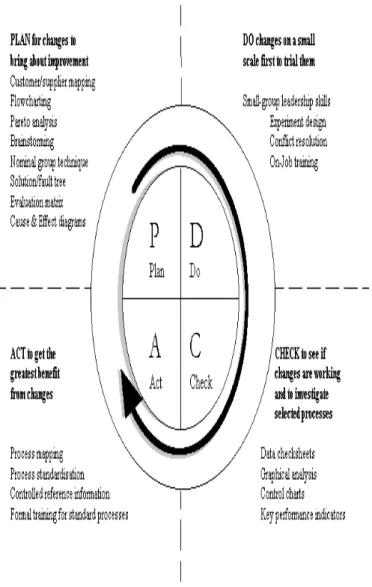
-Figure 2. - PDCA Explained
2.4 Injection molding
International Journal of Research in Engineering & Applied Sciences
http://www.euroasiapub.org - 39 - 39
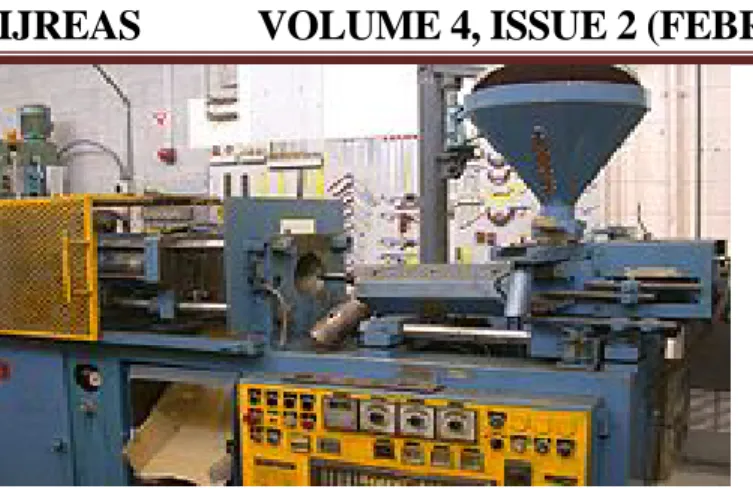
-Figure 3- Injection Moulding Machine
2.5 Molding defects
Injection molding is a complex technology with possible production problems. They can be caused either by defects in the molds, or more often by the molding process itself.
1. Blister 2. Burn marks 3. Flash
4. Embedded contaminates 5. Flow marks
6. Sink marks 7. Short shot 8. Splay marks 9. Stringiness 10.Voids 11.Weld line
2.6 Current Status of Research Nadia Bhuiyan and Amit Baghel
This paper provides an overview of continuous improvement, its inception, how it evolved into sophisticated methodologies used in organizations today, and existing research in this field in the literature.
International Journal of Research in Engineering & Applied Sciences
http://www.euroasiapub.org - 40 - 40
-Vito Romaniello, Paolo Renna and Vincenzo Cinque
They presented that the real case study application of the methodology in area manufacturing of ANSALDO STS S.p.A. The case study discussed here shows the application of basic principles, management tools and techniques towards performance improvement in a manufacturing plant. The innovative issues of the MAAR (Monitor, Analysis, Action and Review) approach developed regard: the possibility to apply the methodology to wide fields of enterprises (as maintenance, quality management, design, financial, etc.) and the real-manufacturing orientation. The results show the real benefits obtained by the implementation of the proposed methodology. Robert V. Hogg and Mary C. Hogg
They examines the need for continuous quality improvement in higher education; the role of academic statisticians in changes in higher education; some of the strategies and techniques colleges and universities are employing related to TQM at college and department levels; what individual instructors can do in terms of making improvements in higher education; and the role and importance of a personal quality vision in such an overall effort for organizational change.
He Zhen, Qi Ershi, Liu Zixian
They presented that how to utilize continuous quality improvement tools in product design and manufacturing. They address the application of QFD and design of experiment to optimize product/process design and how to integrate quality tools. Based on the philosophy of concurrent quality engineering and successful experience of some world class businesses, their paper presents a continuous quality improvement flowchart and puts forward to the strategies to implement continuous quality improvement.
Colin Herron and Paul M. Braiden
Described in paper that improvement methods Just in Time (JIT) and other lean manufacturing techniques were applied in a group of 15 manufacturing companies of all sizes including small and medium enterprises and an exemplar, Nissan Motor Manufacturing UK Ltd. and found that a key outcome is the ability to assign a numerical value to the compatibility between the problems of a particular company .
2.7 Concluding remarks for Literature Review
International Journal of Research in Engineering & Applied Sciences
http://www.euroasiapub.org - 41 - 41
-it would lead to minimization of rejection and thus achieve compet-itive advantages through operational benefits.
Also above study indicates that competitive priorities of companies are focused on improving products by making fundamental changes in the way of manufacturing. The findings of this research work can be applied in order to successful implementation of the continuous improvement practices in the discrete industry. It can be concluded that very less effort have been made to study the implementation of continuous improvement practices in Indian industries.
3. NEED OF THE STUDY
The purpose of this study is to help Company ABC MANUFACTURER improve the product quality and manage the data for a continuous improvement plan.
4. SCOPE OF THE STUDY
This study will help the various automotive/process industries 1. In minimizing the rejection of a specific product, 2. In improving the product quality and
3. In managing the data for a continuous improvement plan.
5. OBJECTIVES OF STUDY
1. To create a process map and evaluate the results to determine the company's current performance.
2. To identify and analyze problems in injection molding processes.
3. To create the possible solutions and make recommendations for the continuous improvement plan.
6. RESEARCH METHODOLOGY
Introduction
International Journal of Research in Engineering & Applied Sciences
http://www.euroasiapub.org - 42 - 42
-Define
The first task in this section was to define the current performance of the injection molding process. Reports from the production and operation department and quality department about the product quality and effects of poor quality products would be gathered. The second task was to identifl a process map of the injection molding process.
Data Collection
Data collection was separated into two main groups: production and cost of poor quality. To minimize thechances of misleading results, the following steps were taken.
1. Data was collected from one injection molding machine. 2. Data from all of the products was recorded.
3. The measurement was 100% inspection. Data Analysis
The seven tools of quality were used to analyze data, identify problems, seek root causes of problems, and solve problems.
7. RESULTS
The purpose of this study was to identify problems in the injection molding process at Company ABC MANUFACTURER, provide feedback to the company for the solutions, and recommend a continuous improvement plan.
This chapter includes the company's current performance, an injection molding process map, problem identification, problem analysis, and recommendations for improvement.
Company's Current Performance and Process Map - Objective I
Company ABC MANUFACTURER has faced unsteady quality of injection molding products, which results in increasing cost, lead time, and customer complaints. One of the reasons for this is that the company's business has increased dramatically within the past couple years.
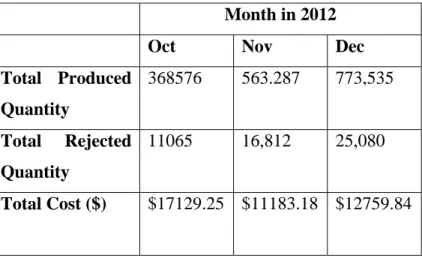
During the last quarter in 2013, Company ABC MANUFACTURER lost more than $40,000 from poor quality products which did not meet standards or requirements from customers as shown
International Journal of Research in Engineering & Applied Sciences
http://www.euroasiapub.org - 43 - 43
-Table 2: Injection molding production efficiency and cost Month in 2012
Oct Nov Dec
Total Produced Quantity
368576 563.287 773,535
Total Rejected Quantity
11065 16,812 25,080
Total Cost ($) $17129.25 $11183.18 $12759.84
Company ABC MANUFACTURER produced more than 400 orders of injection molding products which was more than one million pieces of products. The quality department reported that the overall percentage of rejects or bad quality products was 3.1 1% which may seem fine but was not. As mentioned before, the variety of injection molding products has been escalating; therefore the bad quality percentage had large variation between products. Some products had zero defects while other products had more that 50% defects.
The operators had another duty besides running the machine: to inspect every piece of product in reference to the 12 kinds of defects and record the number of each kind of defect: 1) short, 2) flash, 3) contaminated, 4) splay, 5) pin push, 6) scratch/damage, 7) sink/bubble/void, 8) cold slug, 9) flow line, 10) bum mark, 11) startup, and 12) last off. The products that had defect(s) which could not be repaired or recycled were classified to be scrap or trash. This created additional cost of material, labor, etc. to the company.
Quality engineers randomly inspected the finished products before delivery to the customer. After inspection by the quality engineers, if there were errors and the amount of good quality product is less than the orders, the operator has to start the whole process again to fulfill the order. Therefore, about 5% above the customer's order was produced to account for inspection errors by the operator.
Problem Identification and Analysis - Objective 2
International Journal of Research in Engineering & Applied Sciences
http://www.euroasiapub.org - 44 - 44
-The quality department stated that 12 kinds of defects often occur in the injection molding process: I) short, 2) flash, 3) contaminated, 4) splay, 5) pin push, 6) scratch/darnage, 7) sink/bubble/void, 8) cold slug, 9) flow line, 10) burn mark, 11) start up, and 12) last off.
The possible causes of each defect were found out by brainstorming with quality engineers and operators. The major causes of all defects could be categorized in four categories:
machines,
materials,
molds, and
Humans.
The main causes of contaminated/oil defects were the leak of machine oil and mold assembly lubricant. Contaminated raw material was the minor cause which related to the quality of product or material handling.
Splay and silver streaks are regularly caused by gas and steam, but dirt can cause the problem too. The causes which occurred often in the injection molding process at Company ABC MANUFACTURER were moisture on pellets, moisture from mold, high humidity, dirt, air entrapment, and too high melt temperature.
Start up problems related to machine conditions, materials, and mold. Causes from materials and mold were about 10%-20% of total defects from start up problems.
Eighty percent of total defects were from machine conditions including temperature and pressure setting level.
Shorts or short shots were caused by many parameters but temperature and pressure were the main factors. Specifically, improper melt temperature, low mold temperature, and low injection pressure were the causes. The less likely causes were incorrect shot size, short dwell time, attrition of screw, and air resistance.
International Journal of Research in Engineering & Applied Sciences
http://www.euroasiapub.org - 45 - 45
-during the process, the operators had to wait for the production engineers to solve them. This increased the number of defects, cost, and processing time.
Recommendation for Improvement-Objective 3
This phase was separated into three sections. The first section is recommendations for operators to improve work efficiency. The second section is for the operators to use as a reference for the solutions to the problems leading to the four main kinds of defects: contaminated oil, splay, start up, and short. The last section is to guide the company for a continuous improvement plan. Training for operators. The production managers and quality manager agreed that more training for the operators can prevent defects in the process, reduce the defects, reduce cost, save time, and increase customer satisfaction. Following is the recommended detail that should be involved in the training program:
1) Provide an introduction in the injection molding process.
2) Discuss the components of injection molding machine and their particular functions. 3) Guide the procedures for starting up and shutting down the injection molding machine. 4) Discuss the materials or polymers characteristics.
5) Define common defects in the injection molding process and explain their causes. 6) Provide the solutions for each cause of defects and train to solve the problems.
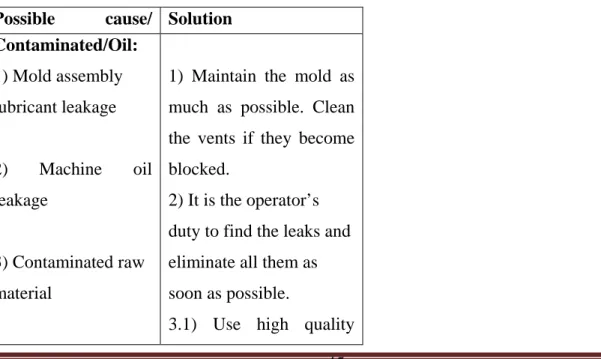
Troubleshooting guide. Table 3 shows solutions for each possible cause of the four main kinds of defects and use it as a reference to solve the problems.
Table 3: Troubleshooting table
Possible cause/ Solution Contaminated/Oil:
1) Mold assembly lubricant leakage
2) Machine oil leakage
3) Contaminated raw material
1) Maintain the mold as much as possible. Clean the vents if they become blocked.
2) It is the operator’s duty to find the leaks and eliminate all them as soon as possible.
International Journal of Research in Engineering & Applied Sciences
http://www.euroasiapub.org - 46 - 46
-product.
3.2) Report back to suppliers about the quality of product.
3.3) Train material handlers how to take care of materials.
3.4) Improve housekeeping practices.
Splay:
1) High melt temperature
2) Condensed moisture on
Pellets
3) Contaminant or dirt
4) Air entrapment
1.1) Decrease melt & Nozzle temperature.
2.1) Dry resin pellets, per the manufacturer's
recommendations, before use
2.2) Follow the material handling procedures to avoid
moisture pick up.
3) Check plastic granules & clean mold surface. 4 ) Improve mold venting Start up:
1) Machine conditions
2) Materials
1) Machine must be thoroughly checked Before starting.
International Journal of Research in Engineering & Applied Sciences
http://www.euroasiapub.org - 47 - 47
-Shorts:
1) Improper melt temperature
2) Low mold
1) Adjust melt temperature within the material supplier's
recommended range.
The current form or "Shift Report" does not contain enough filling information for the company to use later as a reference. Six essential parameters should be added in the form: melt temperature, mold temperature, injection pressure, hold pressure, hold time, and injection speed. A new modified "Shift Report" must have to be introduced for operators to fill and use as further information.
Implement PDSA cycle. The last result of this research was to guide the company for a continuous improvement plan. The company had not decided to implement the continuous plan in the injection molding process. However, a continuous improvement plan can help the company to improve their quality of products and process which can also reduce cost and satisfy customer needs. The Plan-Do-Study-Act (PDSA) cycle or Deming cycle is the most commonly used tool for continuous improvement. This study already provided the plan step for the company. Following are the recommendations for
Company ABC MANUFACTURER to complete the continuous improvement plan: 1) Plan step
2) Do step: The ideas from plan step should be implemented on a small scale. The company should observe and record the result after implementing to point out the strengths and weaknesses of the solution. The plan can be modified depending on the situation.
3) Study step: The collected data from the Do step should be analyzed and compared with the expected outcomes. Whether the problems have been solved or not, the team members will learn through the improvement process and can use this knowledge in their work or in the process for further improvement.
International Journal of Research in Engineering & Applied Sciences
http://www.euroasiapub.org - 48 - 48
-5) The Plan step provided in this study can be used to solve the problems associated with the four main defects only. Therefore, after the company solves the four main types of defects, the remaining types of defects should be solved to minimize the percentage of defects by implementing the PDSA cycle again.
6) The last section of the continuous improvement plan should involve reviewing the actions or processes annually or every six months and replacing them with better solutions.
8. DISCUSSION
Introduction
This chapter provides a summary, major findings, conclusions and the recommendations related to this study.
Summary
The purpose of this study was to help Company ABC MANUFACTURER improve product quality and manage the data for a continuous improvement plan. The objectives of this study were:
1. To create a process map and evaluate the results to determine the company's current performance.
2. To identify and analyze problems in injection molding processes.
3. To create the possible solutions and make recommendations for the continuous improvement plan.
Methods
Methods and procedures of this study include a review of literature relevant to continuous improvement, Deming cycle, seven tools of quality, costs of quality, and injection molding process. The seven tools of quality was selected to help collecting and analyzing data more rapidly and systematically. These tools were also used to identify problems, seek root causes of problems, and solve problems. Every piece of product was inspected and recorded by the operators. The process map was applied to illustrate the entire process of injection molding which can help the investigators understand the process.
Major Findings
International Journal of Research in Engineering & Applied Sciences
http://www.euroasiapub.org - 49 - 49
-2. Company ABC MANUFACTURER did not have enough time to experiment before producing to attain suitable settings for each product like they were able to in the past.
3. Some new employees, which were hired to support the growing business, were lacking quality knowledge and injection molding knowledge.
4. From October to December, Company ABC MANUFACTURER lost more than $40,000 from poor quality products which did not meet standards or requirements from customers.
5. There were 12 kinds of defects in injection molding process: 1) short, 2) flash, 3) contaminated, 4) splay, 5) pinpush, 6) scratch/damage, 7) sink/bubble/void, 8) cold slug, 9) flow line, 10) bum mark, 11) start up, and 12) last off.
CONCLUSIONS
1. In October, there were about 50% defects out of the total processes. November had about 36% defects and December had about 3 1% defects. In summary, 172 processes out of 425 processes from customer orders in October, November, and December were out of control which was 40% of total processes
2. Contaminated/oil, splay, start up, and short were the main problems which made up almost 80% of defects.
3. The major causes of all defects could be categorized in four categories: machines, materials, molds, and humans.
3.1 The main causes of contarninated/oil defects were the leak of machine oil and mold assembly lubricant. Contaminated raw material was the minor cause which related to the quality of product or material handling.
3.2 The causes of splays which occurred often in the injection molding process at Company ABC MANUFACTURER were moisture on pellets, moisture from mold, high humidity, dirt, air entrapment, and too high melt temperature.
3.3 Start up problems related to machine conditions, materials, and mold. Eighty percent of total defects were from machine conditions including temperature and pressure setting level.
International Journal of Research in Engineering & Applied Sciences
http://www.euroasiapub.org - 50 - 50
-4. The operators were trained only to run the injection molding machine and to inspect the bad quality products rather than solve the confronting problems during the processes.
Recommendations Related to this Study
1 Operator training program. Training for the operators can prevent defects in the process, reduce the defects, reduce cost, save time, and increase customer satisfaction. The training should involve the injection molding process, procedures for starting up and shutting down the injection molding machine, characteristics of materials, injection molding machine and mold maintenance, causes of the defects, and solutions to solve the problems.
2 Troubleshooting guide. Operators can use the solutions to solve the four main defects: contaminated/oil, splay, start up, and short problems.
3 A modified form or "Shift Report." Company ABC MANUFACTURER should use a modified form in the injection molding process which includes the six essential parameters: melt temperature, mold temperature, injection pressure, hold pressure, hold time, and injection speed. If this information is collected, the operators can use the products' histories to solve the start up problems which can reduce scraps and cost for Company ABC MANUFACTURER.
4 A continuous improvement plan. PDSA cycle is the most commonly used tool for continuous improvement which can help the company to improve their quality of products and process, reduce cost, and satisfy customer needs. This study already provided the plan step of the PDSA cycle for the company. Therefore, it is recommended that Company ABC MANUFACTURER implement the do step, study step, and act step to complete the continuous improvement plan.
Recommendations for Further Study
International Journal of Research in Engineering & Applied Sciences
http://www.euroasiapub.org - 51 - 51
-REFERENCES
1. Dale H. Besterfield “ Total Quality Management” , Prentice Hall, 2006
2. Narongsawas Chongwatpol “Implementing Continuous Process improvement methods in a Mid Size Plastic Company” May, 2006
3. http://www.isixsigma.com/implementation/financial-analysis/cost-quality-not-only-failure-costs/
4. http://en.wikipedia.org/wiki/Injection_molding.
5. Nadia Bhuiyan and Amit Baghel, “An overview of continuous improvement: from the past to the present”, www.emeraldinsight.com/0025-1747.htm. pp 761-771.
6. Vito Romaniello, Paolo Renna and Vincenzo Cinque, A Continuous Improvement and Monitoring Performance System: Monitor - Analysis -Action – Review (MAAR) Charts”, IBIMA Publishing Vol. 2011 (2011), Article ID 917557, 15 pages.
7. Robert V. Hogg and Mary C. Hogg, “Continuous Quality Improvement in Higher Education”, International Statistical Review (1995), pp 35-48.
8. He Zhen Qi Ershi Liu Zixian, “A Study on continuous quality improvement strategies and methods”, http://www.paper.edu.cn.