Current and Future approaches for Read-Across:
From Research to Practical Implementation
Grace Patlewicz
National Center for Computational Toxicology
GlobalChem 2017: Friday 24th February 2017
ToxPi PRIORITIZATION
Interactive Chemical Safety for Sustainability Web Application TOXCAST iCSS v0.5
Tool Tip Description of Assays (Data) or whatever is being hovered over
Prioritization Mode
Desc Summary Log
80-05-7 80-05-1 80-05-2 80-05-3 80-05-5 CHEMICAL SUMMARY CASRN Chemical Name 80-05-7Bisphenol A 80-05-1Bisphenol B 80-05-2Bisphenol C 80-05-3Bisphenol D 80-05-4Bisphenol E 80-05-5Bisphenol F 80-05-6Bisphenol G 80-05-7Bisphenol H 80-05-8Bisphenol I 80-05-9Bisphenol J A B C D EFG H 1 1 1 1 111 1 SCORING APPLY St udi es
Outline
•
Background & definitions
•
Workflow for category development and
read-across
•
Current tools and approaches
•
Uncertainty assessment in read-across
•
Quantifying uncertainties and Assessing
Performance of read-across
•
From research to implementation
Background & definitions
• Read-across describes one of the data gap filling
techniques used within analogue and category approaches
• “Analogue approach” refers to grouping based on a
very limited number of chemicals (e.g. target substance) + source substance)
• “Category approach” is used when grouping is based
on a more extensive range of analogues (e.g. 3 or more members)
• The grouping assumes chemicals are similar..”the
quality of being alike” ……
• A chemical category is a group of chemicals whose
physico-chemical and human heath and/or environmental toxicological and/or environmental fate properties are likely to be similar or follow a regular pattern as a result of structural similarity (or other similarity characteristics).
Definition: Read-across
Known information on the property of a substance (source) is used to make a prediction of the same
property for another substance (target) that is
considered “similar” i.e. endpoint & often study specific
Source
chemical Target chemical
Property Reliable data Missing data Predicted to be harmful Known to be harmful Acute fish toxicity?
Overarching hypothesis Decision context Data gap analysis for target Analogue evaluation Analogue identification
The Category Workflow
Data gap
Overarching hypothesis Decision context Data gap analysis for target Analogue evaluation Analogue identification
The Category Workflow
Data gap
Decision Context
•
Prioritisation, e.g. PMN
•
Screening level hazard assessment
•
Risk Assessment, e.g. PPRTV
•
Different decision contexts will dictate
the level of uncertainty that can be
Selected Read-Across Tools
Tool AIM ToxMatch AMBIT OECD
Toolbox CBRA ToxRead
Analogue identification X X X X X X Analogue Evaluation NA X by other X tools available X X X For Ames & BCF Data gap analysis NA X Data X matrix can be exported X Data matrix viewable NA NA
Data gap filling NA X User
driven X X X
Uncertainty
assessment NA NA NA X NA NA
Overarching hypothesis Decision context Data gap analysis for target Analogue evaluation Analogue identification
The Category Workflow
Data gap
Sources of Uncertainty
•
Analogue or category approach? (#
analogues)
•
Completeness of the data matrix – no. of
data gaps
•
Data quality for the underlying analogues for
the target and source analogues
•
Consistency of data across the data matrix –
concordance of effects and potency across
analogues
Sources of Uncertainty (cont’d)
•
Overarching hypothesis/similarity rationale
– how to identify similar analogues and
justify their similarity for the endpoint of
interest
•
Address the dissimilarities and whether
these are significant from a toxicological
standpoint
•
Presence vs. absence of toxicity
•Toxicokinetics
Uncertainty Assessment
•
A number of publications exist that can
guide the construction and assessment of
categories and use of read-across
– Guidance and examples (OECD (2014), ECHA (2008),
ECETOC (2012))
– Frameworks for identifying analogues (e.g., Wu et al
(2010), Patlewicz et al (2013))
– Frameworks for assessing read-across (Blackburn and
Stuard (2014), Patlewicz et al (2014), Patlewicz et al (2015), ECHA – RAAF (2015), Schultz et al (2015), Ball et al (2016))
• However read-across acceptance relies on a
subjective expert assessment
• Uncertainty assessment is qualitative in nature • There is no objective measure of read-across
performance
Critical need is an objective measure of uncertainty in a read-across prediction
Quantifying Uncertainty & Assessing
Performance of Read-Across
•GenRA (Generalised Read-Across) is a “local
validity” approach
•Predicting toxicity as a similarity-weighted activity of
nearest neighbors based on chemistry and bioactivity descriptors
•Systematically evaluates read-across performance and
GenRA - Approach
I. Data
1,778 Chemicals
3,239 Structure descriptors (chm) 820 Bioactivity assays (bio)
ToxCast
574 Apical outcomes (tox) ToxRefDB
II. Define Local neighborhoods Us K-means analysis to group chemicals by similarity
Use cluster stability analysis
~ 100 local neighborhoods III. GenRA
Use GenRA to predict apical outcomes in local neighbor hoods Evaluate impact descriptors (chm, bio, bc) on prediction
GenRA – Performance in Each Cluster
• Use GenRA to predict the similarity
weighted toxicity scores for each
– Toxicity type (𝜷𝜷)
– Descriptor ={chm,bio,bc} (𝜶𝜶 )
– No. of nearest neighbors (𝒌𝒌)
– Similarity score threshold ( 𝒔𝒔𝒊𝒊𝒊𝒊𝜶𝜶 )
• Calculate performance by comparing
predicted 𝒚𝒚𝒕𝒕𝒕𝒕𝒕𝒕 and true 𝒕𝒕𝒕𝒕𝒕𝒕𝒕𝒕 for all chemicals using area under ROC curve (AUC)
0.81 s=0.81 k=4
1
1
1
GenRA - Analysing Local
Neighborhood of a Chemical
• The approach enabled a performance baseline for
read-across predictions of specific study outcomes to be established but was still context dependent on the endpoint and the chemical
• Bioactivity descriptors were often found to be
more predictive of in vivo toxicity outcomes
• Ongoing analysis:
• Consideration of other information to refine the
analogue selection – e.g. TK similarity, metabolic similarity, reactivity similarity…
From research to implementation
• Intent is to integrate objective read-across
functionality as part of ongoing dashboard efforts e.g.
Overarching hypothesis Decision context Data gap analysis for target Analogue evaluation Analogue identification
GenRA prototype development
Data gap
GenRA prototype development
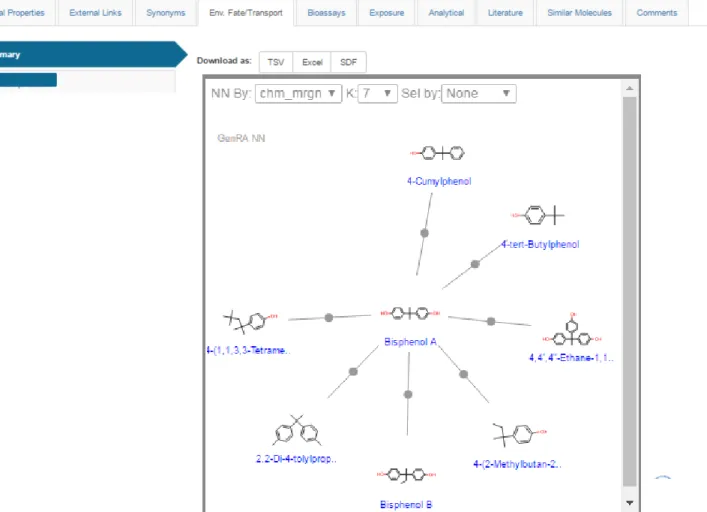
• Analogue identification
–Identifying potential source analogues based on various approaches to characterise chemical
structural information or bioactivity profile from ToxCast data
• Data gap analysis
–Exploring the data availability for the target and source analogues to determine whether the source analogues are a promising starting set
GenRA prototype development
• Analogue evaluation
–Launch a data matrix of the source analogues and target with the available data, colour coded by presence and absence of effects and dose
descriptor information to enable an evaluation of consistency and concordance across category
members and across toxicity effects
• Data gap filling
–Perform a GenRA (read-across) prediction.
Arbitrary thresholds chosen to determine positive, negative and indeterminate calls. Overladen with experimental outcomes to compare
GenRA prototype development
• Uncertainty assessment
–Uncertainty assessment is a feature currently being developed for implementation
Initial interface
Grid feature to allow windows to be moved and dynamically updated in subsequent
Introduce and select a target chemical
Analogue identification:
Search for source analogues on the basis of chemical
fingerprints, filtered by availability of in vivo data
View data quantity
by type View data coverage across study types
To initiate data matrix view
Target
Analogue evaluation
using data
matrix view
Positive and negative effects for toxici – to evaluate consistency and concordan of expt data across analogues and
toxicity effects
Data gap filling using GenRA
within data matrix
Colour density corresponds to toxicity
Update
prediction by removal of analogues
Summary
• Still many challenges remain in read-across • Quantifying the uncertainty of read-across
prediction is a critical issue
• Have illustrated the research directions being taken