Financial Institutions
www.managementsolutions.com
Model Risk Management
Quantitative and
Design and Layout
Marketing and Communication Department Management Solutions - Spain
Content
Introduction
Executive summary
Elements of an objective MRM framework
Model risk quantification
4
8
18
Model risk definition and regulations
12
26
Bibliography
36
M A N A G EM EN T SO LU TI O N S at iv e an d qu al it at iv e as pe ct s 4
Introduction
5
In recent years there has been a trend in financial institutions towards greater use of models in decision making, driven in part by regulation but manifest in all areas of management. In this regard, a high proportion of bank decisions are automated through decision models (whether statistical algorithms or sets of rules)1.
First, the last few years have seen an increase in the use of automated electronic platforms that execute trade commands which have been pre-programmed by time, price or volume, and can start without manual intervention, a system known as algorithmic trading. As an example, an automated trade command that took place on May 6, 2010 resulted in a 4,100 million-dollar “flash crash” of the New York Stock Exchange, which fell more than 1,000 points and recovered to the same value in only 15 minutes2.
Second, partly encouraged by Basel3regulations, banks are increasingly using decision models (consisting of statistical algorithms and decision rules) in their origination, monitoring and credit recovery processes. Thus, whether or not a loan is viable is determined by estimating the probability of default (PD) of the client. Similarly, banks monitor customer accounts and anticipate credit deterioration using automatic alert models, pre-classify customers and determine their credit limits; and, in credit collections, they develop statistical profiles of delinquent customers in order to apply different recovery strategies.
In the commercial area, customers are able to select a product’s characteristics (loan amount, term and purpose, insurance coverage, etc.) and the system makes a real-time decision on viability and price. In many cases, the model asks the customer a number of questions and proactively makes the offer that best suits the customer (doing this manually would be a slow and complex process).
The use of valuation models for products and financial instruments has become widespread in financial institutions, in both the markets and the ALM business. Some classic examples are Black- Scholes, CAPM4and Monte Carlo valuation models. Another area where the use of models is more and more frequent is fraud and money laundering detection. Bank and regulators alike use models that identify fraudulent or money laundering-oriented transactions, which requires combining statistical customer profiling models (know your customer -KYC), transaction monitoring rules and black lists.
Also, customer onboarding, engagement and marketing campaign models have become more prevalent. These models are used to automatically establish customer loyalty and engagement actions both in the first stage of the relationship with the institution and at any time in the customer life cycle. Actions include the cross-selling of products and services that are customized to suit the client’s needs, within the framework of CRM5.
1MIT (2005). 2SEC (2010). 3BCBS (2004-06).
4Capital asset pricing model. 5Customer relationship management
M A N A G EM EN T SO LU TI O N S M od el R is k M an ag em en t Q ua nt it at iv e an d qu al it at iv e as pe ct s 6
Other examples include the calculation of capital charges for all exposures (credit, market, operational, ALM, etc.) through their individual components; the quantification of a bank’s current liquidity position, projected under different scenarios; the projection of the balance sheet and income statement and the use of stress testing models6; or the modeling of many key components in business planning and development, such as optimal bundle, customer and non-customer income or churn (Fig. 1).
The use of models brings undoubted benefits, including:
4 Automated decision-making, which in turns improves efficiency by reducing analysis and manual decision-related costs.
4 Objective decision-making, ensuring that estimated results are the same in equal circumstances and that internal and external information is reused, thus leveraging historical experience.
4 Ability to synthetize complex issues such as a bank’s aggregate risk.
However, using models also involves costs and risk, some of which are the following:
4 Direct resource costs (economic and human) and development and implementation time.
4 The risk of trusting the results of an incorrect or misused model. There are specific and recent examples of this which have resulted in large losses7.
Model risk may thus be defined as «the potential for adverse consequences based on incorrect or misused model output and reports»8.
Model error may include simplifications, approximations, wrong assumptions or an incorrect design process; while model misuse includes applying models outside the use for which they were designed9.
Model risk thus defined is potentially very significant and has captured the attention of regulators and institutions, whose approach ranges from mitigation via model validation to the establishment of a comprehensive framework for active model risk management.
In the more advanced cases, this active management has been formulated into a model risk management (MRM) framework that sets out the guidelines for the entire model design,
Regulations do not discuss model risk quantification aspects in detail, except in very specific cases relating to the valuation of certain products, in which they even require model risk to be estimated through valuation adjustments (model risk AVAs11) that may result in a larger capital requirement or in the possible use of a capital buffer for model risk as a mitigating factor in a broader sense, without its calculation being specified. Against this background, this study aims to provide a
comprehensive view of model risk management: its definition, nature and sources, related regulations and practical
implications. With this in mind, the document is structured in three sections that address three goals:
4 Introducing model risk by providing a definition, analyzing its sources and summarizing the most important
regulations on the subject.
4 Describing a desirable framework from which to approach model risk management in a practical way and based on examples seen in financial institutions.
4 Advancing model risk quantification (and its potential practical application) through a quantitative exercise that will illustrate the impact of this risk.
7
Source: average of several financial institutions
M A N A G EM EN T SO LU TI O N S at iv e an d qu al it at iv e as pe ct s 8
Executive summary
9
This section is intended to summarize the main conclusions reached on model risk management in financial institutions (which are elaborated on in the appropriate sections of this document).
Model risk definition and regulations
1. The use of mathematical models by financial institutions in many areas is rapidly gaining ground. This brings significant benefits (objectivity, automation, efficiency, etc.) but also entails costs.
2. Among these costs is model risk, understood as the loss (economic, reputational, etc.) arising from decisions based on flawed or misused models.
3. Thus understood, model risk may arise from three basic sources: data limitations (in terms of both availability and quality); estimation uncertainty or methodological flaws in the model’s design (volatility of estimators, simplifications, approximations, wrong assumptions, incorrect design, etc.); and inappropriate use of the model (using the model outside its intended use, failure to update and recalibrate, etc.).
4. There has been little regulatory activity on model risk and, with one exception, regulations in this area refer almost exclusively to the need to make valuation adjustments in derivatives, the requirement to cover all risks in the internal capital adequacy assessment process (ICAAP12) or the use of the Basel III leverage ratio as a mitigating factor of model risk when estimating risk-weighted assets for the calculation of capital requirements via internal models13. 5. The exception relates to the Supervisory Guidance on
Model Risk Management14published by the OCC and the U.S. Fed in 2011-12, which, for the first time, accurately defined model risk and provided a set of guidelines establishing the need for entities to develop a Board-approved framework to identify and manage this risk (though not necessarily quantify it).
6. These guidelines cover all phases of a model’s life cycle: development and deployment, use, validation, governance policies, control and documentation by all involved; the documentation aspect is particularly emphasized due to its importance in effective model validation.
7. Among the main requirements is the need to address model risk with the same rigor as any other risk, with the
particularity that it cannot be removed, only mitigated through critical analysis or “effective challenge”.
8. Regulators expressly indicate that, while expert modeling, robust model validation and a duly justified though not excessively conservative approach are necessary elements in model risk mitigation, they are not sufficient and should not serve as an excuse for the industry not to continue to work towards improving models.
9. With regard to model risk organization and governance, regulators do not prescribe a specific framework, but they do address the need to establish a clear distinction between model “ownership”15, “control”16and “compliance”17roles.
10. The Board of Directors is ultimately responsible for approving a framework for model risk management (MRM) and should be regularly informed about any significant model risk to which the entity could be exposed. 11. Finally, regulators emphasize that the fundamental
principle in model risk management is “effective challenge”, understood as critical analysis by objective, qualified people with experience in the line of business in which the model is used, who are able to identify model limitations and assumptions, and suggest appropriate changes. 12. This comprehensive approach to model risk is novel in the
industry, and the expected trend for the coming years is that the industry will gradually take it on board and implement the prescribed practices, as the most advanced institutions are already doing.
12Internal Capital Adequacy Assessment Process. 13BCBS (2010-11).
14OCC-Fed (2011-12).
15Ownership: refers to the model “owner” or user.
16Control: function that validates the model and sets limits on its use.
17Compliance: includes the execution of processes that ensure the other two roles
M A N A G EM EN T SO LU TI O N S at iv e an d qu al it at iv e as pe ct s 10
Elements of an objective MRM framework
13. Banks that are more advanced in this area have a model riskmanagement (MRM) framework that is outlined in a document approved by the Board of Directors and details aspects relating to organization and governance, model management, etc.
14. With regard to organization and governance, the MRM framework is characterized by its cross-cutting nature (it involves several areas, such as Business lines, Risk, Internal Audit, Technology, Finance, etc.), by explicitly defining the three roles prescribed by the regulator (ownership, control and compliance) and assigning them to specific functions in the organization and, above all, by establishing a Model Risk Management function whose responsibility is to create and maintain the MRM framework.
15. While in some organizations the MRM function includes Internal Validation, in others these two functions are separate, but in all cases the MRM function deals with all matters related to model governance: maintaining an updated and global inventory of models, producing and disseminating MRM policies, evaluating all of the institution’s models on an annual basis, etc.
16. The MRM role, usually led by a Model Risk Officer (MRO), often has the final say on the approval of any of the institution’s models.
17. With regard to model management, the MRM framework includes aspects such as: (a) model inventory covering all of the organization’s models in all areas (risk, commercial , finance), usually supported on a suitable technological tool that keeps track of all changes and versions; (b) a model classification or tiering system according to the risk posed to the bank, which will determine the level of thoroughness that will be required in the monitoring, validation and
documentation of models; (c) complete and detailed documentation on each model, which will allow the model to be replicated by a third party and to be transferred to a new modeler without loss of knowledge; and (d) a model follow-up scheme for the early detection of both deviations from target performance and model misuse, in order to act accordingly.
18. Model validation is central to model risk management and its fundamental principle should be the critical, effective and independent questioning (challenging) of all decisions made in connection with model development, monitoring and use. The frequency and intensity of validation for each model should be commensurate with its risk, measured through its associated tier, and the validation process and outcome should be fully documented.
19. Though model risk quantification is not required by the regulations (with the exception of what has already been mentioned in the introduction), some organizations are beginning to incorporate it into their model risk
management program in order to objectively identify and measure any potential impacts should this risk materialize.
Model risk quantification
20. Beyond the regulations, and for management purposes, some organizations have begun to work on the model risk quantification cycle, which consists mainly of three phases: identifying and classifying model risk sources: (1) Data deficiencies, (2) Estimation uncertainty or flaws in the models, and (3) Model misuse; estimating model risk in respect of each source (output sensitivity to input variations); and mitigating model risk through the implementation of appropriate measures.
11
21. In order to explain this process, a study has been conducted in which model and parameter risk associated with credit risk models is estimated.
22. To illustrate the estimation of data deficiencies, the first exercise examines the impact of insufficient information in the most predictive variables of a scoring model for consumer mortgages. It is observed that the presence of errors in the model’s most predictive variables can either significantly increase the default rate or raise the
opportunity cost (reduce the volume of acquired business) if default is fixed at the same level.
23. The second exercise is aimed at analyzing model risk arising from estimation uncertainty, using the confidence intervals of the estimators. To do this, the confidence intervals of a scoring model, the PD calculation and the LGD calculation (separately and combined) are used as a starting point to analyze how the capital requirement for a mortgage portfolio may become underestimated through the combined effect of uncertainty in the score estimators, PD calibration and LGD estimation.
24. Finally, the third exercise analyzes model misuse through a model (a scoring model, in this case) that was not updated for 12 months after it was first developed. This is done by comparing the model’s predictive power at the time of construction with that observed a year later, and assessing the impact the decision not to update it had on default as well as on opportunity cost (lower business acquisition levels). The observed outcome is that failure to update the model under analysis for 12 months reduced predictive power by several percentage points. The consequence of this reduction in predictive power was an increase in the default rate, or alternatively a reduction in the volume of acquired business (i.e. an increase in the opportunity cost) with default remaining at the same level.
25. In summary, model risk can have a very significant quantitative impact that can result in management making poor decisions or even underestimating the institution’s capital requirement or provisions. It is therefore desirable to have a MRM framework in place and, where appropriate, develop robust model risk estimation techniques aimed at implementing suitable mitigation techniques.
M A N A G EM EN T SO LU TI O N S at iv e an d qu al it at iv e as pe ct s 12
13
What is a model?
When analyzing model risk, the first question that may arise is what a model is and what it is not.
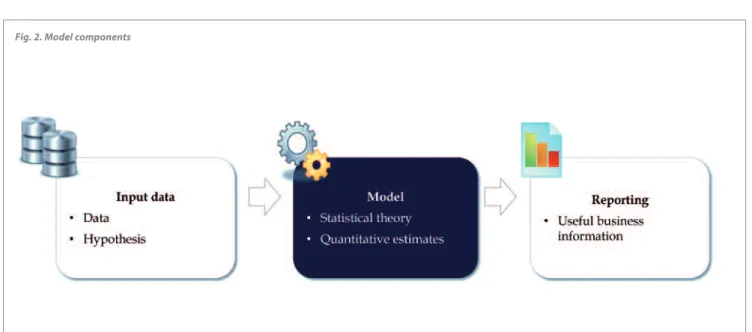
According to the Fed and the OCC18, the term “model” refers to “a quantitative method, system, or approach that applies statistical, economic, financial, or mathematical theories, techniques, and assumptions to process input data into quantitative estimates.” It has three components (Fig. 2):
4The inputs, which introduce hypotheses and assumptions in the model.
4A method to transform the inputs into estimates. This method will generally rely on statistics to produce quantitative estimates.
4A reporting component that converts the estimates into useful business information.
Always according to the Fed and the OCC, “the definition of model also covers quantitative approaches whose inputs are partially or wholly qualitative or based on expert judgment, provided that the output is quantitative in nature.”
As can be seen, the concept of model is broader than what a partial interpretation – more related to the mathematical algorithm in a strict sense – would suggest, and includes expert models, among others.
However, this definition leaves some room for interpretation. For example, under a definition such as the above, the following would no doubt have to be considered as models:
4 An algorithm for the calculation of value-at-risk (VaR) in market risk using either a Monte Carlo or a historical simulation.
4 A score to calculate the probability of default (PD) of the loans in a portfolio using logistic regression.
4 Mechanisms for the valuation of exposures, assets, instruments, portfolios, derivatives, etc.
Conversely, under this definition, it would be questionable whether the following could be considered as models:
4 Any simple data aggregation: sums, averages, standard deviations, financial ratios, etc.
4 A constant annual growth projection based on a single historical year-on-year change, without any other analysis being conducted.
Fig. 2. Model components
insufficient sample size. An example of this would be using appraised value at the date a contract was formalized rather than at the latest date when feeding a model, because the latest date has not been stored in the data bases.
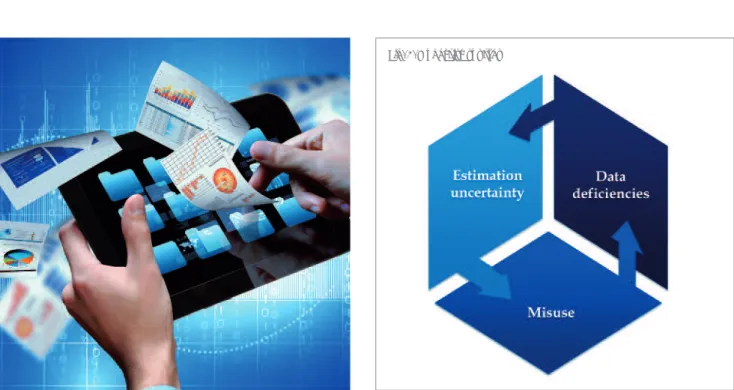
2. Estimation uncertainty or model error in the form of simplifications, approximations, flawed assumptions or incorrect model design. Any of these can occur at any point in model development, from design to implementation, which can lead to erroneous results that are not consistent with the purpose and intended use of the model. They include estimator uncertainty (reflected in the confidence intervals, which are often calculated but tend not to be used), and also the use of unobservable parameters, the lack of market consensus on the model’s functional form, and computational difficulties, among others.
3. Model misuse, which includes using the model for purposes other than those for which it was designed (such as developing a rating model based on a specific portfolio and applying it to a different portfolio, for instance from another country), and not re-estimating or re-calibrating the model in a long time.
M A N A G EM EN T SO LU TI O N S at iv e an d qu al it at iv e as pe ct s 14
4 A decision-making mechanism based solely on the value of a variable; for instance, a simple acceptance or rejection rule based on the LTV value.
It is, however, for each institution to decide the scope of what should constitute a model and therefore would be affected by model risk and the policies defined in connection with it. This scope will at times be unclear and will require a degree of subjective judgment.
Once the scope has been defined, a decision will also have to be made as to the types of model that are to be analyzed (risk, commercial, financial projections, etc.).
Model risk: nature and sources
Models are simplified representations of reality. This simplification is inevitable given the complexity of the relationship between variables, and in any case it is a source of risk that needs to be identified, analyzed and managed like any other risk in an institution.
Model risk, according to the Fed and the OCC, is defined as “the potential for adverse consequences from decisions based on incorrect or misused model outputs and reports”19.
If data deficiencies are explicitly added to this (as they result in incorrect model output), the sources of model risk may be classified into three groups (Fig. 3):
1. Data deficiencies in terms of both availability and quality, including data errors, lack of critical variables, lack of historical depth, errors in the feeding of variables or
Fig. 3. Model risk sources
15
Regulatory context
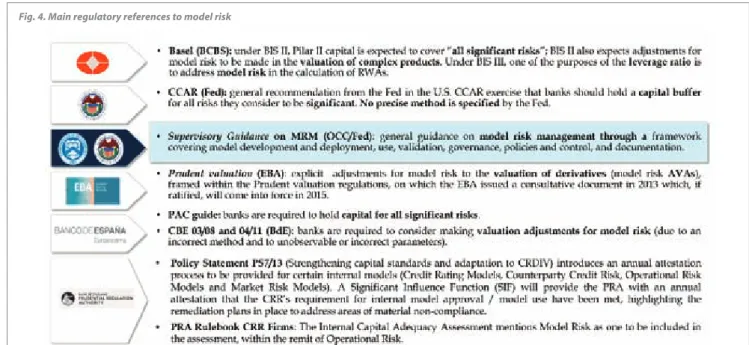
To date, there are few specific regulations covering model risk, and these regulations tend to be non-specific in both their definition and the expected treatment. In addition to the guidance document issued by the Fed and the OCC, which will be analyzed in detail, there are some regulatory references to model risk that can be characterized into three types (Fig. 4):
4 Valuation adjustments: these are regulations governing the need to prudently adjust the valuation of specific products (especially derivatives) to cover any potential model risk.
Although Basel II already indicated20the need to make these adjustments, the main regulatory milestone in this direction occurred in 2013 with the publication of the EBA’s RTS on Prudent Valuation, which for the first time provided specific methodological guidelines on how to perform these adjustments. This is the only case where the explicit quantification of model risk is covered in the regulations, as will be detailed further in this document.
4 Buffer capital linked to ICAAP21: both Basel II in its second pillar and some local regulators22transposing this
regulation address the need to hold capital for all risks considered significant by the organization, as part of their internal capital adequacy assessment process (ICAAP). This is also the case in other ICAAP-related processes, such as the U.S. stress testing exercise known as CCAR23, where the regulator also suggests the possibility of holding a capital buffer for model risk (though it does not require it), which in fact some entities do in practice.
Fig. 4. Main regulatory references to model risk
However, most regulations either only mention model risk tangentially or model risk can be understood to be included in “other risks”.
4 Other mentions: this encompasses other minor references to model risk, which treat it as being implicit in other regulatory elements. The most notable case is the Basel Committee’s treatment of model risk mitigation through the application of the leverage ratio, though it does not go further into detail24.
The main regulatory milestone, however, took place in 2011-12 with the publication of the Supervisory Guidance on Model Risk Management25by the U.S. regulators. In this document, the concept of model risk and the need for institutions to have a framework in place to identify and manage this risk is clearly defined for the first time.
20BCBS (2004-06): “699. Supervisory authorities expect the following valuation
adjustments/reserves to be formally considered at a minimum: […] where appropriate, model risk.”
21Internal Capital Adequacy Assessment Process. 22See, for example, Bank of Spain (2008-14). 23Comprehensive Capital Analysis and Review.
24BCBS (2010-11): «16. […] the Committee is introducing a leverage ratio
requirement that is intended to achieve the following objectives: […] introduce additional safeguards against model risk and measurement error by
supplementing the risk-based measure with a simple, transparent, independent measure of risk.”
Fig. 5. Structure and scope of Fed and OCC’s rule on MRM M A N A G EM EN T SO LU TI O N S at iv e an d qu al it at iv e as pe ct s 16
To achieve this, the standard proposes a set of guidelines or principles for action on model risk, structured by area (Fig. 5), which can be summarized as follows (Fig. 6):
1. Model risk should be managed like any other risk; banks should identify its sources and assess its magnitude in order to manage it.
2. Model risk cannot be eliminated, only mitigated by good management. A combination of expert modeling and robust validation, while necessary, is not sufficient to eliminate model risk.
3. Consequently, there should be a framework for model risk management (MRM) in place, approved by the Board of Directors.
4. A well supported conservative approach regarding inputs, outputs and model design is an effective tool, but should not be an excuse not to continue to work towards the continuous improvement of models.
5. Prudent use of models may include duly justified
conservative approaches, model stress testing, or a possible capital buffer for model risk. However, the regulator also warns that using too many conservative elements may lead to model misuse.
6. There are many sources of model risk and institutions should pay special attention to the aggregate model risk resulting from their combination.
7. While the choice of a suitable organizational model is at the discretion of the institutions, a clear distinction needs to be made between the roles of model ownership, control and compliance; ownership involves knowing the model risk to which the institution is subject; control deals with limit setting and follow-up, as well as independent model
validation; and compliance is the set of processes that ensure the ownership and control roles are performed in accordance with the established policies.
8. The Board of Directors is ultimately responsible for the model risk management framework, which it must approve, and should be regularly informed about any significant model risk to which the entity is exposed.
9. The key principle in model risk mitigation is effective challenge: critical analysis by objective parties who are qualified and experienced in the line of business in which the model is used, and are able to identify the limitations and assumptions and suggest appropriate improvements. In summary, regulators are encouraging institutions to design model risk management frameworks that formalize the criteria to be followed in model development and implementation, ensure their prudent use, establish procedures to validate their performance and define policy governance and applicable documentation criteria.
This comprehensive approach to model risk is new in the industry, and the expected trend for the coming years is that institutions will gradually adopt it, as the more advanced organizations are already doing.
17
Common sources of model risk
Model risk is present in all stages of a model’s life cycle: development and implementation, monitoring, validation and audit; and stems from three main sources: data, estimation uncertainty and error, and model use.
Some of the common problems that generate model risk are summarized below, by source type.
Development and implementation Use Validation Governance, policies and control Documentation
Fig. 6. Summary of the Fed and OCC guidelines on model risk management
4A clear definition of model purpose (statement of purpose) should be provided.
4Data and other information should be appropriate, should undergo rigorous quality testing as well as checks to ensure its use is justified, and any approximations should be thoroughly documented.
4There should be testing procedures to assess the accuracy, robustness, stability and limitations of the model, as well as a behavior test for different input values.
4The entire development process should be documented in detail.
4User feedback provides an opportunity to check model performance.
4Reports should be made using the estimator and model output values for different sets of inputs in order to provide indicators of model precision, robustness and stability.
4A prudent use of models may include duly justified conservative approaches, stress tests or a possible capital buffer for model risk.
4However, even the regulator warns that excessive use of conservative elements may lead to model misuse.
4The validation process should be embedded in a framework that: - Applies to all models, whether developed in-house or by third parties. - Applies to all model components (including inputs, estimation and outputs). - Is commensurate with model use, complexity and materiality.
- Requires independence from model developers and users.
4Validators should have knowledge and expertise and should be familiar with the line of business in which the model is used, and Internal Audit should verify the effectiveness of this framework.
4All models should be reviewed at least once a year and whenever they undergo material changes.
4The MRM framework, which must be reviewed annually, is developed by Senior Management and approved by the Board, which should be regularly informed about any significant model risk.
4The three basic roles in MRM are: ownership (use of the model), control (model risk measurement, limit setting and monitoring) and compliance (compliance with policies by the other two roles).
4There must be a full inventory of all models in use.
4It is advantageous to have external resources perform validation and compliance tasks.
4The model should be documented with a level of detail that would permit a third party to understand the operation, limitations and key assumptions of the model.
4Where third party models (vendor models) are used, it should be ensured that adequate documentation is provided so that the model can be properly validated.
1 2 3 4 5 Data
- Error in data definition
- Error in the mapping of data with the data sources
- Insufficient data feeding frequency - Problems arising from data provisioning - Data migrations
- Accuracy of proxies (margin of error) - Insufficient sample
- Insufficient historical depth - Lack of critical variables
Estimation
- Estimator uncertainty
- Model does not properly depict reality - Mathematical assumptions are inadequate - High sensitivity of expert adjustments - Use of unobservable parameters - Lack of market consensus - Computational difficulties - Non-use of confidence intervals - Outdated model due to parameter
decalibration, expert adjustments that are not updated, variables with no discriminating capacity, etc.
- Model instability
- Lack of comprehensive documentation - Insufficient analytical capabilities - Use of new methodology not supported by
academic research
- Reduced Validation Unit independence from model developers
Use
- Using the model for purposes for which it was not designed
- Differences between regulatory and management practices
- Extending the model’s use beyond its original scope (new products, markets, segments, etc.) - Model not effectively used in practice - Model not re-estimated or re-calibrated in a
long time
- Unapproved changes introduced in the model - Differences in model definition and uses
between the commercial and the risk area - Model lacks credibility with the user
M A N A G EM EN T SO LU TI O N S at iv e an d qu al it at iv e as pe ct s 18
19
MRM Policy
Several international financial institutions have developed a number of key principles for model risk management (MRM), which are summarized and put forward in this section as possible best practices.
All of these organizations believe it necessary to create a MRM framework that should be approved at the highest level and to establish model ownership, control and compliance as the key roles in model risk management.
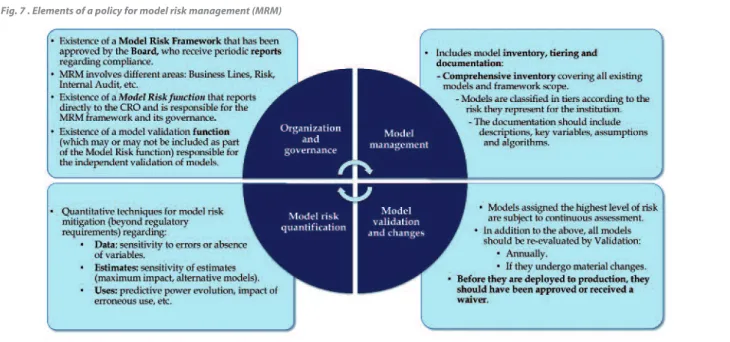
This framework should be embodied in a written and explicit policy that has been approved by the Board of Directors and includes four main elements (Fig. 7):
4Organization and governance: description of roles and responsibilities, in particular establishing the Model Risk Management Function (MRM) as a reference for all matters in this area.
4Model management: guidelines on model classification, development, monitoring, documentation, inventory and reporting.
4Model validation and change management: guidelines for the review of models, the approval of changes, and on waivers required for using the model prior to approval.
4Model risk quantification: methodology for model risk estimation, according to its nature and classification.
The Board of Directors is ultimately responsible for the approval of the MRM framework. Also, and in line with the guidelines established by the OCC and the Fed, the Board should receive regular reports on the implementation of the MRM policy and must be informed of any model risk that may have a material impact on the institution. Thus, best practice puts model risk on the same level as any other significant risk for the institution. From an organizational viewpoint, model risk management is characterized by three components:
4 Cross-cutting nature: model risk management affects several areas within an institution, including the Business lines, Risk, Finance, Internal Audit and Technology.
4 Roles: MRM policy should define the role of each area in model risk management. In line with OCC and Fed guidelines, three roles are usually defined:
- Ownership: this role lies with the model’s end-user areas, which are responsible for ensuring the model is properly used as well as for reporting any errors or inconsistencies; the role of ownership also pertains to
M A N A G EM EN T SO LU TI O N S at iv e an d qu al it at iv e as pe ct s 20
the model development area, which is close to the end user. This role is normally carried out by the Business lines, Finance or Risk.
- Control: an area that measures model risk, sets limits and performs monitoring activities. This role is normally carried out by the Risk area or by a specific and independent control function which may or may not include the Internal Validation function.
- Compliance: an area that oversees compliance with policies by the other two roles. This role is normally fulfilled by the Compliance or the Internal Audit function.
It should be noted that the model development process and those involved in it are not necessarily the same in Europe as in the U.S., where there is a tendency for schemes to be more decentralized and embedded in the Business lines.
4 MRM Function: best practice includes the creation of a Model Risk Management function (MRM) directly reporting to the CRO26and whose responsibility is to set up and maintain the MRM framework. In some organizations MRM contains the Internal Validation function (in others these two functions are dealt with by separate units), and therefore approves models and their use as well as managing all model governance-related issues. Its responsibilities include:
- Working closely with model owners in order to maintain a global, updated inventory.
- Validating models independently according to the model’s classification (in some organizations, this role is performed by other independent units).
- Approving the use of models and indicating their limitations.
- Conducting an annual assessment of all models in the inventory.
- Preparing and disseminating policy on model risk. The MRM function tends to have a hierarchical structure with differentiated roles that report to the Model Risk Officer (MRO).
The MRM framework includes the guidelines that modelers need to consider during the model development process, as well as the key elements for model risk control. Some of the main guidelines are as follows:
1. Objective and use: all models should have a clearly explained objective and should be used for the purpose they were designed and approved for; any use outside the uses intended during development has to be expressly approved.
2. Inventory: Modelers must declare all models developed for their inclusion in the model inventory and for later validation and follow-up.
3. Tiering: all models should be classified according to the risk their use involves for the organization.
4. Documentation: all models should be documented with a level of detail proportionate to their tier, and should include a description of the objectives, intended uses, input data, hypothesis and methodology used.
21
5. No redundancy: prior to the development of a model, the modeler should confirm that there is not an existing model that may cover the user’s needs.
As regards model development and management components in an MRM framework, there are four key areas: model
inventory, tiering, documentation and follow-up. They are detailed as follows.
Model Inventory
Banks should have a complete inventory of all existing models, with an aim to facilitate model risk governance and
management and to keep a record of all uses, changes and the approval status of each model.
The model inventory should:
4 Include all entity models within the perimeter of what the MRM framework considers “model” and in all areas: Risk, Commercial, Finance, etc.
4 Include information on each model’s tier, its
documentation, its review status, intended and real uses, possible waivers that are being applied, and any other information that the MRM function considers relevant for its good governance.
4 Be supported by a proper technological tool which includes a single and centralized repository for the whole entity and, ideally, an interface that permits dialogue between the owner (including the developer), the validator and the auditor of the model.
4 Keep track of all versions, changes, waivers, documents, considerations from the validators and the supervisor (when applicable), and expected dates to review and update the model.
As it can be appreciated, the construction and maintenance of a model inventory requires a considerable effort by
organizations, but is an essential element of model risk management.
Model Tiering
It is good practice to classify models according to the risk their use involves for the entity. Among other factors, the
thoroughness required in model documentation, the need for validators to approve changes or the frequency and rigor of the follow-up depend on this classification or tiering.
In a normal tiering process, the owner of a model suggests a level of risk for the model, but the MRM function approves it and has the last word in this respect.
Model tiering is a partially subjective process that seeks to reflect the criteria through an institution estimates the risk of each model. As an example, tiering may depend on the following factors (Fig. 8):
4 Materiality, which reflects the economic consequences of a possible error or wrong use of the model, and that each owner quantifies in the most appropriate terms: exposure or balance-sheet volume of affected assets, margin at risk, reputational impact metrics, etc.
4 Sophistication, which expresses the model’s level of complexity: highly complex mathematical formulation, dependency on a large number of input variables, observed stability of parameters, numerical approximations to analytical expressions (e.g. stochastic differential
equations), new algorithms or algorithms for which there is no academic evidence of performance and stability, etc.
4 Impact on decisions, reflecting to what extent model results have an influence on decision processes that are sensitive
M A N A G EM EN T SO LU TI O N S at iv e an d qu al it at iv e as pe ct s 22
for the institution, or on the financial statements and regulatory report. High dependency models are those whose result is the main axis of a key decision for the institution, such as the calculation of capital provisions, whereas low dependency models are those used as another factor to support a non-critical decision. They are usually classified in three levels:
- Department, if an error in the model would only affect one department or area.
- Institution, if an error would affect several departments of an institution.
- External, if the error may affect the institution’s reporting to third parties such as the supervisor, the rating agencies, the shareholders, etc.
Each model’s tier needs to be duly justified by the model’s owner and approved by the MRM function.
Model Documentation
The third key element in the development of models is their documentation, on which there is increasing pressure from supervisors. Documentation is an effective lever for model risk control when it is well managed.
It is necessary to complete the model’s documentation in a comprehensive manner before validation can proceed. The documentation should follow unified templates approved by the MRM function, and it should also ensure the entire model can be replicated by an independent third party, or even transferred to a new modeler for it to be updated or improved without this being a costly process.
A model’s documentation should include at least the following:
4 Data sources: databases used, extraction criteria applied, validations performed, staff responsible for data source and extraction, etc.
4 Model methodology report: model description, need and objectives, reach, intended uses, limitations and
assumptions, justification and detailed description of the methodology used, detail of the data used and justification in terms of suitability, quality and robustness, etc.
4 Model calibration report: in the case of models with parameters calibrated with market or historical data, a detailed description of the methodology, applied benchmarks, quantification of estimator uncertainty, and frequency, alerts and procedure for recalibration.
4 Test plan: description of the test plan the model has followed during construction, together with the detailed results.
4 User’s manual: in the case of models that are directly executed by users, detailed instructions for applying the model, limits and assumptions, guide for the interpretation of results and input data limits outside which the model cannot work properly.
4 Technological environment and operational risk: description of the environment where the model is implemented, assessment of the operational risk it involves (especially in cases of implementation outside the entity’s technological environment) and detail of the contingency plans foreseen in the case of operational failure.
23
Summing up, documenting models requires a substantial effort by the entity but is key to facilitating the update, follow-up, validation and audit processes, as well as the supervisory review. Consequently, it is receiving increasingly more attention from entities and regulators.
Model Follow-up
Finally, it is essential to have a decision-model performance monitoring system in place that allows for the early detection of deviations from target and for remedial or preventive action to be taken.
The follow-up should be carried out with a frequency that is proportional to the model risk (measured through its tier), and should consist of a series of alerts and objective criteria that will make it possible to determine when a model needs to be rebuilt, recalibrated or decommissioned. Also, the final user’s feedback is essential in model monitoring, as it is the most effective source for identifying deviations with respect to the model’s expected behavior.
Model monitoring should be comprehensive, in the sense that it should not be limited to the statistical or mathematical algorithm, but should instead monitor all elements employed in the decision (which can include decision rules, expert adjustments, strategies and any element that participates in the final decision) jointly. This is especially relevant and a usual source of model risk, because it is the model as a whole that makes the final decision.
Therefore, a comprehensive follow-up may examine the following elements, among others:
4 Statistical model: the performance of the statistical algorithm is analyzed through:
- Analysis of sample stability through the evolution of variables.
- Metrics on predictive power development, such as the area under the ROC curve, the powerstat or the Kolmogorov-Smirnov distance, among others.
- Assessment of model behavior using techniques such as volatility or predictivity analysis of each variable, backtest of obtained vs. expected results or analysis of residuals.
- Comparison of results with alternative models or industry benchmarks.
4 Decision strategies: the behavior of decision rules accompanying the statistical model is analyzed; for instance, minimum conditions for acceptance, exclusive and restrictive rules or the cut-off point.
4 Expert adjustments: the impact of expert adjustments to the model is analyzed; for instance, the manual decision when the automatic judgment assigned by the decision strategy is modified (override).
For example, sound monitoring of a decision model in credit risk would enable the assessment of many aspects, such as the model’s predictive power, the cut-off point efficiency in terms of default, the binding character of the automatic decision strategy (scoring + rules), the proper functioning and implementation order of the decision rules, the percentage of manual decision and, accordingly, the adequacy of the decision authority, override and the classification of their reasons, the opportunity cost (denied or withdrawn requests), or the use of other criteria besides statistical criteria (e.g. profitability and costs) in decisions, among others.
M A N A G EM EN T SO LU TI O N S at iv e an d qu al it at iv e as pe ct s 24
To this end, it is useful to have tools that cover the entire model follow-up cycle (Fig. 9) and that make it possible to conduct a what-if analysis and to quickly deploy to production all model changes arising from the follow-up observations27.
Model validation is a key element in model risk mitigation and its purpose is to effectively and independently challenge the decisions made during model development, follow-up and use. The frequency and intensity of the validation should be proportionate to the risk each model represents, measured through its tier. Consequently, models assigned the highest risk (tier 1) must be validated by analysts that are sufficiently experienced and qualified and as frequently as their use requires, and their documentation should be especially thorough, whereas lower risk models may be reviewed once a year and the documentation requirements are much less strict. According to the regulations and to best practice, model validation should comply with a number of principles: 1. Thoroughness: all models that may involve risks for the
institution should undergo the validation process. 2. Scope: the validation should not focus solely on the
models’ quantitative attributes, but it should also cover at least the following aspects:
- Methodology. - Documentation. - Quality of the data used. - Quantitative aspects.
- Qualitative aspects (use tests, role of Senior Management, internal controls, etc.). - Technological environment.
3. Headcount and qualification: the Validation function should have a sufficient number of qualified professionals for the different aspects to be analyzed.
4. Independence: the institution should ensure that the Validation function is in a position to issue an opinion with full independence, preventing any possible undue influence from units participating in the development of models or other types of influence.
5. Responsibility: the institution is responsible for the validation process and cannot delegate it to third parties or the supervisor.
6. Frequency: the validation is an iterative process that must be performed with a specific frequency (depending on the model tier).
7. Internal criteria: there is no single standardized validation method for all institutions and models; each institution needs to set standards using its own criteria, and these standards should be commensurate with model risk. 8. Organization: the Validation function roles, responsibilities,
work scheme and setting within the organization should be documented and approved at the corresponding level.
Fig. 9. Policies and Models Manager
27In this respect, Management Solutions has the MIR Policies and Models
25
9. Documentation: descriptive information on different aspects should be kept updated by the Validation function:
- Assessment, measurement and follow-up methodologies, as well as statistical model methodologies.
- Validation reports, including those written by Internal Audit and those related to the validation process, with a clearly indicated conclusion (approved, approved on condition - waiver - or disapproved.
- Historical record of the changes done in internal systems, including the validation system itself. 10. Audit: the Validation function itself must be reviewed by
Internal Audit, which needs to analyze its work and implemented controls, as well as to give its opinion on the degree of actual independence of this unit.
11. Vendor models: models developed by third parties (vendor models) present additional difficulties for their validation, as the documentation may not be complete and the construction data may not be available. In these cases, the entity should request all necessary information and apply the same procedures to validate the model, and should do so with the same rigor as if it was internal, limited only by legal requirements.
As was previously mentioned, while model risk quantification is not required by regulations, in practice some entities are already including specific quantitative techniques in their MRM framework for model risk mitigation purposes.
These techniques are applied to:
4 Data, through sensitivity to error in variables and even to the absence of key data input for model execution.
4 Estimations, by using output sensitivity to the volatility of estimators.
4 Use, by monitoring changes in predictive power and other follow-up metrics.
The following section explains how this quantification may be performed, together with an exercise that illustrates its practical application.
M A N A G EM EN T SO LU TI O N S at iv e an d qu al it at iv e as pe ct s 26
27
Model risk quantitative management cycle
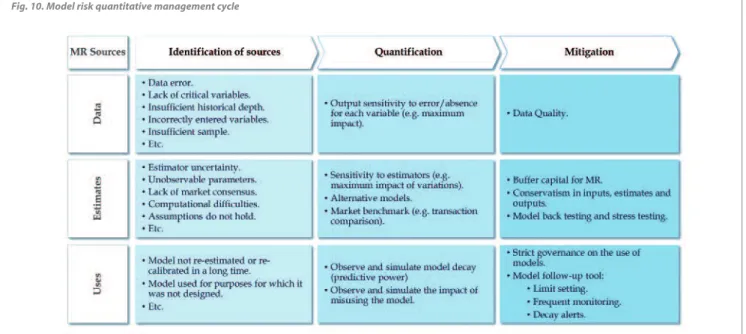
Beyond specific aspects required by the EBA for the valuation of derivatives (model risk AVAs28) , as was previouslymentioned, it is a fact that model risk quantification is not yet explicitly required by regulators, which is why no significant progress has been made by the institutions in this field so far29. Notwithstanding the above and, for management purposes, some institutions have started to work on the model risk management cycle from a quantitative perspective, with an aim to support qualitative model risk management as recommended by the Fed and the OCC regulations. Seen in this light, a model risk quantitative management cycle would comprise three phases (Fig. 10):
4 Identification of model risk sources and classification according to the previously mentioned sections:
- Data deficiencies.
- Estimation uncertainty or model errors - Model misuse.
4 Quantification of the model risk inherent to each source, using a methodology based on model output sensitivity to potential fluctuations (in the inputs or the estimators) that characterize the uncertainty associated to the source.
4 Mitigation of model risk identified and quantified by applying the appropriate measures, which will depend on the nature of each source.
Even though eliminating model risk is not possible, implementing an approach that combines a rigorous risk management structure, as prescribed by the Fed and the OCC, with prudent and detailed quantification such as that described may be an effective strategy to mitigate it.
Motivation and approach of the study
In light of the scant practice observed in model risk quantification in the industry, only undertaken by some institutions, it was considered of interest to carry out an exercise in this connection. For this reason, a study was designed with a view to quantifying this risk in credit risk parameters and models.This exercise is composed of three parts, which coincide with the three model risk sources described:
4 Data deficiencies: in this first phase, the impact of the lack of information in a model’s most predictive variables will be
Fig. 10. Model risk quantitative management cycle
28Model risk additional valuation adjustments (AVAs), detailed in EBA (2013). 29The capital buffer is an exception in the CCAR exercise in the US, which some
M A N A G EM EN T SO LU TI O N S M od el R is k M an ag em en t Q ua nt it at iv e an d qu al it at iv e as pe ct s 28
analyzed; for example, a scoring model for consumer mortgages will be used. To do this, we will reconstruct the scoring model without these variables, and determine the associated decrease in predictive power and its relationship with the model management outputs: the assumed default (type I error) and the missed potential business or
opportunity cost (type II error).
4 Estimation uncertainty or model error: in the second part, the model risk arising from uncertainties in the estimation will be studied. To this end, the confidence intervals of the estimators obtained from the scoring model, the PD calculation in the calibration and the LGD calculation will be used to describe the normal distributions that characterize these estimators. Various parameter sets will be simulated on these distributions using Monte Carlo and regulatory capital for the portfolio will be re-estimated based on the outcome. This will provide a distribution of the capital requirement for the portfolio, its volatility arising exclusively from the uncertainty in the selection of
estimators.
4 Model misuse: finally, the risk arising from a scoring model that was not properly monitored and updated to keep up with portfolio evolution over time will be analyzed. To do this, the model’s predictive power at the time of
construction will be compared with that shown a year later, and the effect of not updating the model on type I and II errors will be analyzed.
With this, three real examples of model risk quantification will have been provided to offer a measure of its relevance.
Data
The study was carried out using the following data, models and parameters30:
4 A real construction sample for a mortgage scoring model. The sample comprises some 200,000 mortgage loans, with a default rate of around 4%.
4 A real implementation sample, a year after construction, of the mortgage loan portfolio at the time of its construction and its performance in the following year.
4 A mortgage scoring model built on the previous sample. It has 14 variables and its predictive power is medium-high (ROC31of around 78%).
4 Calibration mechanisms for the PD, LGD and CCF
Main findings
The main findings from this study are the following:
4 As regards the model risk arising from the data, it is observed that the presence of errors in the three most predictive variables of a scoring model may double the default rate on the balance sheet, or may instead reduce by 40% the business obtained if the same default rate is to be kept.
4 Quantifying the impact of model estimation uncertainty reveals that the capital requirement for a mortgage portfolio may be underestimated by up to 8%, with a confidence level of 90%, due to the combined effect of uncertainty in the score estimators (4% underestimation if considered in isolation), in PD calibration (7%) and in LGD estimation (2%).
4 Finally, with regard to model misuse, it is observed that failure to update a model for 12 months may cause its predictive power to decrease by around 10%. This in turn results in an increase of up to 67% in the default rate, or alternatively, a 15% reduction in the volume of acquired business (i.e. a 15% increase in the opportunity cost) if the cut-off point is fixed so as to maintain the same default rate.
Summing up, in addition to the previously described
qualitative effects, model risk may have substantial quantitative impacts that could lead to erroneous management decisions or to an institution’s capital requirement to be underestimated. Consequently, some banks include robust model risk
quantification techniques in their MRM frameworks in order to properly mitigate this risk.
The estimation of sample parameters is normally accompanied by the obtainment of confidence intervals, which provide a more realistic estimation of the parameter since they represent a range or set of values within which the real value of the estimator lies with a given probability (established by the level of confidence). As a result, an interval with a level of confidence 1 – αfor a parameter 𝜗
is represented as:
[₁,] where 𝑃(₁) = 1-𝛼
There are two general approaches for the estimation of confidence intervals:
- Parametric, in which a known distribution of the estimator is assumed.
- Non parametric, in which no knowledge about the distribution is assumed.
Below are several common techniques for the obtainment of confidence intervals of both parametric assumptions (taking a logistic regression as an example) and non-parametric assumptions (such as the calculation of central-tendency estimators, such as the mean or the median).
Confidence intervals of the logistic regression estimators (parametrical methods)
Generally, logistic regression is used to relate discrete binary responses (such as the non-payment or payment of a debt) with a set of explanatory variables, which is the reason why this is the most frequently used algorithm in scoring and rating models. This relationship may be expressed as follows:
𝑙𝑜𝑔𝑖𝑡 (𝜋) = 𝑙𝑜𝑔 = 𝛼+𝛽´𝑥
Where 𝑥is the vector of explanatory variables used in the model,
𝜋is the probability that the 𝑌response being predicted actually happens, conditioned to 𝑥, that is, 𝜋=𝑃(𝑌=1|𝑥), 𝛼is the
intersection at the origin of the curve, and 𝛽is the vector with the slopes of the 𝑥variables.
When modeling through a logistic regression, the 𝛼and 𝛽
parameters, known as weights or estimators, are obtained. Thus, the main source of model risk in a logistic regression is the error made when estimating its weights, and confidence intervals may be used to quantify it.
Wald’s confidence intervals, also called normal confidence intervals, are based on the fact that estimators show a normal asymptotical behavior, and admit a closed expression. As a result, Wald’s confidence interval 100(1-𝛼)%for the 𝛽estimator is simply:
𝐼 = 𝛽 ± 𝑧-/𝜎̂
where 𝑧is the 100𝑝%percentile of the standard normal distribution, 𝛽is the maximum likelihood estimator of 𝛽, and 𝜎̂
is the standard error estimation of 𝛽.
From the confidence intervals obtained, it is easy to get the empirical distribution of the score for each of the logs in the sample, which is the key element to calculate the model error that is being assumed. The steps to do this would be as follows:
- For each 𝛽estimator, the function of the normal distribution 𝐹 =𝑁𝛽, 𝜎̂is considered, centered in the weight estimator and with standard deviation equal to the estimator of its standard error.
29 - A large amount (𝑛) of random numbers 𝑥is simulated,
according to an even distribution between 0 and 1, 𝑋~𝑈(0,1). - For each 𝑘 ∈{1..𝑛}, a full set of 𝛽estimators for the logistic
regression is simulated through the inverse of its respective distribution functions, 𝛽= 𝐹–1 𝑥.
- The entire portfolio is scored with each set of estimators. This way, the distribution of the score for each portfolio record is obtained, from which it is possible to estimate confidence intervals, volatilities and other measures for the quantification of the model risk shown by the natural uncertainty in the estimation of a logistic regression.
Confidence intervals of central tendency estimators (non-parametric methods)
To establish the uncertainty associated to an estimator that has been calculated using a central tendency estimator (such as a mean or a median, used in the calculation of LGD in credit risk, for example), non-parametric techniques that do not require knowing or assuming a distribution for the estimator are normally used. One of the most common techniques is bootstrapping, which is based on random sampling and basically consists of generating n size samples to obtain the distribution function of the selected estimators (mean, median, etc.) from all the generated samples. In particular, the steps to develop the confidence intervals of the selected estimator for the calculation of a 𝛽estimator would be the following:
- Given the parameter construction sample composed of 𝑛
observations, 𝑥= (𝑥₁, … 𝑥), a random sample is generated to replace the original sample to obtain a bootstrap sample
𝑥* = (𝑥= (𝑥₁, … 𝑥).
- Then, the statistic of interest for the bootstrap sample 𝛽* = 𝛽(𝑥*) is generated.
- Steps 1 and 2 are repeated 𝑁times being 𝑁sufficiently large. Generally, it is suggested that 𝑁reaches values over 1,000 iterations32for the calculation of intervals with confidence levels
between 90% and 95%.
- After the 𝑁iterations, a bootstrap estimator sequence
𝛽*₁, …, 𝛽*will be generated for the statistic distribution to be studied.
The distribution of bootstrap estimators will enable the calculation of a percentile confidence interval for 𝛽(1–𝛼)100%, among other things. This interval will be given by the quantiles (𝑞(𝑝₁), 𝑞(𝑝)) of
𝑁bootstrap replications with 𝑝₁=𝛼/2and 𝑝=(1–𝛼)/2.
32Efron and Tibshirani (1993).
Quantification of uncertainty: confidence intervals
𝜋 1-𝜋
M A N A G EM EN T SO LU TI O N S at iv e an d qu al it at iv e as pe ct s 30
Part I: Data deficiencies
The first exercise focuses on quantifying the impact of model risk through data deficiencies (Fig. 11). To do this, two models are developed from a real mortgage scoring model:
4 Model A: the score resulting from removing the most predictive variable and retraining the model.
4 Model B: the score resulting from removing the three most predictive variables and retraining the model.
In the first case, a decrease in predictive power of almost 2 percentage points is observed, and of nearly 9 percentage points in the second case.
From the two obtained models, the entire portfolio is rescored and two what-if analyses are performed on each model, moving the cut-off point in order to answer the following questions:
4 If a cut-off point were fixed in the new model so as to keep constant the default accepted by the model (type I error), how much would the opportunity cost increase, measured as the potential business volume that is not obtained?
4 If, conversely, a cut-off point were fixed in the new model so as to keep constant the business volume that the model accepts (type II error), how much would the default accepted by the model increase?
The results obtained are as follows (Fig. 12):
4 When reconstructing the model without the most
predictive variable, keeping the default rate equal to that of the original model reduces the business volume obtained by 5% (i.e. the opportunity cost is multiplied by 1.05), and
keeping the business model obtained by the original model also multiplies the default rate by 1.05.
4 When reconstructing the model without the three most predictive variables, keeping the default rate equal to that of the original model reduces the business volume obtained by 40% (i.e. the opportunity cost is multiplied by 1.40), and keeping the business volume obtained by the original model also multiplies the default rate by 1.98 (i.e. it is almost doubled).
As can be seen, the presence of errors in the most predictive variables -if they are sufficient to invalidate their use in the model- has very significant effects on the default and business volume that the model approves.
Fig. 12. First exercise results: Change in the default rate vs. Opportunity cost
M A N A G EM EN T SO LU TI O N S at iv e an d qu al it at iv e as pe ct s 32
Part II: Uncertainty in the estimations
The second exercise seeks to quantify the impact of model risk through the implicit uncertainty in estimators (Fig. 13). To this end, based on a real scoring model, the PD calibration, the LGD estimation and the BIS capital formula, four Monte Carlo simulations are performed:
4 From the confidence interval for each scoring model estimator, their normal distributions are reconstructed. Using these normal distributions, 10,000 parameter sets are simulated, therefore 10,000 models, which are used to rate the entire portfolio and to calculate capital, keeping constant the original PDs and LGDs. This way, the capital’s sensitivity to uncertainty in the scoring model estimators is calculated.
4 From the confidence interval of the PDs in the calibration, 10,000 PD sets are simulated, and with them the capital is calculated, keeping the original scoring and LGD constant. This way, the capital’s sensitivity to uncertainty in the PD calibration is estimated.
4 Similarly, a simulation on the LGDs is performed, keeping the original score and PD constant, to determine the capital’s sensitivity to uncertainty in the LGD estimation.
4 Finally, an aggregated simulation is carried out, in which both the scoring estimators and the PDs and LGDs fluctuate according to their confidence intervals, and capital is calculated. With this, the sensitivity of capital to the combined uncertainty from the score, PD calibration and LGD estimation is calculated.
With a level of confidence of 90%, the findings are as follows (Fig. 14):
4 As a result of the uncertainty in the score estimators, the capital requirement could move up or down by 4%.
4 The uncertainty in PD calibration could cause the capital figure to move up or down by 7%.
4 The uncertainty in LGD estimation could cause capital to move up or down by 2%.
4 Finally, the combined effect of the three previous simulations shows that capital could move up or down by 8% due to the model risk arising from the uncertainty in its elements.
As can be observed, the uncertainty in the estimations could cause a situation in which capital is underestimated by up to 8%, due solely to model risk, a fact that should be considered and mitigated -if possible- with a conservative approach.
Fig. 13. Summarized approach of the second exercise
Fig. 14. Second exercise results: capital variation (multiplier) for each simulation and for the combined simulation