PROBLEMS
sec. 2-4 Average Velocity and Average Speed
•1 During a hard sneeze, your eyes might shut for 0.50 s. If you are driving a car at 90 km/h during such a sneeze, how far does the car move during that time?
Answer: 13 m
•2 Compute your average velocity in the following two cases: (a) You walk 73.2 m at a speed of 1.22 m/s and then run 73.2 m at a speed of 3.05 m/s along a straight track. (b) You walk for 1.00 min at a speed of 1.22 m/s and then run for 1.00 min at 3.05 m/s along a straight track. (c) Graph x versus
t for both cases and indicate how the average velocity is found on the graph.
•3 An automobile travels on a straight road for 40 km at 30 km/h. It then continues in the same direction for another 40 km at 60 km/h. (a) What is the average velocity of the car during the full 80 km trip? (Assume that it moves in the positive x direction.) (b) What is the average speed? (c) Graph x versus t and indicate how the average velocity is found on the graph. Answer:
(a) + 40 km/h; (b) 40 km/h
•4 A car travels up a hill at a constant speed of 40 km/h and returns down the hill at a constant speed of 60 km/h. Calculate the average speed for the round trip.
•5 The position of an object moving along an x axis is given by x = 3t - 4t2 + t3, where x is in meters and t in seconds. Find the position of the object at the following values of t: (a) 1 s, (b) 2 s, (c) 3 s, and (d) 4 s. (e) What is the object's displacement between t = 0 and t = 4 s? (f) What is its average velocity for the time interval from t = 2 s to t = 4 s? (g) Graph x versus t for 0 ≤ t ≤ 4 s and indicate how the answer for (f) can be found on the graph.
Answer:
(a) 0; (b) - 2 m; (c) 0; (d) 12 m; (e) + 12 m; (f) + 7 m/s
•6 The 1992 world speed record for a bicycle (human-powered vehicle) was set by Chris Huber. His time through the measured 200 m stretch was a sizzling 6.509 s, at which he commented, “Cogito ergo zoom!” (I think, therefore I go fast!). In 2001, Sam Whittingham beat Huber's record by 19.0 km/h. What was Whittingham's time through the 200 m?
••7 Two trains, each having a speed of 30 km/h, are headed at each other on the same straight track. A bird that can fly 60 km/h flies off the front of one train when they are 60 km apart and heads directly for the other train. On reaching the other train, the bird flies directly back to the first train, and so forth. (We have no idea why a bird would behave in this way.) What is the total distance the bird travels before the trains collide?
Answer: 60 km
••8 Panic escape. Figure 2-21 shows a general situation in which a stream of people attempt to escape through an exit door that turns out to be locked. The people move toward the door at speed vs = 3.50 m/s, are each d = 0.25 m in depth, and are separated by L = 1.75 m. The
arrangement in Fig. 2-21 occurs at time t = 0. (a) At what average rate does the layer of people at the door increase? (b) At what time does the layer's depth reach 5.0 m? (The answers reveal how quickly such a situation becomes dangerous.)
Figure 2-21 Problem 8.
••9 In 1 km races, runner 1 on track 1 (with time 2 min, 27.95 s) appears to be faster than runner 2 on track 2 (2 min, 28.15 s). However, length L2 of track 2 might be slightly greater than length L1 of track 1. How large can L2 - L1 be for us still to conclude that runner 1 is faster?
Answer: 1.4 m
••10 To set a speed record in a measured (straight-line) distance d, a race car must be driven first in one direction (in time t1) and then in the opposite direction (in time t2). (a) To eliminate the effects of the wind and obtain the car's speed vc in a windless situation, should we find the average
of d/t1 and d/t2 (method 1) or should we divide d by the average of t1 and t2? (b) What is the fractional difference in the two methods when a steady wind blows along the car's route and the ratio of the wind speed vw to the car's speed vc is 0.0240?
••11 You are to drive to an interview in another town, at a distance of 300 km on an expressway. The interview is at 11:15 A.M. You plan to drive at 100 km/h, so you leave at 8:00 A.M. to allow some extra time. You drive at that speed for the first 100 km, but then construction work forces you to slow to 40 km/h for 40 km. What would be the least speed needed for the rest of the trip to arrive in time for the interview?
Answer: 128 km/h
•••12 Traffic shock wave. An abrupt slowdown in concentrated traffic can travel as a pulse, termed a shock wave, along the line of cars, either downstream (in the traffic direction) or upstream, or it can be stationary. Figure 2-22 shows a uniformly spaced line of cars moving at speed v = 25.0 m/s toward a uniformly spaced line of slow cars moving at speed vs = 5.00 m/s.
Assume that each faster car adds length L = 12.0 m (car length plus buffer zone) to the line of slow cars when it joins the line, and assume it slows abruptly at the last instant. (a) For what separation distance d between the faster cars does the shock wave remain stationary? If the separation is twice that amount, what are the (b) speed and (c) direction (upstream or downstream) of the shock wave?
Figure 2-22 Problem 12.
•••13 You drive on Interstate 10 from San Antonio to Houston, half the time at 55 km/h and the other half at 90 km/h. On the way back you travel half the distance at 55 km/h and the other half at 90 km/h. What is your average speed (a) from San Antonio to Houston, (b) from Houston back to San Antonio, and (c) for the entire trip? (d) What is your average velocity for the entire trip? (e) Sketch x versus t for (a), assuming the motion is all in the positive x direction. Indicate how the average velocity can be found on the sketch.
Answer:
(a) 73 km/h; (b) 68 km/h; (c) 70 km/h; (d) 0
sec. 2-5 Instantaneous Velocity and Speed
•14 An electron moving along the x axis has a position given by x = 16te-t
m, where t is in seconds. How far is the electron from the origin when it momentarily stops?
•15 (a) If a particle's position is given by x = 4 - 12t + 3t2
(where t is in seconds and x is in meters), what is its velocity at t = 1 s? (b) Is it moving in the positive or negative direction of x just then? (c) What is its speed just then? (d) Is the speed increasing or decreasing just then? (Try answering the next two questions without further calculation.) (e) Is there ever an instant when the velocity is zero? If so, give the time t; if not, answer no. (f) Is there a time after t = 3 s when the particle is moving in the negative direction of x? If so, give the time t; if not, answer no.
Answer:
(a) - 6 m/s; (b) - x direction; (c) 6 m/s; (d) decreasing; (e) 2 s; (f) no
•16 The position function x(t) of a particle moving along an x axis is x = 4.0 - 6.0t2, with x in meters and t in seconds. (a) At what time and (b) where does the particle (momentarily) stop? At what (c) negative time and (d) positive time does the particle pass through the origin? (e) Graph x versus t
for the range -5 s to +5s. (f) To shift the curve rightward on the graph, should we include the term +20t or the term -20t in x(t)? (g) Does that inclusion increase or decrease the value of x at which the particle momentarily stops?
••17 The position of a particle moving along the x axis is given in centimeters by x = 9.75 + 1.50t3, where t is in seconds. Calculate (a) the average velocity during the time interval t = 2.00 s to t = 3.00 s; (b) the instantaneous velocity at t = 2.00 s; (c) the instantaneous velocity at t = 3.00 s; (d) the instantaneous velocity at t = 2.50 s; and (e) the instantaneous velocity when the particle is midway between its positions at t = 2.00 s and t = 3.00 s. (f) Graph x versus t and indicate your answers graphically.
Answer:
(a) 28.5 cm/s; (b) 18.0 cm/s; (c) 40.5 cm/s; (d) 28.1 cm/s; (e) 30.3 cm/s
sec. 2-6 Acceleration
and t is in seconds. Determine (a) the position, (b) the velocity, and (c) the acceleration of the particle at t = 3.0 s. (d) What is the maximum positive coordinate reached by the particle and (e) at what time is it reached? (f) What is the maximum positive velocity reached by the particle and (g) at what time is it reached? (h) What is the acceleration of the particle at the instant the particle is not moving (other than at t = 0)? (i) Determine the average velocity of the particle between t = 0 and t = 3s.
•19 At a certain time a particle had a speed of 18 m/s in the positive x direction, and 2.4 s later its speed was 30 m/s in the opposite direction. What is the average acceleration of the particle during this 2.4 s interval?
Answer: - 20 m/s2
•20 (a) If the position of a particle is given by x = 20t - 5t3, where x is in meters and t is in seconds, when, if ever, is the particle's velocity zero? (b) When is its acceleration a zero? (c) For what time range (positive or negative) is a negative? (d) Positive? (e) Graph x(t), v(t), and a(t).
••21 From t = 0 to t = 5.00 min, a man stands still, and from t = 5.00 min to t = 10.0 min, he walks briskly in a straight line at a constant speed of 2.20 m/s. What are (a) his average velocity vavg and (b) his average acceleration aavg in the time interval 2.00 min to 8.00 min? What are (c) vavg and (d) aavg in the time interval 3.00 min to 9.00 min? (e) Sketch x versus t and v versus t, and indicate how the answers to (a) through (d) can be obtained from the graphs.
Answer:
(a) 1.10 m/s; (b) 6.11 mm/s2; (c) 1.47 m/s; (d) 6.11 mm/s2
••22 The position of a particle moving along the x axis depends on the time according to the equation x
= ct2 - bt3, where x is in meters and t in seconds. What are the units of (a) constant c and (b) constant b? Let their numerical values be 3.0 and 2.0, respectively. (c) At what time does the particle reach its maximum positive x position? From t = 0.0 s to t = 4.0 s, (d) what distance does the particle move and (e) what is its displacement? Find its velocity at times (f) 1.0 s, (g) 2.0 s, (h) 3.0 s, and (i) 4.0 s. Find its acceleration at times (j) 1.0 s, (k) 2.0 s, (l) 3.0 s, and (m) 4.0 s.
sec. 2-7 Constant Acceleration: A Special Case
•23 An electron with an initial velocity v0 = 1.50 × 10⁵
m/s enters a region of length L = 1.00 cm where it is electrically accelerated (Fig. 2-23). It emerges with v = 5.70 × 10⁶ m/s. What is its acceleration, assumed constant?
Answer: 1.62 × 10¹⁵ m/s2
•24 Catapulting mushrooms. Certain mushrooms launch their spores by a catapult mechanism. As water condenses from the air onto a spore that is attached to the mushroom, a drop grows on one side of the spore and a film grows on the other side. The spore is bent over by the drop's weight, but when the film reaches the drop, the drop's water suddenly spreads into the film and the spore springs upward so rapidly that it is slung off into the air. Typically, the spore reaches a speed of 1.6 m/s in a 5.0 μm launch; its speed is then reduced to zero in 1.0 mm by the air. Using that data and assuming constant accelerations, find the acceleration in terms of g during (a) the launch and (b) the speed reduction.
•25 An electric vehicle starts from rest and accelerates at a rate of 2.0 m/s2 in a straight line until it reaches a speed of 20 m/s. The vehicle then slows at a constant rate of 1.0 m/s2 until it stops. (a) How much time elapses from start to stop? (b) How far does the vehicle travel from start to stop? Answer:
(a) 30 s; (b) 300 m
•26 A muon (an elementary particle) enters a region with a speed of 5.00 × 10⁶ m/s and then is slowed at the rate of 1.25 × = 1014 m/s2. (a) How far does the muon take to stop? (b) Graph x versus t and
v versus t for the muon.
•27 An electron has a constant acceleration of +3.2 m/s2. At a certain instant its velocity is +9.6 m/s. What is its velocity (a) 2.5 s earlier and (b) 2.5 s later?
Answer:
(a) + 1.6 m/s; (b) + 18 m/s
•28 On a dry road, a car with good tires may be able to brake with a constant deceleration of 4.92 m/s2. (a) How long does such a car, initially traveling at 24.6 m/s, take to stop? (b) How far does it travel in this time? (c) Graph x versus t and v versus t for the deceleration.
•29 A certain elevator cab has a total run of 190 m and a maximum speed of 305 m/min, and it accelerates from rest and then back to rest at 1.22 m/s2. (a) How far does the cab move while accelerating to full speed from rest? (b) How long does it take to make the nonstop 190 m run, starting and ending at rest?
Answer:
(a) 10.6 m; (b) 41.5 s
•30 The brakes on your car can slow you at a rate of 5.2 m/s2. (a) If you are going 137 km/h and suddenly see a state trooper, what is the minimum time in which you can get your car under the 90 km/h speed limit? (The answer reveals the futility of braking to keep your high speed from being detected with a radar or laser gun.) (b) Graph x versus t and v versus t for such a slowing. •31 Suppose a rocket ship in deep space moves with constant acceleration equal to 9.8 m/s2
, which gives the illusion of normal gravity during the flight. (a) If it starts from rest, how long will it take to acquire a speed one-tenth that of light, which travels at 3.0 × 10⁸ m/s? (b) How far will it travel in so doing?
Answer:
(a) 3.1 × 10⁶ s; (b) 4.6 × 10¹³ m
•32 A world's land speed record was set by Colonel John P. Stapp when in March 1954 he rode a rocket-propelled sled that moved along a track at 1020 km/h. He and the sled were brought to a stop in 1.4 s. (See Fig. 2-7.) In terms of g, what acceleration did he experience while stopping? •33 A car traveling 56.0 km/h is 24.0 m from a barrier when the driver slams on the brakes.
The car hits the barrier 2.00 s later. (a) What is the magnitude of the car's constant acceleration before impact? (b) How fast is the car traveling at impact?
Answer:
(a) 3.56 m/s2; (b) 8.43 m/s
••34 In Fig. 2-24, a red car and a green car, identical except for the color, move toward each other in adjacent lanes and parallel to an x axis. At time t = 0, the red car is at xr = 0 and the green car is
at xg = 220 m. If the red car has a constant velocity of 20 km/h, the cars pass each other at x = 44.5
m, and if it has a constant velocity of 40 km/h, they pass each other at x = 76.6 m. What are (a) the initial velocity and (b) the constant acceleration of the green car?
Figure 2-24 Problems 34 and 35.
••35 Figure 2-24 shows a red car and a green car that move toward each other. Figure 2-25 is a graph of their motion, showing the positions xg0 = 270 m and xr0 = -35.0 m at time t = 0. The green car has a constant speed of 20.0 m/s and the red car begins from rest. What is the acceleration magnitude of the red car?
Figure 2-25 Problem 35.
Answer: 0.90 m/s2
••36 A car moves along an x axis through a distance of 900 m, starting at rest (at x = 0) and ending at rest (at x = 900 m). Through the first of that distance, its acceleration is +2.25 m/s2. Through the rest of that distance, its acceleration is -0.750 m/s2. What are (a) its travel time through the 900 m
and (b) its maximum speed? (c) Graph position x, velocity v, and acceleration a versus time t for the trip.
••37 Figure 2-26 depicts the motion of a particle moving along an x axis with a constant acceleration. The figure's vertical scaling is set by xs = 6.0 m. What are the (a) magnitude and (b) direction of
the particle's acceleration?
Figure 2-26 Problem 37.
Answer:
(a) 4.0 m/s2; (b) + x
••38 (a) If the maximum acceleration that is tolerable for passengers in a subway train is 1.34 m/s2 and subway stations are located 806 m apart, what is the maximum speed a subway train can attain between stations? (b) What is the travel time between stations? (c) If a subway train stops for 20 s at each station, what is the maximum average speed of the train, from one start-up to the next? (d) Graph x, v, and a versus t for the interval from one start-up to the next.
••39 Cars A and B move in the same direction in adjacent lanes. The position x of car A is given in Fig. 2-27, from time t = 0 to t = 7.0 s. The figure's vertical scaling is set by xs = 32.0 m. At t = 0, car B
is at x = 0, with a velocity of 12 m/s and a negative constant acceleration aB. (a) What must aB be
such that the cars are (momentarily) side by side (momentarily at the same value of x) at t = 4.0 s? (b) For that value of aB, how many times are the cars side by side? (c) Sketch the position x of car
B versus time t on Fig. 2-27. How many times will the cars be side by side if the magnitude of acceleration aB is (d) more than and (e) less than the answer to part (a)?
Figure 2-27 Problem 39.
(a) - 2.5 m/s2; (b) 1; (d) 0; (e) 2
••40 You are driving toward a traffic signal when it turns yellow. Your speed is the legal speed limit of v0 = 55 km/h; your best deceleration rate has the magnitude a = 5.18 m/s
2
. Your best reaction time to begin braking is T = 0.75 s. To avoid having the front of your car enter the intersection after the light turns red, should you brake to a stop or continue to move at 55 km/h if the distance to the intersection and the duration of the yellow light are (a) 40 m and 2.8 s, and (b) 32 m and 1.8 s? Give an answer of brake, continue, either (if either strategy works), or neither (if neither strategy works and the yellow duration is inappropriate).
••41 As two trains move along a track, their conductors suddenly notice that they are headed toward each other. Figure 2-28 gives their velocities v as functions of time t as the conductors slow the trains. The figure's vertical scaling is set by vs = 40.0 m/s. The slowing processes begin when the
trains are 200 m apart. What is their separation when both trains have stopped?
Figure 2-28 Problem 41.
Answer: 40 m
•••42 You are arguing over a cell phone while trailing an unmarked police car by 25 m; both your car and the police car are traveling at 110 km/h. Your argument diverts your attention from the police car for 2.0 s (long enough for you to look at the phone and yell, “I won't do that!”). At the beginning of that 2.0 s, the police officer begins braking suddenly at 5.0 m/s2. (a) What is the separation between the two cars when your attention finally returns? Suppose that you take another 0.40 s to realize your danger and begin braking. (b) If you too brake at 5.0 m/s2, what is your speed when you hit the police car?
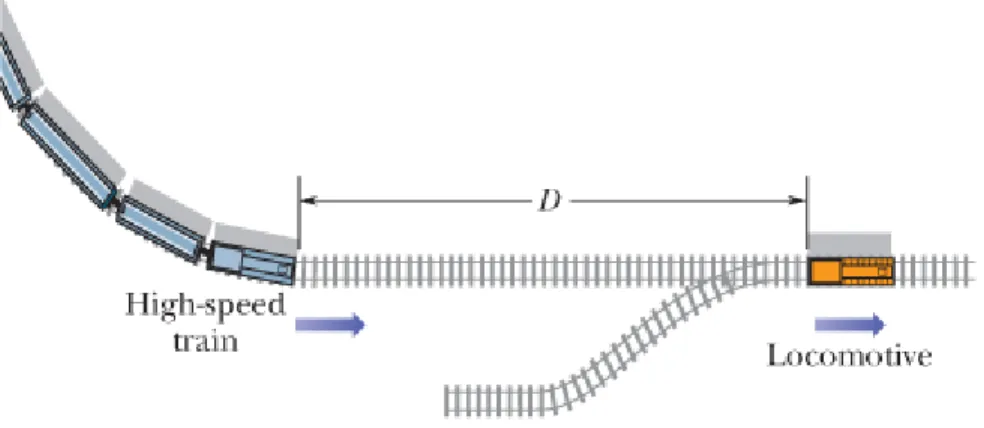
•••43 When a high-speed passenger train traveling at 161 km/h rounds a bend, the engineer is shocked to see that a locomotive has improperly entered onto the track from a siding and is a distance D = 676 m ahead (Fig. 2-29). The locomotive is moving at 29.0 km/h. The engineer of the high-speed train immediately applies the brakes. (a) What must be the magnitude of the resulting constant deceleration if a collision is to be just avoided? (b) Assume that the engineer is at x = 0 when, at t = 0, he first spots the locomotive. Sketch x(t) curves for the locomotive and high-speed train for the cases in which a collision is just avoided and is not quite avoided.
Figure 2-29 Problem 43.
Answer: (a) 0.994 m/s2
sec. 2-9 Free-Fall Acceleration
•44 When startled, an armadillo will leap upward. Suppose it rises 0.544 m in the first 0.200 s. (a) What is its initial speed as it leaves the ground? (b) What is its speed at the height of 0.544 m? (c) How much higher does it go?
•45 (a) With what speed must a ball be thrown vertically from ground level to rise to a maximum height of 50 m? (b) How long will it be in the air? (c) Sketch graphs of y, v, and a
versus t for the ball. On the first two graphs, indicate the time at which 50 m is reached. Answer:
(a) 31 m/s; (b) 6.4 s
•46 Raindrops fall 1700 m from a cloud to the ground. (a) If they were not slowed by air resistance, how fast would the drops be moving when they struck the ground? (b) Would it be safe to walk outside during a rainstorm?
•47 At a construction site a pipe wrench struck the ground with a speed of 24 m/s. (a) From what height was it inadvertently dropped? (b) How long was it falling? (c) Sketch graphs of y, v, and a
versus t for the wrench. Answer:
(a) 29.4 m; (b) 2.45 s
•48 A hoodlum throws a stone vertically downward with an initial speed of 12.0 m/s from the roof of a building, 30.0 m above the ground. (a) How long does it take the stone to reach the ground? (b) What is the speed of the stone at impact?
•49 A hot-air balloon is ascending at the rate of 12 m/s and is 80 m above the ground when a package is dropped over the side. (a) How long does the package take to reach the ground? (b) With what speed does it hit the ground?
Answer:
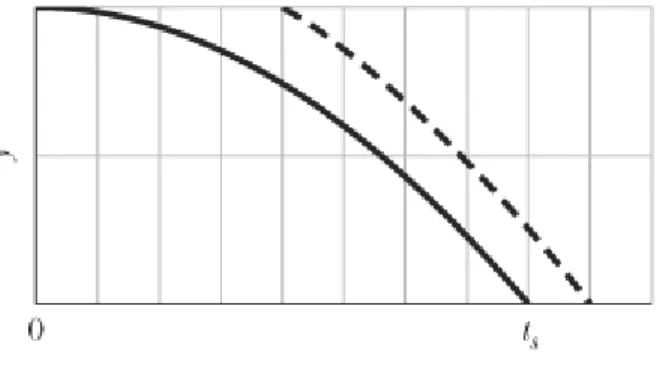
••50 At time t = 0, apple 1 is dropped from a bridge onto a roadway beneath the bridge; somewhat later, apple 2 is thrown down from the same height. Figure 2-30 gives the vertical positions y of the apples versus t during the falling, until both apples have hit the roadway. The scaling is set by
ts = 2.0 s. With approximately what speed is apple 2 thrown down?
Figure 2-30 Problem 50.
••51 As a runaway scientific balloon ascends at 19.6 m/s, one of its instrument packages breaks free of a harness and free-falls. Figure 2-31 gives the vertical velocity of the package versus time, from before it breaks free to when it reaches the ground. (a) What maximum height above the break-free point does it rise? (b) How high is the break-break-free point above the ground?
Figure 2-31 Problem 51.
Answer:
(a) 20 m; (b) 59 m
••52 A bolt is dropped from a bridge under construction, falling 90 m to the valley below the bridge. (a) In how much time does it pass through the last 20% of its fall? What is its speed (b) when it begins that last 20% of its fall and (c) when it reaches the valley beneath the bridge? ••53 A key falls from a bridge that is 45 m above the water. It falls directly into a model
boat, moving with constant velocity, that is 12 m from the point of impact when the key is released. What is the speed of the boat?
Answer: 4.0 m/s
••54 A stone is dropped into a river from a bridge 43.9 m above the water. Another stone is thrown vertically down 1.00 s after the first is dropped. The stones strike the water at the same time. (a) What is the initial speed of the second stone? (b) Plot velocity versus time on a graph for each stone, taking zero time as the instant the first stone is released.
••55 A ball of moist clay falls 15.0 m to the ground. It is in contact with the ground for 20.0 ms before stopping. (a) What is the magnitude of the average acceleration of the ball during the time it is in contact with the ground? (Treat the ball as a particle.) (b) Is the average acceleration up or down?
Answer:
(a) 857 m/s2; (b) up
••56 Figure 2-32 shows the speed v versus height y of a ball tossed directly upward, along a y axis. Distance d is 0.40 m. The speed at height yA is vA. The speed at height yB is . What is speed
vA?
Figure 2-32 Problem 56.
••57 To test the quality of a tennis ball, you drop it onto the floor from a height of 4.00 m. It rebounds to a height of 2.00 m. If the ball is in contact with the floor for 12.0 ms, (a) what is the magnitude of its average acceleration during that contact and (b) is the average acceleration up or down? Answer:
(a) 1.26 × 10³ m/s2; (b) up
••58 An object falls a distance h from rest. If it travels 0.50h in the last 1.00 s, find (a) the time and (b) the height of its fall. (c) Explain the physically unacceptable solution of the quadratic equation in t
that you obtain.
••59 Water drips from the nozzle of a shower onto the floor 200 cm below. The drops fall at regular (equal) intervals of time, the first drop striking the floor at the instant the fourth drop begins to fall. When the first drop strikes the floor, how far below the nozzle are the (a) second and (b) third drops?
Answer:
(a) 89 cm; (b) 22 cm
••60 A rock is thrown vertically upward from ground level at time t = 0. At t = 1.5 s it passes the top of a tall tower, and 1.0 s later it reaches its maximum height. What is the height of the tower? •••61 A steel ball is dropped from a building's roof and passes a window, taking 0.125 s to fall from
back past the window, moving from bottom to top in 0.125 s. Assume that the upward flight is an exact reverse of the fall. The time the ball spends below the bottom of the window is 2.00 s. How tall is the building?
Answer: 20.4 m
•••62 A basketball player grabbing a rebound jumps 76.0 cm vertically. How much total time (ascent and descent) does the player spend (a) in the top 15.0 cm of this jump and (b) in the bottom 15.0 cm? Do your results explain why such players seem to hang in the air at the top of a jump?
•••63 A drowsy cat spots a flowerpot that sails first up and then down past an open window. The pot is in view for a total of 0.50 s, and the top-to-bottom height of the window is 2.00 m. How high above the window top does the flowerpot go?
Answer: 2.34 m
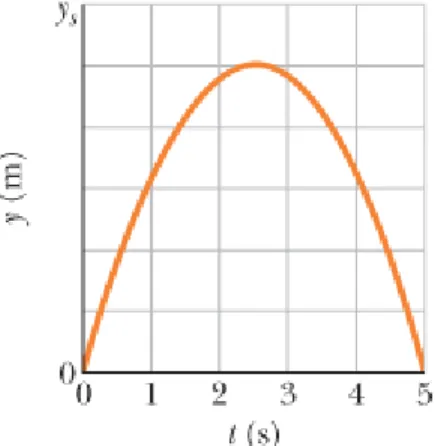
•••64 A ball is shot vertically upward from the surface of another planet. A plot of y versus t for the ball is shown in Fig. 2-33, where y is the height of the ball above its starting point and t = 0 at the instant the ball is shot. The figure's vertical scaling is set by ys = 30.0 m. What are the
magnitudes of (a) the free-fall acceleration on the planet and (b) the initial velocity of the ball?
Figure 2-33 Problem 64.
sec. 2-10 Graphical Integration in Motion Analysis
•65 Figure 2-13a gives the acceleration of a volunteer's head and torso during a rear-end collision. At maximum head acceleration, what is the speed of (a) the head and (b) the torso? Answer:
(a) 2.25 m/s; (b) 3.90 m/s
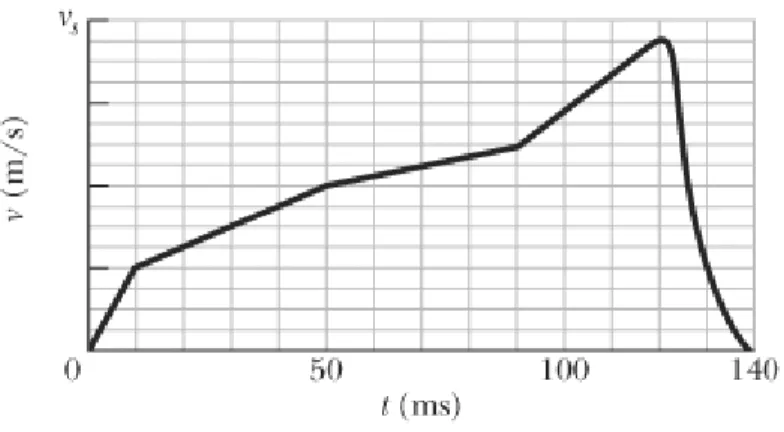
••66 In a forward punch in karate, the fist begins at rest at the waist and is brought rapidly forward until the arm is fully extended. The speed v(t) of the fist is given in Fig. 2-34 for someone skilled in karate. The vertical scaling is set by vs = 8.0 m/s. How far has the fist moved at (a) time
Figure 2-34 Problem 66.
••67 When a soccer ball is kicked toward a player and the player deflects the ball by “heading” it, the acceleration of the head during the collision can be significant. Figure 2-35 gives the measured acceleration a(t) of a soccer player's head for a bare head and a helmeted head, starting from rest. The scaling on the vertical axis is set by as = 200 m/s
2
. At time t = 7.0 ms, what is the difference in the speed acquired by the bare head and the speed acquired by the helmeted head?
Figure 2-35 Problem 67.
Answer: 0.56 m/s
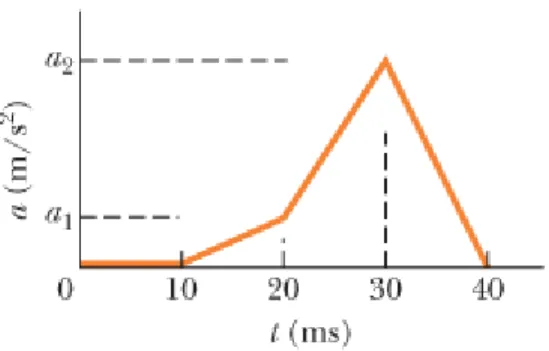
••68 A salamander of the genus Hydromantes captures prey by launching its tongue as a projectile: The skeletal part of the tongue is shot forward, unfolding the rest of the tongue, until the outer portion lands on the prey, sticking to it. Figure 2-36 shows the acceleration magnitude a
versus time t for the acceleration phase of the launch in a typical situation. The indicated accelerations are a2 = 400 m/s
2
and a1 = 100 m/s 2
. What is the outward speed of the tongue at the end of the acceleration phase?
Figure 2-36 Problem 68.
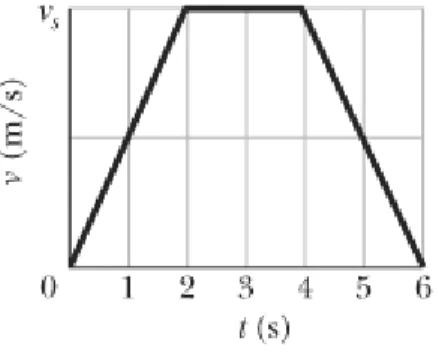
••69 How far does the runner whose velocity–time graph is shown in Fig. 2-37 travel in 16 s? The figure's vertical scaling is set by vs = 8.0 m/s.
Figure 2-37 Problem 69.
Answer: 100 m
•••70 Two particles move along an x axis. The position of particle 1 is given by x = 6.00t2 + 3.00t + 2.00 (in meters and seconds); the acceleration of particle 2 is given by a = -8.00t (in meters per second squared and seconds) and, at t = 0, its velocity is 20 m/s. When the velocities of the particles match, what is their velocity?
Additional Problems
71 In an arcade video game, a spot is programmed to move across the screen according to x = 9.00t - 0.750t3, where x is distance in centimeters measured from the left edge of the screen and t is time in seconds. When the spot reaches a screen edge, at either x = 0 or x = 15.0 cm, t is reset to 0 and the spot starts moving again according to x(t). (a) At what time after starting is the spot
instantaneously at rest? (b) At what value of x does this occur? (c) What is the spot's acceleration (including sign) when this occurs? (d) Is it moving right or left just prior to coming to rest? (e) Just after? (f) At what time t > 0 does it first reach an edge of the screen?
Answer:
(a) 2.00 s; (b) 12 cm; (c) - 9.00 cm/s2; (d) right; (e) left; (f) 3.46 s
72 A rock is shot vertically upward from the edge of the top of a tall building. The rock reaches its maximum height above the top of the building 1.60 s after being shot. Then, after barely missing the edge of the building as it falls downward, the rock strikes the ground 6.00 s after it is launched. In SI units: (a) with what upward velocity is the rock shot, (b) what maximum height above the top
of the building is reached by the rock, and (c) how tall is the building?
73 At the instant the traffic light turns green, an automobile starts with a constant acceleration a of 2.2 m/s2. At the same instant a truck, traveling with a constant speed of 9.5 m/s, overtakes and passes the automobile. (a) How far beyond the traffic signal will the automobile overtake the truck? (b) How fast will the automobile be traveling at that instant?
Answer:
(a) 82 m; (b) 19 m/s
74 A pilot flies horizontally at 1300 km/h, at height h = 35 m above initially level ground. However, at time t = 0, the pilot begins to fly over ground sloping upward at angle θ = 4.3° (Fig. 2-38). If the pilot does not change the airplane's heading, at what time t does the plane strike the ground?
Figure 2-38 Problem 74.
75 To stop a car, first you require a certain reaction time to begin braking; then the car slows at a constant rate. Suppose that the total distance moved by your car during these two phases is 56.7 m when its initial speed is 80.5 km/h, and 24.4 m when its initial speed is 48.3 km/h. What are (a) your reaction time and (b) the magnitude of the acceleration?
Answer:
(a) 0.74 s; (b) 6.2 m/s2
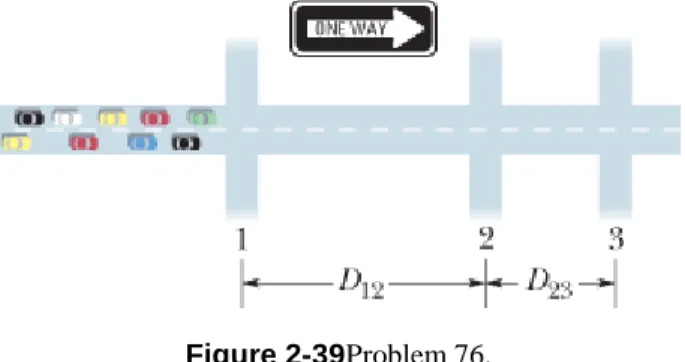
76 Figure 2-39 shows part of a street where traffic flow is to be controlled to allow a platoon of cars to move smoothly along the street. Suppose that the platoon leaders have just reached intersection 2, where the green appeared when they were distance d from the intersection. They continue to travel at a certain speed vp (the speed limit) to reach intersection 3, where the green
appears when they are distance d from it. The intersections are separated by distances D23 and D12. (a) What should be the time delay of the onset of green at intersection 3 relative to that at
intersection 2 to keep the platoon moving smoothly?
Figure 2-39 Problem 76.
Suppose, instead, that the platoon had been stopped by a red light at intersection 1. When the green comes on there, the leaders require a certain time tr to respond to the change and an additional time
when the leaders are distance d from that intersection, how long after the light at intersection 1 turns green should the light at intersection 2 turn green?
77 A hot rod can accelerate from 0 to 60 km/h in 5.4 s. (a) What is its average acceleration, in m/s2, during this time? (b) How far will it travel during the 5.4 s, assuming its acceleration is constant? (c) From rest, how much time would it require to go a distance of 0.25 km if its acceleration could be maintained at the value in (a)?
Answer:
(a) 3.1 m/s2; (b) 45 m; (c) 13 s
78 A red train traveling at 72 km/h and a green train traveling at 144 km/h are headed toward each other along a straight, level track. When they are 950 m apart, each engineer sees the other's train and applies the brakes. The brakes slow each train at the rate of 1.0 m/s2. Is there a collision? If so, answer yes and give the speed of the red train and the speed of the green train at impact,
respectively. If not, answer no and give the separation between the trains when they stop.
79 At time t = 0, a rock climber accidentally allows a piton to fall freely from a high point on the rock wall to the valley below him. Then, after a short delay, his climbing partner, who is 10 m higher on the wall, throws a piton downward. The positions y of the pitons versus t during the falling are given in Fig. 2-40. With what speed is the second piton thrown?
Figure 2-40 Problem 79.
Answer: 17 m/s
80 A train started from rest and moved with constant acceleration. At one time it was traveling 30 m/s, and 160 m farther on it was traveling 50 m/s. Calculate (a) the acceleration, (b) the time required to travel the 160 m mentioned, (c) the time required to attain the speed of 30 m/s, and (d) the distance moved from rest to the time the train had a speed of 30 m/s. (e) Graph x versus t and v
versus t for the train, from rest.
81 A particle's acceleration along an x axis is a = 5.0t, with t in seconds and a in meters per second squared. At t 2.0 s, its velocity is +17 m/s. What is its velocity at t = 4.0 s?
Answer: + 47 m/s
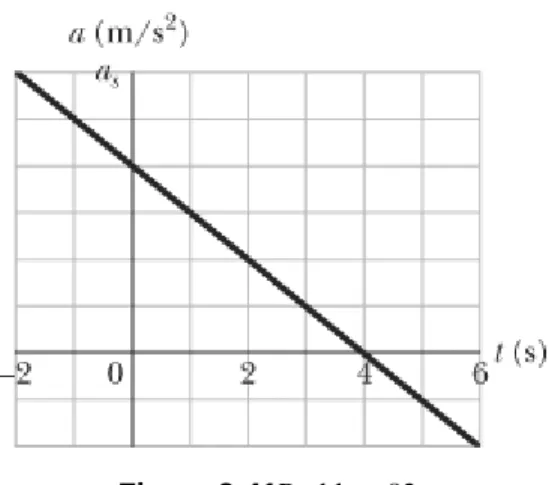
82 Figure 2-41 gives the acceleration a versus time t for a particle moving along an x axis. The a-axis scale is set by as = 12.0 m/s
2
= 6.0 s?
Figure 2-41 Problem 82.
83 Figure 2-42 shows a simple device for measuring your reaction time. It consists of a cardboard strip marked with a scale and two large dots. A friend holds the strip vertically, with thumb and forefinger at the dot on the right in Fig. 2-42. You then position your thumb and forefinger at the other dot (on the left in Fig. 2-42), being careful not to touch the strip. Your friend releases the strip, and you try to pinch it as soon as possible after you see it begin to fall. The mark at the place where you pinch the strip gives your reaction time. (a) How far from the lower dot should you place the 50.0 ms mark? How much higher should you place the marks for (b) 100, (c) 150, (d) 200, and (e) 250 ms? (For example, should the 100 ms marker be 2 times as far from the dot as the 50 ms marker? If so, give an answer of 2 times. Can you find any pattern in the answers?)
Figure 2-42 Problem 83.
Answer:
(a) 1.23 cm; (b) 4 times; (c) 9 times; (d) 16 times; (e) 25 times
84 A rocket-driven sled running on a straight, level track is used to investigate the effects of large accelerations on humans. One such sled can attain a speed of 1600 km/h in 1.8 s, starting from rest. Find (a) the acceleration (assumed constant) in terms of g and (b) the distance traveled. 85 A mining cart is pulled up a hill at 20 km/h and then pulled back down the hill at 35 km/h through
its original level. (The time required for the cart's reversal at the top of its climb is negligible.) What is the average speed of the cart for its round trip, from its original level back to its original level?
Answer: 25 km/h
86 A motorcyclist who is moving along an x axis directed toward the east has an acceleration given by a = (6.1 - 1.2t) m/s2 for 0 ≥ t ≥ 6.0 s. At t = 0, the velocity and position of the cyclist are 2.7 m/s
and 7.3 m. (a) What is the maximum speed achieved by the cyclist? (b) What total distance does the cyclist travel between t = 0 and 6.0 s?
87 When the legal speed limit for the New York Thruway was increased from 55 mi/h to 65 mi/h, how much time was saved by a motorist who drove the 700 km between the Buffalo entrance and the New York City exit at the legal speed limit?
Answer: 1.2 h
88 A car moving with constant acceleration covered the distance between two points 60.0 m apart in 6.00 s. Its speed as it passed the second point was 15.0 m/s. (a) What was the speed at the first point? (b) What was the magnitude of the acceleration? (c) At what prior distance from the first point was the car at rest? (d) Graph x versus t and v versus t for the car, from rest (t = 0).
89 A certain juggler usually tosses balls vertically to a height H. To what height must they be tossed if they are to spend twice as much time in the air?
Answer: 4H
90 A particle starts from the origin at t = 0 and moves along the positive x axis. A graph of the velocity of the particle as a function of the time is shown in Fig. 2-43; the v-axis scale is set by vs =
4.0 m/s. (a) What is the coordinate of the particle at t = 5.0 s? (b) What is the velocity of the particle at t = 5.0 s? (c) What is the acceleration of the particle at t = 5.0 s? (d) What is the average velocity of the particle between t = 1.0 s and t = 5.0 s? (e) What is the average acceleration of the particle between t = 1.0 s and t = 5.0 s?
Figure 2-43 Problem 90.
91 A rock is dropped from a 100-m-high cliff. How long does it take to fall (a) the first 50 m and (b) the second 50 m?
Answer:
(a) 3.2 s; (b) 1.3 s
92 Two subway stops are separated by 1100 m. If a subway train accelerates at +1.2 m/s2 from rest through the first half of the distance and decelerates at -1.2 m/s2 through the second half, what are (a) its travel time and (b) its maximum speed? (c) Graph x, v, and a versus t for the trip.
93 A stone is thrown vertically upward. On its way up it passes point A with speed v, and point B, 3.00 m higher than A, with speed . Calculate (a) the speed v and (b) the maximum height
reached by the stone above point B. Answer:
(a) 8.85 m/s; (b) 1.00 m
94 A rock is dropped (from rest) from the top of a 60-m-tall building. How far above the ground is the rock 1.2 s before it reaches the ground?
95 An iceboat has a constant velocity toward the east when a sudden gust of wind causes the iceboat to have a constant acceleration toward the east for a period of 3.0 s. A plot of x versus t is shown in Fig. 2-44, where t = 0 is taken to be the instant the wind starts to blow and the positive x
axis is toward the east. (a) What is the acceleration of the iceboat during the 3.0 s interval? (b) What is the velocity of the iceboat at the end of the 3.0 s interval? (c) If the acceleration remains constant for an additional 3.0 s, how far does the iceboat travel during this second 3.0 s interval?
Figure 2-44 Problem 95.
Answer:
(a) 2.0 m/s2; (b) 12 m/s; (c) 45 m
96 A lead ball is dropped in a lake from a diving board 5.20 m above the water. It hits the water with a certain velocity and then sinks to the bottom with this same constant velocity. It reaches the bottom 4.80 s after it is dropped. (a) How deep is the lake? What are the (b) magnitude and (c) direction (up or down) of the average velocity of the ball for the entire fall? Suppose that all the water is drained from the lake. The ball is now thrown from the diving board so that it again reaches the bottom in 4.80 s. What are the (d) magnitude and (e) direction of the initial velocity of the ball?
97 The single cable supporting an unoccupied construction elevator breaks when the elevator is at rest at the top of a 120-m-high building. (a) With what speed does the elevator strike the ground? (b) How long is it falling? (c) What is its speed when it passes the halfway point on the way down? (d) How long has it been falling when it passes the halfway point?
Answer:
(a) 48.5 m/s; (b) 4.95 s; (c) 34.3 m/s; (d) 3.50 s
98 Two diamonds begin a free fall from rest from the same height, 1.0 s apart. How long after the first diamond begins to fall will the two diamonds be 10 m apart?
99 A ball is thrown vertically downward from the top of a 36.6-m-tall building. The ball passes the top of a window that is 12.2 m above the ground 2.00 s after being thrown. What is the speed of the ball as it passes the top of the window?
Answer: 22.0 m/s
100 A parachutist bails out and freely falls 50 m. Then the parachute opens, and thereafter she decelerates at 2.0 m/s2. She reaches the ground with a speed of 3.0 m/s. (a) How long is the parachutist in the air? (b) At what height does the fall begin?
101 A ball is thrown down vertically with an initial speed of v0 from a height of h. (a) What is its speed just before it strikes the ground? (b) How long does the ball take to reach the ground? What would be the answers to (c) part a and (d) part b if the ball were thrown upward from the same height and with the same initial speed? Before solving any equations, decide whether the answers to (c) and (d) should be greater than, less than, or the same as in (a) and (b).
Answer:
(a) v = ( + 2gh)0.5; (b) t = [( + 2gh)0.5 - v0] / g; (c) same as (a); (d) t = [( + 2gh) 0.5
+ v0] / g, greater
102 The sport with the fastest moving ball is jai alai, where measured speeds have reached 303 km/h. If a professional jai alai player faces a ball at that speed and involuntarily blinks, he blacks out the scene for 100 ms. How far does the ball move during the blackout?
Copyright © 2011 John Wiley & Sons, Inc. All rights reserved.
PROBLEMS
sec. 3-4 Components of Vectors
•1 What are (a) the x component and (b) the y component of a vector in the xy plane if its direction is 250° counterclockwise from the positive direction of the x axis and its magnitude is 7.3 m?
Answer:
(a) - 2.5 m; (b) - 6.9 m
•2 A displacement vector in the xy plane is 15 m long and directed at angle θ = 30° in Fig. 3-26. Determine (a) the x component and (b) the y component of the vector.
Figure 3-26 Problem 2.
•3
magnitude of ? (b) What is the angle between the direction of and the positive direction of x? Answer:
(a) 47.2 m; (b) 122°
•4 Express the following angles in radians: (a) 20.0°, (b) 50.0°, (c) 100°. Convert the following angles to degrees: (d) 0.330 rad, (e) 2.10 rad, (f) 7.70 rad.
•5 A ship sets out to sail to a point 120 km due north. An unexpected storm blows the ship to a point 100 km due east of its starting point. (a) How far and (b) in what direction must it now sail to reach its original destination?
Answer:
(a) 156 km; (b) 39.8° west of due north
•6 In Fig. 3-27, a heavy piece of machinery is raised by sliding it a distance d = 12.5 m along a plank oriented at angle θ = 20.0° to the horizontal. How far is it moved (a) vertically and (b)
horizontally?
Figure 3-27 Problem 6.
••7 A room has dimensions 3.00 m (height) × 3.70 m × 4.30 m. A fly starting at one corner flies around, ending up at the diagonally opposite corner. (a) What is the magnitude of its displacement? (b) Could the length of its path be less than this magnitude? (c) Greater? (d) Equal? (e) Choose a suitable coordinate system and express the components of the displacement vector in that system in unit-vector notation. (f) If the fly walks, what is the length of the shortest path? (Hint: This can be answered without calculus. The room is like a box. Unfold its walls to flatten them into a plane.)
Answer:
(a) 6.42 m; (b) no; (c) yes; (d) yes; (e) a possible answer: (4.30 m) + (3.70 m) + (3.00 m) ; (f) 7.96 m
sec. 3-6 Adding Vectors by Components
•8 A person walks in the following pattern: 3.1 km north, then 2.4 km west, and finally 5.2 km south. (a) Sketch the vector diagram that represents this motion. (b) How far and (c) in what direction would a bird fly in a straight line from the same starting point to the same final point?
and
In unit-vector notation, find (a) + , (b) - , and (c) a third vector such that - + = 0.
Answer:
(a) (3.0 m) - (2.0 m) + (5.0 m) ; (b) (5.0 m) - (4.0 m) - (3.0 m) ; (c) (- 5.0 m) + (4.0 m) + (3.0 m)
•10
Find the (a) x, (b) y, and (c) z components of the sum of the displacements and whose components in meters are cx = 7.4, cy = - 3.8, cz = -6.1; dx = 4.4, dy = -2.0, dz = 3.3.
•11
(a) In unit-vector notation, what is the sum + if and ? What are the (b) magnitude and (c) direction of + ? Answer:
(a) (- 9.0 m) + (10 m) ; (b) 13 m; (c) 132°
•12 A car is driven east for a distance of 50 km, then north for 30 km, and then in a direction 30° east of north for 25 km. Sketch the vector diagram and determine (a) the magnitude and (b) the angle of the car's total displacement from its starting point.
•13 A person desires to reach a point that is 3.40 km from her present location and in a direction that is 35.0° north of east. However, she must travel along streets that are oriented either north–south or east–west. What is the minimum distance she could travel to reach her destination?
Answer: 4.74 km
•14 You are to make four straight-line moves over a flat desert floor, starting at the origin of an xy
coordinate system and ending at the xy coordinates (-140 m, 30 m). The x component and y
component of your moves are the following, respectively, in meters: (20 and 60), then (bx and -70),
then (-20 and cy), then (-60 and -70). What are (a) component bx and (b) component cy? What are
(c) the magnitude and (d) the angle (relative to the positive direction of the x axis) of the overall displacement?
•15
The two vectors and in Fig. 3-28 have equal magnitudes of 10.0 m and the angles are θ1 = 30° and θ2 = 105°. Find the (a) x and (b) y components of their vector sum , (c) the magnitude of , and (d) the angle makes with the positive direction of the x axis.
Figure 3-28 Problem 15.
Answer:
(a) 1.59 m; (b) 12.1 m; (c) 12.2 m; (d) 82.5° •16
For the displacement vectors and , give
+ in (a) unit-vector notation, and as (b) a magnitude and (c) an angle (relative to ). Now give - in (d) unit-vector notation, and as (e) a magnitude and (f) an angle.
•17
Three vectors , , and each have a magnitude of 50 m and lie in an xy plane. Their directions relative to the positive direction of the x axis are 30°, 195°, and 315°, respectively. What are (a) the magnitude and (b) the angle of the vector + + , and (c) the magnitude and (d) the angle of - + ? What are the (e) magnitude and (f) angle of a fourth vector such that
? Answer:
(a) 38 m; (b) - 37.5°; (c) 130 m; (d) 1.2°; (e) 62 m; (f) 130° •18
In the sum , vector has a magnitude of 12.0 m and is angled 40.0°
counterclockwise from the +x direction, and vector has a magnitude of 15.0 m and is angled 20.0° counterclockwise from the -x direction. What are (a) the magnitude and (b) the angle (relative to +x) of ?
•19 In a game of lawn chess, where pieces are moved between the centers of squares that are each 1.00 m on edge, a knight is moved in the following way: (1) two squares forward, one square rightward; (2) two squares leftward, one square forward; (3) two squares forward, one square leftward. What are (a) the magnitude and (b) the angle (relative to “forward”) of the knight's overall displacement for the series of three moves?
Answer:
••20 An explorer is caught in a whiteout (in which the snowfall is so thick that the ground cannot be distinguished from the sky) while returning to base camp. He was supposed to travel due north for 5.6 km, but when the snow clears, he discovers that he actually traveled 7.8 km at 50° north of due east. (a) How far and (b) in what direction must he now travel to reach base camp?
••21 An ant, crazed by the Sun on a hot Texas afternoon, darts over an xy plane scratched in the dirt. The x and y components of four consecutive darts are the following, all in centimeters: (30.0, 40.0), (bx, -70.0), (-20.0, cy), (-80.0, -70.0). The overall displacement of the four darts has the xy
components (-140, -20.0). What are (a) bx and (b) cy? What are the (c) magnitude and (d) angle
(relative to the positive direction of the x axis) of the overall displacement? Answer:
(a) - 70.0 cm; (b) 80.0 cm; (c) 141 cm; (d) - 172°
••22 (a) What is the sum of the following four vectors in unit-vector notation? For that sum, what are (b) the magnitude, (c) the angle in degrees, and (d) the angle in radians?
••23
If is added to , the result is a vector in the positive direction of the y axis, with a magnitude equal to that of . What is the magnitude of ?
Answer: 3.2 ••24
Vector , which is directed along an x axis, is to be added to vector , which has a magnitude of 7.0 m. The sum is a third vector that is directed along the y axis, with a magnitude that is 3.0 times that of . What is that magnitude of ?
••25 Oasis B is 25 km due east of oasis A. Starting from oasis A, a camel walks 24 km in a direction 15° south of east and then walks 8.0 km due north. How far is the camel then from oasis B? Answer:
2.6 km
••26 What is the sum of the following four vectors in (a) unit-vector notation, and as (b) a magnitude and (c) an angle?
••27
If , , and , then what are, in unit-vector
Answer:
(a) 8 + 16 ; (b) 2 + 4
••28 Two beetles run across flat sand, starting at the same point. Beetle 1 runs 0.50 m due east, then 0.80 m at 30° north of due east. Beetle 2 also makes two runs; the first is 1.6 m at 40° east of due north. What must be (a) the magnitude and (b) the direction of its second run if it is to end up at the new location of beetle 1?
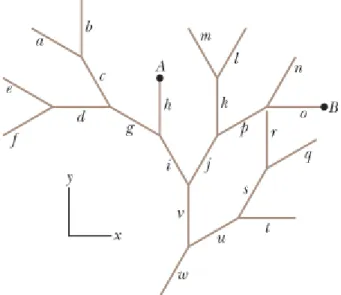
••29 Typical backyard ants often create a network of chemical trails for guidance. Extending outward from the nest, a trail branches (bifurcates) repeatedly, with 60° between the branches. If a roaming ant chances upon a trail, it can tell the way to the nest at any branch point: If it is moving away from the nest, it has two choices of path requiring a small turn in its travel direction, either 30° leftward or 30° rightward. If it is moving toward the nest, it has only one such choice. Figure 3-29 shows a typical ant trail, with lettered straight sections of 2.0 cm length and symmetric bifurcation of 60°. Path v is parallel to the y axis. What are the (a) magnitude and (b) angle (relative to the positive direction of the superimposed x axis) of an ant's displacement from the nest (find it in the figure) if the ant enters the trail at point A? What are the (c) magnitude and (d) angle if it enters at point B?
Figure 3-29 Problem 29.
Answer:
(a) 7.5 cm; (b) 90°; (c) 8.6 cm; (d) 48° ••30 Here are two vectors:
What are (a) the magnitude and (b) the angle (relative to ) of ? What are (c) the magnitude and (d) the angle of ? What are (e) the magnitude and (f) the angle of + ; (g) the magnitude and (h) the angle of - ; and (i) the magnitude and (j) the angle of - ? (k) What is the angle
between the directions of - and - ?
•••31 In Fig. 3-30, a cube of edge length a sits with one corner at the origin of an xyz coordinate system. A body diagonal is a line that extends from one corner to another through the center. In unit-vector notation, what is the body diagonal that extends from the corner at (a) coordinates (0, 0, 0), (b) coordinates (a, 0, 0), (c) coordinates (0, a, 0), and (d) coordinates (a, a, 0)? (e)
Determine the angles that the body diagonals make with the adjacent edges. (f) Determine the length of the body diagonals in terms of a.
Figure 3-30 Problem 31.
Answer:
(a) a + a + a ; (b) - a +a +a ; (c) a - a + a ; (d) - a - a + a ; (e) 54.7°; (f) 30.5a
sec. 3-7 Vectors and the Laws of Physics
•32 In Fig. 3-31, a vector with a magnitude of 17.0 m is directed at angle θ = 56.0°
counterclockwise from the +x axis. What are the components (a) ax and (b) ay of the vector? A
second coordinate system is inclined by angle θ′ = 18.0° with respect to the first. What are the components (c) and (d) in this primed coordinate system?
Figure 3-31 Problem 32.
sec. 3-8 Multiplying Vectors
•33 For the vectors in Fig. 3-32, with a = 4, b = 3, and c = 5, what are (a) the magnitude and (b) the direction of × , (c) the magnitude and (d) the direction of × , and (e) the magnitude and (f) the direction of × ? (The z axis is not shown.)
Figure 3-32 Problems 33 and 54.
Answer:
(a) 12; (b) + z; (c) 12; (d) - z; (e) 12; (f) + z
•34
Two vectors are presented as and . Find (a) × , (b) · ,
(c) , and (d) the component of along the direction of . (Hint: For (d), consider Eq. 3-20 and Fig. 3-18.)
•35 Two vectors, and , lie in the xy plane. Their magnitudes are 4.50 and 7.30 units, respectively, and their directions are 320° and 85.0°, respectively, as measured counterclockwise from the positive x axis. What are the values of (a) · and (b) × ?
Answer:
(a) - 18.8 units; (b) 26.9 units, + z direction •36
If and , then what is ?
•37
Three vectors are given by , , and
. Find (a) , (b) , and (c) .
Answer:
(a) - 21; (b) - 9; (c) 5 - 11 - 9 ••38
For the following three vectors, what is ?
••39
Vector has a magnitude of 6.00 units, vector has a magnitude of 7.00 units, and · has a value of 14.0. What is the angle between the directions of and ?
Answer: 70.5° ••40
Displacement is in the yz plane 63.0° from the positive direction of the y axis, has a positive z
component, and has a magnitude of 4.50 m. Displacement is in the xz plane 30.0° from the positive direction of the x axis, has a positive z component, and has magnitude 1.40 m. What are (a) , (b) , and (c) the angle between and ?
••41
Use the definition of scalar product, , and the fact that to calculate the angle between the two vectors given by
and .
Answer: 22° ••42
In a meeting of mimes, mime 1 goes through a displacement and
mime 2 goes through a displacement . What are (a) , (b)
, (c) , and (d) the component of along the direction of ? (Hint: For (d), see Eq. 3-20 and Fig. 3-18.)
••43 The three vectors in Fig. 3-33 have magnitudes a = 3.00 m, b = 4.00 m, and c = 10.0 m and angle θ = 30.0°. What are (a) the x component and (b) the y component of ; (c) the x
component and (d) the y component of ; and (e) the x component and (f) the y component of ? If , what are the values of (g)p and (h)q?
Figure 3-33 Problem 43.
Answer:
(a) 3.00 m; (b) 0; (c) 3.46 m; (d) 2.00 m; (e) - 5.00 m; (f) 8.66 m; (g) - 6.67; (h) 4.33 ••44
What then is in unit-vector notation if Bx = By?
Additional Problems
45Vectors and lie in an xy plane. has magnitude 8.00 and angle 130°; has components Bx =
-7.72 and By = -9.20. (a) What is ? What is in (b) unit-vector notation and (c)
magnitude-angle notation with spherical coordinates (see Fig. 3-34)? (d) What is the angle between the directions of and ? (Hint: Think a bit before you resort to a calculation.) What is in (e) unit-vector notation and (f) magnitude-angle notation with spherical coordinates?
Figure 3-34 Problem 45.
Answer:
(a) - 83.4; (b) (1.14 × 10³) ; (c) 1.14 × 10³, θ not defined, = 0°; (d) 90.0°; (e) - 5.14 + 6.13 + 3.00 ; (f) 8.54, θ = 130°, = 69.4°
46
Vector has a magnitude of 5.0 m and is directed east. Vector has a magnitude of 4.0 m and is directed 35° west of due north. What are (a) the magnitude and (b) the direction of + ? What are (c) the magnitude and (d) the direction of - ? (e) Draw a vector diagram for each
combination. 47
Vectors and lie in an xy plane. has magnitude 8.00 and angle 130°; has components Bx =
-7.72 and By = -9.20. What are the angles between the negative direction of the y axis and (a) the
direction of , (b) the direction of the product × , and (c) the direction of ?
Answer:
(a) 140°; (b) 90.0°; (c) 99.1° 48
Find the angle between the directions of and . There are two vectors in the xy plane that are perpendicular to and have a magnitude of 5.0 m. One, vector , has a positive x component and the other, vector , a negative x component. What are (b) the x component and (c) the y
component of vector , and (d) the x component and (e) the y component of vector ?
49 A sailboat sets out from the U.S. side of Lake Erie for a point on the Canadian side, 90.0 km due north. The sailor, however, ends up 50.0 km due east of the starting point. (a) How far and (b) in what direction must the sailor now sail to reach the original destination?
Answer:
(a) 103 km; (b) 60.9° north of due west 50
Vector is in the negative direction of a y axis, and vector is in the positive direction of an x
axis. What are the directions of (a) and (b) ? What are the magnitudes of products (c) and (d) ? What is the direction of the vector resulting from (e) and (f) ? What is the magnitude of the vector product in (g) part (e) and (h) part (f)? What are the (i) magnitude and (j) direction of ?
51 Rock faults are ruptures along which opposite faces of rock have slid past each other. In Fig. 3-35, points A and B coincided before the rock in the foreground slid down to the right. The net
displacement is along the plane of the fault. The horizontal component of is the strike-slip AC. The component of that is directed down the plane of the fault is the dip-slip AD. (a) What is the magnitude of the net displacement if the strike-slip is 22.0 m and the dip-slip is 17.0 m? (b) If the plane of the fault is inclined at angle = 52.0° to the horizontal, what is the vertical component of ?
Figure 3-35 Problem 51.
Answer:
52
Here are three displacements, each measured in meters: ,
and . (a) What is
? (b) What is the angle between and the positive z axis? (c) What is the component of along the direction of ? (d) What is the component of that is
perpendicular to the direction of and in the plane of and ? (Hint: For (c), consider Eq. 3-20 and Fig. 3-18; for (d), consider Eq. 3-27.)
53
A vector of magnitude 10 units and another vector of magnitude 6.0 units differ in directions by 60°. Find (a) the scalar product of the two vectors and (b) the magnitude of the vector
product .
Answer: (a) 30; (b) 52 54
For the vectors in Fig. 3-32, with a = 4, b = 3, and c = 5, calculate (a) , (b) , and (c) .
55
A particle undergoes three successive displacements in a plane, as follows: , 4.00 m southwest; then , 5.00 m east; and finally , 6.00 m in a direction 60.0° north of east. Choose a coordinate system with the y axis pointing north and the x axis pointing east. What are (a) the x component and (b) the y component of ? What are (c) the x component and (d) the y component of ? What are (e) the x component and (f) the y component of ? Next, consider the net displacement of the particle for the three successive displacements. What are (g) the x component, (h) the y
component, (i) the magnitude, and (j) the direction of the net displacement? If the particle is to return directly to the starting point, (k) how far and (l) in what direction should it move? Answer:
(a) - 2.83 m; (b) - 2.83 m; (c) 5.00 m; (d) 0; (e) 3.00 m; (f) 5.20 m; (g) 5.17 m; (h) 2.37 m; (i) 5.69 m; (j) 25° north of due east; (k) 5.69 m; (l) 25° south of due west
56 Find the sum of the following four vectors in (a) unit-vector notation, and as (b) a magnitude and (c) an angle relative to +x.
57
If is added to , the result is . If is subtracted from , the result is . What is the magnitude of ?
Answer: 4.1 58
A vector has a magnitude of 2.5 m and points north. What are (a) the magnitude and (b) the direction of ? What are (c) the magnitude and (d) the direction of ?
59
has the magnitude 12.0 m and is angled 60.0° counterclockwise from the positive direction of the x axis of an xy coordinate system. Also, on that same coordinate system. We now rotate the system counterclockwise about the origin by 20.0° to form an x′ y′
system. On this new system, what are (a) and (b) , both in unit-vector notation? Answer:
(a) (9.19 m) + (7.71 m) ; (b) (14.0 m) + (3.41 m) 60
If , , and , then what are (a) and (b) ?
61
(a) In unit-vector notation, what is if ,
, and ? (b) Calculate the angle between
and the positive z axis. (c) What is the component of along the direction of ? (d) What is the component of perpendicular to the direction of but in the plane of and ? (Hint: For (c), see Eq. 3-20 and Fig. 3-18; for (d), see Eq. 3-27.)
Answer:
(a) 11 + 5.0 - 7.0 ; (b) 120°; (c) - 4.9; (d) 7.3
62 A golfer takes three putts to get the ball into the hole. The first putt displaces the ball 3.66 m north, the second 1.83 m southeast, and the third 0.91 m southwest. What are (a) the magnitude and (b) the direction of the displacement needed to get the ball into the hole on the first putt?
63 Here are three vectors in meters:
What results from (a) , (b) , and (c) ?
(a) 3.0 m2; (b) 52 m3; (c) (11 m2) + (9.0 m2) + (3.0 m2)
64 Consider two displacements, one of magnitude 3 m and another of magnitude 4 m. Show how the displacement vectors may be combined to get a resultant displacement of magnitude (a) 7 m, (b) 1 m, and (c) 5 m.
65 A protester carries his sign of protest, starting from the origin of an xyz coordinate system, with the
xy plane horizontal. He moves 40 m in the negative direction of the x axis, then 20 m along a perpendicular path to his left, and then 25 m up a water tower. (a) In unit-vector notation, what is the displacement of the sign from start to end? (b) The sign then falls to the foot of the tower. What is the magnitude of the displacement of the sign from start to this new end?
Answer:
(a) (- 40 - 20 + 25 ) m; (b) 45 m
Copyright © 2011 John Wiley & Sons, Inc. All rights reserved.
PROBLEMS
sec. 4-2 Position and Displacement
•1The position vector for an electron is . (a) Find the
magnitude of . (b) Sketch the vector on a right-handed coordinate system. Answer:
(a) 6.2 m
•2 A watermelon seed has the following coordinates: , , and . Find its position vector (a) in unit-vector notation and as (b) a magnitude and (c) an angle relative to the positive direction of the x axis. (d) Sketch the vector on a right-handed coordinate system. If the seed is moved to the coordinates (3.00 m, 0 m, 0 m), what is its displacement (e) in unit-vector notation and as (f) a magnitude and (g) an angle relative to the positive x direction?
•3
A positron undergoes a displacement ending with the position vector in meters. What was the positron's initial position vector?
Answer:
(- 2.0 m) + (6.0 m) - (10 m)
••4 The minute hand of a wall clock measures 10 cm from its tip to the axis about which it rotates. The magnitude and angle of the displacement vector of the tip are to be determined for three time intervals. What are the (a) magnitude and (b) angle from a quarter after the hour to half past, the (c) magnitude and (d) angle for the next half hour, and the (e) magnitude and (f) angle for the hour after that?
sec. 4-3 Average Velocity and Instantaneous Velocity
•5 A train at a constant 60.0 km/h moves east for 40.0 min, then in a direction 50.0° east of due north for 20.0 min, and then west for 50.0 min. What are the (a) magnitude and (b) angle of its average velocity during this trip?
Answer:
(a) 7.59 km/h; (b) 22.5° east of due north •6
An electron's position is given by with t in seconds and in meters. (a) In unit-vector notation, what is the electron's velocity ? At , what is (b) in unit-vector notation and as (c) a magnitude and (d) an angle relative to the positive direction of the x axis?
•7
An ion's position vector is initially and 10 s later it is
all in meters. In unit-vector notation, what is its during the 10 s?
Answer:
(- 0.70 m/s) + (1.4 m/s) - (0.40 m/s)
••8 A plane flies 483 km east from city A to city B in 45.0 min and then 966 km south from city B to city C in 1.50 h. For the total trip, what are the (a) magnitude and (b) direction of the plane's displacement, the (c) magnitude and (d) direction of its average velocity, and (e) its average speed? ••9 Figure 4-30 gives the path of a squirrel moving about on level ground, from point A(at time ),
to points B (at ), C (at ), and finally D (at ). Consider the average velocities of the squirrel from point A to each of the other three points. Of them, what are the (a) magnitude and (b) angle of the one with the least magnitude and the (c) magnitude and (d) angle of the one with the greatest magnitude?