Cite this article as: Layton JB, Hansen MK, Jakobsen C-J, Kshirsagar AV, Andreasen JJ, Hjortdal VEet al. Statin initiation and acute kidney injury following elective cardiovascular surgery: a population cohort study in Denmark. Eur J Cardiothorac Surg 2016;49:995–1000.
Statin initiation and acute kidney injury following elective
cardiovascular surgery: a population cohort study in Denmark
†
James Bradley Layton
a,b,*, Malene K. Hansen
a, Carl-Johan Jakobsen
c, Abhijit V. Kshirsagar
d, Jan J. Andreasen
e,
Vibeke E. Hjortdal
f, Bodil S. Rasmussen
g, Ross J. Simpson
h, Maurice Alan Brookhart
a,b,dand
Christian F. Christiansen
aa Department of Clinical Epidemiology, Aarhus University Hospital, Aarhus, Denmark
b Department of Epidemiology, University of North Carolina at Chapel Hill, Chapel Hill, NC, USA c Department of Anaesthesiology and Intensive Care, Aarhus University Hospital, Aarhus, Denmark d UNC Kidney Center, University of North Carolina at Chapel Hill, Chapel Hill, NC, USA
e Department of Cardiothoracic Surgery and Clinical Medicine, Center for Cardiovascular Research, Aalborg University Hospital, Aalborg, Denmark f Department of Cardiothoracic and Vascular Surgery, Aarhus University Hospital, Aarhus, Denmark
g Department of Anesthesia and Intensive Care Medicine, Aalborg University Hospital, Aalborg, Denmark h Division of Cardiology, Department of Medicine, University of North Carolina at Chapel Hill, Chapel Hill, NC, USA
* Corresponding author. Department of Clinical Epidemiology, Aarhus University Hospital, 725 Martin Luther King Jr. Blvd., Suite 234, CB 7590, Chapel Hill, NC 27599-7590, USA. Tel: +1-919-8438725; fax: +1-919-9663811; e-mail: [email protected] ( J.B. Layton).
Received 10 March 2015; received in revised form 29 May 2015; accepted 15 June 2015
Abstract
OBJECTIVES: Acute kidney injury (AKI) is a serious complication of cardiac surgery. Statins may prevent post-surgical AKI, yet methodo-logical concerns about existing studies raise questions about the magnitude of a protective effect. We sought to determine the effect of initiating a statin prior to elective cardiac surgery on post-surgical AKI in a regional Danish surgical cohort.
METHODS: We identified adults who underwent cardiac surgery during 2006–11 using the Western Denmark Heart Registry. Presurgical medication use, pre- and post-surgical serum creatinine (sCr) measures, and other patient characteristics were obtained from Danish population-based registries. Post-surgical AKI was assessed using sCr measures within 5 days of surgery. The adjusted risk ratio (RR) of AKI and 95% confidence interval (CI) were estimated for patients who initiated a statin within 100 days prior to surgery compared with patients without prior statin use; long-term statin users were excluded to reduce healthy-user bias. Subanalyses were stratified by surgery type: cor-onary artery bypass grafting (CABG) and non-CABG surgeries.
RESULTS: We identified 1929 CABG and 1775 non-CABG patients. AKI occurred in 25% of CABG and 28% of non-CABG surgeries, and in 29% of the non-users and 21% of the statin initiators. Half of CABG patients and 9% of non-CABG patients initiated a statin prior to surgery. The adjusted RRs for the effect of statin initiation on AKI were as follows: all surgeries combined, RR = 0.86 (95% CI: 0.74, 0.98); CABG, RR = 0.88 (0.74, 1.05); non-CABG RR = 0.87 (0.68, 1.11).
CONCLUSIONS: Presurgical statin initiation is associated with a reduction in AKI risk after cardiac surgery.
Keywords:Surgical outcomes•Perioperative management•Acute renal failure•Acute kidney injury
INTRODUCTION
Post-surgical acute kidney injury (AKI) increases the complexity of surgical hospitalizations [1] and increases long-term risks of chronic kidney disease (CKD), cardiovascular disease (CVD) and mortality [2, 3]. With limited interventions available to reduce the incidence of postoperative AKI, interest has increased in the potentially renoprotective effects of statins.
Some clinical studies have demonstrated reduced post-surgical AKI in statin users [4], but the data are mixed, and others have not shown a protective effect [5]. Methodological limitations of non-randomized studies and under-powering of randomized trials have resulted in continuing uncertainty about the magnitude and reality of the effect.
Cardiac surgery patients’indications for statin use can vary widely, and prior studies have included heterogeneous patient groups: cor-onary artery bypass graft (CABG) patients with advanced corcor-onary artery disease (CAD); and non-CABG cardiac surgery (e.g. aortic resections, valve replacement etc.) patients without CAD but at †Presented at the International Convention on Pharmacoepidemiology and
Therapeutic Risk Management, Taipei, Taiwan 25 October 2014.
© The Author 2015. Published by Oxford University Press on behalf of the European Association for Cardio-Thoracic Surgery. All rights reserved.
ADUL
T
C
ARDIA
C
European Journal of Cardio-Thoracic Surgery 49 (2016) 995–1000
ORIGINAL ARTICLE
doi:10.1093/ejcts/ezv246 Advance Access publication 16 July 2015
high risk for surgically induced AKI due to the invasiveness of the surgery and subsequent longer renal ischaemia time. With different underlying relationships to statins, the effect should be investigated separately in different surgical populations.
We estimated the effect of presurgical statin initiation in Danish surgical patients with rich clinical information and comprehensive medication use histories. We sought to determine whether surgi-cal patients not previously on statins would benefit from initiating one prior to surgery.
METHODS
We conducted a historical new-user cohort study of cardiac surgery patients in Western Denmark.
Data sources
We identified cardiac surgeries occurring between 1 April 2006 and 31 December 2011 in two surgical centres in Aarhus and Aalborg, Denmark using the Western Denmark Heart Registry (WDHR), which records information about cardiothoracic surgeries performed in western Denmark [6]. We utilized WDHR patients in Denmark’s Northern and Central Regions; the source population includes1.8 million individuals accessing Denmark’s uniform healthcare system, which includes partial reimbursement of dispensed medications. Unique patient identifiers allow for linking across registries.
WDHR patients were linked to: the clinical laboratory informa-tion system (LABKA) research database [7], which contains longitu-dinal serum creatinine (sCr) measurements; the National Database of Reimbursed Prescriptions, which records reimbursed dispensed medications from community pharmacies [8] and the Danish National Patient Register, which contains clinical information about all patients in hospitals, outpatient specialist clinics and emergency rooms in Denmark since 1995 [9] to collect comorbid-ities and prior cardio- and cerebrovascular events.
Participants
We identified 15+ year old patients undergoing cardiac surgery, not including heart transplantation. We restricted our cohort study to planned, elective procedures—meaning the time from referral to surgery was equal to or greater than 2 days—to exclude emergency surgeries, which may systematically have worse outcomes and less opportunity for presurgical pharmaceutical intervention. We excluded those with prior heart or lung transplants or dialysis, and those without recent presurgical (within 10 days) or post-surgical (within 5 days) sCr measurements to ensure accurate AKI assessments.
We categorized surgeries as CABG or non-CABG (e.g. valve re-placement, aortic resection, atrial septum repair, other). Due to differences in aetiology, treatment, patient and surgical character-istics and potential for confounding, we also analysed CABG and non-CABG procedures separately. If a patient had a CABG and non-CABG procedure in the same surgery, it was analysed with the CABG group due to the stronger probability of statin use resulting from the existing CAD.
Exposure assessment
We collected pharmacy records for 2 years before surgery. If a statin was dispensed prior to 100 days before surgery, the patient
was considered a prevalent, long-term user and was excluded to avoid comparing cardiac surgeries in patients with controlled car-diovascular disease with those with uncontrolled disease, which may systematically have worse outcomes. Patients given a new statin in the 100 days prior to hospital admission for surgery were considered new initiators. We employed the 100-day initiation window to avoid bias due to the healthy-user effect [10], restrict the cohort study to those with short periods of presurgical use and identify those with at least one active course of statin treat-ment at the time of hospitalization (100 days is the maximum day supply available). Those without any statin dispensed in the 2 years prior to surgery were considered non-users (see Fig.1).
Outcome assessment
The most recent sCr measurement within 10 days prior to surgery was considered the baseline. Post-surgical AKI was assessed by comparing sCr measures within 5 days of surgery to baseline and was classified according to Kidney Disease: Improving Global Outcomes (KDIGO) change in sCr criteria [11]. If a patient required post-surgical dialysis, they qualified as AKI stage 3.
Covariate assessment
Surgical and patient characteristics were collected by the WDHR at the time of surgery and included the European System for Cardiac Operative Risk Evaluation I (EuroSCORE I) [12], a composite risk score of surgical mortality, which we categorized into low, medium and high risk. The baseline estimated glomerular filtration rate (eGFR) was calculated from the baseline sCr measurement using the Chronic Kidney Disease Epidemiology Collaboration equation [13] and was categorized into CKD stages using National Kidney Foundation Kidney Disease Outcomes Quality Initiative guidelines [14]. We ascertained information on prior cardiovascular and cere-brovascular events, and the Charlson Comorbidity Index from the National Patient Register. Our diabetes mellitus definition included treatment information from the WDHR and diagnoses from the National Patient Register. Dispensing of other classes of cardiovas-cular medications and non-steroidal anti-inflammatory drugs during the 100 days prior to surgery was captured from the National Database of Reimbursed Prescriptions.
Statistical analysis
Adjusted risk ratios (RRs) and 95% confidence intervals (CIs) were estimated using multivariable Poisson models with robust variance Figure 1:Study design schematic of presurgical statin initiators versus non-users for the risk of post-surgical AKI. AKI: acute kidney injury.
estimators [15] comparing patients who newly initiated a statin within 100 days prior to surgery with patients without prior statin use. Models were adjusted for preselected confounding variables. Composite scores such as the EuroSCORE and the Charlson Comorbidity Index were used for descriptive analyses but were not included as adjustment variables because the relevant components were included as individual covariates.
As the statin effect and confounding may vary in different surgi-cal populations, we also performed stratified subgroup analyses by surgery type—CABG and non-CABG.
Propensity score models
Propensity scores (PSs) were estimated using multivariable logistic regression models with the preselected potential confounders as predictors. PS distributions were plotted by treatment group to observe the comparability of the statin initiators and non-users [16]. Using the PS, we created a standardized mortality ratio-weighted population where non-users were weighted to have a similar PS dis-tribution to and balanced covariates with the statin initiators [16]. The RR for statin initiation on AKI was re-estimated in the resulting weighted population, resulting in the average treatment effect in the treated. We bootstrapped 300 iterations of the model to estimate CIs [17].
Sensitivity analysis
To determine the sensitivity of the results to model specifications, we repeated the analyses with more complex covariate modelling decisions: continuous variables were modelled as cubic splines
with nodes at: age (40, 60, 80 years); body mass index (BMI) (25, 30 kg/m2) and eGFR (60, 90 ml/min/1.73 m2).
To determine whether aggregation of the surgeries obscured the treatment effect, we also estimated the effect of statin initi-ation in smaller, more homogeneous surgical subtypes.
We also estimated the treatment effect in various clinical sub-groups: males/females; in those with and without pre-existing renal impairment [glomerularfiltration rate (GFR) <60]; and in primary versus secondary cardiovascular prevention (those with and without prior myocardial infarction).
We also investigated the treatment effect separately in the two different surgical centres.
Study logistics
This study was approved by the Danish Data Protection Agency (Central Denmark Region record number: 1-16-02-448). Signed consent was not required from participants. Analyses were per-formed with SAS 9.2 (SAS Institute, Cary, NC, USA).
RESULTS
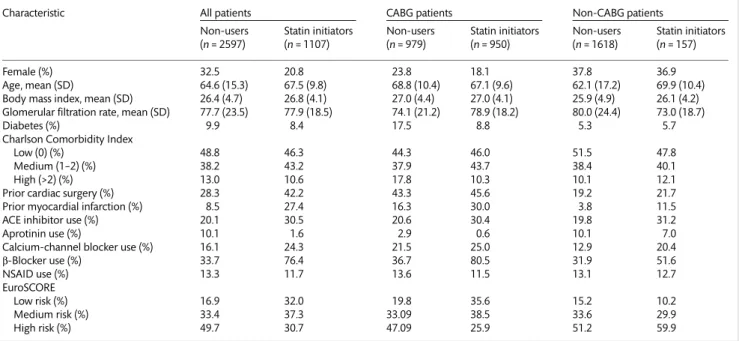
We identified 3768 patients who were either new statin initiators or non-users at the time of surgery. Sixty-four surgeries could not be accurately classified, leaving 1929 (53%) CABG patients and 1775 (47%) non-CABG patients. Distributions of selected patient characteristics by surgery type and statin use are given in Table1
(seeSupplementary Table 1for full characteristics). CABG patients were older and were more likely to be smokers, be overweight, have diabetes and cardiovascular comorbidities and use other medications (except for diuretics, which were more common
Table 1: Select characteristics of cardiac surgical patients by statin initiation status within surgery type
Characteristic All patients CABG patients Non-CABG patients
Non-users (n= 2597)
Statin initiators (n= 1107)
Non-users (n= 979)
Statin initiators (n= 950)
Non-users (n= 1618)
Statin initiators (n= 157)
Female (%) 32.5 20.8 23.8 18.1 37.8 36.9
Age, mean (SD) 64.6 (15.3) 67.5 (9.8) 68.8 (10.4) 67.1 (9.6) 62.1 (17.2) 69.9 (10.4) Body mass index, mean (SD) 26.4 (4.7) 26.8 (4.1) 27.0 (4.4) 27.0 (4.1) 25.9 (4.9) 26.1 (4.2) Glomerular filtration rate, mean (SD) 77.7 (23.5) 77.9 (18.5) 74.1 (21.2) 78.9 (18.2) 80.0 (24.4) 73.0 (18.7)
Diabetes (%) 9.9 8.4 17.5 8.8 5.3 5.7
Charlson Comorbidity Index
Low (0) (%) 48.8 46.3 44.3 46.0 51.5 47.8
Medium (1–2) (%) 38.2 43.2 37.9 43.7 38.4 40.1
High (>2) (%) 13.0 10.6 17.8 10.3 10.1 12.1
Prior cardiac surgery (%) 28.3 42.2 43.3 45.6 19.2 21.7
Prior myocardial infarction (%) 8.5 27.4 16.3 30.0 3.8 11.5
ACE inhibitor use (%) 20.1 30.5 20.6 30.4 19.8 31.2
Aprotinin use (%) 10.1 1.6 2.9 0.6 10.1 7.0
Calcium-channel blocker use (%) 16.1 24.3 21.5 25.0 12.9 20.4
β-Blocker use (%) 33.7 76.4 36.7 80.5 31.9 51.6
NSAID use (%) 13.3 11.7 13.6 11.5 13.1 12.7
EuroSCORE
Low risk (%) 16.9 32.0 19.8 35.6 15.2 10.2
Medium risk (%) 33.4 37.3 33.09 38.5 33.6 29.9
High risk (%) 49.7 30.7 47.09 25.9 51.2 59.9
CABG: coronary artery bypass graft; SD: standard deviation; GFR: glomerular filtration rate; ACE: angiotensin-converting enzyme; NSAID: non-steroidal anti-inflammatory drug; EuroSCORE I: European System for Cardiac Operative Risk Evaluation I.
ADUL
T
C
ARDIA
C
in CABG patients) than CABG patients. However, non-CABG patients tended to have higher EuroSCOREs, indicating higher risk surgical procedures.
Some covariate information was missing for characteristics col-lected at the time of surgery: smoking status, BMI, peripheral arter-ial disease, unstable angina, left ventricular ejection fraction, pulmonary hypertension and previous percutaneous coronary intervention. Some variables appeared to be missing more fre-quently in the non-users than in statin initiators, including: smoking status, BMI and previous percutaneous coronary intervention. Overall, 343 (13.2%) of the non-users and 70 (6.3%) of the statin initiators were excluded from the multivariable and PS analyses due to missing covariate information. The distribution of missingness was less pronounced by surgery type: 189 (9.8%) of CABG patients and 224 (12.6%) of non-CABG patients were excluded for missing information.
When comparing characteristics by statin treatment, treated and untreated groups appear similar in many regards, but statin initiators had more prior cardiovascular interventions, myocardial infarctions and medication use. However, there was more CKD stage 3+ among the non-users than the statin initiators. The plots of the PS distributions by treatment group (Fig.2) show separation of the curves, suggesting underlying differences in measured con-founders between treatment groups.
We observed differences in statin initiation between the CABG and non-CABG patients (see Table 1); 49% of statin-naïve CABG
patients initiated a statin in the 100 days prior to surgery, while only 9% of non-CABG patients did. Among CABG patients, statin initia-tors tended to have slightly better-managed cardiovascular disease, as evidenced by fewer comorbidities, more cardiovascular medica-tion and higher ejecmedica-tion fracmedica-tion. However, there was a much larger prevalence of former myocardial infarction among statin initiators than non-users, more CKD stage 3+ and more blood transfusion required. CABG patients on a statin also had lower EuroSCOREs. Among non-CABG patients, statin initiators were older and had more comorbidities, lower ejection fraction, more medication use, more recent cardiovascular events and a higher EuroSCORE, indi-cating more complex surgeries and CAD. PS overlap was better in the surgical subgroups (seeSupplementary Fig. 1), indicating more comparability between statin initiators and non-users within surgi-cal subtypes, although differences still do remain.
Post-surgical AKI was frequent; AKI occurred following 25% of CABG and 28% of non-CABG surgeries. The majority of AKI events (77%) were mild, Stage 1; however, non-CABG patients tended to experience more severe AKI events.
Post-surgical AKI occurred in 21% of the non-users and 29% of the statin initiators. Among all patients, the crude RR for statin initi-ation on post-surgical AKI was 0.74 (95% CI: 0.65, 0.84). Upon ad-justment, the effect was attenuated to RR = 0.86 (95% CI: 0.75, 0.99), and upon SMR weighting, remained very similar, RR = 0.82 (95% CI: 0.69, 0.99), suggesting a protective effect of presurgical statin initi-ation on post-surgical AKI (see Table2). Upon SMR weighting, the Figure 2:Propensity score overlap of presurgical statin initiators and non-users: (A) original sample; (B) standardized mortality ratio weighted.
Table 2: Effect measure estimates of presurgical statin initiation on post-surgical acute kidney injury
Surgery Treatment N Events % Crude Adjusteda SMRW weighteda
RR (95% CI) RR (95% CI) RR (95% CI)
All Non-user 2,597 749 28.8 – – – – – –
Statin initiator 1,107 235 21.2 0.74 (0.65, 0.84) 0.86 (0.74, 0.98) 0.82 (0.69, 0.98)
CABG Non-user 979 288 29.4 – – – – – –
Statin initiator 950 192 20.2 0.69 (0.59, 0.81) 0.88 (0.74, 1.05) 0.87 (0.68, 1.12)
Non-CABG Non-user 1,618 461 28.5 – – – – – –
Statin initiator 157 43 27.4 0.96 (0.74, 1.25) 0.87 (0.68, 1.11) 0.88 (0.68, 1.16)
SMRW: standardized mortality ratio weight; RR: risk ratio; CI: confidence interval; CABG: coronary artery bypass graft.
aVariable included in adjusted and propensity score models include: age; sex; body mass index category; surgical centre; chronic kidney disease; aprotinin use;
blood transfusion amount; diabetes; peripheral arterial disease; unstable angina; left ventricular dysfunction; pulmonary hypertension; prior percutaneous coronary intervention; prior cardiac surgery; ACE inhibitor use; angiotensin receptor blocker use; diuretic use; calcium-channel blocker use;β-blocker use; non-steroidal anti-inflammatory drug use; prior myocardial infarction; prior heart failure; prior arrhythmias; prior atrial fibrillation; prior stroke.
PS distribution curves were much more similar, suggesting ex-changeability between the treatment groups in the resulting pseu-dopopulation (see Fig.2andSupplementary Table 2).
When stratified by surgery type, the crude RR for statin initi-ation in CABG surgeries was protective, RR = 0.69 (95% CI: 0.59, 0.81), while the crude estimate among non-CABG surgeries was null, RR = 0.96 (95% CI: 0.74, 1.25). Upon adjustment, the effect measure estimates were similarly protective to the effect measure in the overall population: CABG patients, RR = 0.88 (95% CI: 0.74, 1.05); non-CABG surgeries, RR = 0.87 (95% CI: 0.68, 1.11).
In sensitivity analyses with more narrowly defined surgical popu-lations, surgical severity varied greatly between surgical types as indicated by varying EuroSCORE. Aortic surgeries, CABG + aortic valve surgeries, and complex surgeries had the highest mean EuroSCOREs and highest rates of post-surgical AKI. Simple CABG procedures had the lowest EuroSCOREs. Sample sizes were much smaller in some cases, resulting in imprecise effect measure esti-mates (or an inability to calculate estiesti-mates), although among the subgroups which could be estimated, subgroup effects were consistent with the overall effects (see Supplementary Table 3). However, an exception was CABG + aortic valve procedures, one of the highest risk subtypes, where the adjusted RR = 1.18 (95% CI: 0.84, 1.66) suggested no protective effect. Additionally, in sensitivity analyses stratified by sex, CKD status (GFR <60 vs GFR ≥60) and presence of a former myocardial infarction, all estimates were con-sistent with the overall estimate, except in GFR <60, which showed no protective effect (seeSupplementary Table 4).
In sensitivity analyses where cubic splines were employed for continuous covariates, the effect estimate was identical to the primary analysis in the overall population. There was no difference in estimates between the two surgical centres.
DISCUSSION
We observed reduced AKI risk associated with statin initiation prior to cardiac surgery in those previously unexposed to statins. We observed a high rate of post-surgical AKI, and the majority of these events were AKIN stage 1, which may not be clinically recognized or diagnosed, and thus would not have been identified in popula-tion studies relying on administrative claims databases. However, using sCr-based AKIN criteria allowed us to identify mild AKI events which have been demonstrated to have long-term negative effects [2].
Multiple beneficial effects independent of lipid-lowering have been attributed to statins, including reducing inflammation [18], improvingfibroproliferative responses [19], stabilizing atheroscler-otic plaques [20], improving left ventricular ejection fraction [18] and inhibiting the mevalonate–isoprenoid pathway which lessens ischaemia–reperfusion injury [21], all of which may protect one from surgically induced AKI. The protective effect was less pro-nounced in the most complex surgical types and the highest risk patients, but our study demonstrated that even short courses of presurgical treatment yield modest protection against AKI.
This protective effect was similar when investigating the full sur-gical population, or when evaluating CABG and non-CABG surger-ies separately. CABG and non-CABG surgersurger-ies had similar adjusted effect estimates; however, due to differing patient populations, the crude risk ratios and confounding were in opposite directions. In CABG patients, statins seemed to indicate better CVD manage-ment and subsequently showed a very protective crude RR, while in non-CABG patients, statin initiation seems to be a marker of
CAD in addition to the structural cardiac problem, resulting in a null crude RR. However, upon adjustment, both groups yielded similar, modestly protective effect estimates. Statins tend to be used primarily as secondary prevention in Denmark [22]; thus their use is more closely associated with progressed CAD than in the USA, where many previous studies [4,5] of presurgical statin use were performed.
Our estimate generally agrees with findings from previous studies, including studies of prevalent statin use not considering the duration of use [4], a study looking at presurgical new use [23] and a study considering continuing versus discontinuing a statin prior to surgery [24].
The current study design focused on statin initiation prior to surgery rather than long-term prior use, seeking to answer the clinically relevant question of whether a previously statin-naïve patient should initiate a statin when the need for cardiac surgery is determined, and our results suggest that even relatively short-term presurgical statin use may be beneficial for renal function. By employing a new-user design [25], we reduced the healthy-user effect [10] by avoiding comparing long-term users with non-users where better adherence, healthy lifestyle, other behavioural dif-ferences and failure to observe early adverse events lead to exag-gerated or spurious estimates of benefit. A previous study using the new-user design attenuated these biases [23] and demon-strated a similar protective effect, yet it employed administrative claims and lacked detailed surgical factors, baseline renal function and a biomarker-based definition of AKI. Another recent study accounted for treatment duration by only considering continu-ation versus discontinucontinu-ation of pre-existing statin use prior to surgery and found that continuing a statin was associated with reduced levels of kidney injury biomarkers [24].
As with all non-interventional studies, there are potential limita-tions of this analysis. We relied on recorded statin dispensing, and there may be misclassification of true statin exposure. However, all medication studies are subject to non-compliance, reflecting the reality of treatment options available to physicians where therapies can be prescribed but rarely can be enforced. Statin initiation may be associated with factors leading to better clinical outcomes, such as better patient compliance, a more engaged healthcare provider or better healthcare quality. Some missing covariate data did appear to be somewhat associated with statin initiation, perhaps in-dicating better presurgical assessment or care. If patients with missing data had systematically different outcomes, this may have biased our result. However, universal healthcare access in Denmark should reduce confounding by access to care, and all surgeries were performed in two tertiary care, academic hospitals, reducing differential AKI detection or presurgical care by statin status. Additionally, unmeasured confounding may remain in spite of re-striction and adjustment; in CABG patients, statin users had slightly less renal impairment (although non-CABG patients had slightly more), and although we adjusted for this and other confounders, statin use may continue to be associated with unmeasured lifestyle and behavioural factors associated with better outcomes. However, in other respects, statin users appear to be less healthy (e.g. more smoking, obesity), particularly among non-CABG patients. CABG and non-CABG patients had different confounding structures, and yet the adjusted effect estimates are very similar.
When investigating specific surgery types in sensitivity analyses, we observed estimates consistent with the overall and the CABG, non-CABG subgroup effects for most groups. However, a null effect was observed in patients undergoing a combined CABG and aortic valve procedure and in those with pre-existing renal
ADUL
T
C
ARDIA
C
dysfunction. These are higher risk, more invasive and longer pro-cedures and patients already at a high risk of AKI, and it is possible that any protective effect of statin use may be more pronounced in lower risk surgeries with milder insult to the kidneys.
This study has many strengths resulting from the rigorous study design and rich clinical data. Danish registries provide detailed surgi-cal characteristics and pharmacy dispensing information for patients. We utilized longitudinally collected sCr measures to determine AKI status, and detailed clinical information about the surgical proce-dures allowed us to adjust for surgical complexity and baseline renal function. We evaluated different surgical types with differing aetiolo-gies and AKI risk profiles. We had comprehensive patient medica-tion histories, allowing us to exclude long-term statin users, reducing selection bias. Additionally, we restricted the study to a homoge-neous patient population of planned, non-emergency surgeries.
In conclusion, initiation of a statin prior to cardiac surgery was associated with a reduced risk of post-surgical AKI in those previ-ously unexposed to statins. AKI is common after cardiac surgery, and measures to reduce AKI have the potential to reduce hospital length of stay, and long-term renal and cardiovascular events.
SUPPLEMENTARY MATERIAL
Supplementary Material is available atEJCTSonline.
Funding
The data extraction and data management for this project were supported by the Clinical Epidemiology Research Foundation and the Aarhus University Hospital Research Foundation.
Conflict of interest: Abhijit V. Kshirsagar: received investigator-initiated grant support from Amgen. Ross J. Simpson is a paid con-sultant for Merck, Pfizer and Amgen; has given lectures for Merck and Pfizer; and has received research funding from Pfizer, Merck and Amgen. Maurice Alan Brookhart: received investigator-initiated grants from Amgen; is on scientific advisory boards for Amgen and Merck but has not accepted personal compensation (honoraria declined, received by institution, or donated); and has received con-sulting fees from RxAnte/Millennium Labs and World Health Information Consultants for unrelated projects.
REFERENCES
[1] Li SY, Chen JY, Yang WC, Chuang CL. Acute kidney injury network classifi -cation predicts in-hospital and long-term mortality in patients undergoing elective coronary artery bypass grafting surgery. Eur J Cardiothorac Surg 2011;39:323–8.
[2] Hansen MK, Gammelager H, Mikkelsen MM, Hjortdal VE, Layton JB, Johnsen SPet al. Post-operative acute kidney injury andfive-year risk of death, myocardial infarction, and stroke among elective cardiac surgical patients: a cohort study. Crit Care 2013;17:R292.
[3] Coca SG, Singanamala S, Parikh CR. Chronic kidney disease after acute kidney injury: a systematic review and meta-analysis. Kidney Int 2012;81: 442–8.
[4] Singh I, Rajagopalan S, Srinivasan A, Achuthan S, Dhamija P, Hota Det al. Preoperative statin therapy is associated with lower requirement of renal re-placement therapy in patients undergoing cardiac surgery: a meta-analysis of observational studies. Interact CardioVasc Thorac Surg 2013;17:345–52. [5] Liakopoulos Oliver J, Kuhn Elmar W, Slottosch I, Wassmer G, Wahlers T.
Preoperative statin therapy for patients undergoing cardiac surgery. Cochrane Database Syst Rev 2012;4:CD008493.
[6] Schmidt M, Maeng M, Jakobsen CJ, Madsen M, Thuesen L, Nielsen PH et al. Existing data sources for clinical epidemiology: the Western Denmark Heart Registry. Clin Epidemiol 2010;2:137–44.
[7] Grann AF, Erichsen R, Nielsen AG, Froslev T, Thomsen RW. Existing data sources for clinical epidemiology: the clinical laboratory information system (LABKA) research database at Aarhus University, Denmark. Clin Epidemiol 2011;3:133–8.
[8] Johannesdottir SA, Horvath-Puho E, Ehrenstein V, Schmidt M, Pedersen L, Sorensen HT. Existing data sources for clinical epidemiology: the Danish National Database of Reimbursed Prescriptions. Clin Epidemiol 2012;4: 303–13.
[9] Lynge E, Sandegaard JL, Rebolj M. The Danish National Patient Register. Scand J Public Health 2011;39:30–3.
[10] Dormuth CR, Patrick AR, Shrank WH, Wright JM, Glynn RJ, Sutherland J et al. Statin adherence and risk of accidents: a cautionary tale. Circulation 2009;119:2051–7.
[11] Group KDIGOKAKIW. KDIGO Clinical Practice Guideline for Acute Kidney Injury. Kidney Int Suppl 2012;2:1–138.
[12] Nashef SA, Roques F, Michel P, Gauducheau E, Lemeshow S, Salamon R. European system for cardiac operative risk evaluation (EuroSCORE). Eur J Cardiothorac Surg 1999;16:9–13.
[13] Levey AS, Stevens LA, Schmid CH, Zhang Y, Castro AF III, Feldman HIet al. A new equation to estimate glomerularfiltration rate. Ann Intern Med 2009;150:604–12.
[14] K/DOQI clinical practice guidelines for chronic kidney disease: evaluation, classification, and stratification. Am J Kidney Dis 2002;39:S1–266. [15] Zou G. A modified poisson regression approach to prospective studies
with binary data. Am J Epidemiol 2004;159:702–06.
[16] Brookhart MA, Wyss R, Layton JB, Sturmer T. Propensity score methods for confounding control in nonexperimental research. Circ Cardiovasc Qual Outcomes 2013;6:604–11.
[17] Barker N. A practical introduction to the bootstrap using the SAS system. In:Proceedings of the Pharmaceutical Users Software Exchange Conference, Paper Pk02. Heidelberg, 2005.
[18] Sola S, Mir MQ, Lerakis S, Tandon N, Khan BV. Atorvastatin improves left ventricular systolic function and serum markers of inflammation in nonis-chemic heart failure. J Am Coll Cardiol 2006;47:332–7.
[19] Tuuminen R, Nykanen AI, Saharinen P, Gautam P, Keranen MA, Arnaudova R et al. Donor simvastatin treatment prevents ischemia-reperfusion and acute kidney injury by preserving microvascular barrier function. Am J Transplant 2013;13:2019–34.
[20] Tadros RO, Vouyouka AG, Chung C, Malik RK, Krishnan P, Ellozy SHet al. The effect of statin use on embolic potential during carotid angioplasty and stenting. Ann Vasc Surg 2013;27:96–103.
[21] Sharyo S, Yokota-Ikeda N, Mori M, Kumagai K, Uchida K, Ito Ket al. Pravastatin improves renal ischemia-reperfusion injury by inhibiting the mevalonate pathway. Kidney Int 2008;74:577–84.
[22] Thomsen RW, Nielsen RB, Norgaard M, Horsdal HT, Sturmer T, Larsen FB et al. Lifestyle profile among statin users. Epidemiology 2013;24:619–20. [23] Layton JB, Kshirsagar AV, Simpson RJ Jr, Pate V, Jonsson Funk M, Sturmer T
et al. Effect of statin use on acute kidney injury risk following coronary artery bypass grafting. Am J Cardiol 2013;111:823–8.
[24] Molnar AO, Parikh CR, Coca SG, Thiessen-Philbrook H, Koyner JL, Shlipak MGet al. Association between preoperative statin use and acute kidney injury biomarkers in cardiac surgical procedures. Ann Thorac Surg 2014; 97:2081–7.
[25] Ray WA. Evaluating medication effects outside of clinical trials: new-user designs. Am J Epidemiol 2003;158:915–20.