Update and Next Steps for
Real-World Translation of Interventions
for Type 2 Diabetes Prevention:
Reflections From a
Diabetes Care
Editors
’
Expert Forum
Diabetes Care 2016;39:1186–1201|DOI: 10.2337/dc16-0873
The International Diabetes Federation estimates that 415 million adults world-wide now have diabetes and 318 million have impaired glucose tolerance. These numbers are expected to increase to 642 million and 482 million, respectively, by 2040. This burgeoning pandemic places an enormous burden on countries worldwide, particularly resource-poor regions. Numerous landmark trials evalu-ating both intensive lifestyle modification and pharmacological interventions have persuasively demonstrated that type 2 diabetes can be prevented or its onset can be delayed in high-risk individuals with impaired glucose tolerance. However, key challenges remain, including how to scale up such approaches for widespread translation and implementation, how to select appropriately from various interventions and tailor them for different populations and settings, and how to ensure that preventive interventions yield clinically meaningful, cost-effective outcomes. In June 2015, aDiabetes CareEditors’Expert Forum convened to discuss these issues. This article, an outgrowth of the forum, begins with a summary of seminal prevention trials, followed by a discussion of considerations for selecting appropriate populations for intervention and the clinical implications of the various diagnostic criteria for prediabetes. The authors outline knowledge gaps in need of elucidation and explore a possible new avenue for securing reg-ulatory approval of a prevention-related indication for metformin, as well as specific considerations for future pharmacological interventions to delay the on-set of type 2 diabetes. They conclude with descriptions of some innovative, prag-matic translational initiatives already under way around the world.
According to the latest International Diabetes Federation (IDF) calculations, an estimated 415 million adults worldwide (8.8% of the global population) have dia-betesda number that is projected to increase to 642 million (10.4%) by 2040. The vast majority of diabetes cases are attributable to type 2 diabetes. Furthermore, an estimated 318 million adults have impaired glucose tolerance (IGT). That number is expected to climb to 482 million in the next 25 years (1). In the U.S. alone, an estimated 86 million adults have prediabetes (2).
The toll of diabetes and its complications on patients’health and quality of life is enormous. The burgeoning diabetes pandemic also places a great burden on coun-tries throughout the world, particularly in resource-poor regions. The IDF estimates that global spending to treat diabetes ranged between $673 billion and $1.2 trillion
1
Pennington Biomedical Research Center, Louisi-ana State University, Baton Rouge, LA
2
University of North Carolina School of Medicine, Chapel Hill, NC
3Chronic Disease Prevention Unit, National
Insti-tute for Health and Welfare, Helsinki, Finland; Dasman Diabetes Institute, Dasman, Kuwait; Saudi Diabetes Research Group, King Abdulaziz University, Jeddah, Saudi Arabia; and Center for Vascular Prevention, Danube University Krems, Krems, Austria
4
Kinexum, Harpers Ferry, WV
5
CNR Institute of Clinical Physiology, Pisa, Italy
6McMaster University and Hamilton Health
Sci-ences, Hamilton, Canada
7
National Institutes of Health, Phoenix, AZ
8
India Diabetes Research Foundation and Dr. A. Ramachandran’s Diabetes Hospitals, Chennai, India
9Diabetes Unit, Department of Internal
Medi-cine, Hadassah Hebrew University Hospital, Jerusalem, Israel
10
Dallas Diabetes and Endocrine Center at Med-ical City and The University of Texas Southwest-ern Medical Center, Dallas, TX
11
VA Puget Sound Health Care System and Uni-versity of Washington, Seattle, WA
Corresponding author: William T. Cefalu, william. [email protected].
© 2016 by the American Diabetes Association. Readers may use this article as long as the work is properly cited, the use is educational and not for profit, and the work is not altered.
William T. Cefalu,1John B. Buse,2 Jaakko Tuomilehto,3
G. Alexander Fleming,4Ele Ferrannini,5 Hertzel C. Gerstein,6Peter H. Bennett,7 Ambady Ramachandran,8Itamar Raz,9 Julio Rosenstock,10and Steven E. Kahn11
DIABE
TES
CAR
E
EXPE
RT
USD in 2015 (1). A recent global analysis found that a substantial portion of this burden falls on patients in low- and middle-income countries as out-of-pocket costs (3). In concert with the predicted in-crease in new cases of diabetes, global expenditures are projected to rise to be-tween $802 billion and nearly $1.5 tril-lion USD by 2040 (1).
Diabetes is also a leading cause of death. High blood glucose has been identified as the third largest risk factor for premature mortality worldwide, af-ter high blood pressure and tobacco use. Approximately 5 million deaths were at-tributable to diabetes in 2015dmore than those from HIV/AIDS, tuberculosis, and malaria combined (1,4).
Numerous landmark trials in the past quarter-century have demonstrated conclusively that preventive strategies (i.e., lifestyle modification and various pharmacological interventions) can de-lay or prevent the development of type 2 diabetes in high-risk individuals with IGT (5–22). Despite the clarity of thesefindings and large reported effect sizes, translational prevention programs have faced numerous real-world imped-iments, and none of the tested interven-tions have been widely adopted as components of routine clinical care.
There are encouraging signs that this may soon change. An independent expert panel recently confirmed that the expan-sion of the National Diabetes Prevention Program (NDPP) (23), a public-private ini-tiative funded by the Affordable Care Act and launched in 2010 to encourage the provision of evidence-based interven-tions in communities across the country, would reduce spending and improve the quality of patient care (24). This certifi ca-tion is a crucial step toward expanding NDPP for Medicare beneficiaries with prediabetes.
Despite this encouraging news, key challenges remain, including identifying those interventions most suitable for widespread implementation, selecting appropriately from and tailoring these tools for various populations and set-tings, and measuring the impact of their implementation on disease progression and on micro- and macrovascular com-plications (23,25,26). To consider these issues, aDiabetes Care Editors’Expert Forum was convened in June 2015. Pan-elists reviewed the prevention evidence to date, discussed areas of controversy,
identified unanswered research ques-tions, and explored innovative ap-proaches to translating this research to reduce the incidence of type 2 diabetes. This article summarizes the proceedings of that forum. We use the term“ preven-tion”throughout the article to refer to delaying the progression to type 2 dia-betes in a proportion of a population at risk. Ascertaining which individuals will progress from prediabetes to diabetes (and when) is not possible currently. Therefore, it is not feasible to demon-strate that an intervention has pre-vented the lifelong occurrence of diabetes in an individual or a population of individuals who are otherwise certain to progress. For now, intervention trials can only determine the fraction of the studied population that progresses to diabetes. The number of cases that have been prevented during a trial can be derived from positive results, but this calculation has to be qualified by the limited observation period and the like-lihood that treatment must be contin-ued indefinitely to preserve some or all of the prevented cases.
TYPE 2 DIABETES PREVENTION STUDIES: PROGRESS TO DATE
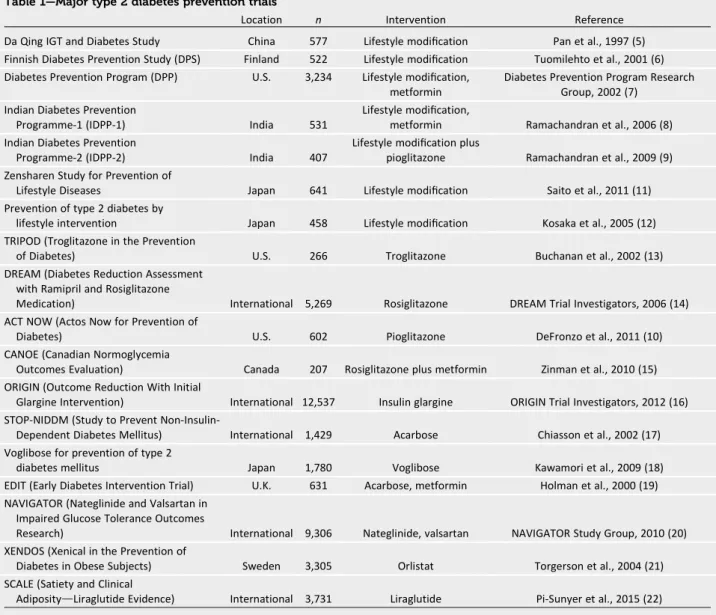
Charting the future of diabetes preven-tion and suggesting logical next steps requires a critical review of the key stud-ies. Different interventions and ap-proaches carried out in a variety of settings in diverse populations have yielded nearly uniform evidence in sup-port of both lifestyle modification and pharmacotherapy as viable means for delaying or preventing diabetes in high-risk individuals (5–22) (Table 1).
The groundbreaking Da Qing IGT and Diabetes Study (5) was thefirst large-scale prevention trial to test the efficacy of lifestyle intervention and has pro-vided the longest follow-up data. It compared the effects of dietary modifi -cation, exercise, or both to a control group given no intervention in high-risk Chinese adults with IGT. After 6 years, the cumulative incidence of dia-betes by 1985 World Health Organiza-tion (WHO) criteria (fasting plasma glucose [FPG].140 mg/dL [7.8 mmol/L] or 2-h postload plasma glucose.200 mg/dL [11.1 mmol/L]) was significantly reduced by 31–46% in all interven-tion groups. Evaluainterven-tion studies involv-ing 94% of the original cohort at the
20- and 23-year follow-ups (27,28) showed a durable 43% lower diabetes incidence rate, a 47% reduction in severe diabetic retinopathy (29), and, by year 23, significant reductions in cardiovascular (41%) and all-cause (29%) mortality.
The Finnish Diabetes Prevention Study (DPS) (6,30) examined the effects of lifestyle intervention in middle-aged, overweight adults with IGT. Participants were individually randomized to either an intervention group that received on-going individualized counseling aimed at reducing weight, making healthy dietary modifications, and increasing physical activity or a control group receiving gen-eral diet and exercise advice but no in-dividualized counseling. After 4 years, diabetes risk was reduced by 58% in the intervention group, which also had greater improvements in all parameters of the metabolic syndrome. No cases of diabetes developed among people who reached at least four of the study’sfive lifestyle intervention targets for diet and physical activity (6). Long-term follow-up found a sustained relative risk reduc-tion in diabetes incidence of 43% after 7 years and 38% after 13 years, while the absolute risk difference between groups continued to increase through 13 years (31,32).
cardiovascular risk factors (34). In the follow-up DPP Outcomes Study, cumulative di-abetes incidence rates still differed significantly 10 years (34 and 18% for lifestyle and metformin compared with placebo, respectively) and 15 years (27 and 17%, respectively) after initial ran-domization into the DPP (34,35). A pro-jection of the DPP interventions’effects over a lifetime yielded estimates that the lifestyle and metformin interventions delayed diabetes by 11 and 3 years, re-spectively, but also reduced the absolute incidence of diabetes by 20 and 8%, re-spectively (36). However, no differences in aggregate microvascular or cardiovas-cular outcomes by randomized arm have become evident in the DPP, although the expected lower prevalence of microvas-cular complications in those who did not develop diabetes was reported (35).
Two Indian Diabetes Prevention Pro-gramme studies (IDPP-1 and IDPP-2) (8,9) focused on developing practical, translatable lifestyle interventions and contributed important insights regard-ing potential ethnicity-based variations in both the pathophysiology of diabetes and responses to lifestyle and pharma-cological interventions. In the IDPP-1, Asian Indian adults with IGTdwho were younger and leaner than the sub-jects in the Finnish and American studies (6–8)dwere assigned to either a sim-ple lifestyle intervention encouraging healthy dietary changes and increased exercise, low-dose metformin therapy (500 mg daily), a combination of lifestyle modification plus metformin, or no in-tervention (control). After 3 years, dia-betes risk was reduced by 28.5, 26.4, and 28.2% in the lifestyle, metformin,
and combination groups, respectively. Both interventions also had positive ef-fects on LDL cholesterol but not on blood pressure (37). The IDPP-2 (9) tested whether adding the TZD pioglita-zone would enhance the efficacy of the IDPP-1 lifestyle intervention. In stark contrast to a 72% diabetes risk reduc-tion found with pioglitazone in the U.S. ACT NOW (Actos Now for Prevention of Diabetes) study (10) (discussed below), pioglitazone had no significant effect beyond that of lifestyle intervention in the IDPP-2 population. The potential ethnic differences in responses to phar-macological preventive therapy
identi-fied in these studies require further investigation. If substantiated, they rep-resent an important additional issue to be addressed in any global prevention strategy.
Table 1—Major type 2 diabetes prevention trials
Location n Intervention Reference
Da Qing IGT and Diabetes Study China 577 Lifestyle modification Pan et al., 1997 (5)
Finnish Diabetes Prevention Study (DPS) Finland 522 Lifestyle modification Tuomilehto et al., 2001 (6)
Diabetes Prevention Program (DPP) U.S. 3,234 Lifestyle modification, metformin
Diabetes Prevention Program Research Group, 2002 (7)
Indian Diabetes Prevention
Programme-1 (IDPP-1) India 531
Lifestyle modification,
metformin Ramachandran et al., 2006 (8)
Indian Diabetes Prevention
Programme-2 (IDPP-2) India 407
Lifestyle modification plus
pioglitazone Ramachandran et al., 2009 (9)
Zensharen Study for Prevention of
Lifestyle Diseases Japan 641 Lifestyle modification Saito et al., 2011 (11)
Prevention of type 2 diabetes by
lifestyle intervention Japan 458 Lifestyle modification Kosaka et al., 2005 (12)
TRIPOD (Troglitazone in the Prevention
of Diabetes) U.S. 266 Troglitazone Buchanan et al., 2002 (13)
DREAM (Diabetes Reduction Assessment with Ramipril and Rosiglitazone
Medication) International 5,269 Rosiglitazone DREAM Trial Investigators, 2006 (14)
ACT NOW (Actos Now for Prevention of
Diabetes) U.S. 602 Pioglitazone DeFronzo et al., 2011 (10)
CANOE (Canadian Normoglycemia
Outcomes Evaluation) Canada 207 Rosiglitazone plus metformin Zinman et al., 2010 (15)
ORIGIN (Outcome Reduction With Initial
Glargine Intervention) International 12,537 Insulin glargine ORIGIN Trial Investigators, 2012 (16)
STOP-NIDDM (Study to Prevent
Non-Insulin-Dependent Diabetes Mellitus) International 1,429 Acarbose Chiasson et al., 2002 (17)
Voglibose for prevention of type 2
diabetes mellitus Japan 1,780 Voglibose Kawamori et al., 2009 (18)
EDIT (Early Diabetes Intervention Trial) U.K. 631 Acarbose, metformin Holman et al., 2000 (19)
NAVIGATOR (Nateglinide and Valsartan in Impaired Glucose Tolerance Outcomes
Research) International 9,306 Nateglinide, valsartan NAVIGATOR Study Group, 2010 (20)
XENDOS (Xenical in the Prevention of
Diabetes in Obese Subjects) Sweden 3,305 Orlistat Torgerson et al., 2004 (21)
SCALE (Satiety and Clinical
The Japanese Zensharen Study for Prevention of Lifestyle Diseases (11) evaluated overweight Japanese adults with FPG levels of 100–125 mg/dL (5.6–6.9 mmol/L) who were randomly assigned to either a frequent or less fre-quent (control) lifestyle intervention program for 3 years. The frequent inter-vention resulted in an overall 44% re-duction in diabetes incidence, although subgroup analyses revealed that it was effective in participants with combined impaired fasting glucose (IFG) and IGT (59% relative risk reduction) or high baseline A1C (76% relative risk reduc-tion) but had no effect in those with isolated IFG or lower baseline A1C. In another, smaller Japanese lifestyle in-tervention study, men with IGT were randomly assigned to a standard inter-vention group (control) or an intensive intervention group (12). Subjects in the control group and in the intensive intervention group were advised to maintain a BMI of,24.0 and ,22.0 kg/m2, respectively, through diet and exercise. In the intensive group, detailed instructions on lifestyle modification were repeated every 3–4 months. The cumulative 4-year incidence of diabetes was 9.3% in the control group and 3.0% in the intensive intervention group; re-duction in diabetes risk from the inten-sive intervention was 67.4%.
Because virtually all of the early dia-betes prevention research suggested that the success of an intervention lies partly in its ability to improve insulin sensitivity and because TZDs were known to reduce insulin resistance, a number of studies have examined the effect of this class of agents. The TRIPOD (Troglitazone in the Prevention of Dia-betes) study (13) demonstrated that troglitazone could reduce the risk of de-veloping diabetes by 55% in Hispanic women with a history of gestational di-abetes mellitus (GDM). The DREAM (Di-abetes Reduction Assessment with Ramipril and Rosiglitazone Medication) trial (14) examined the preventive value of rosiglitazone, and ACT NOW (10) did the same with pioglitazone. In the DREAM trial, adults with IFG (FPG 110 to,126 mg/dL [6.1 to,7.0 mmol/L]), IGT, or both were randomly assigned to either rosiglitazone 8 mg daily or pla-cebo. After 3 years, the composite out-come of incident diabetes or death was reduced by 60% in the rosiglitazone
group, most of which was due to a re-duction in incident diabetes. Rosiglita-zone was also shown to increase the likelihood of reversion to normal glu-cose tolerance (NGT) by;70–80%. In ACT NOW, overweight adults with IGT were randomly assigned to either pio-glitazone titrated to 45 mg daily or placebo. During a median follow-up of 2.4 years, the pioglitazone group had a 72% reduction in diabetes risk compared with placebo. In addition, the CANOE (Canadian Normoglycemia Out-comes Evaluation) trial (15) found that low-dose combination therapy with rosi-glitazone 2 mg plus metformin 500 mg twice daily in adults with IGT reduced the relative risk of diabetes by 66% during a median 3.9 years of treatment with sig-nificantly fewer adverse events than in the DREAM trial. Longer-term passive follow-up of the DREAM cohort showed that at a median 1.6 years after the end of the trial and 4.3 years after randomi-zation the rosiglitazone group retained a 39% lower incidence of the compos-ite outcome but had only 17% more re-version to normoglycemia than the placebo group (38). Thus, limited expo-sure to a TZD (in this case, rosiglitazone, but also troglitazone in the DPP [33] and pioglitazone in ACT NOW [39]) ap-pears to reduce the long-term inci-dence of diabetes by delaying, rather than reversing, the underlying disease process.
The ORIGIN (Outcome Reduction With Initial Glargine Intervention) trial (16,40) explored the same question of preventing diabetes by reducingb-cell load, in this case with insulin therapy. Adults with cardiovascular risk factors who either had or were at risk for de-veloping diabetes were randomized to receive either insulin glargine or stan-dard care. Although the study’s primary focus was on cardiovascular outcomes, incident diabetes among at-risk partici-pants was also examined. After a mean follow-up of 6.2 years, glargine reduced the risk of diabetes by 28% compared with standard care based on oral glu-cose tolerance tests (OGTTs) performed
;1 month after insulin was stopped. When participants were identified through a second OGTT performed
;3 months later and those with uncer-tain new diabetes diagnoses were in-cluded, the total risk reduction was 31%. A 2-year passive follow-up study
of 4,718 of the original 12,537 ORIGIN participants was consistent with a leg-acy effect, with new diabetes cases oc-curring in 41 and 48% of the glargine and standard care groups, respectively, when both confirmed and unconfirmed cases were included (41).
Additional prevention studies have been conducted with other pharmacolog-ical agents. The international STOP-NIDDM (Study to Prevent Non-Insulin-Dependent Diabetes Mellitus) trial (17), a 2009 Japa-nese study (18), and the U.K. Early Diabe-tes Intervention Trial (EDIT) (19) all investigated the preventive effects of
a-glucosidase inhibitors in individuals with IGT. In STOP-NIDDM, participants re-ceiving 100 mg of acarbose three times daily for 3 years had a 25% reduction in relative risk of diabetes compared with placebo. Acarbose therapy also signifi -cantly increased the rate of reversion to NGT (17). In the Japanese study, partici-pants receiving 0.2 mg of voglibose three times daily for 4 years had a 40% reduction in the relative risk of diabetes compared with placebo and were significantly more likely to achieve normoglycemia (18). EDIT randomized 631 U.K. participants at risk for diabetes based on two FPG levels of 99–139 mg/dL (5.5–7.7 mmol/L) to acar-bose 50 mg, metformin 500 mg, or matched placebo three times daily in a 232 factorial study. After 3 years, no statistical risk reductions with were observed with acarbose or metformin (8 and 37%, respectively) compared with placebo (19). Although thefinal EDIT results have not been fully report-ed, no differences were seen in the rel-ative risk for diabetes by 6 years for acarbose (1.04, P = 0.81), metformin (0.99,P = 0.94), or their combination (1.02,P= 0.91). Interestingly, for those with IGT at baseline, the relative risk of diabetes was reduced by acarbose (0.66,
P= 0.046) but not by metformin (1.09,
P= 0.70), perhaps because the fasting glucose level and BMI in this study were lower than in the DPP. The investigators concluded that the ability of therapies to reduce the risk of diabetes may differ for those with IGT versus those with IFG (42).
IGT and cardiovascular disease or car-diovascular risk factors. The study com-pared nateglinide up to 60 mg three times daily or valsartan therapy to pla-cebo. During a median follow-up of 5 years, nateglinide did not significantly reduce the cumulative incidence of dia-betes compared with placebo (36 vs. 34%, respectively). There was no reduc-tion in the nateglinide group in a core cardiovascular composite outcome that included death from cardiovascu-lar causes, nonfatal myocardial infarc-tion, nonfatal stroke, or hospitalization for heart failure (7.9 vs. 8.3%, respec-tively), and there was no reduction in an extended cardiovascular composite outcome that included the individual components of the core composite out-come as well as hospitalization for unstable angina and arterial revascular-ization (14.2 vs. 15.2%, respectively). Furthermore, nateglinide therapy in-creased the risk of hypoglycemia.
In the Swedish XENDOS (Xenical in the Prevention of Diabetes in Obese Sub-jects) trial (21), obese adults with either NGT or IGT were randomly assigned to lifestyle modification plus either orlistat 120 mg or placebo three times daily. After 4 years, the cumulative incidence of diabetes was 9.0% with placebo and 6.2% with orlistat, corresponding to an overall risk reduction of 37.3%. Analyses indicated that the preventive effect of orlistat was explained by its effect on participants with IGT at baseline, in whom orlistat yielded a risk reduction of 52%. Participants receiving orlistat also had significantly greater mean weight loss (5.8 vs. 3.0 kg with placebo), which was not dependent on their glu-cose tolerance status.
The international SCALE (Satiety and Clinical AdipositydLiraglutide Evidence) trial (22) investigated the effects of the glucagon-like peptide 1 recep-tor agonist liraglutide on weight and cardiometabolic risk factors in obese adults without diabetes. Participants were randomly assigned to receive either liraglutide 3.0 mg in once-daily injections or placebo in addition to counseling on lifestyle modification. After 56 weeks, those receiving liraglutide lost signifi -cantly more weight (difference–5.6 kg). Weight loss of at least 5% body weight was achieved in 63.2 and 27.1% of the participants in the liraglutide and placebo groups, respectively, and 33.1
and 10.6%, respectively, lost .10% body weight. A1C, fasting glucose, and fasting insulin levels decreased more with liraglutide than with placebo, and the liraglutide group also had lower glu-cose and higher insulin and C-peptide levels during OGTT. Insulin resistance andb-cell function also improved with liraglutide. The prevalence of prediabe-tes at week 56 was significantly lower with liraglutide (7.2 vs. 20.7% among participants with baseline normoglycemia and 30.8 vs. 67.3% among those with baseline prediabetes), and type 2 diabe-tes developed in fewer patients receiv-ing liraglutide than with placebo (4 vs. 14 cases).
Taken together, these studies con-vincingly support lifestyle modification focusing on healthful eating and in-creased physical activity and various pharmacological therapies as viable strategies for preventing type 2 diabe-tes. However, they also raise important new questions, such as1) how best to identify the most appropriate target populations for intervention,2) how to disseminate lifestyle interventions in the most cost-effective manner, and3) how expanding preventive pharmaco-therapy options might further the goal of reducing diabetes rates worldwide.
TYPE 2 DIABETES PREVENTION STUDIES: CHALLENGING QUESTIONS
Identifying Appropriate Target Populations
Many longitudinal studies have outlined the trajectories of the metabolic factors (i.e., insulin secretion, insulin sensitivity, and 2-h glucose levels) preceding diag-nosis. For example, Tab ´ak et al. (43) showed that insulin secretion and insu-lin action may be considered to be in the normal range until 2–6 years before diag-nosis, when abrupt metabolic changes re-sult in deterioration of fasting and 2-h postload glucose levels. Each of the three clinical categories used to identify the prediabetic state (isolated IFG, isolated IGT, and combined IFG and IGT) may represent a distinctive pathophysiology (44). Individuals in each of these cate-gories have an elevated diabetes risk, and responses to interventions may differ based on the category and severity of the abnormality. Thus, attempts to curb the prevalence of diabetes must focus on effectively screening, identifying, and
treating people who are at increased risk by virtue of being in one of these categories.
However, there is not uniform agree-ment on the specific approach to take. Given the different trajectories of fast-ing glucose, postprandial glucose, and insulin levels before diagnosis, what specific point would be the most appro-priate at which to intervene?
Determining Appropriate Diagnostic Criteria for Prediabetes
The current diagnostic recommendations for diabetes are an FPG level$126 mg/dL (7.0 mmol/L) or a 2-h plasma glucose dur-ing an OGTT$200 mg/dL (11.1 mmol/L) (Fig. 1). These criteria historically were based on thresholds for the risk of reti-nopathy (45–48). The term“impaired glu-cose tolerance,”comprising people at high risk to progress to diabetes, was es-tablished in 1979, and its definition (2-h OGTT glucose levels between the normal and diabetic values) essentially has not changed since then (46). In most diabetes prevention studies to date, subjects have had IGT (i.e., a 2-h OGTT glucose level of 140–199 mg/dL [7.8–11.0 mmol/L]).
at lower risk than other prediabetes def-initions, but more research is needed (54). The success of any broad-based pre-vention strategy will hinge on attaining consensus regarding the most appropri-ate diagnostic test and the glycemic cut point at which to begin intervention. The current lack of concordance on this issue is not a trivial matter and has tremendous clinical implications (55). At present, life-style intervention has been shown to be unequivocally effective in reducing diabe-tes incidence only in subjects with iso-lated IGT or combined IGT and IFG and in subjects with A1C levels of 6.0 to ,6.5% (42 to,48 mmol/mol). Without intervention, these individuals have a much higher incidence of diabetes than do individuals who are classified as having prediabetes by other criteria. Existing data are not sufficient to make evi-dence-based recommendations for those with prediabetes classified by other crite-ria; targeted studies are needed to pro-vide more specific information.
Clinical Implications of the Prediabetes
Diagnosis
More general agreement exists regarding the clinical implications of the prediabetic state. First and foremost, prediabetes is linked to microvascular complications (56– 59). For example, using data from the Na-tional Health and Nutrition Examination Survey (NHANES) and defining“ prediabe-tes”as an FPG$100 mg/dL (5.6 mmol/L) but,126 mg/dL (7.0 mmol/L), Plantinga et al. (56) reported that the prevalence of chronic kidney disease was 17.7% in
individuals with prediabetes compared with 10.6% in those with no diabetes and 39.6% and 41.7% in individuals with diagnosed or undiagnosed diabetes, re-spectively. Second, each category of pre-diabetes (i.e., IFG, IGT, or a combination of both) increases the relative risk and incident rate of progression to diabetes, although isolated IFG has less predictive value (60). Although previous studies pri-marily used an IFG cut point of$110 mg/dL (6.1 mmol/L), there is evidence that lower (but still elevated) 2-h glucose and A1C val-ues also confer risk (61–63), although data on FPG are less clear.
One major factor to consider is whether the ADA-recommended lower thresholds for A1C and IFG are associated with higher cardiovascular risk. Understanding that risk is a graded continuum, one would ex-pect these values to confer some level of increased risk, and there is evidence to support this (64–66), although some stud-ies have demonstrated less excess risk than others. For example, in the U.S. MESA (Multi-Ethnic Study of Atheroscle-rosis) trial (64), IFG was defined as no type 2 diabetes and a fasting glucose of 100–125 mg/dL (5.6–6.9 mmol/L) and was associated with an increased inci-dence of cardiovascular events in univar-iate, but not multivarunivar-iate, analysis compared with those with normal fast-ing glucose. Data from the Emergfast-ing Risk Factors Collaboration (ERFC) (65) sug-gested that“there are generally contin-uous associations between fasting glucose levels greater than 100 mg per
deciliter and risk of death, supporting the view that hyperglycemia (or some fac-tor closely related to it) may be directly relevant.”In addition, Xu et al. (66) per-formed a meta-analysis on the risk of coronary heart disease (CHD) using differ-ent IFG criteria. They found an increased risk of CHD when FPG was as low as 100 mg/dLdthe lower ADA cut point for IFGdand concluded that“these re-sults reaffirm the importance of screening for prediabetes using the ADA criteria.”
Collectively, these studies indicate the clinical implications of the continuum of excess risk for microvascular complica-tions, macrovascular complicacomplica-tions, mor-tality, and type 2 diabetes even at the lower values within the glycemic range that defines prediabetes (67).
Disseminating Lifestyle Interventions Cost-Effectively
Numerous efforts have been made to translate lifestyle interventions into real-world practice, although risk reductions generally have not matched the levels achieved in proof-of-concept research studies (68–79). This is not surprising in that clinical practices face different chal-lenges from those in research settings, including personnel training, funding and reimbursement schemes, competing needs in clinics, and compliance and ad-herence barriers (80).
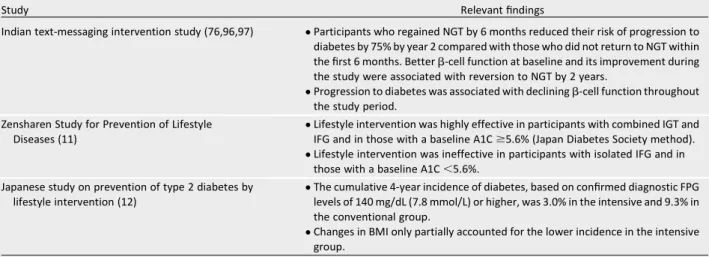
Clearly, more work is needed to make widespread practical use of the lessons learned thus far, to tailor simple and prac-tical interventions to specific populations and individuals, and to identify patients for whom lifestyle modification may not be enough. A great deal of information is now available about the predictors of inci-dent diabetes and of successful risk reduc-tion through lifestyle intervenreduc-tion (Table 2) (5,7,11,12,27–29,34,35,76,81–97). These
findings will help to guide future efforts to determine the most appropriate candi-dates for widespread translation initiatives among high-risk individuals. Other remain-ing questions regardremain-ing lifestyle interven-tion include the following:
c How much do the dietary and exercise components contribute individually to reducing diabetes risk and delaying or preventing the onset of the disease, or are the two inextricably linked? How much weight loss maintained over how many years is required for sus-tained prevention of type 2 diabetes?
Table 2—Predictors of diabetes risk reduction through lifestyle intervention
Study Relevantfindings
Da Qing IGT and Diabetes Study (5,27–29,81) cDiet, exercise, and a combination of diet and exercise intervention for 6 years in Chinese adults with IGT were equally effective in reducing diabetes incidence. cInterventions were effective in people with a BMI higher or lower than 25 kg/m2. cBenefit could not be wholly ascribed to changes in BMI.
cInterventions were most effective in those with less insulin resistance and greater insulin secretion at baseline.
cReduced cumulative diabetes incidence persisted for at least 17 years after the termination of the active intervention.
cLifestyle intervention was associated with a subsequent lower incidence of severe retinopathy and lower mortality.
Finnish Diabetes Prevention Study (DPS) (82–89) cLifestyle intervention was most effective among the oldest participants and those scoring highest on a composite risk assessment at baseline. This scoring instrument or others like it may be useful for identifying individuals most likely to benefit from intensive lifestyle intervention.
cParticipants who had greater insulin sensitivity and better insulin secretion during the study were less likely to progress to diabetes during a mean follow-up of 6 years. Regression to NGT was more strongly associated with greater insulin secretion than with better insulin sensitivity.
cParticipants with greater improvements in weight and BMI during thefirst year were less likely to develop diabetes. Thus, BMI reduction may be a key goal to improve insulin sensitivity, preserve insulin secretion, and ultimately prevent or delay diabetes.
cAchievement of each of the study’sfive lifestyle goals significantly decreased risk. None of the participants who achieved at least four of thefive goals developed diabetes by year 4.
cParticipants with longer typical sleep durations had a higher risk of developing diabetes in the control group but not in the intervention group; lifestyle intervention was similarly effective regardless of participants’sleep habits. Thus, lifestyle intervention may reduce the excess risk conferred by longer sleep duration.
cSeveral genetic variants conferred higher diabetes risk. Post hoc analyses showed that although lifestyle intervention was effective regardless of family history of diabetes its effectiveness varied markedly according to participants’ genetic variant status. This demonstrates the potential role of genotype in diabetes prevention efforts.
Diabetes Prevention Program (DPP) (7,34,35,90–94) cShort- and long-term effects of intensive lifestyle intervention were greatest among older participants, those with greater baseline insulin sensitivity and insulin secretion, and those with greater improvements in each during the active study period.
cFor women with a history of GDM, lifestyle modification and metformin were similarly effective, whereas for women without previous GDM, only lifestyle intervention reduced diabetes risk.
cLifestyle intervention was similarly effective in those with and without higher genetic risk.
cThe presence or absence of diabetes-related antibodies did not affect diabetes risk or predict responses to intervention.
cIndividuals from any group who regained NGT at least once during active intervention reduced their diabetes risk by 56% during long-term follow-up compared with those with persistent prediabetes. Thus, even transient reversion to NGT by any means appears to lower future diabetes risk. Reversion was more common in the lifestyle group and was more likely in participants who achieved greater weight loss, were younger, and had lower glucose levels and betterb-cell function at baseline. Paradoxically, lifestyle group members who did not revert to NGT during the study were actually at higher risk during follow-up, perhaps because of a particularly strong susceptibility (genetic or environmental) to diabetes. Thus, a combination of interventions may be needed for individuals whose dysglycemia is not reversed through lifestyle modification alone.
Indian Diabetes Prevention Programme-1 (IDPP-1) (95) cBaseline A1C was the most significant predictor of diabetes; however, preventive interventions were similarly effective across A1C subgroups.
cLifestyle intervention reduced diabetes risk in this population independent of weight loss.
c Are the beneficial effects of exercise or increased leisure-time activity ef-fective independent of weight loss among people who are overweight/ obese and those who are of normal weight? Is delay or prevention of di-abetes possible in the absence of weight loss in some populations? c Is it appropriate to group individuals
with isolated IFG together with those who have IGT or a combination of both as the target for preventive in-terventions? If not, what strategies might be necessary to reduce diabe-tes risk in people with each type of metabolic dysregulation (or, for that matter, with higher or lower A1C values)?
c How might lifestyle interventions that have proven effective in structured research settings be implemented successfully through large-scale pub-lic health initiatives?
Expanding Pharmacotherapeutic Options: Moving Toward a Prevention-Related Indication for Metformin
Relying on diet and physical activity is not enough to delay progression for some at-risk individuals because long-term adher-ence to healthy lifestyle behaviors can be difficult (26). Furthermore, as previously noted, interventions implemented in re-search studies can be prohibitively labor intensive and expensive to deliver in real-world settings, where they face different obstacles (80). In addition, the costs of prevention services, such as lifestyle mod-ification programs and health coaching, typically have not been reimbursed by payers (25). The recently announced
findings supporting the cost-effectiveness of the NDPP (23,24) are encouraging, as is a recent recommendation from the U.S. Preventive Services Task Force that obese adults aged 40–70 years who do not have symptoms of diabetes should be screened for abnormal blood glucose in the primary care setting (98). Although these and other public health initiatives (99–103) could soon improve this situation, current reimbursement structures and a shortage of qualified lifestyle coaches in primary care and nonmedical settings remain problematic.
For these reasons, preventive pharma-cotherapy has been proposed as an ad-junct to lifestyle modification (39). As reviewed above, strong evidence from randomized controlled trials has shown the potential of various pharmacological therapies to prevent progression to type 2 diabetes in people with IGT (7–10, 13–22,33,104). The preventive effects of these agents, although not fully under-stood, appear to be related primarily to their ability to lower blood glucose and to preserve or delay the deterioration of
b-cell function and thereby modify the disease progression (105), as demon-strated in the DPP (90). TZDs improve in-sulin sensitivity and glucose utilization and also have direct, positive effects on theb-cells;a-glucosidase inhibitors re-tard carbohydrate absorption and lower postprandial hyperglycemia, reducing the
b-cell load; and metformin, a biguanide, suppresses hepatic glucose production. Each of these mechanisms potentially could modulate factors related to preser-vation ofb-cell function by reducing the demand for insulin secretion.
As preventive monotherapy, only metformin has been studied for longer than;3 years, and reductions in diabe-tes incidence have generally dissipated after discontinuation of glucose-lowering drugs (26). In addition, TZDs have been plagued with concerns regarding serious adverse events, and acarbose is associ-ated with gastrointestinal (GI) symptoms and greater adherence problems (17,104,106). Some newer obesity and diabetes medications (e.g., orlistat and glucagon-like peptide 1 receptor ago-nists) (21,22,107) have the potential for diabetes prevention based on their pos-itive effects on weight and cardiovascu-lar risk factors and possibly alsob-cell function and protection. However, such agents are costly, some are injectables (which may pose a barrier for some people), and all require further study in the population with prediabetes (26,108).
Metformin, with proven effective-ness, long-term safety (109), and cost-effectiveness as the first-line type 2 diabetes treatment (110), is the most likely candidate for widespread use in diabetes prevention (100). Although less effective overall than lifestyle inter-vention in the DPP, it was as effective as lifestyle modification for younger partic-ipants, very obese participants ($35 kg/m2), and women with a history of GDM. However, it was no more effective than placebo in older participants (.60 years of age) (7,111). A recent risk-based re-analysis of the DPP (112) found that the benefit of metformin was unevenly dis-tributed within the study population such that only subjects in the highest-risk Table 2—Continued
Study Relevantfindings
Indian text-messaging intervention study (76,96,97) cParticipants who regained NGT by 6 months reduced their risk of progression to diabetes by 75% by year 2 compared with those who did not return to NGT within thefirst 6 months. Betterb-cell function at baseline and its improvement during the study were associated with reversion to NGT by 2 years.
cProgression to diabetes was associated with decliningb-cell function throughout the study period.
Zensharen Study for Prevention of Lifestyle Diseases (11)
cLifestyle intervention was highly effective in participants with combined IGT and IFG and in those with a baseline A1C$5.6% (Japan Diabetes Society method). cLifestyle intervention was ineffective in participants with isolated IFG and in
those with a baseline A1C,5.6%.
Japanese study on prevention of type 2 diabetes by lifestyle intervention (12)
cThe cumulative 4-year incidence of diabetes, based on confirmed diagnostic FPG levels of 140 mg/dL (7.8 mmol/L) or higher, was 3.0% in the intensive and 9.3% in the conventional group.
quartile experienced marked risk re-duction, whereas the remaining sub-jects received little or no benefit. Since 2008, ADA has recommended consid-eration of metformin therapy for indi-viduals who are at very high risk for diabetes (currently including individuals who are ,60 years of age, are very obese, have a history of GDM, or have IGT, IFG, or an A1C of 5.7–6.4% [39–46 mmol/mol]) (113).
Despite this recommendation, met-formin use for diabetes prevention has been minimal in many countries. Cost may not be a major issue, but GI side effects and the lack of perceived benefit with no measurable targets may play a role in the low rate of metformin use in prediabetes. For example, a recent eval-uation of metformin prescription rates in a nationwide sample of.17,000 in-sured adults aged 19–58 years with pre-diabetes in the U.S. found that only 3.7% were prescribed metformin in the 2010– 2012 period. Even within a subgroup of individuals with a BMI.35 kg/m2or a history of GDMdcharacteristics specif-ically identified in ADA guidelinesdonly 7.8% received a metformin prescrip-tion (114). Although more research is needed to pinpoint the reasons for this lack of uptake for metformin use in pre-diabetes, the authors suggested that providers’lack of knowledge about DPP and the natural course of prediabetes, reluctance on the part of patients and providers to“medicalize” prediabetes, and the lack of a metformin prediabe-tes indication approved by the U.S. Food and Drug Administration (FDA) and similar agencies in other countries all may play a role. That said, a prediabe-tes indication for acarbose has been ap-proved in several countries (115), but it is uncertain how often that agent is pre-scribed for this use.
The lack of a prevention-related indi-cation for metformin poses a significant barrier to more widespread use, but perhaps not an insurmountable one. Al-though conventional wisdom holds that the FDA is reluctant to approve such an indication for any drug, the agency’s 2008 draft guidance for industry on de-veloping diabetes drugs seems to sug-gest otherwise (116). This document, although neverfinalized, outlines the FDA’s expectations for “products in-tended to prevent the development of diabetes” (116). These expectations
include that supporting research studies need to1) be conducted in populations of high-risk individuals (e.g., those with IGT, IFG, or a history of GDM);2) include a washout period to confirm that the drug truly delays, rather than merely masks, progression of the under-lying disease process;3) be of substan-tial duration and size; and4) include as possible end points either delay in type 2 diabetes diagnosis or reduction in the proportion of patients diagnosed with type 2 diabetes relative to placebo. The guidance notes that, in the absence of a clearly defined“clinically meaningful effect size,”merely delaying a diagnosis of diabetes may not be a sufficiently tangible benefit against which to judge risks. It sug-gests, however, that certain supporting outcomes, such as demonstration of a du-rable delay in diabetes onset after therapy ends or evidence of delay or reduction of micro- or macrovascular complications, could strengthen a candidate drug’s claim. In addition, the guidance states that the FDA’s expectations for the safety of prevention-related products are likely to be higher than for drugs aimed at treat-ing type 2 diabetes.
Notably, the FDA guidance does not suggest that a candidate agent must be supported by evidence that it actually
“prevents” type 2 diabetes but rather that it durably delays disease onset and thereby can be expected to reduce long-term complications. Some would reserve the term“prevention”for inter-ventions that, at least in a significant proportion of individuals, forestall the onset of diabetes for decades or longer. Others may take a more pragmatic per-spective and hold that the terms“ reduc-tion,” “prevention,”and“delay”may be considered close enough on the same spectrum to be used interchangeably (117). The distinction may be important to the FDA, which likely would set a higher evidence bar for a“prevention” indication than it would for an indication
“for the treatment of prediabetes”or
“for reducing the risk of developing type 2 diabetes.”To date, the only evi-dence in support of strictly defined“ pre-vention”has come from the previously mentioned DPP cost-effectiveness anal-ysis (36) showing that the effects of the metformin intervention, projected over a lifetime, would not only delay diabe-tes but also reduce its absolute incidence by 8%.
Consistent with the FDA guidance, however, the evidence base for metfor-min may already be substantial enough to support approval of some form of prevention-related indication. Some work may be necessary to develop ex-pert consensus with regard to what constitutes a clinically meaningful delay in the development of diabetes in the context of metformin’s known benefits and risks; this would be analogous to a previous successful initiative to estab-lish measures of C-peptide as the pri-mary efficacy end point for new type 1 diabetes drugs (118). Notably, the FDA has awarded cardiovascular prevention indications for statins on the basis of results from a single robust trial showing significant reductions in tangible cardio-vascular events (119).
Admittedly, the DPP did not evaluate participants’diabetes status off therapy by including a metformin washout pe-riod. In its guidance, the FDA reasonably asks for confirmation that normal glu-cose regulation persists after washout to exclude the possibility that a glu-cose-lowering agent is not simply main-taining normoglycemia in those who actually have progressed to diabetes. Evaluating diabetes status after washout must be distinguished from demonstrat-ing the durability of the diabetes-delaydemonstrat-ing effect. The latter is determined by restart-ing treatment and determinrestart-ing at subse-quent time points (each after treatment washout) what proportion of the popula-tion retains normal glucose regulapopula-tion status. This distinction is less important for trials of long duration with a single washout evaluation at the end and more important for shorter trials with a single end point, for which durability remains an open question, and for long trials with intermediate end points. Mea-suring durability becomes more important when the safety profile of a candidate drug is not so benign. Here, weighing the durability of benefit against cumulative adversity would be an important aspect of estimating the overall benefit-to-risk re-lationship of what for some could be a lifelong therapy.
well as neuropathy in those with low vitamin B12levels (120). Similar to cur-rent ADA recommendations, the indica-tion for metformin should limit its use to subpopulations found in the DPP to be at high risk (i.e., those with a history of GDM, who are very obese, or who have more severe or progressive hyperglyce-mia) until additional evidence supports expansion of the indicated population. Of interest in this regard, metformin re-duced IGT progression to diabetes in the IDPP’s lean Indian population about as well as it did in the DPP’s obese popula-tion (7,8).
Key practical questions are: how could approval of a new metformin in-dication be achieved, and who will lead this effort? The conventional mecha-nism would be for one or more of the companies marketing metformin in the U.S. to compile and submit a supple-mentary new drug application contain-ing the data and other necessary information to allow the FDA to approve the indication. However, these compa-nies may not wish to spend the signifi -cant resources required for such an application given that metformin is al-ready available in generic form. Realiz-ing the long-term societal benefits of type 2 diabetes prevention may require other avenues for FDA approval (25). One approach could be for the FDA to receive a comprehensive package of ev-idence and other relevant material and call an advisory committee for a full pub-lic discussion. With a positive vote of its advisory committee, the FDA could con-clude that the indication should be granted and allow companies with ap-proved metformin new drug applications to add the new indication to their labels. An organization such as ADA could very appropriately lead the effort to compile the briefing package for the FDA and fa-cilitate other supportive actions.
UNMET RESEARCH NEEDS
We need to learn more about racial and ethnic differences in responses to life-style and, particularly, pharmacological interventions. Are there meaningful dif-ferences, or are they more perceived than real because different populations were not compared in the same study? The similar effectiveness of the DPP in-terventions infive ethnic groups sug-gests that this may be more theoretical than real (7).
Much remains to be learned about the genetics of diabetes risk, the effects of genetics as a modifier of prevention interventions, and the potential role of genetic testing to identify appropriate subjects for future research. In this re-gard, genetics has been somewhat dis-appointing to date. Compilation of genetic risk scores has demonstrated that greater genetic risk is associated with a greater likelihood of progression to diabetes. However, this work has also demonstrated that a high genetic risk score in adults is typically also associ-ated with elevassoci-ated glucose levels, mean-ing that glucose itself is as good a predictor and certainly less expensive. Thus, the true utility of genetic risk scores may be in identifying young indi-viduals who are at the greatest risk and initiating preventive therapy in them well before their glucose levels start to increase substantially.
More detailed evidence is needed to inform efforts to tailor preventive mea-sures based on patients’phenotype, ge-notype, composite diabetes risk scores, personal characteristics, socioeconomic factors, and other relevant parameters.
THE FUTURE IS NOW: TRANSLATION THROUGH NATIONAL AND COMMUNITY CAMPAIGNS
Carefully conducted landmark preven-tion trials have provided more than enough evidence that prevention or de-lay of type 2 diabetes is possible in high-risk individuals. Clearly, the next step is to implement these strategies, and new technologies and innovations offer promising ways to reduce the labor and costs associated with scaling up pre-vention initiatives on a population level. Individuals can be screened for predia-betes in numerous low-cost ways for en-rollment in an intervention. Community or workplace health screenings, pro-vider referrals, and reviews of electronic medical records all can be leveraged to screen for diabetes risk. Individuals can also self-screen using one of the many available risk scoring instruments. Such risk questionnaires, originating from many sources in various populations, are available on the Internet and can be publicized through traditional adver-tising and social media (82,121–125).
Throughout the world, countries are now developing practical, affordable
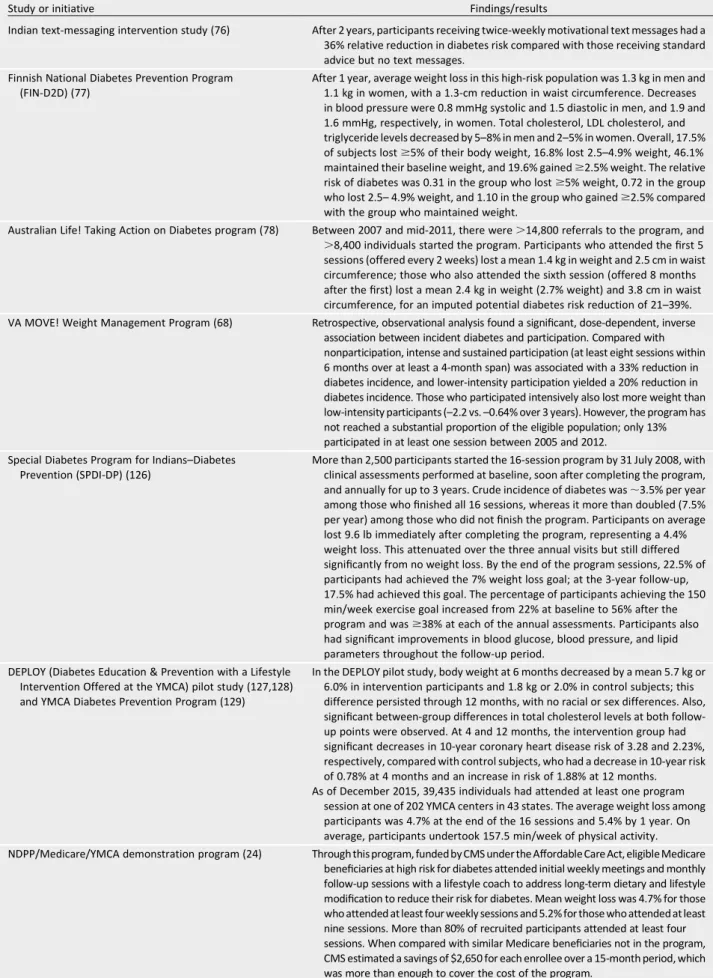
population-based programs that can be tailored for individual and cultural differences and implemented relatively inexpensively. Some of these programs are described below, and their reported results, where available, are summa-rized in Table 3 (24,68,76–78,126–129). Taking advantage of new technolo-gies can aid in the translational effort by reducing costs and expanding reach to a wide audience. For example, an In-dian study assessed the effectiveness of a text-messaging lifestyle interven-tion and convincingly demonstrated that a low-cost, low-labor program of-fering lifestyle modification support through a widely available medium can produce clinically meaningful out-comes (76). Similar approaches are be-ing implemented in other countries, some under the auspices of the WHO/ International Telecommunication Union Be He@lthy, Be Mobile program (130).
Elsewhere, numerous public health initiatives have begun translating preven-tion research into effective community-based, or even nationwide, interventions. The Finnish National Diabetes Prevention Program (FIN-D2D) (77,131,132) was the
first of these efforts. Implemented in 2003 infive districts covering a popula-tion of 1.5 million, it encompasses three concurrent strategies: a high-risk strategy aimed at incorporating diabetes preven-tion and cardiovascular risk reducpreven-tion into routine primary care using existing resources, a population strategy focused on raising awareness, and an early treat-ment strategy for individuals identified through screening as having diabetes. The ultimate goal of FIN-D2D is to refine and expand this multistrategy approach to serve all of Finland. The Finnish expe-rience also has been used in the large European effort DE-PLAN (Diabetes in Europe: Prevention Using Lifestyle, Phy-sical Activity and Nutritional Intervention) to develop screening for type 2 diabetes risk followed by lifestyle programs in sev-eral local settings, mainly in primary care (133). This has been further elaborated within the IMAGE (Development and Im-plementation of a European Guideline and Training Standards for Diabetes Pre-vention) network, which has developed tools for the implementation of preven-tion in practice (134).
Table 3—Sample translational prevention initiatives and their reported outcomes
Study or initiative Findings/results
Indian text-messaging intervention study (76) After 2 years, participants receiving twice-weekly motivational text messages had a 36% relative reduction in diabetes risk compared with those receiving standard advice but no text messages.
Finnish National Diabetes Prevention Program (FIN-D2D) (77)
After 1 year, average weight loss in this high-risk population was 1.3 kg in men and 1.1 kg in women, with a 1.3-cm reduction in waist circumference. Decreases in blood pressure were 0.8 mmHg systolic and 1.5 diastolic in men, and 1.9 and 1.6 mmHg, respectively, in women. Total cholesterol, LDL cholesterol, and triglyceride levels decreased by 5–8% in men and 2–5% in women. Overall, 17.5% of subjects lost$5% of their body weight, 16.8% lost 2.5–4.9% weight, 46.1% maintained their baseline weight, and 19.6% gained$2.5% weight. The relative risk of diabetes was 0.31 in the group who lost$5% weight, 0.72 in the group who lost 2.5–4.9% weight, and 1.10 in the group who gained$2.5% compared with the group who maintained weight.
Australian Life! Taking Action on Diabetes program (78) Between 2007 and mid-2011, there were.14,800 referrals to the program, and .8,400 individuals started the program. Participants who attended thefirst 5 sessions (offered every 2 weeks) lost a mean 1.4 kg in weight and 2.5 cm in waist circumference; those who also attended the sixth session (offered 8 months after thefirst) lost a mean 2.4 kg in weight (2.7% weight) and 3.8 cm in waist circumference, for an imputed potential diabetes risk reduction of 21–39%.
VA MOVE! Weight Management Program (68) Retrospective, observational analysis found a significant, dose-dependent, inverse association between incident diabetes and participation. Compared with nonparticipation, intense and sustained participation (at least eight sessions within 6 months over at least a 4-month span) was associated with a 33% reduction in diabetes incidence, and lower-intensity participation yielded a 20% reduction in diabetes incidence. Those who participated intensively also lost more weight than low-intensity participants (–2.2 vs.–0.64% over 3 years). However, the program has not reached a substantial proportion of the eligible population; only 13% participated in at least one session between 2005 and 2012.
Special Diabetes Program for Indians–Diabetes Prevention (SPDI-DP) (126)
More than 2,500 participants started the 16-session program by 31 July 2008, with clinical assessments performed at baseline, soon after completing the program, and annually for up to 3 years. Crude incidence of diabetes was;3.5% per year among those whofinished all 16 sessions, whereas it more than doubled (7.5% per year) among those who did notfinish the program. Participants on average lost 9.6 lb immediately after completing the program, representing a 4.4% weight loss. This attenuated over the three annual visits but still differed significantly from no weight loss. By the end of the program sessions, 22.5% of participants had achieved the 7% weight loss goal; at the 3-year follow-up, 17.5% had achieved this goal. The percentage of participants achieving the 150 min/week exercise goal increased from 22% at baseline to 56% after the program and was$38% at each of the annual assessments. Participants also had significant improvements in blood glucose, blood pressure, and lipid parameters throughout the follow-up period.
DEPLOY (Diabetes Education & Prevention with a Lifestyle Intervention Offered at the YMCA) pilot study (127,128) and YMCA Diabetes Prevention Program (129)
In the DEPLOY pilot study, body weight at 6 months decreased by a mean 5.7 kg or 6.0% in intervention participants and 1.8 kg or 2.0% in control subjects; this difference persisted through 12 months, with no racial or sex differences. Also, significant between-group differences in total cholesterol levels at both follow-up points were observed. At 4 and 12 months, the intervention grofollow-up had significant decreases in 10-year coronary heart disease risk of 3.28 and 2.23%, respectively, compared with control subjects, who had a decrease in 10-year risk of 0.78% at 4 months and an increase in risk of 1.88% at 12 months. As of December 2015, 39,435 individuals had attended at least one program
session at one of 202 YMCA centers in 43 states. The average weight loss among participants was 4.7% at the end of the 16 sessions and 5.4% by 1 year. On average, participants undertook 157.5 min/week of physical activity.
program (78). Established in 2007 and built in part on the Finnish experience, this statewide program has been implemented in a systematic approach featuring a struc-tured group intervention, standardized facilitator training and accreditation, a facilitator payment process linked to return of data, a participant manual, a continuous quality improvement process, and ongoing evaluation. The program uses an Australian risk tool to screen potential participants and a multifaceted social marketing and communications plan to raise awareness and facilitate recruitment.
In Singapore, several initiatives have been launched as part of the govern-ment’s Healthy Living Master Plan to en-courage the population in general, and individuals with prediabetes specifically, to adopt lifestyle changes to reduce their diabetes risk (135–138). A low-cost, nurse educator–led prediabetes in-tervention program offers participants three individual counseling sessions at community centers or primary care clin-ics and telephone follow-up after 6, 9, and 12 months. OGTTs are performed after 1 year to determine whether par-ticipants’dysglycemia has improved. In addition, the Healthier Dining Pro-gramme encourages food and beverage companies to improve the nutritional quality of their offerings, and the Work-place Health Programme encourages and provides resources to Singaporean employers to provide an integrated ap-proach to workplace health.
Israel recently launched an innovative ap-proach to prevention funded through a so-cial impact bond. Under this arrangement, private donorsfinance a 1-year intensive intervention program in high-risk individu-als. Health maintenance organizations and the Israeli National Insurance Institute will repay donors their original investment plus a dividend based on cost reductions realized through health improvements re-sulting from the program (139).
In the U.S., numerous small DPP trans-lational interventions have been imple-mented in diverse settings using a variety of innovative formats (69–75). On a larger scale, the most promising programs to date have been implemented in the vet-eran population (68) and American Indian/ Alaska Native (AI/AN) communities (126) and through YMCA centers throughout the country (129).
The U.S. Department of Veterans Af-fairs (VA) MOVE! Weight Management
Program (68) offers interactive educa-tion sessions on nutrieduca-tion, physical activ-ity, self-management, and goal setting for veterans who are overweight or obese and have a weight-related disor-der. Since 2005, .500,000 veterans have participated, making MOVE! the largest such program in the U.S.
The Special Diabetes Program for In-dians–Diabetes Prevention (SPDI-DP) (126) targets the AI/AN population, which has the highest diabetes prevalence rate of any segment of the U.S. population (2). Since 2006, the SPDI-DP has tested the feasibility and impact of an adapted DPP lifestyle intervention offered in native communities that lack essential resources and have diverse health care settings and mobile populations, all of which pose challenges to recruitment, retention, and effectiveness. The program is being offered through 36 health care programs serving 80 AI/AN tribes in 18 states.
The YMCA Diabetes Prevention Pro-gram is based on DEPLOY (Diabetes Ed-ucation & Prevention with a Lifestyle Intervention Offered at the YMCA), a 2005–2010 pilot study of a DPP-type in-tervention adapted for community im-plementation through YMCAs (127). The year-long course is open to overweight adults who meet glucose criteria for pre-diabetes, have had GDM, or have a high score on a qualifying risk test. It provides group education and counseling with goals of 5–7% weight loss and $150 min/week of physical activity.
The YMCA program operates as part of NDPP (23), which offers training for life-style coaches and a formal recognition process for high-quality intervention pro-grams. NDPP has facilitated a partnership between the YMCA and United Health Group through which the YMCA receives pay-for-performance reimbursement for the program from insurers and private employers. NDPP is now working to ex-pand that partnership to include more programs and payers and to refine a mar-keting strategy to increase referrals to and participation in lifestyle intervention programs nationwide.
In 2011, the U.S. Centers for Medicare & Medicaid Services (CMS) awarded the National Council of YMCAs of the USA $11.8 million to enroll eligible Medicare beneficiaries at high risk for diabetes in a prevention program targeting weight loss of$5%. The results of this initiative led to the recent independentfindings
in support of the expansion of the NDPP model throughout the Medicare pro-gram (24).
NEXT STEPS
The programs described above have de-veloped innovative, pragmatic methods of delivering lifestyle change interven-tions; many have made use of the latest information and communication tech-nologies; and each has involved the ac-tive cooperation of key stakeholders in the medical community, nongovern-mental organizations, and public and private sector agencies. We are eagerly awaiting reports of their outcomes and hope that the components deployed will play an important role in reducing the prevalence of a disease with such wide-ranging personal, societal, and eco-nomic consequences.
A logical early step in advancing pre-ventive strategies may be for the dia-betes medical community to reach consensus on how to approach wide-spread translational programs that po-tentially can be implemented on a global level. Although lifestyle interventions are effective, our sole reliance on peo-ple’s adherence to diet and physical ac-tivity recommendations will not be enough to delay progression for a large portion of the at-risk population. Thus, attention also must be given to recom-mendations for pharmacological ther-apy to yield long-term societal benefits in the area of type 2 diabetes prevention and reduction in diabetes complica-tions, including cardiovascular disease. Hence, in this Expert Forum, we also discussed a possible alternative avenue for FDA approval of a new prevention indication for metformin. Specifically, we developed a compelling argument that the evidence base for metformin already may be substantial enough to support approval of such an indication. We readily admit that additional work will be needed, and many hurdles re-main. Still, this is an exciting time for diabetes prevention, and although real-world translation is the next great-est hurdle, it also represents the bigggreat-est opportunity to stem the tide of the global diabetes pandemic.