ABSORPTIVE CAPACITY FOR GLOBAL FUND GRANTS: LESSONS FOR THE INTERNATIONAL COMMUNITY
Lilian Pedrosa Heffernan
A dissertation submitted to the faculty of the University of North Carolina at Chapel Hill in partial fulfillment of the requirements for the degree of Doctor of Public Health in the Department of
Health Policy and Management within the Gillings School of Global Public Health.
Chapel Hill 2013
©2013
ABSTRACT
LILIAN PEDROSA HEFFERNAN: Absorptive capacity for Global Fund grants: Lessons to the International Community
(Under the direction of Dr. Bryan Weinner)
This study explores the concept of absorptive capacity of aid programs in health by focusing specifically on Global Fund grants. Based on the findings of the literature review, the main hypothesis of this study is that the absorptive capacity for Global Fund grants (dependent variable) is influenced by the level of governance, the overall level of funding for health, the level of development, the type of implementer, the disease component of grant, the number of grants managed by the recipient, the round of funding (year when grant was awarded) and the burden of disease in the recipient country (independent variables).
This study also aims to investigate the effect of each of the independent variables on the level of funding absorption. These factors are analyzed individually and in various combinations, for example disease component (HIV/AIDS, Tuberculosis or Malaria). This study use a novel analytic method—qualitative comparative analysis—to analyze if, and to what degree, the absorptive capacity for Global Fund grants are influenced by the following factors: the level of governance, the overall level of funding for health, the level of development, the type of implementer and the burden of disease in the recipient country.
To my two children, José Patrick and Sabrina, who were born during this doctoral program.
ACKNOWLEDGEMENTS
▪ To my advisor, Prof Bryan Weiner for teaching me about Qualitative Comparative Analysis and for your insightful comments.
▪To my entire dissertation commitment for your guidance and encouragement throughtout this process. Your patience with the delays was very much appreciated.
▪To all my UNC professors and colleagues, I am very thankful for the opportunity to have completed this program and learning so much from you all.
▪To my family for the patience, support, love and understanding in the last 4 years.
TABLE OF CONTENTS
LIST OF TABLES ………..ix
LIST OF FIGURES ………...xi
CHAPTER 1: INTRODUCTION ……… 1
CHAPTER 2: LITERATURE REVIEW ……… 5
The concept and history of development ………. 5
The concept of absorptive capacity ……… 10
Public Health in a globalized world ………. 16
Performance-Based Funding (PBF) and decision making at the Global Fund ……… 22
Transformations at the Global Fund ……….. 32
Absorptive Capacity of Global Fund grants ……… 38
CHAPTER 3: METHODOLOGY ………. 47
Theoretical and conceptual framework ………. 47
Objectives, hypothesis and outcomes of interest ……… 50
Study data ………. 51
Data analysis ……… 64
CHAPTER 4: ANALYSIS AND DISCUSSION ……… 76
Descriptive analysis of Phase 1 grants ………. 76
Descriptive analysis of Phase 2 grants ………. 77
Fuzzy-set analysis of main outcome ……….. 79
Fuzzy-set analysis of alternative outcome ………. 82
Discussion ………. 92
Importance of findings and future research ………. 97
Study limitations ……… 98
CHAPTER 5: IMPLICATIONS AND PLAN FOR CHANGE ……….. 100
Leadership model ……….101
The Global Fund: application of the models ………..104
The players, resources and parameters ……….. 105
Key recommendations ……… 106
APPENDIX 1: KEY INFORMATION ON GLOBAL FUND GRANTS INCLUDED IN THE STUDY ………. 122
APPENDIX 2: DATA ON ABSORPTIVE CAPACITY FOR PHASE 1 GRANTS INCLUDED IN THIS STUDY ………..……….264
APPENDIX 3: DATA ON ABSORPTIVE CAPACITY FOR PHASE 2 GRANTS INCLUDED IN THIS STUDY ………276
APPENDIX 4: GOVERNANCE, RISK AND TOTAL DISEASE BURDEN SCORES PER COUNTRY …………..……… 318
APPENDIX 5: COUNTRY DISEASE SCORE PER COMPONENT ……….. 322
APPENDIX 6: COUNTRY SCORES FOR DEVELOPMENT ASSISTANCE FOR HEALTH (DAH) PER DISABILITY ADJUSTED YEAR LIFE (DALY) ……….334
APPENDIX 7: DATA ON ROUND OF FUNDING, DISEASE COMPONENT, IMPLEMENTER TYPE AND NUMBER OF GRANTS MANAGED ………..………. 338
APPENDIX 8: SUMMARY OF DATA USED FOR ANALYSIS OF GRANTS THAT COMPLETED PHASE 1 ………. 359
APPENDIX 10: MEMBERSHIP VALUED ADOPTED FOR
FUZZY-SET ANALYSIS ………..……… 398
APPENDIX 11: DATA USED FOR COMPARATIVE ANALYSIS ……….. 399
APPENDIX 12: EXAMPLE OF TRUTH TABLE ………. 400
LIST OF TABLES
Table 2.1. Absorptive Capacity Constraints ….……….…………...20
Table 2.2. The Founding Principles of the Global Fund ………...26
Table 2.3. The Global Fund Evaluation of Performance .……….…....35
Table 2.4. Assigment of Performance Rating for Global Fund Grants .……….………37
Table 2.5. Recommendations from the High Level Independent Panel ……….…….…..41
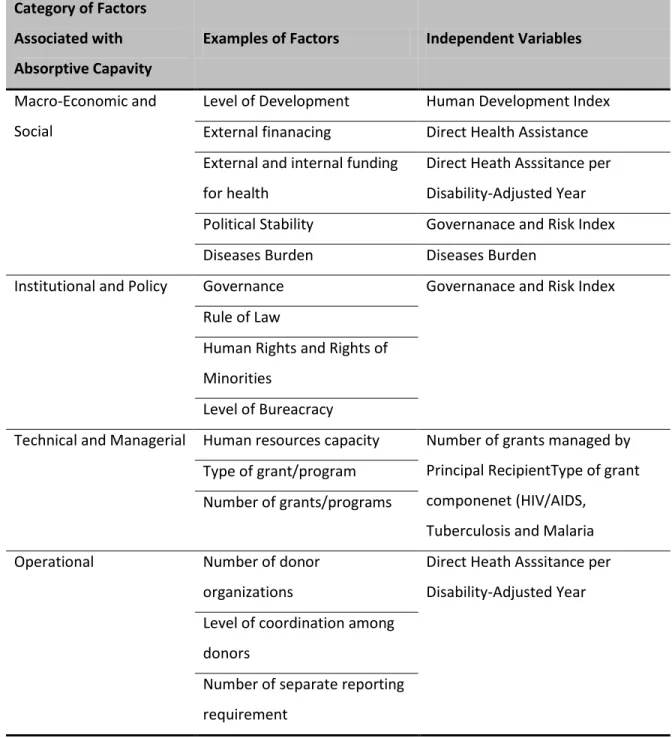
Table 2.6. Factors Associated with Absorptive Capacity as per Literature Review …..……….………..42
Table 2.7. Factors Associated with Absorptive Capacity and Selection of Independent Variables ………...46
Table 3.1. Study’s Hypothesis and Outcomes of Interests ..……….……….………….51
Table 3.2.Variables: Definitions and Formulas ….……….………..………...63
Table 3.3. Key Measurements for Dependent Variable (Absorptive Capacity) ……….…..….…67
Table 3.4. Membership Values Adopted for Outcomes of Interest ……….………...…69
Table 3.5. Key Measurements for Governance and Risk (Independent Variable) ..………...….70
Table 3.6. Membership Values Adopted for Governance and Risk (Independent Variable) ……….……70
Table 3.7. Key Measurements for Development and Disease Burden (Independent Variable) ………...71
Table 3.8. Membership Values Adopted for Development and Disease Burden (Independent Variable) ………..………...71
Table 3.9. Key Measurements for DAH per DALY (Independent Variable) ………..…….72
Table 3.10. Membership Values Adopted for DAH per DALY (Independent Variable) ……….…....72
Table 3.11. Key Measurements for Number of Grants Managed by Principal Recipient (Independent Variable) ………..……….…..73
Table 3.12. Membership Values Adopted for Number of Grants Managed by Principal Recipient (Independent Variable) ………..73
Table 4.2. Notation used of fQCA Results ………...84
Table 4.3. Phase 1 Combinations .………..………....85
Table 4.4. Phase 2 Combinations .………..……….……..89
Table 5.1. Lewin’s 3-stage Change Model..………...102
Table 5.2. Alligment of Kotter’s and Lewin’s Change Models ………..……….…...103
Table 5.3. Recommendations and Actions proposed in the Plan for Change ………..…107
Table 5.4 Key Activities Planned to Ensure Communication of New Risk Framework .……….109
Table 5.5 Key Activities Planned to Promote Frequent Assessment of Bottlenecks associated with Absorptiv Capacaity .………...110
Table 5.6. Key Activities Planned to Develop Joint Tailored Approach ……….………...111
Table 5.7 Key Activities Planned to Map Out Best Practices Associated with High Absorptive Capacity ………..……..……….…….113
Table 5.8. Key Activities Planned to Promote Frequent Assessment of High Absorptive Capacity ………114
Table 5.9 Key Activities Planned to Explore Combinations to Overcome ‘Risk Factors’ .……….……….115
Table 5.10 Key Activities Planned to Promote Exchange of Experience among Global Fund Implementers ………..…...116
Table 5.11 Key Activities Planned to Build and Foster Partnerships .………..…119
Table 5.12 Key Activities Planned to Support the Development of CCMs ………..……..…120
LIST OF FIGURES
CHAPTER 1: INTRODUCTION
The history of development has been defined by the transfer of resources from developed countries and multilateral organizations to developing countries with the noble objective of reducing poverty, expanding infrastructure, improving health, education and social systems and fostering social justice. It is estimated that over $ 2.2 trillion has been invested in development since 1960 (Organization for Economic Co-operation and Development).
Despite important and undeniable achievements, there is a growing criticism of the impact and success rates of development aid. More and more authors and critics point out disappointing results and argue that the failures of development aid outweigh its successes. There is a group of researchers and authors that continue to defend the success of aid and advocate for its increase. As a result, a contentious debate is now taking place: one side argues that only a massive increase in funding would be able push developing countries out of poverty while the other side argues that additional funding not only will not bring significant improvement but might even have detrimental effects to the economies and development of countries.
absorptive capacity issues? How can we better evaluate the impact of aid? How can we ensure that aid contributions are reaching people who need it most?
The international community’s commitment to reduce poverty and achieve the Millennium Development Goals (MDGs), combined with the increasing and persistent burden of diseases in the developing world, have put Global Health at the forefront of the international policy agenda. The aid allocation for health has dramatically increased in the last decade and many new organizations are providing additional funding for health. Recipient countries have also made commitments to increase their state budget allocation for health. This represents a great opportunity and a major challenge for all stakeholders involved in Global Health.
It is clear that resources alone will not lead to better results unless the challenges faced by aid effectiveness in general and by internationally funded health programs in particular are
addressed. Despite recent improvements in access to health care services resulting from global programs, recent experience in scaling-up programs revealed many bottlenecks that hindered the effectiveness of these efforts.
Since 2000, the emergence of new partnerships has changed the landscape of international public health methods by which donors provide assistance. These partnerships provide funding to combat a small number of diseases that disproportionally affect low and middle income countries. More importantly, these new partnerships represent a concerted response from the international community that has leveraged additional funding and technical resources.
From the 1990s until 2009, funding for the fight against HIV/AIDS dramatically increased. In 2008, an estimated $15.6 billion was spent on HIV/AIDS compared to $300 million in 1996. In 2007 alone, the Global Fund and GAVI Alliance donated USD 2.16 billion and The U.S. President's
contribute more than two-thirds of all external funding to fight HIV/AIDS and Malaria in developing countries.
The Global Fund to Fight AIDS, Tuberculosis and Malaria (referred to hereafter as The Global Fund) was created in 2002 as a public-private partnership that would attract and disburse additional resources to prevent and treat HIV/AIDs, Tuberculosis and Malaria. This partnership between governments, civil society, the private sector and affected communities represents a new approach to international health financing. It has since become the main source of finance for programs to fight AIDS, Tuberculosis and Malaria, with approved funding of US$ 19.3 billion for more than 572 programs in 144 countries. It provides a quarter of all international financing for AIDS globally, two-thirds for Tuberculosis and three quarters for Malaria.
The creation of the Global Fund sparked considerable debate regarding the capacity of developing countries to spend substantial additional resources for health effectively. This debate has not subsided with the rapid growth of the Global Fund. On the contrary, the creation of new partnerships and global health initiatives has continued to fuel this debate. The recent findings of corruption and misuse of funding have contributed to the doubts about the efficiency of this model.
This study aims at contributing to the current debate by studying the factors associated with absorptive capacity. The literature review explores the definitions of the absorptive capacity and the main factors associated with high and low absorptive capacity. Based on the literature review, this study hypothesizes that the absorptive capacity for Global Fund grants (dependent variable) is influenced by the level of governance, the overall level of funding for health, the level of development, type of implementer, disease component of the grant (HIV/AIDS, Tuberculosis or Malaria), number of grants managed by implementer, round of funding and the development and burden of disease in the recipient country (independent variables).
This study uses a novel analytic method—qualitative comparative analysis—to analyze if, and to what degree, the absorptive capacity for Global Fund grants are influenced by the
independent variables. The method analyzes how the independent variables contribute, individually and in combination, to the outcome of high and low absorptive capacity.
CHAPTER 2: LITERATURE REVIEW
Chapter II provides an overview of the literature review. It is organized into seven major sections. The first section focuses on the concept of development and how it evolved over time. It explores the different discourses, theories and applications of development aid from the 1950s to the present. The second section focuses on the current debate around the barriers to the effective utilization of aid, common bottlenecks faced by countries and the degree of impact that results from increasing aid to health. The third section focuses on the concept of absorptive capacity and how it figures in the current debate as a central argument.
The fourth section explores the link between development and public health in the context of globalization. It focuses on the emergence of the Global Fund and its institutional design. The fifth section explores the concept of Performance-Based Funding (PBF) and how it is applied as a
decision-making tool for funding for Global Fund grants. The sixth section provides an overview of the changes and challenges faced by the Global Fund over the last decade and how it affected its operational model and application of PBF
The last section explores the links between factors associated with absorptive capacity identified in the Literature Review and elements of the Global Fund grants. It depicts the process applied to select the dependent and indepent variables for this study.
THE CONCEPT AND HISTORY OF DEVELOPMENT
ideas associated with progress, well-being, social justice, human rights and economic growth, the definition of development has been modified and colored with different political and ideological theories. This study adopts the definition crafted by Rist (1997) in an attempt to remove political and ideological views: “Development consists of a set of practices, sometimes appearing in conflict with one another, which require—for the reproduction of society—the general transformation and destruction of the natural environment and of social relations. Its aim is to increase the production of commodities (goods and services) geared, by way of exchange, to effective demand” (Rist, 1997, p.13).
The definition of development aid or development cooperation is much less controversial and it can be easily defined as aid (monetary transfer and in-kind) given by governments and agencies to support the economic, environmental, social and political development of a society. It is distinguished from humanitarian aid by focusing on alleviating poverty in the long term, rather than a short term response to an emergency situation caused by war, internal conflict or natural disaster. The term development cooperation is also widely used by multilateral organizations to express the idea that a partnership should exist between donor and recipient. Most development aid comes from the Western industrialized countries but some poorer countries also contribute aid to neighboring countries. Aid may be bilateral or multilateral. Bilateral aid is given from one country directly to another while multilateral aid is given by the donor country to an international
organization such as the World Bank or the United Nations Agencies which then distributes it among the developing countries.
Although always present in the history of humankind, the modern concept of development dates to the colonial era, when philanthropic and humanitarian ideals were marshaled to support invasions, exploitations and colonization. However, the origin of development as we now know it dates from the end of World War I, when the Covenant of the League of Nations created the first permanent international political institution with the objective of promoting development.
The end of World War II marks a pivotal moment in the history of international development. Many authors point to the Bretton Woods conference as the birth of modern development. During the first three weeks of July in 1947, 700 delegates from 44 countries met to discuss a new framework for a global system of financial and monetary management (Moyo, 2010). It is from these discussions that a plan to rebuild post war Europe emerged and defined the future of development. It was also during the Bretton Woods conference that the foundations of three key world institutions were laid: The International Bank for Reconstruction and Development (World Bank), The International Monetary Fund (IMF) and The International Trade Organization.
In June 1947, George C. Marshall, the U.S.’s foreign minister at the time, proposed a bold plan to reconstruct Europe. The U.S. offered $20 billion (equivalent to over $100 billion today) in what was eventually known as the Marshall Plan. The plan was later formalized by President Truman in the Act for International Development (1950).
The Marshall Plan is considered a success. The large amounts of funding, coordinated by key institutions, succeeded in restoring infrastructure and bringing political and economic stability. It soon became the standard emulated in many parts of the world. The success of the Marshall Plan is evidence that financial capital and investment are critical for economic growth (Rist 1997; Moyo, 2010).
works of the English economist John Maynard Keynes and agree with the assumption that poor economic performance reflects a lack of aggregate demand of resources. Keynesian theory postulates that un unregulated capitalist economy is susceptible to depression and that
government spending on welfare works as a safety net to save economies from collapsing due to unpredictable market forces. His theory subverted the neoclassical theories and developed a twofold strategy for active government intervention: (1) macro-management of economy to ensure growth, and; (2) implementation of a range of social policies to ensure that the fruits of economic growth can reach the entire population.
An economist working in development, inspired by Keynes, would consider capital
accumulation as the motor of economic growth and the assistance during this period took the form of large infrastructure projects (roads, dams, ports etc). In the 1960s, however, the dissatisfaction with development strategy grew as there were few signs of trickle down effects coming from
modern technology. Large infrastructure projects did not yield the expected results as they were not adaptable to local cultures and there were no local maintenance and management capacities. As a result, knowledge and skill transfer were also recognized as growth engines and development programs started to include social infrastructure (schools and universities) and technical assistance (Cypher and Deitz, 1997).
In the early-1980s, a severe world wide debt crisis pushed countries to increase foreign aid and debt relief. Inspired by the success of the ‘Asian Tigers’ countries, the IMF and WB launched the economic restructuring programs that targeted developing countries. These programs aimed at reducing inflation, correcting government deficits and removing trade barriers. As a result of this strategy, the dominant paradigm was top-down planning. The structural adjustments and stabilization policies did not yield the expected results and by the early 1990s, the field started recognizing the need for sound institutions, good governance and democratic accountability as keys for positive aid results (Pitman and al 2005).
The discourse of development is greatly influenced by economic political ideology. As one can note from the difference in aid strategy from the 1960s and 1970s to the1980s, the Keynesian school was challenged by the Chicago school, founded by Milton Friedman. This shift towards neoliberalism was anchored in the assumption that the scope of government should be limited and its functions should be restricted to preserve law and order, to enforce private contracts and to foster competitive markets (Ellerman 2005)
The critiques of0 the neoliberalism approach to development grew louder and louder in the 1990s, influencing a shift to greater development aid and more integration of recipient countries in the planning and implementation process. Additionally, the flourishing of civil society and new large public-private partnerships brought new actors, and more funding, to the field of development (Dichter 2003).
countries and over time. This understanding translates into both a call for additional aid and a call for additional selectivity in allocating aid as both sides of the debate apply different combinations of factors in recipient countries to advocate for an increase of aid and stricter rules for aid transfer.
CURRENT DEBATE ON AID
After 60 years, development continues to be a part of today’s agenda. Governments
continue to set bilateral agencies to channel funding and in-kind, multilateral organizations continue to grow as new actors join the field. After more than 60 years, we are still confronted with shocking poverty, dismal inequality in access to health and education, and a lack of basic infrastructure in many parts of the world. It is understandable that so many scholars are pondering the question “Where did all the aid go?” A fair question considering it is estimated that from 1960 to the present, over $ 2.2 trillion of official development aid has been transferred to developing countries (Easterly, 1997). Over $ 1 trillion was transferred to Africa alone (Hebert, 2004; Erixon, 2005) and some African countries are poorer today than they were fifty years ago (Moyo, 201).
Since the 1960s, the volume of aid has increased in real terms, excluding a period of decline in 1990s, and the plan is to reach a massive increase by 2015. Jeffrey Sachs, professor at Columbia University and chief advisor of the United Nations Millennium Development Project called for a ‘Big Push’ doubling the amount of aid immediately (in 2005) and then doubling it again by 2015, in order for countries to meet the MDGs. The view that countries need a massive increase in aid to escape poverty is supported by many multilateral agencies, Governments and influential pop culture personalities like singer Bono, Brad Pitt, Angelina Jolie and Penelope Cruz to name a few.
Onchocerciasis Control Program (both WHO led initiatives). Severe and moderate malnutrition has been greatly reduced in parts of Africa and there is no doubt that development assistance can play a significant role in improving water, sanitation, school enrolment and child mortality rates.
Some countries are hailed as proof that development aid can lift countries out of poverty. There are many articles on the development successes of Korea, Taiwan, Uganda, Tanzania and Vietnam (World Bank 1998, Devarajan et al. 2001, Bourguignon and Leipziger, 2006).
Despite the success cases, there are a growing number of authors that focus on aid ineffectiveness. They examine the reasons for ‘disappointing’ results and question the way aid is distributed and managed. Aid ineffectiveness can be defined as the low performance of aid in promoting economic growth, reducing poverty and improving health and education systems. The debate on aid ineffectiveness has been going on for decades and has generated a vast and many times controversial body of literature. The literature review showed many attempts to understand the reasons for the apparent lack of results in foreign aid assistance. Overall, the explanations can be divided in three categories: shortcomings of recipient country, shortcomings of donor agencies and shortcomings of the way aid is managed and delivered (shortcoming of agencies and
organization that deliver aid).
The first explanation holds that issues like corruption, bad governance, political instability and weak institutions often explain the low performance of aid (World Bank 1998, Lancaster 1999, Easterly 2006 b). The literature in this first category is by far the largest and it examines in detail the characteristics of the recipient countries that are associated with successes and failures related to aid.
budget deficit of 7 per cent of GDP between 1970 and 1997 in spite of 22 adjustment loans throughout this period.
A number of empirical studies have supported the argument that causes of aid
ineffectiveness lie in the country. In 1996, Boone published a controversial paper that showed the majority of aid was used for wasteful public consumption instead of financing investment and growth, regardless of political regime. Subsequently, Burnside and Dollar (2000) expanded on Boone’s paper and found that aid has a positive impact on growth in a good policy environment (good fiscal, monetary and trade policies). This was the beginning of numerous contradictions in the empirical literature on aid performance. Collier and Dollar (2002), using a broader measure of policy environment (World Bank’s Country Policy and Institutional Assessment) and a larger sample of countries, confirmed Burnside and Dollar’s results. Svensson (1999) showed that foreign aid positively affects long-run growth in democratic countries.
These studies fall in the camp that defend the idea that aid does spur economic growth but only under specific conditions (Burnside and Dollar 2000; Hansen and Tarp 2000, 2001; Collier and Dollar 2002; Clemens et al. 2004; Moreira 2005).
clear that there are numerous factors in the aid delivery network with multifaceted interactions and relationships among them.
Another important approach to improving the absorptive capacity of health areas is adopted by Mooney and Houston (2004). They incorporate the concept of ‘capacity to benefit’ to understand the potential for absorption at the recipient level. The ‘capacity to benefit’ is defined as the extent to which heath areas can take full advantage of resources allocated to them. This concept is linked to what the authors define as ‘Management Economic Social and Human (MESH) Infrastructure’. The authors explain that health service jurisdictions differ in terms of their capacities to produce results for three main reasons: (i) the health level of the population, (ii) the type of typical health problems; and (iii) the capacity of local health system. In situations where both the health levels and the health problems are similar, one health service may be better placed or better equipped to benefit its population than the other. In this case, the capacity to benefit is inhibited because it lacks the necessary MESH infrastructure to deliver health benefits to its population. This approach differs from traditional approach that measures the health needs and focuses on the benefits sought in allocating resources.
The second, and much smaller, category of explanations found in the literature emphasizes issues related to the donors’ side. This category includes studies that point out these donor
countries strategic interests and the aid allocation criteria used by aid agencies are often not what it is necessary for the development of a recipient country. This seems to be more prominent in
Ostrom et al (2001) points out that the holding this many actors accountable for the results is the main reason for aid ineffectiveness. For instance, the richest countries in the world (such as the U.S., France, Germany, United Kingdom and Japan) with the largest decision-making power in international organizations are also the ones influencing and formulating aid policies. They also have influence over the selection of recipient countries (Clements 2005) and in the design and
implementation of projects (Tendler 1975; Dichter 2003). For instance, Lancaster (1999) depicts the appearance of ‘donor-driven’ countries and links it to the weakness of national institutions. The former President of Nigeria, Mr. Olusegun Obasanjo made a declaration that illustrates this point well: “In education and in industrialization, we have used borrowed ideas, utilized borrowed experiences and funds and engaged borrowed hands. In our development programmes and strategies, not much, if anything, is ours.” (Lancaster 1999).
The third set of explanations, also related to the donors’ side of the equation, postulates that international institutions involved in providing aid and implementing development programs are also a source of aid ineffectiveness. For example, part of the problem of aid ineffectiveness can be due to the fact that the largest part of aid transferred may not reach the beneficiaries. Cudjoe (2006) estimates that out of every dollar given to Africa, 16% goes into consultant fees, 26% in emergency aid and relief and 14% in debt servicing, leaving less than 50% for program
implementation.
A potential cause for aid ineffectiveness from the donor side is the ‘Money-Moving
principal-agent theory and explores the institutional incentives that affect the characteristics of an optimal and efficient contract.
The explanations and insight found in the literature review point to a complex phenomenon where different factors are influencing the effectiveness of aid. Apart from ocassional success stories, the overall impact of aid on macroeconomic variables evidenced in the literature remains weak and ambiguous (Gibson et al. 2005; Bourguignon and Sundberg 2007). Mosley (1986) calls the co-existence of ambiguous macro-economic outcomes with successful projects the “micro-macro” paradox.
Doucouliagos and Paldam (2005) report that until 01 January 2005, the aid effectiveness literature consisted of 97 studies, using one of the three aforementioned approaches. The authors applied meta-analysis techniques and found that despite a great variation in the findings,
aggregated results showed that the average effect of aid is positive, but small and statistically non significant.
Aid has also been negatively associated with growth in developing countries; however, this association does not prove that aid caused the decrease in growth. Easterly (2003) points out that in many cases aid has not been able to halt the deterioration of growth or that success could occur without foreign assistance.
a much stronger impact than aid as a whole. This result does not depend on levels of income, strength of institutions or quality of its policies.
Despite controversial results in aid literature, there are clear indications that aid has diminishing returns. Most studies reviewed in the literature point out that an ‘aid saturation point’ could be reached anywhere between 15% to 45% of Gross Domestic Product (GDP), beyond which the benefits of additional aid inflows become negative (De Rezio 2005). This finding poses important questions to the development community as a bigger and faster increase in funding could
potentially lead to faster diminishing returns.
What are the possible factors that cause the diminishing return? A small but growing literature identifies absorptive capacity as the main obstacle and key factor responsible for limited aid effectiveness and decline in marginal returns.
THE CONCEPT OF ABSORPTIVE CAPACITY
The concept of absorptive capacity is receiving increasing attention in the past few years. The on-going debate on a potential increase in aid and the bottlenecks to the scaling up of development and health programs have brought the concept of absorptive capacity to the center stage of several theories and arguments.
Despite its aura of novelty, the concept of absorptive capacity in development has been used for over 50 years. The literature review traces the origin of this concept to a proposal made by Millikan and Rostow in 1957 to allocate aid according to the absorptive capacity of the recipient country. Rosenstein-Rodan presented in 1961 a very comprehensive use of the concept to measure the capital needs in a country.
contradictory that these authors were referring to absorptive capacity while advocating for the ‘Big Push’. However, as pointed out by Guillaumont and Jeanneney (2007), both concepts rely on the idea that low income countries face structural obstacles for growth, which are reflected in the absorptive capacity, and increasing aid is a way to overcome this. It is, however, important to put this discussion in a historical context. The concept of absorptive capacity was used 50 years ago as a way to mobilize aid rather than criteria to limit aid, as it is discussed presently.
Nevertheless, absorptive capacity remains an ambiguous concept that is applied by different schools in the development community and it continues to be used to advocate for both more and less funding for aid.
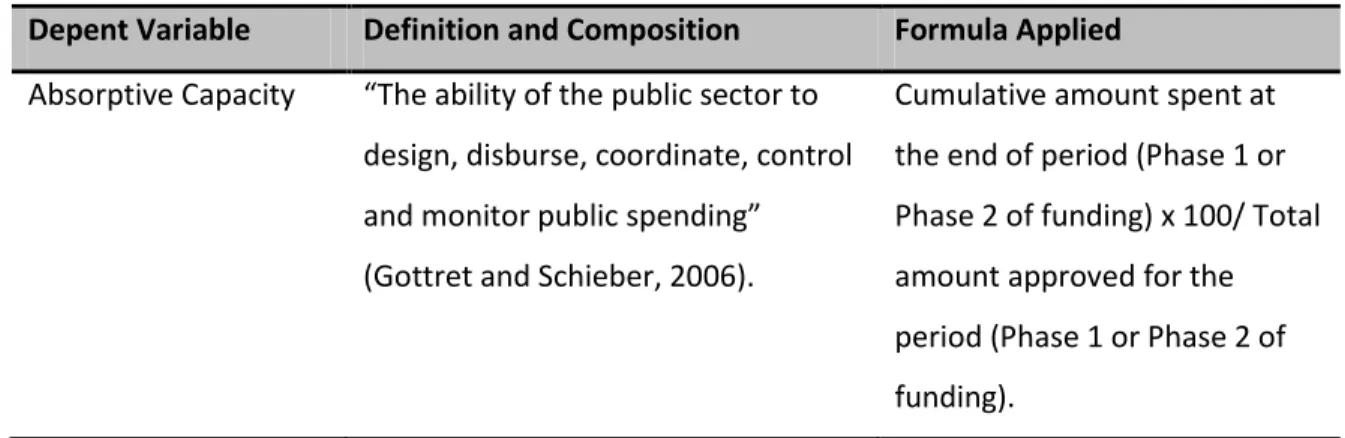
Gottret and Schieber (2006) discuss absorptive capacity in relation to whether countries are able to spend effectively those new resources for health made available by donors. However, the authors point out that absorptive capacity is not exclusively a problem of donor aid but also affects domestic expenditure. Absorptive capacity is defined as follows: “Absorptive capacity includes the ability of the public sector to design, disburse, coordinate, control, and monitor public spending. This coordination is both vertical (between central and local governments) and horizontal (between line ministries at any given level). The question is whether governments or even institutions such as health ministries have the capacity to manage a large increase in real expenditures beyond a usual trend” (Gottret and Schieber 2006, p. 239).
Absorptive Capacity is now mostly being considered in heath areas to express concerns that massive increases in funding will not lead to improved results in health indicators. Clements and Redelet (2003) observe that both large amounts of funds and demand for quick results can create bottlenecks by placing increased demands on weak systems. Bhagwati (2005) goes even further and warns that a significant increase in aid can become problematic as countries will spent it
These concerns contrast greatly with the international efforts and advocacy campaigns to mobilize funding to meet the MDGs. However, quick and substantial increase in aid funding does not necessarily mean that funds will be wasted or misused. Some authors suggest that countries in a post-conflict phase are more able to utilise large amount of funds effectively (Clemens and Radelet 2003, Mackinnon et al. 2003).
The findings of the literature review on absorptive capacity can be summarized in four main categories of constraints:
- Macroeconomic - Institutional and Policy - Technical and Managerial - Donors’ Practices
Macroeconomic Constraints
A large and sudden increase in aid inflows in the form of foreign currency provokes a ‘Dutch Disease’ effect, causing an appreciation of the exchange rate and therefore harming the export sector. When aid flows in the form of loans, it can raise concerns about debt sustainability. Aid flows can also be unpredictable and volatile, which can negatively influence the macro-economic stability by causing inflation and interest-rate and exchange-rate volatility. This is often the case when aid comes in the form of budget support. Additionally, aid increases can cause labour market pressure for skilled workers.
theorem to postulate that there cannot be a ‘Big Push’ without real appreciation: if aid succeeds to support a big push, it should make the real value of the currency appreciate.
Institutional and Policy Constraints
Recent research has confirmed the importance of strong institutions for development. The capacity to generate sound policies, the transparency and efficiency of budget systems, and the degree of decentralization are some key institutional issues that can have an impact on absorption capacity. In many countries, the existing systems cannot absorb large increases of resources without increasing waste and fuelling corruption (De Rezio, 2005). High dependency on aid, in turn, can have negative incentives for reforms and a negative impact on accountability.
Technical and Managerial Constraints
Lack of qualified human resources remains a serious problem in many developing countries with serious consequences for the health sector. In some countries this is compounded by the effects of the HIV/AIDS pandemic. Moreover, the lack of adequate infrastructure and equipment prevents access to goods and services.
Although an increase in aid can address some of these constraints, like hiring additional staff and providing training, the lack of qualified human resources in key technical and managerial areas of the sector is a significant challenge for the efficient implementation and scale up of health projects (De Rezio 2005).
Constraints generated by donor practices
towards sector and general supports are trying to address this issue but the results so far are not clear. (De Rezio 2005).
Finally, the lack of certainty and predictability of aid flows can seriously hamper a
government’s efforts to plan and implement programs. The Paris Declaration on Aid Effectiveness (2005) aims at improving donor coordination and predictability of funding to recipient countries by the harmonization and alignment of donors practices, requirements and performance indicators.
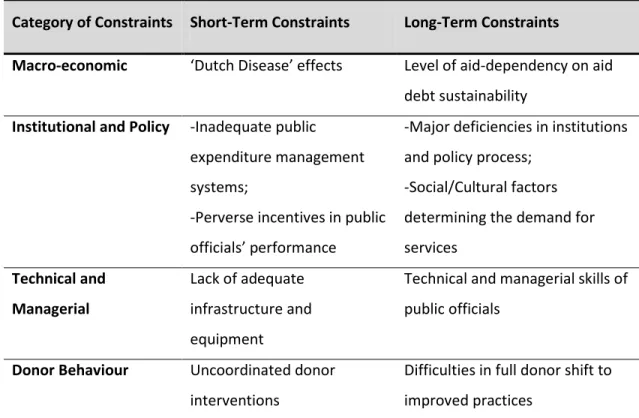
Absorptive capacity constraints can take many forms and have different impacts on the short and long-term. The table below, adapted from De Renzio 2005, depicts its main constraints.
Table 2.1 Absorptive Capacity Constraints
Category of Constraints Short-Term Constraints Long-Term Constraints
Macro-economic ‘Dutch Disease’ effects Level of aid-dependency on aid debt sustainability
Institutional and Policy -Inadequate public expenditure management systems;
-Perverse incentives in public officials’ performance
-Major deficiencies in institutions and policy process;
-Social/Cultural factors determining the demand for services
Technical and
Managerial
Lack of adequate infrastructure and equipment
Technical and managerial skills of public officials
Donor Behaviour Uncoordinated donor
interventions
Difficulties in full donor shift to improved practices
Diarra (2010) combines the constraints at recipient and donor sides and examines absorptive capacity from a ‘pipeline approach’. The aid pipeline represents the amount of aid pledged by donors but not yet disbursed. This waiting stock can be cancelled or postponed
the pipeline level is influenced by the magnitude of bottlenecks and constraints. Also, it can provide a good indication of the recipient country’s capacity to manage and report on aid programs.
The limited literature on disbursement delays shows conflicting results. Some authors (Svensson, 2000, 2006; Kanbur 2000) state that there are inadequate quick disbursements because donors are caught in moral dilemmas or because donors fall victim to the ‘Money-Moving
Syndrome’. Both are classic problems of agency theory where the existence of many principals and the asymmetric information contribute to large and inefficient disbursements. (Easterly 2000, Leandro et al. 1999, Hagen 2006, Pedersen 2001).
Other authors (Odedokun 2003; Leurs 2005; Deutscher and Fyson 2008; Celasun and WAlliser 2008; OECD-DAC 2008; Bulir Hamman 2006, Bluir Lane 2002 and Roodman, 2006) affirm that the slow rhythm and long delays in aid disbursement are negatively impacting the recipient countries.
Despite being used by both sides of the debate, the issue of absorptive capacity is not receiving concerted attention. The UN Millennium Project simply states that “scaling up needs to be carefully planned and overseen to ensure successful and sustainable implementation” (2005: 31). The Commission for Africa also underplays the importance of absorptive capacity as it argues that it is not a stringent obstacle to delivering development benefits, provided that there are (a) continuing policy and governance improvements within Africa, (b) better allocation of aid resources, and (c) better quality of assistance.
The rich literature on absorptive capacity shows that it is a key concept essential in
PUBLIC HEALTH ON A GLOBALIZED WORLD
Public Health is a field of political struggle, historically cantered on the tensions between individual liberties and government’s rights and obligations to protect the health of the community (Turnock, 2008). When there is an occurrence of a disease, Public Health address three fundamental issues: First, whose problem is it? Second, how should the problems be brought under control? And, whose responsibility is it to do so? Szlezák (2008) observes that while addressing these issues, the disease is circumscribed and the boundary is created between those affected by the disease and those who are not. This boundary, however, is created as a result of the discourses of Public Health officials and has significantly changed over time.
The second half of the 20th century brought rapid development to the field of Public Health and many changes to the way diseases are understood and perceived (Rosen, 1993). In general, the literature agrees that the representations of health and diseases changed in four major ways. First, the biomedical view was increasingly challenged and the concepts of diseases and health expanded to include cross-cutting economic, social, behavioural and political issues.
Second, there was a shift in the way health and diseases are distributed in the world. The concept of epidemiological transition shows that with rising standards of living, developing countries will no longer be seriously affected by infectious disease but will face increasing rates of non- communicable diseases.
Commission on Macroeconomics and Health, which was responsible for producing research and studies on this new perspective.
Fourth, the relationship between health and state has also recently transformed as health and diseases are understood to be transnational. The rapid spread of infectious diseases, like HIV/AIDS, bird flu, Sever Acute Respiratory Syndrome (SARS) etc, collectively confirmed that the transmission of diseases does not stop at country borders.
The changes in the health and disease concepts were accompanied by changes in the Public Health landscape. The field that was until then dominated by state and the World Health
Organization (WHO) increased to include the participation of multiple actors, including non-governmental organizations, private-public partnership, community-based organizations and new multidisciplinary initiatives (Widdus, 2001). Reinicke (1997) captures the essence of these changes by stating that health became a global public good.
This shift towards partnership marks the underlying reassignment of responsibilities away from nation state onto multiple actors (Buse and Walt, 2000a, 2000b). Szlezák (2008) explains that if disease is no longer a simple biomedical issue but rather a matter of economics, politics, society and culture, and now has the potential to affect the entire globe, then governments and multilateral organizations can no longer be the only ones to provide solutions.
The launch of The Global Fund to Fight AIDS, Tuberculosis and Malaria (hereafter referred as The Global Fund) marked an important moment in the history of global health, not only for the enormous increase in funding for the three diseases but also for its innovative institutional design. The emergence of The Global Fund is the result of intense political struggles over the responsibility for the provision of antiretroviral therapy (ARVs) for patients in developing countries. It reflects the shift in the focus of responsibility away from state and multilateral organization towards
it was after being launched that Tuberculosis and Malaria were integrated as part of the mission (Macro International Inc., 2008).
Despite the alarming increase in number of people living with HIV and AIDS in the 1990s, and the certainty that many countries would be severely affected by the disease, the provision of ARVs for developing countries was not considered feasible for three main reasons. First, the ARVs were very expensive, reaching more than USD 10,000 per year per patient (Gellman, 2000d) and they were not considered to be as cost-efficient as prevention campaigns. Second, the international donors believed that the provision of ARVs in developing countries was technically not possible as it required sophisticated machinery in health care facilities, highly trained doctors, and patients able to follow complicated drug intake schedules (Gellman, 2000d). Lastly, many governments continued to deny the existence of HIV and the presence of AIDS in their countries, which would impede any program implementation.
The discovery of triple therapy in 1995-1996 brought new hopes that it would be possible to control the disease, that it may no longer be viewed as a ‘death sentence’. This contributed to the further widening of the gap between patients in the developed and developing world, making it more difficult for donors to legitimize on-going HIV/AIDS prevention campaigns but no treatment. “Access to Treatment” became the new motto to many NGOs and activists and soon their attention turned to the pharmaceutical industry and the high prices of ARVs treatment (Macro International Inc., 2009 a)
by President Clinton, a price reduction of 85% to 90% of ARV drugs for the developing world was announced (Szlezák, 2008). This is known as the Accelerating Access Initiative.
The drop in prices of ARV treatment and the rising global concerns with HIV/AIDS brought the question of providing ARVs drugs to the developing world back to the discussion. However, donors continue to have concerns that the lack of personnel and technology needed to roll out an AIDS treatment would make the endeavour impossible. Additionally, donors were also concerned that the low level of education would prevent patients from correctly following treatment
instructions.
In an attempt to counter these arguments, some NGOs and academic professors started running ARV treatment in Cape Town shanty towns (Levy, Miksad et al. 2005) and in rural Haiti (Farmer, L. et al. 2001a, 2001b; Behforouz, Farmer et al. 2004). Paul Farmer, as the head of Partners in Health, demonstrated that administrating and adherence to the triple therapy could be achieved by training local lay people to accompany patients and supervise the intake of ARV drugs. They also succeed in showing that ‘low-tech’ parameters could be used in place of sophisticated machines to monitor treatment success (Koening, Leandre et al 2004).
In a G-8 summit in Genoa, it was decided that The Global Fund would be created as a public-private partnership. A Transitional Working Group (TWG) was charged with the operationalization of the Global Fund (Copson and Salaam 2005) and in March 2002, the first round of funding was announced (Ramsay 2002).
The creation of the Global Fund introduced innovations that increased expectations that a donor organization could be faster, more transparent and less bureaucratic. The founding principles reflected the urgency of the mission and hopes for effective management of grants.
Table 2.2 The Founding Principles of the Global Fund
Founding Principles of the Global
Fund Operationalization of Principles
I. Operateas a financial instrument, not an implementing entity
The Global Fund's purpose is to attract, manage and
disburse resources to fight AIDS, TB and Malaria. It does not implement programs directly, relying instead on a broad network of partnerships with other development
organizations on the ground to supply local knowledge and technical assistance where required.
II. Make available and leverage
additional financial resources
The Global Fund is charged with raising large sums of money which neither replace nor reduce other resources to fight AIDS, TB and Malaria. It addresses gaps in country efforts to fight the three diseases and strengthen underlying health systems by financing programs that complement those of other donors, and seeks to use its own grants to stimulate further investment by both donors and recipients.
III. Support programs that evolve
from national plans and priorities
requirement that all areas of society with a stake in public health be involved in the development process, including civil society and private sector, ensures strong and comprehensive programs.
IV. Operate in a balanced manner in
terms of different regions, diseases
and interventions
The Global Fund gives priority to financing programs from countries with low income and high disease burden, though it will also consider programs from countries in the higher World Bank income brackets. While it finances the fight against AIDS, TB and Malaria worldwide, the Global Fund's demand-driven approach ensures that the money is going where it is most needed.
V. Pursue an integrated and balanced
approach to prevention and
treatment.
The Global Fund takes a comprehensive approach to AIDS, TB and Malaria, funding both prevention and treatment based on locally determined needs.
VI. Evaluate proposals through
independent review processes.
The Global Fund's use of an independent Technical Review Panel ensures that limited resources are invested in technically sound programs with the greatest chances of success. The panel includes disease experts, as well as experts in the field of development who are able to assess how proposed programs complement ongoing health and poverty reduction efforts at the country level
VII. Operate with transparency and
accountability.
The Global Fund holds its recipients accountable to strict standards that require programs to reach specific targets throughout the life of the grant. The public can track the progress of all grants via this website, which also publishes independent evaluations of the organization’s own
The significant amount of funding created expectations that a measurable impact in the fight against the three diseases would be attained in a short time. Additionally, there was strong political commitment to increase the participation of NGOs and the private sector and to address gender inequalities in access to treatment of the three diseases.
The design of The Global Fund was formulated to catalyse additional funding and disburse it more rapidly and effectively than existing organizations (Brugha and Walt 2001). During the
consultation process led by the TWG with representatives from 38 countries (developed and developing) and organizations, it was decided that the organization should be vertical and it should focuses on the three biggest fatal infectious diseases in the developing world: HIV/AIDS,
Tuberculosis and Malaria.
It was also decided that priority should be given to countries with the greatest diseases burden (The Global Fund 2002a). The institutional framework then detailed a combination of economic, epidemiological and political criteria for eligibility. The Global Fund envisions a new way of conducting development aid (Richards 2001) and it broke away from ‘business as usual’ by rearranging the relationships between actors in the field: states, multilateral organizations, donors and recipient countries and civil society (Mallipeddi 2007). Therefore, its governance model aims at crafting an organization that can respond efficiently to countries needs and produces observable results that satisfy donors (Poku 2002).
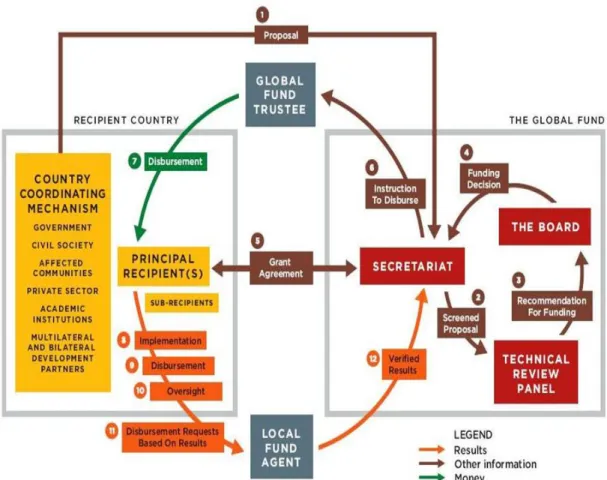
Figure 2.1. The Global Fund Core Structure1
1
The innovations of The Global Fund’s institutional design are based on 4 main pillars. The first pillar is Science. It emphasizes that scientific approaches and expertise are central to effective public health actions. The Technical Review Panel embodies this pillar as they are responsible for evaluating all funding proposals received on their technical merits.
The second pillar of innovation is based on local ownership. In contrast to other large donors and multilateral organizations, all grants are locally initiated, designed and implemented. As an institution, the Global Fund does not dictate scope of projects, key interventions or how grants should be implemented. All decisions are agreed in country.
A third pillar in the institutional design is The Country Coordinating Mechanism (CCM), which is an obligatory stakeholder that serves to ensure that multiple local actors, including civil society and organizations representing patients, actively take part in the design of the proposal and the oversight of grant implementation. The operational guidelines stipulate that the CCM must be composed of no more than 50 per cent of its members from the Government. There are 6 minimum requirements that the CCM must adopt in order to be eligible for funding.
The CCM is a fundamental piece of The Global Fund architecture as it is also responsible for nominating the Principal Recipient (PR), the organization or government institution that is
responsible for the implementation of the grants. The CCM embodies both local ownership and participatory decision-making, both key values of the organization.
The forth pillar of the institutional design is the Technical Review Panel (TRP), an independent body responsible for the technical review of proposals received from CCMs and resource allocation procedures. The TRP is made up of 26 health and development specialists appointed by the Global Fund’s board.
can only approve or reject categories of proposal, not individual proposals. This is a mechanism to ensure that technical merit is the only criteria for approval and to ‘depoliticizing’ the funding decisions. The fact that Iran, North Korea and Myanmar are recipients of Global Fund grants show that The Global Fund have succeeded in keeping politics out of funding decisions.
The Global Fund relies on technical agencies (i.e. WHO, UNAIDS, USAID, DFID etc) at the global and local level. At the global level, the technical agencies provide the standards and best practices in public health; and at the local level, they provide support for proposal development and grant implementation.
The Global Fund design represents a bold move to change the way development aid works. It proposes to move away from donor-driven to locally designed and implemented programs while redistributing the responsibilities for global health among governments, multilateral agencies, private sector, civil society and people living or affected by the diseases. A new dynamic between these actors is created and reinforced by a new financing mechanism.
The institutional design of The Global Fund was created to balance the principle of
accountability at two levels. On one hand The Global Fund must be accountable to its donors and on the other hand, it must empower local actors. Slezak (2008) argues that The Global Fund reached this balance by combining the inclusion of stakeholders at the local level and a scientific institution at the global level.
The Global Fund Secretariat, based in Geneva, manages the grant portfolio, including screening submitted proposals, issuing instructions to disburse money to grant recipients and implementing performance-based funding of grants.
The Global Fund signs a legal grant agreement with a Principal Recipient (PR), which is designated by the CCM. The PR receives Global Fund financing directly, and then uses it to implement prevention, care and treatment programs or passes it on to other organizations (sub-recipients) who provide those services. The PR also makes regular requests for additional
disbursements from the Global Fund based on demonstrated progress towards defined goals and objectives.
Since the Global Fund does not have staff at country level, it contracts firms to act as “Local Fund Agents” (LFAs) to monitor implementation. LFAs are responsible for providing
recommendations to the Secretariat on the capacity of the PRs and on the soundness of regular requests for the disbursement of funds and reports submitted by PRs.
PERFORMANCE-BASED FUNDING (PBF) AND DECISION-MAKING AT THE GLOBAL FUND
PBF is at the heart of The Global Fund’s operating model. The application of PBF to grant management is the most praised contribution of The Global Fund to the field. Many organizations have now adopted this approach as part of their operating model.
PBF is not a new concept; it was developed in the 1970s in the education sector. It has gained a lot of popularity recently and it is now being employed by several aid and grant organizations as a way to increase the accountability, efficiency and effectiveness of funded
Figure 2 depicts the Global Fund operating model. It makes an explicit link between PBF and funding, both for grantees and The Global Fund.
Figure 2.2. The Global Fund operating model
Raise it: The first past of the Global Fun mission is to raise funds to maintain the high levels of funding for the three diseases.
Invest it: The funding raised is channelled through grants to 144 countries.
Prove it: The achievements of grant activities are measured against
performance indicators and the results are used for on-going funding decisions. The proven performance of Global Fund grants is critical to rising additional funding from donors.
semester or quarter, the grant needs to demonstrate results against defined performance targets. Subsequent financing (for the last 3 years of the grant) can be attained by undergoing an in-depth review of the performance of the grant in terms of results achieved, value-for-money and efficient management.
Targets proposed by grantees are negotiated with the Global Fund, thereby ensuring they are appropriate to the national context and local program realities. Performance-based funding at the Global Fund provides a platform for grants to demonstrate that they can convert financing into results, enabling further funds to be committed to the programs fighting AIDS, Tuberculosis and Malaria.
The goal of the PBF framework at the Global Fund is to link funding to the achievement of objectives and targets; to ensure that money is spent on delivering services for people in need; and, to provide a tool for grant oversight and monitoring by the Global Fund Secretariat.
Although the PBF model is being implemented by several international health and
development organizations, it continues to raise concerns that it may penalize poorer countries and may not be flexible enough to strengthen health systems. Data from several articles on PBF
implementation in countries show that it can be a powerful incentive to scale up implementation of programs. However, caution is required to ensure that indicators and targets set are controlled by countries2.
In the Global Fund’s performance-based funding model, financing is therefore not only linked to the achievement of indicator results but also the overall management of grants. Performance-based funding supports decisions based on a comprehensive and transparent
assessment of program performance which also includes grant management, contextual challenges
2
The Global Fund to Fight AIDS, Tuberculosis and Malaria (2009).
and, ultimately, impact on the fight against the three diseases. The guiding principle of the PBF framework is to promote results-based decisions at all levels (Global Fund Secretariat, Country Coordinating Mechanism, program implementers) that will allow for acceleration of
implementation, investment in capacity strengthening, identification of efficiencies/savings and reallocation of funds not used to other grants.
PBF guides the decision for the amount of funding at every period of a grant. Most grants receive funding every quarter. High performing grants tend to receive funding every 6 months. The PBF funding decisions are based on increasingly comprehensive information on the grant
achievement against set targets and higher-level evidence of the success of the programs and their impact on the three diseases. The new methodology adopted in 2008 links overall achievement against set targets as well as management issues with an indicative disbursement range. It impacts not only every disbursement of a grant but the amount of funding committed for Phase 2 (last three years of the grant)
The new Global Fund’s evaluation of program performance is based primarily on results and outcomes and is summarize in the table below.
Table 2.3. The Global Fund Evaluation of Performance
Elements of Performance
Evaluation Examples
Programmatic results The achievement of output indicator results vs. targets (for example, the number of people on antiretroviral treatment, the number of people on DOTS (the internationally recognized standard of treatment for Tuberculosis), te number of insecticide-treated bed nets (ITNs) distributed).
Achievement of
Outcomes/impact
indicators percentage of people infected with HIV, TB case detection and treatment success rates, mortality rates among children younger than five years, etc).
Program Management The overall management of the grant, including challenges, if any, in the areas of: (1) monitoring and evaluation, (2)
procurement of health commodities, (3) financial management, and (4) governance (for example, poor data
quality, procurement delays, ineligible expenditures, etc).
Financial Performance Analysis of the program expenditures vs. budgets, including breakdowns per program area in order to link financial performance with programmatic results.
External Factors Only considered in exceptional cases when severe and unexpected changes in the external environment (e.g. natural disaster, civil unrest, etc.) have had a material
negative impact on program implementation.
In 2008 the Global Fund rolled out a new methodology to ensure that the PB funding decisions are consistent across the regions of the world and are more objective. This new methodology comprises two major steps:
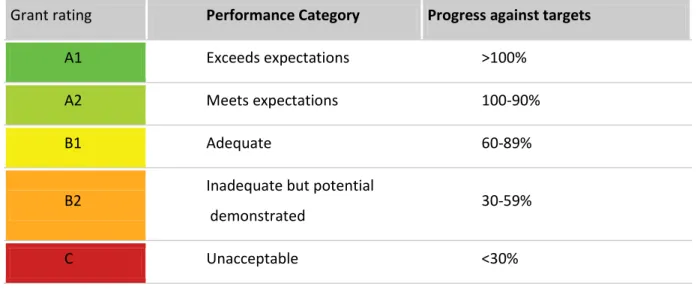
1st Step - Assigning a performance rating
programmatic performance may be downgraded due to critical management issues (e.g. poor data quality, procurement delays and ineligible expenditures).
Table 2.4. Assigment of Performance Rating for Global Fund grants
Grant rating Performance Category Progress against targets
A1 Exceeds expectations >100%
A2 Meets expectations 100-90%
B1 Adequate 60-89%
B2 Inadequate but potential
demonstrated 30-59%
C Unacceptable <30%
At the time of grant renewals, the performance rating of a grant may be upgraded if there is documented evidence of impact towards the goals of the program. Impact is defined strictly by changes in incidence, prevalence and mortality.
2nd Step - Deciding on a disbursement amount
TRANSFORMATIONS AT THE GLOBAL FUND
The Global Fund was set up as a unique global public/private partnership, often referred to as the ‘new multilaterals’, dedicated to attracting and disbursing additional resources to prevent and treat HIV/AIDS, Tuberculosis and Malaria. This partnership between governments, civil society, the private sector and affected communities represents a new approach to international health financing. Since its creation in 2002, The Global Fund has become the dominant financier of programs to fight AIDS, Tuberculosis and Malaria, contributing to improved impact and
cost-effectiveness of interventions in the three diseases and mobilizing additional financial support to the health sector in general.
Despite its achievements and relevance for international health, the Global Fund’s model and achievements were called into question in 2011 when an article on corruption and misuse of funds disbursed by the Global Fund to countries was picked up by several newspapers3. Although the article was written as a “revelation” of the results of the Global Fund Inspector General’s work, all the reports and findings had been previously published on the Global Fund website.
The publication of this article was the spark that ignited a crisis that culminated with a loss of confidence by donors and the international community and resulted in the withdraw of pledges for funding from the Scandinavian countries, Germany, Netherlands, Japan and some private organizations. The reputational damage seemed very severe at the time and the entire operational model of the Global Fund was being called into question.
In order to address the crisis and restore donors’ confidence, The Board of the Global Fund appointed a High-Level Independent Panel (hereafter referred to as the High-Level Panel) with the mandate to assess the organization’s fiduciary controls, to offer recommendations to solve
systematic problems in grant selection and oversight, to advise on risk mitigation and to contribute
to the development of a new strategy for the Global Fund. The High-Level Panel was chaired by the Honarable Michael O. Lewis (former Governor and Secretary of Health and Human Serives) and His Excellency Festus Mogae (former President of the Republic of Botswana)4.
The High-Level Panel conducted an extensive review of published and unpublished documentation of the Global Fund as well as interviews and field missions to follow the financing from the Secretariat down to the country level and to beneficiaries. The High-Panel acknowledges that the crisis was fuelled by a combination of economic distress among donors and the reports from the Office of the Inspector General.
Overall, the High-Level Panel’s recommendations urged the Board and Secretariat to adjust to the new economic, technological and epidemiologic realities in order to transition from an organization responding to an emergency to a financing institution that is geared towards a sustainable response. The transition was envisioned to position the organization to provide maximum accountability, comprehensive risk management, efficiency and value for money. The High-Level Panel pointed out that three new trends are forcing the Global Fund to change: a new austerity environment, demand for accountability from donors and the international community and innovations in Medicine, Public Health and technologies.
The Global Fund was created to respond to the emergency posed by the three diseases with the mandate to leverage and disburse large amounts of funding to countries to significantly impact the fight against the diseases. The sense of emergency and drive to provide treatment ‘at any cost’ formed the culture and modus-operandis of the organization. The rapid growth of the organization
4
The High-Level Panel was also composed by the following members:
and the results achieved require the organization to shift from emergency response to sustainability and fiduciary responsibility.
In addition, the economic crisis that still grips major industrial economies has significantly reduced the unprecedented outpouring of financial resources to international health. As a result, the Global Fund is transitioning from an era of expansion to consolidation. During 2011, the financial outlook of the organization raised serious concerns to future and on-going grants.
The reports from the Office of Inspector General on fraud and misuse of grant funding combined with the new economic scenario contributed to the decline of donors’ confidence. More than ever, international organizations are required to present accurate data on their programs and results while ensuring cost-effectiveness and safeguarding of investments. Consequently, the Global Fund must review its fiduciary controls and accountability mechanisms to anchor the transition from emergency,
By assessing the factors that led The Global Fund to a crisis and the way the organization responded to it provided invaluable insights into limitations of the Global Fund model and how it should be adapted to face the new realities aforementioned. The final report highlights that the organization made very few strategic and operational decisions based on risk and that its
bureaucracy provided a false sense of security while oversight was actually inadequate in detecting and preventing fraud and misuse of grant money.