R E V I E W A N D S Y N T H E S E S
Geography, assortative mating, and the effects of sexual
selection on speciation with gene flow
Maria R. Servedio
Department of Biology, University of North Carolina, Chapel Hill, NC, USA
Keywords
allopatry, assortative mating, migration, secondary contact, sympatry, two-island model.
Correspondence
Maria R. Servedio, Department of Biology, University of North Carolina, CB# 3280, Coker Hall, Chapel Hill, NC 27599, USA.
Tel.: +1-919-8432692; fax: +1-919-9621625; e-mail: [email protected] Received: 28 February 2015 Accepted: 1 July 2015 doi:10.1111/eva.12296
Abstract
Theoretical and empirical research on the evolution of reproductive isolation have both indicated that the effects of sexual selection on speciation with gene flow are quite complex. As part of this special issue on the contributions of women to basic and applied evolutionary biology, I discuss my work on this question in the context of a broader assessment of the patterns of sexual selection that lead to, versus inhibit, the speciation process, as derived from theoretical research. In particular, I focus on how two factors, the geographic context of spe-ciation and the mechanism leading to assortative mating, interact to alter the effect that sexual selection through mate choice has on speciation. I concentrate on two geographic contexts: sympatry and secondary contact between two geo-graphically separated populations that are exchanging migrants and two mecha-nisms of assortative mating: phenotype matching and separate preferences and traits. I show that both of these factors must be considered for the effects of sex-ual selection on speciation to be inferred.
Introduction
The fascination that biologists have long had with specia-tion has increased in recent decades as we have gained a better and better understanding of the complexity of this engine of biodiversity. One of the most intriguing aspects of speciation is how it might proceed under the most diffi-cult of circumstances, namely in the face of gene flow. Gene flow poses an especially interesting problem for evolution-ary theorists because it counters the forces driving differen-tiation between species, leading to continued cohesion across them. The problem of speciation with gene flow also has conservation implications; the onset of gene flow after a period of allopatric divergence can erode differences between species or races, posing important questions regarding how species differences can be maintained, or how speciation may continue to proceed.
Speciation in the presence of gene flow, in sexual species, can be driven by two general processes: (i) nonrandom mating that results in assortative mating, the mating of like with like, which reduces gene flow between groups, and (ii) divergent selection, which favors extremes in a population and thus can lead to a splitting of the species (e.g., Kirk-patrick and Ravigne 2002; Coyne and Orr 2004; Gavrilets
2004; selection against hybrids can fall into this category, e.g., Dobzhansky 1937; Muller 1942). To understand when speciation may occur in the face of gene flow, one must understand the joint action of both of these processes.
2008; Maan and Seehausen 2011; Smadja and Butlin 2011; Servedio and Kopp 2012).
In this paper, I maintain that to understand the role that sexual selection plays in speciation with gene flow, it is crit-ical to consider two key factors. First, the geographic con-text in which gene flow occurs can be very important, as it can alter the patterns of selection that lead to divergence. Second, there are two fundamentally different mechanisms by which assortative mating can occur, even when only considering those forms of assortative mating that act through mate choice (as I do here): phenotype matching and separate preferences and traits. These two mechanisms generate sexual selection in different ways. As part of this special issue on the contributions of women to basic and applied evolutionary biology, I will review theoretical research addressing how the geography of speciation and type of assortative mating interact to affect the role of sex-ual selection in speciation with gene flow, with an emphasis on synthesizing my own views and contributions to our understanding of this problem, particularly in the case of secondary contact.
Geography and speciation with gene flow
The geographic background upon which the process of spe-ciation proceeds has long been considered the primary determinant of the ease of speciation, but in recent years, there has been a growing recognition that geographic clas-sifications capture only part of the picture (Butlin et al. 2008; Fitzpatrick et al. 2009; Marie Curie Speciation Net-work 2012). In a simplistic view, the key distinction between the geographic categories of allopatric, parapatric, and sympatric speciation can be thought of as whether gene flow between incipient species is possible; allopatric specia-tion occurs in the absence of gene flow, while parapatric and sympatric speciation assume the occurrence of varying degrees of gene flow (Mayr 1963). We now understand that there are finer geographic distinctions that can have impor-tant effects on the likelihood of speciation (see Coyne and Orr 2004; Fitzpatrick et al. 2009). Furthermore, even within cases of speciation with gene flow, the geographic context can affect patterns of gene flow, which can ulti-mately have important effects on the likelihood of diver-gence (Servedio and Kirkpatrick 1997; Gavrilets 2004; Kisdi and Prikopil 2011; Rettelbach et al. 2013).
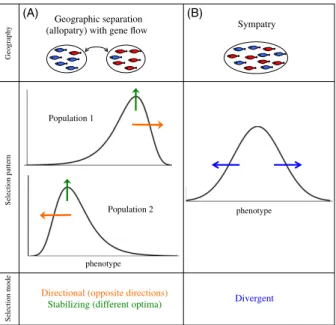
As mentioned in the Introduction, one of the essential components of speciation with gene flow is divergent selec-tion. Selection must be divergent, that is, between the incipient species. If the diverging pair of populations is, however, geographically separated but undergoing gene flow through the exchange of migrants (Fig. 1A, top, note that I still refer to these as ‘allopatric’ as a shorthand), the selection regime within each of the diverging populations
can potentially lead to speciation if it is directional, in opposite directions in each population (Fig. 1A, middle, orange arrows). In other words, this opposing directional selection within each population approximates divergent selection when both populations are considered together. Similarly, selection within each population could poten-tially be stabilizing, but for different optima (Fig. 1A, mid-dle, green arrows). Several theoretical studies have considered ecological speciation between two populations exchanging migrants using ‘two-island’ models with these types of selection regimes (often including intrinsic selec-tion against hybrids as an addiselec-tional force favoring diver-gence, e.g., Felsenstein 1981; Liou and Price 1994; Servedio and Kirkpatrick 1997; Proulx and Servedio 2009). On the other hand, sympatric speciation, which occurs within a single population, requires that selection be divergentper se (Fig. 1B, middle). This selection pattern can emerge either as a result of disruptive selection resulting from, for exam-ple, bimodally distributed resources, or even because of competition among individuals when resources are uni-modal (e.g. Dieckmann and Doebeli 1999; B€urger et al. 2006; Pennings et al. 2008).
The differences in the mode of selection required with and without geographic separation are important, because
Sympatry
phenotype
Divergent Geographic separation
phenotype
Directional (opposite directions) Stabilizing (different optima)
Population 1
(A) (B)
Population 2
Geography
Selection pattern
Selection mode
these modes may differ in how common or how strong they are in nature. Kingsolver et al. (2001), for example, found that, although more data are needed to measure it accurately, current evidence suggests that stabilizing selec-tion and disruptive selecselec-tion may be weak, while direc-tional selection is often fairly strong in natural populations (see also Kingsolver and Diamond 2011). More specula-tively, one could imagine that a vicariance event within a landscape or colonization of a new area may not infre-quently lead to the patterns of selection illustrated in Fig. 1A (directional in different directions, or stabilizing for different optima), due to the presence of environmental gradients or divergent environmental conditions.
Sexual selection, like natural selection, can take on differ-ent modes during the process of assortative mating. Sexual selection is not static, but changes in a population as the rel-ative proportions of genotypes in the choosing sex changes; that is, sexual selection is inherently frequency dependent. Because of this, directional, stabilizing, or disruptive sexual selection can arise during speciation, depending on the mechanism of assortative mating and the distribution of phenotypes already present in the population, the latter of which can be strongly affected by the geographic context of the speciation event. As I discuss in the following sections, in some cases, the mode that sexual selection takes can drive divergence between populations, but, in others, it can be a powerful force preventing or inhibiting speciation or the maintenance of species differences.
Modes of sexual selection and the mechanism of assortative mating
Theoretical evolutionary biologists have primarily consid-ered two mechanisms of assortative mating by mate choice: phenotype matching and separate genetic determination of preferences and mating traits (hereafter simply called ‘traits’). (Note that assortative mating can also occur as a byproduct of habitat choice or temporal isolation, which can also generate sexual selection but which I do not con-centrate on in this review). During phenotype matching, the choosing sex (which I will call females) prefers to mate with males that match its own trait phenotype; this trait could be a display, such as coloration, a morphological character such as body size, or even a trait that constrains mating such as chirality in snails (e.g., Johnson 1982). When there are instead separate preference and trait loci, the traits might again be functional (e.g., body size, tail length), but if they are ornamental, they may be expressed more commonly in only one sex (e.g., the male). The pref-erence/trait mechanism may therefore comprise a wider variety of mating displays, including potentially across a greater range of sensory modalities, than phenotype match-ing might typically include.
The mechanisms of phenotype matching and separate preferences and traits generate frequency-dependent sexual selection in different ways. Because preferences during phe-notype matching are determined by the trait itself, pheno-type matching generates positive frequency-dependent selection based on the frequency of the trait phenotype. If traits are normally distributed, for example, the positive frequency-dependent selection generated by phenotype matching will be stabilizing around the trait mean (see models of this process discussed below). If instead the dis-tribution of traits follows the pattern in Fig. 1A (skewed in different directions in different populations), this positive frequency dependence can produce a selection pattern that is effectively divergent across the two populations.
In contrast, when preferences and traits are determined by separate loci, sexual selection becomes positive fre-quency-dependent based upon the frequency of the prefer-ence, rather than the frequency of the trait. Preferences that are centered around the trait mean can ultimately generate either stabilizing or disruptive selection, depending on the variance in preferences versus traits (reviewed in van Doorn et al. 2004; Weissing et al. 2011). Specifically, if such preferences have a relatively low variance relative to the trait, they will generate stabilizing selection on trait phenotypes. If, however, preference variation is large enough, competition among individuals with different traits may cause disruptive selection on trait phenotypes, in a way analogous to the disruptive selection generated on traits due to competition over resources under wide resource distributions (van Doorn and Weissing 2001; see Fig. 3 in Weissing et al. 2011). On the other hand, when preferences are displaced from the trait distribution, sexual selection can be directional. To obtain the pattern of dis-ruptive selection, by sexual selection alone, shown in Fig. 1A (orange arrows), preferences would have to be dis-placed beyond the trait means in different directions in each diverging population.
2010; Rettelbach et al. 2013). These are important contexts and worthy of equal consideration in a broader review.
Sympatric speciation and secondary sympatry
The scenario of sympatric speciation starts with a single population, which one can imagine might often have uni-modally distributed traits and preferences. Under pheno-type matching, a unimodal distribution of traits would, as discussed above, generate stabilizing sexual selection. Sym-patric speciation, however, requires exactly the opposite type of selection, disruptive selection, to proceed (Fig. 1B). The stabilizing sexual selection generated by phenotype matching can, by opposing any disruptive ecological selec-tion, either prevent sympatric speciation completely or cause the assortative mating that evolves during the process of sympatric speciation to stall at an intermediate level (e.g., Matessi et al. 2001; Gourbiere 2004; Kirkpatrick and Nuismer 2004; Otto et al. 2008; Pennings et al. 2008; Sade-din et al. 2009). If trait frequencies are sufficiently skewed within the initial population, the positive frequency-depen-dent selection generated by phenotype matching can also have a substantial directional component, leading to the loss of trait variation and thus preventing the evolution of assortment (e.g., Gourbiere 2004; Schneider 2005; B€urger and Schneider 2006; B€urger et al. 2006; Schneider and B€urger 2006; Otto et al. 2008; Pennings et al. 2008). The sexual selection generated during phenotype matching thus may generally inhibit sympatric speciation in its earliest stages.
If the distribution of trait phenotypes in sympatry was bimodal, however, the positive frequency-dependent sexual selection generated by phenotype matching could instead be divergent. Bimodal trait phenotypes could arise either if sympatric speciation were to proceed under phenotype matching despite the initial stabilizing (or directional) selection that it generates, or if populations divergent in their trait means were to come into secondary sympatry. The model of the evolution of assortative mating during sympatry by Otto et al. (2008), for example, nicely demon-strates this effect using a diploid trait controlled by a single locus. They show that when heterozygotes are common they will be favored, on the whole, by the sexual selection generated by phenotype matching; this can tend to restrict the evolution of a modifier that strengthens assortative mating. When, however, populations have diverged in allopatry and come into secondary sympatry, heterozygotes may initially be rare, especially if there is already any assor-tative mating. In this case, Otto et al. (2008) show that phenotype matching will cause sexual selection to further favor both homozygotes over the heterozygotes, promoting the evolution of even stronger assortative mating. This has the potential to lead to the evolution of complete
assort-ment (see top right of fig. 4 in Otto et al. 2008; see also Doebeli 1996; Matessi et al. 2001; Arnegard and Kon-drashov 2004; Pennings et al. 2008).
Sympatric speciation with separate preferences and traits is likely to be much more difficult than with phenotype matching, primarily because the large amount of preference variation necessary to generate disruptive selection on traits may be very difficult to achieve (reviewed in Weissing et al. 2011). In the scenario of sympatric speciation, one way to generate sufficient preference variation would be if prefer-ences themselves were under disruptive selection (see van Doorn et al. 2004), but this may be rare in natural popula-tions.
Allopatric populations with migration—phenotype matching
If populations that have undergone trait divergence in allopatry begin to exchange migrants, one would expect trait distributions could be skewed in opposite directions, or in the case of a discrete trait, different trait alleles may initially be at a high frequency in each divergent popula-tion. In this case, the positive frequency-dependent sexual selection generated by phenotype matching will tend to have a directional component, in opposite directions, in each population, matching the pattern of selection that will maintain, or further promote, divergence between popula-tions as shown in Fig. 1A (orange arrows; there can also be a stabilizing component for different trait means, green arrows). In Servedio (2011), I used a population genetic model of two populations undergoing secondary contact by migration to explore the ability of phenotype matching alone to generate enough sexual selection to both allow trait divergence and to promote the evolution of yet stron-ger assortative mating. To isolate the evolutionary effects of assortative mating by phenotype matching, viability and fecundity selection were assumed to be absent; there was no local adaptation of traits or search costs associated with mate choice. To guarantee that the results were not due to the low fitness of hybrids (reinforcement), haploids were used so that no intermediate phenotypes were generated. Females were simply assumed to have a preference for matching the trait allele (T1or T2) that they also carried.
were to encounter males at equal frequencies; an a of 0 would correspond to random mating and a highawould correspond to very strong preferences). If the strength of preference does not vary between populations, the frequen-cies of the traits evolve to be symmetric between popula-tions when divergence is maintained; the difference between the black curves in Fig. 2 thus represents the amount of trait divergence that the populations experience (see figure legend). As can be seen in Fig. 2, with very weak preferences, and hence mating that is close to random, trait divergence cannot be maintained, but as preference strength increases, traits initially become more divergent. Interestingly, however, a yet-further increase in preference strength causes the amount of divergence to drop (once aoptis crossed); when preferences are very strong, no trait differentiation can be maintained.
The decline in trait divergence with strong preferences can be explained by the fact that positive frequency-depen-dent sexual selection, which is the only evolutionary force leading to divergence in this model, starts to decline as preferences become too strong. This can be understood by considering the mating success of rare males. When
preferences are absent, rare males mate in proportion to their frequencies, so there is no positive frequency-depen-dent sexual selection. Importantly, this is also true when preferences are very strong; in this case, rare females have such a strong preference for rare males (just as common females do for common males) that they will not accept mates that do not match their phenotype. It is only when preferences are of an intermediate strength that they gener-ate positive frequency-dependent sexual selection, so it is only at these intermediate strengths that sexual selection can oppose the homogenizing effects of migration to lead to divergence.
Interestingly, the value of the preference strength that maximizes the divergence between traits across the popula-tions, aopt, is also the value that will evolve if assortative mating strength is allowed to vary evolutionarily (Servedio 2011). This occurs because an allele that causes more trait divergence will naturally become genetically associated with the more common allele in each population and thus will increase in frequency through indirect selection as the trait undergoes divergent sexual selection (for a full explanation see Servedio 2011). Because preferences will evolve to the strength that maximizes divergence, assortative mating can indeed evolve due to the presence of phenotype matching alone; it can evolve from a very low preference strength to this optimum. However, it will also tend to evolve from a very high preference strength, if it were to reach a high strength by some other means (e.g., perhaps in allopatry), down to this optimum. Populations in this situation will thus tend to reach an evolutionarily stable intermediate level of assortative mating (e.g.,aopt6 or 3 in Fig. 2).
These properties of phenotype matching can also be seen in models that contain more biological complications. If traits are locally adapted, for example, they will not neces-sarily lose variation if preferences are too weak or too strong (they will be in migration/selection balance), but divergence will still be maximized at the intermediate pref-erence strength that leads to the strongest positive fre-quency-dependent sexual selection (Servedio 2011; preference strength is still seen to evolve to the value that maximizes divergence,aopt, in this case). Proulx and Serve-dio (2009) examined the evolution of 12 different combi-nations of preferences for traits that were locally adapted, influenced hybrid fitness, or matched the female’s trait value, using a two-island model. They similarly found that when preferences were very strong, there was a decrease in the rate of spread of any mating strategy that included phe-notype matching of a locally adapted trait, although they did not examine the evolution of the strength of assortative mating.
Assortative mating by phenotype matching may likewise generate the most divergent sexual selection across popula-tions at an intermediate preference strength during the opt= 6.07, with m = 0.01
1.0
0.8
0.6
0.4
0.2
0 10 20 30 40
0
t 2
Strength of preference
opt = 3.08, with m= 0.03
Figure 2The amount of trait divergence between two populations exchanging migrants under assortative mating by phenotype matching, as a function of the strength of preferences,a, for two different migra-tion rates (m=0.01 andm=0.03). The lines shown are equilibrium frequencies of the trait T2in population 2; as the identity of the ‘local’
trait is interchangeable in a model with only phenotype matching, if T2
is at the frequency shown by the top line in population 2, then T1will
be at the same frequency in population 1. The difference between the two lines can thus be considered a measure of the divergence between the traits across the two populations. The solid black line is a stable equilibrium line reached from the assumption of secondary contact between divergent populations and the dashed gray line is an unstable equilibrium. Stable lines of equilibrium where both populations are fixed for T2or for T1and an unstable equilibrium at 0.5 are not shown on the
figure. The value ofathat leads to the maximum amount of divergence between the populations,aopt, is labeled for each migration rate
process of reinforcement. Reinforcement, defined as the evolution of premating isolation as an evolutionary response to selection against hybrids or hybridization (Dobzhansky 1940; Servedio and Noor 2003), has garnered much attention as a process whereby species boundaries can be bolstered after secondary contact. Reinforcement models are considerably more complicated than the basic model of Servedio (2011), partially because of the increased number of genotypes that can both act as cues for mating (while in males) and can express mating preferences (while in females). A variant of a reinforcement model, in which phenotype matching occurred across two loci (N and M), was also examined in additional analyses in Servedio (2011); here, ‘purebred’ N1M1and N2M2females preferred matching males, while hybrid N1M2and N2M1females had no preference. Intermediate preference strengths were found to lead to the most divergence at the M and N loci both when hybrids had low fitness simply due to lower mating success, and when viability selection against hybrids was explicitly introduced.
Because the reduction in divergent sexual selection across populations with strong phenotype matching results from the very basic phenomenon of the increased mating success of rare males, it should be general to many models of phenotype matching with spatial structure (although there may be situations where the effect is masked, including by activity at other loci). Indeed, I have now recognized this phenomenon to be present in some older models of my own (e.g., the models of phenotype matching of a locally adapted trait with male and female preferences in Servedio 2007) and have documented it in phenotype matching reinforcement models with diverse conditions such as a learned trait (Olofsson et al. 2011) and with within-genera-tional learning about prospective mates (Servedio and Dukas 2013). Whether it is a notable phenomenon in natu-ral systems that use phenotype matching will depend in part on whether preference strengths in nature are strong enough to be above the preference strengthaoptthat leads to the peak in trait divergence. With migration rates in the low single digits (e.g., 1–3%), the preference strengths at which trait divergence would start to decline, while high, would be potentially measurable (e.g., females being 3–6 times more likely to mate with preferred males in a choice trial). Of course, in cases where preferences may have indeed been strong enough to eliminate population differ-entiation there would be no divergent populations to study; this does not mean the phenomenon is not biologically rel-evant, but just that it will not be observed. In populations with low density, it is also possible that females may alter their behavior to be less discriminatory, even if they have strong underlying preferences, when rare males are too rare. This may retard the reduction in trait divergence with very strong preferences, but whether it would eliminate it
would depend on how rare males must be before loss of discrimination would occur, as well as on the degree of this loss of discrimination.
The relevance of these effects will also, of course, depend on how often phenotype matching occurs in natural popu-lations. While this question is underexplored, there is at present a dearth of strong evidence to suggest that it is common (M. Kopp, M. R. Servedio, T. C. Mendelson, R. J. Safran, R. L. Rodriguez, E. S. C. Scordato, L. B. Symes, C. N. Balakrishnan, M. E. Hauber, D. M. Zonana and G. S. van Doorn, unpublished manuscript). It turns out, how-ever, that sexual imprinting, provided that it is on kin, can be a close proxy for phenotype matching and is found across many taxa (reviewed in Verzijden et al. 2012). Females that establish a mating preference by sexually imprinting on a maternal or paternal trait will very often be matching their preference to the trait alleles that they themselves carry (even if these traits are not expressed). These forms of imprinting have the potential to behave very similarly to phenotype matching in both sympatric speciation (Verzijden et al. 2005) and reinforcement (Servedio et al. 2009) models in certain cases. Maternal and paternal imprinting do, however, differ in several important properties, including in the fact that, under polygyny, paternal imprinting enhances the effects of sexual selection by leading to exaggerated preferences (Tramm and Servedio 2008); this can lead to interesting differences in the specifics of their effects on trait divergence (Verzij-den et al. 2005; Chaffee et al. 2013; Yeh and Servedio 2015).
Allopatric populations with migration—separate preferences and traits
for different reasons, Barton and Turelli 1991; note that, the lines can reduce to a point if preferences are costly, e.g., Pomiankowski 1987). When there is strict allopatry, differ-ent populations can end up on differdiffer-ent places on the line of equilibria and hence have divergent traits and prefer-ences (even potentially when there are preference costs, see Uyeda et al. 2009). In cases in which the line of equilibria is unstable, runaway sexual selection could potentially drive populations to widely divergent trait and preference values (a runaway can also occur even with directly selected pref-erences, Hall et al. 2000). Divergent traits and preferences between populations could result in premating isolation and hence potentially speciation.
Less well appreciated is the issue of whether this process of divergence can occur if there is any migration between allopatric populations, resulting in gene flow. Lande (1982) and Payne and Krakauer (1997) both determined in clinal models that in the absence of local adaptation, Fisherian sexual selection alone could not maintain the differences in preferences and traits. This was confirmed in a two-island population genetic model by Servedio and B€urger (2014) and is consistent with the difficulties faced by sympatric speciation models that consider preferences and traits (e.g., Weissing et al. 2011), discussed above.
In Servedio and B€urger (2014), we also considered a situ-ation much more favorable to specisitu-ation—one which quite a number of speciation researchers that I informally polled (including myself!) thought would lead to sexual selection promoting speciation, despite gene flow. In this model, we assumed that the male trait was, itself, under divergent selection, so that allopatric populations had evolved a pref-erence for a locally adapted male trait before migration began between them. Traits that are both under divergent ecological selection and used as mating cues during assorta-tive mating have been well established to result in the evo-lution of premating isolation particularly easily (Gavrilets 2004), in comparison with cases in which different sets of loci perform these two different functions. Because of the ease with which they result in speciation, they have been termed ‘magic traits’ (Gavrilets 2004); this name implies that they may be rare, but they are being found in more and more species pairs (Servedio et al. 2011). When prefer-ences are very weak, locally adapted mating cues will be close to migration/selection balance, so divergence between the populations will be maintained. We initially expected that if preferences for the locally adapted trait were stronger in each population (remembering that preferences, like traits, were assumed to have diverged in allopatry), more differentiation in traits would be maintained in each popu-lation at equilibrium.
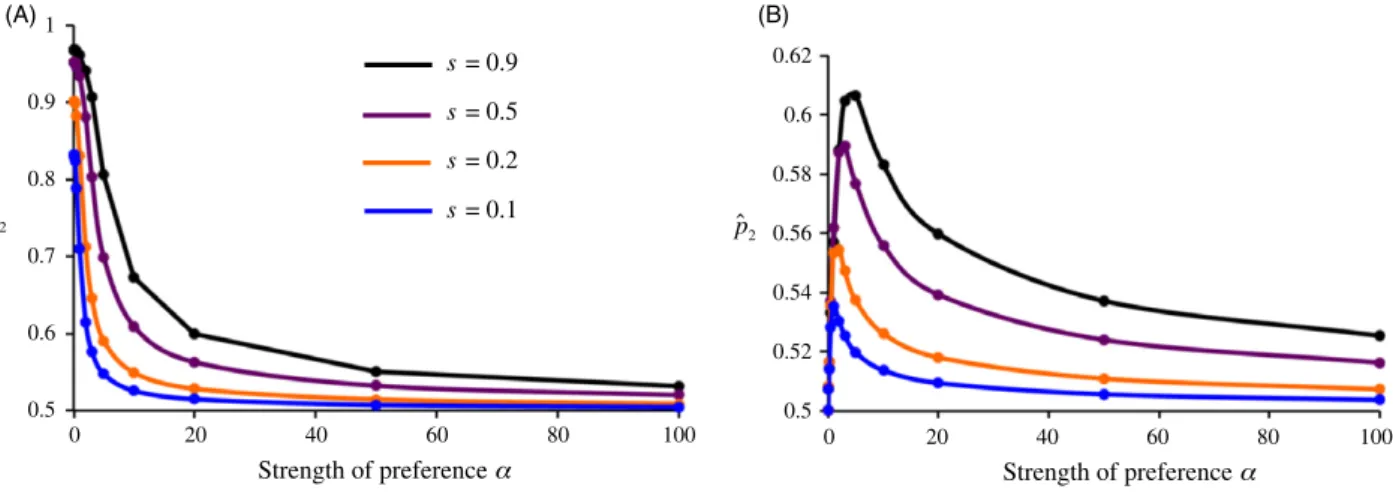
We instead obtained the opposite result; stronger prefer-ences resulted in less, not more, differentiation between populations in trait (and sometimes preference)
frequen-cies (Fig. 3, Servedio and B€urger 2014). The explanation of this effect is as follows. First, it is important to keep in mind two facts: (i) with low migration rates or strong local adaptation, the amount of divergence in trait frequencies between populations can be relatively high right after via-bility selection occurs in the life cycle, and (ii) sexual selec-tion naturally occurs after viability selecselec-tion (only surviving adults have the opportunity to mate). When there is random mating (no preferences,a=0 on Fig. 3), sexual selection does not act to change trait frequencies after viability selection, and trait differentiation, as explained above, will reach the value determined by migra-tion/selection balance (recalling that we are interested here in traits that are locally adapted). When instead there are very strong preferences, sexual selection will cause the trait frequencies among successfully mated males to mimic the preference frequencies, as each female will not mate with any male except the type that she prefers. The effects of local adaptation on trait frequencies will therefore be superseded by those of sexual selection.
The key, however, is that preference frequencies in this scenario will always, under Fisherian sexual selection, be more homogenized between populations than trait fre-quencies will. Both preference and trait alleles will tend to be homogenized between populations by migration. With locally adapted traits, this migration is countered by viabil-ity selection to lead to trait divergence. Preference alleles, however, are not under local adaptation. Instead, under Fisherian sexual selection, they evolve only due to the link-age disequilibrium that they have with male traits. Because this indirect selection on preference alleles is mediated by the strength of linkage disequilibrium, it is generally weak (e.g., Kirkpatrick and Barton 1997), and low preference dif-ferentiation results. These homogenized preferences will in turn cause sexual selection to tend to be a homogenizing force between populations, and the stronger it is, the more it will counter local adaptation to bring trait frequencies closer together (Fig. 3).
Interestingly, if the strength of sexual selection is itself allowed to evolve in this model, it evolves to random mat-ing, as a result of the fact that alleles for weaker preferences become associated in each population with the locally adapted trait (Servedio and B€urger 2014). This prevents the maintenance, across the populations, of complexes of traits and preferences with high levels of linkage disequilibrium. Thus, strong preferences reduce population differentiation when they are not allowed to evolve, and when they are allowed to evolve, they evolve toward random mating. These combined effects leave very little room for Fisherian sexual selection to contribute toward diversification with this geographic scenario.
would be generated by a process that is present in almost all forms of sexual selection. The fact that preferences place direct selection on traits, and themselves evolve as a corre-lated response to this selection, is fundamental to any process of sexual selection that includes variable and herita-ble preferences and traits. It is thus, and I believe rightly, considered a ‘null model’ for sexual selection (Prum 2010). In cases of secondary contact by migration where sexual selection seems to promote divergence, the results of Serve-dio and B€urger (2014) indicate that a more biologically complex form of sexual selection is occurring. I hope these results will prompt researchers to determine exactly why sexual selection may be promoting divergence in such cases. Note that, while some departures from Fisherian sex-ual selection can reverse the effect found in Servedio and B€urger (2014), and allow sexual selection to promote diver-gence, others will still result in sexual selection tending to inhibit trait divergence (see the mixed results of variant models with search costs, viability selection in females, and a best-of-n choice strategy in Servedio and Burger 2014).€
One situation of secondary contact in which stronger preferences may have the potential to lead to more trait dif-ferentiation between populations is when there is selection against hybrids, that is, when reinforcement is occurring. Kelly and Noor (1996) and Bank et al. (2012), for example, have considered models of reinforcement with very differ-ent biological underpinnings, but which assume specific preferences for divergent male phenotypes. In both cases, they discovered that a modifier that effectively increased the strength of the underlying preferences could spread, but that this required hybrids having low fitness. In the case
of Bank et al. (2012), modifiers of large effect were even found to be able to lead to complete reproductive isolation. On the other hand, Servedio (2000) used a reinforcement model to consider the evolution of a novel preference for a locally adapted trait characteristic of just one of two diverging populations. When the ancestral allele at this preference locus was for random mating, evolution of the preference would reduce the production of low-fitness hybrids in the population in which it evolved. In this case, stronger preferences did not necessarily allow reinforce-ment, measured as an increase in the novel preference, to occur more easily, due in part to selection against the novel preference when it was in the foreign population. In gen-eral, the dynamics in models including sexual selection by separate preferences and traits are quite complex, and it is difficult to make general statements about their results; much may depend on the underlying biology of a specific pair of species (e.g., Bank et al. 2012).
Conclusions
What can we conclude about the effects of sexual selection on speciation in these geographic contexts from these theo-retical models? In sympatric speciation, it is very difficult to argue that sexual selection is doing anything but inhibit-ing divergence in most cases. With phenotype matchinhibit-ing, sexual selection is unlikely to contribute to divergence except in the late stages of sympatric speciation or in sec-ondary sympatry, when there is already substantial diver-gence present (e.g., Doebeli 1996; Matessi et al. 2001; Arnegard and Kondrashov 2004; Gourbiere 2004; Otto
t 2 p
2
Strength of preference Strength of preference
0.5 0.6 0.7 0.8 0.9 1
(A) (B)
0 20 40 60 80 100
0.5 0.52 0.54 0.56 0.58 0.6 0.62
0 20 40 60 80 100
s = 0.9
s = 0.5
s = 0.2
s = 0.1
Figure 3Local trait (t2) and preference (p2) frequencies in population 2 at equilibrium, as a function of the strength of preferences,a. Higher values
represent more differentiation between the two populations in trait and preference frequencies, while a frequency of 0.5 represents no differentia-tion. (A) equilibrium trait frequencies. (B) equilibrium preference frequencies [note the range of they-axis differs from panel (A)]. The migration rate m=0.01; higher migration results in the same pattern but with each curve at lower values of^t2andp^2. The strengths of selection leading to the
local adaptation of trait T2are shown in the inset on panel (A), where the locally adapted trait has a relative viability of 1+sin each population.
et al. 2008; Pennings et al. 2008). With separate preferences and traits, special conditions, such as divergent selection on preferences themselves, must be present to allow enough preference variation for sexual selection to contribute to sympatric divergence (reviewed in Weissing et al. 2011). In sympatric speciation, sexual selection will generally either produce stabilizing selection on traits or eliminate trait variation with both mechanisms of assortment.
In the case of migration between two geographically iso-lated populations, as in secondary sympatry, sexual selection can promote divergence when assortative mating occurs by phenotype matching; here, matching produces positive fre-quency-dependent sexual selection that can be effectively directional in opposite directions in each population, driv-ing trait means apart. As discussed above, however, this selection can be relatively ineffective, because it can drop or even disappear at high preference strengths (Servedio 2011). When assortative mating instead occurs by separate prefer-ences and traits, the most basic form of sexual selection (Fisherian) will fail to maintain trait divergence and will indeed tend to evolve toward random mating (Servedio and B€urger 2014). While certain forms of sexual selection may be able to promote differentiation in this case, sexual selection cannot be said to generally have the property of driving speciation. Over all of these cases and geographies, the role of sexual selection in speciation is not generally positive.
The case of secondary contact between species that have diverged somewhat in allopatry may be of particular inter-est. First, it may occur relatively frequently, as evidenced by the ability of many species to hybridize when they are in contact (Mallet 2005; Nosil et al. 2009). Second, it has con-servation implications if rates of contact are increasing due to anthropogenic change. There are, however, many miss-ing pieces that would need to be gathered empirically to truly address the role of sexual selection in this context, to complement the theoretical work in this area.
First, it is important to have a better assessment of how often there are genetically distinct preferences and traits versus phenotype matching (or a proxy of matching such as sexual imprinting). While the biology of many systems, such as those that are sexually dimorphic, seems to make it much more likely that they have separate preferences and traits rather than use phenotype matching, truly proving that one or the other of these mechanisms exists is not nec-essarily trivial (reviewed in Kopp et al., unpublished manu-script, see Verzijden et al. 2012 for a review of sexual imprinting). More than one system which has originally been considered to have separate preferences and traits, for example, have been shown by further study to have prefer-ences altered by exposure to the phenotype of the parents, leading to a matching-like mechanism (e.g., Verzijden and ten Cate 2007; Verzijden et al. 2008; Kozak et al. 2011).
Even once the type of assortative mating mechanism is established, it would be difficult to make theoretical predic-tions about the role that sexual selection may play for a par-ticular species pair without knowing a lot more information. For the case of separate preferences and traits, for example, we might need to know the strength and direction of selection on preferences, preference and trait distributions, the strength and direction of natural selection on traits, the range of preference strengths found between incipient spe-cies, and the strength of correlations between preferences and traits, among other factors. For phenotype matching, at
Box 1:
Personal Reflections
My strategy as a woman in science, early in my career, was to plow on as though being a woman was irrelevant, as ideally it should be. I am not in any way suggesting that I am currently blissfully ignorant of challenges such as glass ceilings and implicit (or explicit) bias, although early on perhaps I was. I was very fortunate to benefit from excellent mentorship at all points in my career. As an undergraduate at Harvard I received a lot of encouragement from Bruce Waldman, A.W. Crompton, and Jeff McKinnon, whom I worked for when he was a graduate student. As a graduate student myself, at the University of Texas at Austin, I worked with Mark Kirkpatrick and benefitted immensely from the high standard to which he held me. My post doc mentors, Alex Kondrashov (at Cornell), Michael Turelli and Sergey Nuzhdin (at UC Davis), and Russ Lande (at UCSD) were also extremely supportive, put a tremendous amount of time into mentoring me and generally aided my transition to an independent career. The only female role model that I had as a mentor was Susan Kalisz (Univ. of Pittsburgh), in whose laboratory I spent 2 years when I was a graduate student. I could not have asked for a more amazing example of a brilliant woman scientist with an excellent work/ life balance. If I ever had any doubts that I could have what I wanted in both of these arenas, they vanished in those years.
a minimum, we would need to know distributions of traits (including skew), the strength of preferences for matched phenotypes, and the costs of searching for mates (e.g., Schneider and B€urger 2006; Kopp and Hermisson 2008).
In general we, as a field, are far from having all of the data necessary to empirically explore many of the predictions from theoretical studies of speciation. The con-tribution that these theoretical studies provide is a test of our verbal logic as to how the complicated pieces of the puzzle may fit together to lead to speciation; they clarify these chains of cause and effect (Servedio et al. 2014). The-oretical studies have made it clear that just showing empiri-cally that sexual selection currently leads to some reproductive isolation does not prove that stronger sexual selection would allow more, rather than less, trait diver-gence, or even more easily facilitate population divergence. It is only by a merging of the functions of theoretical and empirical work that we will fully understand the bigger pic-ture of how often, and why, sexual selection contributes to, versus inhibits, the speciation process.
Acknowledgements
I would like to thank Maren Wellenreuther and Louis Ber-natchez for the invitation to participate in this special issue. M. Verzijden, C. Willett, D.J. Yeh and two anonymous reviewers provided helpful comments on the manuscript. This work was supported by the National Science Founda-tion Grant DEB 1255777.
Data archiving statement
This article has no associated data to be archived.
Literature cited
Arnegard, M. E., and A. S. Kondrashov 2004. Sympatric speciation by sexual selection alone is unlikely. Evolution58:222–237.
Bank, C., J. Hermisson, and M. Kirkpatrick. 2012. Can reinforcement complete speciation? Evolution66:229–239.
Barton, N. H., and M. Turelli 1991. Natural and sexual selection on many loci. Genetics127:229–255.
Bolnick, D. J., and B. M. Fitzpatrick 2007. Sympatric speciation: models and empirical evidence. Annual Review of Ecology, Evolution and Systematics38:459–487.
B€urger, R., and K. A. Schneider 2006. Intraspecific competitive divergence and convergence under assortative mating. The American Naturalist167:190–205.
B€urger, R., K. A. Schneider, and M. Willendsdorfer 2006. The
conditions for speciation through intraspecific competition. Evolution 60:2185–2206.
Butlin, R. K., J. Galindo, and J. W. Grahame 2008. Sympatric, parapatric or allopatric: the most important way to classify speciation? Philosophical Transactions of the Royal Society B–Biological Sciences363:2997–3007.
Chaffee, D. W., H. Griffin, and R. T. Gilman 2013. Sexual imprinting: what strategies should we expect to see in nature? Evolution67: 3588–3599.
Coyne, J. A., and H. A. Orr 2004. Speciation. Sinauer Associates Inc, Sunderland, MA.
Dieckmann, U., and M. Doebeli 1999. On the origin of species by sympatric speciation. Nature400:354–357.
Dobzhansky, T. 1937. Genetics and the Origin of Species. Columbia University Press, New York.
Dobzhansky, T. 1940. Speciation as a stage in evolutionary divergence. The American Naturalist74:312–321.
Doebeli, M. 1996. A quantitative genetic competition model for sym-patric speciation. Journal of Evolution Biology9:893–909. van Doorn, G. S., and F. Weissing 2001. Ecological versus Sexual
Selection Models of Sympatric Speciation: a Synthesis. Selection 2:17–40.
van Doorn, G. S., U. Dieckmann, and F. J. Weissing 2004. Sympatric speciation by sexual selection: a critical reevaluation. The American Naturalist163:709–725.
Felsenstein, J. 1981. Skepticism towards Santa Rosalia, or why are there so few kinds of animals? Evolution35:124–138.
Fisher, R. A. 1930. The Genetical Theory of Natural Selection. Clarendon Press, Oxford.
Fitzpatrick, B. M., J. A. Fordyce, and S. Gavrilets 2009. Pattern, process and geographic modes of speciation. Journal of Evolutionary Biology 22:2342–2347.
Gavrilets, S. 2004. Fitness Landscapes and the Origin of Species. Prince-ton University Press, PrincePrince-ton, N.J, Oxford, UK.
Gourbiere, S. 2004. How do natural and sexual selection contribute to sympatric speciation? Journal of Evolutionary Biology17: 1297–1309.
Hall, D. W., M. Kirkpatrick, and B. West 2000. Runaway sexual selection when female preferences are directly selected. Evolution54:1862– 1869.
Hoekstra, H. E., J. M. Hoekstra, D. Berrigan, S. N. Vignieri, A. Hoang, C. E. Hill, P. Beerli et al. 2001. Strength and tempo of directional selection in the wild. Proceedings of the National Academy of Science USA98:9157–9160.
Johnson, M. S. 1982. Polymorphism for direction of coil in Partula sutu-ralis: behavioral isolation and positive frequency-dependent selection. Heredity49:145–151.
Kelly, J. K., and M. Noor 1996. Speciation by reinforcement: a model derived from studies ofDrosophila. Genetics143:1485–1497. Kingsolver, J. G., and S. E. Diamond 2011. Phenotypic selection in
natu-ral populations: what limits directional selection? The American Natu-ralist177:346–357.
Kingsolver, J. G., H. E. Hoekstra, J. M. Hoekstra, D. Berrigan, S. N. Vignieri, C. E. Hill, A. Hoang et al. 2001. The strength of pheno-typic selection in natural populations. The American Naturalist 157:245–261.
Kirkpatrick, M. 1982. Sexual selection and the evolution of female choice. Evolution36:1–12.
Kirkpatrick, M. 2001. Reinforcement during ecological speciation. Proceedings of the Royal Society of London, B268:1259–1263. Kirkpatrick, M., and N. H. Barton 1997. The strength of indirect
selec-tion on female mating preferences. Proceedings of the Naselec-tional Acad-emy of Science, USA94:1282–1286.
Kirkpatrick, M., and V. Ravigne 2002. Speciation by natural and sexual selection: models and experiments. The American Naturalist 159:S22–S35.
Kirkpatrick, M., and M. R. Servedio 1999. The reinforcement of mating preferences on an island. Genetics151:865–884.
Kisdi, E., and T. Prikopil 2011. Evolutionary branching of a magic trait. Journal of Mathematical Biology63:361–397.
Kopp, M., and J. Hermisson 2008. Competitive speciation and costs of choosiness. Journal of Evolutionary Biology21:1005–1023.
Kozak, G. M., M. L. Head, and J. W. Boughman 2011. Sexual imprinting on ecologically divergent traits leads to sexual isolation in sticklebacks. Proceedings of the Royal Society of London B278:2604–2610. Lande, R. 1981. Models of speciation by sexual selection on polygenic
traits. Proceedings of the National Academy of Science USA78: 3721–3725.
Lande, R. 1982. Rapid origin of sexual isolation and character divergence in a cline. Evolution36:213–233.
Liou, L. W., and T. D. Price 1994. Speciation by reinforcement of pre-mating isolation. Evolution48:1451–1459.
Maan, M. E., and O. Seehausen 2011. Ecology, sexual selection, and spe-ciation. Ecology Letters14:591–602.
Mallet, J. 2005. Hybridization as invasion of the genome. Trends in Ecol-ogy and Evolution20:229–237.
Mallet, J. 2008. Hybridization, ecological races and the nature of species: empirical evidence for the ease of speciation. Philosophical Transac-tions of the Royal Society of London B363:2971–2986.
Marie Curie Speciation Network. 2012. What do we need to know about speciation? Trends in Ecology and Evolution27:27–39.
Matessi, C., A. Gimelfarb, and S. Gavrilets 2001. Long-term buildup of reproductive isolation promoted by disruptive selection: how far does it go? Selection2:41–64.
Mayr, E. 1963. Animal Species and Evolution. Belknap Press, Cambridge, MA.
M’Gonigle, L. K., and R. G. FitzJohn 2010. Assortative mating and spa-tial structure in hybrid zones. Evolution64:444–455.
Muller, H. J. 1942. Isolating mechanisms, evolution and temperature. Bi-ological Symposia6:71–125.
Norvaisas, P., and E. Kisdi 2012. Revisiting Santa Rosalia to unfold a degeneracy of classic models of speciation. The American Naturalist 180:388–393.
Nosil, P. 2008. Speciation with gene flow could be common. Molecular Ecology17:2103–2106.
Nosil, P., L. J. Harmon, and O. Seehausen 2009. Ecological explanations for (in)complete speciation. Trends in Ecology and Evolution24:145–156. Olofsson, H., A. M. Frame, and M. R. Servedio 2011. Can reinforcement
occur with a learned trait? Evolution65:1992–2003.
Otto, S. P., M. R. Servedio, and S. L. Nuismer 2008. Frequency-depen-dent selection and the evolution of assortative mating. Genetics 179:2091–2112.
Panhuis, T. M., R. Butlin, M. Zuk, and T. Tregenza 2001. Sexual selec-tion and speciaselec-tion. Trends in Ecology Evoluselec-tion16:364–371. Payne, R. J. H., and D. C. Krakauer 1997. Sexual selection, space, and
speciation. Evolution51:1–9.
Pennings, P. S., M. Kopp, G. Meszena, U. Dieckmann, and J. Hermisson 2008. An analytically tractable model for competitive speciation. The American Naturalist171:E44–E71.
Pomiankowski, A. 1987. The costs of choice in sexual selection. Journal of Theoretical Biology128:195–218.
Proulx, S., and M. R. Servedio 2009. Dissecting selection on female mat-ing preferences durmat-ing secondary contact. Evolution63:2031–2046.
Prum, R. O. 2010. The Lande-Kirkpatrick mechanism is the null model of evolution by intersexual selection: implications for meaning, hon-esty, and design in intersexual signals. Evolution64:3085–3100. Rettelbach, A., M. Kopp, U. Dieckmann, and J. Hermisson 2013. Three
modes of adaptive speciation in spatially structured populations. The American Naturalist182:E215–E234.
Ritchie, M. G. 2007. Sexual selection and speciation. Annual Review of Ecology, Evolution and Systematics28:79–102.
Sadedin, S., J. Hollander, M. Panova, K. Johannesson, and S. Gavrilets 2009. Case studies and mathematical models of ecological speciation. 3. Ecotype formation in a Swedish snail. Molecular Ecology18:4006– 4023.
Schneider, K. A. 2005. Competitive divergence in non-random mating populations. Theoretical Population Biology68:105–118.
Schneider, K. A., and R. Burger 2006. Does competitive divergence occur€
if assortative mating is costly? Journal of Evolutionary Biology 19:570–598.
Servedio, M. R. 2000. Reinforcement and the genetics of nonrandom mating. Evolution54:21–29.
Servedio, M. R. 2007. Male versus female mate choice: sexual selection and the evolution of species recognition via reinforcement. Evolution 61:2772–2789.
Servedio, M. R. 2011. Limits to the evolution of assortative mating by female choice under restricted gene flow. Proceeding of the Royal Society of London Series B278:179–187.
Servedio, M. R., and R. B€urger 2014. The counterintuitive role of sexual selection in species maintenance and speciation. Proceedings of the National Academy of Science, USA111:8113–8118.
Servedio, M. R., and R. Dukas 2013. Effects on population divergence of within-generational learning about prospective mates. Evolution 67:2363–2375.
Servedio, M. R., and M. Kirkpatrick 1997. The effects of gene flow on reinforcement. Evolution51:1764–1772.
Servedio, M. R., and M. Kopp 2012. Sexual selection and magic traits in speciation with gene flow. Current Zoology58:510–516.
Servedio, M. R., and M. A. F. Noor 2003. The role of reinforcement in speciation: theory and data meet. Annual Review of Ecology and Sys-tematics34:339–364.
Servedio, M. R., S. A. Sæther, and G.-P. Sætre 2009. Reinforcement and learning. Evolutionary Ecology23:109–123.
Servedio, M. R., G. S. van Doorn, M. Kopp, A. M. Frame, and P. Nosil 2011. Magic traits in speciation: ‘magic’ but not rare? Trends in Ecol-ogy and Evolution26:389–397.
Servedio, M. R., Y. Brandvain, S. Dhole, C. L. Fitzpatrick, E. E. Goldberg, C. A. Stern, J. Van Cleve et al. 2014. Not just a theory–the utility of mathematical models in evolutionary biology. PLoS Biology12: e1002017.
Smadja, C., and R. K. Butlin 2011. A framework for comparing processes of speciation in the presence of gene flow. Molecular Ecology 20:5123–5140.
Tramm, N. A., and M. R. Servedio 2008. Evolution of mate-choice imprinting: competing strategies. Evolution62:1991–2003. Uyeda, J. C., S. J. Arnold, P. A. Hohenlohe, and L. S. Mead 2009. Drift
promotes speciation by sexual selection. Evolution63:583–594. Verzijden, M. N., and C. ten Cate 2007. Early learning influences species
assortative mating preferences in Lake Victoria cichlid fish. Biology Letters3:134–136.
Verzijden, M. N., R. E. M. Korthof, and C. ten Cate 2008. Females learn from mothers and males learn from others. The effect of mother and siblings on the development of female mate preferences and male aggression biases in Lake Victoria cichlids, genus Mbipia. Behavioural Ecology and Sociobiology62:1359–1368.
Verzijden, M. N., C. ten Cate, M. R. Servedio, G. Kozak, J. W. Bough-man, and E. Svensson 2012. Learning, sexual selection and speciation. Trends in Ecology and Evolution27:511–519.
Weissing, F. J., P. Edelaar, and G. S. van Doorn 2011. Adaptive specia-tion theory: a conceptual review. Behavioral Ecology and Sociobiology 65:461–480.
West-Eberhard, M. J. 1983. Sexual selection, social competition, and speciation. Quarterly Review of Biology58:155–183.