STAYING, MOVING, AND VOCATIONAL TRAINING:
EXPLAINING THE CAREER WAGE MOBILITY OF LOW-END SERVICE WORKERS IN THE U.S. AND W. GERMANY
Michael A. Schultz
A thesis submitted to the faculty at the University of North Carolina at Chapel Hill in partial fulfillment of the requirements for the degree of Master of Arts in the Department of Sociology in the College of Arts and Sciences.
Chapel Hill 2015
Approved by:
Arne L. Kalleberg
Ted Mouw
ii
ABSTRACT
Michael A. Schultz: Staying, Moving, and Vocational Training: Explaining the Career Wage Mobility of Low-end Service Workers in the U.S. and W. Germany
(Under the direction of Arne L. Kalleberg)
Do strong vocational training systems lead to higher wages for low-end service workers
over their careers? Low-wage work is growing in the advanced capitalist countries raising the
question of how differences in vocational training systems affect wage mobility. Previous studies
of wage mobility for low-wage workers rarely account for the influence of detailed occupations
or country-level institutions. I address these weaknesses by analyzing the career wage mobility
of workers in seven low-end service occupations in the U.S. and West Germany. I find that
workers entering these occupations in both countries have similarly low rates of wage growth.
The primary route to upward mobility in both countries is by moving occupations. Occupational
mobility is lower in Germany likely due to barriers created by the strong vocational training
system. This results in lower odds for upward mobility in Germany than in the U.S. for workers
iv
TABLE OF CONTENTS
LIST OF TABLES...v
LIST OF FIGURES...vi
LIST OF ABREVIATIONS...vii
STAYING, MOVING, AND VOCATIONAL TRAINING...1
Previous Work on the Mobility of Low-wage Workers...3
Research Design...8
An Occupational Approach...9
Conceptual Framework...10
Vocational Training Systems in the U.S. and Germany...13
Other Important Institutional Differences...16
Hypotheses and the Problem of Selection...20
Data and Methods...23
Results and Discussion...28
Conclusion...41
APPENDIX A: OCCUPATION HARMONIZATION...44
APPENDIX B: MODEL RESULT TABLES...45
LIST OF TABLES
Table 1: Wage, employment growth, and modal education for 7 large, growing
low-wage occupations in the U.S...11
Table 2: Descriptive statistics for workers starting in low-end service occupations...29
Table 3: Mobility out of bottom two quintiles of the full-time hourly wage distribution...31
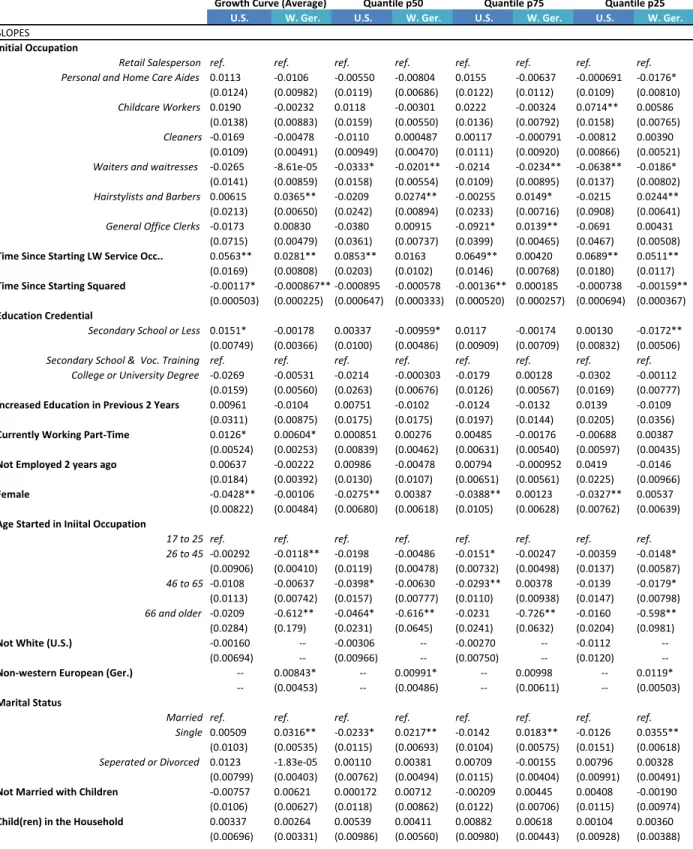
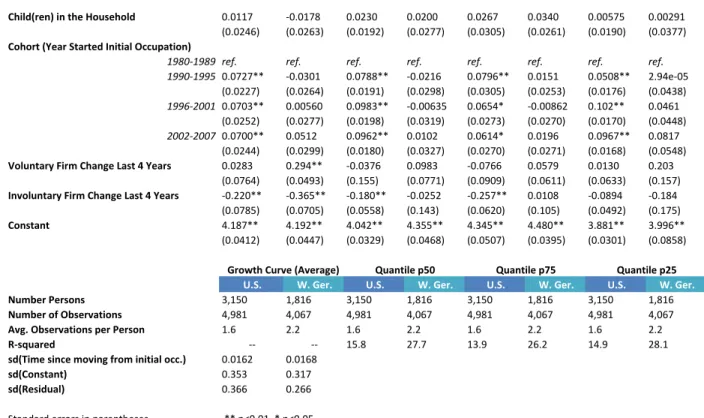
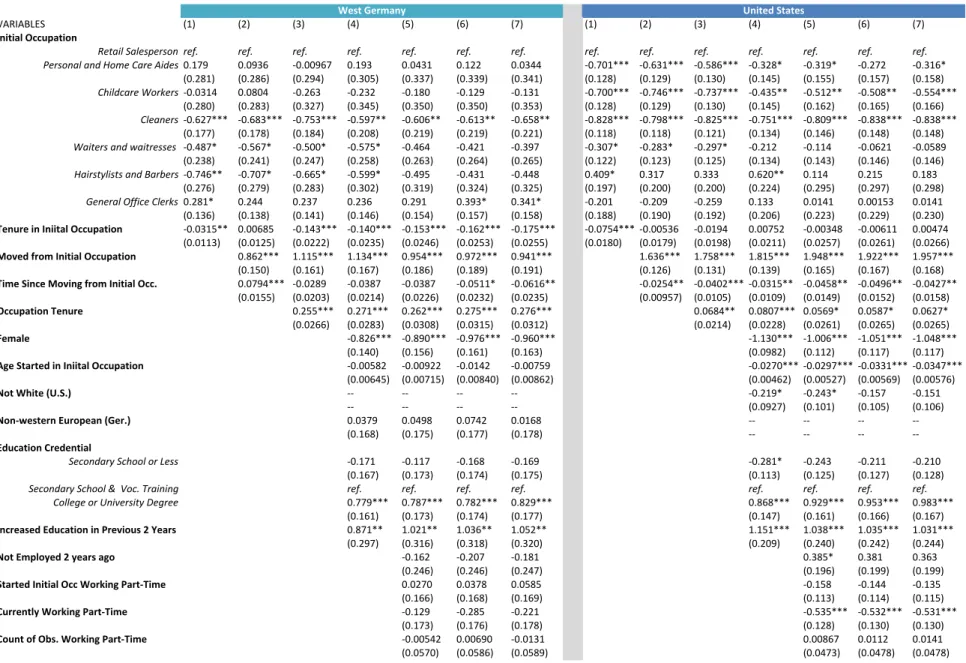
Table 4: Quantile model results for workers while in a low-end service occupation...45
Table 5:Quantile model results for workers after they move from a low-end service occupation...47
vi
LIST OF FIGURES
Figure 1: Wage mobility conceptual framework...11
Figure 2: Predicted wage growth for workers while in a low-end service occupation,
quantile models...34
Figure 3: Predicted wage growth for workers after they move from a low-end service
occupation, quantile models... 34
Figure 4: Predicted career wage growth for a worker with an average duration in a
low-end service occupation, quantile models...34
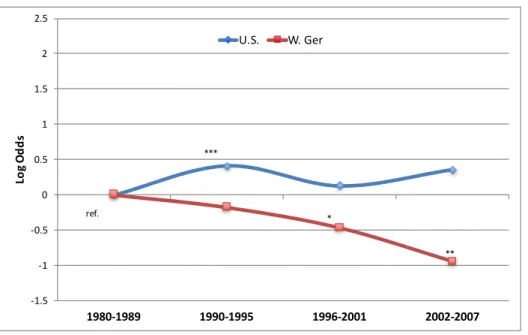
Figure 5: Significant coefficients from a discrete-time event history analysis, mobility out of the bottom two quintiles of the hourly wage distribution, full model, log odds...38
Figure 6: Cohort coefficients from a discrete-time event history analysis, mobility out of
LIST OF ABREVIATIONS
BLS U.S. Bureau of Labor Statistics
Ger. Germany
ISCO-88 International Classification of Occupations 1988
KldB-88 German Klassifikation der Berufe 1992
p25 25th percentile
p50 50th percentile
p75 75th percentile
PSID U.S. Panel Study of Income Dynamics
ref. reference category
SIPP Survey of Income and Program Participation
SOEP German Socio-Economic Panel
1
STAYING, MOVING, AND VOCATIONAL TRAINING
The transition to the service economy in the advanced capitalist countries of Europe,
Asia, and North America is creating a new economy. For the past the 30 years, the number of
manufacturing jobs had declined. Jobs in finance and business services on the high-wage end and
retail, hotels, and restaurants on the low-wage end are replacing them (Wren 2013). Most of the
job growth since the 2008 Great Recession in the U.S. is in low-end service occupations.
Consequently, the recession may have hastened the trend towards the new economy dominated
by low-wage work. Many observers are interested in how this transition to a new economy is
affecting the career trajectories of the working poor (e.g. Connolly, Gottschalk, and Newman
2004, Cockx and Picchio 2012). In the U.S., low-end service occupations are low-wage, low
skill, and likely dead-end jobs (Kalleberg 2011). Workers in these jobs are not expected to
achieve higher wages over the course of their careers. Some evidence indicates that there is a
route out of low-wage work for workers who move to and stay with firms that offer higher wages
for low-skilled workers (Andersson, Holzer, and Lane 2005).
The growth of low-end service occupations is occurring in all the advanced capitalist
countries. Many of these countries have stronger institutions that shape the wages, working
hours, and the careers of low-wage workers than the U.S. (Gautié and Schmitt 2010). Huber and
Stephens (2014) find these institutional differences are related to the level of inequality in a
country. Vocational training systems, collective bargaining agreements, and unions are
institutions expected to shape the wages of low-end service workers. Pontusson (2011) describes
explains how vocational training systems affect skill formation and matching to jobs.
Despite these differences, cross-national studies of the careers of low-wage workers are
scarce. Notable exceptions are the case studies edited by Gautie and Schmidt (2010) comparing
low-wage work in several industries for 5 countries and Salverda and Mayhew’s (2009)
quantitative analysis of the incidence and mobility out of low-wage work in 13 countries. I begin
to address this gap by modeling the wage mobility over the career for U.S and West German
workers in seven low-end service occupations. My primary research question in an institutional
question: Do strong vocational training systems lead to higher wages for low-end service
workers over their careers? I narrow in on vocational training systems as the primary
country-level institution in this study.
The seven service occupations I study are large, growing, low-wage, and low-skill in the
U.S. Working in these occupations is considered a “bad job” (Kalleberg 2011:1). Most previous
studies of mobility out of low-wage work ignore detailed occupations (but see Mouw and
Kalleberg 2015) and analyze all workers below a given low-wage threshold. In contrast, I study
the wage growth of all workers entering seven occupations over the remainder of their careers:
retail salespersons, personal & home care aides, childcare workers, cleaners, waiters &
waitresses, hairstylists & barbers, and general office clerks. Low-wage work spans industries and
occupations, but much of the growth in low-wage work is occurring in occupations like these at
the bottom of the service sector.
An occupational analysis has several benefits. It allows me to compare workers doing the
same work by matching detailed occupations across countries. Low-wage workers in different
countries can be in different occupations and industries. Comparing workers in the same
2
vocational training systems is expected primarily through higher skills and occupational tenure.
As a result, an occupational approach helps me to isolate the effect of vocational training systems
on wage mobility.
Previous Work on the Mobility of Low-wage Workers
Sociologists studying mobility have mostly focused on intergenerational mobility from
parents to children following Blau and Duncan (1978) (see Diprete 2007 for a review). With
some exceptions, most of the recent work on intragenerational mobility or the careers of workers
in sociology comes from comparative life course sociologists like Blossfeld and colleagues in
Germany (e.g. Blossfeld et al 2005, Blossfeld and Hofmeister 2006, Blossfeld and Bernardi
2006). Mobility in this literature is conceptualized in terms of status attainment using
occupational prestige scores and/or categorical groupings of a measure of socio-economic status
(Grunow 2006). Some economists use occupational prestige to study mobility as well (Connolly,
Gottschalk, and Newman 2003, Knabe and Plum 2010). Sociologists using a life course
perspective to study worker’s careers follow Elder (2003) and emphasize either worker’s
transitions into and out of unemployment (e.g. Grunow 2006) or, in the case of women’s careers,
time out of the labor force do to having children (e.g. Aisenbrey and Grunow 2009).
In contrast, economists study intragenerational wage mobility in order to refine theories
of human capital. Recent work in this area is focusing on the distinctions between firm-specific
(Pavan 2011), industry-specific (Neal 1995) occupation-specific (Kambourov and Manovskii
2009), and task-specific forms of human capital (Gathmann and Schöenberg 2010, and
Yamaguchi 2012). This work seeks to better understand and test the importance of different
types of skills for wage growth (see Sanders 2014 for a recent review). The theory is that
Occupations can be understood as bundles of tasks. Gathmann and Schöenberg (2010) use a
three-part typology of tasks: analytical (research, design, program), manual (manufacture, clean,
serve), and interactive (sell, teach, manage). Their approach makes a distinction between skills
that are obsolete when changing occupations (occupation-specific) and transferable skills
(task-specific). In studies not making this distinction, measures of occupation-specific human capital
encompass both types. The prevailing finding of this literature is that task-specific human capital
and occupation-specific human capital are the most important for wage mobility. Firm-tenure
produces small effects in some studies, while the effects of industry-specific human capital are
negligible.
A primary interest of economists studying wage mobility is the mobility of workers out
low-wage jobs (e.g. Stewart and Swaffield 1999, French et al 2005). A central question in this
literature is whether low-wage jobs are stepping-stones to higher wages; in other words, that
labor market attachment builds human capital for unemployed and low-skill workers (Connolly
and Gottschalk 2001, Knabe and Plum 2010, Cockx and Picchio 2012). Andersson et al (2005)
find that moving to and staying with an employer with a higher wage differential is a key path
out of low-wage work. The importance of firms it highlighted through the distinction between
high-road (Costco) and low-road (Walmart) employers (in the retail sector).
While more economists are including occupational categories in their models to account
for occupation- or task-specific human capital, these tend to be broad categories. For example:
Aertz and Gürtzgen (2012) and Holmes and Tholen (2013) use 6 occupational categories in their
analysis. Fedorets (2013) goes one step farther and uses 1-digit codes from the German KldB-88
4
detailed 3-digit level. Yamaguchi’s (2012) recent work uses detailed 3-digit occupational codes,
but he models the wage mobility for all workers.
State dependence, unobserved heterogeneity, or the problem of selection is a central
concern of the economic literature on mobility out of low-wage work – concerns that the related
literature on poverty in sociology is starting to take more seriously (Andriopoulou and
Tsakloglou 2011). The problem of selection is whether workers in low-wage jobs are selected
into low-wages due to unobserved factors “such as ‘ambition’ or ‘ability’ that affect mobility”
(Mouw and Kalleberg 2015:5). In reviewing this literature, Mouw and Kalleberg find that
existing studies are problematic due to untenable assumptions and propose an alternative method
to mitigate the selection problem (2014:5). They theorize that there are two kinds of workers
moving out of low-wage jobs: (1) workers who move up quickly and are selected on unobserved
characteristics and (2) workers who move up more slowly due to acquiring task or
occupational-specific human capital with experience. Workers who move up due to accruing human capital
likely do so by moving to an occupation with similar skills. By modeling the accrual of skill
through occupational duration (positive state dependence), they mitigate the effects of selection.
Mouw and Kalleberg’s innovative approach is bringing together the work on task-specific human
capital and mobility out of low-wage work and applying a sociological lens.
In recent years, there has been a growing resurgence by sociologists in studying
intragenerational mobility and worker’s careers. Sociologists are revitalizing an earlier literature
that starts with Spilerman (1977) (see also Rosenfeld 1992; Abbott 2004). Maume and Wilson
(2015) compare the wage mobility of workers aged 18 to 30 in the 1979 and 1997 cohorts in the
National Longitudinal Study of Youth. They find that the early career wage mobility for workers
(2006) finds similar results and shows that more recent cohorts are more insecure in West
Germany. Maume and Wilson attribute this change to the growing precarity associated with the
transition to the new service economy.
Newman (2008) studied the careers of workers who applied to a fast-food restaurant in
Harlem in 1993. Starting with a sample of 294 individuals in 1993, Newman re-interviewed 103
individuals in 1997 and 40 individuals in 2002 to learn about their career trajectories. She
documents that some “high-flyers” achieve high wage mobility of over $5 over 4 years from
1993 to 1997 (2008:73). Connolly, Gottschalk, and Newman (2003) use the Survey of Income
and Program Participation (SIPP) to replicate Newman’s qualitative sample using a nationally
representative dataset. They confirm Newman’s original findings. In the SIPP analysis, 11% of
male and 13% of female metropolitan food workers from poor near poor households are high
flyers in the 1990s. The number of high-flyers increases to 19% and 17% when all
non-management workers in poor or near poor households are included. Mouw and Kalleberg (2015)
find a similar level of mobility out of low-wage work in the U.S. In their analysis of SIPP data,
16% of low-wage workers making below $11 an hour escape from working poverty over a
three-year period. A pathway out of low-wage work appears to exist for some workers in the U.S., but
most low-wage workers remain in low-wages.
Newman’s (2008) in-depth interviews reveal the importance of family context and the
different pathways high-flyers take to achieve higher wages. Family support helps workers
remain in the labor market and acquire the job tenure and career experience needed to move to
higher wages. In Newman’s sample, stable families help individuals achieve stable employment,
a key determinant of wage mobility. Women who were able to use family for childcare were
6
move out of low-wage work: internal labor markets, inter-firm occupational mobility, education
credentials, union jobs, and government jobs. The first three are forms of human capital
development: firm-specific skills, occupation-specific skills, and by completing higher
educational credentials. Union jobs and government jobs on the other hand offer higher-wages
and employment stability do to the firm institutional environment, including negotiated
collective bargaining agreements and seniority systems.
A comparative literature in sociology and political economy describes the importance of
institutions for shaping work outcomes. These comparative institutional studies of work and
careers build off the work of political economists and political scientists in the comparative
welfare state (e.g. Huber and Stephens 2001, Esping-Anderson 1990) and varieties of capitalism
(Hall and Sockice 2001, Thelen 2014) literatures. Gangl (2006) finds that labor market structure,
unemployment insurance, and employment protection legislation strongly influence whether
unemployment results in decreased wages. Mason and Salverda (2010) find that countries with
stronger labor market institutions have lower amounts of low-wage work. This evidence
collaborates the industry case studies in the same volume (Gautie and Schmidt 2010). Stronger
country institutions also matter for the level inequality (Huber and Stephens 2014) and poverty
(Brady 2009) in a country. Brady et al (2013) in a comparative study of states in the U.S. find
that “unionization is the most important state-level influence on working poverty” (2013:889).
This finding suggests that unionization has spillover effects beyond the direct effect of raising
the wages of unionized workers. Iversen and Stephens (2008) and Busemeyer and Trampusch
(2011) describe differences in education systems, including vocational training between
countries and describe how these differences shape human capital formation.
wage mobility focus on one country (Stewart and Swaffield 1999; Andersson et al 2005, Cockx
and Picchio 2012, Holmes and Tholen 2013, Mouw and Kalleberg 2015). Exceptions are recent
studies by Salverda and colleagues (Salverda and Mayhew 2009; Mason and Salverda 2010).
Salverda and Mayhew (2009) is a follow-up article that builds on Mason and Salverda’s (2010)
book chapter (published later) in Low-wage work in the wealthy world. They use data from Panel
Study of Income Dynamics and the European Community Household Panel from 1994 to 2001
to study the mobility out of low-pay work in 14 countries, including the U.S. and Germany.
Low-pay work is defined as work below 2/3rd the median income. Salverda and Mayhew (2009)
find that from 1995 to 2001, the percentage of low-pay workers moving out of low-pay is 41% in
the U.S. and 25.6% in Germany. Their analysis indicates that there is a weak relationship
between the incidence of low-pay in a country and the mobility rate out of low-pay.
Research Design
I first model wage growth over the career for workers in 7 low-end service occupations in
the U.S. and West Germany. I use quantile regression to explore the variation in wage
trajectories of workers at the bottom, middle, and top of the distribution. I then model upward
mobility of workers in these low-end service occupations out of the bottom two quintiles of the
full-time hourly wage distribution for both countries. Comparing the results from the U.S. and
West Germany allows me to answer my primary research question: do strong vocational training
systems increase the wages of low-end service workers over their careers? The U.S. and
Germany are good cases to answer this question about the advanced capitalist countries. The
8
while the vocational training system is strong a central part of the German education system even
in the service sector (Thelen 2004; Protsch and Solga 2015).
I make two primary contributions to the existing literature: (1) I compare the effect of
vocational training systems on the wage growth and upward mobility of low-wage workers; and
(2) I use detailed occupations to model wage growth and upward mobility over the career. Most
previous research on mobility out of low-wage work is of a single country and does not study
institutional differences across countries. Recent work using detailed occupations to study
mobility focused on mobility between pairs of occupations and not over the career (see Mouw
and Kalleberg 2015). Furthermore, my cross-national comparison moves forward the debate over
whether low-wage work is a stepping stone or a trap by explaining the effect of vocational
training systems on wage mobility.
An Occupational Approach
I selected the 7 occupations in the study because they are large, growing occupations with
low wages and education requirements in the U.S. (see Table 1). These 7 occupations are meant
as a descriptive look at growing low-end service occupations and are not intended to be an
exhaustive list. Occupations are harmonized across U.S. and German occupational systems. The
result is some detailed occupations in the Bureau of Labor Statistics (BLS) data are combined
together to make the harmonized occupations shown in Table 1. For example, the occupation
personal and home care aides in the study combines the occupational categories of personal care
aides and home care aides from the BLS classification system together (see Appendix A for
more on the harmonization process).
There are several benefits of using detailed occupations to analyze the wage mobility of
translates into higher wages. Human capital theorists predict that workers accrue
occupation-specific and task-occupation-specific skills by working in a given occupation (Gathmann and Schöenberg
2010). Higher occupation-specific skills could result in higher wages as workers are rewarded for
higher skills and productivity. Occupations are bundles of tasks and as such some occupations
can be arranged on a gradient of similarity in task-specific skills. The stepping stone argument is
that low-wage workers can accrue task-specific skills and then move to an occupation with
similar tasks. If this new occupation pays higher wages, then this is a route to upward mobility.
The trap or dead-end hypothesis is that workers in low-wage occupations are low-skill and so
workers do not accrue any valuable occupation- or task-specific skills. As a result, workers will
remain in or churn between similar low-wage, low-skill occupations. The workers who achieve
upward mobility in the dead-end job scenario do so by moving to an occupation with a dissimilar
skill profile.
Second, studying the mobility of all workers in an occupation highlights the possible
variation within a particular occupation. An occupation could be a stepping-stone for some types
of workers and not others. While on the whole these are low-wage occupations, some workers in
these occupations may have higher wages possibly as a result of a ‘high-road’ firm strategy. The
literature has often studied the hardest case (the lowest paid workers) to answer questions of
human capital theory and overlooked the variation within the occupations where the low-wage
jobs are.
Finally, when comparing across countries it is important to use detailed occupations to
compare the same work. While growth in low-end services in a cross-national phenomenon, the
shape of labor markets differs across countries. Low-wage workers may be in different
10
MA Conceptual Framework 3-19-15
Michael Schultz Demographic Characteristics: Age Gender Race Immigrant Status Num. of Children Head of Household
Starting Wage Human Capital from General Education Working Hours Wage Growth Over Career Institutional Environment
Education and Vocational Training System Unions and Collective Bargaining Agreements Minimum Wage Laws
Labor Market Structure
Period and Cohort Vocational Training and Credentialing Accumulated Human Capital Occupation-Specific Firm-Specific Task-Specific Job Match Job Movement Over Career Table 1: Wage, employment growth, and modal education for 7 large, growing low-wage occupations in the U.S
Figure 1: Wage mobility conceptual framework SOC
2010
Code Harmonized Occupation Title
Median Hourly Wage1 Annual Median Wage1 Total Emp. 2012 (1000s)2 Total Est. Emp. 2022 (1000s)2 2012-2022 Growth (1000s)2 2012-2022
Growth %2 Typical Education3
39-9021 Personal and Home Care Aides $9.85 $21,423 1,032.9 1,535.4 502.5 48.7% High School Diploma or Less
35-3021 Waiters and Waitresses $8.87 $23,549 2,665.8 2,942.6 276.9 10.4% High School Diploma or Less
39-9011 Childcare Workers $9.42 $22,480 1,312.7 1,496.8 184.1 14.0% High School Diploma
37-2012 Cleaners $10.45 $20,044 1,879.3 2,111.0 231.7 12.3% High School Diploma
39-5012 Hairstylists and Barbers $11.16 $28,040 663.3 746.6 83.4 12.6% Post-Secondary Certificate
41-2031 Retail Salespersons $10.16 $21,140 4,447.0 4,881.7 434.7 9.8% High School Diploma
43-9061 Office Clerks, General $13.49 $22,160 2,983.5 3,167.6 184.1 6.2% High School Diploma
how the careers of workers differ across institutional contexts.
Conceptual Framework
My conceptual framework is presented in Figure 1. Wage growth over a worker’s career
is a result of accumulated human capital and institutional environment and varies by
demographic characteristics that reflect different choices, privilege, and discrimination. Human
capital is accumulated through education and work experience. Full-time workers accrue more
human capital than part-time workers and this is reflected in starting wages and wage growth. A
worker’s choice to move occupations and/or firms influences her wage growth over her career.
Staying with the same firm or occupation will likely return rewards to gained skill. Moving firms
within the same occupation likely results in higher wages as firms compete for a worker’s skills.
Moving occupations could result in higher wages if the destination occupation utilizes a worker’s
accumulated task-specific skills. It could also result in lower wages if firm-specific human
capital is not-transferrable when moving to a new firm or if the worker moves to an occupation
with dissimilar task-specific skill requirements.
Gender, race, and immigrant statuses influence human capital formation through
differential educational attainment, labor market attachment, and discrimination. The number of
children in the household and whether the worker is the head of the household combine with
gender to influence whether a worker works part-time or exits the labor force. Worker
preferences and household types are different between the U.S. and Germany and could be a
primary source of differences in wage mobility between countries. Discrimination might result in
12
matches. The social construction of racial and ethnic categories varies significantly between the
U.S. and Germany. This makes comparisons difficult and problematic.
The institutional environment is an important feature that shapes how individuals are
matched to jobs and the wages and wage mobility they obtain over the course of their careers.
Labor market institutions aren’t independent. The presence of unions affects the education
system. A strong vocational education system can reinforce support for collective bargaining
agreements. The structure of the labor force shapes the jobs available and is shaped by the supply
of workers with different skills. Institutions change over time and affect a worker’s steps from
education to job, to job trajectories and wages over her career. The education system affects the
type of human capital created from education and vocational training. Unions and collective
bargaining agreements affect the matching of workers to jobs and their starting wages and
expected working hours.
The shift to the new economy is changing the structure of the labor market. The shifting
occupation structure may be increasing the supply of available workers to low-end service work
even as the size of these occupations increases. As a result, wages may be driven down over time
relative to rising median wages without intervention from strong minimum wage laws or
collective bargaining agreement. Economic conditions could operate as period effects. Connolly,
Gottschalk, and Newman (2003) present evidence that the number of high-flyers is stable across
different economic environments.
Age and cohort effects are expected. A worker in earlier cohort experiencing
unemployment due to the transitioning economy in mid-life may remain stuck in low-wage work
if his previous skills are obsolete. More recent cohorts are receiving higher levels of education.
occupation match in which to accrue firm- or occupation-specific human capital. In Germany,
the deterioration of collective bargaining agreements could be having a downward effect on
wages and the skill profiles of low-end service occupations with more recent cohorts.
Vocational Training in the U.S. and Germany
The strength of the German vocational education and training (VET) system has
traditionally been in the craft and manufacturing sector. However, by 1980 half of the
apprenticeships in West Germany were in service occupations (Protsch and Solga 2015). So, the
German vocational training system began several decades ago to adapt to the service expansion.
In 2011, Protsch and Solga the number of apprenticeships in service occupations had increased
to 59% in West Germany. The increase from 1980 to 2011 is mostly the result of a decline in the
number of apprenticeships in crafts and manufacturing and is not due to a growth in the number
of apprenticeships in the services. A lingering weakness of the German VET system is an
inability to attract more employers in the service sector to take on apprenticeships. As a result, a
growing proportion of students (22% in 2013) where in a school-based only VET program that
consists of occupations in agriculture, trades, and domestic services (Protsch and Solga 2015). So
many of the workers in the low-end service occupations in this study are expected to have
vocational training credentials.
The U.S. vocational training system is weak and almost non-existent when it comes to
service occupations. A notable exception is the apprenticeships in U.S. auto industry. The U.S.
education system develops general skills and then relies upon on-the-job training (Iversen and
Stephens 2008). Occupational licensing can serve a similar function as vocational training by
14
My primary research question is an institutional question. I am interested in the overall
effect of the vocational training systems (following Allmendinger 1989) on workers’ wages. A
strong vocational training systems should increase wages by increasing occupational tenure and
occupation-specific skills. There are two theories for why strong vocational training systems
would increase occupational tenure. The first is a strong vocational training system results in a
more structured and credentialed labor market (Protsch and Solga 2015). This results in more
barriers to entry into jobs which limits occupational mobility and increases occupational tenure.
A second theory is a strong vocational training system creates a better match between workers’
skills and jobs. The better match is expected to result in workers voluntarily staying longer in
their current position which will increase occupational tenure. However, Witte and Kalleberg
(1995) found that workers with apprenticeships in Germany were less likely to report that their
training matched their job. They theorize that this is because apprenticeships provide general
skills, as opposed to specific skills as predicted by this theory. General skills are more applicable
when changing occupations which is how Witte and Kalleberg explain why apprenticeships
provide more opportunity for occupational mobility. Witte and Kalleberg’s findings suggest that
job match for workers may not be as significant a factor in increasing occupational tenure.
Another way stronger vocational training systems could increase wages and wage growth
for low-end service workers by up-skilling traditionally low-skill occupations. Employers could
arrange the tasks within an occupation to increase the skill profile of the job in order to match the
increased training. One approach would be to give workers’ more autonomy and responsibility in
job tasks. Increasing the skill profile of the job could result in higher wages and higher wage
increasing the skill of these occupations could lower employee turnover and reduce the number
of needed employees and offset the cost to employers of paying workers higher wages.
A stronger vocational training system could also more effectively sort workers into jobs
(Arrow 1973). Students in Germany are tracked after grade 4 or 6 into the lower secondary
school (Hauptschule), intermediate secondary school (Realschule), or upper secondary to obtain
the university entrance degree (Arbitur). There is a strong relationship between secondary school
degree and the type of vocational training program a student is able to enter (Protsch and Solga
2015). If this sorting is meritocratic, then it could be that those workers with the least aptitude
end up with the lowest credentials and in the lowest-paid jobs - like the low-end service
occupations in this study. In contrast, in a country like the U.S., where the education system is
more open and focused on general skills, there may be more opportunity for a person to be
wrongly sorted based on their education credential. As a result, more workers with higher ability
could find their way into low-wage jobs. Higher ability workers would be expected to have a
much higher rate of upward mobility. An employer is more likely to promote a worker with
higher ability faster. Similarly, a worker may realize she has higher ability and be able to find a
different job that better matches her skills. So, a higher mobility out of low wage work in a
country with a less structured labor market could be because more workers with high ability
become low-wage workers before moving on to jobs that better match their skills.
Other Important Institutional Differences
There are several other important institutional differences between the U.S. and West
Germany other than the vocational training system that may affect the mobility of low-end
16
countries: a Nordic type (e.g. Sweden, Denmark), a Liberal type (U.S., U.K.), and a Continental
type (e.g. Germany, France) (see Huber and Stephens 2001, Schröder 2009). The Nordic
countries are known for their universal welfare state and strong unions. Thelen (2014) describes
how even when Nordic countries liberalize they do so in a way that strengthens social solidarity
rather than creating duality. In the Liberal countries, unions and employment protections are
weak and the welfare state uses a market logic that results in targeted, means tested benefits.
Continental countries are known for traditionally strong unions that negotiate strong
collective bargaining agreements for higher wages, leave and other benefits, and employment
security. The welfare state is Bismarkian and built around a male breadwinner model with
employers making important contributions to the system along with the government. Palier
(2010) finds that union membership and collective bargaining coverage are waning in the
continental countries. Gautie and Schmidt (2010) find low-paying work is growing. The result of
these changes is labor market dualization or segmentation where labor market insiders obtain
high wages and employment security and outsiders work in low-wage, flexible arrangements
(Palier 2010; Thelen 2014). The Continental welfare state faces challenges in adapting its male
breadwinner- orientated model to the needs of workers to balance work and family and to
mitigate the greater risks of unemployment in the new economy, particularly for single parent
households (O’Connor 2015). In response, new reforms to the welfare state in Continental
countries have introduced targeted programs with lower benefit levels and work requirements.
Palier (2010) describes this reform as creating a dualization in the welfare state with different
benefits for labor market insiders and outsiders.
The U.S. is a prototypical Liberal country in the typology. Unionization rates continue to
organize and so most workers in low-end service occupations are not in a union or covered by a
union contract. Minimum wage laws are the primary institution shaping the wages of low-end
service workers in the U.S. As a result of not being indexed to inflation, most increases in the
minimum wage occur on an ad hoc basis at politically opportune moments. The federal
minimum wage has deteriorated over the last several decades and was particularly low in the
1980s. States are able to set their own minimum wages many of which are higher the federal
minimum wage.
Union strength has been historically strong in Germany, but the percentage of workers in
a union is now less than a third of the workforce (Pontusson 2011). Nevertheless, industry-wide
collective bargaining agreements still cover most workers in Germany. These agreements should
have the same effect as minimum wage laws in the U.S. and raise the wage floor for low-end
service workers. In recent years, these collective bargaining agreements have begun to erode.
Sub-contracting to contractors not covered by the agreements has become more common in the
low-wage sector. Germany used tax policy to create untaxed ‘mini-jobs’ for part-time workers at
a fixed low-wage rate (Gautie and Schmidt 2010). Many women who are the secondary earners
in their household find these mini-jobs attractive. These changes help explain the growth of
low-wage work in Germany since the 1990s (Salverda and Mayhew 2009). In response, Germany
approved the country’s first minimum wage in 2014.
A major difference for low-end service workers in the U.S. in Germany is their ability to
get health insurance. All Germans receive health insurance through a de-centralized system of
sickness funds that receive employer, employee, and government contributions (Huber and
Stephens 2001). Most workers in the U.S. have health insurance through their employers. The
18
As a result, employers offer benefits to medium- and high-wage workers instead of wage
increases. However, most low-end service workers lack employer-sponsored health insurance
and other benefits including retirement, paid sick leave and vacation time (Kalleberg 2011).
Because the jobs are low-wage and low-skill, employers gain little from offering benefits and
workers lack the power to bargain for higher wages and/or benefits. Workers without health
insurance through their employer can buy insurance through the market or be covered through a
spouse’s employer plan, but at a high cost. The passage of the Affordable Care Act in 2010 has
begun to remedy some of these gaps in coverage.
Another important difference between the U.S. and Germany is women’s labor force
participation and attachment. In this U.S., the dual-breadwinner model is the norm with most
women working full-time (O’Connor 2015). However, homophily in marriage and partnership is
common in the U.S. This means that low-end service workers are likely to be partnered with a
worker with a similar level of education and earning power. Women in Germany are more likely
to work part-time than their U.S. counterparts and are more likely to rely upon their partner as
their primary breadwinner. O’Connor (2015) calls this the one and a half breadwinner model
with women working part-time as the half part of the model. This raises the possibility that many
more women in Germany are choosing to take low-paying service jobs, as typified by the
tax-incentivized mini-job for part-time work, for reasons of fit or work-family balance. For these
workers, developing their skills and achieving higher wages over their careers may not be the
goal. So, low-end service workers in Germany could be better off then their American
counterparts even if they have lower wage mobility. In this type of arrangement, the low-wages
and lack of some benefits of a low-end service job could be offset by flexibility in work
service worker in Germany could have a higher household income and greater household
economic security than a similar worker in the U.S.
In this paper, I study the wage growth and wage mobility of low-end service workers in
the U.S. and Germany. However, the welfare state literature reminds us that wages are only part
of the story. Studying wages masks cross-national variation in health insurance and other
benefits. So, low-wages or even similar rates of mobility do not necessarily mean that low-end
service jobs are equally bad for the individual workers across countries. As Kalleberg (2007)
points out, workers may choose jobs that fit their needs for flexibility, geographic proximity,
interests, or many other characteristics. Comparing other aspects of job quality, including
subjective measures like job satisfaction and objective measures like task repetition and benefits,
is beyond the scope of this paper.
Furthermore, low-wages do not necessarily equate to poverty. Households share income
and resources and make shared labor market choices. So, poverty and other measures of relative
deprivation are measured at the household level. Low-wages are also more likely to lead to
poverty in the absence of health insurance and other benefits. Using household budgets or other
methods to incorporate households is also beyond the present analysis. However, cross-national
researchers of low-wage work should seek to address this problem in future research.
Hypotheses and the Problem of Selection
I hypothesize that the strong vocational training system in Germany will result in longer
occupational tenure for workers in low-end service occupations than in the U.S. I theorize that
this longer tenure results from barriers to occupational mobility due to the high level of
20
training system has resulted in these occupations being up-skilled, then I expect a higher starting
wage and a higher rate of wage growth for low-end service workers in Germany. Stronger
collective bargaining agreements in Germany could also account for a higher wage floor in
Germany than in the U.S. A similar rate of wage growth in the same occupation across countries
would indicate that the returns to a year of experience are the same.
Workers with longer occupational tenure in a low-end service occupation develop more
task-specific skills. So, I expect that workers with longer occupational tenure should be more
likely to use the low-end service occupation as a stepping-stone to a better paying occupation.
Since occupational tenure is higher in Germany, the use of low-end service occupations as
stepping-stones should be higher in Germany. I am not able to directly test the skill similarity
between a worker’s origin low-end service occupation and the destination occupation for
worker’s who moves occupations. I plan to incorporate such a test in future work. However, if a
longer occupational tenure in a low-end service occupation increases wage growth for a worker
after she moves to a new occupation, this is evidence that there was some benefit to tenure in the
low-end service occupation. While indirect, returns to occupational tenure in a low-end service
occupation suggest this occupation was used as a stepping-stone.
High rates of movement out of a low-end service occupation could be an indication that
workers understand the job as a dead-end with limited opportunity for upward mobility. In this
case, a vocational training system that limits mobility between occupations may further trap
low-end service workers in low-wage jobs. If low-low-end service occupations are dead-low-ends, there are
several ways to account for the workers who achieve upward mobility. First, select workers
could be using the occupation as a transition to the labor market. For example, a recent college
job. Younger workers and overqualified workers (with a college degree) are the most likely to
use low-end service jobs as a temporary transition. These workers are expected to move quickly
to an occupation that more closely matches their education and pays higher wages. The
occupations these workers move to are likely to be highly dissimilar in the task profile when
compared to low-end service occupations.
Second, workers could realize these occupations are dead-end and increase their
education to achieve higher wages. Similar to the workers using the job as transition to the labor
market, after increasing their education they are likely to move quickly to another occupational
that utilizes their new credential. Finally, workers selected on unobserved characteristics like
ambition or ability not captured by education credentials are more likely to upwardly mobile. As
described earlier, the upward mobility on unobserved characteristics could be higher in the U.S.
if the vocational training system in Germany more effectively sorts workers with unobserved
characteristics into the different schools where they obtain different credentials and job
opportunities. Workers with unobserved skills should achieve wage growth and mobility more
quickly as employers recognize and reward their skills in the same occupation or workers
recognize their ability and move to a job that is better suites their skills and ability.
If low-end service occupations are dead-end jobs than workers who achieve mobility do
so quickly and move to occupations more dissimilar skills profiles. This fits with Mouw and
Kalleberg’s (2015) theoretical framing and analytic approach to dealing with the problem of
selection on unobserved characteristics. They define a “dead-end job” as one where the accrual
of skill does not result in increased probabilities of mobility (Mouw and Kalleberg 2015:10).
In my models, I control for current education level and increases in education attainment.
22
positive duration dependence leading to wage growth or mobility, some of risk of bias from
selection on unobserved characteristics is mitigated. This is because the biasing effect of
unobserved heterogeneity is downward, so any positive duration dependence is not a result on
unobserved heterogeneity. Mouw and Kalleberg use a measure of skill similarity between pairs
of occupations to verify that higher wage mobility after occupational change is a result skill
transfer. I recently obtained a comparable measure of skill similarity between pairs of
occupations in Germany, but have not yet been able to incorporate this measure into my analysis.
However, by seeing if there is an effect for occupational tenure in the initial occupation on wage
growth or mobility, my analysis can suggest whether workers moving occupations and achieving
mobility are using low-end service occupations as stepping-stones.
Data and Methods
The data for my analysis come from the Panel Study of Income Dynamics (PSID) for the
U.S. and the Socio-Economic Panel (SOEP) for Germany. I use the odd years of the survey from
1985 through 2007. The PSID moved to surveying respondents every other year starting after
1997. Occupational and firm moves are central to my analysis and so I drop the even years so all
moves are observed over equal two-year periods. 1985 corresponds to the first odd year of
available data from the German SOEP. Since I do not have data that extends through and beyond
the global financial crisis I end my analysis in 2007 in order to not introduce the effects of the
crisis into my analysis. Workers enter my sample when they enter one of the 7 low-end service
occupations in the study during the odd years of the observation period from 1985 to 2007. I
exclude all workers from East Germany because of the different wage structure in East Germany
and the lack of observations spanning the whole observation window. A limitation of the
key variable of interest hourly wages (calculated from monthly earnings and average hours
worked a week) as well as covariates like firm tenure. My analysis could be improved by using
multiple imputation to address this issue.
I use hourly wages to account for differences in full-time working hours between
countries. I normalize each worker’s hourly wages to the country median hourly wage using a
3-year rolling average of all workers in the PSID and SOEP. An alternative approach is the use the
Purchasing Power Parity that compares the buying power of different currencies based on a
standard basket of goods. However, this measure has been criticized because what goods people
buy varies across countries based on difference in consumption behavior. Using the median
hourly wage to normalize wages is more akin to relative poverty measures as it measures the
relative distance to a median person in the country. This is appropriate since the concern over
low-wages is usually that they produce working poverty.
The U.S. and German education systems are structured differently. I use a 3-category
schema to harmonize education credentials across countries. The first category is workers with a
secondary school education or less and no vocational training. In the U.S., this includes workers
with a high school diploma or equivalent or less and workers with some college, but no college
degree or vocational training credential. The second category is workers with a secondary school
education and vocational training. In the U.S., this includes workers with a high school diploma
or equivalent or less and all workers with a vocational training credential, but no college degree.
The final category is all workers with a college or university degree or higher. In the U.S., this
includes workers with an Associate’s degree. I follow Solga (2004) in highlighting the
distinction between workers in Germany with and without vocational training credentials. Solga
24
employers not considering workers without the requisite credential. I include this education
variable in all my models, but I do not expect that workers with or without vocational training
will achieve higher wage growth or upward mobility. This is because education credentials are
used to sort workers into jobs. Since I am selecting all workers already in low-end service
occupations, I do not expect differential returns to education. I do expect that workers with
college degrees, who are likely using as transitional jobs into the labor market, will achieve
higher wage growth and upward mobility.
The focal part of my analysis is modeling human capital acquisition. I include whether a
worker is working part-time or full-time, since part-time workers accrue less human capital from
experience. I model increases in education and a spells of unemployment two years previously,
since educational credentials and unemployment spells are important signals to employers of
skills and employability. I am not able to account for the reason for unemployment spells. As
such, workers who are unemployed could also be out of the labor force by choice, for example a
parent could be taking time out of the labor force with young children, or as a result of job loss.
Since I dropped all the even years of the data due to the survey gap in the PSID, two
years ago is the previous observation in the sample. As a result, my measures of occupational
tenure, firm tenure, and occupational and firm moves are measured over 2 year intervals. I
distinguish between occupational tenure in the initial low-end service occupation and
occupational tenure in the current occupation where appropriate. In the wage growth models, I
distinguish between voluntary and involuntary firm and occupation changes. Voluntary changes
are changes where workers obtain the same wage level or an increase in the new occupation or
firm, while involuntary are changes with a wage decrease. The two-year gap in measurement
or occupation changes. Workers are unlikely to move jobs and reduce their wages voluntarily.
However, some workers may choose a new job for reasons of job match that I cannot account
for. In the wage growth models, I allow for the occupation and firm change effects to last for 2
observation periods (4 years) as workers may receive a wage increase or decrease when changing
occupations or firms that would then dissipate over time.
I model variation among demographic groups and household status. I include measures of
age started in the given low-end service occupation, gender, race or ethnic group, martial status,
a dummy for children in the household, and a dummy for not married with children. The race or
ethnicity variables differ for West Germany and the U.S. In the U.S. models, I use a dummy
variable for white or non-white. In West German models, I use a dummy variable for Western
European ethnicity or not. I include these variables in an attempt to see whether dominant racial
or ethnic groups enjoy privilege or status of higher wage mobility even out of low-wage work.
The household composition variables are important to control for differences in household
composition between countries. Women (and particularly married women with children) are
more likely to work part-time in West Germany than in the U.S.
I first present results from a pooled analysis of all 7 low-end service occupations. Results
are available for each occupation individually. The trends I describe characterize them all. While
pooled, movement out of the low-end service occupation could include moving to one of the
other 6 occupations in the sample. I achieve this by isolating all workers in a given low-end
service occupation and creating the requisite variables for occupational tenure and occupational
moves. I then combine these separate datasets together for the analysis. As a result, some
workers may be represented in the data more than once if they entered more than once of the
26
I present two methods to answer my research question: quantile regression of wage
growth and discrete-time event history analysis of upward mobility. I make use of quantile
regression as a form of growth curve analysis. A growth curve model predicts the average
worker across the attributes in the model. In contrast, quantile regression allows me to model
wage growth of low-end service workers at the 25th, 50th, and 75th percentiles. I include estimates
from a growth curve analysis along with the quantile regression estimates in Appendix B.
Quantile regression allows me to explore how wage growth trajectories differ at the bottom,
middle, and top of the distribution.
There are three benefits of using a wage growth method over the event history mobility
method. First, I am able to include all workers in the 7 occupations in my analysis. The mobility
method requires using a wage threshold and as a result all workers must start below the
threshold, which hides variation within the occupation in terms of wages. Second, using a
threshold hides differences in starting position relative to the threshold. As Salverda and
Mayhew (2009) note, low-pay workers in some countries like the U.S. start much farther from
the threshold than workers in other countries. Third, the growth curve method allows me to
differentiate between factors influencing the level and slope. I first model the wage growth of
workers while they remain in the initial low-end service occupation. I then separately model the
wage growth of workers who move occupations after the change occupations and through all
remaining observations in the survey data. These models predict logged normalized hourly
wages. Separate models for wage growth for workers in the initial occupation and after a move
from the initial occupation allow me to more clearly show the effects occupational tenure (and
In the second set of models, I present results from a discrete-time event history analysis
predicting mobility out of the bottom two hourly wage quintiles for low-end service workers.
The primary benefit of this method is the same as the weakness I cited above. By isolating only
workers at the bottom of the hourly wage distribution, I am better able to discern the effects of
occupational tenure for achieving upward mobility into the middle of the distribution. In
addition, I model the effect of the time in the initial occupation and occupational moves on
upward mobility. The benefit of event history method over logistic regression is the ability to
control for right censoring due to sample attrition. This allows me to distinguish between
stepping stone and trap forms of mobility.
I use the hourly wage distribution for full-time workers in the PSID and SOEP to create
quintiles. I conceptualize upward mobility as receiving the wages of a standard worker and so I
use the distribution for full-time workers. The result is a threshold that is higher than the
traditional cut-off of 2/3rds the median wage for low-wage work. The bottom quintile cut-off is
73.5% and the second quintile cut-off is the median hourly wage (100%) for all workers in U.S.
The cut-offs for W. Germany are 73.3% for the bottom quintile and 91.6% for the second
quintile. The higher second quintile cut-off point for the U.S. is likely a reflection a larger gap in
hourly wages between part-time and full-time workers in the U.S. than in W. Germany. Wage
compression due to a higher wage floor from collective bargaining agreements is a possible
explanation. In the future, I plan to re-do my analysis for different wage thresholds to check the
robustness of my results.
Results and Discussion
28
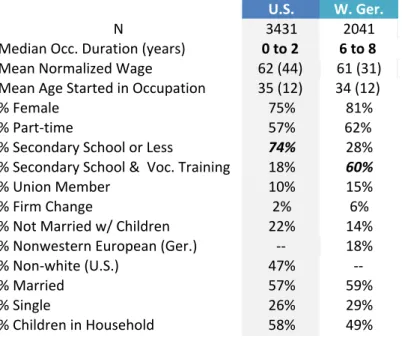
much shorter than in the U.S. The median worker in these occupations in the U.S. stays in the
occupation less than 2 years. In Germany, the median worker stays much longer at 6 to 8 years. I
use survival analysis to model these occupational durations to account for right censoring.
Waiters and waitresses are the one occupation of the 7 in Germany with similar occupation
duration as the U.S. This is possibly a result a higher percentage of young, college educated
workers using this occupation as a transitional job. Similarly, education credentials differ as
expected with most U.S. workers in these occupations having a high school education or less
without vocational training. In Germany, it is reversed with most having secondary school with
some vocational training credential. There are a mildly higher percentage of workers in these
occupations in Germany with a college or university degree (12% to 8%). This suggests that
more workers use low-end service jobs as transitional in W. Germany than the U.S.
Table 2:Descriptive statistics for workers starting in low-end service occupations
Perhaps most surprisingly, the mean normalized hourly wages are about the same. The
variation in wages is much higher in the U.S. This is likely a result of the difference wage
U.S. W. Ger.
N 3431 2041
Median Occ. Duration (years) 0 to 2 6 to 8
Mean Normalized Wage 62 (44) 61 (31)
Mean Age Started in Occupation 35 (12) 34 (12)
% Female 75% 81%
% Part-time 57% 62%
% Secondary School or Less 74% 28%
% Secondary School & Voc. Training 18% 60%
% Union Member 10% 15%
% Firm Change 2% 6%
% Not Married w/ Children 22% 14%
% Nonwestern European (Ger.) -- 18%
% Non-white (U.S.) 47%
--% Married 57% 59%
% Single 26% 29%
structures in each country. Wages in West Germany are more compressed towards the median
than in the U.S. Union membership is higher in West Germany, but not by a large amount. It is
coverage under collective bargaining agreements, not union membership directly that is expected
to matter for wages and benefits. The demographic composition is similar. There are a somewhat
higher proportion of female and part-time workers in Germany. The average age workers start in
one of these low-end service occupations is around the same age at 34 or 35. There is similar
variation in age at start in both countries. More workers in the U.S. are in the precarious status of
being not married with children. Conceptualizing racial or ethnic disadvantage is difficult in the
German (and European) context. As a proxy I use, Nonwestern European ethnicity under the
theory that being a member of the dominant group results in privilege. A much higher percentage
of workers in the U.S. are of a minority racial group.
The results in Table 2 show that occupational mobility is lower in West Germany (at least
for workers in low-end service occupations) than in the U.S. Does lower occupational mobility
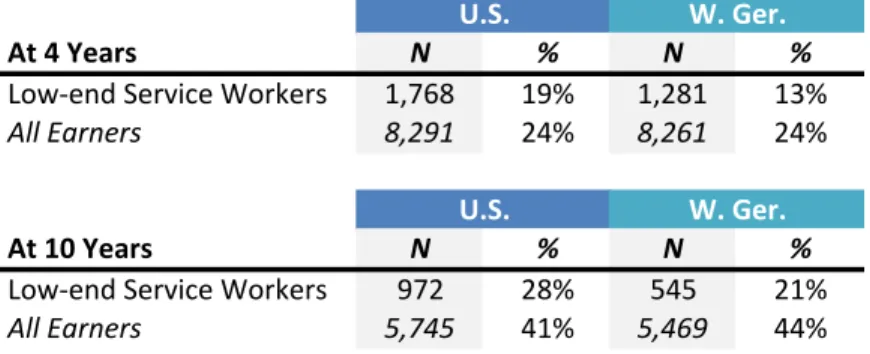
result in lower wage mobility? Table 3 shows the level of mobility out of the bottom two
quintiles of the hourly wage distribution at 4 years and 10 year intervals for workers in low-end
service occupations. I use the hourly wage distribution for full-time workers. For a comparison
point, I compare the mobility of all earners in the bottom two quintiles in the SOEP and PSID to
those in the low-end service occupations. Note that these estimates require a worker to have
wage observations at 4 years and 10 years reducing the sample size. An alternative approach
would be to measure mobility in 4 years and 10 years using failure analysis. Time zero for
low-end service workers in the year they were first observed in the occupation. Time zero for all
30
quintiles with a valid wage at 4 and 10 years respectively. For the all earners measure, I
randomly selected one interval per person.
For this analysis and the upward mobility analysis to follow, I necessarily exclude
workers in these occupations whose starting wages are in the third quintile or above. 10.13% of
West German and 6.75% of U.S. workers in my sample are excluded for these analyses. It is
important to remember that all workers in low-end service occupations are not homogenous and
some of them do not receive low wages. Again, the difference between the countries in this
regard is somewhat smaller than might be expected given Germany’s collective bargaining
agreements. I include both a measure of occupational tenure in the initial low-end service
occupation as well as time since moving occupations.
Table 3: Mobility out of bottom two quintiles of the full-time hourly wage distribution
The upward mobility for all earners in the bottom two quintiles is similar in the U.S. and
West Germany. Despite more limited occupational mobility, there does not appear to be more
limited upward mobility for all earners in the bottom two quintiles. In a related estimate,
Salverda and Mayhew (2009) find an overall mobility rate of 41% in the U.S using the PSID
from 1994 to 2001 (7 years) with a low-wage threshold of the 2/3rds of the median wage. My
estimate is in line with theirs given the higher threshold and longer time period. Their estimate
for Germany over the same period using data from the European Community Household Panel is
At 4 Years N % N %
Low-end Service Workers 1,768 19% 1,281 13%
All Earners 8,291 24% 8,261 24%
At 10 Years N % N %
Low-end Service Workers 972 28% 545 21%
All Earners 5,745 41% 5,469 44%
U.S. W. Ger.
much lower than my estimate at 25.6% in 7 years. The discrepancy could be because Salverda
and Mayhew use data from East and West Germany. Lower rates of mobility in East Germany
could be expected because wages are lower in East Germany, but the median wage for the whole
country is likely little moved because the population of West Germany is many times larger.
Upward mobility is higher in the U.S. than in W. Germany for low-end service workers
by 6% at 4 years, which increases to 7% at 10 years. In both countries and at both intervals,
upward mobility is much lower for low-end service workers than all earners in the bottom
quintiles. An explanation for this difference is that many young workers in a wide range of
occupations start their careers with hourly wages in the bottom 40% of the distribution. As these
workers gain experience in the labor market their hourly wage rate goes up moving them up the
wage distribution. The upward mobility gap between U.S. and W. German low-end service
workers holds steady at 10 years. So, the first fours years are where the upward mobility gap is
created between countries. The longer occupational tenure in low-end service occupations in W.
Germany is the likely cause. So, these initial descriptive findings support the theory that a strong
vocational training system limits the upward mobility out of workers in low-end service
occupations by increasing occupational duration.
There are other possible explanations for this upward mobility gap between the U.S. and
W. Germany. These include differences the demographic composition of these occupations, the
greater prevalence of part-time work in W. Germany potentially indicating worker choice, and
selection of unobserved characteristics. I begin to address some of these concerns using quantile
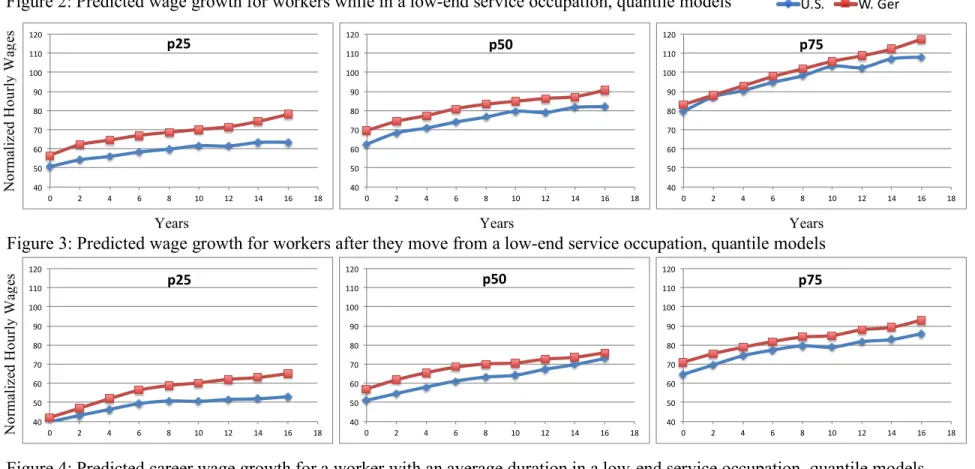
wage growth models. Figures 2 and 3 present the predicted normalized wage growth over time
(years) in a low-end service occupation and after moving occupations. I use quantile analysis to
32
wage growth distribution. I use the margins command in Stata 13 to calculates the average
marginal effect across all the covariates in the model. The results shown in the figures are
normalized hourly wages. Full results from the quantile regressions can be found in Appendix B.
Even though most workers in the U.S. stay less than 2 years in a low-end service
occupation, Figure 2 predicts normalized wages if a worker stayed in the occupation longer.
Wage growth for workers while in one of the 7 low-end service occupations is similar in the U.S.
and W. Germany. A typical worker with median wage growth who stayed in the occupation for
10 years in the U.S. or W. Germany would see an increase of about 1% of the median hourly
wages a year – a modest growth rate. So, if the median hourly wage was $15 an hour that would
be an increase of 15 cents a year or $1.50 in 10 years above inflation. The biggest difference in
wage growth for workers accruing tenure in a low-end service occupation comes from workers at
the bottom. In W. Germany, the workers with the lowest wages are able to achieve wage growth
at about 2% of the median a year or double the growth rate of the median worker in either
country. This rate is also double the rate of U.S. workers at 25th percentile while in the initial
low-end service occupation. The major difference between the U.S. and W. German workers for
wage growth in low-end service occupation is in the starting wages. Across the board, at the 25th,
50th, and 75th percentiles the differences of starting wages between the countries are statistically
significant for wage growth in the initial low-end service occupation.
The wage growth models for workers after moving from a low-end service occupation in
Figure 3 show a similar wage gap in wage levels between the U.S. and W. Germany at the 25th
and 50th percentiles. These differences are statistically significant. The gap in wage levels
between countries is absent at the 75th percentile for workers moving to a new occupation. The
33 -1.5 -1 -0.5 0 0.5 1 1.5 2 2.5
1980-1989 1990-1995 1996-2001 2002-2007
Lo
g
O
dd
s
U.S. W. Ger
*
** ***
Figure 2: Predicted wage growth for workers while in a low-end service occupation, quantile models
Figure 3: Predicted wage growth for workers after they move from a low-end service occupation, quantile models
Figure 4: Predicted career wage growth for a worker with an average duration in a low-end service occupation, quantile models 40 50 60 70 80 90 100 110 120
0 2 4 6 8 10 12 14 16 18
p25 40 50 60 70 80 90 100 110 120
0 2 4 6 8 10 12 14 16 18
p50 40 50 60 70 80 90 100 110 120
0 2 4 6 8 10 12 14 16 18 p75 40 50 60 70 80 90 100 110 120
0 2 4 6 8 10 12 14 16 18
p25 40 50 60 70 80 90 100 110 120
0 2 4 6 8 10 12 14 16 18
p50 40 50 60 70 80 90 100 110 120
0 2 4 6 8 10 12 14 16 18
p75 40 50 60 70 80 90 100 110 p25 40 50 60 70 80 90 100 110 120 p50 40 50 60 70 80 90 100 110 120 p75 No rm al iz ed Ho ur ly W ag es No rm al iz ed Ho ur ly W ag es No rm al iz ed Ho ur ly W ag es
Years Years